Deterministic generation of cat states with more than 100 photons under dissipation
Pith reviewed 2026-06-28 09:52 UTC · model grok-4.3
The pith
A balanced qubit superposition drives a bosonic mode deterministically from vacuum to a cat state with over 120 photons.
A machine-rendered reading of the paper's core claim, the machinery that carries it, and where it could break.
Core claim
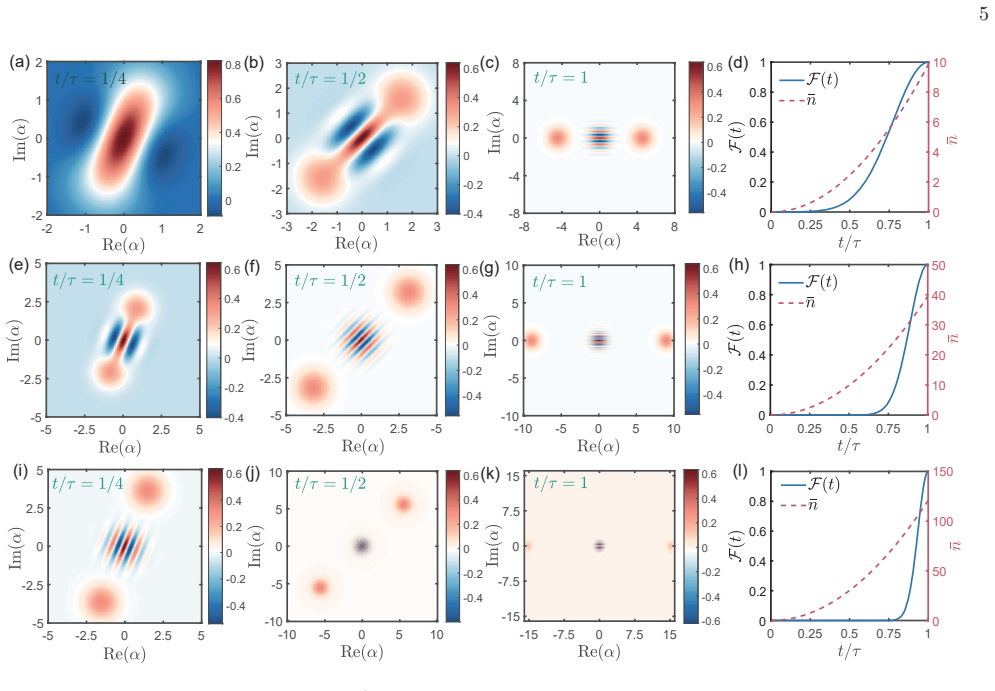
When the qubit is prepared in a balanced superposed state, the bosonic mode can evolve deterministically from the vacuum state to the cat state of a mean photon number over 120. In the Hermitian case, the generation is perfect; and in the non-Hermitian case, the fidelity is over 0.962. The controllable dynamics are encoded in the evolution of the dynamical invariant, which is analyzed in the ancillary picture via a unitary transformation conditional on the qubit state and constrained by the Heisenberg equation.
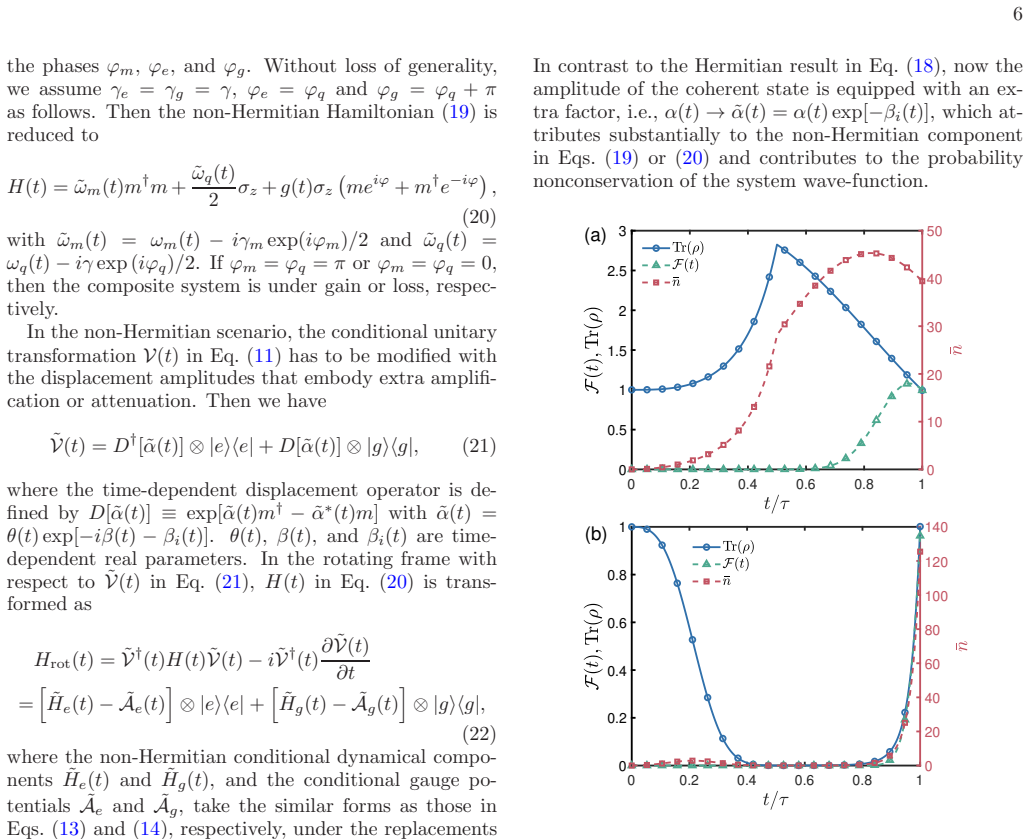
What carries the argument
Dynamical invariant of the hybrid qubit-bosonic system, whose evolution under the Heisenberg equation imposes constraints on the time-dependent Hamiltonian.
If this is right
- The same protocol generates intrinsic cat states and four-component cat states of comparably large size.
- Universal quantum control extends directly to hybrid discrete-continuous variable systems.
- Macroscopic quantum states remain reachable even when decoherence is modeled by non-Hermitian dynamics.
- Deterministic evolution holds from the vacuum state whenever the qubit starts in a balanced superposition.
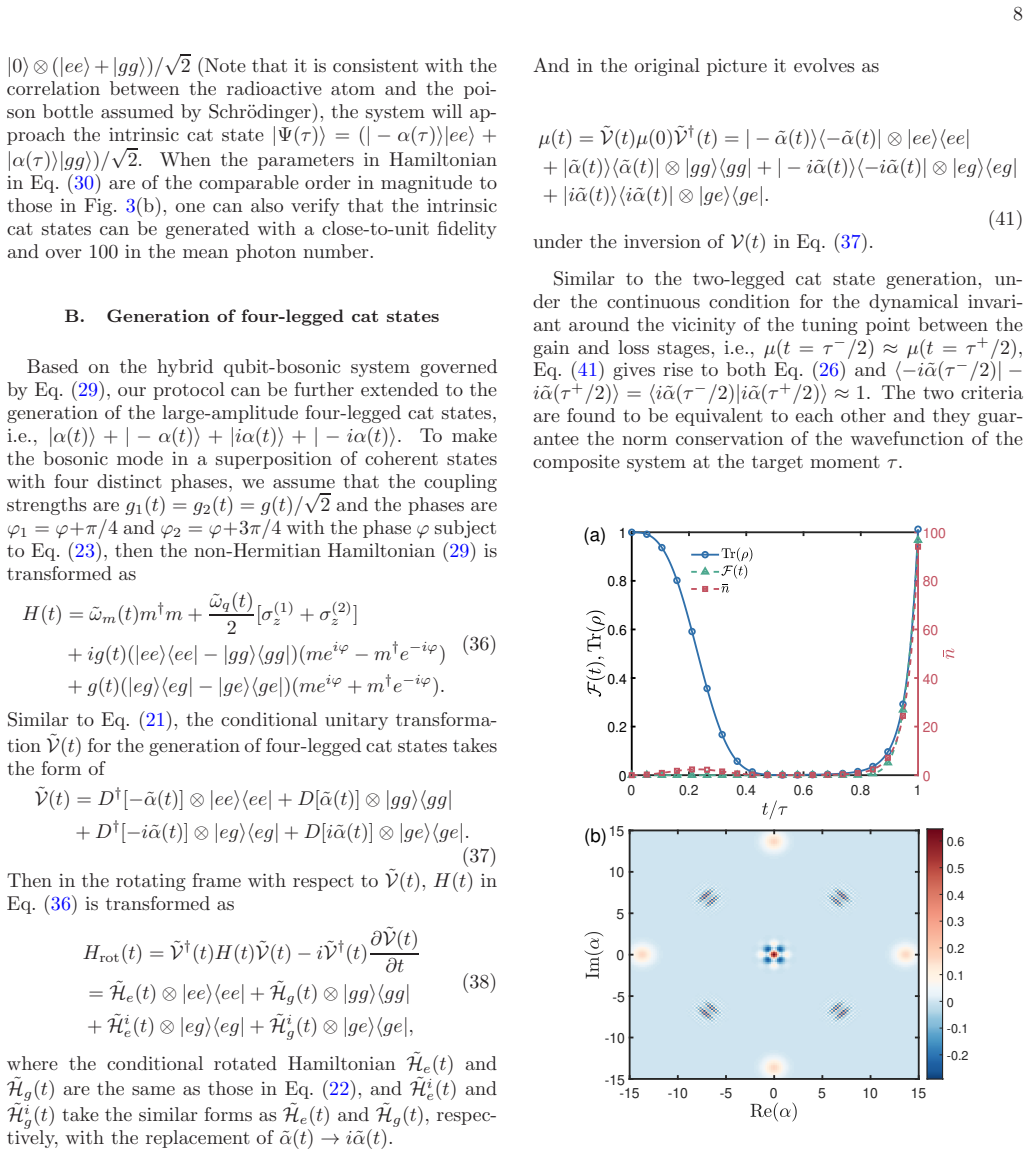
Where Pith is reading between the lines
- If real-time Hamiltonian engineering proves feasible in circuit-QED hardware, the method could produce cat states with several hundred photons.
- The ancillary-picture approach may generalize to other hybrid platforms such as optomechanical systems for generating macroscopic superpositions.
- Combining this invariant-based control with error-correction codes could stabilize large cat states against additional noise channels not treated in the paper.
- The protocol's reliance on a single qubit suggests it could be scaled by entangling multiple qubits to produce multi-mode entangled cat states.
Load-bearing premise
The time-dependent Hamiltonian can be engineered in real time to exactly satisfy the constraints imposed by the Heisenberg equation on the dynamical invariant.
What would settle it
An experiment applying the prescribed time-dependent Hamiltonian to a qubit-boson system but measuring a final-state fidelity below 0.9 to the target cat state under dissipation would falsify the deterministic generation claim.
Figures
read the original abstract
Large-size cat states are especially meaningful and fundamental for exploring the quantum-to-classical transition, as well as promising resources for quantum metrology and fault-tolerant quantum computation. However, amplifying the magnitude of cat states remains challenging because of the growing fragility under decoherence. We propose to generate large cat states by using the dynamical invariant of hybrid qubit-bosonic systems under Hermitian or non-Hermitian time-dependent Hamiltonian. It is a study with the universal quantum control (UQC) theory, in which the system dynamics is analyzed in the ancillary picture via a unitary transformation conditional on the qubit state. The controllable dynamics that can be encoded in the evolution of the dynamical invariant is presented by the Heisenberg equation, which imposes constrains on the Hamiltonian. When the qubit is prepared in a balanced superposed state, the bosonic mode can evolve deterministically from the vacuum state to the cat state of a mean photon number over $120$. In the Hermitian case, the generation is perfect; and in the non-Hermitian case, the fidelity is over $0.962$. Our protocol can also be applied to the generation of the intrinsic cat states and the four-component cat states of large size. Through the preparation of macroscopic quantum states, our work essentially advances UQC to hybrid discrete-continuous variable systems.
Editorial analysis
A structured set of objections, weighed in public.
Referee Report
Summary. The manuscript proposes generating large cat states (>120 mean photons) deterministically in hybrid qubit-bosonic systems from the vacuum state by using dynamical invariants under time-dependent Hermitian or non-Hermitian Hamiltonians. The dynamics are analyzed in the ancillary picture via a conditional unitary transformation within universal quantum control (UQC) theory; the Heisenberg equation imposes constraints on the Hamiltonian. The qubit is prepared in a balanced superposition, yielding perfect fidelity in the Hermitian case and fidelity >0.962 in the non-Hermitian case. The protocol is also applied to intrinsic and four-component cat states.
Significance. If the central claims are substantiated, the work would advance the deterministic preparation of macroscopic quantum states with over 100 photons, which are relevant for quantum-to-classical transition studies, quantum metrology, and fault-tolerant quantum computation. The extension to non-Hermitian dynamics under dissipation addresses realistic open-system conditions, and the UQC framework applied to hybrid discrete-continuous variable systems offers a potentially generalizable approach.
major comments (1)
- [Abstract (UQC analysis paragraph)] Abstract (UQC analysis paragraph): The fidelity result (>0.962) for the non-Hermitian case rests on the ancillary-picture unitary transformation remaining valid throughout the evolution. Non-Hermitian Hamiltonians generate non-unitary dynamics, so the conditional unitary and its compatibility with the Heisenberg-equation constraints on the dynamical invariant require explicit justification rather than following automatically from the Hermitian UQC framework. This is load-bearing for the non-Hermitian claim.
Simulated Author's Rebuttal
We thank the referee for the positive evaluation of the significance of our work and for the constructive comment. We address the major comment below.
read point-by-point responses
-
Referee: The fidelity result (>0.962) for the non-Hermitian case rests on the ancillary-picture unitary transformation remaining valid throughout the evolution. Non-Hermitian Hamiltonians generate non-unitary dynamics, so the conditional unitary and its compatibility with the Heisenberg-equation constraints on the dynamical invariant require explicit justification rather than following automatically from the Hermitian UQC framework. This is load-bearing for the non-Hermitian claim.
Authors: We agree that the non-Hermitian extension requires explicit justification rather than automatic inheritance from the Hermitian UQC case. The conditional unitary is a qubit-state-dependent basis change defined on the composite Hilbert space and can be introduced independently of whether the subsequent evolution operator is unitary. The dynamical invariant is then required to obey the Heisenberg equation, which yields algebraic constraints on the Hamiltonian coefficients; these constraints remain well-defined for non-Hermitian operators. The fidelity value is obtained by direct numerical integration of the resulting time-dependent evolution (or master equation) and comparison with the target cat state. In the revised manuscript we will add a dedicated paragraph that explicitly verifies the commutation relations and the preservation of the invariant form under the non-Hermitian Hamiltonian, thereby addressing the load-bearing concern. revision: yes
Circularity Check
No circularity: derivation applies external UQC framework and Heisenberg constraints without reduction to inputs
full rationale
The paper invokes universal quantum control (UQC) theory to analyze the system in an ancillary picture via a conditional unitary transformation, then uses the Heisenberg equation on the dynamical invariant to constrain the time-dependent Hamiltonian. When the qubit starts in a balanced superposition, the bosonic mode evolves from vacuum to a large cat state. This chain relies on standard external theory rather than self-definition, fitted parameters renamed as predictions, or load-bearing self-citations. The target photon number (>120) and fidelity (>0.962) emerge from satisfying the derived constraints, not by construction from the target itself. No steps match the enumerated circularity patterns.
Axiom & Free-Parameter Ledger
axioms (2)
- domain assumption System dynamics of hybrid qubit-bosonic systems can be analyzed in the ancillary picture via a unitary transformation conditional on the qubit state.
- domain assumption The controllable dynamics encoded in the dynamical invariant can be presented by the Heisenberg equation, which imposes constraints on the Hamiltonian.
Reference graph
Works this paper leans on
-
[1]
Deterministic generation of cat states with more than $100$ photons under dissipation
2 [ 39]. Besides the two-legged cat states, the four-legged cat states or so-called compass states [ 24, 38, 40–46]: |α ⟩ + | −α ⟩ + |iα ⟩ + | −iα ⟩ are more promising candidates for quantum technologies, such as quantum metrology [ 43], dark matter searching [ 44], and quantum error tracking and correction in the presence of photon loss [ 38, 41, 42]. Re...
work page internal anchor Pith review Pith/arXiv arXiv 2026
-
[2]
Here θ(t) and β (t) are time-dependent amplitude and phase, respectively
takes a conditional form as V(t) = D†[α (t)] ⊗ |e⟩⟨e|+D[α (t)] ⊗ |g⟩⟨g|, (11) whereD[α (t)] ≡ exp[α (t)m† − α ∗ (t)m] is a displacement operator with α (t) = θ(t) exp[−iβ (t)]. Here θ(t) and β (t) are time-dependent amplitude and phase, respectively. In the rotating frame with respect to V(t) in Eq. ( 11), H(t) in Eq. ( 10) is transformed as Hrot(t) = V †...
-
[3]
Equation (
(15) The constraint on the eigenfrequency of the qubit is re- laxed. Equation (
-
[4]
And using Eq
suggests that the systematic pa- rameters inH(t) are not necessarily time-dependent, pro- vided thatθ(t) andβ (t) can be chosen as a linear function of time and constant, respectively. And using Eq. ( 15), Hrot(t) in Eq. ( 12) is reduced to Hrot(t) = ω m(t)m†m + ω q(t) 2 σz − ω m(t)θ2(t). (16) Then according to Eq. ( 3), the relevant dynamical invari- ant...
-
[5]
has to be modified with the displacement amplitudes that embody extra amplifi- cation or attenuation. Then we have ˜V(t) = D†[ ˜α (t)] ⊗ |e⟩⟨e|+D[ ˜α (t)] ⊗ |g⟩⟨g|, (21) where the time-dependent displacement operator is de- fined by D[ ˜α (t)] ≡ exp[ ˜α (t)m† − ˜α ∗ (t)m] with ˜α (t) = θ(t) exp[−iβ (t) − βi(t)]. θ(t), β (t), and βi(t) are time- dependent rea...
-
[6]
Using ˜Ae and ˜Ag, the linear terms of Hrot(t) in Eq
and ( 14), respectively, under the replacements of ω m(t) → ˜ω m(t), ω q(t) → ˜ω q(t), and α (t) → ˜α (t). Using ˜Ae and ˜Ag, the linear terms of Hrot(t) in Eq. (22) can be neutralized by imposing the following constraints on the dynamical components: ω m(t) = ˙β (t) + γm 2 sinϕ m, g (t) = ˙θ(t)e− β i(t), ϕ =β (t) + π 2, γ m cosϕ m = − 2 ˙βi(t), (23) unde...
-
[7]
0 0.2 0.4 0.6 0.8 1 0 0.5 1 1.5 2 2.5 3 0 10 20 30 40 50(a) 0 0.2 0.4 0.6 0.8 1 0 0.2 0.4 0.6 0.8 1 0 20 40 60 80 100 120 140(b) FIG
or ( 20) and contributes to the probability nonconservation of the system wave-function. 0 0.2 0.4 0.6 0.8 1 0 0.5 1 1.5 2 2.5 3 0 10 20 30 40 50(a) 0 0.2 0.4 0.6 0.8 1 0 0.2 0.4 0.6 0.8 1 0 20 40 60 80 100 120 140(b) FIG. 3. Dynamics of the density-matrix trace about the whole system Tr[ρ(t)], the fidelity F(t) with respect to the target state |Ψ(τ)⟩ = ( ...
-
[8]
The longitudinal coupling strength is larger than the gain or loss rates by one order in magnitude
142λ 1,θ(t) = 7πt/ 2τ. The longitudinal coupling strength is larger than the gain or loss rates by one order in magnitude. g/γ m ∼ 10 for t ∈ [0,τ/ 2] and g/γ m ∼ 20 for t ∈ [τ/ 2,τ ]. To save the probability conservation at the target mo- ment t = τ, the whole evolution can be parameterized to two stages as (i) t1 ∈ [0,τ/ 2] and (ii) t2 ∈ [τ/ 2,τ ]. Duri...
-
[9]
and ( 25), at the turning point t = τ/ 2, the sudden switching from the gain ef- fect to loss effect (or vice versa) can be realized by a sudden change in βi(t). Despite the parameters might be non-differentiable, however, the system dynamics pre- sented by the dynamical invariant is required to be con- 7 tinuous around the vicinity of the tuning point. Thu...
-
[10]
For the composite system initially in the state |ψ (0)⟩ = |0⟩ ⊗ | +⟩, it will evolve to a highly entangled cat state at t = τ
can be simplified as |exp(−λ 1θ(τ− / 2)) − exp(−λ 2θ(τ+/ 2))|2 ≈ 0, which is always attainable under appropriate choices of λ 1 andλ 2. For the composite system initially in the state |ψ (0)⟩ = |0⟩ ⊗ | +⟩, it will evolve to a highly entangled cat state at t = τ. The gain or loss rate of the qubit is set as γτ = 0. 5 with ϕ q = 0 when t ∈ [0,τ/ 2] and ϕ q =...
-
[11]
In the rotating frame with respect to the conditional unitary transformation ˜V(t), obtained by Eq
conditioned by the single- qubit state. In the rotating frame with respect to the conditional unitary transformation ˜V(t), obtained by Eq. ( 21) with the replacements of |e⟩ → | ee⟩ and |g⟩ → | gg⟩, the trans- formed Hamiltonian is expressed as Hrot(t) = ˜V †(t)H(t) ˜V(t) − i ˜V †(t)∂ ˜V(t) ∂t = [ ˜He(t) + ˜ω q(t) 2 ] ⊗ |ee⟩⟨ee| + [ ˜Hg(t) − ˜ω q(t) 2 ] ...
-
[12]
( 30) are of the comparable order in magnitude to those in Fig
When the parameters in Hamiltonian in Eq. ( 30) are of the comparable order in magnitude to those in Fig. 3(b), one can also verify that the intrinsic cat states can be generated with a close-to-unit fidelity and over 100 in the mean photon number. B. Generation of four-legged cat states Based on the hybrid qubit-bosonic system governed by Eq. ( 29), our p...
-
[13]
is found to be µ (0) = |0⟩⟨0| ⊗ |ee⟩⟨ee|+ |0⟩⟨0| ⊗ |gg⟩⟨gg| + |0⟩⟨0| ⊗ |eg⟩⟨eg|+ |0⟩⟨0| ⊗ |ge⟩⟨ge|. (40) And in the original picture it evolves as µ (t) = ˜V(t)µ (0) ˜V †(t) = | − ˜α (t)⟩⟨− ˜α (t)| ⊗ |ee⟩⟨ee| + |˜α (t)⟩⟨˜α (t)| ⊗ |gg⟩⟨gg|+ | −i ˜α (t)⟩⟨−i ˜α (t)| ⊗ |eg⟩⟨eg| + |i ˜α (t)⟩⟨i ˜α (t)| ⊗ |ge⟩⟨ge|. (41) under the inversion of V(t) in Eq. ( 37). ...
-
[14]
Pioneer” and “Leading Goose
gives rise to both Eq. ( 26) and ⟨−i ˜α (τ− / 2)| − i ˜α (τ+/ 2)⟩ = ⟨i ˜α (τ− / 2)|i ˜α (τ+/ 2)⟩ ≈ 1. The two criteria are found to be equivalent to each other and they guar- antee the norm conservation of the wavefunction of the composite system at the target moment τ. 0 0.2 0.4 0.6 0.8 1 0 0.2 0.4 0.6 0.8 1 0 20 40 60 80 100(a) -15 -10 -5 0 5 10 15 -15 ...
-
[15]
While the quantum-jump terms for the qubit component are neglected after postselection [ 70], those for the bosonic mode are fully retained [ 71, 72]
from the Lindblad mas- ter equation for a hybrid spin-bosonic system. While the quantum-jump terms for the qubit component are neglected after postselection [ 70], those for the bosonic mode are fully retained [ 71, 72]. In general, the dynam- ics of an open hybrid system consisting of a qubit lon- gitudinally coupled to a bosonic mode can be described by...
-
[16]
Schr¨ odinger,Die gegenw¨ artige situation in der quan- tenmechanik, Naturwissenschaften 23, 844 (1935)
E. Schr¨ odinger,Die gegenw¨ artige situation in der quan- tenmechanik, Naturwissenschaften 23, 844 (1935)
1935
-
[17]
Fr¨ owis, P
F. Fr¨ owis, P. Sekatski, W. D¨ ur, N. Gisin, and N. Sangouard, Macroscopic quantum states: Measures, fragility, and implementations, Rev. Mod. Phys. 90, 025004 (2018)
2018
-
[18]
D. J. Wineland, Nobel lecture: Superposition, entanglement, and raising schr¨ odinger’s cat, Rev. Mod. Phys. 85, 1103 (2013)
2013
-
[19]
Haroche, Nobel lecture: Controlling photons in a box and exploring the quantum to classical boundary, Rev
S. Haroche, Nobel lecture: Controlling photons in a box and exploring the quantum to classical boundary, Rev. Mod. Phys. 85, 1083 (2013)
2013
-
[20]
Arndt and K
M. Arndt and K. Hornberger, Testing the limits of quantum mechanical superpositions, Nat. Phys. 10, 271 (2014)
2014
-
[21]
G. S. Agarwal, R. R. Puri, and R. P. Singh, Atomic schr¨ odinger cat states,Phys. Rev. A 56, 2249 (1997)
1997
-
[22]
Omran, H
A. Omran, H. Levine, A. Keesling, G. Semeghini, T. T. Wang, S. Ebadi, H. Bernien, A. S. Zibrov, H. Pich- ler, S. Choi, J. Cui, M. Rossignolo, P. Rembold, S. Montangero, T. Calarco, M. Endres, M. Greiner, V. Vuleti´ c, and M. D. Lukin, Generation and manip- ulation of schr¨ odinger cat states in rydberg atom arrays, Science 365, 570 (2019)
2019
-
[23]
C. Song, K. Xu, H. Li, Y.-R. Zhang, X. Zhang, W. Liu, Q. Guo, Z. Wang, W. Ren, J. Hao, H. Feng, H. Fan, D. Zheng, D.-W. Wang, H. Wang, and S.-Y. Zhu, Gen- eration of multicomponent atomic schr¨ odinger cat states of up to 20 qubits, Science 365, 574 (2019)
2019
-
[24]
Y. A. Yang, W.-T. Luo, J.-L. Zhang, S.-Z. Wang, C.-L. Zou, T. Xia, and Z.-T. Lu, Minute-scale schr¨ odinger-cat state of spin-5/2 atoms, Nat. Photon. 19, 89 (2025)
2025
-
[25]
Schleich, M
W. Schleich, M. Pernigo, and F. L. Kien, Non- classical state from two pseudoclassical states, Phys. Rev. A 44, 2172 (1991)
1991
-
[26]
C. C. Gerry and P. L. Knight, Quantum superposi- tions and schr¨ odinger cat states in quantum optics, Am. J. Phys. 65, 964 (1997)
1997
-
[27]
Leonhardt and H
U. Leonhardt and H. Paul, Measuring the quantum state of light, Prog. Quantum Electron. 19, 89 (1995)
1995
-
[28]
A. J. Leggett, Testing the limits of quantum me- chanics: motivation, state of play, prospects, J. Phys.: Condens. Matter 14, R415 (2002)
2002
-
[29]
M. Bild, M. Fadel, Y. Yang, U. von L¨ upke, P. Martin, A. Bruno, and Y. Chu, Schr¨ odinger cat states of a 16-microgram mechanical oscillator, Science 380, 274 (2023)
2023
-
[30]
J. B. Brask, I. Rigas, E. S. Polzik, U. L. Andersen, and A. S. Sørensen, Hybrid long-distance entanglement distri- bution protocol, Phys. Rev. Lett. 105, 160501 (2010)
2010
-
[31]
Lee and H
S.-W. Lee and H. Jeong, Near-deterministic quan- tum teleportation and resource-efficient quantum computation using linear optics and hybrid qubits, Phys. Rev. A 87, 022326 (2013)
2013
-
[32]
Gilchrist, K
A. Gilchrist, K. Nemoto, W. J. Munro, T. C. Ralph, S. Glancy, S. L. Braunstein, and G. J. Milburn, Schr¨ odinger cats and their power for quantum information processing, J. Opt. B: Quantum Semiclass. Opt. 6, S828 (2004)
2004
-
[33]
J. Joo, W. J. Munro, and T. P. Spiller, Quan- tum metrology with entangled coherent states, Phys. Rev. Lett. 107, 083601 (2011)
2011
-
[34]
Giovannetti, S
V. Giovannetti, S. Lloyd, and L. Maccone, Advances in quantum metrology, Nat. Photon. 5, 222 (2011)
2011
-
[35]
Pezz` e, A
L. Pezz` e, A. Smerzi, M. K. Oberthaler, R. Schmied, and P. Treutlein, Quantum metrol- ogy with nonclassical states of atomic ensembles, Rev. Mod. Phys. 90, 035005 (2018)
2018
-
[36]
P. T. Cochrane, G. J. Milburn, and W. J. Munro, Macroscopically distinct quantum-superposition states as a bosonic code for amplitude damping, Phys. Rev. A 59, 2631 (1999)
1999
-
[37]
T. C. Ralph, A. Gilchrist, G. J. Milburn, W. J. Munro, and S. Glancy, Quantum computation with optical coher- ent states, Phys. Rev. A 68, 042319 (2003)
2003
-
[38]
A. P. Lund, T. C. Ralph, and H. L. Hasel- grove, Fault-tolerant linear optical quantum com- puting with small-amplitude coherent states, Phys. Rev. Lett. 100, 030503 (2008)
2008
-
[39]
Mirrahimi, Z
M. Mirrahimi, Z. Leghtas, V. V. Albert, S. Touzard, R. J. Schoelkopf, L. Jiang, and M. H. Devoret, Dynamically protected cat-qubits: a new paradigm for universal quan- tum computation, New J. Phys. 16, 045014 (2014)
2014
-
[40]
Grimm, N
A. Grimm, N. E. Frattini, S. Puri, S. O. Mundhada, S. Touzard, M. Mirrahimi, S. M. Girvin, S. Shankar, and M. H. Devoret, Stabilization and operation of a kerr-cat qubit, Nature 584, 205 (2020)
2020
-
[41]
Chamberland, K
C. Chamberland, K. Noh, P. Arrangoiz-Arriola, E. T. Campbell, C. T. Hann, J. Iverson, H. Putterman, T. C. Bohdanowicz, S. T. Flammia, A. Keller, G. Re- fael, J. Preskill, L. Jiang, A. H. Safavi-Naeini, O. Painter, and F. G. Brand˜ ao, Building a fault- tolerant quantum computer using concatenated cat codes, PRX Quantum 3, 010329 (2022)
2022
-
[42]
Hastrup and U
J. Hastrup and U. L. Andersen, All-optical cat-code quan- tum error correction, Phys. Rev. Res. 4, 043065 (2022)
2022
-
[43]
Putterman, K
H. Putterman, K. Noh, R. N. Patel, G. A. Peairs, G. S. MacCabe, M. Lee, S. Aghaeimeibodi, C. T. 11 Hann, I. Jarrige, G. Marcaud, Y. He, H. Moradinejad, J. C. Owens, T. Scaffidi, P. Arrangoiz-Arriola, J. Iver- son, H. Levine, F. G. S. L. Brand˜ ao, M. H. Matheny, and O. Painter, Preserving phase coherence and linear- ity in cat qubits with exponential bit-fli...
2025
-
[44]
Lescanne, M
R. Lescanne, M. Villiers, T. Peronnin, A. Sarlette, M. Delbecq, B. Huard, T. Kontos, M. Mirrahimi, and Z. Leghtas, Exponential suppression of bit-flips in a qubit encoded in an oscillator, Nat. Phys. 16, 509 (2020)
2020
-
[45]
schr¨ odinger cat
C. Monroe, D. M. Meekhof, B. E. King, and D. J. Wineland, A “schr¨ odinger cat” superposition state of an atom, Science 272, 1131 (1996)
1996
-
[46]
P. C. Haljan, K.-A. Brickman, L. Deslauriers, P. J. Lee, and C. Monroe, Spin-dependent forces on trapped ions for phase-stable quantum gates and entangled states of spin and motion, Phys. Rev. Lett. 94, 153602 (2005)
2005
-
[47]
M. J. McDonnell, J. P. Home, D. M. Lucas, G. Im- reh, B. C. Keitch, D. J. Szwer, N. R. Thomas, S. C. Webster, D. N. Stacey, and A. M. Steane, Long-lived mesoscopic entanglement outside the lamb-dicke regime, Phys. Rev. Lett. 98, 063603 (2007)
2007
-
[48]
H.-Y. Lo, D. Kienzler, L. de Clercq, M. Marinelli, V. Neg - nevitsky, B. C. Keitch, and J. P. Home, Spin–motion entanglement and state diagnosis with squeezed oscilla- tor wavepackets, Nature 521, 336 (2015)
2015
-
[49]
K. G. Johnson, J. D. Wong-Campos, B. Neyen- huis, J. Mizrahi, and C. Monroe, Ultrafast cre- ation of large schr¨ odinger cat states of an atom, Nat. Commun. 8, 697 (2017)
2017
-
[50]
Rojkov, M
I. Rojkov, M. Simoni, E. Zapusek, F. Re- iter, and J. Home, Stabilization of cat-state manifolds using nonlinear reservoir engineering, Phys. Rev. X 16, 011056 (2026)
2026
-
[51]
J. E. Mooij, T. P. Orlando, L. Levitov, L. Tian, C. H. van der Wal, and S. Lloyd, Josephson persistent-current qubit, Science 285, 1036 (1999)
1999
-
[52]
J. R. Friedman, V. Patel, W. Chen, S. K. Tolpygo, and J. E. Lukens, Quantum superposition of distinct macro- scopic states, Nature 406, 43 (2000)
2000
-
[53]
Vlastakis, G
B. Vlastakis, G. Kirchmair, Z. Leghtas, S. E. Nigg, L. Frunzio, S. M. Girvin, M. Mirrahimi, M. H. Devoret, and R. J. Schoelkopf, Deterministically encoding quan- tum information using 100-photon schr¨ odinger cat states, Science 342, 607 (2013)
2013
-
[54]
D. V. Sychev, A. E. Ulanov, A. A. Pushkina, M. W. Richards, I. A. Fedorov, and A. I. Lvovsky, Enlargement of optical schr¨ odinger’s cat states, Nat. Photon. 11, 379 (2017)
2017
-
[55]
W. H. Zurek, Sub-planck structure in phase space and its relevance for quantum decoherence, Nature 412, 712 (2001)
2001
-
[56]
Leghtas, G
Z. Leghtas, G. Kirchmair, B. Vlastakis, M. H. Devoret, R. J. Schoelkopf, and M. Mirrahimi, Deterministic pro- tocol for mapping a qubit to coherent state superpositions in a cavity, Phys. Rev. A 87, 042315 (2013)
2013
-
[57]
Leghtas, G
Z. Leghtas, G. Kirchmair, B. Vlastakis, R. J. Schoelkopf, M. H. Devoret, and M. Mirrahimi, Hardware-efficient autonomous quantum memory protec- tion, Phys. Rev. Lett. 111, 120501 (2013)
2013
-
[58]
Lee, C.-W
S.-Y. Lee, C.-W. Lee, H. Nha, and D. Kaszlikowski, Quantum phase estimation using a multi-headed cat state, J. Opt. Soc. Am. B 32, 1186 (2015)
2015
-
[59]
Zheng, Y
P. Zheng, Y. Cai, B. Xu, S. Wen, L. Zhang, Z. Ni, J. Mai, Y. Zeng, L. Lin, L. Hu, X. Deng, S. Liu, J. Shu, Y. Xu, and D. Yu, Quantum-enhanced dark matter search using cat states, Phys. Rev. Lett. 136, 171002 (2026)
2026
-
[60]
He, Z.-L
S. He, Z.-L. Yang, S. Jin, F.-Y. Zhang, and C. Li, Generation of four-component magnonic schr¨ odinger cat states via floquet engineering, Phys. Rev. A 113, 013739 (2026)
2026
- [61]
-
[62]
J. I. Cirac, M. Lewenstein, K. Mølmer, and P. Zoller, Quantum superposition states of bose-einstein conden- sates, Phys. Rev. A 57, 1208 (1998)
1998
-
[63]
Goto, Universal quantum computa- tion with a nonlinear oscillator network, Phys
H. Goto, Universal quantum computa- tion with a nonlinear oscillator network, Phys. Rev. A 93, 050301(R) (2016)
2016
-
[64]
S. Puri, S. Boutin, and A. Blais, Engineering the quan- tum states of light in a kerr-nonlinear resonator by two- photon driving, npj Quantum Inf. 3, 18 (2017)
2017
-
[65]
Hatomura, Shortcuts to adiabatic cat-state generation in bosonic josephson junctions, New J
T. Hatomura, Shortcuts to adiabatic cat-state generation in bosonic josephson junctions, New J. Phys. 20, 015010 (2018)
2018
-
[66]
Iyama, T
D. Iyama, T. Kamiya, S. Fujii, H. Mukai, Y. Zhou, T. Na- gase, A. Tomonaga, R. Wang, J.-J. Xue, S. Watabe, S. Kwon, and J.-S. Tsai, Observation and manipula- tion of quantum interference in a superconducting kerr parametric oscillator, Nat. Commun. 15, 86 (2023)
2023
-
[67]
Y.-H. Chen, W. Qin, X. Wang, A. Miranow- icz, and F. Nori, Shortcuts to adiabaticity for the quantum rabi model: Efficient generation of gi- ant entangled cat states via parametric amplification, Phys. Rev. Lett. 126, 023602 (2021)
2021
-
[68]
Hacker, S
B. Hacker, S. Welte, S. Daiss, A. Shaukat, S. Rit- ter, L. Li, and G. Rempe, Deterministic cre- ation of entangled atom–light schr¨ odinger-cat states, Nat. Photon. 13, 110 (2019)
2019
-
[69]
A. P. Lund, H. Jeong, T. C. Ralph, and M. S. Kim, Conditional production of superpositions of coherent states with inefficient photon detection, Phys. Rev. A 70, 020101(R) (2004)
2004
-
[70]
J. S. Neergaard-Nielsen, B. M. Nielsen, C. Hettich, K. Mølmer, and E. S. Polzik, Generation of a super- position of odd photon number states for quantum infor- mation networks, Phys. Rev. Lett. 97, 083604 (2006)
2006
-
[71]
Gerrits, S
T. Gerrits, S. Glancy, T. S. Clement, B. Calkins, A. E. Lita, A. J. Miller, A. L. Migdall, S. W. Nam, R. P. Mirin, and E. Knill, Generation of optical coherent-state super- positions by number-resolved photon subtraction from the squeezed vacuum, Phys. Rev. A 82, 031802(R) (2010)
2010
-
[72]
Laghaout, J
A. Laghaout, J. S. Neergaard-Nielsen, I. Rigas, C. Krag h, A. Tipsmark, and U. L. Andersen, Amplification of realistic schr¨ odinger-cat-state-like states by homodyn e heralding, Phys. Rev. A 87, 043826 (2013)
2013
-
[73]
Takase, J.-i
K. Takase, J.-i. Yoshikawa, W. Asavanant, M. Endo, and A. Furusawa, Generation of optical schr¨ odinger cat states by generalized photon subtraction, Phys. Rev. A 103, 013710 (2021)
2021
-
[74]
Sun, S.-S
F.-X. Sun, S.-S. Zheng, Y. Xiao, Q. Gong, Q. He, and K. Xia, Remote generation of magnon schr¨ odinger cat state via magnon-photon entanglement, Phys. Rev. Lett. 127, 087203 (2021)
2021
-
[75]
Gilles, B
L. Gilles, B. M. Garraway, and P. L. Knight, Generation of nonclassical light by dissipative two-photon processes , 12 Phys. Rev. A 49, 2785 (1994)
1994
-
[76]
Leghtas, S
Z. Leghtas, S. Touzard, I. M. Pop, A. Kou, B. Vlas- takis, A. Petrenko, K. M. Sliwa, A. Narla, S. Shankar, M. J. Hatridge, M. Reagor, L. Frunzio, R. J. Schoelkopf, M. Mirrahimi, and M. H. Devoret, Confining the state of light to a quantum manifold by engineered two-photon loss, Science 347, 853 (2015)
2015
-
[77]
Zapletal, A
P. Zapletal, A. Nunnenkamp, and M. Brunelli, Stabilization of multimode schr¨ odinger cat states via normal-mode dissipation engineering, PRX Quantum 3, 010301 (2022)
2022
-
[78]
C. J. Myatt, B. E. King, Q. A. Turchette, C. A. Sackett, D. Kielpinski, W. M. Itano, C. Monroe, and D. J. Wineland, Decoherence of quantum su- perpositions through coupling to engineered reservoirs, Nature 403, 269 (2000)
2000
-
[79]
Jin and J
Z.-y. Jin and J. Jing, Universal per- spective on nonadiabatic quantum control, Phys. Rev. A 111, 012406 (2025)
2025
-
[80]
Jin and J
Z.-y. Jin and J. Jing, Universal quan- tum control by non-hermitian hamiltonian, Phys. Rev. A 112, 032605 (2025)
2025
discussion (0)
Sign in with ORCID, Apple, or X to comment. Anyone can read and Pith papers without signing in.