REVIEW 3 major objections 6 minor 18 references
Lukthung Classification Using Neural Networks on Lyrics and Audios
T0 review · 3 major / 6 minor · reviewed 2026-08-14 · deepseek-v4-flash
Pith's one-line read Combining lyrics and audio embeddings classifies Thai Lukthung songs with F1 0.86.
desk verdict A genuinely new Lukthung benchmark that fails to test its own never-seen-artist claim because the data is split at song level, not artist level, so the reported F1 is likely optimistic. read the letter →
The pith
A machine-rendered reading of the paper's core claim, the machinery that carries it, and where it could break.
The reading
What carries the argument
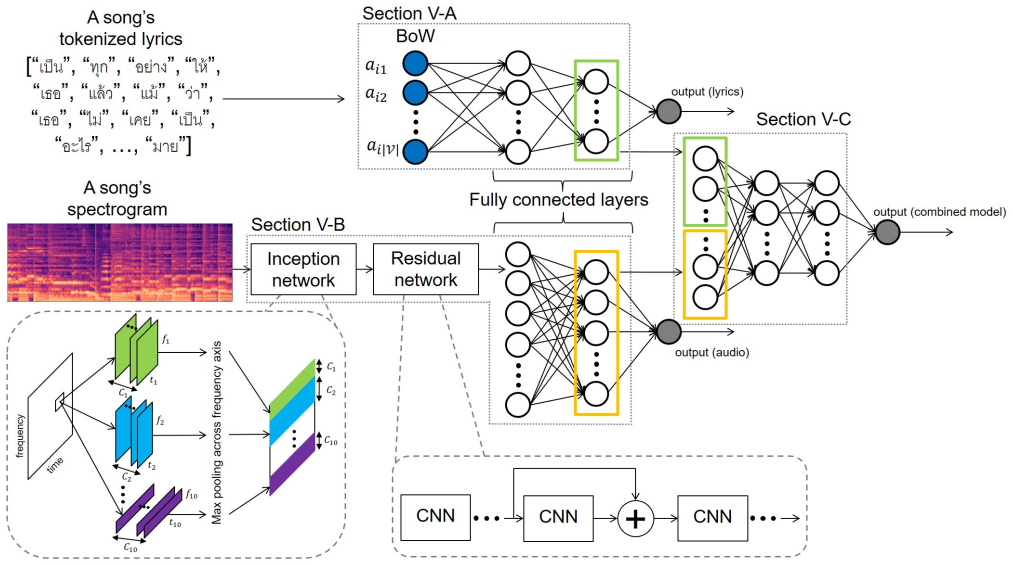
The machinery is a two-stream feature-extraction architecture: a bag-of-words MLP for lyrics and a spectrogram CNN with parallel vertical and horizontal filters for audio, whose last-layer representations are concatenated and fed to a small feed-forward classifier. The vertical filters are designed to capture timbral features such as overtone stacks and vibrato, and the horizontal filters capture tempo and rhythm; fusing these learned representations is what carries the combined model's improvement.
What would settle it
Compute the same F1 on an artist-disjoint split, where all songs by one artist go into the same partition; a large drop would show that the 0.86 F1 is inflated by artist-specific cues rather than genre-level recognition.
Extended reading notes
Core claim
The paper reports that classifying Lukthung from other Thai genres is best done by combining lyrics and audio: the combined model reaches an F1 of 0.8561, beating the lyrics-only BoW-MLP (0.7905) and the audio-only Spectro-CNN (0.7730), and far exceeding classical MFCC baselines, including a random forest that achieves high precision but only 0.1313 recall. The authors also find that the learned features separate the classes in t-SNE, and that false negatives are mainly modern Lukthung songs resembling Pop or Rock and songs whose labels appear incorrect, while false positives are nearby genres such as Life and Lukkrung or non-Lukthung songs sung by Lukthung artists.
Load-bearing premise
The load-bearing premise is that the random song-level split into training and test sets measures genre-level generalization, even though no artist-disjoint split is reported and artists may appear in both sets.
Editorial extensions
If this is right
- If the reported F1 holds, Thai streaming services can automatically tag Lukthung songs in large catalogs and exclude them from recommendations for non-Lukthung listeners.
- The lyrics-only bag-of-words model demonstrates that a small dataset and simple text features can compete with deeper lyric models, avoiding the need for large pretrained word embeddings.
- The error analysis suggests that isolating singing voice and modeling vocal accent or vibrato could improve classification of modern Lukthung songs that otherwise resemble Pop or Rock.
- The learned feature representations could be reused to study how Lukthung changes across eras, since the features separate songs by genre and reveal boundary cases.
- The combined architecture is a template for genre classification in other regional or under-resourced music traditions where both lyrics and audio are available.
Reading between the lines
- The paper removes artist names from the lyrics but still evaluates on a random song-level split; a fair test of genre-level generalization would hold out whole artists, and without that split the 0.86 F1 could partially reflect artist identity rather than genre.
- The same two-stream fusion could be tested on neighboring Thai genres such as Lukkrung and Mor-lam to see whether the learned features distinguish among country-like genres or only separate Lukthung from the rest.
- Because the audio model was adapted from an architecture designed for western music tagging, its filter shapes may be implicitly tuned to the spectrogram statistics of that music; retuning them for Thai vocal vibrato could be a direct next step.
- The paper's claim about complementary lyrics and audio features could be tested adversarially by ablating each stream in the combined model and measuring how much the F1 drops.
Editorial analysis
A structured set of objections, weighed in public.
Referee Report
Summary. The paper presents a binary classification system for distinguishing Lukthung, a Thai country music genre, from five other genres using lyrics and audio. A bag-of-words representation fed to a two-layer MLP is used for lyrics; a spectrogram-based CNN with vertical and horizontal filters is used for audio; and a combined model concatenates the last-layer features of both. The dataset consists of 10,547 expert-tagged Thai songs from 1985 to 2019. On a random 55/20/25 split, the combined model achieves F1 = 0.8561, outperforming the audio-only baselines (RF, LR, SVM) and the individual proposed models.
Significance. If the reported performance holds under rigorous evaluation, the paper would be a useful demonstration of multimodal genre classification for a non-Western music genre, with practical implications for music streaming services. The authors make several commendable choices: a sizable expert-annotated corpus, explicit architectural adaptations to Lukthung-specific traits such as vibrato and traditional instruments, and an analysis of false positives and false negatives. However, the evaluation protocol currently does not support the paper's generalization claim to never-before-seen artists, and the statistical significance of the gains is not established.
major comments (3)
- [IV-A, VI] The paper claims in Section IV-A that removing artist names allows classification of 'songs from unknown or never-seen-before artists,' but Section VI evaluates only a random song-level split (55/20/25) with no artist-disjoint partition. Because lyrics vocabulary, songwriting habits, and audio production are artist-specific, a random split can place songs by the same artist in both training and test, allowing the models to memorize artist identity rather than genre. The error analysis in Section VI reports false positives including 'Lukthung songs sung with Pop/Rock artists,' which indicates that artist identity is a confound. The authors should either provide an artist-disjoint split with per-artist statistics or retract the generalization claim.
- [VI, Table II] The F1 differences between the combined model (0.8561), BoW-MLP (0.7905), and Spectro-CNN (0.7730) are reported without confidence intervals, significance tests, or multiple runs. A single random split cannot establish that the observed gains are not due to chance; the authors should report mean and standard deviation over several seeds, or at least a paired significance test, to support the claim that combining features substantially improves performance.
- [VI, Table II] The comparison baselines are limited to audio-only classifiers (RF, LR, SVM) with default Scikit-learn parameters and MFCC features; no lyrics-only baselines (e.g., TF-IDF with SVM) or standard multimodal baselines are included. Consequently, the abstract's claim that the proposed models 'outperform all of the standard classifiers' rests on a narrow set of weak baselines. Adding a lyrics baseline and a late-fusion baseline would make the comparison more informative and the claim more accurate.
minor comments (6)
- [V-B] In Section V-B, the phrase 'We used the chorus part solely not only for computational reasons but also because...' is ungrammatical; please rephrase to 'not only... but also...'.
- [References] Reference [16] misspells 'October' as 'Octoboer' and Reference [11] misspells 'International' as 'Internataional'.
- [VI, Table II] Table II is garbled for the combined model row: the Input column reads 'Lyrics & Combined model' and 'Audios' appears after the F1 value. Please reformat the table.
- [V-A, Eq. (1)] The normalization in Eq. (1) divides by $\max \log c_i$, which is undefined when the maximum word count of a song is 1; please clarify how such cases are handled.
- [VI] The claim that the best scores are highlighted in bold should be verified; the bold formatting is not visible in the manuscript text, and the final version should ensure consistent highlighting.
- [III] In Section III, 'There are few songs before 2000s' should be 'before the 2000s' or 'before 2000'.
Circularity Check
No circularity: the F1 comparison is an empirical evaluation, not a quantity forced by definitions, fitted inputs, or self-citations.
full rationale
The paper's derivation chain is a standard supervised machine-learning pipeline: lyrics are converted to bag-of-words vectors and fed to an MLP; audio is converted to mel spectrograms and fed to a CNN; the combined model concatenates intermediate learned features and trains a feed-forward classifier. The reported F1 score of 0.856 is measured on a held-out test split and compared against baselines in Table II. No parameter is fitted to the test set and then renamed as a prediction, and no mathematical identity equates the evaluation quantity with a training objective. The claim that combining lyrics and audio features improves performance is an empirical observation from the table, not a consequence of the models' definitions. Citations such as [5], [17], and [18] are to external prior work, and the paper explicitly modifies the architecture from [5]; no load-bearing premise is justified solely by a self-citation. The artist-overlap concern about the random song-level split is a potential threat to external validity and generalization to never-seen-before artists, not a form of circularity: the evaluation remains an honest estimate on held-out songs, even if not on held-out artists. No equation is shown to equal another by construction, and no fitted input is presented as a prediction. Therefore no circular steps are identified, and the circularity score is 0.
Assumptions & free parameters
free parameters (6)
- BoW-MLP hidden layer size =
100 neurons per hidden layer
- Audio CNN filter configuration =
sizes and counts in Table I (e.g., 115x7 x32, 7x165 x32)
- Combined model input dimension =
800 (100 lyrics features + 700 audio features)
- Vocabulary pruning thresholds =
min count 10, max word length 20
- Chorus start fraction =
30% of total song duration
- Spectrogram extraction parameters =
128 mel bins, n_fft 2048, hop 512, sample rate 22050 Hz, band 300-8000 Hz
assumptions (5)
- domain assumption The music expert genre labels in the dataset are correct enough to serve as ground truth.
- domain assumption A random song-level split into train/validation/test estimates performance on never-seen artists.
- domain assumption The 10-second clip beginning at 30% of the song duration approximates the chorus with the richest instrumental content.
- domain assumption The externally built bag-of-words vocabulary from about 85k songs is a suitable feature space for lyrics.
- domain assumption Mel spectrograms capture the timbral and temporal cues (overtones, vibrato, rhythm) needed to separate Lukthung.
Cite this review
Pith. "Pith review of Lukthung Classification Using Neural Networks on Lyrics and Audios." pith.science (2026). https://pith.science/paper/TYTZDTVI
@misc{pith2026190808769,
  author       = {Pith},
  title        = {Pith review of: Lukthung Classification Using Neural Networks on Lyrics and Audios},
  year         = {2026},
  howpublished = {\url{https://pith.science/paper/TYTZDTVI}},
  note         = {Machine review of arXiv:1908.08769}
}
abstract
Music genre classification is a widely researched topic in music information retrieval (MIR). Being able to automatically tag genres will benefit music streaming service providers such as JOOX, Apple Music, and Spotify for their content-based recommendation. However, most studies on music classification have been done on western songs which differ from Thai songs. Lukthung, a distinctive and long-established type of Thai music, is one of the most popular music genres in Thailand and has a specific group of listeners. In this paper, we develop neural networks to classify such Lukthung genre from others using both lyrics and audios. Words used in Lukthung songs are particularly poetical, and their musical styles are uniquely composed of traditional Thai instruments. We leverage these two main characteristics by building a lyrics model based on bag-of-words (BoW), and an audio model using a convolutional neural network (CNN) architecture. We then aggregate the intermediate features learned from both models to build a final classifier. Our results show that the proposed three models outperform all of the standard classifiers where the combined model yields the best $F_1$ score of 0.86, allowing Lukthung classification to be applicable to personalized recommendation for Thai audience.
Figures


Figures from the paper (2 more)


Reference graph
Works this paper leans on
-
[1]
Luk thung: The culture and politics of thailands most popular music,
B. Chan, “Luk thung: The culture and politics of thailands most popular music,” Journal of the Malaysian Branch of the Royal Asiatic Society , vol. 89, pp. 171–172, January 2016
work page 2016
-
[2]
Lukthung: Authenticity and modernity in thai country music,
A. Jirattikorn, “Lukthung: Authenticity and modernity in thai country music,” Asian Music , vol. 37, pp. 24–50, December 2006
work page 2006
-
[3]
Musical genre classification of audio signals,
G. Tzanetakis and P. Cook, “Musical genre classification of audio signals,” IEEE Transactions on Speech and Audio Processing , vol. 10, no. 5, pp. 293–302, July 2002
work page 2002
-
[4]
Music genre recognition using spectrograms,
Y . M. G. Costa, L. S. Oliveira, A. L. Koericb, and F. Gouyon, “Music genre recognition using spectrograms,” in 2011 18th International Conference on Systems, Signals and Image Processing (IWSSIP) , June 2011, pp. 1–4
work page 2011
-
[5]
End-to-end learning for music audio tagging at scale,
J. Pons, O. Nieto, M. Prockup, E. M. Schmidt, A. F. Ehmann, and X. Serra, “End-to-end learning for music audio tagging at scale,” CoRR, vol. abs/1711.02520, 2017
arXiv 2017
-
[6]
Music artist style identification by semi- supervised learning from both lyrics and content,
T. Li and M. Ogihara, “Music artist style identification by semi- supervised learning from both lyrics and content,” in Proceedings of the 12th ACM International Conference on Multimedia , January 2004, pp. 364–367
work page 2004
-
[7]
Lyrics-based analysis and classification of music,
M. Fell and C. Sporleder, “Lyrics-based analysis and classification of music,” in Proceedings of the 25th International Conference on Computational Linguistics: Technical Papers (COLING 2014) . Dublin, Ireland: Dublin City University and Association for Computational Linguistics, August 2014, pp. 620–631
work page 2014
-
[8]
Music genre classification by ensembles of audio and lyrics features,
R. Mayer and A. Rauber, “Music genre classification by ensembles of audio and lyrics features,” in Proceedings of the 12th International Society for Music Information Retrieval Conference (ISMIR 2011) , Miami, Florida, USA, October 2011, pp. 675–680
work page 2011
Show all 18 references
-
[9]
Turkish music genre classification using audio and lyrics features,
¨O. oban, “Turkish music genre classification using audio and lyrics features,” S¨uleyman Demirel University Journal of Natural and Applied Sciences, vol. 21, no. 2, pp. 322–331, May 2017
2017
-
[10]
Audio musical genre classification using convolutional neural networks and pitch and tempo transformations,
L. Li, “Audio musical genre classification using convolutional neural networks and pitch and tempo transformations,” Master’s thesis, City University of Hong Kong, Hong Kong, 2010
2010
-
[11]
Automatic musical pattern feature extraction using convolutional neural network,
T. L. Li, A. B. Chan, and A. H. Chun, “Automatic musical pattern feature extraction using convolutional neural network,” in Proceedings of the Internataional Conference on Data Mining and Applications (IMECS) , March 2010
2010
-
[12]
Audio music genre classification using different classifiers and feature selection methods,
Y . Yaslan and Z. Cataltepe, “Audio music genre classification using different classifiers and feature selection methods,” in Proceedings of the 18th International Conference on Pattern Recognition (ICPR 2006) , vol. 2, January 2006, pp. 573–576
2006
-
[13]
Deep convolutional neural networks for lvcsr,
T. N. Sainath, A.-r. Mohamed, B. Kingsbury, and B. Ramabhadran, “Deep convolutional neural networks for lvcsr,” in 2013 IEEE In- ternational Conference on Acoustics, Speech and Signal Processing (ICASSP), May 2013, pp. 8614–8618
2013
-
[14]
End-to-end learning for music audio,
S. Dieleman and B. Schrauwen, “End-to-end learning for music audio,” in 2014 IEEE International Conference on Acoustics, Speech and Signal Processing (ICASSP), May 2014, pp. 6964–6968
2014
-
[15]
A deep bag-of-features model for music auto-tagging,
J. Nam, J. Herrera, and K. Lee, “A deep bag-of-features model for music auto-tagging,” CoRR, vol. abs/1508.04999, 2016
2016 arXiv
-
[16]
Transfer learning by supervised pre-training for audio-based music classification,
A. van den Oord, S. Dieleman, and B. Schrauwen, “Transfer learning by supervised pre-training for audio-based music classification,” in Proceedings of the 15th Conference of the International Society for Music Information Retrieval, Proceedings (ISMIR) , Octoboer 2014, pp. 29–34
2014
-
[17]
Lyrics-based music genre classification using a hier- archical attention network,
A. Tsaptsinos, “Lyrics-based music genre classification using a hier- archical attention network,” in Proceedings of the 18th International Society for Music Information Retrieval Conference (ISMIR 2017) , Suzhou, China, October 2017, pp. 694–701
2017
-
[18]
Deep residual learning for image recognition,
K. He, X. Zhang, S. Ren, and J. Sun, “Deep residual learning for image recognition,” in 2016 IEEE Conference on Computer Vision and Pattern Recognition (CVPR) , June 2016, pp. 770–778
2016
Reviewed August 14, 2026 · model on record in the stance chip above.
Discussion (0). Continue with ORCID to comment.