REVIEW 4 major objections 5 minor 63 references
Configuration Dynamics of a Flexible Polymer Chain in a Bath of Chiral Active Particles
T0 review · 4 major / 5 minor · reviewed 2026-08-14 · deepseek-v4-flash
Pith's one-line read A chiral active bath can collapse, ring, and re-swell a polymer chain.
desk verdict A real new phenomenology—polymer collapse, ring formation, and oscillation in a chiral active bath—with a plausible R0 scaling that needs error bars and quantitative support before the universality claim can be trusted. read the letter →
The pith
A machine-rendered reading of the paper's core claim, the machinery that carries it, and where it could break.
The reading
What carries the argument
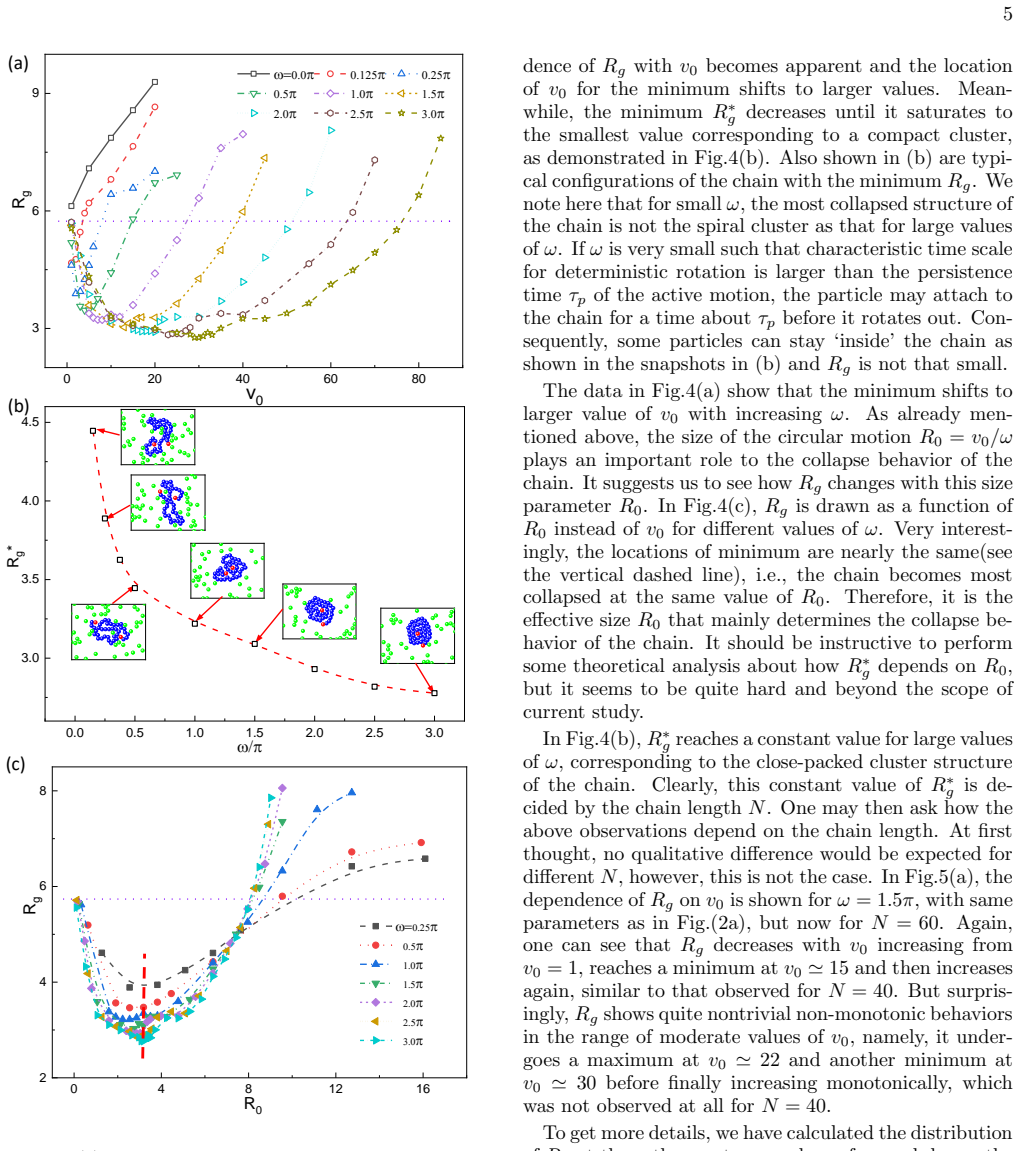
The load-bearing object is the radius $R_0=v_0/\omega$ of the circular trajectory that a chiral active particle would trace in the absence of noise, together with the competition between the two effects it separates. When $R_0$ is very small, the particle's motion is nearly achiral and the chain swells with activity, as in an achiral bath. When $R_0$ is comparable to the chain's characteristic size, particles are effectively excluded from concave interior regions, producing the proposed osmotic-pressure imbalance that collapses the chain into a compact cluster. When $R_0$ grows beyond the chain scale, the circular motion is no longer felt during a collision and persistence stretching resumes. The same $R_0$ also sets the condition for ring formation and for the cluster-ring oscillation: the extrema in $R_g(v_0)$ align across $\omega$ values when plotted against $R_0$, making $R_0$ the single parameter that selects the polymer conformation.
What would settle it
Compute the local crowder density on the interior side of a partially collapsed chain versus the exterior side as $R_0=v_0/\omega$ is varied at fixed $v_0$: the proposed mechanism predicts a measurable density (pressure) difference that peaks at the same $R_0$ as the $R_g$ minimum and vanishes when $\omega=0$. Alternatively, two simulations with different pairs $(v_0,\omega)$ but the same $R_0$ should give the same $R_g(v_0)$ curve; agreement would support, and disagreement would falsify, the claim that $R_0$ is the controlling scale.
Extended reading notes
Core claim
The central claim is that a bath of chiral active particles acts on a flexible polymer through two opposing mechanisms, and their balance produces a sequence of conformational states as propulsion speed rises. The persistence motion of the particles—the same mechanism that swells chains in an achiral active bath—tends to stretch the chain. The deterministic circular motion, however, tends to keep particles out of the chain's concave interior regions, creating an osmotic-pressure-like imbalance between interior and exterior that drives collapse. The paper shows that for a chain of $N=40$ beads at $\omega=1.5\pi$, $R_g$ first falls to a minimum at $v_0\simeq15$, where the chain forms a stable compact spiral rotating opposite to the particles, and then grows beyond its passive value as $v_0$ increases further. For $N=60$, the curve develops an extra maximum and a second minimum: at $v_0\simeq22.5$ the chain forms a hollow ring rotating with the particles, and at $v_0\simeq30$ it oscillates between ring and cluster. The decisive observation is that when $R_g$ is plotted against the circular-motion radius $R_0=v_0/\omega$, the minima and maxima for different $\omega$ nearly coincide, marking $R_0$ as the controlling length scale.
Load-bearing premise
The collapse is attributed to an osmotic-pressure imbalance created by the particles' circular motion, but this mechanism is asserted from simulation snapshots and $R_g$ trends rather than measured or derived; if the collapse instead comes from finite-box crowding or the specific interaction parameters, the proposed explanation would not hold.
Editorial extensions
If this is right
- If the central claim is right, the conformation of a flexible polymer in a chiral active bath can be switched among free, collapsed-cluster, hollow-ring, and swollen states simply by tuning the ratio $v_0/\omega$.
- The collapse, ring, and oscillation thresholds are set by $R_0=v_0/\omega$ rather than by $v_0$ or $\omega$ separately, so the same polymer response can be achieved at different combinations of speed and chirality.
- The rotation direction of the polymer structure encodes the chirality of the bath: compact clusters rotate opposite to the particles, while hollow rings rotate with them.
- For long chains, a range of intermediate activity produces spontaneous oscillation between cluster and ring, implying that a single polymer can act as a bistable conformational switch driven by a steady non-equilibrium environment.
- The non-monotonic dependence of $R_g$ on activity means that measurements of polymer size alone cannot distinguish a weak active bath from a strongly chiral one; the full $v_0$ dependence is needed.
Reading between the lines
- An inference not drawn in the paper: the same interior-exterior pressure imbalance might be generated by non-chiral means, such as a spatial gradient of passive crowders, so the collapse mechanism could be a generic 'active osmosis' rather than a specifically chiral effect.
- The $R_0$-scaling suggests a testable design rule for experiments with artificial microswimmers: match $v_0/\omega$ to the polymer's persistence or contour length to select the desired folded state, independent of the absolute speed.
- The paper asserts but does not directly measure the osmotic-pressure difference; a direct measurement of local crowder density or collision flux inside versus outside the chain at the same $R_0$ would be a natural extension.
- For chains longer than those simulated here, one might expect multiple coexisting rings or nested structures when $R_0$ matches multiples of the sub-chain length, a regime the paper leaves open.
Signed reviews
Editorial analysis
A structured set of objections, weighed in public.
Referee Report
Summary. The paper reports Langevin dynamics simulations of a flexible polymer chain immersed in a two-dimensional bath of chiral active Brownian particles, each self-propelling with speed v0 and rotating with angular velocity ω. The central observation is that the polymer's radius of gyration Rg is a non-monotonic function of v0 when ω is nonzero: the chain first collapses into a compact rotating cluster at moderate v0, then re-swells at high v0, in contrast to the monotonic swelling seen for achiral active baths. For longer chains (N=60) additional states appear, including a hollow closed ring and a dynamical oscillation between ring and cluster, producing a double-minimum structure in Rg(v0). The authors interpret these behaviors as a competition between persistence-motion stretching and an 'effective osmotic pressure' collapse caused by the circular particle trajectories, and they argue that the key length scale is R0 = v0/ω, because the extrema for different ω occur at nearly the same R0.
Significance. If the reported effects are quantitatively robust, the paper identifies dynamic chirality of the bath as a nontrivial control parameter for polymer conformations, enabling collapse, ring formation, and oscillatory states that have not been reported before for flexible chains in active baths. The simulation model is standard (WCA exclusions, FENE bonding, overdamped Langevin dynamics), and the parameter choices are clearly documented, which makes the simulation setup reproducible. The main qualitative findings, including the snapshots and probability distributions, are internally consistent. However, the central quantitative claim—that extrema in Rg occur at nearly the same R0 for different ω—is supported only by visual inspection of curves without error bars or uncertainty estimates, and the proposed osmotic-pressure mechanism is asserted rather than directly tested. These gaps currently limit the strength of the conclusions and the generalizability of the R0 scaling.
major comments (4)
- [Sec. II (last sentence) and Sec. III, Fig. 4(c) and Fig. 6] The paper states that all data are averaged over 50 independent runs, but no error bars or standard errors are shown in any figure. The central claim that the minima (and, for N=60, the maximum and second minimum) occur at 'nearly the same' R0 is based on visual alignment of curves for different ω. The uncertainty in the location of these extrema is not quantified, and given only 50 runs, the apparent coincidence in R0 could be within statistical noise. The authors should provide error bars or confidence intervals on the plotted quantities, and ideally extract the extremum positions quantitatively (e.g., by parabolic interpolation or bootstrap) with associated uncertainties, to substantiate the universality of R0.
- [Sec. III, Fig. 5(a) and Fig. 5(b)] The double-minimum structure in Rg(v0) for N=60 is a headline result, but Fig. 5(a) shows no error bars, and the second minimum at v0≈30 corresponds to a bimodal distribution in Fig. 5(b). The average Rg in a bimodal state is sensitive to the relative time spent in the two states, so without reporting the standard error or the state population fraction, the existence and location of this extremum are not quantitatively established. The authors should report the sampling uncertainty and, ideally, the fraction of time spent in each state to support the claim of a genuine local minimum.
- [Sec. III, paragraph following Fig. 2, and Sec. IV (Conclusion)] The collapse is attributed to an 'effective osmotic pressure' caused by the circular motion of the active particles, but no direct measurement of pressure, local density, or force balance is provided. The statement 'Our analysis shows...' (also in the abstract) overstates what is currently a heuristic interpretation. The authors should either provide supporting measurements (e.g., radial distribution of crowder density around the chain, or a comparison of collision rates on interior versus exterior faces) or explicitly frame the mechanism as a plausible hypothesis rather than an established conclusion.
- [Sec. II and Sec. III] The R0 scaling is demonstrated only for a single crowder volume fraction (φ=0.1) and a single box size (L=50). Since the proposed mechanism depends on the ability of chiral particles to enter or be excluded from the chain interior, the collapse and the R0 universality could depend on φ. Without varying φ or L, the assertion that R0 is the governing length scale is not tested against other system parameters. A single additional data set at a different φ, or an explicit statement that the R0 scaling is established only at φ=0.1, is needed to support the generality claimed for the result.
minor comments (5)
- [Sec. II, Eq. (2) and surrounding text] The sentence 'In particular, ω in (2) gives the angular velocity of the particle' appears to reference Eq. (2) (the FENE potential), but the angular velocity ω is introduced in Eq. (4). The equation number appears to be a typo and should be corrected.
- [All figures] The figures do not indicate any measure of statistical error, even though only 50 runs were used. Figure captions should state that no error bars are shown or, better, include standard errors in the plots.
- [Abstract] The abstract says the ring 'may oscillate with the cluster if v0 is large,' but in the text the oscillation is observed at moderate v0 (e.g., v0=30 for N=60), not for the largest v0. The wording should be adjusted to avoid implying that oscillation occurs only at the highest activities.
- [Sec. III, Fig. 2(a)] The text refers to a 'dash-dotted line' for the chiral case and a 'dashed line' for the achiral case, but the figure legend labels them differently; the correspondence should be made explicit in the caption.
- [General] The manuscript contains several typographical and stylistic issues (e.g., 'in consistent with' should be 'consistent with', missing spaces after commas). A careful proofreading pass is recommended.
Circularity Check
No significant circularity: the simulation results are directly measured and the R0 scaling is an observed pattern, not an input fitted to produce the target.
full rationale
This paper is a Langevin-dynamics simulation study, not an analytic derivation, and its central claims are read off the simulated gyration radius Rg rather than derived from a fitted model. The non-monotonic dependence of Rg on v0, the compact-cluster minimum, the ring state, and the cluster-ring oscillation are reported as measured data with snapshots and distribution functions; no parameter is fitted to a subset of the data and then relabeled as a prediction. The quantity R0 = v0/omega is a natural length scale defined by the equations of motion (Eqs. 3-4), and the claim that extrema occur at nearly the same R0 for different omega is a cross-check performed by replotting the same simulation data on a rescaled axis; the alignment is an empirical observation, not an algebraic identity that forces the minima together. The proposed mechanism (persistence stretching versus an osmotic-pressure-like collapse from circular motion) is a qualitative interpretation offered after the data are collected, and it is not used to generate the trajectories or to select parameters, so it cannot make the results circular. The manuscript cites several prior papers by the same group (e.g., Refs. 36-41, 46), but these are background references on active systems and are not invoked as uniqueness theorems, nor are they load-bearing for the present simulation outcomes. The absence of error bars on the extremum positions is a quantitative-support concern, but not circularity. Overall, the derivation chain does not reduce to its own inputs.
Assumptions & free parameters
assumptions (4)
- domain assumption Overdamped Langevin dynamics with Gaussian white noise adequately describes polymer and crowder motion at low Reynolds number.
- domain assumption The WCA and FENE potentials capture the essential excluded-volume and connectivity interactions of a flexible polymer.
- domain assumption A single simulation box with L=50 and Nc=318 crowders (volume fraction 0.1) is representative of an infinite chiral active bath.
- domain assumption Dynamic chirality is captured by a deterministic constant angular velocity omega in the orientation equation.
Cite this review
Pith. "Pith review of Configuration Dynamics of a Flexible Polymer Chain in a Bath of Chiral Active Particles." pith.science (2026). https://pith.science/paper/TZ2SZHEJ
@misc{pith2026190809099,
  author       = {Pith},
  title        = {Pith review of: Configuration Dynamics of a Flexible Polymer Chain in a Bath of Chiral Active Particles},
  year         = {2026},
  howpublished = {\url{https://pith.science/paper/TZ2SZHEJ}},
  note         = {Machine review of arXiv:1908.09099}
}
abstract
We investigate configuration dynamics of a flexible polymer chain in a bath of active particles with dynamic chirality, i.e., particles rotate with a deterministic angular velocity $\omega$ besides self-propulsion,by Langevin dynamics simulations in two dimensional space. Particular attentions are paid to how the gyration radius $R_{g}$ changes with the propulsion velocity $v_{0}$,angular velocity $\omega$ and chain length. We find that in a chiral bath with a typical nonzero $\omega$, the chain first collapses into a small compact cluster and swells again with increasing $v_{0}$, in quite contrast to the case for a normal achiral bath $(\omega=0)$ wherein a flexible chain swells with increasing $v_{0}$. More interestingly, the polymer can even form a closed ring if the chain length is large enough,which may oscillate with the cluster if $v_{0}$ is large. Consequently, the gyration radius $R_{g}$ shows nontrivial non-monotonic dependences on $v_{0}$, i.e., it undergoes a minimum for relatively short chains, and two minima with a maximum in between for longer chains. Our analysis shows that such interesting phenomena are mainly due to the competition between two roles played by the chiral active bath: while the persistence motion due to particle activity tends to stretch the chain, the circular motion of the particle may lead to an effective osmotic pressure that tends to collapse the chain. In addition, the size of the circular motion $R_{0}=v_{0}/\omega$ shows an important role in that the compact clusters and closed-rings are both observed at nearly the same values of $R_{0}$ for different $\omega$.
Figures


Figures from the paper (3 more)


Reference graph
Works this paper leans on
-
[1]
In- terestingly, the chain is suppressed to a rotating compact cluster at this minimum if ω is not small, of which the rotation direction is opposite to the crowder particles. In addition, we found that the sizeR0 =v0/ω of the circular motion plays a subtle role, in that the minima for differ- ent values ofω take places at nearly the same value ofR0. Our a...
-
[2]
A. B. Fulton, Cell 30, 345 (1982)
work page 1982
-
[3]
J. Pelletier, K. Halvorsen, B.-Y. Ha, R. Paparcone, S. J. Sandler, C. L. Woldringh, W. P. Wong, and S. Jun, Proc. Natl. Acad. Sci. U.S.A. 109, E2649 (2012)
work page 2012
- [4]
-
[5]
V. V. Palyulin, T. Ala-Nissila, and R. Metzler, Soft mat- ter 10, 9016 (2014)
work page 2014
-
[6]
C. Tan, S. Saurabh, M. P. Bruchez, R. Schwartz, and P. LeDuc, Nat. Nanotechnol. 8, 602 (2013)
work page 2013
-
[7]
E. J. Foster, E. B. Berda, and E. Meijer, J. Am. Chem. Soc. 131, 6964 (2009)
work page 2009
- [8]
Show all 63 references
-
[9]
D. Hu, J. Yu, K. Wong, B. Bagchi, P. J. Rossky, and P. F. Barbara, Nature 405, 1030 (2000)
2000
-
[10]
J. Kim, C. Jeon, H. Jeong, Y. Jung, and B.-Y. Ha, Soft Matter 11, 1877 (2015)
2015
-
[11]
Majumder, J
S. Majumder, J. Zierenberg, and W. Janke, Soft matter 13, 1276 (2017)
2017
-
[12]
J. Shin, A. G. Cherstvy, and R. Metzler, Soft matter 11, 472 (2015)
2015
-
[13]
Y. Bian, X. Cao, P. Li, and N. Zhao, Soft matter 14, 8060 (2018)
2018
-
[14]
N. M. Toan, D. Marenduzzo, P. R. Cook, and C. Micheletti, Phys. Rev. Lett. 97, 178302 (2006)
2006
-
[15]
J. Shin, A. G. Cherstvy, and R. Metzler, ACS Macro Letters 4, 202 (2015)
2015
-
[16]
C. Jeon, Y. Jung, and B.-Y. Ha, Soft matter 12, 9436 (2016)
2016
-
[17]
Stiehl, K
O. Stiehl, K. Weidner-Hertrampf, and M. Weiss, New J. Phys. 15, 113010 (2013)
2013
-
[18]
Eilers and G
M. Eilers and G. Schatz, Cell 52, 481 (1988)
1988
-
[19]
J. S. Kim, V. Backman, and I. Szleifer, Phys. Rev. Lett. 106, 168102 (2011)
2011
-
[20]
Chen and N
A. Chen and N. Zhao, Phys. Chem. Chem. Phys. (2019)
2019
-
[21]
J. Wang, Y. Bian, X. Cao, and N. Zhao, AIP Adv. 7, 115120 (2017)
2017
-
[22]
H. Kang, P. A. Pincus, C. Hyeon, and D. Thirumalai, Phys. Rev. Lett. 114, 068303 (2015)
2015
-
[23]
Prakash and A
S. Prakash and A. Matouschek, Trends Biochem.Sci. 29, 593 (2004)
2004
-
[24]
Rodriguez-Larrea and H
D. Rodriguez-Larrea and H. Bayley, Nat. Nanotechnol. 8, 288 (2013)
2013
-
[25]
Balchin, M
D. Balchin, M. Hayer-Hartl, and F. U. Hartl, Science 353, aac4354 (2016)
2016
-
[26]
G.-W. Li, O. G. Berg, and J. Elf, Nat. Phys. 5, 294 (2009)
2009
-
[27]
Czir´ ok and T
A. Czir´ ok and T. Vicsek, Physica. A281, 17 (2000)
2000
-
[28]
Woolley, Reproduction 126, 259 (2003)
D. Woolley, Reproduction 126, 259 (2003)
2003
-
[29]
Sokolov, I
A. Sokolov, I. S. Aranson, J. O. Kessler, and R. E. Gold- stein, Phys. Rev. Lett. 98, 158102 (2007)
2007
-
[30]
Vicsek and A
T. Vicsek and A. Zafeiris, Phys. Rep. 517, 71 (2012)
2012
-
[31]
Fily and M
Y. Fily and M. C. Marchetti, Phys. Rev. Lett. 108, 235702 (2012)
2012
-
[32]
Schwarz-Linek, C
J. Schwarz-Linek, C. Valeriani, A. Cacciuto, M. Cates, D. Marenduzzo, A. Morozov, and W. Poon, Proc. Natl. Acad. Sci. U.S.A. 109, 4052 (2012)
2012
-
[33]
Wittkowski, A
R. Wittkowski, A. Tiribocchi, J. Stenhammar, R. J. Allen, D. Marenduzzo, and M. E. Cates, Nat. Commun. 5, 4351 (2014)
2014
-
[34]
Stenhammar, R
J. Stenhammar, R. Wittkowski, D. Marenduzzo, and M. E. Cates, Phys. Rev. Lett. 114, 018301 (2015)
2015
-
[35]
J. A. Cohen and R. Golestanian, Phys. Rev. Lett. 112, 068302 (2014)
2014
-
[36]
Dunkel, S
J. Dunkel, S. Heidenreich, K. Drescher, H. H. Wensink, M. B¨ ar, and R. E. Goldstein, Phys. Rev. Lett. 110, 228102 (2013)
2013
-
[37]
Jiang, H
H. Jiang, H. Ding, M. Pu, and Z. Hou, Soft matter 13, 836 (2017)
2017
-
[38]
M. Pu, H. Jiang, and Z. Hou, Soft matter 13, 4112 (2017)
2017
-
[39]
H. Ding, H. Jiang, and Z. Hou, Phys. Rev. E 95, 052608 (2017)
2017
-
[40]
Feng and Z
M. Feng and Z. Hou, Soft Matter 13, 4464 (2017)
2017
-
[41]
Feng and Z.-h
M.-k. Feng and Z.-h. Hou, Chin. J. Chem. Phys. 31, 584 (2018)
2018
-
[42]
Y. Du, H. Jiang, and Z. Hou, Soft matter15, 2020 (2019)
2019
-
[43]
Bechinger, R
C. Bechinger, R. Di Leonardo, H. L¨ owen, C. Reichhardt, G. Volpe, and G. Volpe, Rev. Mod. Phys. 88, 045006 (2016)
2016
-
[44]
Kaiser and H
A. Kaiser and H. L¨ owen, J. Chem. Phys. 141, 044903 (2014)
2014
-
[45]
Harder, C
J. Harder, C. Valeriani, and A. Cacciuto, Phys. Rev. E 90, 062312 (2014)
2014
-
[46]
J. Shin, A. G. Cherstvy, W. K. Kim, and R. Metzler, New J. Phys. 17, 113008 (2015)
2015
-
[47]
M. Pu, H. Jiang, and Z. Hou, J. Chem. Phys.145, 174902 (2016)
2016
-
[48]
Nikola, A
N. Nikola, A. P. Solon, Y. Kafri, M. Kardar, J. Tailleur, and R. Voituriez, Phys. Rev. Lett. 117, 098001 (2016)
2016
-
[49]
Y.-q. Xia, K. Chen, Y.-q. Ma, et al., Phys. Chem. Chem. Phys. 21, 4487 (2019)
2019
-
[50]
Corkidi, B
G. Corkidi, B. Taboada, C. Wood, A. Guerrero, and A. Darszon, Biochem. Biophys. Res. Commun. 373, 125 (2008)
2008
-
[51]
I. H. Riedel, K. Kruse, and J. Howard, Science 309, 300 (2005)
2005
-
[52]
Lauga, W
E. Lauga, W. R. DiLuzio, G. M. Whitesides, and H. A. Stone, Biophys. J. 90, 400 (2006)
2006
-
[53]
K¨ ummel, B
F. K¨ ummel, B. ten Hagen, R. Wittkowski, I. Buttinoni, R. Eichhorn, G. Volpe, H. L¨ owen, and C. Bechinger, Phys. Rev. Lett. 110, 198302 (2013)
2013
-
[54]
Liao, X.-q
J.-j. Liao, X.-q. Huang, and B.-q. Ai, J. Chem. Phys. 148, 094902 (2018)
2018
-
[55]
Wu, J.-n
J.-c. Wu, J.-n. Zhou, and B.-q. Ai, Physica. A 462, 864 (2016)
2016
-
[56]
B.-q. Ai, Sci. Rep 6, 18740 (2016)
2016
-
[57]
Hu, Y.-l
C.-t. Hu, Y.-l. Ou, J.-c. Wu, and B.-q. Ai, J. Stat. Mech.: Theory Exp. 2016, 033207 (2016)
2016
-
[58]
Ai, Y.-f
B.-q. Ai, Y.-f. He, and W.-r. Zhong, Soft Matter 11, 3852 (2015)
2015
-
[59]
Liebchen and D
B. Liebchen and D. Levis, Phys. Rev. Lett. 119, 058002 (2017)
2017
-
[60]
Mijalkov and G
M. Mijalkov and G. Volpe, Soft Matter 9, 6376 (2013)
2013
-
[61]
Chen and B.-q
Q. Chen and B.-q. Ai, J. Chem. Phys. 143, 09B612 1 (2015)
2015
-
[62]
Liao and S
G.-J. Liao and S. H. Klapp, Soft matter 14, 7873 (2018)
2018
-
[63]
J. Chen, Y. Hua, Y. Jiang, X. Zhou, and L. Zhang, Sci. Rep 7, 15006 (2017)
2017
Reviewed August 14, 2026 · model on record in the stance chip above.
Discussion (0). Continue with ORCID to comment.