REVIEW 4 major objections 5 minor 23 references
Video-based Bottleneck Detection utilizing Lagrangian Dynamics in Crowded Scenes
T0 review · 4 major / 5 minor · reviewed 2026-08-14 · deepseek-v4-flash
Pith's one-line read A crowd bottleneck can be detected from video by reading the Lagrangian deformation of the crowd flow: long-term filtered FTLE fields segment the crowd, convex-hull defects mark candidate narrowing points, and temporal consistency turns…
desk verdict New bottleneck detector with a strong idea and a flawed evaluation: the reported accuracy could be achieved by a detector that never fires, and parameters are chosen on the test set. read the letter →
The pith
A machine-rendered reading of the paper's core claim, the machinery that carries it, and where it could break.
The reading
What carries the argument
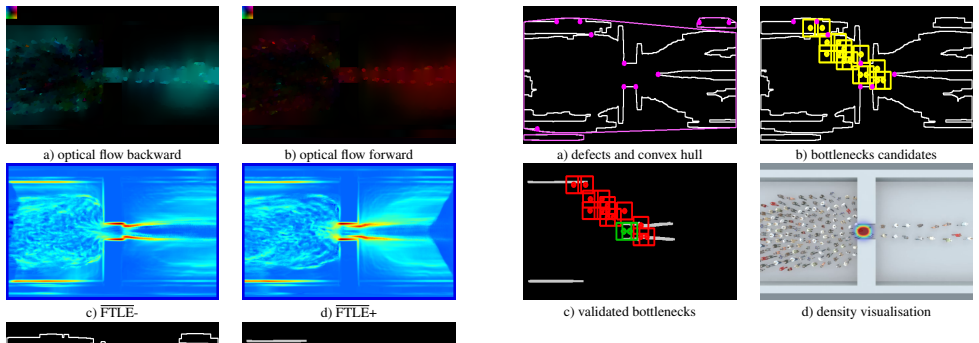
The load-bearing object is the long-term temporal filtered FTLE field. Finite-Time Lyapunov Exponents measure the exponential separation of neighbouring path lines advected through optical flow; the paper computes forward and backward FTLE fields, takes their median over a buffer of reference frames to suppress unsteady ridges from individuals, and thresholds them into a segmentation map (union of low-threshold maps) and a validation map (intersection of high-threshold maps). The detection step then uses convex-hull defects of the crowd-flow contour, geometric constraints on candidate point pairs, and temporal propagation to turn contour indentations into spatio-temporal bottleneck detections.
What would settle it
Run the detector on a systematically wider set of bottleneck videos, holding crowd density and camera angle fixed, and plot accuracy at localization error 1 against bottleneck width; the claim predicts accuracy should stay roughly flat, while the paper's stated limitation predicts it should collapse once the bottleneck is wide enough that its ridges lie outside the fixed search radius. A collapse at a precisely measured width would show that the contour-defect assumption, not the Lagrangian segmentation, is the active constraint.
Extended reading notes
Core claim
In the paper's own terms, physical bottlenecks are tied to bottlenecks in the contour of the crowd-flow segment. The crowd-flow segment is obtained by binarizing long-term filtered FTLE fields at a low threshold and combining forward and backward ridge maps; a validation map formed by the intersection of high-threshold forward and backward ridges is used to confirm that candidate points lie near genuine stable barriers. Candidates are the defects of the contour relative to its convex hull, filtered by two geometric constraints (the ratio of Euclidean distance to contour length, and the requirement that contour distance exceeds twice the Euclidean distance) and by temporal consistency: a detection is accepted only if it recurs within a fixed radius across a number of reference frames. The paper concludes from its experiments that this pipeline detects bottleneck events spatially and temporally well on both natural and synthetic data, independently of camera angle, while noting a current limitation in bottleneck width due to the fixed-size region of interest.
Load-bearing premise
The premise on which the method rests is that every bottleneck leaves a stable indentation in the crowd-flow contour within the fixed-size search region; the paper itself states that wide bottlenecks defeat the filter because their validation-map ridges cannot be included at all.
Editorial extensions
If this is right
- An operator monitoring a crowded area could receive a spatial and temporal alert directly from video flow fields, without additional sensors or scene modification.
- The same parameter settings transfer across camera viewpoints, so a multi-camera setup does not need per-camera tuning for the reported scenarios.
- Because integration time $\tau=15$ already reaches top accuracy on all sequences, the method is computationally lighter than long-horizon trajectory analysis and compatible with live monitoring.
- The released ground truth and metric give future detectors a common yardstick for spatio-temporal bottleneck localization.
Reading between the lines
- If the contour-defect signature is general, the same pipeline could be applied to other congestion events such as entrance turnstiles, ticket barriers, or corridor merges, with threshold retuning only; the paper demonstrates the mechanism but does not test these cases.
- An adaptive search radius that scales with local contour width would directly test the stated limitation: the paper says wide bottlenecks currently fail because their validation-map ridges fall outside the fixed $\sigma_r$ region.
- The method defines a bottleneck by flow behavior rather than physical geometry, so it could be combined with density estimation to distinguish genuine congestion risk from harmless narrow passages; this distinction is definitional in the paper but not implemented as a separate signal.
Signed reviews
Editorial analysis
A structured set of objections, weighed in public.
Referee Report
Summary. The paper presents a video-based bottleneck detector for crowded scenes. The pipeline computes optical flow fields, then long-term temporally filtered Finite-Time Lyapunov Exponent (FTLE) fields via a median filter over a buffer of consecutive FTLE maps. The filtered fields are binarized into low and high ridge maps, from which a crowd-flow contour segmentation map and a validation map are formed by combining forward and backward FTLE ridges. Bottleneck candidates are extracted as convexity defects on the contour, filtered by geometric constraints and validated against high-ridge structure in the validation map, with temporal consistency enforced over consecutive frames. The authors extend the J\"ulich and AGORASET datasets with spatial and temporal bottleneck ground truth, introduce a localization-error metric εd and a frame-wise accuracy metric, and report 0.70 accuracy on all sequences and 0.87 on the AGORASET subset at εd = 1. The conclusion claims that the method detects bottleneck events spatially and temporally well for both natural and synthetic data and is independent of camera angle.
Significance. The problem is important for crowd safety, and the paper contributes a clearly described pipeline based on temporally filtered FTLE fields, plus a public release of ground-truth annotations and an evaluation script on two existing datasets. The long-term median filtering of FTLE fields is a simple and potentially useful idea that may reduce unsteady individual-motion ridges while preserving global crowd-flow boundaries. If the claimed performance were rigorously established, the released benchmark could become a useful resource for future bottleneck-detection work. However, the evaluation as currently presented does not substantiate the central claim: the frame-level Accuracy metric is dominated by true negatives over long non-bottleneck intervals, the reported best parameters are selected on the same test set, no baseline comparisons are provided, and the acknowledged wide-bottleneck failure is not quantified. These issues are load-bearing because the headline numbers are the main evidence for the paper's conclusion.
major comments (4)
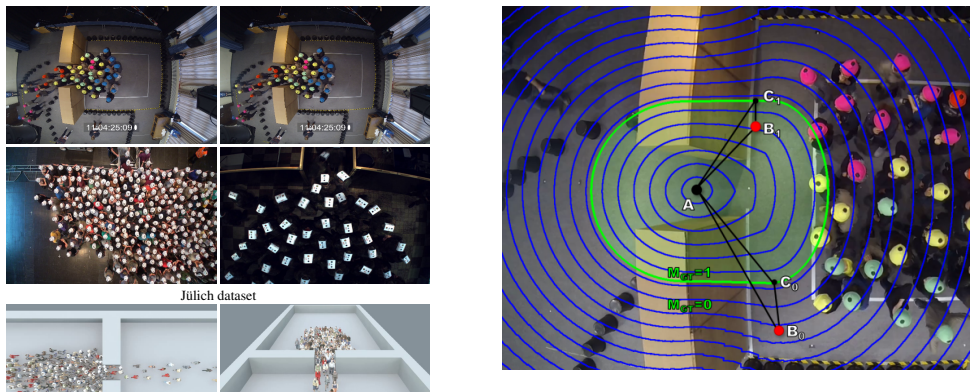
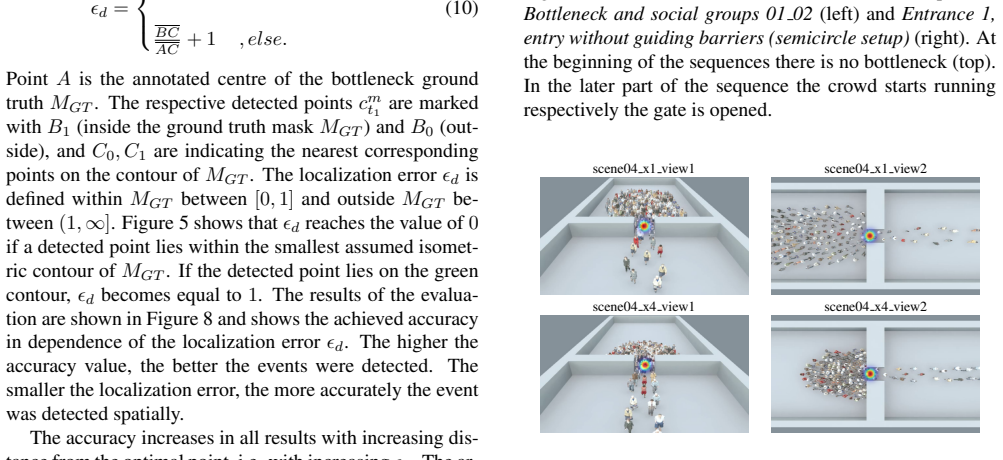
- [Section 4, Eq. (9), Table 1] The frame-wise Accuracy metric includes true negatives over long intervals without a bottleneck, and the text itself notes that at the beginning of the sequences there is no bottleneck (Figure 6 caption) and that the J\"ulich data contain long periods without a bottleneck. Under this class imbalance, a detector that never outputs a positive detection attains Accuracy = TN/(TN+FN), i.e., the fraction of non-bottleneck frames, with no detections at all. Because no precision, recall, F1, false-positive, or false-negative rates are reported, the values 0.70 and 0.87 in Table 1 are compatible with a permanently silent detector and do not establish that the method detects any bottleneck event. Please report frame-level and event-level precision/recall/F1, the FP/FN distribution, or at least the accuracy restricted to bottleneck frames.
- [Section 4, Figure 8, Table 1] The parameter sweeps for the integration time τ, the buffer size τs, and the validation radius σr are performed on the same 80 sequences used for the final reported numbers, and Table 1 selects the best settings for each subset after inspecting the test-set curves. Because the same test data are used for model selection and evaluation, the reported 0.70 and 0.87 values include selection bias, and no error bars or per-sequence variance are given. A held-out validation split or nested cross-validation with parameters fixed before evaluation, together with per-sequence results, is needed to support the headline accuracies.
- [Section 4, wide-bottleneck limitation] The scope of the central claim in Section 5 ("detect bottleneck events spatially and temporally well") is constrained by the acknowledged failure for wide bottlenecks: "The filter fails because the ridges in the validation map cannot be included at all." The paper does not state how many of the 80 sequences are affected or how performance varies with the bottleneck width relative to the fixed region-of-interest radius σr. Stratifying the results by bottleneck width would delimit the actual range of scenes for which the method can be expected to work.
- [Section 4, comparison to prior work] The paper cites Solmaz et al. [19] as prior work that also detects bottleneck situations from optical flow, but the evaluation in Figure 8 and Table 1 contains no quantitative comparison with any existing method. Since the authors present a new benchmark and metric, at least one baseline comparison on the same sequences is needed to judge the added value of the proposed detector over the referenced optical-flow-based approach.
minor comments (5)
- [Section 4, Eq. (10)] The definition of the localization error is hard to follow because Eq. (10) uses A, B, and C without subscripts, while the text introduces B0, B1, C0, and C1. Please define the distances explicitly for the inside-mask and outside-mask cases, including what AC denotes in the outside case.
- [Section 3, Eqs. (6)–(8) and Figures 1–2] The notation for the temporally filtered FTLE fields is not defined consistently; the overline symbol used in the text appears to be missing in several equations and figure captions, and Figure 1 labels both the unsteady and the filtered field as "FTLE-". Please unify the notation throughout.
- [Section 4, ground-truth annotation] The ground-truth bottleneck locations are described as "carefully annotated after the subjective evaluation by scientific staff." Because the annotations and evaluation script are released as a benchmark, a short annotation protocol and inter-annotator statistics would greatly strengthen the benchmark's reliability.
- [Section 2, after Eq. (5)] The sentence "Only the intersections of FTLE+ and FTLE- ridge structures can segment regions of coherent movement" is asserted without support. Either provide a citation for this claim or soften it to describe the design choice made in this work.
- [Abstract and Section 1] The phrase "characteristic stowage patterns" is unusual for crowd-flow deformation; consider using "clogging" or "congestion patterns" for clarity.
Circularity Check
No significant circularity: the bottleneck detector is computed from optical-flow-derived FTLE fields and compared against independent manual annotations; the cited Lagrangian framework is a tool, not the evidence for the claim, and the evaluation weaknesses are validity concerns, not circular reductions.
full rationale
The method chain is self-contained with respect to the ground truth: Eq. (1)-(5) define the flow map and FTLE from optical flow, Eq. (6)-(8) define the subsampled flow fields, median-filtered FTLE, and binary ridge maps, and the contour-defect extraction in Section 3 is a deterministic geometric procedure. None of these equations uses the manually annotated bottleneck masks M_GT or the accuracy metric of Eq. (9) as inputs. The ground-truth annotations are described as independently 'carefully annotated after the subjective evaluation by scientific staff' (Section 4), so a detection is not defined in terms of the ground truth and the reported accuracy is an external comparison rather than a tautology. The self-citation to Kuhn et al. [8] is used to justify the Lagrangian framework as a computational tool for video analytics; the paper does not invoke that citation as proof that bottleneck detection works, and the framework's assumptions (path-line advection, FTLE ridges as motion boundaries) are stated assumptions rather than the target conclusion. The parameter sweeps in Figure 8 are performed on the same 80 sequences used for the final numbers, and the frame-wise Accuracy metric includes true negatives, which can inflate scores on long non-bottleneck periods; these are legitimate concerns about statistical validity and evaluation design, but they are not cases where a predicted quantity reduces by construction to a fitted input or to a self-citation. The acknowledged limitation for wide bottlenecks ('the ridges in the validation map cannot be included at all') further confirms that the method is exposed to failure rather than trivially matching its input. No circular step is exhibited in the paper's derivation chain, so the appropriate finding is no significant circularity.
Assumptions & free parameters
free parameters (7)
- tau (FTLE integration time) =
not reported as a single setting; tested 15, 30, 50
- tau_s (temporal median buffer size) =
not reported as a single setting; tested 10, 20, 40
- sigma_r (validation region radius) =
30 (best on all sequences); tested 20, 30, 60, 120
- sigma_low, sigma_high (FTLE binarization thresholds) =
not reported
- sigma_s (contour geometry threshold) =
not reported
- sigma_o (temporal consistency count) =
not reported
- delta_t (frame subsampling factor) =
not reported
assumptions (4)
- domain assumption Crowds can be described as a flowing continuum, so optical flow fields and Lagrangian particle dynamics capture meaningful crowd behavior.
- domain assumption High ridges in FTLE fields correspond to motion boundaries and stable Lagrangian coherent structures.
- domain assumption Physical bottlenecks correspond to indentations (defects) in the contour of the crowd flow segment.
- domain assumption The manual ground-truth annotations of bottleneck centers and temporal intervals are correct enough to serve as labels.
Cite this review
Pith. "Pith review of Video-based Bottleneck Detection utilizing Lagrangian Dynamics in Crowded Scenes." pith.science (2026). https://pith.science/paper/TZDA3FJO
@misc{pith2026190807772,
  author       = {Pith},
  title        = {Pith review of: Video-based Bottleneck Detection utilizing Lagrangian Dynamics in Crowded Scenes},
  year         = {2026},
  howpublished = {\url{https://pith.science/paper/TZDA3FJO}},
  note         = {Machine review of arXiv:1908.07772}
}
read the original abstract
Avoiding bottleneck situations in crowds is critical for the safety and comfort of people at large events or in public transportation. Based on the work of Lagrangian motion analysis we propose a novel video-based bottleneckdetector by identifying characteristic stowage patterns in crowd-movements captured by optical flow fields. The Lagrangian framework allows to assess complex timedependent crowd-motion dynamics at large temporal scales near the bottleneck by two dimensional Lagrangian fields. In particular we propose long-term temporal filtered Finite Time Lyapunov Exponents (FTLE) fields that provide towards a more global segmentation of the crowd movements and allows to capture its deformations when a crowd is passing a bottleneck. Finally, these deformations are used for an automatic spatio-temporal detection of such situations. The performance of the proposed approach is shown in extensive evaluations on the existing J\"ulich and AGORASET datasets, that we have updated with ground truth data for spatio-temporal bottleneck analysis.
Figures

Figures from the paper (3 more)


Reference graph
Works this paper leans on
- [19]
-
[1]
E. Acar, T. Senst, A. Kuhn, I. Keller, H. Theisel, S. Albayrak, and T. Sikora. Human action recognition using lagrangian descriptors. In IEEE Workshop on Multimedia Signal Pro- cessing, pages 360–365, 2012
work page 2012
- [2]
- [3]
-
[4]
N. Bain and D. Bartolo. Dynamic response and hydrodynam- ics of polarized crowds. Science, 363(6422):46–49, 2019
work page 2019
-
[5]
G. Haller. A variational theory of hyperbolic Lagrangian Coherent Structures. Physica D: Nonlinear Phenomena , 240(7):574 – 598, 2011
work page 2011
-
[6]
G. Haller. Lagrangian coherent structures. Annual Review of Fluid Mechanics, 47(1):137–162, 2015
work page 2015
-
[7]
R. L. Hughes. The flow of human crowds. Annual Review of Fluid Mechanics, 35(1):169–182, 2003
work page 2003
Show all 23 references
-
[8]
A. Kuhn, T. Senst, I. Keller, T. Sikora, and H. Theisel. A lagrangian framework for video analytics. In IEEE Inter- national Workshop on Multimedia Signal Processing, pages 387–392, 2012
2012
-
[9]
T. Li, H. Chang, M. Wang, B. Ni, R. Hong, and S. Yan. Crowded scene analysis: A survey. IEEE Transactions on Circuits and Systems for Video Technology, 25(3):367–386, 2015
2015
-
[10]
W. Liao, A. Seyfried, J. Zhang, M. Boltes, X. Zheng, and Y . Zhao. Experimental study on pedestrian flow through wide bottleneck. Transportation Research Procedia, 2:26 – 33, 2014
2014
-
[11]
B. E. Moore, S. Ali, R. Mehran, and M. Shah. Visual Crowd Surveillance Through a Hydrodynamics Lens. Communica- tions of the ACM, 54(12):64–73, 2011
2011
-
[12]
Senst, V
T. Senst, V . Eiselein, A. Kuhn, and T. Sikora. Crowd Vi- olence Detection Using Global Motion-Compensated La- grangian Features and Scale-Sensitive Video-Level Repre- sentation. IEEE Transactions on Information Forensics and Security, 12(12):2945–2956, 2017
2017
-
[13]
Senst, J
T. Senst, J. Geistert, and T. Sikora. Robust local optical flow: Long-range motions and varying illuminations. In 2016 IEEE International Conference on Image Processing , pages 4478–4482, 2016
2016
-
[14]
Senst, A
T. Senst, A. Kuhn, H. Theisel, and T. Sikora. Detecting peo- ple carrying objects utilizing lagrangian dynamics. In Inter- national Conference on Advanced Video and Signal-Based Surveillance, pages 398–403, 2012
2012
-
[15]
Seyfried, O
A. Seyfried, O. Passon, B. Steffen, M. Boltes, T. Rup- precht, and W. Klingsch. New Insights into Pedestrian Flow Through Bottlenecks. Transportation Science, 43(3):395– 406, 2009
2009
-
[16]
Sieben, J
A. Sieben, J. Schumann, and A. Seyfried. Collective phe- nomena in crowds - Where pedestrian dynamics need social psychology. PLOS ONE, 12(6):1–19, 2017
2017
-
[17]
J. C. Silveira Jacques Junior, S. R. Musse, and C. R. Jung. Crowd Analysis Using Computer Vision Techniques. IEEE Signal Processing Magazine, 27(5):66–77, 2010
2010
-
[18]
Sklansky
J. Sklansky. Finding the Convex Hull of a Simple Polygon. Pattern Recognition Letters, 1(2):79–83, 1982
1982
-
[20]
Soori and M
U. Soori and M. R. Arshad. Underwater crowd flow detec- tion using Lagrangian dynamics. In International Confer- ence Underwater System Technology, pages 359–364, 2008
2008
-
[21]
G. K. Still. Crowd dynamics. PhD thesis, University of War- wick, July 2000
2000
-
[22]
von Kr ¨uchten, F
C. von Kr ¨uchten, F. M ¨uller, A. Svachiy, O. Wohak, and A. Schadschneider. Empirical Study of the Influence of So- cial Groups in Evacuation Scenarios. In V . L. Knoop and W. Daamen, editors, Traffic and Granular Flow ’15, pages 65–72, 2016
2016
-
[23]
S. Wu, B. E. Moore, and M. Shah. Chaotic invariants of Lagrangian particle trajectories for anomaly detection in crowded scenes. In Conference on Computer Vision and Pat- tern Recognition, pages 2054–2060, 2010. 8
2010
Reviewed August 14, 2026 · model on record in the stance chip above.
Discussion (0). Continue with ORCID to comment.