Extraction of slip velocity in NEMD Couette flow systems using frictional dissipation
Pith reviewed 2026-06-26 15:55 UTC · model grok-4.3
The pith
Dissipation at the solid-fluid interface defines an unambiguous slip velocity in NEMD Couette flows.
A machine-rendered reading of the paper's core claim, the machinery that carries it, and where it could break.
Core claim
By equating the macroscale frictional heat, defined as the product of the friction force and the slip velocity, to the microscale sum of the works exerted by solid atoms on fluid atoms and vice versa, the authors obtain a unique slip velocity at the solid-fluid interface that is independent of arbitrary choices in locating the boundary at the atomic scale.
What carries the argument
The dissipation equivalence between macroscale frictional heat (friction force multiplied by slip velocity) and the microscale sum of pairwise atomic interaction works at the solid-fluid interface.
If this is right
- The friction coefficient becomes determinable without dependence on specific velocity sampling points.
- This definition applies directly to any NEMD system under shear where interface dissipation can be computed.
- It offers a thermal basis for slip that complements the usual mechanical force-velocity relation.
- Results from different simulation setups can be compared more consistently.
Where Pith is reading between the lines
- This approach might bridge equilibrium and non-equilibrium methods for friction studies by providing a common dissipation metric.
- Extensions could test the definition in systems with complex geometries or varying temperatures.
- If the equivalence holds, it suggests that all interfacial dissipation is captured by pairwise forces without non-local contributions.
Load-bearing premise
The total energy dissipated at the interface equals exactly the macroscopic friction force times the slip velocity, with the microscale pairwise works accounting for all of it.
What would settle it
A direct comparison in a NEMD simulation showing that the heat calculated from force times this dissipation slip velocity does not match the summed atomic works would falsify the definition.
Figures
read the original abstract
Velocity slip at the solid--fluid (SF) interface plays a key role in fluid transport at the nanoscale, and the SF friction coefficient has been extensively studied because it indicates the degree of slippage. Owing to the scale of this phenomenon, molecular dynamics (MD) simulations are commonly employed using two major approaches: the Green-Kubo integral method in equilibrium MD (EMD), and the direct calculation of friction force and slip velocity in non-equilibrium MD (NEMD) systems under shear. Regarding the latter, a strict definition of the slip velocity is missing due to the nonzero thickness of the boundary at the microscale, and the average velocity of the first adsorption layer or the velocity at the boundary obtained by extrapolation or interpolation is often used. In this study, we propose an alternative description of the slip velocity based on a thermal perspective from the two different scales, i.e., at the macroscale, frictional heat is defined as the product of the friction force and slip velocity, whereas at the microscale, it can be expressed as the sum of the works exerted on the fluid and solid by each other. By combining the two different scales, we defined the slip velocity based on the dissipation induced at the SF interface under shear, which avoids the arbitrariness in the slip velocity at the microscale.
Editorial analysis
A structured set of objections, weighed in public.
Referee Report
Summary. The manuscript proposes an alternative definition of slip velocity at solid-fluid interfaces in NEMD Couette flow by equating macroscale frictional dissipation (friction force times slip velocity) to the microscale sum of pairwise works exchanged between solid and fluid atoms. This is claimed to yield a dissipation-based slip velocity that avoids arbitrariness in choosing an adsorption layer or extrapolation plane.
Significance. If the central equality is rigorously derived and the method validated, the approach would supply a physically motivated, energy-balance-consistent definition of slip velocity that could reduce variability across nanoscale friction studies. The identification of arbitrariness in existing microscale definitions is a clear strength of the framing.
major comments (2)
- [Abstract] Abstract: the central claim rests on an untested equality between macroscale frictional power (force × slip velocity) and the microscale sum of solid-fluid pairwise works, yet no explicit equation for the resulting slip velocity (e.g., v_slip = Σ(F_sf · Δv)/F_total) or derivation from global energy balance is supplied. This equality is load-bearing for the entire proposal.
- [Abstract] Abstract: the manuscript presents only a conceptual proposal and contains no numerical implementation, comparison against conventional definitions (first-layer average or extrapolated velocity), or error analysis, leaving the practical advantage and accuracy of the new definition untested.
Simulated Author's Rebuttal
We thank the referee for the constructive comments. We address each major point below and will revise the manuscript to improve clarity and completeness.
read point-by-point responses
-
Referee: [Abstract] Abstract: the central claim rests on an untested equality between macroscale frictional power (force × slip velocity) and the microscale sum of solid-fluid pairwise works, yet no explicit equation for the resulting slip velocity (e.g., v_slip = Σ(F_sf · Δv)/F_total) or derivation from global energy balance is supplied. This equality is load-bearing for the entire proposal.
Authors: We agree that the abstract would benefit from an explicit equation. The definition follows directly from equating macroscale frictional power F_friction · v_slip to the microscale interfacial dissipation ∑(F_sf · Δv) over all solid-fluid pairs, which rearranges to v_slip = Σ(F_sf · Δv)/F_total. This is obtained from global energy balance under steady shear with no other dissipation channels. We will revise the abstract and add a short derivation section to make the equality and resulting expression explicit. revision: yes
-
Referee: [Abstract] Abstract: the manuscript presents only a conceptual proposal and contains no numerical implementation, comparison against conventional definitions (first-layer average or extrapolated velocity), or error analysis, leaving the practical advantage and accuracy of the new definition untested.
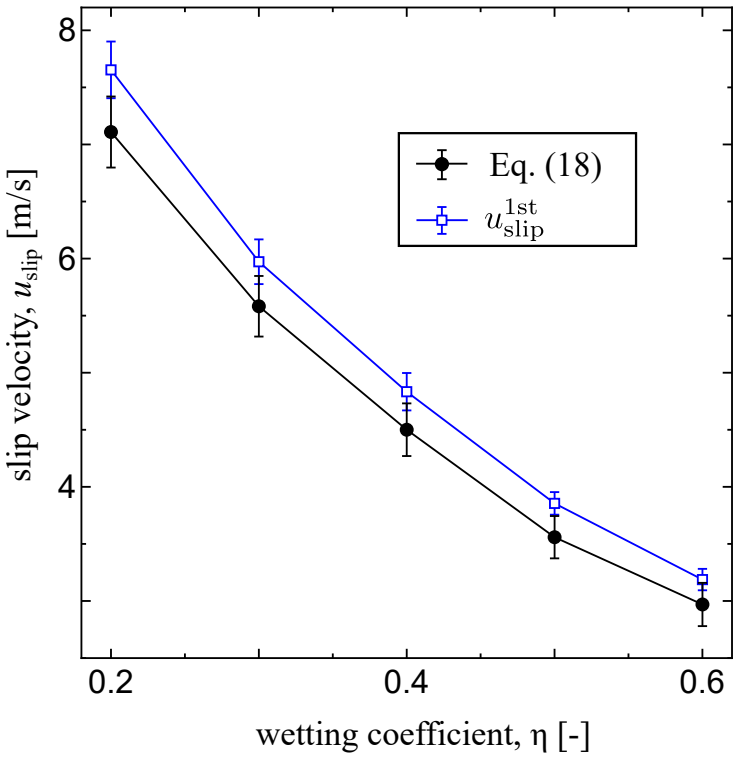
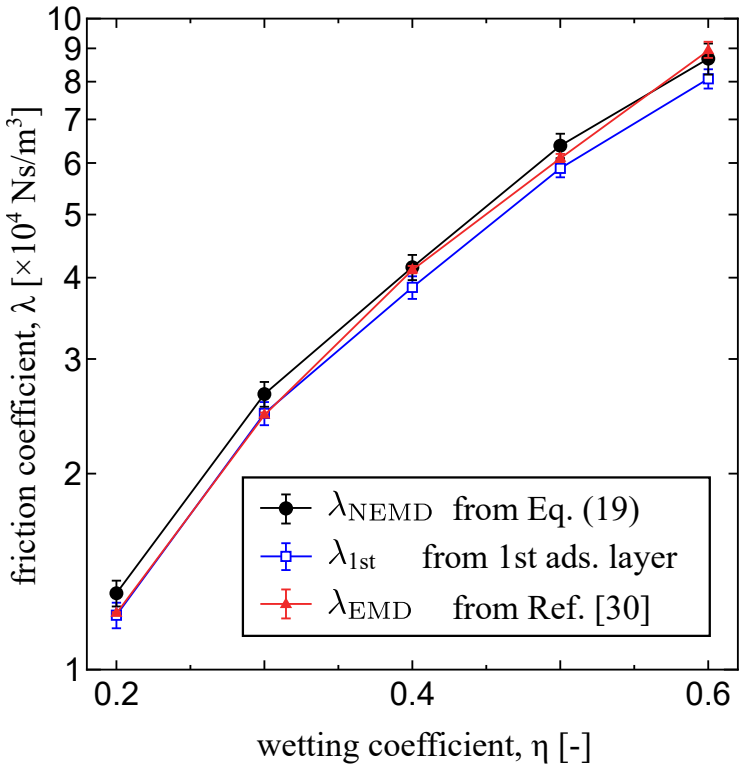
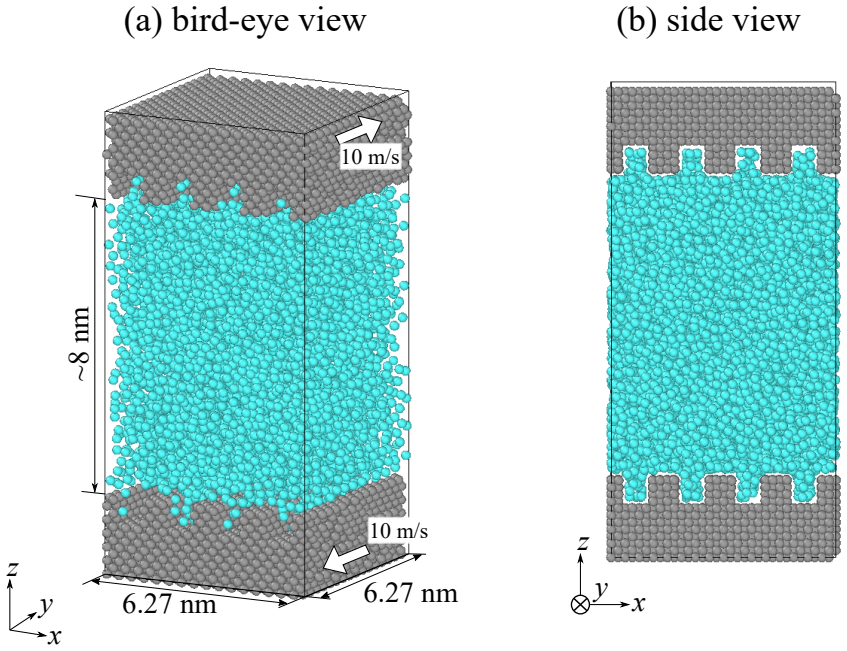
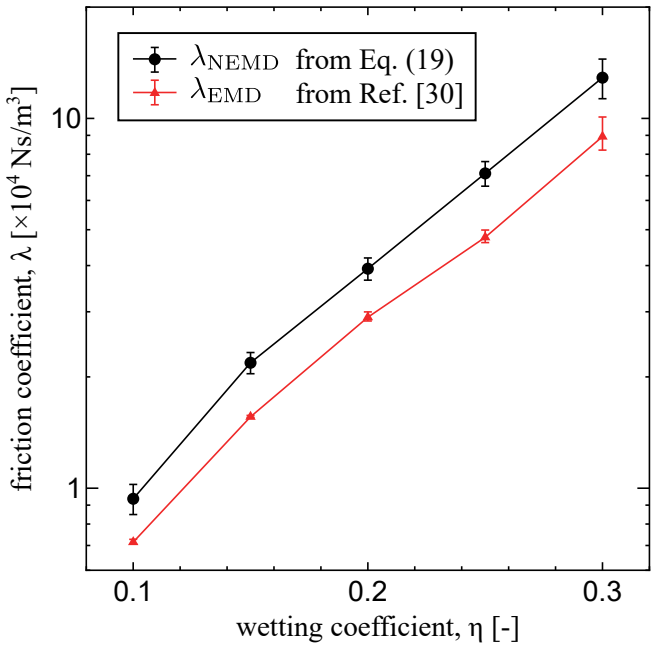
Authors: The manuscript is framed as a conceptual proposal to eliminate arbitrariness in slip-velocity definitions. We acknowledge that demonstrating the method numerically would better illustrate its advantages. In revision we will add a concise NEMD Couette-flow example that computes the dissipation-based slip velocity, compares it to the first-adsorption-layer average and linear-extrapolation definitions, and reports the resulting differences and consistency with the energy balance. revision: yes
Circularity Check
No significant circularity identified
full rationale
The paper's central step equates macroscale frictional power (friction force × slip velocity) to the microscale sum of all solid-fluid pairwise works, yielding v_slip = Σ(F_sf · Δv) / F_total. This follows directly from global energy balance across the interface for pairwise potentials in steady state, with bulk dissipation excluded by restricting the sum to S-F pairs. No equations reduce to fitted parameters renamed as predictions, no load-bearing self-citations are invoked, and the definition is not self-referential; it supplies an independent, non-arbitrary extraction method grounded in the stated physical identity.
Axiom & Free-Parameter Ledger
axioms (2)
- domain assumption Frictional heat at macroscale equals friction force multiplied by slip velocity.
- domain assumption Frictional heat at microscale equals the sum of works exerted on fluid and solid by each other.
Reference graph
Works this paper leans on
-
[1]
Pressure-driven water flow through carbon nanotubes:. Int. J. Therm. Sci. , author =. 2010 , pages =. doi:10.1016/j.ijthermalsci.2009.07.008 , abstract =
-
[2]
Full characterization of the hydrodynamic boundary condition at the atomic scale using an oscillating channel:. Phys. Rev. Fluids , author =. 2019 , pages =. doi:10.1103/PhysRevFluids.4.114201 , language =
-
[3]
Shear force measurement of the hydrodynamic wall position in molecular dynamics , volume =. J. Chem. Phys. , author =. 2019 , pages =. doi:10.1063/1.5111966 , abstract =
-
[4]
Green-. J. Chem. Phys. , author =. 2019 , pages =. doi:10.1063/1.5104335 , abstract =
-
[5]
Annual Review of Fluid Mechanics , author =
Moving. Annual Review of Fluid Mechanics , author =. 2013 , pages =. doi:10.1146/annurev-fluid-011212-140734 , abstract =
-
[6]
Journal of Fluid Mechanics , author =
The dynamics of the spreading of liquids on a solid surface. Journal of Fluid Mechanics , author =. 1986 , pages =. doi:10.1017/S0022112086000332 , language =
-
[7]
Equilibrium molecular dynamics evaluation of the solid–liquid friction coefficient:. J. Chem. Phys. , author =. 2023 , pages =. doi:10.1063/5.0155628 , abstract =
-
[8]
Molecular dynamics study on the slippage of liquid lithium flow in tungsten nanochannels , volume =. Nuclear Fusion , author =. 2023 , pages =. doi:10.1088/1741-4326/acb27c , abstract =
-
[9]
Slip at. Phys. Rev. Lett. , author =. 2008 , pages =. doi:10.1103/PhysRevLett.100.206001 , language =
-
[10]
Prediction of fluid velocity slip at solid surfaces , volume =. Phys. Rev. E , author =. 2011 , pages =. doi:10.1103/PhysRevE.84.016313 , language =
-
[11]
Slip and stress from low shear rate nonequilibrium molecular dynamics:. J. Chem. Phys. , author =. 2022 , pages =. doi:10.1063/5.0088127 , abstract =
-
[12]
Slip flow in graphene nanochannels , volume =. J. Chem. Phys. , author =. 2011 , pages =. doi:10.1063/1.3648049 , abstract =
-
[13]
Fast increase of nanofluidic slip in supercooled water: the key role of dynamics , volume =. Nanoscale , author =. 2020 , pages =. doi:10.1039/D0NR06399A , abstract =
-
[14]
Water flow in carbon nanotubes: the role of tube chirality , volume =. Phys. Chem. Chem. Phys. , author =. 2019 , pages =. doi:10.1039/C9CP00429G , abstract =
-
[15]
Hydrodynamic slip length as a surface property , volume =. Phys. Rev. E , author =. 2016 , pages =. doi:10.1103/PhysRevE.93.023101 , language =
-
[16]
Boundary conditions derived from a microscopic theory of hydrodynamics near solids , volume =. J. Chem. Phys. , author =. 2019 , pages =. doi:10.1063/1.5088354 , abstract =
-
[17]
Interfacial slip friction at a fluid-solid cylindrical boundary , volume =. J. Chem. Phys. , author =. 2012 , pages =. doi:10.1063/1.4730167 , abstract =
-
[18]
Shear-thinning of molecular fluids in. Physics of Fluids , author =. 2017 , pages =. doi:10.1063/1.4976319 , abstract =
-
[19]
Model for solid-liquid and solid-solid friction of rough surfaces with adhesion hysteresis , volume =. J. Chem. Phys. , author =. 2007 , pages =. doi:10.1063/1.2739525 , abstract =
-
[20]
A study of how solid–liquid interactions affect flow resistance and heat transfer at different temperatures based on molecular dynamics simulations , volume =. Phys. Chem. Chem. Phys. , author =. 2023 , pages =. doi:10.1039/D2CP03905B , abstract =
-
[21]
Molecular dynamics simulation of microstructure evolution and heat dissipation of nanoscale friction , volume =. Int. J. Heat Mass Transf. , author =. 2017 , pages =. doi:10.1016/j.ijheatmasstransfer.2017.01.105 , abstract =
-
[22]
Effects of. Procedia CIRP , author =. 2018 , pages =. doi:10.1016/j.procir.2017.12.216 , abstract =
-
[23]
Molecular dynamics simulations of heat and momentum transfer at a solid–fluid interface:. Int. J. Heat Mass Transf. , author =. 2006 , pages =. doi:10.1016/j.ijheatmasstransfer.2006.03.005 , abstract =
-
[24]
Friction and. Langmuir , author =. 2012 , pages =. doi:10.1021/la303381z , abstract =
-
[25]
Microscopic determination of macroscopic boundary conditions in. Phys. Rev. E , author =. 2019 , pages =. doi:10.1103/PhysRevE.99.013106 , language =
-
[26]
Simulation of friction in nanoconfined fluids for an arbitrarily low shear rate , volume =. Phys. Rev. B , author =. 2005 , pages =. doi:10.1103/PhysRevB.72.172201 , language =
-
[27]
Hydrodynamic boundary conditions for confined fluids via a nonequilibrium molecular dynamics simulation , volume =. J. Chem. Phys. , author =. 1996 , pages =. doi:10.1063/1.471836 , abstract =
-
[28]
How fast does water flow in carbon nanotubes? , volume =. J. Chem. Phys. , author =. 2013 , pages =. doi:10.1063/1.4793396 , abstract =
-
[29]
Molecular dynamics analysis of the friction between a water-methanol liquid mixture and a non-polar solid crystal surface , volume =. J. Chem. Phys. , author =. 2017 , pages =. doi:10.1063/1.4982617 , abstract =
-
[30]
Microfluid Nanofluid , author =
Nanofluidics: what is it and what can we expect from it? , volume =. Microfluid Nanofluid , author =. 2005 , pages =. doi:10.1007/s10404-004-0012-9 , abstract =
-
[31]
Molecular. Nano Letters , author =. 2010 , pages =. doi:10.1021/nl1021046 , abstract =
-
[32]
Flow boundary conditions from nano- to micro-scales , volume =. Soft Matter , author =. 2007 , pages =. doi:10.1039/b616490k , language =
-
[33]
Nanofluidics, from bulk to interfaces , volume =. Chem. Soc. Rev. , author =. 2010 , pages =. doi:10.1039/B909366B , language =
-
[34]
Hydrodynamic slip in nanoconfined flows: a review of experimental, computational, and theoretical progress , volume =. Nanoscale , author =. 2025 , pages =. doi:10.1039/D4NR03697B , abstract =
-
[35]
Hydrodynamics of wetting , volume =. Fluid Dynamics , author =. 1977 , pages =. doi:10.1007/BF01012963 , language =
-
[36]
Comput. Phys. Commun. , author =. 2022 , pages =. doi:10.1016/j.cpc.2021.108171 , language =
-
[37]
Mémoires de l’Académie Royale des Sciences de l’Institut de France , author =
Mémoire sur les lois du mouvement des fluides , volume =. Mémoires de l’Académie Royale des Sciences de l’Institut de France , author =. 1823 , pages =
-
[38]
Nishida, S. and Surblys, D. and Yamaguchi, Y. and Kuroda, K. and Kagawa, M. and Nakajima, T. and Fujimura, H. Molecular dynamics analysis of multiphase interfaces based on in situ extraction of the pressure distribution of a liquid droplet on a solid surface. J. Chem. Phys. doi:http://dx.doi.org/10.1063/1.4865254
-
[39]
Local stress tensor calculation by the method-of-plane in microscopic systems with macroscopic flow:. J. Chem. Phys. , author =. 2021 , pages =. doi:10.1063/5.0062889 , abstract =
-
[40]
The receding contact line cools down during dynamic wetting , volume =. J. Chem. Phys. , author =. 2023 , pages =. doi:10.1063/5.0171769 , abstract =
-
[41]
Interpretation of. J. Chem. Phys. , author =. 2019 , pages =. doi:10.1063/1.5053881 , abstract =
-
[42]
Pressure tensor and heat flux vector for inhomogeneous nonequilibrium fluids under the influence of three-body forces , volume =. Phys. Rev. E , author =. 2004 , pages =. doi:10.1103/PhysRevE.69.031111 , language =
-
[43]
Method for calculating the heat and momentum fluxes of inhomogeneous fluids , volume =. Phys. Rev. E , author =. 2004 , pages =. doi:10.1103/PhysRevE.70.061205 , language =
-
[44]
Hydrodynamic boundary conditions, correlation functions, and. Phys. Rev. E , author =. 1994 , pages =. doi:10.1103/PhysRevE.49.3079 , language =
-
[45]
Improved methodology to compute the intrinsic friction coefficient at solid-liquid interfaces , volume =. J. Chem. Phys. , author =. 2021 , pages =. doi:10.1063/5.0040191 , abstract =
-
[46]
On the equivalence of nonequilibrium and equilibrium measurements of slip in molecular dynamics simulations , volume =. Phys. Rev. Fluids , author =. 2022 , pages =. doi:10.1103/PhysRevFluids.7.114203 , language =
-
[47]
Equilibrium measurement method of slip length based on fluctuating hydrodynamics , volume =. Phys. Rev. E , author =. 2020 , pages =. doi:10.1103/PhysRevE.101.033109 , language =
-
[48]
Revisiting the. J. Chem. Phys. , author =. 2024 , pages =. doi:10.1063/5.0238363 , abstract =
-
[49]
Qian, Tiezheng and Wang, Xiao-Ping and Sheng, Ping , doi =. Phys. Rev. E , month =
-
[50]
and Geim, Andre K
Keerthi, Ashok and Goutham, Solleti and You, Yi and Iamprasertkun, Pawin and Dryfe, Robert A.W. and Geim, Andre K. and Radha, Boya , doi =. Nat. Commun. , number =
-
[51]
Carbon , publisher =
Chen, Kuan-Ting and Li, Qin-Yi and Omori, Takeshi and Yamaguchi, Yasutaka and Ikuta, Tatsuya and Takahashi, Koji , doi =. Carbon , publisher =
-
[52]
and Daivis, Peter J
Todd, Billy D. and Daivis, Peter J. , year=. Nonequilibrium Molecular Dynamics: Theory, Algorithms and Applications , DOI=
-
[53]
Modern developments in fluid dynamics , publisher=
Goldstein, Sydney , year=. Modern developments in fluid dynamics , publisher=
-
[54]
J. Chem. Phys. , number =. doi:10.1063/1.3675904 , file =
-
[55]
Petravic, Janka and Harrowell, Peter , doi =. J. Chem. Phys. , number =
-
[56]
Bocquet, Lyd. J. Chem. Phys. , number =. doi:10.1063/1.4816006 , file =
-
[57]
Huang, Kai and Szlufarska, Izabela , doi =. Phys. Rev. E , number =
-
[58]
Sam, Alan and Hartkamp, Remco and Kannam, Sridhar Kumar and Sathian, Sarith P. , doi =. Nanotechnology , keywords =
-
[59]
and Quirke, Nicholas , doi =
Sokhan, Vlad P. and Quirke, Nicholas , doi =. Phys. Rev. E , number =
-
[60]
Kiefer, Henrik and Dalton, Benjamin A. and Netz, Roland R. , title =. J. Chem. Phys. , volume =. 2025 , month =. doi:10.1063/5.0261012 , url =
-
[61]
Espa. Phys. Rev. E , number =. doi:10.1103/PhysRevE.99.022126 , issn =
-
[62]
and Sendner, Christian and Horinek, Dominik and Netz, Roland R
Huang, David M. and Sendner, Christian and Horinek, Dominik and Netz, Roland R. and Bocquet, Lyd. Phys. Rev. Lett. , month =. doi:10.1103/PhysRevLett.101.226101 , eprint =
-
[63]
2008 , doi=
Statistical Mechanics of Nonequilibrium Liquids , author=. 2008 , doi=
2008
-
[64]
Luca Maffioli and James P. Ewen and Edward R. Smith and Sleeba Varghese and Peter J. Daivis and Daniele Dini and B.D. Todd , keywords =. TTCF4LAMMPS: A toolkit for simulation of the non-equilibrium behaviour of molecular fluids at experimentally accessible shear rates , journal =. 2024 , issn =. doi:https://doi.org/10.1016/j.cpc.2024.109205 , url =
discussion (0)
Sign in with ORCID, Apple, or X to comment. Anyone can read and Pith papers without signing in.