A Bilevel Optimization Model for Bottom-Up Coordination of Multiple Low-Voltage Energy Communities and the Medium-Voltage Network
Pith reviewed 2026-06-26 23:32 UTC · model grok-4.3
The pith
A bilevel Stackelberg model with KKT reformulation coordinates low-voltage energy communities and the medium-voltage network exactly while supporting a distributed solver.
A machine-rendered reading of the paper's core claim, the machinery that carries it, and where it could break.
Core claim
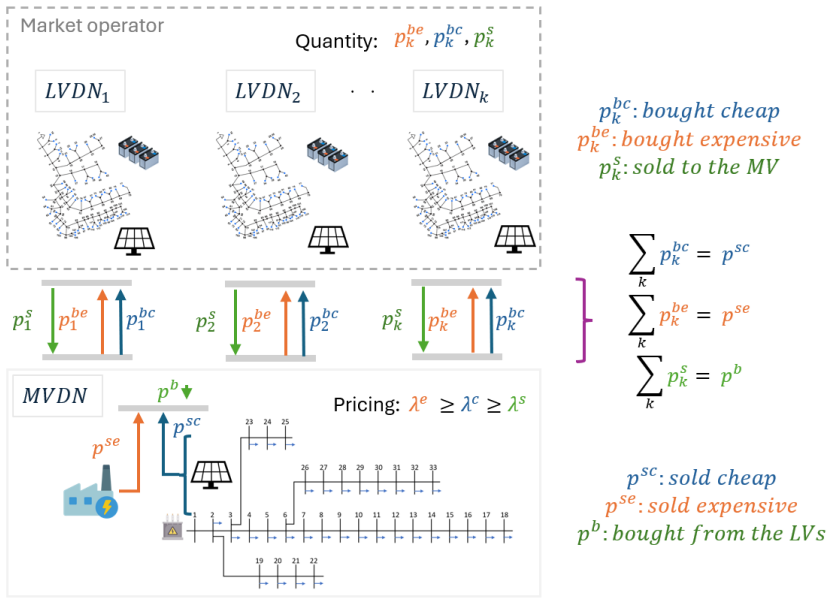
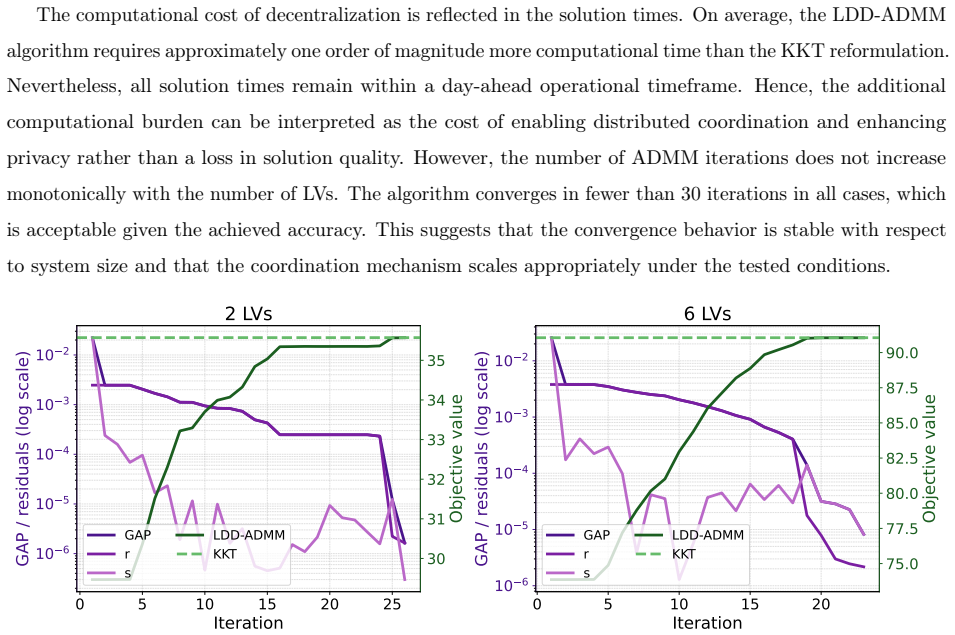
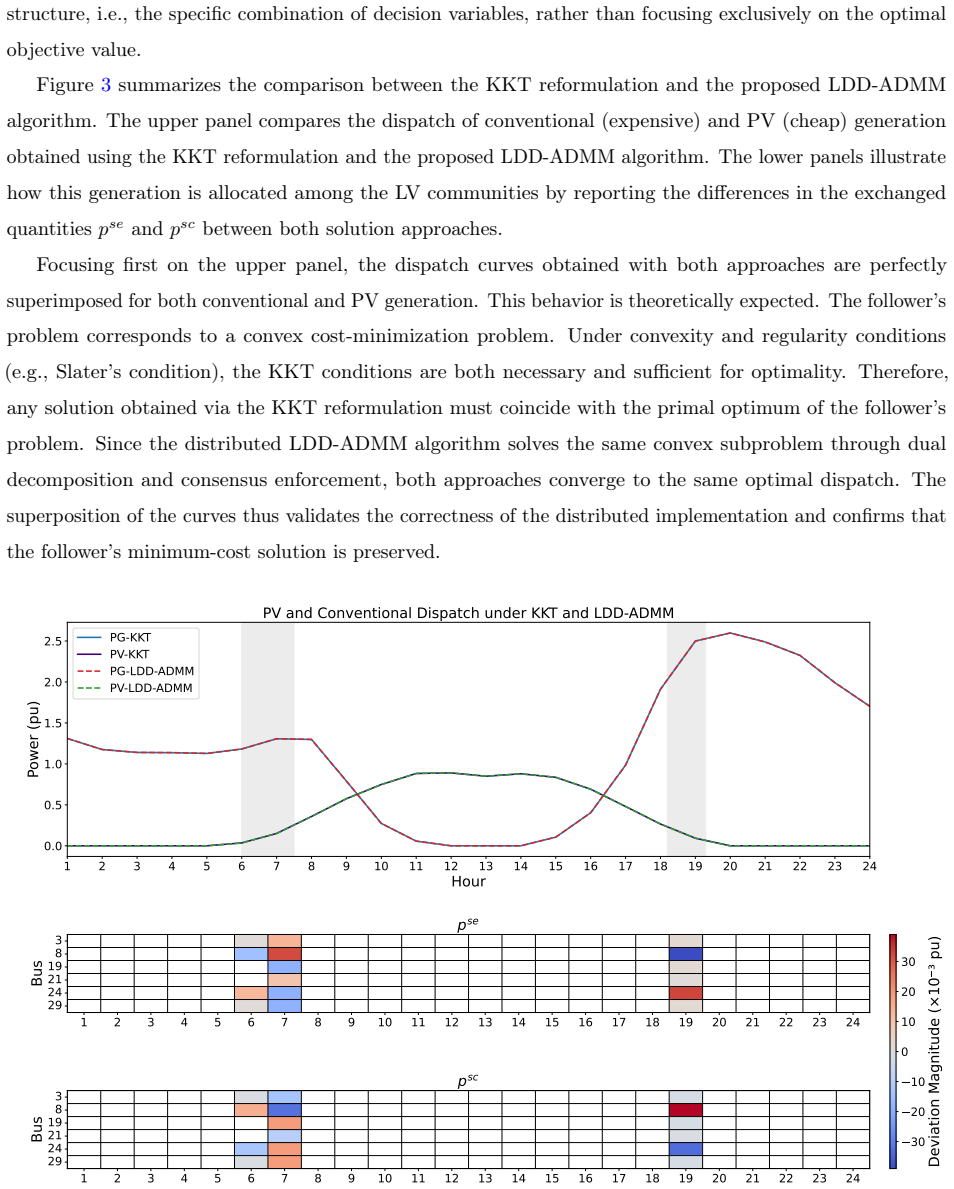
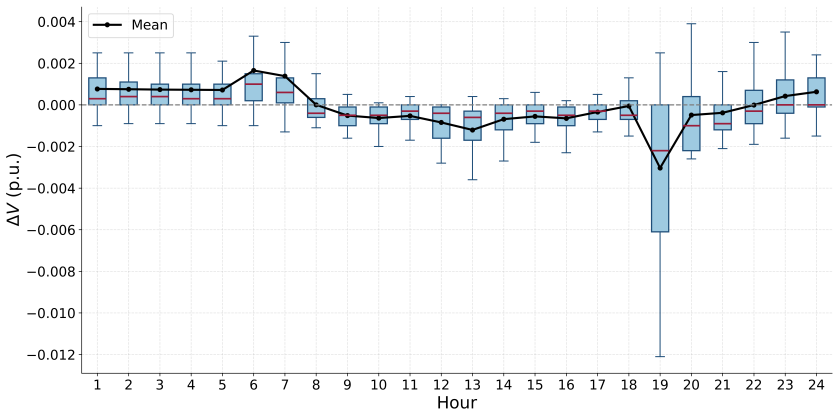
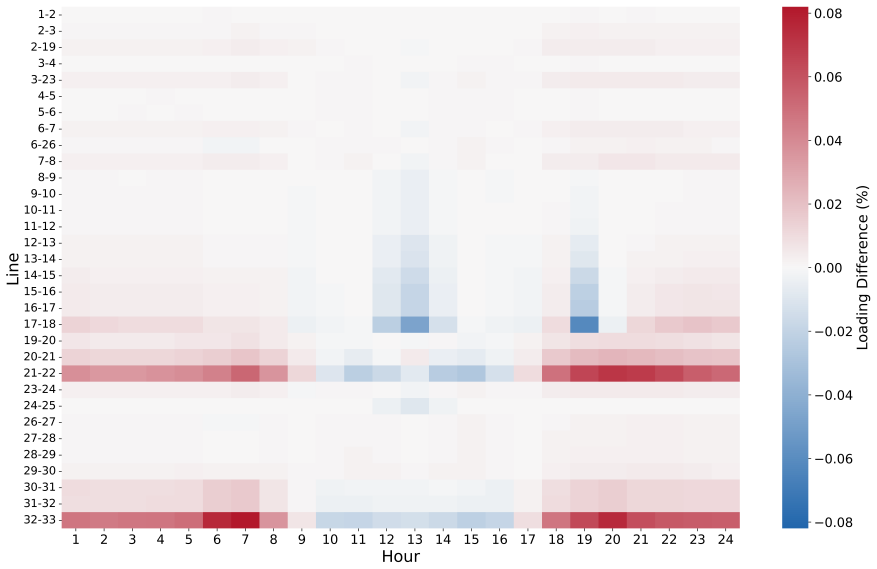
The central claim is that concentrating discrete scheduling decisions at the low-voltage level while retaining a convex continuous formulation at the medium-voltage level permits both an exact KKT-based single-level reformulation of the bilevel problem and an effective distributed LDD-ADMM algorithm whose solutions deviate from the centralized optimum by only 1.7e-4 on average, with larger deviations appearing only during scarcity of the cheap resource.
What carries the argument
The KKT conditions of the convex medium-voltage follower problem, which produce an exact single-level equivalent of the Stackelberg bilevel model between the low-voltage aggregator and the medium-voltage dispatcher.
If this is right
- The LDD-ADMM algorithm coordinates multiple low-voltage communities in parallel while preserving data confidentiality.
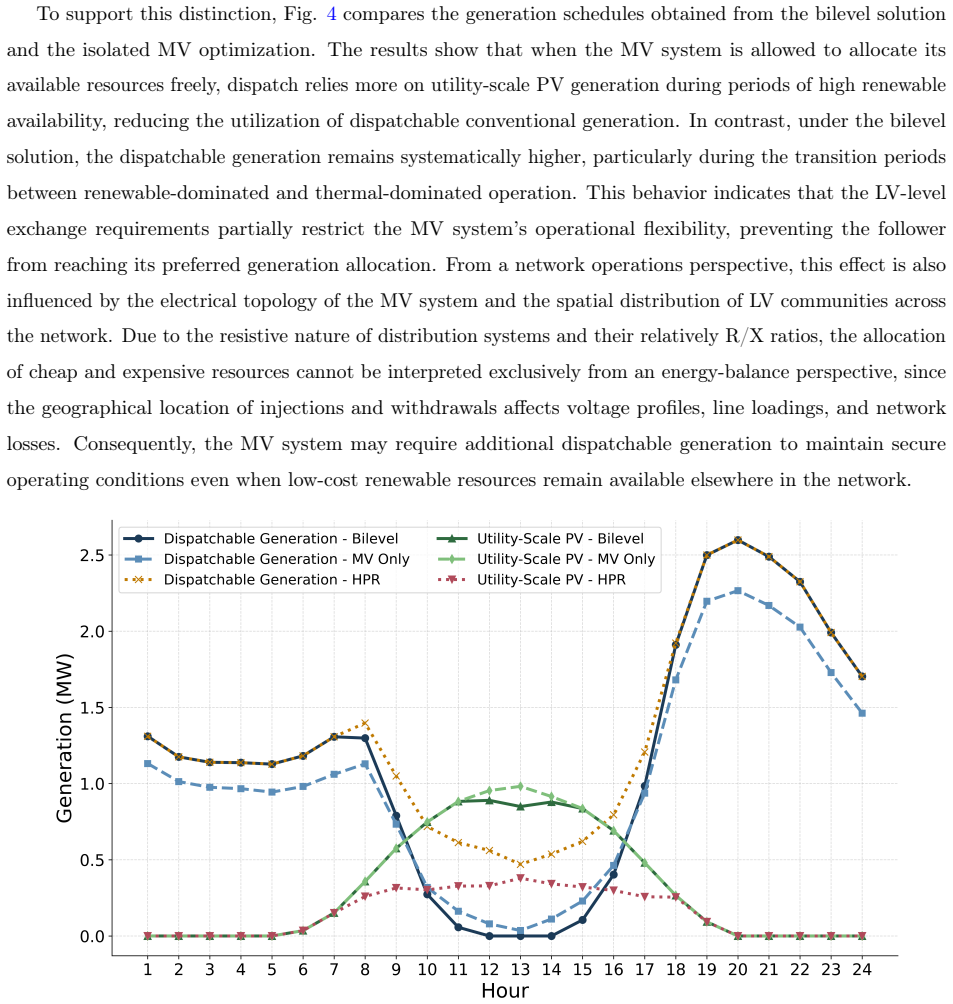
- Decisions taken by the low-voltage leader can raise the costs incurred by the medium-voltage follower relative to the follower's independent optimum.
- A feasibility-based single-level relaxation satisfies the required energy exchanges but produces a less cost-efficient allocation of medium-voltage resources than the exact reformulation.
- The framework scales to the IEEE 33-bus medium-voltage system coupled with multiple 206-bus low-voltage feeders without loss of the near-exact match between distributed and centralized solutions.
Where Pith is reading between the lines
- If the convexity assumption continues to hold when uncertainty or discrete decisions are added at the medium-voltage level, the same KKT reformulation could be applied to larger hierarchical networks.
- The observed deviations during scarcity periods indicate that tightening the handling of binding constraints inside the distributed algorithm could further reduce error.
- The same leader-follower structure with exact reformulation may transfer to other multi-level energy coordination problems such as transmission-distribution or microgrid-market interactions.
Load-bearing premise
The medium-voltage network economic dispatch remains a convex continuous problem whose KKT conditions yield an exact single-level reformulation of the original bilevel problem.
What would settle it
A concrete test case in which the medium-voltage dispatch problem loses convexity and the KKT reformulation no longer recovers the true bilevel optimum, or a run of the LDD-ADMM algorithm whose relative deviation from the exact solution exceeds 1.7e-4 by a large margin outside scarcity periods.
Figures
read the original abstract
The increasing penetration of distributed energy resources (DERs) is transforming low-voltage (LV) networks into active systems, including energy communities, whose generation, storage, and energy exchange activities require enhanced coordination with upstream medium-voltage (MV) networks. In the proposed Stackelberg structure, a local market operator aggregates multiple LV communities and acts as a single leader, determining DER operations and boundary energy exchanges, while the MV network serves as the follower, ensuring efficient system feasibility through an economic dispatch that includes both conventional and utility-scale PV generation. The proposed bottom-up coordination scheme concentrates discrete DER scheduling at the LV level while the MV level retains a convex continuous formulation, enabling an exact single-level reformulation via the Karush-Kuhn-Tucker (KKT) conditions. In addition, a distributed coordination algorithm that combines Lagrangian Dual Decomposition (LDD) with the Alternating Direction Method of Multipliers (ADMM) is developed to coordinate LV communities in parallel while preserving data confidentiality. The framework is validated using the IEEE 33-bus system at the MV level and six European 206-bus LV test feeders. Results indicate that the LDD-ADMM algorithm closely matches the exact reformulation, with an average relative deviation of 1.7e-4, with deviations confined to periods of scarcity for the cheap resource. Furthermore, leaders' decisions can induce operating conditions that increase followers' costs relative to their independently optimal dispatch, a pattern reinforced by comparison with a feasibility-based single-level relaxation that satisfies the required energy exchanges but fails to achieve a cost-efficient allocation of MV resources.
Editorial analysis
A structured set of objections, weighed in public.
Referee Report
Summary. The manuscript proposes a Stackelberg bilevel model for bottom-up coordination of multiple LV energy communities (aggregated by a local market operator as leader) with an MV network (as follower). The leader optimizes DER scheduling and boundary exchanges; the follower solves a convex continuous economic dispatch including conventional and utility-scale PV generation. This convexity enables an exact single-level reformulation via KKT conditions. A distributed LDD-ADMM algorithm is developed for parallel LV coordination while preserving confidentiality. Validation on the IEEE 33-bus MV system and six 206-bus LV feeders reports that LDD-ADMM matches the exact reformulation with average relative deviation 1.7e-4 (deviations limited to scarcity periods) and that leader decisions can raise follower costs relative to independent dispatch, as shown by comparison to a feasibility-based relaxation.
Significance. If the MV convexity holds, the work supplies both an exact KKT-based reformulation and a scalable distributed algorithm for privacy-preserving coordination, with concrete numerical evidence of close agreement and a useful contrast to the feasibility relaxation. The explicit reporting of the 1.7e-4 deviation and the scarcity-period localization constitute reproducible strengths.
major comments (2)
- [Abstract] Abstract (paragraph on Stackelberg structure and reformulation): The central claim of an 'exact single-level reformulation via the KKT conditions' requires the MV economic dispatch to remain a convex continuous problem. The text asserts that 'the MV level retains a convex continuous formulation,' but does not explicitly verify that all included constraints (utility-scale PV, network limits, etc.) preserve convexity and admit strong duality; any hidden non-convexity would invalidate the KKT equivalence and thereby the benchmark used to assess the LDD-ADMM deviation.
- [Results] Results section (LDD-ADMM vs. exact reformulation): The reported average relative deviation of 1.7e-4 is small, yet the observation that deviations occur only in scarcity periods for the cheap resource suggests possible sensitivity precisely where binding constraints test the convexity assumption most stringently. No additional diagnostics (e.g., constraint violation counts or dual variable behavior in those periods) are provided to confirm that the deviation remains numerical rather than structural.
minor comments (2)
- [Abstract] The abstract states 'six European 206-bus LV test feeders' without citing the specific reference or providing a brief description of their topology or load/generation profiles; adding this in the case-study section would improve reproducibility.
- Notation for the boundary energy exchange variables between LV and MV levels is introduced without an explicit table of symbols; a compact nomenclature table would aid readers.
Simulated Author's Rebuttal
We thank the referee for the constructive feedback on the convexity verification and numerical diagnostics. We address each major comment below and will incorporate revisions to strengthen the manuscript.
read point-by-point responses
-
Referee: [Abstract] The central claim of an 'exact single-level reformulation via the KKT conditions' requires the MV economic dispatch to remain a convex continuous problem. The text asserts that 'the MV level retains a convex continuous formulation,' but does not explicitly verify that all included constraints (utility-scale PV, network limits, etc.) preserve convexity and admit strong duality; any hidden non-convexity would invalidate the KKT equivalence and thereby the benchmark used to assess the LDD-ADMM deviation.
Authors: We agree that explicit verification is warranted. The MV economic dispatch is a linear program: linear objective (generation costs), continuous variables (conventional generation, utility-scale PV output, line flows), and linear constraints (power balance, capacity limits, and linearized network equations). No discrete decisions or nonlinear terms are present. In the revised manuscript we will add a short paragraph in Section II-B confirming linearity/convexity and noting that Slater's condition holds (strict feasibility via positive capacity margins), ensuring strong duality and equivalence of the KKT system. revision: yes
-
Referee: [Results] The reported average relative deviation of 1.7e-4 is small, yet the observation that deviations occur only in scarcity periods for the cheap resource suggests possible sensitivity precisely where binding constraints test the convexity assumption most stringently. No additional diagnostics (e.g., constraint violation counts or dual variable behavior in those periods) are provided to confirm that the deviation remains numerical rather than structural.
Authors: We accept the suggestion. In the revision we will append a short subsection (or supplementary material) reporting (i) maximum primal constraint violations across all periods (observed < 1e-6) and (ii) the evolution of the dual variables on the binding scarcity constraints. These diagnostics will confirm that the 1.7e-4 deviation is attributable to ADMM tolerance rather than any violation of the convexity or KKT assumptions. revision: yes
Circularity Check
No significant circularity detected
full rationale
The derivation chain rests on the standard application of KKT conditions to reformulate a bilevel problem whose follower (MV economic dispatch) is stated to be convex and continuous. This is a conventional mathematical step that does not reduce to any self-definition, fitted parameter renamed as prediction, or self-citation chain. The numerical comparison of LDD-ADMM to the reformulated solution is presented as an empirical validation (average relative deviation 1.7e-4), not a result forced by construction from the paper's own inputs. No load-bearing self-citations, uniqueness theorems, or ansatzes are quoted or required for the central claim.
Axiom & Free-Parameter Ledger
axioms (1)
- standard math KKT conditions provide an exact single-level reformulation when the follower problem is convex and continuous
Reference graph
Works this paper leans on
-
[1]
M. Adham, S. Keene, R. B. Bass, Distributed energy resources: A systematic literature review, Energy Reports 13 (2025) 1980–1999. doi:10.1016/j.egyr.2025.01.026
-
[2]
M. Mehdinejad, H. A. Shayanfar, B. Mohammadi-Ivatloo, H. Nafisi, Designing a robust decentralized energy transactions framework for active prosumers in peer-to-peer local electricity markets, IEEE Access 10 (2022) 26743–26755. doi:10.1109/ACCESS.2022.3151922
-
[3]
R. Silva, E. Alves, R. Ferreira, J. Villar, C. Gouveia, Characterization of TSO and DSO grid system services and TSO–DSO basic coordination mechanisms in the current decarbonization context, Energies 14 (2021). doi:10.3390/en14154451
-
[4]
T. Alazemi, M. Darwish, M. Radi, TSO/DSO coordination for RES integration: A systematic literature review, Energies 15 (2022). doi:10.3390/en15197312
-
[5]
V. A. Evangelopoulos, I. I. Avramidis, P. S. Georgilakis, Flexibility services management under uncertainties for power distribution systems: Stochastic scheduling and predictive real-time dispatch, IEEE Access 8 (2020) 38855–38871. doi:10.1109/ACCESS.2020.2975663
-
[6]
S. Bjerland, P. C. Del Granado, H. Grøttum, E. Nokandi, TSO–DSO coordination under wind and solar power uncertainty: A two-stage stochastic programming approach, in: 2024 20th International Conference on the European Energy Market (EEM), 2024, pp. 1–8. doi:10.1109/EEM60825.2024.10609023
-
[7]
H. Bakhtiari, M. R. Hesamzadeh, D. W. Bunn, TSO–DSO operational coordination using a look-ahead multi-interval framework, IEEE Transactions on Power Systems 38 (2023) 4221–4239. doi:10.1109/ TPWRS.2022.3219581
arXiv 2023
-
[8]
R. Jabr, Radial distribution load flow using conic programming, IEEE Transactions on Power Systems 21 (2006) 1458–1459. doi:10.1109/TPWRS.2006.879234
-
[9]
O. K. Olsen, D. Sieraszewski, D. Ivanko, I. Oleinikova, H. Farahmand, Hybrid AC/DC optimal power flow modelling approach for coordination in flexibility market, in: 2021 International Conference on Smart Energy Systems and Technologies (SEST), 2021, pp. 1–6. doi:10.1109/SEST50973.2021.9543104
-
[10]
B. Stott, J. Jardim, O. Alsac, DC power flow revisited, IEEE Transactions on Power Systems 24 (2009) 1290–1300. doi:10.1109/TPWRS.2009.2021235
-
[11]
G. Migliavacca, M. Rossi, D. Six, M. Džamarija, S. Horsmanheimo, C. Madina, I. Kockar, J. M. Morales, SmartNet: H2020 project analysing TSO–DSO interaction to enable ancillary services provision from distribution networks, CIRED Open Access Proceedings Journal 2017 (2017) 1998–2002. doi:10.1049/ oap-cired.2017.0104. 40
arXiv 2017
-
[12]
F. García-Muñoz, A. Ivanova, J. Farré Montané, M. Serrano, C. Corchero, A DSO flexibility platform based on an optimal congestion management model for the European CoordiNet project, Electric Power Systems Research 221 (2023) 109386. doi:10.1016/j.epsr.2023.109386
-
[13]
M. Kalantar-Neyestanaki, R. Cherkaoui, Grid-cognizant TSO and DSO coordination framework for active and reactive power flexibility exchange: The Swiss case study, Electric Power Systems Research 235 (2024) 110747. doi:10.1016/j.epsr.2024.110747
-
[14]
R. L. Mourão, C. Gouveia, G. Sampaio, F. Retorta, C. Merckx, F. Benothman, A. Águas, P. Boto, C. D. Silva, G. Milzer, G. Marzano, C. Dumont, P. Crucifix, M. Kaffash, E. Heylen, The EUniversal Portuguese demonstrator: from MV–LV coordinated identification of flexibility needs to activation through the UMEI, in: IET Conference Proceedings CP823, volume 2023...
-
[15]
B. Uzum, Y. Yoldas, S. Bahceci, A. Onen, Comprehensive review of transmission system operators–distribution system operators collaboration for flexible grid operations, Electric Power Systems Research 227 (2024) 109976. doi:10.1016/j.epsr.2023.109976
-
[16]
W. Lu, J. Chen, L. Cheng, W. Liu, Bilevel mixed-integer model and efficient algorithm for DER aggregator bidding: Accounting for EV aggregation uncertainty and distribution network security, Mathematics 14 (2026). doi:10.3390/math14040631
-
[17]
H. Zhang, S. Zhan, K. Kok, N. G. Paterakis, Establishing a hierarchical local market structure using multi-cut Benders decomposition, Applied Energy 363 (2024) 123073. doi:10.1016/j.apenergy.2024. 123073
-
[18]
W. Ananduta, A. Sanjab, L. Marques, Ensuring grid-safe forwarding of distributed flexibility in sequential DSO–TSO markets, IEEE Transactions on Energy Markets, Policy and Regulation 3 (2025) 157–169. doi:10.1109/TEMPR.2025.3555378
-
[19]
Y. Yang, Z. Hu, N. Yang, A. P. Zhao, C. Gu, A comprehensive review of coordinated operation of transmission-distribution networks: Frameworks, problems and future trends, Energy Conversion and Economics n/a (2026). doi:10.1049/enc2.70035
-
[20]
Z. Yuan, M. R. Hesamzadeh, Hierarchical coordination of TSO–DSO economic dispatch considering large-scale integration of distributed energy resources, Applied Energy 195 (2017) 600–615. doi:10.1016/ j.apenergy.2017.03.042
2017
-
[22]
J. M. Morales, S. Pineda, Y. Dvorkin, Learning the price response of active distribution networks for TSO–DSO coordination, IEEE Transactions on Power Systems 37 (2022) 2858–2868. doi:10.1109/TPWRS. 2021.3127343
-
[23]
M. Simoes, A. G. Madureira, F. Soares, J. P. Lopes, TSO–DSO coordinated operational planning in the presence of shared resourcesi, m, o, t, in: 2023 IEEE Belgrade PowerTech, 2023, pp. 01–08. doi:10.1109/PowerTech55446.2023.10202840
-
[24]
C. Gu, J. Wang, L. Wu, Distributed energy resource and energy storage investment for enhancing flexibility under a TSO–DSO coordination framework, IEEE Transactions on Automation Science and Engineering 21 (2024) 2961–2973. doi:10.1109/TASE.2023.3272532
-
[25]
S. Owais, M. J. A. Shohan, M. O. Faruque, Analytical target cascading based co-optimization of transmission and distribution systems with energy storage system, IEEE Transactions on Power Systems 40 (2025) 4249–4260. doi:10.1109/TPWRS.2025.3543671
-
[26]
S. Bahramara, M. Parsa Moghaddam, M. R. Haghifam, Modelling hierarchical decision making framework for operation of active distribution grids, IET Generation, Transmission & Distribution 9 (2015) 2555–2564. doi:10.1049/iet-gtd.2015.0327
-
[27]
S. Bahramara, M. Parsa Moghaddam, M. Haghifam, A bi-level optimization model for operation of distribution networks with micro-grids, International Journal of Electrical Power & Energy Systems 82 (2016) 169–178. doi:10.1016/j.ijepes.2016.03.015
-
[28]
E. Fernandez, M. Hossain, K. Mahmud, M. S. H. Nizami, M. Kashif, A bi-level optimization-based community energy management system for optimal energy sharing and trading among peers, Journal of Cleaner Production 279 (2021) 123254. doi:10.1016/j.jclepro.2020.123254
-
[29]
Stability of entropic optimal transport and Schrödinger bridges.J
H. Le Cadre, I. Mezghani, A. Papavasiliou, A game-theoretic analysis of transmission-distribution system operator coordination, European Journal of Operational Research 274 (2019) 317–339. doi:10.1016/j. ejor.2018.09.043
work page doi:10.1016/j 2019
-
[30]
A. S. Gazafroudi, M. Khorasany, R. Razzaghi, H. Laaksonen, M. Shafie-khah, Hierarchical approach for coordinating energy and flexibility trading in local energy markets, Applied Energy 302 (2021) 117575. doi:10.1016/j.apenergy.2021.117575
-
[31]
J. Iria, P. Scott, A. Attarha, D. Gordon, E. Franklin, MV–LV network-secure bidding optimisation of an aggregator of prosumers in real-time energy and reserve markets, Energy 242 (2022) 122962. doi:10.1016/j.energy.2021.122962
-
[32]
J. Zhang, L. Che, X. Wan, M. Shahidehpour, Distributed hierarchical coordination of networked charging stations based on peer-to-peer trading and EV charging flexibility quantification, IEEE Transactions on Power Systems 37 (2022) 2961–2975. doi:10.1109/TPWRS.2021.3123351. 42
-
[33]
H. Yao, Y. Xiang, S. Hu, G. Wu, J. Liu, Optimal prosumers’ peer-to-peer energy trading and scheduling in distribution networks, IEEE Transactions on Industry Applications 58 (2022) 1466–1477. doi:10.1109/ TIA.2021.3133207
arXiv 2022
-
[34]
Bi- temporal semantic reasoning for the semantic change detection in HR remote sensing images,
T. Gokcek, I. Sengor, O. Erdinc, A novel multi-hierarchical bidding strategy for peer-to-peer energy trading among communities, IEEE Access 10 (2022) 23798–23807. doi:10.1109/ACCESS.2022.3154393
-
[35]
L. Wang, Z. Wang, Z. Li, M. Yang, X. Cheng, Distributed optimization for network-constrained peer-to-peer energy trading among multiple microgrids under uncertainty, International Journal of Electrical Power & Energy Systems 149 (2023) 109065. doi:10.1016/j.ijepes.2023.109065
-
[36]
H. Jia, X. Wang, X. Jin, L. Cheng, Y. Mu, X. Yu, W. Wei, Optimal pricing of integrated community energy system for building prosumers with P2P multi-energy trading, Applied Energy 365 (2024) 123259. doi:10.1016/j.apenergy.2024.123259
-
[37]
X. Chen, X. Wang, M. Shahidehpour, L. Affolabi, Z. Lu, K. Li, Distributed peer-to-peer coordination of hierarchical three-phase energy transactions among electric vehicle charging stations in constrained power distribution and urban transportation networks, IEEE Transactions on Transportation Electrification 10 (2024) 4407–4420. doi:10.1109/TTE.2023.3315398
-
[38]
F. García-Muñoz, M. Venegas Escalona, DSO led-bilevel optimization framework for TSO–DSO coordination across active distribution networks, 2026.arXiv:2603.23099
arXiv 2026
-
[39]
G. C. Kryonidis, K. D. Pippi, A. I. Nousdilis, T. A. Papadopoulos, Analysis and coordinated provision of voltage regulation and power smoothing services in MV–LV distribution grids, IEEE Transactions on Industry Applications 61 (2025) 1161–1170. doi:10.1109/TIA.2024.3481389
-
[40]
M. Baran, F. Wu, Optimal sizing of capacitors placed on a radial distribution system, IEEE Transactions on Power Delivery 4 (1989) 735–743. doi:10.1109/61.19266
-
[41]
S. H. Low, Convex relaxation of optimal power flow—part i: Formulations and equivalence, IEEE Transactions on Control of Network Systems 1 (2014) 15–27. doi:10.1109/TCNS.2014.2309732
-
[42]
T. Yang, Y. Guo, L. Deng, H. Sun, W. Wu, A linear branch flow model for radial distribution networks and its application to reactive power optimization and network reconfiguration, IEEE Transactions on Smart Grid 12 (2021) 2027–2036. doi:10.1109/TSG.2020.3039984
-
[43]
D. K. Molzahn, I. A. Hiskens, Convex relaxations of optimal power flow problems: An illustrative example, IEEE Transactions on Circuits and Systems I: Regular Papers 63 (2016) 650–660. doi:10.1109/ TCSI.2016.2529281
arXiv 2016
-
[44]
Dempe, Foundations of Bilevel Programming, Springer, 2002
S. Dempe, Foundations of Bilevel Programming, Springer, 2002. doi:10.1007/b101970. 43
-
[45]
Aussel, C
D. Aussel, C. Egea, M. Schmidt, A tutorial on solving single-leader-multi-follower problems using SOS1 reformulations, International Transactions in Operational Research 32 (2025) 1227–1250. doi:10.1111/ itor.13466
2025
-
[46]
F. R. Ranjbar, S. N. Ravadanegh, A. Safari, Transactive energy trading in distribution systems via privacy-preserving distributed coordination, Applied Energy 361 (2024) 122823. doi:10.1016/j.apenergy. 2024.122823
-
[47]
P. Neal, C. Eric, P. Borja, E. Jonathan, Distributed optimization and statistical learning via the alternating direction method of multipliers, Foundations and Trends®in Machine Learning 3 (2011) 1–122. doi:10.1561/2200000016
-
[48]
H. Nie, J. Li, Z. Wen, An augmented Lagrangian value function method for lower-level constrained stochastic bilevel optimization, 2025.arXiv:2509.24249
arXiv 2025
-
[49]
W. Zhao, Q. Liao, R. Qiu, C. Liu, N. Xu, X. Yu, Y. Liang, Pipe sharing: A bilevel optimization model for the optimal capacity allocation of natural gas network, Applied Energy 359 (2024) 122731. doi:10.1016/j.apenergy.2024.122731
-
[50]
doi:10.1007/ s00158-006-0077-z
S.Tosserams, L.P.Etman, J.Rooda, AnaugmentedLagrangiandecompositionmethodforquasi-separable problems in mdo, Structural and Multidisciplinary Optimization 34 (2007) 211–227. doi:10.1007/ s00158-006-0077-z
2007
-
[51]
T. Wei, Y. Xu, X. Wang, P.-H. Ho, R. State, B. Ottersten, et al., Low-complexity algorithm for Stackelberg prediction games with global optimality, 2026.arXiv:2604.02676
Pith/arXiv arXiv 2026
-
[52]
M. L. Goncalves, J. G. Melo, R. D. Monteiro, Convergence rate bounds for a proximal ADMM with over-relaxation stepsize parameter for solving nonconvex linearly constrained problems, 2017. arXiv:1702.01850
Pith/arXiv arXiv 2017
-
[53]
K. Wei, A. Aviles-Rivero, J. Liang, Y. Fu, H. Huang, C.-B. Schönlieb, Tfpnp: Tuning-free plug-and-play proximal algorithms with applications to inverse imaging problems, Journal of Machine Learning Research 23 (2022) 1–48. doi:10.1007/s12532-023-00250-8
-
[54]
S. H. Dolatabadi, M. Ghorbanian, P. Siano, N. D. Hatziargyriou, An enhanced IEEE 33 bus benchmark test system for distribution system studies, IEEE Transactions on Power Systems 36 (2021) 2565–2572. doi:10.1109/TPWRS.2020.3038030
-
[55]
J. M. Pigem, F. García-Muñoz, N. J. Bravo, R. Aránguiz, V. C. Burgos, Optimal sizing of community photovoltaic and battery energy storage systems with second-life batteries in peer-to-peer energy communities, Journal of Energy Storage 148 (2026) 120031. doi:10.1016/j.est.2025.120031. 44
-
[56]
L. Wang, Q. Zhou, Z. Xiong, Z. Zhu, C. Jiang, R. Xu, Z. Li, Security constrained decentralized peer-to-peer transactive energy trading in distribution systems, CSEE Journal of Power and Energy Systems 8 (2022) 188–197. doi:10.17775/CSEEJPES.2020.06560
- [57]
-
[58]
B. Colson, P. Marcotte, G. Savard, An overview of bilevel optimization, Annals of Operations Research 153 (2007) 235–256. doi:10.1007/s10479-007-0176-2
-
[59]
C. Lu, J. Feng, S. Yan, Z. Lin, A unified alternating direction method of multipliers by majorization minimization, IEEE Transactions on Pattern Analysis and Machine Intelligence 40 (2018) 527–541. doi:10.1109/TPAMI.2017.2689021
-
[60]
Y. Li, L. Balzano, D. Needell, H. Lyu, Convergence and complexity of block majorization-minimization for constrained block-Riemannian optimization, Journal of Machine Learning Research 27 (2026) 1–77. URL:https://jmlr.org/papers/v27/24-0020.html. 45
2026
discussion (0)
Sign in with ORCID, Apple, or X to comment. Anyone can read and Pith papers without signing in.