REVIEW 2 major objections 1 minor 20 references
KidRisk: Benchmark Dataset for Children Dangerous Action Recognition
T0 review · 2 major / 1 minor · reviewed 2026-06-25 · grok-4.3
Pith's one-line read Vision-language models reach 96.14% accuracy on a new benchmark for spotting children's dangerous actions.
desk verdict KidRisk adds a new dataset for child action safety but the abstract and lack of methods details leave the accuracy claims unverifiable. read the letter →
The pith
A machine-rendered reading of the paper's core claim, the machinery that carries it, and where it could break.
The reading
What carries the argument
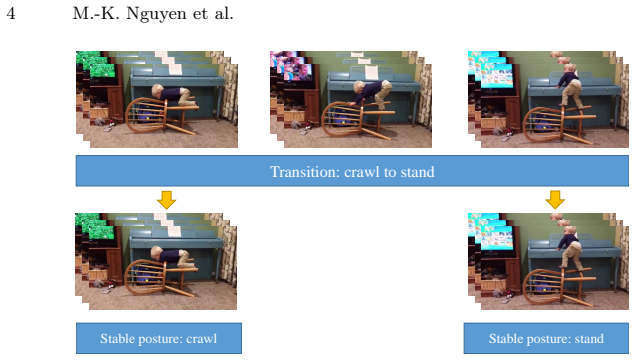
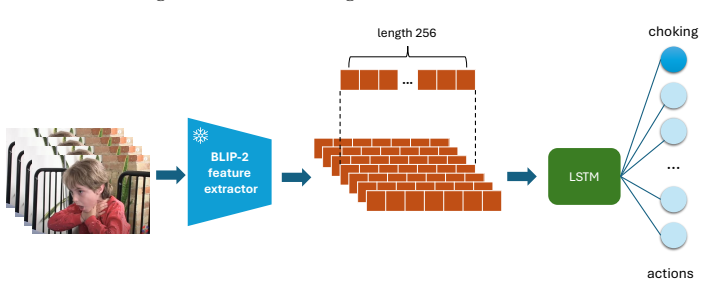
The KidRisk dataset of videos and images together with vision-language baselines that supply context understanding of visual information.
What would settle it
Retraining and testing the same vision-language models on a fresh collection of unscripted home or playground videos and recording accuracy below 70% would falsify the reported effectiveness.
Extended reading notes
Core claim
The paper establishes KidRisk as a challenging benchmark dataset and shows that vision-language models, by leveraging combined visual and language understanding, deliver 83.53% accuracy on children's action classification and 96.14% accuracy on dangerous action recognition, clearly surpassing traditional deep learning methods on the same tasks.
Load-bearing premise
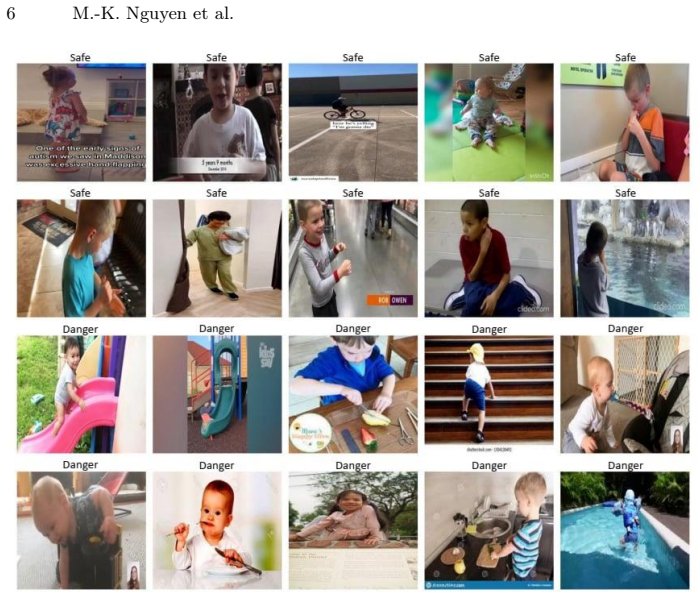
The 2,500 videos and 10,000 images form a representative sample of real-world dangerous actions performed by children without supervision.
Editorial extensions
If this is right
- Vision-language models can be applied directly to child safety monitoring tasks where traditional models fall short.
- The KidRisk collection acts as a testbed that exposes weaknesses in existing action-recognition pipelines.
- Accuracy above 96% on dangerous-action detection supports development of real-time alert systems for caregivers.
- Multimodal methods become the preferred route for any future work on hazardous child behavior recognition.
Reading between the lines
- The same modeling approach could be tested on live camera feeds to measure latency and false-positive rates in actual homes.
- Comparable datasets for elderly fall detection or unsupervised pet behavior might follow the same construction pattern.
- Pairing the models with simple notification hardware would create an end-to-end safety pipeline that the current paper leaves unexplored.
Signed reviews
Editorial analysis
A structured set of objections, weighed in public.
Referee Report
Summary. The paper introduces the KidRisk dataset consisting of 2,500 short videos of children's actions and 10,000 images focused on dangerous actions of children. It benchmarks traditional deep learning models, which show limited effectiveness, against newly developed vision-language baselines that achieve 83.53% accuracy on children's action classification and 96.14% on dangerous action recognition, claiming these outperform traditional approaches and support applications in child safety.
Significance. If the dataset is shown to be representative, well-annotated, and free of leakage or bias, and if the reported performance gains are reproducible with the stated protocols, the work could provide a useful benchmark resource for vision-based child safety systems and demonstrate the value of vision-language models in this application domain.
major comments (2)
- [Abstract] Abstract: The central claims rest on reported accuracies of 83.53% (action classification) and 96.14% (dangerous action recognition) together with superiority over traditional models, yet the abstract supplies no information on data collection protocol, annotation process, definition of 'dangerous' actions, inter-annotator agreement, subject demographics, train/test splits, or baseline implementation details. These omissions are load-bearing for any interpretation of the benchmark results.
- [Abstract] Abstract (dataset construction claim): The assertion that the 2,500 videos and 10,000 images form a 'challenging' and representative benchmark for real-world children's dangerous actions is stated without supporting evidence on collection methodology, age/ethnicity distribution, potential staging bias, or split methodology. This directly affects whether the performance numbers establish real-world effectiveness.
minor comments (1)
- [Abstract] Abstract: Grammatical error ('This paper build' should read 'This paper builds').
Simulated Author's Rebuttal
We thank the referee for the constructive feedback on the abstract and dataset claims. We agree that the abstract requires expansion to be self-contained and will revise the manuscript accordingly to include the requested details and supporting evidence.
read point-by-point responses
-
Referee: [Abstract] Abstract: The central claims rest on reported accuracies of 83.53% (action classification) and 96.14% (dangerous action recognition) together with superiority over traditional models, yet the abstract supplies no information on data collection protocol, annotation process, definition of 'dangerous' actions, inter-annotator agreement, subject demographics, train/test splits, or baseline implementation details. These omissions are load-bearing for any interpretation of the benchmark results.
Authors: We agree that the abstract is too concise and omits these load-bearing details. While the full manuscript provides this information in Sections 3 (Dataset Construction) and 4 (Experiments), the abstract does not. In the revised version we will expand the abstract to concisely summarize the data collection protocol, annotation process, definition of dangerous actions, inter-annotator agreement, subject demographics, train/test splits, and baseline implementation details. revision: yes
-
Referee: [Abstract] Abstract (dataset construction claim): The assertion that the 2,500 videos and 10,000 images form a 'challenging' and representative benchmark for real-world children's dangerous actions is stated without supporting evidence on collection methodology, age/ethnicity distribution, potential staging bias, or split methodology. This directly affects whether the performance numbers establish real-world effectiveness.
Authors: We acknowledge the abstract states the benchmark claim without inline supporting evidence. The main text already contains the relevant methodology, but to directly address this point we will revise both the abstract and the dataset section to explicitly report collection methodology, age/ethnicity distributions, a discussion of potential staging bias, and the train/test split strategy, thereby providing the evidence needed to support the representativeness claim. revision: yes
Circularity Check
No circularity; empirical benchmark on newly collected data
full rationale
The paper introduces the KidRisk dataset (2,500 videos + 10,000 images) and reports direct empirical accuracies (83.53% action classification, 96.14% dangerous-action recognition) from standard model evaluations. No equations, derivations, fitted parameters renamed as predictions, or self-citation chains appear in the provided text. The central claims rest on external benchmark performance rather than any reduction to the paper's own inputs by construction, satisfying the self-contained criterion.
Assumptions & free parameters
Cite this review
Pith. "Pith review of KidRisk: Benchmark Dataset for Children Dangerous Action Recognition." pith.science (2026). https://pith.science/paper/TZYUNDU2
@misc{pith2026260625298,
  author       = {Pith},
  title        = {Pith review of: KidRisk: Benchmark Dataset for Children Dangerous Action Recognition},
  year         = {2026},
  howpublished = {\url{https://pith.science/paper/TZYUNDU2}},
  note         = {Machine review of arXiv:2606.25298}
}
read the original abstract
Children are naturally energetic, and during their spontaneous activities, they often encounter potentially dangerous situations, especially when lacking parental supervision. Identifying actions that pose risks plays a crucial role in ensuring their safety. This paper build a novel challenging dataset, namely KidRisk, including 2,500 short videos of children's actions and 10,000 images for dangerous action of children. We also introduce a benchmark on our newly constructs dataset and find that traditional deep learning models demonstrated limited effectiveness on these tasks. Therefore, we develop vision-language based baselines with exceptional context understanding of visual information. Our proposed methods achieved an accuracy of 83.53% in classifying children's actions and 96.14% in recognizing children's dangerous actions, significantly outperforming traditional approaches. These results confirm that vision-language models are not only feasible but also highly effective in detecting hazardous actions, contributing positively to safeguarding children's safety.
Figures

Figures from the paper (3 more)

Reference graph
Works this paper leans on
-
[1]
Advances in neural information processing systems35, 23716– 23736 (2022)
Alayrac, J.B., Donahue, J., Luc, P., Miech, A., Barr, I., Hasson, Y., Lenc, K., Men- sch, A., Millican, K., Reynolds, M., et al.: Flamingo: a visual language model for few-shot learning. Advances in neural information processing systems35, 23716– 23736 (2022)
2022
-
[2]
In: Proceedings of the IEEE/CVF international confer- ence on computer vision
Arnab, A., Dehghani, M., Heigold, G., Sun, C., Lučić, M., Schmid, C.: Vivit: A video vision transformer. In: Proceedings of the IEEE/CVF international confer- ence on computer vision. pp. 6836–6846 (2021)
2021
-
[3]
Bertasius, G., Wang, H., Torresani, L.: Is space-time attention all you need for video understanding? In: ICML. vol. 2, p. 4 (2021)
2021
-
[4]
In: Proceedings of the IEEE/CVF conference on computer vision and pattern recognition
Chen, C.F.R., Panda, R., Ramakrishnan, K., Feris, R., Cohn, J., Oliva, A., Fan, Q.: Deep analysis of cnn-based spatio-temporal representations for action recogni- tion. In: Proceedings of the IEEE/CVF conference on computer vision and pattern recognition. pp. 6165–6175 (2021)
2021
-
[5]
Learning Phrase Representations using RNN Encoder-Decoder for Statistical Machine Translation
Cho, K., Van Merriënboer, B., Gulcehre, C., Bahdanau, D., Bougares, F., Schwenk, H., Bengio, Y.: Learning phrase representations using rnn encoder-decoder for sta- tistical machine translation. arXiv preprint arXiv:1406.1078 (2014)
work page Pith review arXiv 2014
-
[6]
An Image is Worth 16x16 Words: Transformers for Image Recognition at Scale
Dosovitskiy, A., Beyer, L., Kolesnikov, A., Weissenborn, D., Zhai, X., Unterthiner, T., Dehghani, M., Minderer, M., Heigold, G., Gelly, S., et al.: An image is worth 16x16 words: Transformers for image recognition at scale. arXiv preprint arXiv:2010.11929 (2020)
work page Pith review arXiv 2010
-
[7]
In: Proceedings of the IEEE/CVF Conference on Computer Vision and Pattern Recognition
Huang, X., Luan, L., Hatamimajoumerd, E., Wan, M., Kakhaki, P.D., Obeid, R., Ostadabbas, S.: Posture-based infant action recognition in the wild with very lim- ited data. In: Proceedings of the IEEE/CVF Conference on Computer Vision and Pattern Recognition. pp. 4912–4921 (2023)
2023
-
[8]
In: International conference on machine learning
Jia, C., Yang, Y., Xia, Y., Chen, Y.T., Parekh, Z., Pham, H., Le, Q., Sung, Y.H., Li, Z., Duerig, T.: Scaling up visual and vision-language representation learning with noisy text supervision. In: International conference on machine learning. pp. 4904–4916. PMLR (2021)
2021
Show all 20 references
-
[9]
In: Proceedings of the IEEE/CVF Conference on Computer Vision and Pattern Recognition
Li,D.,Li,J.,Li,H.,Niebles,J.C.,Hoi,S.C.:Alignandprompt:Video-and-language pre-training with entity prompts. In: Proceedings of the IEEE/CVF Conference on Computer Vision and Pattern Recognition. pp. 4953–4963 (2022)
2022
-
[10]
In: International conference on machine learning
Li, J., Li, D., Savarese, S., Hoi, S.: Blip-2: Bootstrapping language-image pre- training with frozen image encoders and large language models. In: International conference on machine learning. pp. 19730–19742. PMLR (2023)
2023
-
[11]
In: International confer- ence on machine learning
Li, J., Li, D., Xiong, C., Hoi, S.: Blip: Bootstrapping language-image pre-training for unified vision-language understanding and generation. In: International confer- ence on machine learning. pp. 12888–12900. PMLR (2022)
2022
-
[12]
Li, M., Chen, S., Chen, X., Zhang, Y., Wang, Y., Tian, Q.: Actional-structural graphconvolutionalnetworksforskeleton-basedactionrecognition.In:Proceedings of the IEEE/CVF conference on computer vision and pattern recognition. pp. 3595–3603 (2019)
2019
-
[13]
In: Proceedings of the IEEE/CVF international conference on computer vision
Lin, J., Gan, C., Han, S.: Tsm: Temporal shift module for efficient video under- standing. In: Proceedings of the IEEE/CVF international conference on computer vision. pp. 7083–7093 (2019)
2019
-
[14]
In: Proceed- ings of the IEEE/CVF conference on computer vision and pattern recognition
Miech,A.,Alayrac,J.B.,Smaira,L.,Laptev,I.,Sivic,J.,Zisserman,A.:End-to-end learning of visual representations from uncurated instructional videos. In: Proceed- ings of the IEEE/CVF conference on computer vision and pattern recognition. pp. 9879–9889 (2020) 12 M.-K. Nguyen et al
2020
-
[15]
In: 2018 IEEE International Conference on Robotics and Biomimetics (ROBIO)
Nie, Q., Wang, X., Wang, J., Wang, M., Liu, Y.: A child caring robot for the dangerous behavior detection based on the object recognition and human action recognition. In: 2018 IEEE International Conference on Robotics and Biomimetics (ROBIO). pp. 1921–1926. IEEE (2018)
2018
-
[16]
In: International conference on machine learning
Radford, A., Kim, J.W., Hallacy, C., Ramesh, A., Goh, G., Agarwal, S., Sastry, G., Askell, A., Mishkin, P., Clark, J., et al.: Learning transferable visual models from natural language supervision. In: International conference on machine learning. pp. 8748–8763. PMLR (2021)
2021
-
[17]
Advances in neural information processing systems28(2015)
Shi, X., Chen, Z., Wang, H., Yeung, D.Y., Wong, W.K., Woo, W.c.: Convolutional lstm network: A machine learning approach for precipitation nowcasting. Advances in neural information processing systems28(2015)
2015
-
[18]
Academic Journal of Computing & Information Science5(6), 89–94 (2022)
Wang, C., Zhang, H., Zhai, Z., et al.: Real time dangerous action warning system based on graph convolution neural network. Academic Journal of Computing & Information Science5(6), 89–94 (2022)
2022
-
[19]
arXiv preprint arXiv:2108.10904 (2021)
Wang, Z., Yu, J., Yu, A.W., Dai, Z., Tsvetkov, Y., Cao, Y.: Simvlm: Sim- ple visual language model pretraining with weak supervision. arXiv preprint arXiv:2108.10904 (2021)
2021
-
[20]
In: Proceedings of the AAAI conference on ar- tificial intelligence
Yan, S., Xiong, Y., Lin, D.: Spatial temporal graph convolutional networks for skeleton-based action recognition. In: Proceedings of the AAAI conference on ar- tificial intelligence. vol. 32 (2018)
2018
Reviewed June 25, 2026 · model on record in the stance chip above.
Discussion (0). Continue with ORCID to comment.