REVIEW 2 major objections 5 minor 13 references
Energy-Efficient Proactive Caching for Fog Computing with Correlated Task Arrivals
T0 review · 2 major / 5 minor · reviewed 2026-08-14 · deepseek-v4-flash
Pith's one-line read The paper claims that proactive caching of correlated task results at a fog access point, optimized jointly with computation offloading via semidefinite relaxation, reduces long-term weighted-sum energy, and that a sliding-window online…
desk verdict Clean SDR-based heuristic for computation caching with correlated tasks; the assumed correlation model is the main soft spot. read the letter →
The pith
A machine-rendered reading of the paper's core claim, the machinery that carries it, and where it could break.
The reading
What carries the argument
The key machinery is the lift-and-relax transformation of the binary caching vector. The paper writes $\mathbf{I}=[I_1,\dots,I_N]^\top$, sets $\mathbf{a}=[\mathbf{I};1]$ and $\mathbf{A}=\mathbf{a}\mathbf{a}^\top$, and expresses every term of the objective, including the correlation-dependent input length $D_i=L_i((\tau_1-1)I_{i-1}+(\tau_2-1)I_{i-2}+(1-\tau_2)I_{i-1}I_{i-2}+1)$, as a linear function of $\mathbf{A}$. Dropping the rank-one constraint gives a semidefinite program, and the relaxed last-column entries $\mathbf{A}(i,N+1)\in[0,1]$ are rounded to recover the caching decisions. The sliding-window online implementation repeatedly solves this SDP over $S$ future slots and commits only to the first decision.
What would settle it
Take a trace of task-input lengths in which the $L_i$ are statistically independent across slots, run the paper's online and offline algorithms under its own energy model, and compare with the no-caching policy; if the optimized policies show a systematic energy gain, the correlation assumption is being exploited where none exists, which points to an implementation error or an unintended dependence in the model.
Extended reading notes
Core claim
The central claim is that the binary decision of whether to cache the current task result is naturally coupled with how much to offload, and the coupling is captured by a per-slot input length $D_i$ that depends on the previous two caching choices. Under the paper's model with $\tau=[\tau_1,\tau_2]^\top$ and $\tau_1<\tau_2$, if slot $i-1$ was cached then only a $\tau_1$ fraction of $L_i$ must be processed, and if only slot $i-2$ was cached then the fraction is $\tau_2$; if neither was cached, all $L_i$ bits remain. Minimizing $\sum_i(\alpha_1(E_i^{\mathrm{loc}}+E_i^{\mathrm{off}}+E_i^{\mathrm{up}})+\alpha_0 E_i^{\mathrm{ec}})$ subject to slot deadlines is a mixed-integer non-convex problem, and the paper shows that lifting the caching vector into a rank-one matrix and dropping the rank constraint turns it into a semidefinite program whose optimum has entries in $[0,1]$. Rounding those entries yields caching decisions, and under an inactive-offloading condition the relaxed solution is provably near rank-one. The paper's claim is that computation caching exploiting temporal correlation is not an ad-hoc add-on: it can be jointly optimized with offloading by SDR and implemented online by a sliding window.
Load-bearing premise
The plan's whole value comes from the assumption that a cached result from one of the previous two slots reduces the next task's input work by a fixed, known fraction; if real task inputs are not correlated in exactly that way, or if those fractions are wrong, the claimed energy savings have no guarantee.
Editorial extensions
If this is right
- If the SDR approximation is as tight as the numerics suggest, the offline lower bound is essentially achievable by rounding, so there is little additional energy to gain from exact binary optimization.
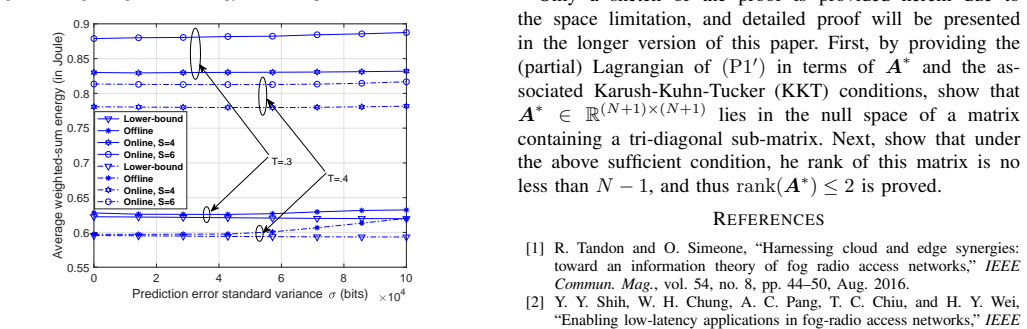
- A short window ($S=4$) is the right operating point when deadlines are tight or prediction error is large; longer windows only help when prediction is accurate.
- Fixed caching rules such as always cache, never cache, or random cache are dominated by decision-dependent caching, so an energy-optimal system should let the correlation structure choose when to cache.
- Extending the per-slot deadline $T$ lowers weighted energy for all schemes, but the relative gain of optimized caching persists in the latency-critical regime.
Reading between the lines
- The same lifting trick should carry over to one-user systems with $r>2$ correlated slots, but the SDP would contain products of more than two caching variables; maintaining a tractable relaxation then requires either a higher-order moment matrix or a different rounding rule.
- Because the gain is driven by fixed factors $\tau_1$ and $\tau_2$, a practical deployment would need to estimate these factors online from measured task-input lengths; treating them as uncertain parameters is a testable extension of the paper's formulation.
- The per-slot structure suggests an immediate multi-user generalization: each user's task sequence has its own correlation, and the access point must share cache storage and upload bandwidth, so the SDR relaxation would need coupling constraints across users.
- A quick empirical check is that if real task-input lengths are independent across slots, the optimized policy should reduce to essentially no caching; a systematic energy gain in that setting would indicate the correlation model is being relied on where none exists.
Signed reviews
Editorial analysis
A structured set of objections, weighed in public.
Referee Report
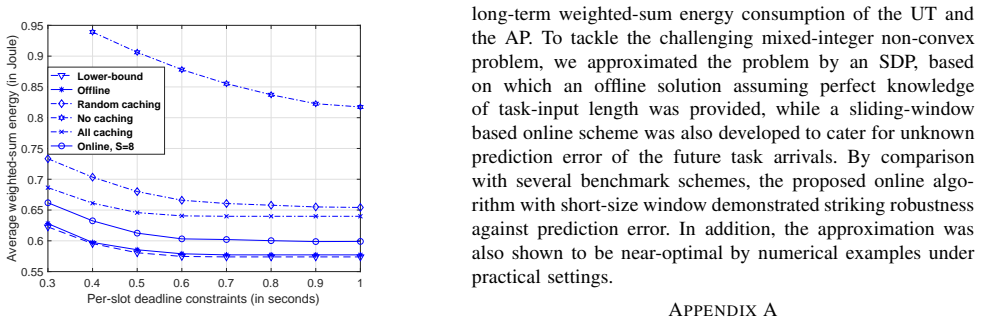
Summary. The manuscript studies a one-user, one-AP fog computing system over a finite horizon. Task-input lengths are predictable with error, and consecutive tasks are correlated over three slots. The authors formulate a weighted-sum energy minimization problem that jointly selects the offloading variables {l_i} and binary caching decisions {I_i}, subject to per-slot deadline constraints. They relax the binary constraints through semidefinite relaxation (SDR), solve the relaxed problem as an SDP, and round the solution to obtain an offline policy. They then propose a sliding-window online policy that solves the SDP over a window of future slots and applies only the first-slot decisions. Numerical experiments compare the online policy with the SDR lower bound, the rounded offline solution, and random/no/all caching benchmarks.
Significance. If the results hold, the paper contributes a tractable SDR formulation for joint computation offloading and caching under correlated task arrivals, and a causal online heuristic whose complexity is controlled by the sliding-window length S. The numerical study uses standard channel models and averages over 500 Monte-Carlo realizations, and it compares against several relevant fixed-caching benchmarks; the observations that the rounded offline solution is close to the SDR lower bound and that the online scheme outperforms fixed caching policies are presented clearly. The main weaknesses are the deferred proof of the rank bound that justifies the rounding step, and the absence of any sensitivity analysis for the correlation parameters τ that drive the value of caching.
major comments (2)
- [Section III, Proposition 3.2 and Appendix A] The proof of Proposition 3.2 is only sketched; Appendix A explicitly states that the detailed proof will be presented in a longer version. Since the rank bound rank(A*) <= 2 is the theoretical justification for the rounding rule (9) and for the claim that the offline solution is near-optimal, this is a load-bearing assertion. Please provide a complete proof in the manuscript, or clearly state the rank bound as a conjecture supported by systematic numerical evidence. Additionally, reporting the empirical rank distribution of A* in the simulations would help substantiate the rounding step.
- [Section V and Eq. (2)] All simulations set τ = (1/2, 3/4) and use the same τ both in the data-generating process for the task-input lengths and inside the optimizer. Because Eq. (2) is the only mechanism by which caching reduces energy consumption, the reported gains are conditional on this exact correlation model. The manuscript does not test mismatched τ or estimate τ from historical data. Please add a sensitivity analysis that varies τ, including the weakly correlated regime τ close to 1, and an experiment in which the optimizer's τ differs from the true τ. Without this, the practical significance of the energy gains is not established.
minor comments (5)
- [Abstract, Section I, Section III] The statements that the SDR solution 'serves as a theoretical upper bound' are inaccurate: an SDR relaxation provides a lower bound on the original minimization problem, whereas the rounded feasible offline solution provides an upper bound. Please correct this wording throughout.
- [Section III, Proposition 3.1] Proposition 3.1 says that after relaxing the rank-one constraint problem (P1) 'is equivalent to an SDP'; this should say that (P1) is relaxed to an SDP, since the relaxation is generally not exact unless the rank-one condition happens to hold.
- [Section V] The simulations do not state the horizon N or the window length S used in Fig. 2 (S=8) and Fig. 3 (S=4,6), nor how S is chosen in practice. Please specify these parameters and any dependence of the results on them.
- [Fig. 3] In Fig. 3 the legend repeats the curve labels for the two deadline cases T=.3 and T=.4, which makes the figure difficult to parse. Please use distinct line styles or a single consolidated legend.
- [Eq. (2)] In the general definition (2), the parameter r is used before the special case r=2 is introduced, and for slots i<r the indices i-k are not well defined. Please clarify the indexing and state explicitly how the first r slots are handled.
Circularity Check
No significant circularity: the paper's claims are conditional on an explicit correlation model and are validated by self-contained optimization and simulation.
full rationale
The derivation chain is self-contained. Equation (2) defines the effective task-input bits Di as an explicit function of previous caching decisions with a prescribed vector tau; this is a stated modeling assumption, not a fitted or predicted output. The objective in (P1) is a well-defined minimization over offloading policies {li} and caching decisions {Ii}, and the SDR reformulation in Proposition 3.1 is a standard relaxation that provides a valid lower bound for the integer problem. The offline rounding procedure and the online sliding-window algorithm are heuristic methods evaluated by simulation; their reported energy savings are conditional on the assumed correlation model and on the chosen simulation parameters, but none of the numerical claims is obtained by fitting a parameter to the target metric. The benchmarks, including 'No caching', are fixed policies rather than fitted baselines, so the comparison does not reduce a prediction to an input by construction. The citations used for technical lemmas, such as [4] and [11], are external works and are not self-citations that carry the paper's central claim. The only substantive concern, namely that the caching benefit is an artifact of the assumed two-slot correlation model, is a modeling and generalizability limitation, not circularity under the criteria used here.
Assumptions & free parameters
free parameters (3)
- tau1, tau2 =
tau1=0.5, tau2=0.75 in simulations
- Sliding window length S =
S=4 and S=6 in simulations
- Objective weights alpha1, alpha0 =
alpha1=0.85, alpha0=0.15
assumptions (4)
- domain assumption Task-input correlation is exactly captured by r=2 with only the latest cached result useful: D_i = L_i(tau1 if I_{i-1}=1, tau2 if I_{i-2}=1 and I_{i-1}=0, 1 otherwise).
- domain assumption Task-output length R_i is perfectly profiled given the application type, so uploading energy is known exactly.
- ad hoc to paper The SDR solution A* yields near-optimal binary caching decisions via rounding, relying on Proposition 3.2 (rank(A*) <= 2 under inactive offloading constraints) and Lemma 3.1.
- domain assumption Prediction errors can be arbitrary, and the sliding-window re-optimization remains robust without a formal regret or optimality guarantee.
Cite this review
Pith. "Pith review of Energy-Efficient Proactive Caching for Fog Computing with Correlated Task Arrivals." pith.science (2026). https://pith.science/paper/TZZCRVEO
@misc{pith2026190806334,
  author       = {Pith},
  title        = {Pith review of: Energy-Efficient Proactive Caching for Fog Computing with Correlated Task Arrivals},
  year         = {2026},
  howpublished = {\url{https://pith.science/paper/TZZCRVEO}},
  note         = {Machine review of arXiv:1908.06334}
}
read the original abstract
With the proliferation of latency-critical applications, fog-radio network (FRAN) has been envisioned as a paradigm shift enabling distributed deployment of cloud-clone facilities at the network edge. In this paper, we consider proactive caching for a one-user one-access point (AP) fog computing system over a finite time horizon, in which consecutive tasks of the same type of application are temporarily correlated. Under the assumption of predicable length of the task-input bits, we formulate a long-term weighted-sum energy minimization problem with three-slot correlation to jointly optimize computation offloading policies and caching decisions subject to stringent per-slot deadline constraints. The formulated problem is hard to solve due to the mixed-integer non-convexity. To tackle this challenge, first, we assume that task-related information are perfectly known {\em a priori}, and provide offline solution leveraging the technique of semi-definite relaxation (SDR), thereby serving as theoretical upper bound. Next, based on the offline solution, we propose a sliding-window based online algorithm under arbitrarily distributed prediction error. Finally, the advantage of computation caching as well the proposed algorithm is verified by numerical examples by comparison with several benchmarks.
Figures

Reference graph
Works this paper leans on
-
[4]
Multi-user multi-task of floading and resource allocation in mobile cloud systems,
M. Chen, B. Liang, and M. Dong, “Multi-user multi-task of floading and resource allocation in mobile cloud systems,” IEEE Trans. Wireless Commun., vol. 17, no. 10, pp. 6790–6805, Oct. 2018
work page 2018
-
[1]
Harnessing cloud and edge syne rgies: toward an information theory of fog radio access networks,
R. Tandon and O. Simeone, “Harnessing cloud and edge syne rgies: toward an information theory of fog radio access networks,” IEEE Commun. Mag. , vol. 54, no. 8, pp. 44–50, Aug. 2016
work page 2016
-
[2]
Enabling low-latency applications in fog-radio access ne tworks,
Y . Y . Shih, W. H. Chung, A. C. Pang, T. C. Chiu, and H. Y . Wei, “Enabling low-latency applications in fog-radio access ne tworks,” IEEE Netw., vol. 31, no. 1, pp. 52–58, Jan. 2017
work page 2017
-
[3]
Joint offloading and co mputing optimization in wireless powered mobile-edge computing sy stems,
F. Wang, J. Xu, X. Wang, and S. Cui, “Joint offloading and co mputing optimization in wireless powered mobile-edge computing sy stems,” IEEE Trans. Wireless Commun. , vol. 17, no. 3, pp. 1784–1797, Mar. 2018
2018
-
[5]
Dynamic computation offloading for mobile-edge computing with energy harvesting devices,
Y . Mao, J. Zhang, and K. B. Letaief, “Dynamic computation offloading for mobile-edge computing with energy harvesting devices, ” IEEE J. Sel. Areas Commun. , vol. 34, no. 12, pp. 3590–3605, Dec. 2016
work page 2016
-
[6]
Living on the edge: T he role of proactive caching in 5g wireless networks,
E. Bastug, M. Bennis, and M. Debbah, “Living on the edge: T he role of proactive caching in 5g wireless networks,” IEEE Commun. Mag. , vol. 52, no. 8, pp. 82–89, Aug. 2014
2014
-
[7]
Proactive edge com puting in latency-constrained fog networks,
M. S. Elbamby, M. Bennis, and W. Saad, “Proactive edge com puting in latency-constrained fog networks,” in Proc. European Conference on Networks and Communications (EuCNC) , Oulu, Finland, Jun. 2017
work page 2017
-
[8]
Joint service caching and tas k offload- ing for mobile edge computing in dense networks,
J. Xu, L. Chen, and P . Zhou, “Joint service caching and tas k offload- ing for mobile edge computing in dense networks,” in Proc. IEEE International Conference on Computer Communications (INF OCOM), Honolulu, HI, USA, Apr. 2018
work page 2018
Show all 13 references
-
[9]
Ener gy efficient task caching and offloading for mobile edge computi ng,
Y . Hao, M. Chen, L. Hu, M. S. Hossain, and A. Ghoneim, “Ener gy efficient task caching and offloading for mobile edge computi ng,” IEEE Access, vol. 6, pp. 11 365–11 373, Mar. 2018
2018
-
[10]
Mobile edge computing: A survey o n architec- ture and computation offloading,
P . Mach and Z. Becvar, “Mobile edge computing: A survey o n architec- ture and computation offloading,” IEEE Commun. Surveys Tuts. , vol. 19, no. 3, pp. 1628–1656, third quart. 2017
2017
-
[11]
Sem idefinite relaxation of quadratic optimization problems,
Z.-Q. Luo, W.-K. Ma, A. M.-C. So, Y . Y e, and S. Zhang, “Sem idefinite relaxation of quadratic optimization problems,” IEEE Signal Process. Mag., vol. 27, no. 3, pp. 20–34, May 2010
2010
-
[12]
CVX: Matlab software for discipli ned convex programming, version 2.1,
M. Grant and S. Boyd, “CVX: Matlab software for discipli ned convex programming, version 2.1,” Mar. 2014. [Online]. Ava ilable: http://cvxr.com/cvx
2014
-
[13]
Real-time energy storag e manage- ment for renewable integration in microgrid: An off-line op timization approach,
K. Rahbar, J. Xu, and R. Zhang, “Real-time energy storag e manage- ment for renewable integration in microgrid: An off-line op timization approach,” IEEE Trans. Smart Grid , vol. 6, no. 1, pp. 124–134, Jan. 2015
2015
Reviewed August 14, 2026 · model on record in the stance chip above.
Discussion (0). Continue with ORCID to comment.