Low Complexity Kolmogorov-Arnold Network-based DPD for Analog RoF Fronthaul
Pith reviewed 2026-06-26 02:21 UTC · model grok-4.3
The pith
A symbolized Kolmogorov-Arnold Network digital predistortion model delivers neural-network level performance for analog radio-over-fiber at near-polynomial computational cost.
A machine-rendered reading of the paper's core claim, the machinery that carries it, and where it could break.
Core claim
The ETDKAN model incorporates physical constraints of RF nonlinear devices and, through KAN symbolization, achieves a significant reduction in computational complexity while improving interpretability. The symbolic ETDKAN attains ACLR and EVM performance comparable to neural network-based models, while maintaining a computational complexity close to that of memory polynomials, with experimental validation showing 4-5 dB ACLR reduction.
What carries the argument
The envelope time-delay KAN (ETDKAN) with subsequent symbolization to produce symbETDKAN, which embeds RF device constraints into a spline-based network structure for low-complexity predistortion.
Load-bearing premise
The KAN symbolization step preserves the physical constraints of RF nonlinear devices without requiring post-hoc tuning that would increase complexity back toward MLP levels.
What would settle it
A direct comparison experiment where symbETDKAN is applied to the same A-RoF setup but fails to achieve the reported ACLR reduction or requires complexity adjustments exceeding memory polynomial levels would falsify the claim.
Figures



read the original abstract
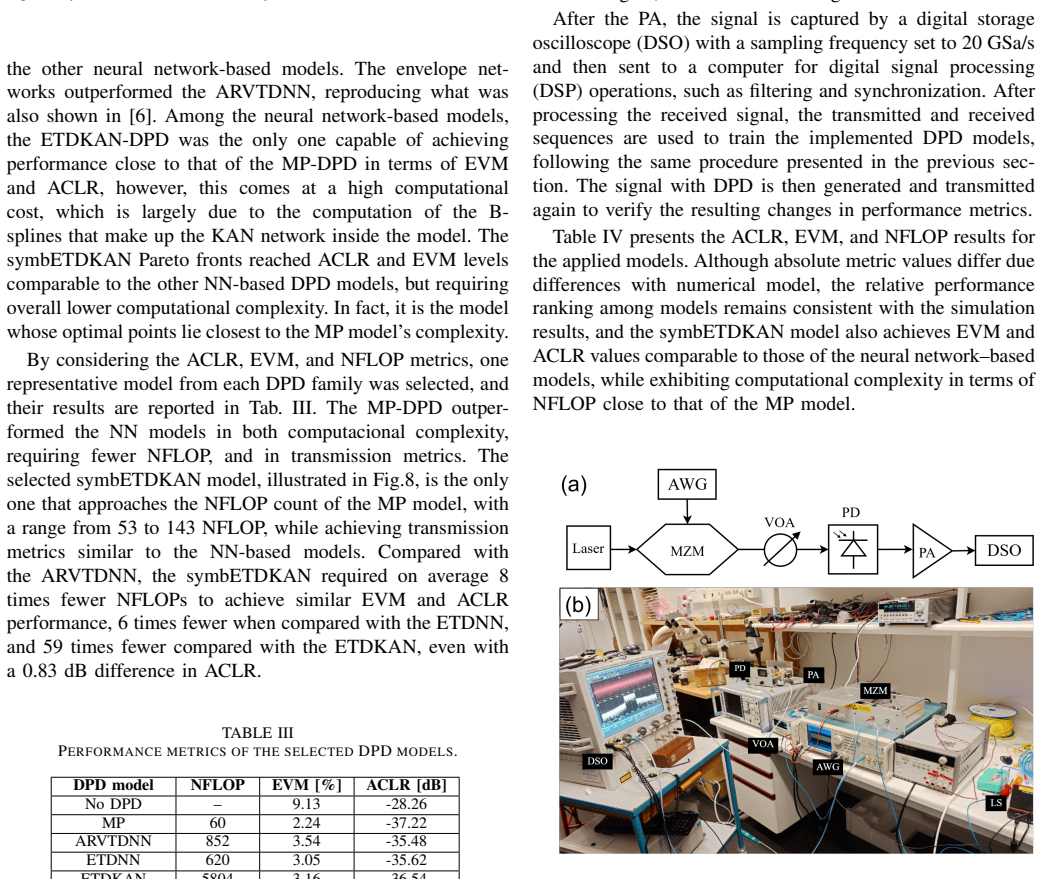
This paper proposes and demonstrates experimentally for the first time a Kolmogorov-Arnold Network (KAN)-based digital predistortion (DPD) model, named envelope time-delay KAN (ETDKAN), for mitigating nonlinear distortions in analog radio-over-fiber (A-RoF) systems. The ETDKAN model incorporates physical constraints of radio-frequency (RF) nonlinear devices and, through KAN symbolization, achieves a significant reduction in computational complexity while improving interpretability. The proposed model is numerically implemented and optimized alongside multilayer perceptron (MLP) and memory-polynomial-based DPDs. Results show that the resulting symbolic ETDKAN (symbETDKAN) attains ACLR and EVM performance comparable to neural network-based models, while maintaining a computational complexity close to that of memory polynomials. Experimental validation using an A-RoF system confirms the practical feasibility of the proposed approach, which resulted in a 4-5 dB reduction in ACLR in the analyzed scenario.
Editorial analysis
A structured set of objections, weighed in public.
Referee Report
Summary. The manuscript proposes the first Kolmogorov-Arnold Network (KAN)-based digital predistortion (DPD) model, termed envelope time-delay KAN (ETDKAN), for mitigating nonlinear distortions in analog radio-over-fiber (A-RoF) fronthaul. The model incorporates RF device physical constraints; KAN symbolization is used to produce a symbolic variant (symbETDKAN) that is claimed to match multilayer-perceptron (MLP) ACLR/EVM performance while retaining computational complexity comparable to memory-polynomial (MP) baselines. Numerical optimization against MLP and MP models plus experimental A-RoF validation are reported, with a claimed 4-5 dB ACLR improvement.
Significance. If the complexity reduction after symbolization is verified by explicit operation counts, this would constitute a meaningful advance: the first experimental KAN DPD demonstration that bridges the interpretability and low-complexity advantages of polynomials with the modeling power of neural networks, directly relevant to real-time fronthaul hardware constraints.
major comments (2)
- [Abstract] Abstract: the central claim that symbETDKAN 'maintains a computational complexity close to that of memory polynomials' after KAN symbolization is unsupported by any tabulated operation counts, basis-function counts, or before/after complexity metrics; without these data the reduction cannot be confirmed to survive symbolization and the comparison to MLP remains unverifiable.
- [Abstract] Abstract (experimental validation paragraph): the reported 4-5 dB ACLR reduction is presented without accompanying details on measurement uncertainty, number of independent trials, or statistical tests, which is load-bearing for the claim of practical feasibility and parity with neural-network models.
Simulated Author's Rebuttal
We thank the referee for the constructive comments on our manuscript. We address each major comment below, indicating the revisions we will incorporate to strengthen the presentation of our results.
read point-by-point responses
-
Referee: [Abstract] Abstract: the central claim that symbETDKAN 'maintains a computational complexity close to that of memory polynomials' after KAN symbolization is unsupported by any tabulated operation counts, basis-function counts, or before/after complexity metrics; without these data the reduction cannot be confirmed to survive symbolization and the comparison to MLP remains unverifiable.
Authors: We agree that the abstract would benefit from explicit supporting metrics. The full manuscript includes complexity comparisons between ETDKAN, symbETDKAN, MLP, and memory-polynomial models. In the revision we will add a dedicated table (or subsection) reporting operation counts, basis-function counts, and before/after metrics after symbolization. We will also revise the abstract to include a concise quantitative statement referencing these results, thereby making the complexity claim directly verifiable. revision: yes
-
Referee: [Abstract] Abstract (experimental validation paragraph): the reported 4-5 dB ACLR reduction is presented without accompanying details on measurement uncertainty, number of independent trials, or statistical tests, which is load-bearing for the claim of practical feasibility and parity with neural-network models.
Authors: The reported 4-5 dB ACLR improvement was obtained from the described A-RoF experimental campaign. We will revise both the abstract and the experimental-results section to supply the requested supporting information: measurement uncertainty estimates, the number of independent trials, and any statistical tests performed. These additions will strengthen the evidence for practical feasibility and performance parity. revision: yes
Circularity Check
No circularity: model proposal and experimental validation are independent of fitted inputs
full rationale
The paper proposes ETDKAN as a new architecture that incorporates RF physical constraints by design and uses KAN symbolization for complexity reduction. Performance claims rest on numerical optimization and experimental A-RoF measurements compared to external MLP and memory-polynomial baselines. No equations reduce a prediction to a fitted parameter by construction, no self-citation chain justifies a uniqueness claim, and no ansatz is smuggled via prior work. The central result (comparable ACLR/EVM at near-memory-polynomial complexity) is externally falsifiable via the reported measurements and does not collapse to input data.
Axiom & Free-Parameter Ledger
Reference graph
Works this paper leans on
-
[1]
6G Wireless Communications Networks: A Com- prehensive Survey,
M. Alsabahet al., “6G Wireless Communications Networks: A Com- prehensive Survey,”IEEE Access, vol. 9, pp. 148 191–148 243, 2021
2021
-
[2]
A Comprehensive Survey on Millimeter Wave Communications for Fifth-Generation Wireless Networks: Feasibility and Challenges,
A. N. Uwaechia and N. M. Mahyuddin, “A Comprehensive Survey on Millimeter Wave Communications for Fifth-Generation Wireless Networks: Feasibility and Challenges,”IEEE Access, vol. 8, pp. 62 367– 62 414, 2020
2020
-
[3]
Radio-Over-Fiber Technology: Present and Future,
C. Lim and A. Nirmalathas, “Radio-Over-Fiber Technology: Present and Future,”Journal of Lightwave Technology, vol. 39, no. 4, pp. 881–888, 2021
2021
-
[4]
A Generalized Memory Polynomial Model for Digital Predistortion of RF Power Amplifiers,
D. R. Morganet al., “A Generalized Memory Polynomial Model for Digital Predistortion of RF Power Amplifiers,”IEEE Transactions on Signal Processing, vol. 54, no. 10, pp. 3852–3860, 2006
2006
-
[5]
Augmented Real-Valued Time-Delay Neural Network for Compensation of Distortions and Impairments in Wireless Trans- mitters,
D. Wanget al., “Augmented Real-Valued Time-Delay Neural Network for Compensation of Distortions and Impairments in Wireless Trans- mitters,”IEEE Transactions on Neural Networks and Learning Systems, vol. 30, no. 1, pp. 242–254, 2019
2019
-
[6]
Efficient Digital Predistortion Using Sparse Neural Network,
M. Tanio, N. Ishii, and N. Kamiya, “Efficient Digital Predistortion Using Sparse Neural Network,”IEEE Access, vol. 8, pp. 117 841–117 852, 2020
2020
-
[7]
Base-band Derived V olterra Series for Power Amplifier Modeling,
E. G. Limaet al., “Base-band Derived V olterra Series for Power Amplifier Modeling,” in2009 IEEE MTT-S International Microwave Symposium Digest. Boston, MA, USA: IEEE, 2009
2009
-
[8]
KAN: Kolmogorov–Arnold Networks,
Z. Liuet al., “KAN: Kolmogorov–Arnold Networks,” inThe Thirteenth International Conference on Learning Representations, 2025. [Online]. Available: https://openreview.net/forum?id=Ozo7qJ5vZi
2025
-
[9]
Real-Valued Time Delay Kolmogorov-Arnold Network for Digital Predistortion of RF Power Amplifiers,
J. Chenet al., “Real-Valued Time Delay Kolmogorov-Arnold Network for Digital Predistortion of RF Power Amplifiers,” in2025 International Conference on Microwave and Millimeter Wave Technology (ICMMT). Xi’an, China: IEEE, 2025
2025
-
[10]
Linearization of RF Power Amplifiers in Wideband Communication Systems by Adaptive Indirect Learning Using RPEM Algorithm,
D. H. Leet al., “Linearization of RF Power Amplifiers in Wideband Communication Systems by Adaptive Indirect Learning Using RPEM Algorithm,”Mobile Networks and Applications, vol. 25, pp. 1988–1997, 2020
1988
-
[11]
Novel Machine Learning Linearization Scheme for 6G A-RoF Systems,
L. A. M. Pereiraet al., “Novel Machine Learning Linearization Scheme for 6G A-RoF Systems,”Journal of Lightwave Technology, vol. 41, no. 23, pp. 7245–7252, 2023
2023
-
[12]
Seimetz,High-Order Modulation for Optical Fiber Transmission, ser
M. Seimetz,High-Order Modulation for Optical Fiber Transmission, ser. Springer Series in Optical Sciences. Berlin, Heidelberg: Springer, 2009
2009
-
[13]
An Analytical Model for Performance Estimation in Modern High-Capacity IMDD Systems,
G. Rizzelliet al., “An Analytical Model for Performance Estimation in Modern High-Capacity IMDD Systems,”J. Lightw. Technol., vol. 42, no. 5, pp. 1443–1452, Mar. 2024. JOURNAL OF LIGHTW A VE TECHNOLOGY , VOL. XX, NO. X, FEBRUARY 2026 9
2024
-
[14]
Realistic power amplifier model for the new radio evaluation,
“Realistic power amplifier model for the new radio evaluation,” 3GPP TSG-RAN WG4 Meeting #79, Tech. Rep., 2016
2016
-
[15]
Optuna: A next-generation hyperparameter optimization framework,
T. Akibaet al., “Optuna: A next-generation hyperparameter optimization framework,” inProceedings of the 25th ACM SIGKDD International Conference on Knowledge Discovery and Data Mining, 2019
2019
-
[16]
Pytorch: An imperative style, high-performance deep learning library,
A. Paszkeet al., “Pytorch: An imperative style, high-performance deep learning library,” inAdvances in Neural Information Processing Systems
-
[17]
8024–8035
Curran Associates, Inc., 2019, pp. 8024–8035
2019
-
[18]
KAN or MLP: A fairer comparison,
R. Yu, W. Yu, and X. Wang, “KAN or MLP: A fairer comparison,” inarXiv preprint arXiv:2407.16674, 2024. [Online]. Available: https://arxiv.org/abs/2407.16674
discussion (0)
Sign in with ORCID, Apple, or X to comment. Anyone can read and Pith papers without signing in.