REVIEW 5 major objections 5 minor 2 cited by
Synthetic Tabular Data Generation: A Comparative Survey for Modern Techniques
T0 review · 5 major / 5 minor · reviewed 2026-08-06 · deepseek-v4-flash
Pith's one-line read The paper argues that synthetic tabular data generation should be organized by generation objective, and its two-dataset benchmark of six models shows no single generator dominates: TABSYN preserves structure and distributions best but is…
desk verdict A useful but overclaimed survey whose benchmark rankings are not stable because each model was trained only once. read the letter →
The pith
A machine-rendered reading of the paper's core claim, the machinery that carries it, and where it could break.
The reading
What carries the argument
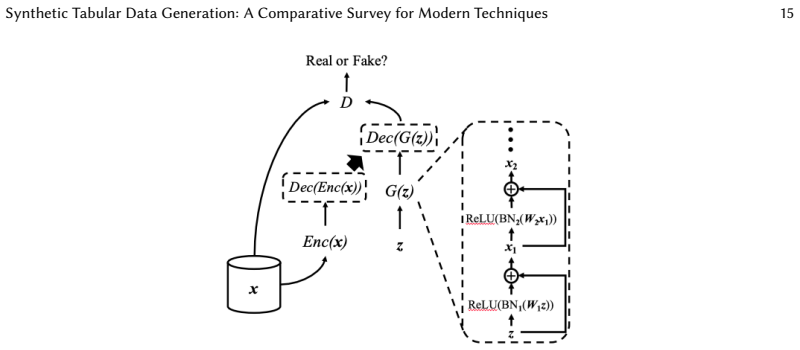
The machinery that carries the argument is the objective-based taxonomy combined with a four-criterion benchmark. The taxonomy sorts methods by what they are built to do—feature-dependency preservation, statistical fidelity, privacy, conditioning, and domain-specific tailoring—and each category is tied to concrete model mechanisms: CTGAN's conditional vector and mode-specific normalization, CTAB-GAN's information and classifier losses, FCT-GAN's Fourier-domain tokenization, diffusion-based denoising in TABSYN, and differential-privacy noise injection in DP-CTGAN and PATE-GAN. The benchmark then operationalizes the taxonomy with measurements: Pearson correlation difference, uncertainty coefficient difference, and correlation ratio difference for feature dependency; Jensen-Shannon divergence and Wasserstein distance for distributional similarity; model-inversion accuracy and AUROC for privacy; and F1, AUROC, AUPRC, and accuracy of models trained on synthetic data and tested on real holdout data for utility. This arrangement lets the paper read each model's strengths and weaknesses as consequences of its design objective rather than as scattered empirical findings.
What would settle it
Run the same six models on several additional tabular datasets—for example a healthcare claims dataset and a marketing dataset—with multiple random seeds and fixed privacy budgets; if TABSYN's near-zero distributional divergence and the dramatic utility collapse of DP-CTGAN and PATE-GAN do not reproduce, the benchmark's ranking and the privacy-utility tradeoff story would be undermined.
Extended reading notes
Core claim
The paper's central claim is that the right question is not "which generative model is best" but "which objective is the synthetic data for," and that this question should drive both method choice and evaluation. To support it, the paper classifies tabular generators along five objectives—maintaining feature dependencies, preserving statistical properties, privacy, conditioning on specific attributes, and domain-specific adaptation—and then directly compares CTGAN, FCT-GAN, CTAB-GAN, TABSYN, DP-CTGAN, and PATE-GAN on Adult and CreditRisk. In the comparison, TABSYN shows the smallest deviations in Pearson correlation, uncertainty coefficient, correlation ratio, Jensen-Shannon divergence, and Wasserstein distance, and its differences are not statistically significant, meaning it reproduces structure and distributions closely; yet it also has the highest model-inversion accuracy and AUROC, indicating leakage. CTAB-GAN is the most useful generator for downstream classification, with F1-scores around 0.74–0.75 and accuracy near 0.79, while DP-CTGAN and PATE-GAN bring inversion AUROC close to 0.50 but drop accuracy to about 0.43, exhibiting the classical privacy-utility tradeoff. The paper reads this as evidence that objective-based selection, not a universal ranking, is the correct organizing principle.
Load-bearing premise
The paper's comparative conclusions rest on the assumption that two public datasets, six models, and a single training run per model are representative enough to reveal general patterns about synthetic tabular data generation.
Editorial extensions
If this is right
- If the objective-based taxonomy is accepted, a practitioner's first decision is which property the synthetic data must satisfy, and model selection follows from that decision rather than from a leaderboard.
- For applications where faithful structure and distributions matter more than privacy, TABSYN is the paper's indicated choice, with near-zero divergence and non-significant fidelity differences on both benchmark datasets.
- For downstream predictive modeling, CTAB-GAN outperforms the other tested generators on F1, AUROC, AUPRC, and accuracy, making it the paper's recommended default when utility is the priority.
- For use cases under strict privacy requirements, DP-CTGAN and PATE-GAN bring model-inversion AUROC close to random guessing, but their utility loss is large, so the paper treats privacy guarantees as explicit costs that must be budgeted.
- Dataset complexity interacts with these rankings: on the higher-dimensional, imbalanced CreditRisk data, fidelity and utility losses grow, especially for privacy-preserving models, so the same model may need different choices across datasets.
Reading between the lines
- A direct consequence the paper leaves implicit is that its taxonomy can be read as a decision checklist: define the required privacy budget first, then pick among remaining models by fidelity or utility; this turns the survey's tables into a selection procedure rather than a description.
- The paper's model-inversion metric measures leakage, but the same benchmark could be extended with membership-inference and attribute-inference attacks to separate overfitting-related leakage from genuine privacy failure, which would strengthen or qualify the reported tradeoff.
- Because the benchmark includes only six generators, the ranking's stability is untested for diffusion-only models like TabDDPM and language-model generators like GReaT, which the survey discusses but does not compare; adding them could change the fidelity-privacy frontier.
- The benchmark's fidelity metrics are aggregate; a natural extension is per-feature and per-subgroup leakage and fidelity analysis to see whether near-zero average divergence hides systematic errors on rare categories such as high-risk borrowers.
Editorial analysis
A structured set of objections, weighed in public.
Referee Report
Summary. This manuscript presents a survey of synthetic tabular data generation organized around generation objectives, and it reports a small benchmark comparing six generative models (CTGAN, FCT-GAN, CTAB-GAN, TABSYN, DP-CTGAN, and PATE-GAN) on the Adult and CreditRisk datasets. The survey covers feature dependency, statistical fidelity, privacy preservation, conditioning on specific attributes, and domain-specific applications, and it closes with challenges and limitations. The benchmark evaluates fidelity via correlation and divergence metrics, privacy via a model inversion attack, and utility via downstream classification performance on real holdout data.
Significance. If the claims held, the paper would provide a useful objective-driven taxonomy and an openly reproducible model-selection benchmark for tabular synthetic data, with public code. The survey prose is generally accurate, the definitions and equations collected in the appendices are a helpful reference, and the discussion of privacy-utility trade-offs is sensible. The benchmark, however, is not currently sufficient to support the model rankings and selection guidance in Section 4.2, for the reasons detailed below.
major comments (5)
- [Section 4.1] The benchmark trains each model once per dataset and then generates 10 synthetic datasets per model. The reported standard deviations and permutation p-values therefore capture sampling variability of the fitted generator, not training variability of the model. For GANs and DP-trained models, training is seed- and initialization-dependent, so rankings such as 'TABSYN achieves the lowest deviations' (Fig. 8), 'TABSYN and CTGAN are most vulnerable' (Fig. 10), and 'CTAB-GAN consistently delivers strong performance' (Fig. 11) could change with retraining. The comparative claims in Section 4.2 require multiple training runs per model and a statistical test performed across those runs, not across samples drawn from a single fitted generator.
- [Section 4.2] The text interprets non-significant p-values as evidence that synthetic data closely preserves real-data relationships, e.g., 'p-values for TABSYN are above 0.09, indicating that these differences are not statistically significant and thus the synthetic data closely preserves the real data relationships.' A non-significant p-value is not evidence of equivalence; with the low-power repeated-sampling design it may simply reflect large variance. Equivalence tests, effect-size thresholds, or confidence intervals are needed before claims of high fidelity can be supported.
- [Section 4.1] The privacy models are evaluated under different privacy budgets: PATE-GAN is trained with epsilon = 1.0 while DP-CTGAN is trained with epsilon = 2.0. Any comparison of privacy versus utility between these two models is confounded by the privacy budget rather than by the model behavior. The budgets should be equalized, or a sweep over epsilon should be reported, before drawing conclusions about which privacy-preserving method is better.
- [Section 4.2] The model inversion attack used to measure privacy leakage is not fully specified. The paper reports Accuracy and AUROC for a 'model inversion attack' but does not describe the adversary's knowledge, the target attributes, the model class, the training procedure, or how the attack is mounted on synthetic data. Without a precise attack definition, the privacy leakage rankings in Figure 10 are not reproducible and could be driven by arbitrary choices in the attack implementation.
- [Sections 3 and 4] The benchmark covers only CTGAN, FCT-GAN, CTAB-GAN, TABSYN, DP-CTGAN, and PATE-GAN, yet the taxonomy in Section 3 gives detailed treatment to TabDDPM, TVAE, GReaT, and PrivBayes, among others. Because the paper claims that objective-driven choices determine model selection, the benchmark cannot test its own taxonomy without including representative methods from the discussed families. Either the benchmark should be extended or the model-selection guidance in Section 4.2 should be explicitly scoped to the six evaluated models.
minor comments (5)
- [Section 1] In the final paragraph of the introduction, 'll of which support and complement' should read 'all of which support and complement'.
- [Section 3.3] The sentence beginning 'CTGAN with differential privacy a potential approach' is a fragment and should be completed or merged with the surrounding text.
- [Table C.7] The column alignment in Table C.7 appears broken in the manuscript, making it difficult to verify which methods receive ticks for feature dependencies, statistical property preservation, conditioning, and privacy preservation; please reformat the table so each row aligns with the correct headings.
- [Table D.8] In Table D.8, 'Area Under the Receiver Operating Characteristics Curv' should be 'Curve'.
- [Section 4.1] The phrase '10 independent synthetic datasets' is misleading because the datasets are drawn from a single fitted model; consider using 'freshly sampled synthetic datasets' or an equivalent description.
Circularity Check
No significant circularity: the survey's taxonomy and benchmark are descriptive and empirical, not derived from their own outputs.
full rationale
This paper is a survey and comparative benchmark, not a derivation chain, and none of its central claims reduce to its own inputs. The proposed objective-based taxonomy is a classification and organizing framework: the categories (feature dependency, statistical preservation, privacy, conditioning, domain-specific knowledge) are chosen descriptively from prior literature, and the paper does not claim to derive any of them from the taxonomy itself. The formal definitions in Section 2 (e.g., Xsyn ~ P_hat(X)) are standard restatements from cited external work, not self-referential constructions. The benchmark in Section 4 uses standard evaluation metrics (Pearson correlation difference, JSD, Wasserstein distance, model inversion AUROC, and ML utility) and compares six externally implemented models; no parameter is fitted to the benchmark outcome and then renamed as a prediction. There are no self-citations, no author-imported uniqueness theorems, and no ansatz smuggled in via citation. The single training run per model and the generation of 10 synthetic datasets from that one fitted generator are legitimate methodological concerns about variance estimation and reproducibility, but they are not circularity: the reported rankings are empirical outcomes that could in principle change, not results forced by construction. The comparative claims rest on external benchmarks that this paper did not generate, so the circularity burden is low and the appropriate finding is no significant circularity.
Assumptions & free parameters
free parameters (2)
- RandomForest hyperparameters =
n_estimators=100, max_depth=10
- Differential privacy budgets =
epsilon=1.0 for PATE-GAN, epsilon=2.0 for DP-CTGAN
assumptions (2)
- domain assumption Adult and CreditRisk are representative tabular datasets
- domain assumption Model inversion attack accuracy/AUROC measures privacy leakage
Cite this review
Pith. "Pith review of Synthetic Tabular Data Generation: A Comparative Survey for Modern Techniques." pith.science (2026). https://pith.science/paper/U2HQQRFA
@misc{pith2026250711590,
  author       = {Pith},
  title        = {Pith review of: Synthetic Tabular Data Generation: A Comparative Survey for Modern Techniques},
  year         = {2026},
  howpublished = {\url{https://pith.science/paper/U2HQQRFA}},
  note         = {Machine review of arXiv:2507.11590}
}
read the original abstract
As privacy regulations become more stringent and access to real-world data becomes increasingly constrained, synthetic data generation has emerged as a vital solution, especially for tabular datasets, which are central to domains like finance, healthcare and the social sciences. This survey presents a comprehensive and focused review of recent advances in synthetic tabular data generation, emphasizing methods that preserve complex feature relationships, maintain statistical fidelity, and satisfy privacy requirements. A key contribution of this work is the introduction of a novel taxonomy based on practical generation objectives, including intended downstream applications, privacy guarantees, and data utility, directly informing methodological design and evaluation strategies. Therefore, this review prioritizes the actionable goals that drive synthetic data creation, including conditional generation and risk-sensitive modeling. Additionally, the survey proposes a benchmark framework to align technical innovation with real-world demands. By bridging theoretical foundations with practical deployment, this work serves as both a roadmap for future research and a guide for implementing synthetic tabular data in privacy-critical environments.
Figures


Figures from the paper (16 more)


Forward citations
Cited by 2 Pith papers
-
LAB-Tab: LLM-Augmented Bayesian Network Adaptation for Few-Shot Tabular Generation
A source-trained Bayesian network, augmented with LLM-proposed edges and calibrated by PPO, generates synthetic tabular data that outperforms six baselines in six ACS distribution-shift scenarios.
-
SecretFan: Synthesizing Realistic Data without Breaking Privacy
A GAN-inspired pipeline that uses a grammar fuzzer instead of a learned generator can produce tabular data with competitive utility, but the claimed privacy protection is not established.
Reference graph
Works this paper leans on
-
[11]
André Bauer, Simon Trapp, Michael Stenger, Robert Leppich, Samuel Kounev, Mark Leznik, Kyle Chard, and Ian Foster. 2024. Comprehensive exploration of synthetic data generation: A survey. arXiv preprint arXiv:2401.02524 (2024)
arXiv 2024
-
[39]
Alvaro Figueira and Bruno Vaz. 2022. Survey on synthetic data generation, evaluation methods and GANs.Mathematics 10, 15 (2022), 2733
2022
-
[73]
Yingzhou Lu, Minjie Shen, Huazheng Wang, Xiao Wang, Capucine van Rechem, and Wenqi Wei. 2023. Machine learning for synthetic data generation: a review. arXiv preprint arXiv:2302.04062 (2023)
arXiv 2023
-
[1]
Nazmiye Ceren Abay, Yan Zhou, Murat Kantarcioglu, Bhavani Thuraisingham, and Latanya Sweeney. 2019. Privacy preserving synthetic data release using deep learning. In Machine Learning and Knowledge Discovery in Databases: European Conference, ECML PKDD 2018, Dublin, Ireland, September 10–14, 2018, Proceedings, Part I 18 . Springer, 510–526
2019
-
[2]
Gergely Acs, Luca Melis, Claude Castelluccia, and Emiliano De Cristofaro. 2018. Differentially private mixture of generative neural networks. IEEE Transactions on Knowledge and Data Engineering 31, 6 (2018), 1109–1121
2018
-
[3]
Amplitude. 2024. What Is Data Democratization? Definition and Principles . https://www.amplitude.com/blog/data- democratization
2024
-
[4]
Meenatchi Sundaram Muthu Selva Annamalai, Andrea Gadotti, and Luc Rocher. 2024. A linear reconstruction approach for attribute inference attacks against synthetic data. In 33rd USENIX Security Symposium (USENIX Security 24). 2351–2368
2024
-
[5]
Martin Arjovsky, Soumith Chintala, and Léon Bottou. 2017. Wasserstein generative adversarial networks. In Interna- tional conference on machine learning . PMLR, 214–223
2017
Show all 122 references
-
[6]
Karim Armanious, Chenming Jiang, Marc Fischer, Thomas Küstner, Tobias Hepp, Konstantin Nikolaou, Sergios Gatidis, and Bin Yang. 2020. MedGAN: Medical image translation using GANs. Computerized medical imaging and graphics 79 (2020), 101684
2020
-
[7]
Lisa Arthur. 2013. Big data marketing: engage your customers more effectively and drive value . John Wiley & Sons
2013
-
[8]
Samuel A Assefa, Danial Dervovic, Mahmoud Mahfouz, Robert E Tillman, Prashant Reddy, and Manuela Veloso
-
[9]
Laura Aviñó, Matteo Ruffini, and Ricard Gavaldà. 2018. Generating synthetic but plausible healthcare record datasets. arXiv preprint arXiv:1807.01514 (2018)
2018 arXiv
-
[10]
Rohit Babbar and Bernhard Schölkopf. 2019. Data scarcity, robustness and extreme multi-label classification. Machine Learning 108, 8 (2019), 1329–1351
2019
-
[12]
Leonard E Baum, Ted Petrie, George Soules, and Norman Weiss. 1970. A maximization technique occurring in the statistical analysis of probabilistic functions of Markov chains. The annals of mathematical statistics 41, 1 (1970), 164–171
1970
-
[13]
Barry Becker and Ronny Kohavi. 1996. Adult. UCI Machine Learning Repository. DOI: https://doi.org/10.24432/C5XW20
1996 doi
-
[14]
Vincent Bindschaedler, Reza Shokri, and Carl A Gunter. 2017. Plausible deniability for privacy-preserving data synthesis. arXiv preprint arXiv:1708.07975 (2017). ACM Comput. Surv., Vol. 1, No. 1, Article . Publication date: August 2025. 32 Raju Challagundla, Mohsen Dorodchi, P...
2017 arXiv
-
[15]
Christopher M Bishop and Nasser M Nasrabadi. 2006. Pattern recognition and machine learning . Vol. 4. Springer
2006
-
[16]
Vadim Borisov, Kathrin Seßler, Tobias Leemann, Martin Pawelczyk, and Gjergji Kasneci. 2022. Language models are realistic tabular data generators. arXiv preprint arXiv:2210.06280 (2022)
2022 arXiv
-
[17]
George EP Box, Gwilym M Jenkins, Gregory C Reinsel, and Greta M Ljung. 2015. Time series analysis: forecasting and control. John Wiley & Sons
2015
-
[18]
Huiwen Chang, Han Zhang, Lu Jiang, Ce Liu, and William T Freeman. 2022. Maskgit: Masked generative image transformer. In Proceedings of the IEEE/CVF conference on computer vision and pattern recognition . 11315–11325
2022
-
[19]
Nitesh V Chawla, Kevin W Bowyer, Louis O Hall, and Wayne P Kegelmeyer. 2002. SMOTE: Synthetic Minority Over-sampling Technique. Journal of Artificial Intelligence Research 16 (2002), 321–357
2002
-
[20]
Zhengping Che, Yu Cheng, Shuangfei Zhai, Zhaonan Sun, and Yan Liu. 2017. Boosting deep learning risk prediction with generative adversarial networks for electronic health records. In 2017 IEEE International Conference on Data Mining (ICDM). IEEE, 787–792
2017
-
[21]
Edward Choi, Siddharth Biswal, Bradley Malin, Jon Duke, Walter F Stewart, and Jimeng Sun. 2017. Generating multi- label discrete patient records using generative adversarial networks. In Machine learning for healthcare conference . PMLR, 286–305
2017
-
[22]
Alexandra Chouldechova and Aaron Roth. 2018. The frontiers of fairness in machine learning. arXiv preprint arXiv:1810.08810 (2018)
2018 arXiv
-
[23]
Antonio Clim, Razvan Daniel Zota, and Grigore Tinica. 2019. Big Data in home healthcare: A new frontier in personalized medicine. Medical emergency services and prediction of hypertension risks. International Journal of Healthcare Management 12, 3 (2019), 241–249
2019
-
[24]
Forbes Technology Council. 2023. The New Era Of Big Data. (2023). https://www.forbes.com/councils/ forbestechcouncil/2023/05/24/the-new-era-of-big-data/ Accessed: 2025-01-18
2023
-
[25]
Andrea Dal Pozzolo, Giacomo Boracchi, Olivier Caelen, Cesare Alippi, and Gianluca Bontempi. 2017. Credit card fraud detection: a realistic modeling and a novel learning strategy. IEEE transactions on neural networks and learning systems 29, 8 (2017), 3784–3797
2017
-
[26]
Anne Marie Delaney, Eoin Brophy, and Tomas E Ward. 2019. Synthesis of realistic ECG using generative adversarial networks. arXiv preprint arXiv:1909.09150 (2019)
2019 arXiv
-
[27]
Arthur P Dempster, Nan M Laird, and Donald B Rubin. 1977. Maximum likelihood from incomplete data via the EM algorithm. Journal of the royal statistical society: series B (methodological) 39, 1 (1977), 1–22
1977
-
[28]
Jacob Devlin. 2018. Bert: Pre-training of deep bidirectional transformers for language understanding. arXiv preprint arXiv:1810.04805 (2018)
2018 arXiv
-
[29]
Prafulla Dhariwal and Alexander Nichol. 2021. Diffusion models beat gans on image synthesis. Advances in neural information processing systems 34 (2021), 8780–8794
2021
-
[30]
Hao-Wen Dong, Wen-Yi Hsiao, Li-Chia Yang, and Yi-Hsuan Yang. 2018. Musegan: Multi-track sequential generative adversarial networks for symbolic music generation and accompaniment. In Proceedings of the AAAI conference on artificial intelligence, Vol. 32
2018
-
[31]
Alexey Dosovitskiy, German Ros, Felipe Codevilla, Antonio Lopez, and Vladlen Koltun. 2017. CARLA: An open urban driving simulator. In Conference on robot learning . PMLR, 1–16
2017
-
[32]
Georgios Douzas and Fernando Bacao. 2019. Geometric SMOTE a geometrically enhanced drop-in replacement for SMOTE. Information sciences 501 (2019), 118–135
2019
-
[33]
Conor Durkan, Artur Bekasov, Iain Murray, and George Papamakarios. 2019. Neural spline flows. Advances in neural information processing systems 32 (2019)
2019
-
[34]
Cynthia Dwork. 2006. Differential privacy. In International colloquium on automata, languages, and programming . Springer, 1–12
2006
-
[35]
Cynthia Dwork, Frank McSherry, Kobbi Nissim, and Adam Smith. 2016. Calibrating noise to sensitivity in private data analysis. Journal of Privacy and Confidentiality 7, 3 (2016), 17–51
2016
-
[36]
Cynthia Dwork, Aaron Roth, et al. 2014. The algorithmic foundations of differential privacy. Foundations and Trends® in Theoretical Computer Science 9, 3–4 (2014), 211–407
2014
-
[37]
European Union. 2016. General Data Protection Regulation. L119 pages. https://gdpr-info.eu Retrieved from https://gdpr-info.eu
2016
-
[38]
Mei Ling Fang, Devendra Singh Dhami, and Kristian Kersting. 2022. Dp-ctgan: Differentially private medical data generation using ctgans. In International Conference on Artificial Intelligence in Medicine . Springer, 178–188
2022
-
[40]
Vaneza Flores, Stella Heras, and Vicente Julian. 2022. Comparison of predictive models with balanced classes using the SMOTE method for the forecast of student dropout in higher education. Electronics 11, 3 (2022), 457. ACM Comput. Surv., Vol. 1, No. 1, Article . Publication d...
2022
-
[41]
Matthew Fredrikson, Eric Lantz, Somesh Jha, Simon Lin, David Page, and Thomas Ristenpart. 2014. Privacy in pharmacogenetics: An{End-to-End} case study of personalized warfarin dosing. In 23rd USENIX security symposium (USENIX Security 14). 17–32
2014
-
[42]
Debolina Ghatak and Kouichi Sakurai. 2022. A survey on privacy preserving synthetic data generation and a discussion on a privacy-utility trade-off problem. In International Conference on Science of Cyber Security . Springer, 167–180
2022
-
[43]
Arna Ghosh, Biswarup Bhattacharya, and Somnath Basu Roy Chowdhury. 2016. Sad-gan: Synthetic autonomous driving using generative adversarial networks. arXiv preprint arXiv:1611.08788 (2016)
2016 arXiv
-
[44]
Ethan Goan and Clinton Fookes. 2020. Bayesian Neural Networks: An Introduction and Survey. arXiv preprint arXiv:2006.12024 (2020)
2020 arXiv
-
[45]
Ian Goodfellow, Jean Pouget-Abadie, Mehdi Mirza, Bing Xu, David Warde-Farley, Sherjil Ozair, Aaron Courville, and Yoshua Bengio. 2014. Generative adversarial nets. Advances in neural information processing systems 27 (2014)
2014
-
[46]
Gretel.ai. 2023. What is synthetic data? https://gretel.ai/technical-glossary/what-is-synthetic-data Accessed: 2025-01-22
2023
-
[47]
Vincent Guan, Florent Guépin, Ana-Maria Cretu, and Yves-Alexandre de Montjoye. 2024. A zero auxiliary knowledge membership inference attack on aggregate location data. arXiv preprint arXiv:2406.18671 (2024)
2024 arXiv
-
[48]
Manbir Gulati and Paul Roysdon. 2023. TabMT: Generating tabular data with masked transformers. Advances in Neural Information Processing Systems 36 (2023), 46245–46254
2023
-
[49]
Agrim Gupta, Justin Johnson, Li Fei-Fei, Silvio Savarese, and Alexandre Alahi. 2018. Social gan: Socially acceptable trajectories with generative adversarial networks. In Proceedings of the IEEE conference on computer vision and pattern recognition. 2255–2264
2018
-
[50]
Hui Han, Wen-Yuan Wang, and Bing-Huan Mao. 2005. Borderline-SMOTE: a new over-sampling method in imbalanced data sets learning. In International conference on intelligent computing . Springer, 878–887
2005
-
[51]
Haibo He, Yang Bai, Edwardo A Garcia, and Shutao Li. 2008. ADASYN: Adaptive synthetic sampling approach for imbalanced learning. In 2008 IEEE international joint conference on neural networks (IEEE world congress on computational intelligence). Ieee, 1322–1328
2008
-
[52]
Haibo He and Edward A Garcia. 2009. Learning from imbalanced data. IEEE Transactions on Knowledge and Data Engineering 21, 9 (2009), 1263–1284
2009
-
[53]
Mikel Hernandez, Gorka Epelde, Ane Alberdi, Rodrigo Cilla, and Debbie Rankin. 2022. Synthetic data generation for tabular health records: A systematic review. Neurocomputing 493 (2022), 28–45
2022
-
[54]
Jonathan Ho, Ajay Jain, and Pieter Abbeel. 2020. Denoising diffusion probabilistic models. Advances in neural information processing systems 33 (2020), 6840–6851
2020
-
[55]
Emiel Hoogeboom, Alexey A Gritsenko, Jasmijn Bastings, Ben Poole, Rianne van den Berg, and Tim Salimans. 2021. Autoregressive diffusion models. arXiv preprint arXiv:2110.02037 (2021)
2021 arXiv
-
[56]
Emiel Hoogeboom, Didrik Nielsen, Priyank Jaini, Patrick Forré, and Max Welling. 2021. Argmax flows and multinomial diffusion: Learning categorical distributions. Advances in Neural Information Processing Systems 34 (2021), 12454– 12465
2021
-
[57]
Mengxiao Hu, Jinlong Li, Maolin Hu, and Tao Hu. 2020. Hierarchical modes exploring in generative adversarial networks. In Proceedings of the AAAI Conference on Artificial Intelligence , Vol. 34. 10981–10988
2020
-
[58]
Xin Huang, Ashish Khetan, Milan Cvitkovic, and Zohar Karnin. 2020. Tabtransformer: Tabular data modeling using contextual embeddings. arXiv preprint arXiv:2012.06678 (2020)
2020 arXiv
-
[59]
Alexia Jolicoeur-Martineau, Kilian Fatras, and Tal Kachman. 2024. Generating and imputing tabular data via diffusion and flow-based gradient-boosted trees. In International Conference on Artificial Intelligence and Statistics . PMLR, 1288–1296
2024
-
[60]
James Jordon, Jinsung Yoon, and Mihaela Van Der Schaar. 2018. PATE-GAN: Generating synthetic data with differential privacy guarantees. In International conference on learning representations
2018
-
[61]
Kaggle. n.d.. Credit Risk Dataset. https://www.kaggle.com/datasets/laotse/credit-risk-dataset Accessed: 2025-01-28
2025
-
[62]
Sanket Kamthe, Samuel Assefa, and Marc Deisenroth. 2021. Copula flows for synthetic data generation.arXiv preprint arXiv:2101.00598 (2021)
2021 arXiv
-
[63]
Tero Karras, Samuli Laine, and Timo Aila. 2019. A style-based generator architecture for generative adversarial networks. In Proceedings of the IEEE/CVF conference on computer vision and pattern recognition . 4401–4410
2019
-
[64]
Prateek Kate, Vadlamani Ravi, and Akhilesh Gangwar. 2022. Fingan: Generative adversarial network for analytical customer relationship management in banking and insurance. arXiv preprint arXiv:2201.11486 (2022)
2022 arXiv
-
[65]
Jayoung Kim, Chaejeong Lee, and Noseong Park. 2022. Stasy: Score-based tabular data synthesis. arXiv preprint arXiv:2210.04018 (2022)
2022 arXiv
-
[66]
Diederik P Kingma and Max Welling. 2013. Auto-encoding variational bayes. arXiv preprint arXiv:1312.6114 (2013)
2013 arXiv
-
[67]
Akim Kotelnikov, Dmitry Baranchuk, Ivan Rubachev, and Artem Babenko. 2023. Tabddpm: Modelling tabular data with diffusion models. In International Conference on Machine Learning . PMLR, 17564–17579. ACM Comput. Surv., Vol. 1, No. 1, Article . Publication date: August 2025. 34 ...
2023
-
[68]
Gihyun Kwon, Chihye Han, and Dae-shik Kim. 2019. Generation of 3D brain MRI using auto-encoding generative adversarial networks. In International Conference on Medical Image Computing and Computer-Assisted Intervention . Springer, 118–126
2019
-
[69]
Jaehoon Lee, Jihyeon Hyeong, Jinsung Jeon, Noseong Park, and Jihoon Cho. 2021. Invertible tabular GANs: Killing two birds with one stone for tabular data synthesis. Advances in Neural Information Processing Systems 34 (2021), 4263–4273
2021
-
[70]
Yitong Li, Martin Min, Dinghan Shen, David Carlson, and Lawrence Carin. 2018. Video generation from text. In Proceedings of the AAAI conference on artificial intelligence , Vol. 32
2018
-
[71]
Zongyi Li, Nikola Kovachki, Kamyar Azizzadenesheli, Burigede Liu, Kaushik Bhattacharya, Andrew Stuart, and Anima Anandkumar. 2020. Fourier neural operator for parametric partial differential equations. arXiv preprint arXiv:2010.08895 (2020)
2020 arXiv
-
[72]
Jianhua Lin. 1991. Divergence measures based on the Shannon entropy. IEEE Transactions on Information theory 37, 1 (1991), 145–151
1991
-
[74]
Chao Ma, Sebastian Tschiatschek, Konstantina Palla, José Miguel Hernández-Lobato, Sebastian Nowozin, and Cheng Zhang. 2018. Eddi: Efficient dynamic discovery of high-value information with partial vae. arXiv preprint arXiv:1809.11142 (2018)
2018 arXiv
-
[75]
Ben Mildenhall, Pratul P Srinivasan, Matthew Tancik, Jonathan T Barron, Ravi Ramamoorthi, and Ren Ng. 2021. Nerf: Representing scenes as neural radiance fields for view synthesis. Commun. ACM 65, 1 (2021), 99–106
2021
-
[76]
Roger B Nelsen. 2006. An introduction to copulas. Springer
2006
-
[77]
Alexander Quinn Nichol and Prafulla Dhariwal. 2021. Improved denoising diffusion probabilistic models. In Interna- tional conference on machine learning . PMLR, 8162–8171
2021
-
[78]
Department of Health and Human Services
U.S. Department of Health and Human Services. 1996. Health Insurance Portability and Accountability Act of 1996 (HIPAA). https://www.hhs.gov/hipaa
1996
-
[79]
Nicolas Papernot, Martín Abadi, Ulfar Erlingsson, Ian Goodfellow, and Kunal Talwar. 2016. Semi-supervised knowledge transfer for deep learning from private training data. arXiv preprint arXiv:1610.05755 (2016)
2016 arXiv
-
[80]
Noseong Park, Mahmoud Mohammadi, Kshitij Gorde, Sushil Jajodia, Hongkyu Park, and Youngmin Kim. 2018. Data synthesis based on generative adversarial networks. arXiv preprint arXiv:1806.03384 (2018)
2018 arXiv
-
[81]
Neha Patki, Roy Wedge, and Kalyan Veeramachaneni. 2016. The synthetic data vault. In 2016 IEEE international conference on data science and advanced analytics (DSAA) . IEEE, 399–410
2016
-
[82]
Judea Pearl. 2014. Probabilistic reasoning in intelligent systems: networks of plausible inference . Elsevier
2014
-
[83]
Haoyue Ping, Julia Stoyanovich, and Bill Howe. 2017. Datasynthesizer: Privacy-preserving synthetic datasets. In Proceedings of the 29th International Conference on Scientific and Statistical Database Management . 1–5
2017
-
[84]
Lawrence R Rabiner. 1989. A tutorial on hidden Markov models and selected applications in speech recognition. Proc. IEEE 77, 2 (1989), 257–286
1989
-
[85]
Alec Radford. 2018. Improving language understanding by generative pre-training. (2018)
2018
-
[86]
Colin Raffel, Noam Shazeer, Adam Roberts, Katherine Lee, Sharan Narang, Michael Matena, Yanqi Zhou, Wei Li, and Peter J Liu. 2020. Exploring the limits of transfer learning with a unified text-to-text transformer. Journal of machine learning research 21, 140 (2020), 1–67
2020
-
[87]
Arafatur Rahman, Alireza Moayedikia, and Uffe Kock Wiil
Md. Arafatur Rahman, Alireza Moayedikia, and Uffe Kock Wiil. 2023. Editorial: Data-driven technologies for future healthcare systems. Frontiers in Medical Technology 5 (2023), 1183687. doi:10.3389/fmedt.2023.1183687
2023
-
[88]
Amirarsalan Rajabi and Ozlem Ozmen Garibay. 2022. Tabfairgan: Fair tabular data generation with generative adversarial networks. Machine Learning and Knowledge Extraction 4, 2 (2022), 488–501
2022
-
[89]
Aaditya Ramdas, Nicolás García Trillos, and Marco Cuturi. 2017. On wasserstein two-sample testing and related families of nonparametric tests. Entropy 19, 2 (2017), 47
2017
-
[90]
Douglas A Reynolds et al. 2009. Gaussian mixture models. Encyclopedia of biometrics 741, 659-663 (2009)
2009
-
[91]
Franco Scarselli, Marco Gori, Ah Chung Tsoi, Markus Hagenbuchner, and Gabriele Monfardini. 2008. The graph neural network model. IEEE transactions on neural networks 20, 1 (2008), 61–80
2008
-
[92]
Mitt Shah, Manish Gupta, and Priyank Thakkar. 2021. SatGAN: Satellite image generation using conditional adversarial networks. In 2021 International Conference on Communication information and Computing Technology (ICCICT) . IEEE, 1–6
2021
-
[93]
Jiaming Song, Chenlin Meng, and Stefano Ermon. 2020. Denoising diffusion implicit models. arXiv preprint arXiv:2010.02502 (2020)
2020 arXiv
-
[94]
Yang Song, Jascha Sohl-Dickstein, Diederik P Kingma, Abhishek Kumar, Stefano Ermon, and Ben Poole. 2020. Score- based generative modeling through stochastic differential equations. arXiv preprint arXiv:2011.13456 (2020). ACM Comput. Surv., Vol. 1, No. 1, Article . Publication ...
2020 arXiv
-
[95]
Syntheticus.ai. 2023. The benefits and limitations of generating synthetic data. https://syntheticus.ai/blog/the- benefits-and-limitations-of-generating-synthetic-data Accessed: 2025-01-22
2023
-
[96]
Syntho.ai. 2023. Synthetic data vs real data: which is the better choice? https://www.syntho.ai/synthetic-data-vs- real-data-which-is-the-better-choice/ Accessed: 2025-01-22
2023
-
[97]
Xin Tian, Jing Selena He, and Meng Han. 2021. Data-driven approaches in FinTech: a survey. Information Discovery and Delivery 49, 2 (2021), 123–135
2021
-
[98]
Zhan Tong, Yibing Song, Jue Wang, and Limin Wang. 2022. Videomae: Masked autoencoders are data-efficient learners for self-supervised video pre-training. Advances in neural information processing systems 35 (2022), 10078–10093
2022
-
[99]
Aaron Van Den Oord, Sander Dieleman, Heiga Zen, Karen Simonyan, Oriol Vinyals, Alex Graves, Nal Kalchbrenner, Andrew Senior, Koray Kavukcuoglu, et al . 2016. Wavenet: A generative model for raw audio. arXiv preprint arXiv:1609.03499 12 (2016)
2016 arXiv
-
[100]
Ashish Vaswani, Noam Shazeer, Niki Parmar, Jakob Uszkoreit, Llion Jones, Aidan N Gomez, Łukasz Kaiser, and Illia Polosukhin. 2017. Attention is all you need. Advances in neural information processing systems 30 (2017)
2017
-
[101]
V. N. Vishweswar Sastry, D. R. Guruprasad Desai, Hemanth Kumar, and Manjushree M. 2024. Big Data Analytics in Finance: Predictive Modeling for Investment Strategies. European Economic Letters (EEL) 14, 3 (Aug. 2024), 572–581. https://eelet.org.uk/index.php/journal/article/view/1803
2024
-
[102]
Milena Vuletić, Felix Prenzel, and Mihai Cucuringu. 2024. Fin-gan: Forecasting and classifying financial time series via generative adversarial networks. Quantitative Finance 24, 2 (2024), 175–199
2024
-
[103]
Ting-Chun Wang, Ming-Yu Liu, Jun-Yan Zhu, Guilin Liu, Andrew Tao, Jan Kautz, and Bryan Catanzaro. 2018. Video- to-video synthesis. arXiv preprint arXiv:1808.06601 (2018)
2018 arXiv
-
[104]
Yuxuan Wang, RJ Skerry-Ryan, Daisy Stanton, Yonghui Wu, Ron J Weiss, Navdeep Jaitly, Zongheng Yang, Ying Xiao, Zhifeng Chen, Samy Bengio, et al . 2017. Tacotron: Towards end-to-end speech synthesis. arXiv preprint arXiv:1703.10135 (2017)
2017 arXiv
-
[105]
Haochong Xia, Shuo Sun, Xinrun Wang, and Bo An. 2024. Market-gan: Adding control to financial market data generation with semantic context. InProceedings of the AAAI Conference on Artificial Intelligence, Vol. 38. 15996–16004
2024
-
[106]
Lei Xu, Maria Skoularidou, Alfredo Cuesta-Infante, and Kalyan Veeramachaneni. 2019. Modeling tabular data using conditional gan. Advances in neural information processing systems 32 (2019)
2019
-
[107]
Lei Xu and Kalyan Veeramachaneni. 2018. Synthesizing tabular data using generative adversarial networks. arXiv preprint arXiv:1811.11264 (2018)
2018 arXiv
-
[108]
Samuel Yeom, Irene Giacomelli, Matt Fredrikson, and Somesh Jha. 2018. Privacy risk in machine learning: Analyzing the connection to overfitting. In 2018 IEEE 31st computer security foundations symposium (CSF) . IEEE, 268–282
2018
-
[109]
Jinsung Yoon, James Jordon, and Mihaela Schaar. 2018. Gain: Missing data imputation using generative adversarial nets. In International conference on machine learning . PMLR, 5689–5698
2018
-
[110]
Jinsung Yoon, Michel Mizrahi, Nahid Farhady Ghalaty, Thomas Jarvinen, Ashwin S Ravi, Peter Brune, Fanyu Kong, Dave Anderson, George Lee, Arie Meir, et al . 2023. EHR-Safe: generating high-fidelity and privacy-preserving synthetic electronic health records. NPJ Digital Medicine...
2023
-
[111]
Jinsung Yoon, William Zame, and Mihaela van der Schaar. 2019. Time-Series Generative Adversarial Networks. Proceedings of the 36th International Conference on Machine Learning 97 (2019), 5614–5623
2019
-
[112]
Lantao Yu, Weinan Zhang, Jun Wang, and Yong Yu. 2017. Seqgan: Sequence generative adversarial nets with policy gradient. In Proceedings of the AAAI conference on artificial intelligence , Vol. 31
2017
-
[113]
Rich Zemel, Yu Wu, Kevin Swersky, Toni Pitassi, and Cynthia Dwork. 2013. Learning fair representations. In International conference on machine learning . PMLR, 325–333
2013
-
[114]
Hengrui Zhang, Jiani Zhang, Balasubramaniam Srinivasan, Zhengyuan Shen, Xiao Qin, Christos Faloutsos, Huzefa Rangwala, and George Karypis. 2023. Mixed-type tabular data synthesis with score-based diffusion in latent space. arXiv preprint arXiv:2310.09656 (2023)
2023 arXiv
-
[115]
Jun Zhang, Graham Cormode, Cecilia M Procopiuc, Divesh Srivastava, and Xiaokui Xiao. 2017. Privbayes: Private data release via bayesian networks. ACM Transactions on Database Systems (TODS) 42, 4 (2017), 1–41
2017
-
[116]
Jun Zhang, Wei Wang, Feng Xia, Yu-Ru Lin, and Hanghang Tong. 2020. Data-driven computational social science: A survey. Big Data Research 21 (2020), 100145
2020
-
[117]
Wei Zhao and Li Zhang. 2019. Logistical challenges in data collection for machine learning. IEEE Transactions on Big Data 5, 3 (2019), 345–356
2019
-
[118]
Zilong Zhao, Robert Birke, and Lydia Y Chen. 2022. FCT-GAN: Enhancing Table Synthesis via Fourier Transform. arXiv preprint arXiv:2210.06239 (2022)
2022 arXiv
-
[119]
Zilong Zhao, Aditya Kunar, Robert Birke, and Lydia Y Chen. 2021. Ctab-gan: Effective table data synthesizing. In Asian Conference on Machine Learning . PMLR, 97–112. ACM Comput. Surv., Vol. 1, No. 1, Article . Publication date: August 2025. 36 Raju Challagundla, Mohsen Dorodch...
2006
-
[121]
This represents the probability that the hidden state at time𝑖 is𝑘 given the observations
E-step: In this step, we estimate the posterior probabilities of the hidden states given the obser- vations using the Forward-Backward algorithm: 𝛾ik = P(zi = k| X)Í j P(zi = j| X). This represents the probability that the hidden state at time𝑖 is𝑘 given the observations. ACM ...
2025
-
[122]
Once the parameters of the HMM are estimated using the EM algorithm, synthetic data can be generated by sampling from the learned model
M-step: In this step, we update the transition probabilities, emission probabilities, and initial probabilities based on the expected values computed in the E-step: P(zi = k| zi−1 = j) = Ín i=1𝛾i−1,jP(zi = k| zi−1 = j)Ín i=1𝛾i−1,j . Once the parameters of the HMM are estimated...
2025
-
[2020]
In Proceedings of the First ACM International Conference on AI in Finance
Generating synthetic data in finance: opportunities, challenges and pitfalls. In Proceedings of the First ACM International Conference on AI in Finance . 1–8
Reviewed August 6, 2026 · model on record in the stance chip above.
Discussion (0). Sign in to comment.