REVIEW 5 major objections 5 minor 2 cited by
Style4D-Bench: A Benchmark Suite for 4D Stylization
T0 review · 5 major / 5 minor · reviewed 2026-08-05 · deepseek-v4-flash
Pith's one-line read The paper introduces Style4D-Bench, the first benchmark for 4D stylization (artistic style applied to dynamic 3D scenes), and Style4D, a 4D Gaussian Splatting method that tops nearly all twelve metrics and wins the user study.
desk verdict A useful first benchmark and a plausible baseline, but the evaluation protocol is not validated against human judgment and the headline 'SOTA' claim outruns Table 1. read the letter →
The pith
A machine-rendered reading of the paper's core claim, the machinery that carries it, and where it could break.
The reading
What carries the argument
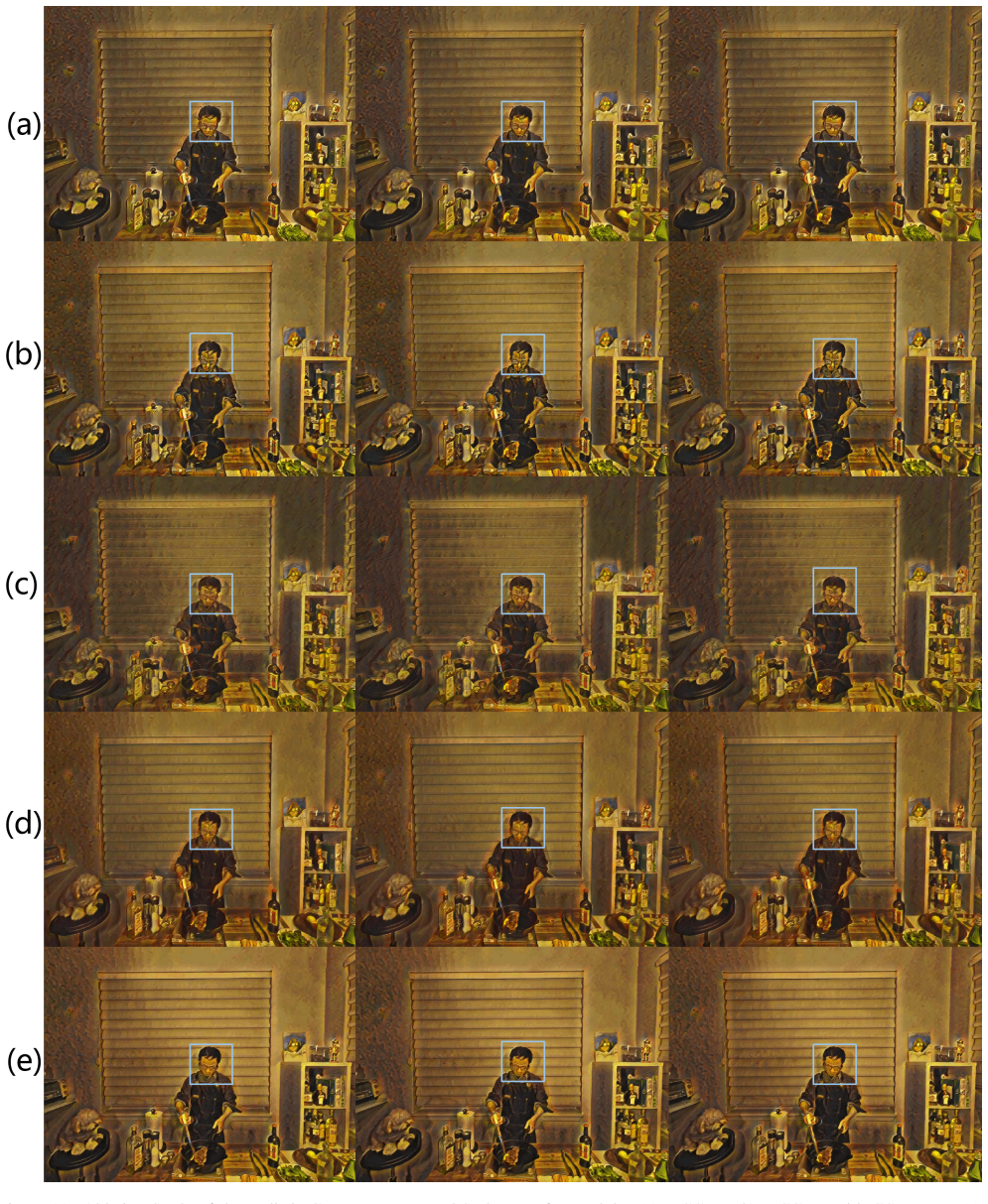
Two mechanisms carry the argument. The Style Gaussian Representation: every Gaussian in the 4DGS scene carries a two-layer MLP with four hidden units that receives the time step and the ray-Gaussian intersection depth and outputs a per-Gaussian color increment and opacity change, so appearance is controllable over space and time while the geometry network from the first stage stays frozen — reducing stylization to a per-Gaussian fitting problem, which is what buys multi-view and temporal consistency. The Holistic Geometry-Preserved Style Transfer (HGST) module: an encoder-transformer-decoder stylization network that fuses content and style features with a multi-channel correlation, then enfo
What would settle it
Correlate the twelve metric scores with the 34-participant preference percentages computed from the paper's own tables, method by method and scene by scene. If warp loss, UIQM, or Qalign rank the four methods differently from the human votes — or correlate weakly — the benchmark would not reflect human perception and the state-of-the-art ranking would lose its anchor. The needed numbers are all in the paper, so the test is a spreadsheet calculation, not a new experiment.
Extended reading notes
Core claim
The paper's central claim is that 4D stylization should be decomposed into geometry learning and style learning: a pre-trained 4D Gaussian Splatting captures the dynamic structure, and a separate style stage modulates only color and opacity. Its Style Gaussian Representation attaches a tiny MLP to every Gaussian — inputs are the time step and ray-Gaussian intersection depth, outputs a color increment and opacity adjustment — so style varies smoothly in space and time without disturbing the learned geometry. Stylized training frames come from a Holistic Geometry-Preserved Style Transfer module, an encoder-transformer-decoder that adds an attention-guided local contrastive loss and a global co
Load-bearing premise
The benchmark's validity rests on the unverified assumption that its twelve automated scores — no-reference image-quality models, aesthetic scorers, and a flow-based warp error — track what humans mean by good stylization, since the paper never compares its user-study votes with the metric scores.
Editorial extensions
If this is right
- Future 4D stylization work can be benchmarked on the same scenes and twelve scores, replacing ad-hoc frame-wise losses and informal polls as the field's common yardstick.
- The two-stage recipe — lock geometry, then fit appearance with per-Gaussian MLPs — is shown to avoid the temporal flicker and blur of training 4DGS directly on stylized frames, and the same representation improves plain reconstruction PSNR over 4DGS on all six benchmark scenes.
- Frame-by-frame 2D style transfer (AdaIN, AdaAttN) is insufficient for dynamic scenes, so those shortcuts are ruled out as viable 4D baselines.
- The state-of-the-art claim is bounded by the paper's own limitation: one fixed style per scene and a multi-stage training cost of about two hours per scene, so fast style switching and region-specific stylization remain open.
- The ablation of HGST shows its local contrastive loss reduces background flicker beyond the base MCCNet architecture, while the content loss preserves object boundaries.
Reading between the lines
- The paper's own tables allow a direct test it does not run: correlating the twelve metric scores with the 34-participant preference percentages. That correlation is the difference between a benchmark that ranks methods the way people judge them and one that ranks them by proxy.
- Because the per-Gaussian MLPs touch only color and opacity, the same pipeline plausibly extends to relighting, recoloring, or material editing of dynamic scenes with the geometry untouched — an application the paper does not claim.
- The quantitative comparison covers three of the six Neu3D scenes; extending the protocol to the remaining scenes and to multiple style pairs per scene would test whether the margins hold across the full range of motion and background complexity.
- The twelve-metric protocol could serve as a template for benchmarking other 4D appearance-editing tasks, such as object insertion, removal, or relighting, where temporal and multi-view consistency are likewise the hard part.
Editorial analysis
A structured set of objections, weighed in public.
Referee Report
Summary. The paper introduces Style4D-Bench, a proposed benchmark suite for 4D stylization, comprising an evaluation protocol with six dimensions and twelve metrics, a baseline method Style4D built on 4D Gaussian Splatting, and a collection of dynamic scenes. The baseline combines a 4DGS scene representation, per-Gaussian MLP style codes, and a Holistic Geometry-preserved Style Transfer module. Experiments are conducted on three Neu3D scenes, comparing Style4D against 4DGS with AdaIN/AdaAttN and 4DStyleGaussian, plus a 34-participant user study. The paper claims state-of-the-art performance and that the benchmark standardizes evaluation for 4D stylization.
Significance. If the benchmark's metrics were validated and the dataset were clearly defined, this would be a useful contribution: it addresses an under-explored task, proposes a concrete evaluation protocol, and provides a reproducible baseline with released code and project page. However, the central validity of the 12-metric protocol is not established. The user study is not compared against any of the twelve metrics, no correlation or significance analysis is reported, and several text claims are contradicted by the paper's own Table 1. The SOTA claim and the benchmark's usefulness both rest on these unvalidated metrics, so the manuscript needs substantial revision before the central claims can be accepted.
major comments (5)
- [Sec. 3.1–3.2 and Sec. 3.3] The benchmark's central claim is that the twelve metrics reliably evaluate 4D stylization quality and consistency. No validation is provided that these metrics track human perception. The 34-participant user study (Tables 2–3) reports only preference percentages; it is never correlated with any of the twelve metrics, no rank agreement is computed, and no significance tests or confidence intervals are given. The paper itself acknowledges in Sec. 3 that style is subjective and ground truth is absent. This is load-bearing: if the metrics do not align with human judgment, the benchmark rankings and the SOTA claim collapse. Please add a validation experiment (e.g., per-scene/per-method Spearman correlation between metric scores and user-study preferences, or pairwise agreement) and report error bars over random seeds/viewpoints/frames.
- [Table 1 vs. Sec. 5.1] The text claims Style4D achieves 'the lowest DISTS and Warp Loss values' and 'the best DINO scores'. Table 1 contradicts this: on cookspinach, 4DStyleGaussian has lower Warp Loss (0.0053 vs. 0.0058); on searsteak, 4DStyleGaussian again has lower Warp Loss (0.0050 vs. 0.0066); on cookspinach, 4DStyleGaussian has higher DINO (0.9403 vs. 0.9395). Since no aggregation rule is given for 'most metrics', the selective reporting makes the SOTA claim non-verifiable. Either specify a pre-registered aggregation/ranking procedure or correct the overclaims.
- [Sec. 5 'Datasets' vs. Abstract/Contributions] The abstract and contributions claim the benchmark includes 'a curated collection of high-resolution dynamic 4D scenes'. The experiments, however, use the existing Neu3D dataset, and no curation protocol, dataset statistics, or release details for a new dataset are provided. This makes the benchmark's dataset contribution unclear: is the benchmark a protocol applied to Neu3D, a selected subset of Neu3D scenes, or a new dataset? If the latter, the paper must describe and release it; if the former, the abstract and contributions should be rephrased. The evaluation also covers only three of the six Neu3D scenes, with no rationale for excluding the others.
- [Sec. 4, Eqs. (5)–(6) vs. Sec. 3.2] Several benchmark metrics overlap with Style4D's training objectives: content consistency (LPIPS/SSIM) overlaps with L_id and L_content, style consistency (CKDN/LPIPS) overlaps with L_style, and spatiotemporal consistency (DISTS/warp loss) overlaps with L_consistency. Since Style4D is both the benchmark proposer and the baseline, the evaluation is not independent of the method's design. This does not by itself invalidate the benchmark, but it should be acknowledged and mitigated—for example, by reporting metrics that are not used in training, or by an external evaluation protocol. Without this, the SOTA claim is vulnerable to circularity concerns.
- [Table 1 and Sec. 5.1] All quantitative comparisons report single numbers with no error bars, significance tests, or variance across random seeds, test viewpoints, or frames. The claim of 'consistently top performance' is therefore not statistically supported. At minimum, report means and standard deviations over multiple runs or over frames, and a significance test for the main comparisons.
minor comments (5)
- [Sec. 5.1 and Appendix B.1] The main text refers to 'Table 5' for the quantitative results, but the main quantitative table is labeled Table 1; Appendix B.1 also labels a table as Table 5. Renumber tables consistently and fix all cross-references.
- [Sec. 3.2] The taxonomy is confusing: '4D stylization consistency' is said to distinguish 'Temporal Quality and Stylization Quality', but 'Stylization Quality' appears to contain style and content consistency, not temporal aspects. Clarify the relationship among the three levels of the decomposition.
- [Eq. (2)] The contrastive loss notation is undefined: what are the indices m and n, and what is the size of the sample set N? The variables Gx,y and G(x,y) are also used without a clear formal definition. Please spell out the sampling procedure and the exact dimensions.
- [Throughout] Scene names are inconsistent (e.g., 'cook spinach' vs. 'cookspinach', 'sear steak' vs. 'searsteak'). Use a single naming convention in tables and text. There are also grammatical typos such as 'the the geometry' in Sec. 4 and 'that make an initial attempt' in the abstract.
- [Appendix C, Table 7] The PSNR comparison in Table 7 shows Style4D's representation improving over 4DGS on all six Neu3D scenes, but this result is not connected to the stylization benchmark in the main text. Clarify whether this is an evaluation of the style Gaussian representation on un-stylized reconstruction and how it relates to the benchmark claims.
Circularity Check
No significant circularity: benchmark metrics are external, the baseline is evaluated on novel viewpoints, and no self-citation chain is load-bearing.
full rationale
The derivation chain from benchmark design to the SOTA claim contains no circular reduction. The benchmark metrics (Sec. 3.1–3.2: UIQM, Clipiqa+, Musiq, Qalign, Dists, warp loss, DINO, CKDN, LPIPS, SSIM) are pre-existing, externally defined measures applied to rendered videos; none is defined in terms of Style4D's outputs or fitted values. Style4D's training objectives (Eqs. 2–6) include content, style, and temporal-consistency losses that are conceptually aligned with some benchmark dimensions (e.g., Lcontent versus LPIPS content consistency, Lstyle versus style similarity, Lconsistency versus warp loss). That alignment is a design choice, not a constructor: the benchmark evaluates novel viewpoints and arbitrary times from a Gaussian representation trained on fixed stylized frames (Eq. 6), so the evaluation is a genuine generalization test. No benchmark score is a re-statement of a training loss, no parameter is fitted to benchmark scores, and the user study is not used to fit or rename any metric. There are also no load-bearing self-citations; the cited prior works (4DGS, SuperGaussians, MCCNet, CCPL) are external. The paper's weaknesses—the 34-participant user study is never correlated with the 12 metrics, and the text overclaims 'lowest DISTS and Warp Loss' despite Table 1 showing 4DStyleGaussian lower on some scenes—are validation/correctness concerns, not circularity.
Assumptions & free parameters
free parameters (4)
- Loss weights λ_consistency, λ_style, λ_id, λ_illum, λ_ins =
3, 18, 7, 1e-5, 1
- Contrastive temperature τ =
0.07
- Per-Gaussian MLP hidden units =
4
- Style scene subset =
3 of 6 Neu3D scenes
assumptions (4)
- domain assumption Neu3D scenes are representative of 4D stylization needs.
- domain assumption No-reference metrics (UIQM, Clipiqa+, Musiq, Qalign, etc.) measure stylization quality faithfully.
- domain assumption Warp loss computed with RAFT optical flow is a valid measure of temporal consistency on stylized frames.
- ad hoc to paper The decomposition of 4D stylization into six dimensions (imaging, aesthetic, spatiotemporal, subject, style, content) is the right task definition.
invented entities (1)
-
Style Gaussian Representation (per-Gaussian MLP style codes)
Cite this review
Pith. "Pith review of Style4D-Bench: A Benchmark Suite for 4D Stylization." pith.science (2026). https://pith.science/paper/U3AJ6QSM
@misc{pith2026250819243,
  author       = {Pith},
  title        = {Pith review of: Style4D-Bench: A Benchmark Suite for 4D Stylization},
  year         = {2026},
  howpublished = {\url{https://pith.science/paper/U3AJ6QSM}},
  note         = {Machine review of arXiv:2508.19243}
}
read the original abstract
We introduce Style4D-Bench, the first benchmark suite specifically designed for 4D stylization, with the goal of standardizing evaluation and facilitating progress in this emerging area. Style4D-Bench comprises: 1) a comprehensive evaluation protocol measuring spatial fidelity, temporal coherence, and multi-view consistency through both perceptual and quantitative metrics, 2) a strong baseline that make an initial attempt for 4D stylization, and 3) a curated collection of high-resolution dynamic 4D scenes with diverse motions and complex backgrounds. To establish a strong baseline, we present Style4D, a novel framework built upon 4D Gaussian Splatting. It consists of three key components: a basic 4DGS scene representation to capture reliable geometry, a Style Gaussian Representation that leverages lightweight per-Gaussian MLPs for temporally and spatially aware appearance control, and a Holistic Geometry-Preserved Style Transfer module designed to enhance spatio-temporal consistency via contrastive coherence learning and structural content preservation. Extensive experiments on Style4D-Bench demonstrate that Style4D achieves state-of-the-art performance in 4D stylization, producing fine-grained stylistic details with stable temporal dynamics and consistent multi-view rendering. We expect Style4D-Bench to become a valuable resource for benchmarking and advancing research in stylized rendering of dynamic 3D scenes. Project page: https://becky-catherine.github.io/Style4D . Code: https://github.com/Becky-catherine/Style4D-Bench .
Figures


Figures from the paper (8 more)


Forward citations
Cited by 2 Pith papers
-
Learning Physics from Pretrained Video Models: A Multimodal Continuous and Sequential World Interaction Models for Robotic Manipulation
PhysGen uses video models to learn physics for robots, outperforming baselines by up to 13.8% on Libero and matching specialized models in real-world tasks.
-
OOWM: Structuring Embodied Reasoning and Planning via Object-Oriented Programmatic World Modeling
OOWM models the world as an explicit symbolic tuple with UML diagrams and trains via SFT plus GRPO to outperform text-based CoT on embodied planning benchmarks.
Reference graph
Works this paper leans on
-
[1]
Mip-nerf: A multiscale representation for anti-aliasing neu- ral radiance fields
Jonathan T Barron, Ben Mildenhall, Matthew Tancik, Peter Hedman, Ricardo Martin-Brualla, and Pratul P Srinivasan. Mip-nerf: A multiscale representation for anti-aliasing neu- ral radiance fields. In Proceedings of the IEEE/CVF inter- national conference on computer vision , pages 5855–5864,
-
[2]
Hexplane: A fast representa- tion for dynamic scenes
Ang Cao and Justin Johnson. Hexplane: A fast representa- tion for dynamic scenes. In Proceedings of the IEEE/CVF Conference on Computer Vision and Pattern Recognition , pages 130–141, 2023. 2
2023
-
[3]
Emerg- ing properties in self-supervised vision transformers
Mathilde Caron, Hugo Touvron, Ishan Misra, Herv ´e J´egou, Julien Mairal, Piotr Bojanowski, and Armand Joulin. Emerg- ing properties in self-supervised vision transformers. In Pro- ceedings of the IEEE/CVF international conference on com- puter vision, pages 9650–9660, 2021. 3
2021
-
[4]
Efficient geometry-aware 3d generative adversarial networks
Eric R Chan, Connor Z Lin, Matthew A Chan, Koki Nagano, Boxiao Pan, Shalini De Mello, Orazio Gallo, Leonidas J Guibas, Jonathan Tremblay, Sameh Khamis, et al. Efficient geometry-aware 3d generative adversarial networks. In Pro- ceedings of the IEEE/CVF conference on computer vision and pattern recognition, pages 16123–16133, 2022. 2
work page 2022
-
[5]
Tensorf: Tensorial radiance fields
Anpei Chen, Zexiang Xu, Andreas Geiger, Jingyi Yu, and Hao Su. Tensorf: Tensorial radiance fields. InEuropean con- ference on computer vision, pages 333–350. Springer, 2022. 2
2022
-
[6]
Coherent online video style transfer
Dongdong Chen, Jing Liao, Lu Yuan, Nenghai Yu, and Gang Hua. Coherent online video style transfer. In Proceedings of the IEEE International Conference on Computer Vision , pages 1105–1114, 2017. 4
work page 2017
-
[7]
Gaussianeditor: Swift and control- lable 3d editing with gaussian splatting
Yiwen Chen, Zilong Chen, Chi Zhang, Feng Wang, Xi- aofeng Yang, Yikai Wang, Zhongang Cai, Lei Yang, Huaping Liu, and Guosheng Lin. Gaussianeditor: Swift and control- lable 3d editing with gaussian splatting. In Proceedings of the IEEE/CVF conference on computer vision and pattern recognition, pages 21476–21485, 2024. 2
2024
-
[8]
Upst-nerf: Uni- versal photorealistic style transfer of neural radiance fields for 3d scene
Yaosen Chen, Qi Yuan, Zhiqiang Li, Yuegen Liu, Wei Wang, Chaoping Xie, Xuming Wen, and Qien Yu. Upst-nerf: Uni- versal photorealistic style transfer of neural radiance fields for 3d scene. IEEE Transactions on Visualization and Com- puter Graphics, 2024. 2
work page 2024
Show all 72 references
-
[9]
Stylizing 3d scene via im- plicit representation and hypernetwork
Pei-Ze Chiang, Meng-Shiun Tsai, Hung-Yu Tseng, Wei- Sheng Lai, and Wei-Chen Chiu. Stylizing 3d scene via im- plicit representation and hypernetwork. InProceedings of the IEEE/CVF winter conference on applications of computer vi- sion, pages 1475–1484, 2022. 1, 2
2022
-
[10]
Arbitrary video style transfer via multi-channel correlation
Yingying Deng, Fan Tang, Weiming Dong, Haibin Huang, Chongyang Ma, and Changsheng Xu. Arbitrary video style transfer via multi-channel correlation. In Proceedings of the AAAI conference on artificial intelligence, pages 1210–1217,
-
[11]
Simoncelli
Keyan Ding, Kede Ma, Shiqi Wang, and Eero P. Simoncelli. Image quality assessment: Unifying structure and texture similarity. CoRR, abs/2004.07728, 2020. 3
2004 arXiv
-
[12]
4d-rotor gaussian splatting: towards efficient novel view synthesis for dynamic scenes
Yuanxing Duan, Fangyin Wei, Qiyu Dai, Yuhang He, Wen- zheng Chen, and Baoquan Chen. 4d-rotor gaussian splatting: towards efficient novel view synthesis for dynamic scenes. In ACM SIGGRAPH 2024 Conference Papers , pages 1–11,
2024
-
[13]
Fast dynamic radiance fields with time-aware neural vox- els
Jiemin Fang, Taoran Yi, Xinggang Wang, Lingxi Xie, Xi- aopeng Zhang, Wenyu Liu, Matthias Nießner, and Qi Tian. Fast dynamic radiance fields with time-aware neural vox- els. In SIGGRAPH Asia 2022 Conference Papers, pages 1–9,
2022
-
[14]
8 Ccedit: Creative and controllable video editing via diffu- sion models
Ruoyu Feng, Wenming Weng, Yanhui Wang, Yuhui Yuan, Jianmin Bao, Chong Luo, Zhibo Chen, and Baining Guo. 8 Ccedit: Creative and controllable video editing via diffu- sion models. In Proceedings of the IEEE/CVF Conference on Computer Vision and Pattern Recognition , pages 6712– ...
2024
-
[15]
Plenoxels: Radiance fields without neural networks
Sara Fridovich-Keil, Alex Yu, Matthew Tancik, Qinhong Chen, Benjamin Recht, and Angjoo Kanazawa. Plenoxels: Radiance fields without neural networks. In Proceedings of the IEEE/CVF conference on computer vision and pattern recognition, pages 5501–5510, 2022. 2
2022
-
[16]
K-planes: Explicit radiance fields in space, time, and appearance
Sara Fridovich-Keil, Giacomo Meanti, Frederik Rahbæk Warburg, Benjamin Recht, and Angjoo Kanazawa. K-planes: Explicit radiance fields in space, time, and appearance. In Proceedings of the IEEE/CVF Conference on Computer Vi- sion and Pattern Recognition, pages 12479–12488, 2023. 2
2023
-
[17]
Im- age style transfer using convolutional neural networks
Leon A Gatys, Alexander S Ecker, and Matthias Bethge. Im- age style transfer using convolutional neural networks. In Proceedings of the IEEE conference on computer vision and pattern recognition, pages 2414–2423, 2016. 1, 2
2016
-
[18]
Ar- bitrary style transfer with deep feature reshuffle
Shuyang Gu, Congliang Chen, Jing Liao, and Lu Yuan. Ar- bitrary style transfer with deep feature reshuffle. InProceed- ings of the IEEE conference on computer vision and pattern recognition, pages 8222–8231, 2018. 1, 2
2018
-
[19]
Instruct-nerf2nerf: Edit- ing 3d scenes with instructions
Ayaan Haque, Matthew Tancik, Alexei A Efros, Aleksander Holynski, and Angjoo Kanazawa. Instruct-nerf2nerf: Edit- ing 3d scenes with instructions. In Proceedings of the IEEE/CVF International Conference on Computer Vision , pages 19740–19750, 2023. 2
2023
-
[20]
Koniq-10k: An ecologically valid database for deep learning of blind image quality assessment
Vlad Hosu, Hanhe Lin, Tamas Sziranyi, and Dietmar Saupe. Koniq-10k: An ecologically valid database for deep learning of blind image quality assessment. IEEE Transactions on Image Processing, 29:4041–4056, 2020. 3
2020
-
[21]
Arbitrary style transfer in real-time with adaptive instance normalization
Xun Huang and Serge Belongie. Arbitrary style transfer in real-time with adaptive instance normalization. In Proceed- ings of the IEEE international conference on computer vi- sion, pages 1501–1510, 2017. 1, 2, 14
2017
-
[22]
Stylizednerf: consistent 3d scene stylization as styl- ized nerf via 2d-3d mutual learning
Yi-Hua Huang, Yue He, Yu-Jie Yuan, Yu-Kun Lai, and Lin Gao. Stylizednerf: consistent 3d scene stylization as styl- ized nerf via 2d-3d mutual learning. In Proceedings of the IEEE/CVF Conference on Computer Vision and Pattern Recognition, pages 18342–18352, 2022. 2
2022
-
[23]
Rave: Randomized noise shuf- fling for fast and consistent video editing with diffusion mod- els
Ozgur Kara, Bariscan Kurtkaya, Hidir Yesiltepe, James M Rehg, and Pinar Yanardag. Rave: Randomized noise shuf- fling for fast and consistent video editing with diffusion mod- els. In Proceedings of the IEEE/CVF Conference on Com- puter Vision and Pattern Recognition , pages 6507–6516,
-
[24]
Musiq: Multi-scale image quality transformer
Junjie Ke, Qifei Wang, Yilin Wang, Peyman Milanfar, and Feng Yang. Musiq: Multi-scale image quality transformer. In Proceedings of the IEEE/CVF International Conference on Computer Vision, pages 5148–5157, 2021. 3
2021
-
[25]
3d gaussian splatting for real-time radiance field rendering
Bernhard Kerbl, Georgios Kopanas, Thomas Leimk ¨uhler, and George Drettakis. 3d gaussian splatting for real-time radiance field rendering. ACM Trans. Graph., 42(4):139–1,
-
[26]
Style transfer by relaxed optimal transport and self-similarity
Nicholas Kolkin, Jason Salavon, and Gregory Shakhnarovich. Style transfer by relaxed optimal transport and self-similarity. In Proceedings of the IEEE/CVF con- ference on computer vision and pattern recognition , pages 10051–10060, 2019. 1, 2
2019
-
[27]
Exploring the temporal consistency of arbitrary style transfer: A channelwise perspective
Xiaoyu Kong, Yingying Deng, Fan Tang, Weiming Dong, Chongyang Ma, Yongyong Chen, Zhenyu He, and Chang- sheng Xu. Exploring the temporal consistency of arbitrary style transfer: A channelwise perspective. IEEE Trans- actions on Neural Networks and Learning Systems , 35(6): 8482...
2024
-
[28]
Learning blind video temporal consistency
Wei-Sheng Lai, Jia-Bin Huang, Oliver Wang, Eli Shechtman, Ersin Yumer, and Ming-Hsuan Yang. Learning blind video temporal consistency. In Proceedings of the European con- ference on computer vision (ECCV) , pages 170–185, 2018. 1
2018
-
[29]
Neural 3d video synthesis from multi-view video
Tianye Li, Mira Slavcheva, Michael Zollhoefer, Simon Green, Christoph Lassner, Changil Kim, Tanner Schmidt, Steven Lovegrove, Michael Goesele, Richard Newcombe, et al. Neural 3d video synthesis from multi-view video. In Proceedings of the IEEE/CVF conference on computer vi- si...
2022
-
[30]
4dstylegaussian: Zero-shot 4d style transfer with gaussian splatting
Wanlin Liang, Hongbin Xu, Weitao Chen, Feng Xiao, and Wenxiong Kang. 4dstylegaussian: Zero-shot 4d style transfer with gaussian splatting. arXiv preprint arXiv:2410.10412, 2024. 2
2024 arXiv
-
[31]
Visual attribute transfer through deep image analogy
Jing Liao, Yuan Yao, Lu Yuan, Gang Hua, and Sing Bing Kang. Visual attribute transfer through deep image analogy. arXiv preprint arXiv:1705.01088, 2017. 1
2017 arXiv
-
[32]
Microsoft coco: Common objects in context
Tsung-Yi Lin, Michael Maire, Serge Belongie, James Hays, Pietro Perona, Deva Ramanan, Piotr Doll´ar, and C Lawrence Zitnick. Microsoft coco: Common objects in context. In Computer vision–ECCV 2014: 13th European conference, zurich, Switzerland, September 6-12, 2014, proceeding...
2014
-
[33]
Stylerf: Zero-shot 3d style transfer of neural radiance fields
Kunhao Liu, Fangneng Zhan, Yiwen Chen, Jiahui Zhang, Yingchen Yu, Abdulmotaleb El Saddik, Shijian Lu, and Eric P Xing. Stylerf: Zero-shot 3d style transfer of neural radiance fields. In Proceedings of the IEEE/CVF Conference on Computer Vision and Pattern Recognition , pages 8...
2023
-
[34]
Stylegaussian: Instant 3d style transfer with gaussian splatting
Kunhao Liu, Fangneng Zhan, Muyu Xu, Christian Theobalt, Ling Shao, and Shijian Lu. Stylegaussian: Instant 3d style transfer with gaussian splatting. In SIGGRAPH Asia 2024 Technical Communications, pages 1–4. 2024. 1, 2
2024
-
[35]
Structure-guided arbitrary style transfer for artistic image and video
Shiguang Liu and Ting Zhu. Structure-guided arbitrary style transfer for artistic image and video. IEEE Transactions on Multimedia, 24:1299–1312, 2021. 4
2021
-
[36]
Adaattn: Revisit attention mechanism in arbitrary neural style transfer
Songhua Liu, Tianwei Lin, Dongliang He, Fu Li, Meiling Wang, Xin Li, Zhengxing Sun, Qian Li, and Errui Ding. Adaattn: Revisit attention mechanism in arbitrary neural style transfer. In Proceedings of the IEEE/CVF international conference on computer vision, pages 6649–6658, 20...
2021
-
[37]
Robust dynamic radiance fields
Yu-Lun Liu, Chen Gao, Andreas Meuleman, Hung-Yu Tseng, Ayush Saraf, Changil Kim, Yung-Yu Chuang, Jo- hannes Kopf, and Jia-Bin Huang. Robust dynamic radiance fields. In Proceedings of the IEEE/CVF Conference on Com- puter Vision and Pattern Recognition, pages 13–23, 2023. 2
2023
-
[38]
Dynamic 3d gaussians: Tracking by per- 9 sistent dynamic view synthesis
Jonathon Luiten, Georgios Kopanas, Bastian Leibe, and Deva Ramanan. Dynamic 3d gaussians: Tracking by per- 9 sistent dynamic view synthesis. In 2024 International Con- ference on 3D Vision (3DV), pages 800–809. IEEE, 2024. 1, 2
2024
-
[39]
Nerf: Representing scenes as neural radiance fields for view syn- thesis
Ben Mildenhall, Pratul P Srinivasan, Matthew Tancik, Jonathan T Barron, Ravi Ramamoorthi, and Ren Ng. Nerf: Representing scenes as neural radiance fields for view syn- thesis. Communications of the ACM , 65(1):99–106, 2021. 2
2021
-
[40]
Instant neural graphics primitives with a mul- tiresolution hash encoding
Thomas M ¨uller, Alex Evans, Christoph Schied, and Alexan- der Keller. Instant neural graphics primitives with a mul- tiresolution hash encoding. ACM transactions on graphics (TOG), 41(4):1–15, 2022. 2
2022
-
[41]
Snerf: stylized neural implicit representations for 3d scenes
Thu Nguyen-Phuoc, Feng Liu, and Lei Xiao. Snerf: stylized neural implicit representations for 3d scenes. arXiv preprint arXiv:2207.02363, 2022. 1, 2
2022 arXiv
-
[42]
Nerfies: Deformable neural radiance fields
Keunhong Park, Utkarsh Sinha, Jonathan T Barron, Sofien Bouaziz, Dan B Goldman, Steven M Seitz, and Ricardo Martin-Brualla. Nerfies: Deformable neural radiance fields. In Proceedings of the IEEE/CVF international conference on computer vision, pages 5865–5874, 2021. 2
2021
-
[43]
Hypernerf: A higher- dimensional representation for topologically varying neural radiance fields
Keunhong Park, Utkarsh Sinha, Peter Hedman, Jonathan T Barron, Sofien Bouaziz, Dan B Goldman, Ricardo Martin- Brualla, and Steven M Seitz. Hypernerf: A higher- dimensional representation for topologically varying neural radiance fields. arXiv preprint arXiv:2106.13228, 2021
2021 arXiv
-
[44]
D-nerf: Neural radiance fields for dynamic scenes
Albert Pumarola, Enric Corona, Gerard Pons-Moll, and Francesc Moreno-Noguer. D-nerf: Neural radiance fields for dynamic scenes. In Proceedings of the IEEE/CVF con- ference on computer vision and pattern recognition , pages 10318–10327, 2021. 1, 2
2021
-
[45]
Gaussian splatting in style
Abhishek Saroha, Mariia Gladkova, Cecilia Curreli, Do- minik Muhle, Tarun Yenamandra, and Daniel Cremers. Gaussian splatting in style. In DAGM German Conference on Pattern Recognition, pages 234–251. Springer, 2024. 1, 2
2024
-
[46]
Tensor4d: Efficient neural 4d decomposition for high-fidelity dynamic reconstruction and rendering
Ruizhi Shao, Zerong Zheng, Hanzhang Tu, Boning Liu, Hongwen Zhang, and Yebin Liu. Tensor4d: Efficient neural 4d decomposition for high-fidelity dynamic reconstruction and rendering. In Proceedings of the IEEE/CVF Conference on Computer Vision and Pattern Recognition, pages 166...
2023
-
[47]
Very deep convo- lutional networks for large-scale image recognition
Karen Simonyan and Andrew Zisserman. Very deep convo- lutional networks for large-scale image recognition. arXiv preprint arXiv:1409.1556, 2014. 12
2014 arXiv
-
[48]
Direct voxel grid optimization: Super-fast convergence for radiance fields reconstruction
Cheng Sun, Min Sun, and Hwann-Tzong Chen. Direct voxel grid optimization: Super-fast convergence for radiance fields reconstruction. In Proceedings of the IEEE/CVF conference on computer vision and pattern recognition , pages 5459– 5469, 2022. 2
2022
-
[49]
Raft: Recurrent all-pairs field transforms for optical flow
Zachary Teed and Jia Deng. Raft: Recurrent all-pairs field transforms for optical flow. In Computer Vision–ECCV 2020: 16th European Conference, Glasgow, UK, August 23– 28, 2020, Proceedings, Part II 16, pages 402–419. Springer,
2020
-
[50]
Clip-nerf: Text-and-image driven ma- nipulation of neural radiance fields
Can Wang, Menglei Chai, Mingming He, Dongdong Chen, and Jing Liao. Clip-nerf: Text-and-image driven ma- nipulation of neural radiance fields. In Proceedings of the IEEE/CVF conference on computer vision and pattern recognition, pages 3835–3844, 2022. 2
2022
-
[51]
Nerf-art: Text-driven neural radiance fields stylization
Can Wang, Ruixiang Jiang, Menglei Chai, Mingming He, Dongdong Chen, and Jing Liao. Nerf-art: Text-driven neural radiance fields stylization. IEEE Transactions on Visualiza- tion and Computer Graphics, 2023. 1, 2
2023
-
[52]
Ex- ploring clip for assessing the look and feel of images
Jianyi Wang, Kelvin CK Chan, and Chen Change Loy. Ex- ploring clip for assessing the look and feel of images. In AAAI, 2023. 3
2023
-
[53]
Cbam: Convolutional block attention module
Sanghyun Woo, Jongchan Park, Joon-Young Lee, and In So Kweon. Cbam: Convolutional block attention module. In Computer Vision – ECCV 2018 , pages 3–19, Cham, 2018. Springer International Publishing. 4
2018
-
[54]
4d gaussian splatting for real-time dynamic scene rendering
Guanjun Wu, Taoran Yi, Jiemin Fang, Lingxi Xie, Xiaopeng Zhang, Wei Wei, Wenyu Liu, Qi Tian, and Xinggang Wang. 4d gaussian splatting for real-time dynamic scene rendering. In Proceedings of the IEEE/CVF conference on computer vi- sion and pattern recognition, pages 20310–2032...
2024
-
[55]
Q-align: Teaching lmms for visual scoring via discrete text-defined levels
Haoning Wu, Zicheng Zhang, Weixia Zhang, Chaofeng Chen, Chunyi Li, Liang Liao, Annan Wang, Erli Zhang, Wenxiu Sun, Qiong Yan, Xiongkuo Min, Guangtai Zhai, and Weisi Lin. Q-align: Teaching lmms for visual scoring via discrete text-defined levels. arXiv preprint arXiv:2312.17090...
2023 arXiv
-
[56]
Ccpl: Con- trastive coherence preserving loss for versatile style transfer
Zijie Wu, Zhen Zhu, Junping Du, and Xiang Bai. Ccpl: Con- trastive coherence preserving loss for versatile style transfer. In European conference on computer vision, pages 189–206. Springer, 2022. 4
2022
-
[57]
Supergaussians: Enhancing gaussian splat- ting using primitives with spatially varying colors, 2024
Rui Xu, Wenyue Chen, Jiepeng Wang, Yuan Liu, Peng Wang, Lin Gao, Shiqing Xin, Taku Komura, Xin Li, and Wenping Wang. Supergaussians: Enhancing gaussian splat- ting using primitives with spatially varying colors, 2024. 4
2024
-
[58]
Real-time photorealistic dynamic scene representation and rendering with 4d gaussian splatting
Zeyu Yang, Hongye Yang, Zijie Pan, and Li Zhang. Real-time photorealistic dynamic scene representation and rendering with 4d gaussian splatting. arXiv preprint arXiv:2310.10642, 2023. 1
2023 arXiv
-
[59]
Cogvideox: Text-to-video diffusion models with an expert transformer
Zhuoyi Yang, Jiayan Teng, Wendi Zheng, Ming Ding, Shiyu Huang, Jiazheng Xu, Yuanming Yang, Wenyi Hong, Xiao- han Zhang, Guanyu Feng, et al. Cogvideox: Text-to-video diffusion models with an expert transformer. arXiv preprint arXiv:2408.06072, 2024. 4
2024 arXiv
-
[60]
Generalizable neural voxels for fast human radiance fields
Taoran Yi, Jiemin Fang, Xinggang Wang, and Wenyu Liu. Generalizable neural voxels for fast human radiance fields. arXiv preprint arXiv:2303.15387, 2023. 2
2023 arXiv
-
[61]
From patches to pictures (paq-2-piq): Mapping the perceptual space of pic- ture quality
Zhenqiang Ying, Haoran Niu, Praful Gupta, Dhruv Maha- jan, Deepti Ghadiyaram, and Alan Bovik. From patches to pictures (paq-2-piq): Mapping the perceptual space of pic- ture quality. In Proceedings of the IEEE/CVF conference on computer vision and pattern recognition, pages 3575–3585,
-
[62]
Gaussian opacity fields: Efficient adaptive surface reconstruction in unbounded scenes
Zehao Yu, Torsten Sattler, and Andreas Geiger. Gaussian opacity fields: Efficient adaptive surface reconstruction in unbounded scenes. ACM Transactions on Graphics (TOG), 43(6):1–13, 2024. 4
2024
-
[63]
Styl- 10 izedgs: Controllable stylization for 3d gaussian splatting
Dingxi Zhang, Yu-Jie Yuan, Zhuoxun Chen, Fang-Lue Zhang, Zhenliang He, Shiguang Shan, and Lin Gao. Styl- 10 izedgs: Controllable stylization for 3d gaussian splatting. arXiv preprint arXiv:2404.05220, 2024. 1, 2
2024 arXiv
-
[64]
Arf: Artistic radiance fields
Kai Zhang, Nick Kolkin, Sai Bi, Fujun Luan, Zexiang Xu, Eli Shechtman, and Noah Snavely. Arf: Artistic radiance fields. In European Conference on Computer Vision, pages 717–733. Springer, 2022. 1, 2
2022
-
[65]
The unreasonable effectiveness of deep features as a perceptual metric
Richard Zhang, Phillip Isola, Alexei A Efros, Eli Shecht- man, and Oliver Wang. The unreasonable effectiveness of deep features as a perceptual metric. In Proceedings of the IEEE conference on computer vision and pattern recogni- tion, pages 586–595, 2018. 3
2018
-
[66]
Learning conditional knowledge distilla- tion for degraded-reference image quality assessment.ICCV,
Heliang Zheng, Jianlong Fu, Yanhong Zeng, Zheng-Jun Zha, and Jiebo Luo. Learning conditional knowledge distilla- tion for degraded-reference image quality assessment.ICCV,
-
[67]
Extract free dense labels from clip
Chong Zhou, Chen Change Loy, and Bo Dai. Extract free dense labels from clip. In European conference on computer vision, pages 696–712. Springer, 2022. 3
2022
-
[68]
Dreameditor: Text-driven 3d scene editing with neural fields
Jingyu Zhuang, Chen Wang, Liang Lin, Lingjie Liu, and Guanbin Li. Dreameditor: Text-driven 3d scene editing with neural fields. In SIGGRAPH Asia 2023 Conference Papers, pages 1–10, 2023. 2 11 A. Implementation and Network Details 4DGS Representation. We follow the training con...
2023
-
[69]
The style perceptual loss Lstyle minimizes the style differences between the generated image Ics and the style image Is by comparing the mean and variance of features extracted from each layer of a pre-trained VGG19. For- mally, the loss is expressed as: Lstyle = X l ∥µl(Ics) ...
-
[70]
The identity loss Lid helps to preserve the content structure while maintaining the richness of the style pat- terns: Lid = ∥Icc − Ic∥2 + ∥Iss − Is∥2 (10) where Icc and Iss are the generated results using natural im- ages and paintings as content and style images, respectively
-
[71]
It is defined as: Lillum = ∥G(Ic, Is) − G(Ic + ϵ, Is)∥2 (11) where G(·) is the generation function, and ϵ ∼ N (0, σ2I) represents random Gaussian noise
Illumination Loss Lillum: Illumination loss addresses the flickering effect caused by illumination variations in video sequences. It is defined as: Lillum = ∥G(Ic, Is) − G(Ic + ϵ, Is)∥2 (11) where G(·) is the generation function, and ϵ ∼ N (0, σ2I) represents random Gaussian noise
-
[72]
Inner Channel Similarity Loss Lins: This loss strengthens the consistency of generated features within each channel, ensuring that there are no disharmonious ar- eas: Lins = CX c=1 Innerc,i (12) where Innerc,i is the inner similarity defined as: Innerc,i = arg min i h×wX j=1 1...
Reviewed August 5, 2026 · model on record in the stance chip above.
Discussion (0). Sign in to comment.