REVIEW 3 major objections 6 minor 25 references
Robustness-enhanced Myoelectric Control with GAN-based Open-set Recognition
T0 review · 3 major / 6 minor · reviewed 2026-08-11 · deepseek-v4-flash
Pith's one-line read This paper claims that a GAN-based discriminator operating on CNN output features can identify and reject previously unseen gesture classes in myoelectric control, cutting the active error rate by 23.6% while keeping known-class accuracy…
desk verdict The claimed 23.6% AER improvement is likely a protocol artifact because the rejection threshold is tuned on real unknown samples; the method is a modest, plausible application of known GAN-based open-set ideas to EMG. read the letter →
The pith
A machine-rendered reading of the paper's core claim, the machinery that carries it, and where it could break.
The reading
What carries the argument
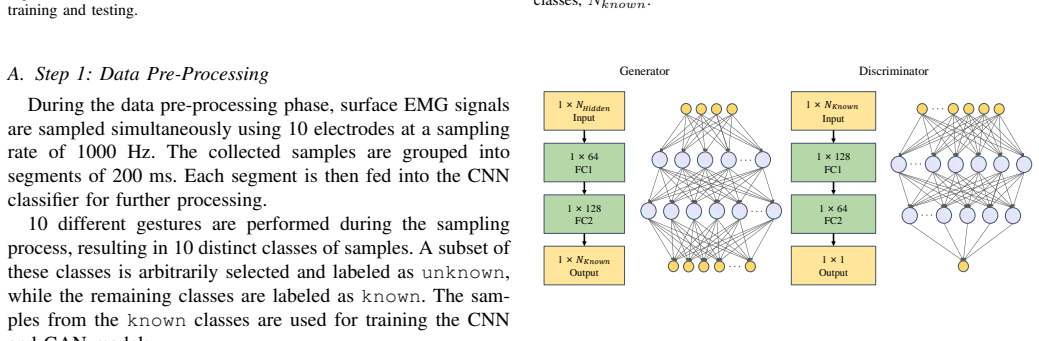
The load-bearing object is the GAN discriminator applied to the CNN's output feature vector, a $1 \times N_{\text{known}}$ probability vector. The generator takes Gaussian noise and emits synthetic feature vectors meant to resemble what an unknown gesture would produce; the discriminator is trained with cross-entropy loss to output high scores for real known-gesture features and low scores for synthetic unknowns, and a threshold is fixed from the ROC curve to convert scores into accept or reject decisions. This design moves the burden of open-set recognition off the raw EMG signal and onto a low-dimensional feature space, which keeps the added computation small enough for edge deployment.
What would settle it
Train the CNN and GAN on one subject's known gestures, then test the trained discriminator on real unknown gestures recorded from a different subject or on a different day; if the discriminator's AUC falls to roughly 0.5 or the active error rate stays above 80%, the synthetic-unknown proxy has failed. A sharper test is to withhold all real unknown gestures from threshold selection and set the threshold using only the GAN's synthetic samples; if the rejection performance then collapses to the no-discriminator baseline, the claimed gain depends on validation-time access to real unknowns rather than on the GAN's synthetic distribution.
Extended reading notes
Core claim
The paper's central claim is that a discriminator trained adversarially on the output features of a CNN gesture classifier can separate known gestures from unknown ones well enough to block the unknown ones before they reach the actuator. The discriminator sees only the K-dimensional prediction vector of a CNN trained on known gestures; the generator manufactures synthetic 'unknown' prediction vectors from Gaussian noise, and the discriminator learns to tell the CNN's real known-gesture outputs from these synthetic unknowns. At run time, if the discriminator's score for a new sample falls below a threshold chosen from the ROC curve, the system holds its default or last state instead of moving. Within the same subject and recording session this reduces the proportion of executed actions that are wrong by 23.6% while preserving 97.6% accuracy on known classes; the paper shows the improvement is consistent across several known-to-unknown ratios, though it degrades sharply in cross-subject tests.
Load-bearing premise
The paper assumes that synthetic unknown-gesture features generated by a GAN stand in for real unknown-gesture features well enough that a threshold tuned on real validation unknowns will also reject real unknowns at run time, and the evidence suggests this holds within one recording session but not across subjects.
Editorial extensions
If this is right
- Deploying this guard means an EMG-driven prosthetic or exoskeleton will stay still rather than perform an unintended motion when it encounters an unfamiliar gesture, improving clinical usability.
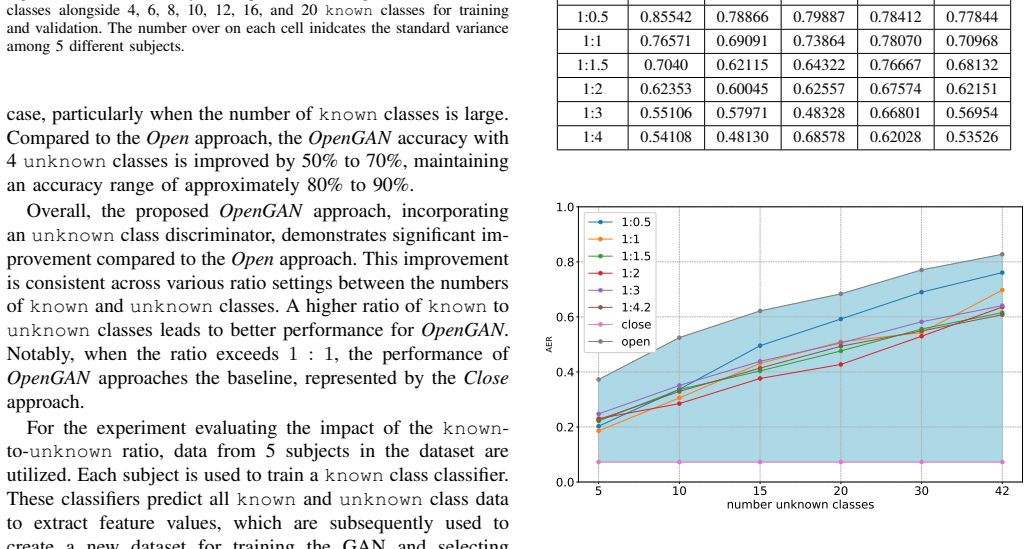
- The approach works across known-to-unknown ratios up to about 1:2; beyond that, with many more unknown than known gestures, AER grows and the method loses its advantage.
- Because the discriminator operates on the CNN's prediction vector rather than on raw signals, it can be added to an already-trained gesture classifier without retraining the classifier.
- The 97.6% known-class accuracy and 23.6% AER improvement were measured within a single recording session; the paper's cross-subject tests show AER above 80%, so within-session deployment is the realistic near-term target.
Reading between the lines
- A deployed system would need a way to set the rejection threshold without access to real unknown gestures, since the paper's threshold is chosen from an ROC curve built with validation unknowns; how to set it from synthetic data alone is left open.
- The same discriminator-on-features design could be attached to any closed-set classifier that outputs a fixed-size prediction vector, so the idea may transfer to other biosignal control loops such as EEG or EOG-based interfaces.
- Combining this unknown-gesture guard with confidence-based rejection for known gestures would address two separate error sources; the paper names this as future work, and the experimental trend suggests the two mechanisms are complementary.
- Because the generator only sees CNN output vectors, the approach is agnostic to the underlying classifier architecture; this means stronger or weaker classifiers can be swapped in without changing the open-set rejection layer.
Signed reviews
Editorial analysis
A structured set of objections, weighed in public.
Referee Report
Summary. The paper proposes a GAN-based open-set recognition framework for myoelectric control. A CNN classifier first maps EMG windows into class probabilities for known gestures; a GAN discriminator is then trained on known-class features together with synthetic features produced by a generator, and a threshold on the discriminator output is used to reject presumed unknown gestures before an actuator executes a movement. The method is evaluated on the Ninapro DB1 dataset and on self-collected surface-EMG data from ten gestures, reporting 97.6% accuracy on known classes and a 23.6 percentage-point improvement in Active Error Rate after rejection. Additional experiments vary the known-to-unknown ratio, test new unknown classes, and probe cross-domain (cross-subject) performance.
Significance. If the evaluation protocol were sound, this paper would make a useful and practically relevant contribution: it tackles the underexplored problem of unknown gestures in myoelectric control, the proposed module is lightweight and suitable for edge deployment, and the authors provide publicly available code and a real-hardware validation with a Shimmer device. These are genuine strengths. However, the headline results rest on an evaluation protocol in which real unknown samples are used to select the rejection threshold (Sec. IV.C, Fig. 6) and, in the ratio experiments, to create the feature set for GAN training and discriminator selection (Sec. VI.A). This makes the reported 97.6% accuracy and 23.6% AER improvement artifacts of tuning to the target unknown distribution rather than evidence of open-set generalization. The cross-domain experiments (Sec. VI.C, Fig. 11) show AER above 80% for all methods, further limiting the claims to within-session conditions. The central idea is worth pursuing, but the current experiments need to be redesigned before the claims can be accepted.
major comments (3)
- [Section IV.C, Fig. 6] The rejection threshold is selected as the point closest to the upper-left corner of the ROC curve computed on the test set derived from self-collected data, and this test set contains the exact real unknown gestures later used in Sec. VI.D to report the 97.6% known-class accuracy and the 23.6% AER improvement. Because the threshold is tuned using labels of the very unknown samples being rejected, the headline result measures threshold overfitting to the evaluation set rather than open-set generalization. The threshold should be chosen using only known-class data, synthetic unknowns, or a separate validation set disjoint from the unknown classes used for final evaluation.
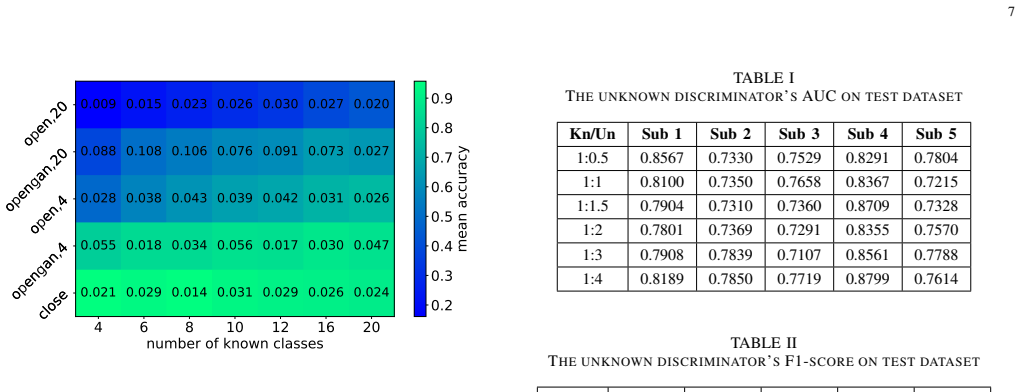
- [Section VI.A] The text states that classifiers predict features from 'all known and unknown class data' and that these features are used 'to create a new dataset for training the GAN and selecting the discriminator.' This directly contradicts Sec. IV.C, which says the unknown EMG samples are preserved for the final evaluation of the discriminator. In the ratio experiments, real unknown samples therefore enter GAN training or discriminator selection, so the AUC values in Table I, the F1-scores in Table II, and the AER comparisons in Figs. 8-10 do not measure rejection of previously unseen gestures. The authors need to specify exactly which real unknown samples are used for training versus evaluation and re-run the experiments with strict separation.
- [Section VI.C, Fig. 11] In cross-domain testing, the AER values exceed 80% for all methods, including the proposed OpenGAN approach. This indicates that the method's apparent success is confined to the same subject and recording session, and it does not support the abstract's general claim of robustness under 'inter-subject/session variability.' The conclusions should be explicitly scoped to the within-session setting, or the cross-domain performance must be improved before the claimed real-world applicability is justified.
minor comments (6)
- [Section IV.A] The phrase 'spited into known and unknown dataset' appears to be a typo for 'split into known and unknown datasets.'
- [Fig. 9 caption] The caption contains the typo 'inidcates' instead of 'indicates.'
- [Fig. 13 caption] The caption refers to 'the right heatmap plot' and 'the right error plot,' but the text describes what appears to be a left heatmap and a right error plot; the figure-caption orientation should be corrected.
- [Section VI.D] The phrase '57.6% open set accuracy' is unclear; it should be defined explicitly as the accuracy on the combined known-plus-unknown test set before rejection, so that the improvement to 81.2% is unambiguous.
- [Fig. 5] The generator's hidden dimension NHidden is referenced in the figure and in Sec. IV.C, but no numerical value is reported in the experiments; please state the value used for each evaluation.
- [Section IV.B] The notation is inconsistent between the introduction's 'K-patterns' and the later 'Nknown'; a single notation for the number of known classes would improve readability.
Circularity Check
Reported open-set gains are in-sample ROC-optimized: real unknown-class samples enter GAN training/selection or threshold fitting, so the 23.6% AER improvement is not a prediction on truly unseen gestures.
-
fitted input called prediction
[Sec. VI-A, 'Impact of Known-to-Unknown Ratio' (paragraph after Fig. 9)]
"For the experiment evaluating the impact of the known-to-unknown ratio, data from 5 subjects in the dataset are utilized. Each subject is used to train a known class classifier. These classifiers predict all known and unknown class data to extract feature values, which are subsequently used to create a new dataset for training the GAN and selecting the discriminator."
The GAN discriminator is trained and selected using features extracted from real unknown-class samples, then the same unknown-class setup is used to report AER improvement over the 'Open' baseline. The claimed generalization to 'unknown classes' is therefore measured on data that already participated in discriminator training/selection, making the improvement an in-sample fit rather than an open-set prediction.
-
fitted input called prediction
[Fig. 6 caption; Sec. V-B 'Model Training']
"The ROC curve and its optimal cutoff are determined using the test set derived from self-collected data. ... To optimize the performance of the discriminator, a threshold is determined based on the AUC value produced by the discriminator. As shown in Fig. 6, the ROC curve of the discriminator is analyzed, and the point nearest to the top-left corner is selected as the threshold."
The rejection threshold is chosen as the ROC-optimal point on a test set that contains the real unknown gestures. The same test set is then used to compute the reported AER improvement and accuracy after rejection. Since any threshold can be tuned to maximize ROC performance on the exact labels being evaluated, the headline rejection metrics are forced by construction rather than by genuine open-set generalization.
1 more flagged steps
-
fitted input called prediction
[Sec. VI-D, 'Verification of Self-Collected EMG signal']
"Six of the gestures were selected as known classes for training the classification model, while the remaining four were designated as unknown classes to form the validation set. The model achieved 97.6% accuracy on the known class dataset. ... The trained CNN achieved 57.6% open set accuracy, which improved to 81.2% after rejecting unknown classes with the discriminator."
The self-collected evaluation designates the four unknown gestures as the 'validation set' and then reports the accuracy improvement after applying a discriminator threshold that, per Fig. 6, was determined from self-collected test data containing those same unknown gestures. The 23.6% AER improvement is thus an artifact of using the target unknown labels to set the operating point of the rejection rule.
full rationale
The paper's central claim is that a GAN-based discriminator can reject previously unseen gestures, but the evidence chain leaks real unknown-class information into model selection and threshold calibration. Sec. VI-A explicitly states that real known and unknown class data are both used to create the GAN training set and to select the discriminator, contradicting Sec. IV-C's assertion that unknown samples are preserved only for final evaluation. Separately, the ROC-based rejection threshold is chosen using a test set containing the real unknown gestures (Fig. 6, Sec. V-B), and the same unknown gestures are used to compute the reported 97.6% accuracy and 23.6% AER improvement (Sec. VI-D). Consequently, the headline open-set rejection numbers are in-sample ROC-optimized quantities, not predictions on truly unseen classes. The cross-domain experiments (Sec. VI-C) reinforce this reading: when the discriminator is applied to a genuinely different subject, AER exceeds 80% for all methods. This is a partial but real circularity in the evaluation protocol, so the score is 6 rather than 0; the architecture itself is not entirely tautological, but the principal empirical result reduces to fitting on the evaluation labels.
Assumptions & free parameters
free parameters (3)
- Rejection threshold =
Not reported
- GAN hidden dimension NHidden =
Not reported
- Number of known gesture classes (self-collected) =
6 known, 4 unknown
assumptions (4)
- domain assumption Synthetic unknown feature vectors sampled from the generator are representative of real unknown gesture features.
- domain assumption 200 ms windows of sEMG contain sufficient discriminative information for gesture classification.
- domain assumption The K-dimensional CNN output preserves enough information to separate known from unknown gestures.
- standard math Standard GAN training dynamics and loss functions apply as described in Sec. III.
Cite this review
Pith. "Pith review of Robustness-enhanced Myoelectric Control with GAN-based Open-set Recognition." pith.science (2026). https://pith.science/paper/U3OKAI6C
@misc{pith2026241215819,
  author       = {Pith},
  title        = {Pith review of: Robustness-enhanced Myoelectric Control with GAN-based Open-set Recognition},
  year         = {2026},
  howpublished = {\url{https://pith.science/paper/U3OKAI6C}},
  note         = {Machine review of arXiv:2412.15819}
}
read the original abstract
Electromyography (EMG) signals are widely used in human motion recognition and medical rehabilitation, yet their variability and susceptibility to noise significantly limit the reliability of myoelectric control systems. Existing recognition algorithms often fail to handle unfamiliar actions effectively, leading to system instability and errors. This paper proposes a novel framework based on Generative Adversarial Networks (GANs) to enhance the robustness and usability of myoelectric control systems by enabling open-set recognition. The method incorporates a GAN-based discriminator to identify and reject unknown actions, maintaining system stability by preventing misclassifications. Experimental evaluations on publicly available and self-collected datasets demonstrate a recognition accuracy of 97.6\% for known actions and a 23.6\% improvement in Active Error Rate (AER) after rejecting unknown actions. The proposed approach is computationally efficient and suitable for deployment on edge devices, making it practical for real-world applications.
Figures


Figures from the paper (8 more)




Reference graph
Works this paper leans on
-
[1]
Interpreting deep learning features for myoelectric control: A comparison with handcrafted features,
U. C. Allard, E. Campbell, A. Phinyomark, F. Laviolette, B. Gosselin, and E. J. Scheme, “Interpreting deep learning features for myoelectric control: A comparison with handcrafted features,” Frontiers in Bioengi- neering and Biotechnology , vol. 8, 2020
work page 2020
-
[2]
Electromyography-based control of lower limb prostheses: A systematic review,
B. Ahkami, K. Ahmed, A. Thesleff, L. J. Hargrove, and M. Ortiz- Catal´an, “Electromyography-based control of lower limb prostheses: A systematic review,” IEEE transactions on medical robotics and bionics , vol. 5, pp. 547 – 562, 2023
work page 2023
-
[3]
A. Fleming, S. Huang, E. Buxton, F. Hodges, and H. Huang, “Direct continuous electromyographic control of a powered prosthetic ankle for improved postural control after guided physical training: A case study,” Wearable technologies, vol. 2, 2021
work page 2021
-
[4]
A soft neuroprosthetic hand providing simultaneous myoelectric control and tactile feedback
G. Gu, N. Zhang, H. Xu, S. Lin, Y . Yu, G. Chai, L. Ge, H. Yang, Q. Shao, X. Sheng, X. Zhu, and X. Zhao, “A soft neuroprosthetic hand providing simultaneous myoelectric control and tactile feedback.”Nature biomedical engineering, 2021
work page 2021
-
[5]
Domain adaptation for semg- based gesture recognition with recurrent neural networks,
I. Ketyk ´o, F. Kov ´acs, and K. Z. Varga, “Domain adaptation for semg- based gesture recognition with recurrent neural networks,” 2019 Inter- national Joint Conference on Neural Networks (IJCNN) , pp. 1–7, 2019
work page 2019
-
[6]
M. Atzori, M. Cognolato, and H. M ¨uller, “Deep learning with convo- lutional neural networks applied to electromyography data: A resource for the classification of movements for prosthetic hands,” Frontiers in Neurorobotics, vol. 10, 2016
work page 2016
-
[7]
Deep learning for emg- based human-machine interaction: A review,
D. Xiong, D. Zhang, X. Zhao, and Y . Zhao, “Deep learning for emg- based human-machine interaction: A review,” IEEE/CAA Journal of Automatica Sinica, vol. 8, pp. 512–533, 2021
work page 2021
-
[8]
Y . Wang, L. Jiang, L. Ren, P. Huang, M. Yu, L. Tian, X. Li, J. Xie, P. Fang, and G. Li, “Towards improving the quality of electrophysio- logical signal recordings by using microneedle electrode arrays,” IEEE Transactions on Biomedical Engineering, vol. 68, pp. 3327–3335, 2021
work page 2021
Show all 25 references
-
[9]
Classification of hand movements in amputated subjects by semg and accelerometers,
M. Atzori, A. Gijsberts, H. M ¨uller, and B. Caputo, “Classification of hand movements in amputated subjects by semg and accelerometers,” 2014 36th Annual International Conference of the IEEE Engineering in Medicine and Biology Society , pp. 3545–3549, 2014
2014
-
[10]
Cooperative sensing and wearable computing for sequential hand gesture recogni- tion,
X. Zhang, Z. Yang, T. Chen, D. Chen, and M.-C. Huang, “Cooperative sensing and wearable computing for sequential hand gesture recogni- tion,” IEEE Sensors Journal , vol. 19, pp. 5775–5783, 2019
2019
-
[11]
Surface emg-based inter-session gesture recognition enhanced by deep domain adaptation,
Y . Du, W. Jin, W. Wei, Y . Hu, and W. dong Geng, “Surface emg-based inter-session gesture recognition enhanced by deep domain adaptation,” Sensors (Basel, Switzerland) , vol. 17, 2017
2017
-
[12]
Deep learning for electromyo- graphic hand gesture signal classification using transfer learning,
U. C ˆot´e-Allard, C. L. Fall, A. Drouin, A. Campeau-Lecours, C. Gosselin, K. Glette, F. Laviolette, and B. Gosselin, “Deep learning for electromyo- graphic hand gesture signal classification using transfer learning,” IEEE Transactions on Neural Systems and Rehabilitation Engi...
2019
-
[13]
Unsupervised domain adver- sarial self-calibration for electromyography-based gesture recognition,
U. C ˆot´e-Allard, G. Gagnon-Turcotte, A. Phinyomark, K. Glette, E. J. Scheme, F. Laviolette, and B. Gosselin, “Unsupervised domain adver- sarial self-calibration for electromyography-based gesture recognition,” IEEE Access, vol. 8, pp. 177 941–177 955, 2020
2020
-
[14]
Surface emg signals and deep transfer learning-based physical action classification,
F. Demir, V . Bajaj, M. C. Ince, S. Taran, and A. S ¸eng ¨ur, “Surface emg signals and deep transfer learning-based physical action classification,” Neural Computing and Applications , vol. 31, pp. 8455 – 8462, 2019
2019
-
[15]
A real-time pattern recognition based myoelectric control usability study implemented in a virtual environment,
L. J. Hargrove, Y . G. Losier, B. A. Lock, K. B. Englehart, and B. Hudgins, “A real-time pattern recognition based myoelectric control usability study implemented in a virtual environment,” 2007 29th Annual International Conference of the IEEE Engineering in Medicine and Biolo...
2007
-
[16]
Selective classifi- cation for improved robustness of myoelectric control under nonideal conditions,
E. J. Scheme, K. B. Englehart, and B. Hudgins, “Selective classifi- cation for improved robustness of myoelectric control under nonideal conditions,” IEEE Transactions on Biomedical Engineering, vol. 58, pp. 1698–1705, 2011
2011
-
[17]
Confidence-based rejection for improved pattern recognition myoelectric control,
E. J. Scheme, B. Hudgins, and K. B. Englehart, “Confidence-based rejection for improved pattern recognition myoelectric control,” IEEE Transactions on Biomedical Engineering, vol. 60, pp. 1563–1570, 2013
2013
-
[18]
Effects of confidence-based rejection on usability and error in pattern recognition- based myoelectric control,
J. W. Robertson, K. B. Englehart, and E. J. Scheme, “Effects of confidence-based rejection on usability and error in pattern recognition- based myoelectric control,” IEEE Journal of Biomedical and Health Informatics, vol. 23, pp. 2002–2008, 2019
2002
-
[19]
Cnn confidence estimation for rejection-based hand gesture classification in myoelectric control,
T. Bao, S. A. J. Zaidi, S. Xie, P. Yang, and Z. Zhang, “Cnn confidence estimation for rejection-based hand gesture classification in myoelectric control,” IEEE Transactions on Human-Machine Systems , vol. 52, pp. 99–109, 2022
2022
-
[20]
Learning to classify with incremental new class,
D.-W. Zhou, Y . Yang, and D.-C. Zhan, “Learning to classify with incremental new class,” IEEE Transactions on Neural Networks and Learning Systems, vol. 33, pp. 2429–2443, 2022
2022
-
[21]
Generative openmax for multi-class open set classification,
Z. Ge, S. Demyanov, Z. Chen, and R. Garnavi, “Generative openmax for multi-class open set classification,” ArXiv, vol. abs/1707.07418, 2017
2017 arXiv
-
[22]
Unsupervised anomaly detection with generative adversarial networks to guide marker discovery,
T. Schlegl, P. Seeb ¨ock, S. M. Waldstein, U. M. Schmidt-Erfurth, and G. Langs, “Unsupervised anomaly detection with generative adversarial networks to guide marker discovery,” in IPMI, 2017
2017
-
[23]
Open set learning with counterfactual images,
L. Neal, M. L. Olson, X. Z. Fern, W.-K. Wong, and F. Li, “Open set learning with counterfactual images,” in ECCV, 2018
2018
-
[24]
Generative adversarial nets,
I. J. Goodfellow, J. Pouget-Abadie, M. Mirza, B. Xu, D. Warde-Farley, S. Ozair, A. C. Courville, and Y . Bengio, “Generative adversarial nets,” in NIPS, 2014. 11
2014
-
[25]
Electromyography data for non-invasive naturally-controlled robotic hand prostheses,
M. Atzori, A. Gijsberts, C. Castellini, B. Caputo, A.-G. M. Hager, S. Elsig, G. Giatsidis, F. Bassetto, and H. M ¨uller, “Electromyography data for non-invasive naturally-controlled robotic hand prostheses,” Scientific Data, vol. 1, 2014
2014
Reviewed August 11, 2026 · model on record in the stance chip above.
Discussion (0). Continue with ORCID to comment.