REVIEW 3 major objections 5 minor 81 references
Contribution of the chiral vortical effect to the evolution of the hypermagnetic field and the matter-antimatter asymmetry in the early Universe
T0 review · 3 major / 5 minor · reviewed 2026-08-14 · deepseek-v4-flash
Pith's one-line read With nonzero initial vorticity and nonzero matter asymmetry, the chiral vortical effect can generate a hypermagnetic field from zero initial value in the pre-electroweak plasma, after which the chiral magnetic effect amplifies it.
desk verdict Clean mechanism paper showing CVE can seed hypermagnetic fields from zero B, but only under a highly tuned helical ansatz; deserves peer review. read the letter →
The pith
A machine-rendered reading of the paper's core claim, the machinery that carries it, and where it could break.
The reading
What carries the argument
The object that carries the argument is the fully helical, monochromatic Chern-Simons wave configuration assigned to both vector potentials: $\vec{A}_Y = \gamma(t)(\sin kz, \cos kz, 0)$ for the hypermagnetic field and $\vec{S} = r(t)(\sin kz, \cos kz, 0)$ for the velocity field, giving $\vec{B}_Y = (k/R)\vec{A}_Y$, $\vec{v} = (k/R)\vec{S}$, and $\vec{\omega} = (k/R)\vec{v}$. Because the two potentials share the same wavevector, helicity sign, and spatial alignment, the advection term $\vec{v}\times\vec{B}_Y$ disappears and the plasma is force-free ($\vec{J}\times\vec{B}_Y = 0$), so the vorticity term in the field equation survives only as a source proportional to $\langle \vec{v}\cdot\vec{B}_Y\rangle = v(t)B(t)$. That alignment is what converts the chiral vortical current $\vec{J}_{cv} = c_v\,\vec{\omega}$ with $c_v = (g'/8\pi^2)(\mu_{eR}^2 - \mu_{eL}^2)$ into a driver of field growth from zero.
What would settle it
Solve the full three-dimensional anomalous MHD equations with $B(0)=0$ and a generic spectrum of initial velocity perturbations instead of the single-mode aligned ansatz: if the correlation $\langle \vec{v}\cdot\vec{B}_Y\rangle$ that feeds the CVE source term does not emerge, or emerges with the wrong alignment, the field does not grow from zero. The paper's own Section 5 already demonstrates the sharpness of the condition — swapping to a different basis configuration of the Chern-Simons ansatz annihilates the seed, and opposite helicity suppresses it by about 23 orders of magnitude. A complementary check is to ask whether any realistic pre-electroweak vorticity source (decaying magnetic fields, bubble collisions, or the QCD transition) produces the required same-handedness alignment in the first place.
Extended reading notes
Core claim
The central discovery is a source term. In the anomalous magnetohydrodynamics equation for the hypermagnetic field amplitude, the chiral vortical effect contributes the term $C_5 (y_R^2 - y_L^2)\, v(x) / x^{3/2}$ (the last term of Eq. (3.12)), which is nonzero only when the vorticity amplitude $v(x)$ and the electron chirality imbalance $y_R^2 - y_L^2$ are both nonzero. With the fully helical Chern-Simons wave configuration chosen for both the velocity and the hypermagnetic vector potentials — same wavevector, same helicity, same alignment — the correlation $\langle \vec{v}\cdot\vec{B}_Y\rangle$ reduces to $v(t)B(t)$, so this term acts as a genuine source and the field grows out of $B(0)=0$. The chiral magnetic effect then amplifies the seeded field to a saturation value near $10^{20}$ Gauss at the onset of the electroweak phase transition, and the matter asymmetries convert at a temperature that rises with the initial vorticity. The paper further establishes the correct symmetric-phase vorticity coefficient $c_v = (g'/8\pi^2)(\mu_{eR}^2 - \mu_{eL}^2)$, which vanishes once chirality-flip reactions equalize the two electron chemical potentials — so the vortical effect acts only briefly, yet that brief action is what makes the entire evolution possible.
Load-bearing premise
The result stands on the assumption that the plasma's velocity field and the hypermagnetic field begin as perfectly aligned helical waves with the same wavelength and the same handedness: if the two vector potentials are misaligned the source term $\langle \vec{v}\cdot\vec{B}_Y\rangle$ vanishes and no field is produced, and with opposite handedness the generated field is about 23 orders of magnitude smaller — both limitations stated in the paper's own Section 5.
Editorial extensions
If this is right
- Magnetogenesis before the electroweak transition needs no pre-existing seed field: a nonzero vorticity plus a nonzero matter asymmetry generates the hypermagnetic field from $B=0$, which the chiral magnetic effect then amplifies.
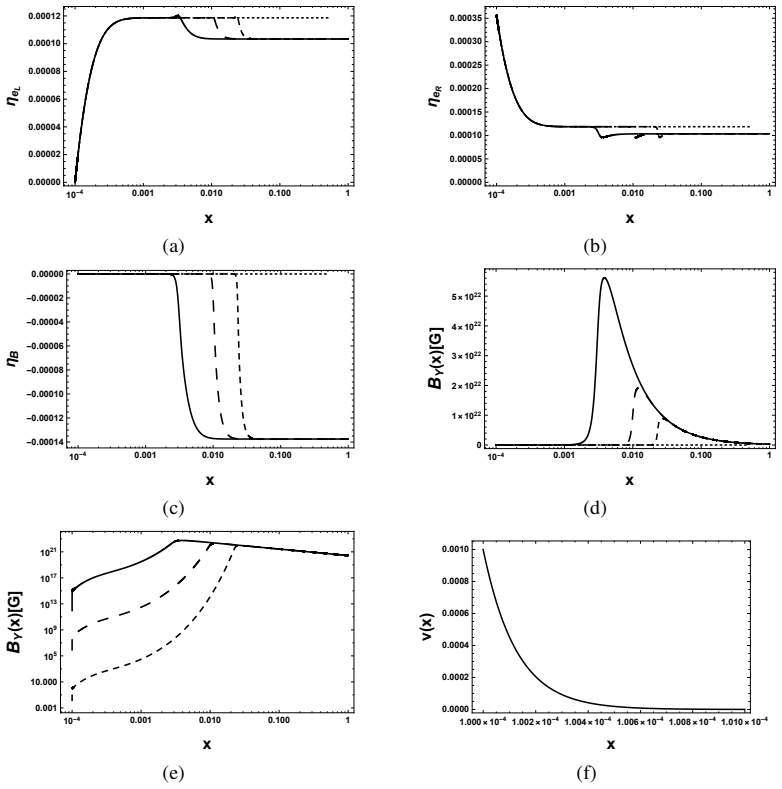
- The final hypermagnetic field strength at the electroweak transition — about $10^{20}$ Gauss in the benchmark calculation — depends on the initial matter asymmetries and is nearly independent of the initial vorticity, as long as the vorticity is nonzero.
- Larger initial vorticity shifts the saturation event to higher temperature, so the conversion of lepton and baryon asymmetries happens earlier in cosmic history.
- The vortical effect self-terminates: once electron chirality-flip reactions equilibrate the right- and left-handed chemical potentials, $c_v$ vanishes and the CVE switches off, confining its role to the short seeding phase.
- Viscous damping of the vorticity, although extremely rapid, does not significantly affect the hypermagnetic field or the final asymmetries, because the seed is produced before the vorticity decays.
Reading between the lines
- Editorial inference: the paper's observation that a non-helical field component would make $\vec{J}\times\vec{B}_Y$ nonzero and source new vorticity points to a feedback loop the paper does not follow — magnetic fields regenerating the very vorticity that seeded them, which could prolong the CVE's active window beyond chirality-flip equilibration.
- Editorial inference: the sharp helicity sensitivity (opposite helicity suppresses the field by about 23 orders of magnitude) means the mechanism doubles as a diagnostic — future measurements of the helicity of intergalactic magnetic fields could constrain the helicity of the pre-electroweak velocity field, which is otherwise unobservable.
- Editorial inference: because $c_v$ is quadratic in the electron chemical potentials while $c_B$ is linear, one can tune the chemical potentials so that the chiral magnetic current vanishes while the chiral vortical current does not (e.g., $-2\mu_{eR} + \mu_{eL} - \frac{3}{4}\mu_B = 0$ with $\mu_{eR}^2 \ne \mu_{eL}^2$); the paper does not study this CVE-only regime.
- Editorial inference: a direct testable extension is to replace the single-mode ansatz with a broadband spectrum of wavevectors — the paper asserts the seed would still be produced, but the magnitude and sign of $\langle \vec{v}\cdot\vec{B}_Y\rangle$ for a realistic spectrum remain an open calculation.
Editorial analysis
A structured set of objections, weighed in public.
Referee Report
Summary. The paper extends earlier anomalous magnetohydrodynamics (AMHD) studies by adding the chiral vortical effect (CVE) to the evolution of hypermagnetic fields and matter asymmetries in the symmetric phase, for temperatures 100 GeV to 10 TeV. The authors adopt a fully helical, monochromatic Chern-Simons ansatz for both the hypermagnetic vector potential and the velocity vector potential, with the same wavevector and helicity. Within this ansatz they derive a closed set of ordinary differential equations for the right- and left-handed lepton asymmetries, the baryon asymmetry, the hypermagnetic field amplitude, and the velocity amplitude. The central numerical result is that, starting from zero hypermagnetic field but nonzero initial right-handed electron asymmetry and nonzero initial vorticity, the CVE source term in Eq. (3.12) generates a seed field that the chiral magnetic effect then amplifies; the saturation value of the field and the temperature at which the asymmetries are converted depend on the initial velocity. The paper also examines the effect of viscosity and finds that while it damps the velocity field quickly, the qualitative evolution is similar in the viscous and inviscid cases.
Significance. If the result is taken as an existence proof, the paper is a useful contribution to the AMHD literature. It provides a transparent derivation of the chiral vortical coefficient in the symmetric phase from the Standard Model hypercharge assignments, reduces the coupled system to a compact ODE set, and demonstrates numerically that, for the chosen ansatz, the CVE can seed a hypermagnetic field from B=0. The authors are candid in Section 5 about the restrictive nature of the configuration. The broader claim of cosmological relevance, however, is not yet supported: the seed mechanism depends on a specially prepared, measure-zero initial field configuration, and the input matter asymmetry is many orders of magnitude larger than the observationally inferred baryon asymmetry. The paper is therefore best read as a consistent proof of principle rather than as a complete magnetogenesis scenario.
major comments (3)
- [Section 5; Eqs. (2.24)-(2.25)] The central claim that the hypermagnetic field can grow from zero initial value only in the presence of nonzero vorticity is established only for the exactly aligned, same-helicity, single-mode Chern-Simons ansatz. The paper itself states in Section 5 that if the vector potentials are chosen in different basis configurations, the dot product in Eqs. (3.6) and (3.8) vanishes and no seed field is produced, and that with opposite helicity the generated BY and eta_B are about 23 orders of magnitude smaller. Since no physical mechanism is given for producing or maintaining this alignment and helicity in the early Universe, the abstract's claim overreaches. The authors should either supply a physical production mechanism for the aligned initial data or explicitly reframe the result as conditional on the ansatz.
- [Section 4, initial conditions] The numerical solutions use y_R(0)=10^3 with y_L(0)=y_B(0)=0. Using the paper's definition y_B = (4e4 pi^2 g*/15) eta_B, the observed baryon asymmetry eta_B ~ 1e-10 corresponds to y_B ~ 3e-8, so the initial right-handed electron asymmetry is more than ten orders of magnitude larger than the asymmetry the model is intended to explain. No mechanism is provided for generating such a large lepton asymmetry at T ~ 10 TeV, and the paper does not show whether observationally plausible initial asymmetries would still give a seed. This input is load-bearing because the saturation values and transition temperatures are controlled by the initial matter asymmetries.
- [Section 4; Eq. (3.13)] The initial velocity v0 is scanned over fifteen orders of magnitude (10^-18 to 10^-3) without a physical estimate of the vorticity amplitude or correlation scale produced in the symmetric phase. Since the seed term in Eq. (3.12) is proportional to v(x) and the velocity decays exponentially through viscosity, the quantitative predictions such as the saturation temperature depend on the magnitude and lifetime of this unmodeled input. The paper should either motivate v0 from a concrete source (e.g., turbulence, phase-transition dynamics, or some other vorticity-generation mechanism) or present the results as a parameter study with an explicit statement that the initial vorticity is a free parameter.
minor comments (5)
- [Abstract] The temperature range is written as 100GeV < T < 10TeV in the abstract text but as 100GeV <= T <= 10TeV in the body; these should be made consistent.
- [Section 3, Eq. (3.3)] The text reads 'Plank mass' and should read 'Planck mass'; the same typo appears in the reference list.
- [Section 5] There is a capitalization typo: 'Then, The seed hypermagnetic field' should be 'Then, the seed hypermagnetic field'.
- [Various] The manuscript has several spacing and hyphenation issues, such as 'Cher n-Simons' in the footnote to Section 2 and 'M nchen' in the final reference; a careful proofread would be helpful.
- [Figures 1 and 2] The figures would be easier to interpret if the caption explicitly stated that the dotted lines in Figure 2 correspond to the inviscid case and if the transition region in Figure 1(e) were marked with the critical temperature values quoted in the text.
Circularity Check
No significant circularity: the CVE seed term is derived from anomaly coefficients and Standard Model couplings, not fitted, and the alignment ansatz is explicit and disclosed.
full rationale
The paper's central result follows from the evolution equations it derives: the only term in Eq. (3.12) that can seed a hypermagnetic field from B_Y(0)=0 is C5 (y_R^2 - y_L^2) v(x)/x^(3/2), with C5 constructed from g', pi, and k, and v(x) is an initial condition that is scanned rather than tuned. The vorticity coefficient c_v in Eq. (2.20) is obtained from the anomaly coefficients in Eq. (2.10) and the Standard Model hypercharges, not from the final field values, and c_B is handled similarly. The choice of aligned, fully helical single-mode vector potentials in Eqs. (2.24)-(2.25) is an explicit ansatz, and the paper itself discloses in Sec. 5 that a different basis choice suppresses the seed and that opposite helicity reduces the generated field by about 23 orders of magnitude, so the conditional nature of the result is not hidden. Self-citations to the authors' prior works [35,38] appear for the previously studied CME coefficient and saturation behavior, but the new CVE source term is derived independently and the conclusion does not reduce to those citations. No fitted parameter is renamed as a prediction, and no load-bearing premise is justified solely by a self-citation; the derivation is self-contained given its stated assumptions.
Assumptions & free parameters
free parameters (4)
- Comoving wavenumber k =
10^-7 (GeV units)
- Initial right-handed electron asymmetry y_R(0) =
10^3 (xi_eR = 0.1)
- Initial velocity amplitude v0 =
0, 10^-18, 10^-10, 10^-3
- Helicity and alignment choice =
positive helicity, same basis for A_Y and S
assumptions (6)
- domain assumption Only first-generation lepton and baryon chemical potentials contribute to cv and cB (Eqs. 2.20-2.21).
- domain assumption Quark chemical potentials satisfy mu_uR = mu_dR = mu_Q and the Higgs asymmetry is zero; mu_Q = mu_B/12 (Eq. 2.17 and text after Eq. 2.21).
- domain assumption The plasma is homogeneous and incompressible with vanishing pressure gradient; the Navier-Stokes equation reduces to dv/dt = -nu k'^2 v (Eq. 2.32).
- ad hoc to paper The single-mode, fully helical Chern-Simons ansatz (Eqs. 2.24-2.25) represents the early-Universe fields and makes curl B proportional to B, so J x B = 0.
- domain assumption Transport inputs sigma = 100T, nu = 1/(5 alpha_Y^2 T), g_* = 106.75, and the chirality-flip rate Gamma_RL (Eq. 3.3) are valid in this temperature range.
- standard math The Abelian anomaly equations (3.1) and conservation of B - L and flavor charges hold as in the Standard Model.
Cite this review
Pith. "Pith review of Contribution of the chiral vortical effect to the evolution of the hypermagnetic field and the matter-antimatter asymmetry in the early Universe." pith.science (2026). https://pith.science/paper/U3OQUJX2
@misc{pith2026190810105,
  author       = {Pith},
  title        = {Pith review of: Contribution of the chiral vortical effect to the evolution of the hypermagnetic field and the matter-antimatter asymmetry in the early Universe},
  year         = {2026},
  howpublished = {\url{https://pith.science/paper/U3OQUJX2}},
  note         = {Machine review of arXiv:1908.10105}
}
read the original abstract
In this paper, we study the contribution of the chiral vortical effect, in addition to that of the chiral magnetic effect, to the evolution of the hypermagnetic field and the matter-antimatter asymmetry in the symmetric phase of the early Universe in the temperature range 100GeV < T < 10TeV. We choose a fully helical Chern-Simons wave configuration for the velocity and the hypermagnetic vector potential fields. The latter makes the plasma force-free in the absence of viscosity. We show that the most pronounced effect of the chiral vorticity is the production and initial growth of the hypermagnetic field. In particular, we show that in the presence of a non-zero matter asymmetry, the hypermagnetic field can grow from zero initial value only in the presence of a non-zero vorticity field. Moreover, we show that larger initial growths not only result in larger maximum values of the hypermagnetic field, but also cause the saturation of the hypermagnetic field and the conversion of the lepton-baryon asymmetry to occur more quickly, i.e., at a higher temperature. We show that the damping of the vorticity due to the presence of viscosity, which typically occurs extremely rapidly, does not significantly affect the evolution.
Figures

Reference graph
Works this paper leans on
-
[1]
Kazuharu Bamba, C. Q. Geng, S. H. Ho, Hypermagnetic baryo genesis, Physics Letters B 664 (2008), [arXiv:0712.1523 [hep-ph]]
arXiv 2008
-
[2]
Big-Bang nucleosynthesis (Particle Data Group mini-review)
B. Fields and S. Sarkar, Big-Bang nucleosynthesis (2006 Particle Data Group mini-review), J. Phys. G 33 (2006) 1 [arXiv:astro-ph/0601514]; G. Steigman, Primordial Nucleosynthesis: The Predicted an d Ob- served Abundances and Their Consequences, PoS NICXI (2010) 001, [arXiv:1008.4765 [astro-ph.CO]]
work page Pith review arXiv 2006
-
[3]
V . Simha and G. Steigman, Constraining The Early-Univer se Baryon Density And Expansion Rate, JCAP 0806 (2008) 016, [arXiv:0803.3465 [astro-ph]]
arXiv 2008
-
[4]
M. Fukugita and T. Y anagida, Baryogenesis Without Grand Unification, Phys. Lett. B 174 (1986) 45, [DOI: 10.1016/0370-2693(86)91126-3]
-
[5]
Baryogenesis via leptogenesis in multi-field inflation
G. Panotopoulos and N. Videla, Baryogenesis via leptoge nesis in multi-field inflation, Eur. Phys. J. C78 (2018) 774, [arXiv:1809.07633 [gr-qc]]
work page Pith review arXiv 2018
-
[6]
V . A. Kuzmin, V . A. Rubakov and M. E. Shaposhnikov, On the A nomalous Electroweak Baryon Number Nonconservation in the Early Uni verse, Phys. Lett. B 155 (1985) 36,][DOI: 10.1016/0370-2693(85)91028-7]
-
[7]
A. D. Sakharov, Violation of CP Invariance, C Asymmetry, and Baryon Asymmetry of the Universe, Pisma Zh. Eksp. Teor. Fiz. 5 (1967 ) 32 [JETP Lett. 5 (1967) 24] [Sov. Phys. Usp. 34 (1991) 392] [Usp. Fiz. N auk 161 (1991) 61], [DOI: 10.1070/PU1991v034n05ABEH002497]. 22
-
[8]
A. D. Dolgov, NonGUT baryogenesis, Phys. Rept. 222, 309 (1992), [DOI: 10.1016/0370-1573(92)90107-B]
Show all 81 references
-
[9]
Bertolami, D
O. Bertolami, D. Colladay, V . A. Kostelecky and R. Pottin g, CPT violation and baryogenesis, Phys. Lett. B 395, (1997) 178, [arXiv:hep-ph/9612437]
1997 arXiv
-
[10]
Bjrn Garbrecht , Why is there more matter than antimatte r? Cal- culational methods for leptogenesis and electroweak baryo genesis, [arXiv:1812.02651 [hep-ph]]
-
[11]
t Hooft, Symmetry Breaking Through Bell-Jackiw Anom alies, Phys
G. t Hooft, Symmetry Breaking Through Bell-Jackiw Anom alies, Phys. Rev. Lett. 37 (1976), [DOI: 10.1103/PhysRevLett.37.8]
1976 doi
-
[12]
L. M. Widrow, Origin of galactic and extragalactic magn etic fields, Rev. Mod. Phys. 74, 775 (2002), [arXiv:astro-ph/0207240]
2002 arXiv
-
[13]
P . P . Kronberg, Extragalactic magnetic fields, Rep. Pro g. Phys. 57, 325 (1994), [DOI: 10.1088/0034-4885/57/4/001]
1994 doi
-
[14]
J. P . V allee, Cosmic magnetic fields as observed in the Un iverse, in galac- tic dynamos, and in the Milky Way, New Aston. Rev.48,763 (200 4), [DOI: 10.1016/j.newar.2004.03.017]
2004 doi
-
[15]
P . A. R. Ade et al. (Planck Collaboration), Planck 2015 r esults. XIX. Con- straints on primordial magnetic fields, Astron. Astrophys. 594, A19 (2016)
2016
-
[16]
Ando and A
S. Ando and A. Kusenko, Evidence for Gamma-Ray Halos Around Active Galactic Nuclei and the First Measurement of Intergalactic Magnetic Fields, Astrophys.J. 722 (2010) L39 [arXiv:1005.1924 [astro-ph.HE]]
2010 arXiv
-
[17]
Essey, S
W. Essey, S. Ando and A. Kusenko, Determination of intergalactic mag- netic fields from gamma ray data , Astropart.Phys. 35 (2011) 135-139 [arXiv:1012.5313 [astro-ph.HE]]
2011 arXiv
-
[18]
W. Chen, J. H. Buckley, and F. Ferrer, Search for GeV Gamma-Ray Pair Halos Around Low Redshift Blazars , Phys. Rev. Lett. 115 (2015) 211103 [arXiv:1410.7717 [astro-ph.HE]]
2015 arXiv
-
[19]
W. Chen, B. D. Chowdhury, F. Ferrer, H. Tashiro, and T. V a chaspati, In- tergalactic magnetic field spectra from diffuse gamma-rays , Mon. Not. Roy. Astron. Soc. 450 (2015) 3371 [arXiv:1412.3171 [astro-ph.CO]]
2015 arXiv
-
[20]
Brandenburg, D
A. Brandenburg, D. Sokoloff, and K. Subramanian, Curre nt status of turbu- lent dy- namo theory: From large-scale to small-scale dynam os, Space Sci. Rev.169, 123(2012), [arXiv:1203.6195 [astro-ph.SR]]. 23
2012 arXiv
-
[21]
Grasso and H
D. Grasso and H. R. Rubinstein, Magnetic fields in the ear ly Universe, Phys. Rep. 348, 163 (2001), [arXiv:astro-ph/0009061]
2001 arXiv
-
[22]
Durrer and A
R. Durrer and A. Neronov, Cosmological magnetic fields: Their genera- tion, evolution and observation, Astron. Astrophys. Rev. 21, 62 (2013), [arXiv:1303.7121 [astro-ph.CO]]
2013 arXiv
-
[23]
M. J. Rees, The origin and cosmogonic implications of se ed magnetic fields, Quart. J. Roy. Astr. Soc., 28, 197-206 (1987)
1987
-
[24]
Subramanian, D
K. Subramanian, D. Narasimha, and S. M. Chitre, Mon. Not . Roy. Astron. Soc. 271, 15 (1994)
1994
-
[25]
R. M. Kulsrud and E. G. Zweibel, The Origin of Astrophysi cal Magnetic Fields, Rept. Prog. Phys. 71, 0046091 (2008), [arXiv:0707.2783 [astro-ph]]
2008 arXiv
-
[26]
M. S. Turner and L. M. Widrow, Inflation Produced, Large S cale Magnetic Fields, Phys. Rev. D 37, 2743 (1988), [DOI: 10.1103/PhysRevD.37.2743]
1988 doi
-
[27]
Enqvist and P
K. Enqvist and P . Olesen, On primordial magnetic fields o f electroweak ori- gin, Phys. Lett. B 319, 178 (1993), [arXiv:hep-ph/9308270]
1993 arXiv
-
[28]
Bamba, Property of the spectrum of large-scale magne tic fields from in- flation, Phys
K. Bamba, Property of the spectrum of large-scale magne tic fields from in- flation, Phys. Rev. D 75, 083516 (2007), [arXiv:astro-ph/0703647]
2007 arXiv
-
[29]
Joyce and M
M. Joyce and M. Shaposhnikov, Primordial magnetic field s, right-handed electrons, and the Abelian anomaly, Phys. Rev. Lett. 79, 1193 (1997), [arXiv:astro-ph/9703005]
1997 arXiv
-
[30]
Kandus, K
A. Kandus, K. E. Kunze and C. G. Tsagas, Primordial magne togenesis, Phys. Reports.505, 1 (2011), [arXiv:1007.3891 [astro-ph.CO]]
2011 arXiv
-
[31]
M. E. Shaposhnikov, Structure of the High Temperature G auge Ground State and Electroweak Production of the Baryon Asymmetry, N ucl. Phys. B 299, 797 (1988); M. Giovannini and M. E. Shaposhnikov, Primordi al hypermagnetic fields and triangle anomaly, Phys. Rev. D 57, 2186 (1998...
1988 arXiv
-
[32]
Dvornikov and V
M. Dvornikov and V . B. Semikoz, Leptogenesis via hypermagnetic fields and baryon asymmetry, J. Cosmol. Astropart. Phys. 1202 (2012) 0 40; Erratum: JCAP 1208 (2012) E01, [arXiv:1111.6876 [hep-ph]]
2012 arXiv
-
[33]
Dvornikov and V
M. Dvornikov and V . B. Semikoz, Lepton asymmetry growth in the sym- metric phase of an electroweak plasma with hypermagnetic fie lds ver- sus its washing out by sphalerons, Phys. Rev. D 87, 025023 (2013), [arXiv:1212.1416 [astro-ph.CO]]. 24
2013 arXiv
-
[34]
V . B. Semikoz, A. Y u. Smirnov, and D. D. Sokoloff, Genera tion of hyper- magnetic helicity and leptogenesis in the early Universe, P hys. Rev. D 93, 103003 (2016), [arXiv:1604.02273 [hep-ph]]
2016 arXiv
-
[35]
Rostam Zadeh and S
S. Rostam Zadeh and S. S. Gousheh, Contributions to the UY (1) Chern- Simons term and the evolution of fermionic asymmetries and h ypermagnetic fields, Phys. Rev. D 94, 056013 (2016), [arXiv:1512.01942 [hep-ph]]
2016 arXiv
-
[36]
Kamada and A
K. Kamada and A. J. Long, Large-scale magnetic fields can explain the baryon asymmetry of the Universe, Phys. Rev. D 93, 083520 (2016), [ arXiv:1602.02109 [hep-ph]]
2016 arXiv
-
[37]
Kamada and A
K. Kamada and A. J. Long, Baryogenesis from decaying mag netic helicity, Phys. Rev. D 94, 123509 (2016), [arXiv:1606.08891 [astro-ph.CO]]
2016 arXiv
-
[38]
Rostam Zadeh and S
S. Rostam Zadeh and S. S. Gousheh, Effects of the UY (1) Chern-Simons term and its baryonic contribution on matter asymmetries and hypermagnetic fields, Phys. Rev. D 95, 056001 (2017), [arXiv:1607.00650 [hep-ph]]
2017 arXiv
-
[39]
Rostam Zadeh and S
S. Rostam Zadeh and S. S. Gousheh, A Minimal System Inclu ding Weak Sphalerons for Investigating the Evolution of Matter A symme- tries and Hypermagnetic Fields, Phys. Rev. D 99, 096009, (2019), [arXiv:1812.10092 [hep-ph]]
2019 arXiv
-
[40]
B. E. Goldstein, E. J. Smith, A. Balogh, T. S. Horbury, M. L. Goldstein, and D. A. Roberts, Geophys. Res. Lett. 22, 3393 (1995)
1995
-
[41]
Armstrong, B
J.W. Armstrong, B. J. Rickett, and S. R. Spangler, Elect ron density power spectrum in the local interstellar medium, Astrophys. J. 443, 209. (1995), [DOI: 10.1086/175515]
1995 doi
-
[42]
Chepurnov and A
A. Chepurnov and A. Lazarian, Extending Big Power Law in the Sky with Turbulence Spectra from WHAM data, Astrophys. J. 710, 853 (2010), [arXiv:0905.4413 [astro-ph.GA]]
2010 arXiv
-
[43]
J. M. Scalo, in Interstellar Processes, edited by D. J. H ollenbach and H. A. Thronson Jr. (Reidel, Dordrecht, 1987), p. 349
1987
-
[44]
Brandenburg, K
A. Brandenburg, K. Enqvist, and P . Olesen, Large scale m agnetic fields from hydromagnetic turbulence in the very early universe, Phys. Rev. D 54, 1291 (1996), [arXiv:astro-ph/9602031]
1996 arXiv
-
[45]
Brandenburg, K
A. Brandenburg, K. Enqvist, and P . Olesen, The Effect of Silk damp- ing on primordial magnetic fields, Phys. Lett. B 392, 395 (1997), [arXiv:hep-ph/9608422]. 25
1997 arXiv
-
[46]
Olesen, On inverse cascades in astrophysics, Phys
P . Olesen, On inverse cascades in astrophysics, Phys. L ett. B 398, 321 (1997), [arXiv:astro-ph/9610154]
1997 arXiv
-
[47]
D. T. Son, Magnetohydrodynamics of the early universe a nd the evo- lution of primordial magnetic fields, Phys. Rev. D 59, 063008 (1999), [arXiv:hep-ph/9803412]
1999 arXiv
-
[48]
B. A. Campbell, S. Davidson, J. R. Ellis, and K. A. Olive, On the baryon, lepton flavor and right-handed electron asymmetries of the u niverse, Phys. Lett. B 297, 118 (1992)
1992
-
[49]
J. M. Cline, K. Kainulainen, and K. A. Olive, Erasure and Regeneration of the Primordial Baryon Asymmetry by Sphalerons, Phys. Rev . Lett. 71, 2372 (1993), [arXiv:hep-ph/9304321]; J.M. Cline, K. Kainulainen, and K. A. Olive, Protecting the primordial baryon asymmetry fro m era...
1993 arXiv
-
[50]
Vilenkin, Macroscopic Parity Violating Effects: Ne utrino Fluxes From Rotating Black Holes And In Rotating Thermal Radiation, Phy s
A. Vilenkin, Macroscopic Parity Violating Effects: Ne utrino Fluxes From Rotating Black Holes And In Rotating Thermal Radiation, Phy s. Rev. D 20, 1807 (1979), [DOI: 10.1103/PhysRevD.20.1807]; A. Vilenki n, Equilibrium Parity Violating Current In A Magnetic Field, Phys. Rev. D...
1979 doi
-
[51]
Tashiro, T
H. Tashiro, T. V achaspati, and A. Vilenkin, Chiral effe cts and cosmic magnetic fields, Phys. Rev. D 86, 105033 (2012), [arXiv:1206.5549 [astro-ph.CO]]
2012 arXiv
-
[52]
Mukherjee, Soma Sanyal, Particle temperature and the Chiral V or- tical Effect in the early Universe, Modern Physics Letters A V ol
Tamal K. Mukherjee, Soma Sanyal, Particle temperature and the Chiral V or- tical Effect in the early Universe, Modern Physics Letters A V ol. 32, No. 32 (2017), [arXiv:1709.00211 [hep-ph]]
2017 arXiv
-
[53]
Anand, J
S. Anand, J. R. Bhatt, and A. K. Pandey, Chiral Battery, s caling laws and magnetic fields, JCAP 1707, 051 (2017), [arXiv:1705.03683 [astro-ph.CO]]
2017 arXiv
-
[54]
Kirilin, A.V
V .P . Kirilin, A.V . Sadofyev, V .I. Zakharov. Chiral V ortical Effect in Super- fluid , Phys.Rev. D 86, 025021, (2012),[arXiv:1203.6312 [hep-th]]
2012 arXiv
-
[55]
D.T. Son, P . Surowka, Hydrodynamics with Triangle Anom alies, Phys.Rev.Lett. 103, 191601, (2009), [arXiv:0906.5044 [hep-th]]
2009 arXiv
-
[56]
Son, A.R
D.T. Son, A.R. Zhitnitsky, Quantum anomalies in dense m atter, Phys.Rev.D 70, 074018, (2004), [arXiv:hep-ph/0405216]. 26
2004 arXiv
-
[57]
A. V . Sadofyev, V . I .Shevchenko, V . I. Zakharov, Notes o n chiral hydro- dynamics within effective theory approach, Phys.Rev.D 83, 105025, (2011), [arXiv:1012.1958 [hep-th]]
2011 arXiv
-
[58]
D 83, 094017 (2011), [arXiv:1008.2418 [nucl-th]]
Shi Pu, Jian-hua Gao and Qun Wang, A consistent descript ion of ki- netic equation with triangle anomaly, Phys.Rev. D 83, 094017 (2011), [arXiv:1008.2418 [nucl-th]]
2011 arXiv
-
[59]
Dayi, Eda Kilinarslan, Quantum Kinetic Equatio n in the Rotating Frame and Chiral Kinetic Theory, Phys.Rev
Omer F. Dayi, Eda Kilinarslan, Quantum Kinetic Equatio n in the Rotating Frame and Chiral Kinetic Theory, Phys.Rev. D 98 (2018), [arXiv:1807.05912 [hep-th]]
2018 arXiv
-
[60]
D. E. Kharzeev, J. Liao, S. A. V oloshin, and G. Wang, Prog ress in Particle and Nuclear Physics, 88, (2016)
2016
-
[61]
Pavlotic, N
P . Pavlotic, N. Leite, G. Sigl, Chiral Magnetohydrodyn amic Turbulence, Phys Rev. D 96, 023504 (2017), [arXiv:1612.07382 [astro-ph.CO]]
2017 arXiv
-
[62]
Dvornikov, V
M. Dvornikov, V . B. Semikoz, Generation of strong magne tic fields in old neutron stars driven by the chiral magnetic ef- fect, [arXiv:1904.05768 [astro-ph.HE]]. arXiv:[1904.05768]
1904 arXiv
-
[63]
Chandrasekhar, P
S. Chandrasekhar, P . C. Kendall, ON FORCE-FREE MAGNETI C FIELDS, 1957; S. Chandrasekhar and Magnetohydrodynamics, E. N. Par ker J. Astro- phys. Astr. (1996) 17, 147166, []
1996
-
[64]
Banerjee, K
R. Banerjee, K. jedamzik, The Evolution of cosmic magne tic fields: From the very early universe, to recombination, to the present, P hys Rev. D 70, 123003 (2004), [ arXiv:astro-ph/0410032]
2004 arXiv
-
[65]
C. P . Dettmann, N. E. Frankel, and V . Kowalenko, Plasma e lectrodynamics in the expanding Universe, Phys Rev. D 48, 12 (1993), [DOI: 10.1103/Phys- RevD.48.5655]
1993 doi
-
[66]
Subramanian, J
K. Subramanian, J. D. Barrow, Magnetohydrodynamics in the Early Uni- verse and the Damping of Non-linear Alfven Waves, Phys. Rev. D 58, 083502 ,(1998), [arXiv:astro-ph/9712083]
1998 arXiv
-
[67]
A. J. Long, E. Sabancilar, and T. V achaspati, Leptogene sis and pri- mordial magnetic fields, J. Cosmol. Astropart. Phys. 02 (201 4) 036, [arXiv:1309.2315 [astro-ph.CO]]
-
[68]
Laine, Real-time Chern-Simons term for hypermagnet ic fields, J
M. Laine, Real-time Chern-Simons term for hypermagnet ic fields, J. High Energy Phys. 10 (2005) 056, [arXiv:hep-ph/0508195]. 27
2005 arXiv
-
[69]
Rubakov and A
V . Rubakov and A. Tavkhelidze, Stable anomalous states of superdense mat- ter in gauge theories, Phys. Lett. B 165, 109 (1985), [DOI: 10.1016/0370- 2693(85)90701-4]
1985 doi
-
[70]
Rubakov, On the electroweak theory at high fermion density, Prog
V . Rubakov, On the electroweak theory at high fermion density, Prog. Theor. Phys. 75, 366 (1986), [DOI: 10.1143/PTP .75.366]
1986 doi
-
[71]
Giovannini, Hypermagnetic knots, Chern-Simons wav es and the baryon asymmetry, Phys.Rev
M. Giovannini, Hypermagnetic knots, Chern-Simons wav es and the baryon asymmetry, Phys.Rev. D 61 (2000) 063502,[hep-ph/9906241]
2000 arXiv
-
[72]
Boyarsky, J
A. Boyarsky, J. Froehlich, O. Ruchayskiy, Self-consistent evolution of mag- netic fields and chiral asymmetry in the early Universe , Phys. Rev. Lett. 108, 031301 (2012), [arXiv:1109.3350 [astro-ph.CO]]
2012 arXiv
-
[73]
Boyarsky, J
A. Boyarsky, J. Frohlich, and O. Ruchayskiy, Magnetohydrodynam- ics of Chiral Relativistic Fluids , Phys. Rev. D 92 (2015) 043004 [arXiv:1504.04854 [hep-ph]]
2015 arXiv
-
[74]
Giovannini, Spectrum of anomalous magnetohydrodyn amics, Phys
M. Giovannini, Spectrum of anomalous magnetohydrodyn amics, Phys. Rev. D 93, 103518 (2016), [arXiv:1509.02126 [hep-th]]
2016 arXiv
-
[75]
Avkhadiev V .P .Kirilin, A
A. Avkhadiev V .P .Kirilin, A. V . Sadofyev and V . I. Zakha rov, On consis- tency of hydrodynamic approximation for chiral media, Phys . Lett. B 755 (2016),[arXiv:1402.3587 [hep-th]]
2016 arXiv
-
[76]
Avkhadiev and A
A. Avkhadiev and A. V . Sadofyev, Chiral V ortical Effect for Bosons, Phys. Rev. D 96, no.4, 045015 (2017), [arXiv:1702.07340 [hep-th]]
2017 arXiv
-
[77]
V . P . Kirilin, A. V . Sadofyev, Anomalous Transport and G eneralized Axial Charge, Phys.Rev. D96 (2017) no.1, 016019, [arXiv:1703.02483 [hep-th]]
2017 arXiv
-
[78]
Weinberg, Gravitation and Cosmology (John Wiley & So ns, New york, 1972)
S. Weinberg, Gravitation and Cosmology (John Wiley & So ns, New york, 1972)
1972
-
[79]
G. E. V olovik and A. Vilenkin, Macroscopic parity viola ting effects and He 3 − A, Phys.Rev. D 62, 025014 (2000) [arXiv:hep-ph/9905460]
2000 arXiv
-
[80]
G. E. V olovik, Superfluid analogies of cosmological phe nomena, Phys. Rept. 351 (2001), [arXiv:gr-qc/0005091]. 195348
2001 arXiv
-
[81]
PhD thesis, Ludwig-Maximilians-Universitt, Mnche n 28
Banerjee R (2002) Evolution of primordial magnetic fiel ds in the early Uni- verse. PhD thesis, Ludwig-Maximilians-Universitt, Mnche n 28
2002
Reviewed August 14, 2026 · model on record in the stance chip above.
Discussion (0). Continue with ORCID to comment.