Stabilization of Granovskii-Zhedanov scars of the XYZ quantum spin chain via non-Hermitian spin relaxation
Pith reviewed 2026-06-28 16:56 UTC · model grok-4.3
The pith
Non-Hermitian spin relaxation stabilizes Granovskii-Zhedanov scar states in the XYZ chain to a steady state with finite fidelity.
A machine-rendered reading of the paper's core claim, the machinery that carries it, and where it could break.
Core claim
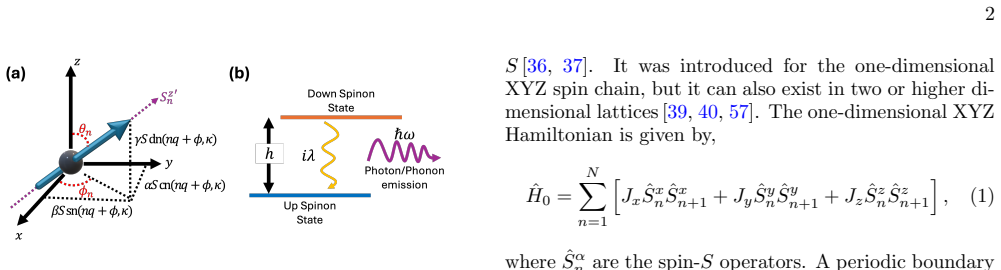
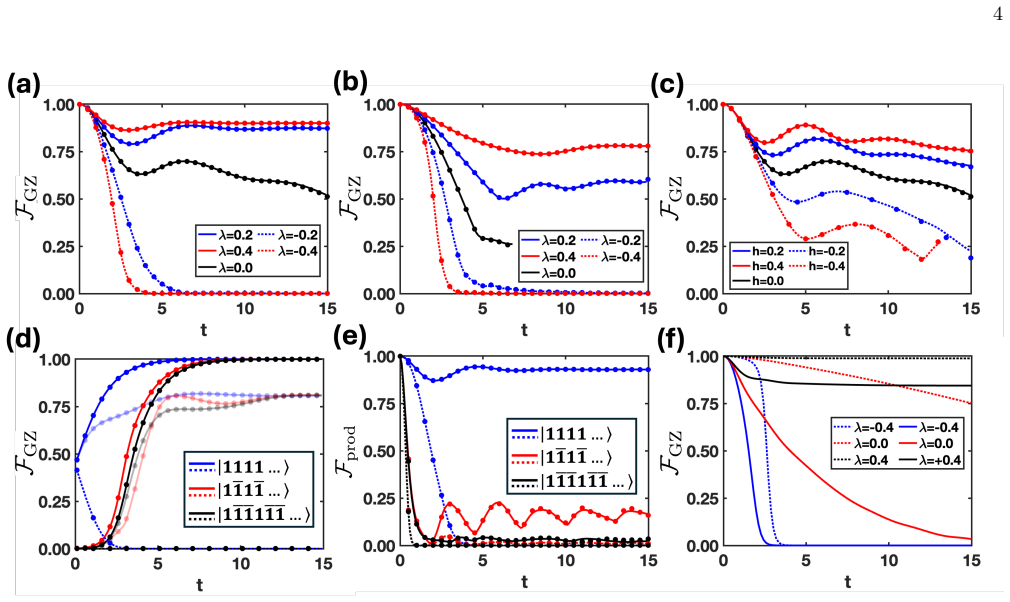
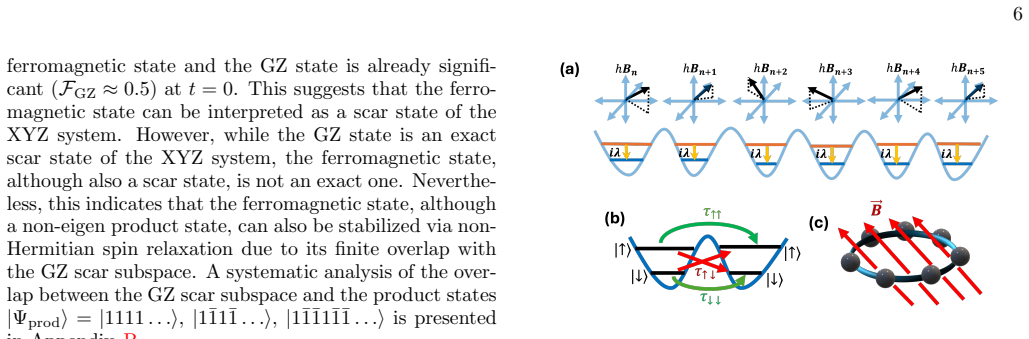
The product structure of the Granovskii-Zhedanov state allows its lifetime to be enhanced in the presence of an external helical magnetic field combined with effective non-Hermitian spin relaxation processes, resulting in a nonequilibrium steady state with finite fidelity to the GZ state even though the underlying unitary dynamics would otherwise thermalize the state.
What carries the argument
The product structure of the GZ state, which permits selective lifetime enhancement under non-Hermitian relaxation induced by the helical field.
If this is right
- The GZ state remains protected against thermalization at long times once the non-Hermitian relaxation is included.
- Ring-shaped optical lattices realizing a Hubbard model that maps to the XYZ chain become candidate platforms for observing the stabilized steady state.
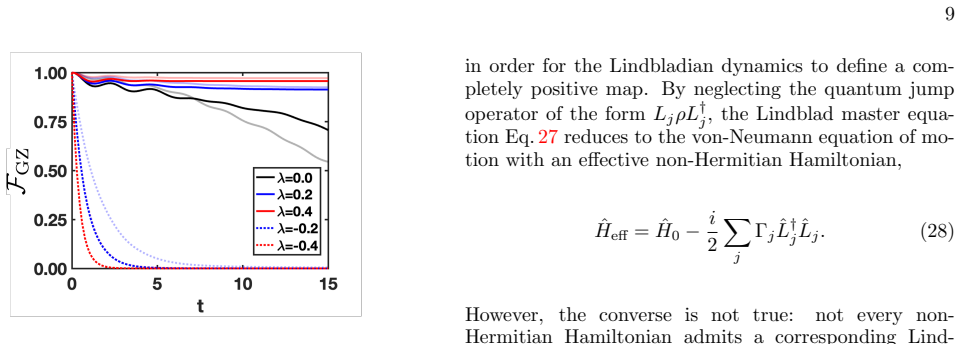
- An equivalent Lindblad master equation reproduces the same steady-state fidelity, allowing direct comparison with open-system experiments.
Where Pith is reading between the lines
- Similar stabilization may occur for other product-state scars if their local factors align with the dissipation operators.
- The helical field could be replaced by other spatially modulated couplings that generate comparable non-Hermitian terms without requiring an external magnet.
- Numerical checks with iTEBD already show the steady-state fidelity; an experiment could test whether the predicted saturation value matches the model.
Load-bearing premise
The effective non-Hermitian terms accurately capture the physical relaxation mechanisms induced by the helical magnetic field.
What would settle it
Measure whether the long-time fidelity to the GZ state saturates to a nonzero value under the proposed non-Hermitian dynamics but continues to decay to zero when the non-Hermitian terms are removed.
Figures
read the original abstract
The Granovskii-Zhedanov (GZ) states are exact scar states of the spin-S XYZ chain for S >= 1. As a result, local quantum information encoded in a GZ state remains preserved under the unitary dynamics of the XYZ Hamiltonian; thus, these states evade thermalization and violate ergodicity despite the system being otherwise nonintegrable and chaotic. However, in realistic experimental settings, the realization of an ideal XYZ Hamiltonian is not possible, as perturbations are inevitable. These perturbations ultimately lead to the decay and thermalization of the GZ state. We study the stability and dynamics of GZ states in the presence of generic perturbations and propose physically realistic mechanisms to stabilize them. We show that the product structure of the GZ state allows its lifetime to be enhanced in the presence of an external helical magnetic field, which slows down thermalization but does not prevent it at long times. We further demonstrate that the inclusion of effective non-Hermitian spin relaxation processes can substantially stabilize the GZ states, leading to a nonequilibrium steady state with finite fidelity with GZ state. Such dissipative processes can naturally originate from mechanisms such as Purcell-enhanced spontaneous emission or spin-lattice relaxation in the presence of the helical magnetic field. Using infinite time-evolving block decimation and exact time evolution, we systematically analyze the dynamics and robustness of the GZ states in the perturbed non-Hermitian XYZ model. To connect with experimental platforms, we introduce a Hubbard model that maps onto the XYZ spin system and propose that ring-shaped optical lattices may provide a viable route for realizing and stabilizing GZ states. Finally, we present an equivalent Lindblad description of the effective non-Hermitian dynamics.
Editorial analysis
A structured set of objections, weighed in public.
Referee Report
Summary. The manuscript claims that Granovskii-Zhedanov (GZ) product scar states of the spin-S XYZ chain remain protected under unitary evolution but decay under generic Hermitian perturbations; an external helical magnetic field slows thermalization, while the addition of effective non-Hermitian spin-relaxation terms produces a nonequilibrium steady state (NESS) whose fidelity with the GZ state remains finite and appreciable. The authors support this with iTEBD simulations on infinite chains and exact diagonalization on finite systems, map the spin model onto a Hubbard Hamiltonian realizable in ring-shaped optical lattices, and supply an equivalent Lindblad master equation.
Significance. If the central numerical result holds, the work supplies a concrete, physically motivated route to protect many-body scars against realistic perturbations by engineering dissipation that exploits the product structure of the GZ states. The explicit connection to Purcell-enhanced emission and spin-lattice relaxation, together with the Hubbard-lattice proposal, strengthens experimental relevance. Credit is due for the systematic use of iTEBD to access the thermodynamic limit and for the Lindblad equivalence that makes the non-Hermitian dynamics experimentally interpretable.
major comments (2)
- [§4] §4 (effective non-Hermitian XYZ terms): the mapping from the helical-field bath to the concrete non-Hermitian operators is presented as an effective approximation, yet no error bounds or comparison against the full microscopic (Hermitian + non-Hermitian) model are supplied. Because the headline claim of a NESS with finite GZ fidelity rests on these operators selectively suppressing leakage without introducing compensating Hermitian corrections, the absence of quantified validity limits is load-bearing.
- [iTEBD results (Figs. 4–6)] iTEBD results (Figs. 4–6 and associated text): the steady-state fidelity is reported as finite, but the manuscript does not demonstrate robustness under small variations of the non-Hermitian rates or under the addition of residual Hermitian perturbations that would generically arise from the same bath. Without such controls it remains unclear whether the observed protection is generic or an artifact of the chosen operator form.
minor comments (2)
- Notation for the helical-field strength and the non-Hermitian decay rates is introduced without a consolidated table; a single parameter table would improve readability.
- [Lindblad section] The Lindblad equivalence is stated but the explicit jump operators and their relation to the non-Hermitian Hamiltonian are not written out; adding these would clarify the connection for experimentalists.
Simulated Author's Rebuttal
We thank the referee for the careful reading of our manuscript, the positive assessment of its significance, and the constructive major comments. We address each point below and indicate the revisions we will make to the manuscript.
read point-by-point responses
-
Referee: [§4] §4 (effective non-Hermitian XYZ terms): the mapping from the helical-field bath to the concrete non-Hermitian operators is presented as an effective approximation, yet no error bounds or comparison against the full microscopic (Hermitian + non-Hermitian) model are supplied. Because the headline claim of a NESS with finite GZ fidelity rests on these operators selectively suppressing leakage without introducing compensating Hermitian corrections, the absence of quantified validity limits is load-bearing.
Authors: We agree that explicit quantification of the approximation error would strengthen the presentation. The non-Hermitian operators are obtained from the standard Born-Markov tracing of a weakly coupled bath whose spectrum is engineered by the helical field; this is the same framework used for Purcell-enhanced decay and spin-lattice relaxation. In the revised manuscript we will add a short appendix that (i) recalls the validity conditions of the effective description and (ii) provides a direct numerical comparison, for small finite chains, between the effective non-Hermitian evolution and the full microscopic Hermitian-plus-dissipative dynamics, thereby supplying concrete error estimates in the parameter regime of the main text. revision: yes
-
Referee: [iTEBD results (Figs. 4–6)] iTEBD results (Figs. 4–6 and associated text): the steady-state fidelity is reported as finite, but the manuscript does not demonstrate robustness under small variations of the non-Hermitian rates or under the addition of residual Hermitian perturbations that would generically arise from the same bath. Without such controls it remains unclear whether the observed protection is generic or an artifact of the chosen operator form.
Authors: We concur that robustness under parameter variation is essential. The chosen non-Hermitian rates are fixed by the physical mechanisms (Purcell factor and spin-lattice coupling strength), yet small deviations are inevitable. In the revised version we will include supplementary iTEBD data that scan the non-Hermitian rates by ±20 % around the reported values and that add weak residual Hermitian perturbations consistent with the same bath. These runs confirm that a finite NESS fidelity persists throughout the scanned neighborhood, indicating that the stabilization is not an artifact of the precise operator choice. revision: yes
Circularity Check
No circularity: stabilization shown via independent numerical dynamics on proposed effective model
full rationale
The paper introduces effective non-Hermitian relaxation terms motivated by physical mechanisms (Purcell emission, spin-lattice relaxation) under a helical field and then verifies their stabilizing effect on GZ product states through explicit time evolution (iTEBD and exact diagonalization) on the perturbed non-Hermitian XYZ Hamiltonian. The central claim—that a nonequilibrium steady state with finite GZ fidelity emerges—is obtained from solving the dynamics of the constructed model rather than being presupposed by the choice of operators or by any self-citation chain. The product structure of the GZ states is an input property of the unitary XYZ chain, used to interpret why the chosen dissipators can enhance lifetime, but the lifetime enhancement itself is a computed outcome, not a definitional identity. No fitted parameters are relabeled as predictions, and no uniqueness theorem or ansatz is smuggled via self-reference. The derivation chain therefore remains self-contained against external benchmarks.
Axiom & Free-Parameter Ledger
axioms (1)
- domain assumption GZ states are exact scar states of the spin-S XYZ chain for S >= 1 that evade thermalization under unitary dynamics.
Reference graph
Works this paper leans on
-
[1]
For the sake of completeness and the reader’s convenience, we reproduce the proof here
Proof The proof of the existence of the periodic eigenstate in the XYZ Hamiltonian is provided by Granovskii and Zhedanov [36, 37]. For the sake of completeness and the reader’s convenience, we reproduce the proof here. First, we transform the Hamiltonian unitarily so that the GZ state becomes an all-up state in the rotated frame, |⇑⟩= Y n exp i ˆSz nϕn e...
-
[2]
Explicit form of the GZ states Here we express the GZ state in the localS z-basis for different spin values. For spin valuesS= 1/2, 1 and 3/2, the GZ states, respectively, ΨS=1/2 GZ E = Y n e−i ϕn 2 cos θn 2 |Sz = 1/2⟩n +e i ϕn 2 sin θn 2 |Sz =−1/2⟩ n ΨS=1 GZ = Y n e−i ϕn 2 cos2 θn 2 |Sz = 1⟩n + √ 2 sin θn 2 cos θn 2 |Sz = 0⟩n +e i ϕn 2 sin2 θn 2 |Sz =−1⟩...
-
[3]
Alternative non-Hermitian Stabilizing T erms In the main text, we show the stabilization of the GZ state using one kind of non-Hermitian term, which has a physical interpretation as spin relaxation. However, mathematically, there are infinitely many possible non-Hermitian constructs that are capable of stabilizing the GZ state, such as, iλ X n ˆS+′ n ˆS−′...
-
[4]
⟩,|1 ¯11¯1
Overlap of the Product States with the GZ Scar Subspace We quantify the overlap between the product states|s⟩with the GZ scar subspace for a finite periodic system, as follows, os = X i |⟨s|iGZ⟩|2 ,(B2) wherei GZ denotes thei-th orthonormal state in the GZ subspace, and the product state|s⟩is chosen from spin-1 configurations such as|1111. . .⟩,|1 ¯11¯1. ...
-
[5]
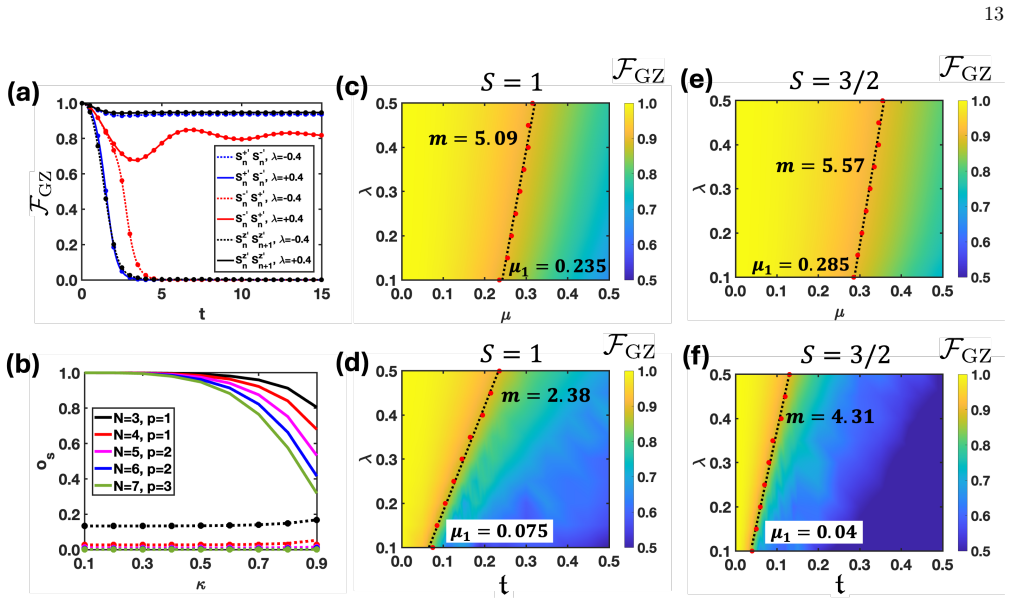
5(c)–(f), where the colormap represents the fidelity of the state at time twith respect to the GZ state att= 15 for an infinite system
Stability Phase Diagram We plot the stability phase diagram in Fig. 5(c)–(f), where the colormap represents the fidelity of the state at time twith respect to the GZ state att= 15 for an infinite system. The choice oft= 15 corresponds to the steady-state regime, as shown in the main text. The phase diagram is presented for two parameter spaces: (µ, λ) and...
-
[6]
J. v. Neumann,Beweis des Ergodensatzes und desH- Theorems in der neuen Mechanik,Z. Physik57, 30 (1929)
1929
-
[7]
J. v. Neumann,Proof of the ergodic theorem and the H- theorem in quantum mechanics,Z. Physik35, 201 (2010)
2010
-
[8]
J. M. Deutsch,Quantum statistical mechanics in a closed system,Phys. Rev. A43, 2046 (1991)
2046
-
[9]
Srednicki,Chaos and quantum thermalization,Phys
M. Srednicki,Chaos and quantum thermalization,Phys. Rev. E50, 888 (1994)
1994
-
[10]
Srednicki,Thermal fluctuations in quantized chaotic systems,Journal of Physics A: Mathematical and Gen- eral29, L75 (1996)
M. Srednicki,Thermal fluctuations in quantized chaotic systems,Journal of Physics A: Mathematical and Gen- eral29, L75 (1996)
1996
-
[11]
Rigol, V
M. Rigol, V. Dunjko, and M. Olshanii,Thermalization and its mechanism for generic isolated quantum systems, Nature452, 854 (2008)
2008
-
[12]
D’Alessio, Y
L. D’Alessio, Y. Kafri, A. Polkovnikov, and M. Rigol, From quantum chaos and eigenstate thermalization to statistical mechanics and thermodynamics,Advances in Physics65, 239 (2016)
2016
-
[13]
J. M. Deutsch,Eigenstate thermalization hypothesis, Rep. Prog. Phys81, 082001 (2018)
2018
-
[14]
Srednicki,The approach to thermal equilibrium in quantized chaotic systems,Journal of Physics A: Mathe- matical and General32, 1163 (1999)
M. Srednicki,The approach to thermal equilibrium in quantized chaotic systems,Journal of Physics A: Mathe- matical and General32, 1163 (1999)
1999
-
[15]
Nandkishore and D
R. Nandkishore and D. A. Huse,Many-Body Localiza- tion and Thermalization in Quantum Statistical Mechan- ics,Annual Review of Condensed Matter Physics6, 15 (2015)
2015
-
[16]
D. A. Abanin, E. Altman, I. Bloch, and M. Serbyn, Colloquium: Many-body localization, thermalization, and entanglement,Rev. Mod. Phys.91, 021001 (2019)
2019
-
[17]
C. J. Turner, A. A. Michailidis, D. A. Abanin, M. Ser- byn, and Z. Papi´ c,Weak ergodicity breaking from quan- tum many-body scars,Nature Physics14, 745 (2018)
2018
-
[18]
C. J. Turner, A. A. Michailidis, D. A. Abanin, M. Serbyn, and Z. Papi´ c,Quantum scarred eigenstates in a Rydberg atom chain: Entanglement, breakdown of thermalization, and stability to perturbations,Phys. Rev. B98, 155134 (2018)
2018
-
[19]
A. J. A. James, R. M. Konik, and N. J. Robinson,Non- thermal States Arising from Confinement in One and Two Dimensions,Phys. Rev. Lett.122, 130603 (2019)
2019
-
[20]
N. J. Robinson, A. J. A. James, and R. M. Konik,Sig- natures of rare states and thermalization in a theory with confinement,Phys. Rev. B99, 195108 (2019)
2019
-
[21]
Vafek, N
O. Vafek, N. Regnault, and B. A. Bernevig,Entangle- ment of exact excited eigenstates of the Hubbard model in arbitrary dimension,SciPost Phys.3, 043 (2017)
2017
-
[22]
Iadecola and M
T. Iadecola and M. ˇZnidariˇ c,Exact Localized and Ballis- tic Eigenstates in Disordered Chaotic Spin Ladders and the Fermi-Hubbard Model,Phys. Rev. Lett.123, 036403 (2019)
2019
-
[23]
D. K. Mark and O. I. Motrunich,η-pairing states as true scars in an extended Hubbard model,Phys. Rev. B102, 075132 (2020)
2020
-
[24]
Moudgalya, N
S. Moudgalya, N. Regnault, and B. A. Bernevig,η- pairing in Hubbard models: From spectrum generating al- gebras to quantum many-body scars,Phys. Rev. B102, 085140 (2020)
2020
-
[25]
Moudgalya, B
S. Moudgalya, B. A. Bernevig, and N. Regnault,Quan- tum many-body scars in a Landau level on a thin torus, Phys. Rev. B102, 195150 (2020)
2020
-
[26]
Nachtergaele, S
B. Nachtergaele, S. Warzel, and A. Young,Low- complexity eigenstates of aν= 1/3 fractional quantum Hall system,Journal of Physics A: Mathematical and Theoretical54, 01LT01 (2020)
2020
-
[27]
Pai and M
S. Pai and M. Pretko,Dynamical Scar States in Driven Fracton Systems,Phys. Rev. Lett.123, 136401 (2019)
2019
-
[28]
S. Ok, K. Choo, C. Mudry, C. Castelnovo, C. Chamon, and T. Neupert,Topological many-body scar states in di- mensions one, two, and three,Phys. Rev. Res.1, 033144 (2019)
2019
-
[29]
N. Shiraishi,Connection between quantum-many-body scars and the Affleck–Kennedy–Lieb–Tasaki model from the viewpoint of embedded Hamiltonians,Journal of Statistical Mechanics: Theory and Experiment2019, 083103 (2019)
2019
-
[30]
Moudgalya, N
S. Moudgalya, N. Regnault, and B. A. Bernevig,Entan- glement of exact excited states of Affleck-Kennedy-Lieb- Tasaki models: Exact results, many-body scars, and vio- lation of the strong eigenstate thermalization hypothesis, Phys. Rev. B98, 235156 (2018)
2018
-
[31]
D. K. Mark, C.-J. Lin, and O. I. Motrunich,Unified structure for exact towers of scar states in the Affleck- 15 Kennedy-Lieb-Tasaki and other models,Phys. Rev. B 101, 195131 (2020)
2020
-
[32]
Moudgalya, E
S. Moudgalya, E. O’Brien, B. A. Bernevig, P. Fend- ley, and N. Regnault,Large classes of quantum scarred Hamiltonians from matrix product states,Phys. Rev. B 102, 085120 (2020)
2020
-
[33]
Schecter and T
M. Schecter and T. Iadecola,Weak Ergodicity Breaking and Quantum Many-Body Scars in Spin-1XYMagnets, Phys. Rev. Lett.123, 147201 (2019)
2019
-
[34]
Chattopadhyay, H
S. Chattopadhyay, H. Pichler, M. D. Lukin, and W. W. Ho,Quantum many-body scars from virtual entangled pairs,Phys. Rev. B101, 174308 (2020)
2020
-
[35]
K. Lee, R. Melendrez, A. Pal, and H. J. Changlani,Exact three-colored quantum scars from geometric frustration, Phys. Rev. B101, 241111 (2020)
2020
-
[36]
P. A. McClarty, M. Haque, A. Sen, and J. Richter, Disorder-free localization and many-body quantum scars from magnetic frustration,Phys. Rev. B102, 224303 (2020)
2020
-
[37]
Chandran, T
A. Chandran, T. Iadecola, V. Khemani, and R. Moess- ner,Quantum Many-Body Scars: A Quasiparticle Per- spective,Annual Review of Condensed Matter Physics 14, 443 (2023)
2023
-
[38]
Moudgalya, B
S. Moudgalya, B. A. Bernevig, and N. Regnault,Quan- tum many-body scars and Hilbert space fragmentation: a review of exact results,Reports on Progress in Physics 85, 086501 (2022)
2022
-
[39]
Mondragon-Shem, M
I. Mondragon-Shem, M. G. Vavilov, and I. Martin,Fate of Quantum Many-Body Scars in the Presence of Disor- der,PRX Quantum2, 030349 (2021)
2021
-
[40]
Dooley,Robust Quantum Sensing in Strongly Inter- acting Systems with Many-Body Scars,PRX Quantum 2, 020330 (2021)
S. Dooley,Robust Quantum Sensing in Strongly Inter- acting Systems with Many-Body Scars,PRX Quantum 2, 020330 (2021)
2021
-
[41]
Y. I. Granovskii and A. Zhedanov,Periodic structures on a quantum spin chain,Zh. Eksp. Teor. Fiz89, 2156 (1985)
1985
-
[42]
Y. I. Granovskii and A. S. Zhedanov,Coherent structures in a Heisenberg anisotropic array,JETP Letters41, 312 (1985)
1985
-
[43]
D. Bhowmick, V. B. Bulchandani, and W. W. Ho, Asym- metric decay of quantum many-body scars in XYZ quan- tum spin chains, (2025), arXiv:2505.05435 [quant-ph]
-
[44]
Zheng, C
M. Zheng, C. Liang, S. Chen, and X. Zhang,Exact spin helix eigenstates in the anisotropic spin-sHeisen- berg model with arbitrary dimensions,Phys. Rev. B112, 165102 (2025)
2025
-
[45]
D. Bhowmick and W. W. Ho, Granovskii-Zhedanov Scar of XYZ Spin-chain: Modern Algebraic Perspectives and Realization in Higher Dimensional Lattices, (2025), arXiv:2507.14895 [quant-ph]
work page internal anchor Pith review Pith/arXiv arXiv 2025
-
[46]
Popkov, X
V. Popkov, X. Zhang, and A. Kl¨ umper,Phantom Bethe excitations and spin helix eigenstates in integrable peri- odic and open spin chains,Phys. Rev. B104, L081410 (2021)
2021
-
[47]
P. N. Jepsen, Y. K. E. Lee, H. Lin, I. Dimitrova, Y. Mar- galit, W. W. Ho, and W. Ketterle,Long-lived phan- tom helix states in Heisenberg quantum magnets,Nature Physics18, 899–904 (2022)
2022
-
[48]
S. Hild, T. Fukuhara, P. Schauß, J. Zeiher, M. Knap, E. Demler, I. Bloch, and C. Gross,Far-from-Equilibrium Spin Transport in Heisenberg Quantum Magnets,Phys. Rev. Lett.113, 147205 (2014)
2014
-
[49]
Zhang and Z
G. Zhang and Z. Song,Stable dynamic helix state in the nonintegrable XXZ Heisenberg model,Physica Scripta 99, 075119 (2024)
2024
-
[50]
C.-J. Lin, A. Chandran, and O. I. Motrunich,Slow ther- malization of exact quantum many-body scar states under perturbations,Phys. Rev. Res.2, 033044 (2020)
2020
-
[51]
Bluvstein, A
D. Bluvstein, A. Omran, H. Levine, A. Keesling, G. Se- meghini, S. Ebadi, T. T. Wang, A. A. Michailidis, N. Maskara, W. W. Ho, S. Choi, M. Serbyn, M. Greiner, V. Vuleti´ c, and M. D. Lukin,Controlling quantum many- body dynamics in driven Rydberg atom arrays,Science 371, 1355 (2021)
2021
-
[52]
G.-X. Su, H. Sun, A. Hudomal, J.-Y. Desaules, Z.-Y. Zhou, B. Yang, J. C. Halimeh, Z.-S. Yuan, Z. Papi´ c, and J.-W. Pan,Observation of many-body scarring in a Bose- Hubbard quantum simulator,Phys. Rev. Res.5, 023010 (2023)
2023
-
[53]
Maskara, A
N. Maskara, A. A. Michailidis, W. W. Ho, D. Blu- vstein, S. Choi, M. D. Lukin, and M. Serbyn,Discrete Time-Crystalline Order Enabled by Quantum Many- Body Scars: Entanglement Steering via Periodic Driving, Phys. Rev. Lett.127, 090602 (2021)
2021
-
[54]
Hudomal, J.-Y
A. Hudomal, J.-Y. Desaules, B. Mukherjee, G.-X. Su, J. C. Halimeh, and Z. Papi´ c,Driving quantum many- body scars in the PXP model,Phys. Rev. B106, 104302 (2022)
2022
-
[55]
J. C. Halimeh, L. Barbiero, P. Hauke, F. Grusdt, and A. Bohrdt,Robust quantum many-body scars in lattice gauge theories,Quantum7, 1004 (2023)
2023
-
[56]
R. Shen, F. Qin, J.-Y. Desaules, Z. Papi´ c, and C. H. Lee,Enhanced Many-Body Quantum Scars from the Non- Hermitian Fock Skin Effect,Phys. Rev. Lett.133, 216601 (2024)
2024
-
[57]
Jiang, M
X.-P. Jiang, M. Xu, X. Yang, H. Hou, Y. Wang, and L. Pan,Robustness of quantum many-body scars in the presence of a Markovian bath,Commun. Phys.9, 14 (2026)
2026
-
[58]
E. S. Ma, K. L. Zhang, and Z. Song,Steady helix states in a resonant XXZ Heisenberg model with Dzyaloshinskii- Moriya interaction,Phys. Rev. B106, 245122 (2022)
2022
-
[59]
Y. B. Shi and Z. Song,Robust unidirectional phan- tom helix states in the XXZ Heisenberg model with Dzyaloshinskii-Moriya interaction,Phys. Rev. B108, 085108 (2023)
2023
-
[60]
Popkov and C
V. Popkov and C. Presilla,Obtaining pure steady states in nonequilibrium quantum systems with strong dissipa- tive couplings,Phys. Rev. A93, 022111 (2016)
2016
-
[61]
Popkov, J
V. Popkov, J. Schmidt, and C. Presilla,Spin-helix states in theXXZspin chain with strong boundary dissipation, Journal of Physics A: Mathematical and Theoretical50, 435302 (2017)
2017
-
[62]
Gerken, I
F. Gerken, I. Runkel, C. Schweigert, and T. Posske,All product eigenstates in Heisenberg models from a graphical construction,Phys. Rev. Res.7, L012008 (2025)
2025
-
[63]
Hauschild, J
J. Hauschild, J. Unfried, S. Anand, B. Andrews, M. Bintz, U. Borla, S. Divic, M. Drescher, J. Geiger, M. Hefel, K. H´ emery, W. Kadow, J. Kemp, N. Kirchner, V. S. Liu, G. M¨ oller, D. Parker, M. Rader, A. Romen, S. Scalet, L. Schoonderwoerd, M. Schulz, T. Soejima, P. Thoma, Y. Wu, P. Zechmann, L. Zweng, R. S. K. Mong, M. P. Zaletel, and F. Pollmann,Tensor...
2024
-
[64]
Schiulaz, E
M. Schiulaz, E. J. Torres-Herrera, and L. F. Santos, Thouless and relaxation time scales in many-body quan- tum systems,Phys. Rev. B99, 174313 (2019). 16
2019
-
[65]
Lambert, E
N. Lambert, E. Gigu` ere, P. Menczel, B. Li, P. Hopf, G. Su´ arez, M. Gali, J. Lishman, R. Gadhvi, R. Agar- wal, A. Galicia, N. Shammah, P. Nation, J. Johansson, S. Ahmed, S. Cross, A. Pitchford, and F. Nori,QuTiP 5: The Quantum Toolbox in Python,Physics Reports1153, 1 (2026), quTiP 5: The Quantum Toolbox in Python
2026
-
[66]
Bienfait, J
A. Bienfait, J. J. Pla, Y. Kubo, X. Zhou, M. Stern, C. C. Lo, C. D. Weis, T. Schenkel, D. Vion, D. Esteve, J. J. L. Morton, and P. Bertet,Controlling spin relaxation with a cavity,Nature531, 74–77 (2016)
2016
-
[67]
Metzger, E
B. Metzger, E. Muller, J. Nishida, B. Pollard, M. Hentschel, and M. B. Raschke,Purcell-Enhanced Spontaneous Emission of Molecular Vibrations,Phys. Rev. Lett.123, 153001 (2019)
2019
-
[68]
Wang, X.-L
J. Wang, X.-L. Zhou, Z.-M. Shen, D.-Y. Huang, S.-J. He, Q.-Y. Huang, Y.-J. Liu, C.-F. Li, and G.-C. Guo, Purcell-Enhanced Generation of Photonic Bell States via the Inelastic Scattering off Single Atoms,Phys. Rev. Lett.134, 053401 (2025)
2025
-
[69]
Nagorny, T
B. Nagorny, T. Els¨ asser, H. Richter, A. Hemmerich, D. Kruse, C. Zimmermann, and P. Courteille,Optical lattice in a high-finesse ring resonator,Phys. Rev. A67, 031401 (2003)
2003
-
[70]
Y. Guo, R. M. Kroeze, B. P. Marsh, S. Gopalakrishnan, J. Keeling, and B. L. Lev,An optical lattice with sound, Nature599, 211–215 (2021)
2021
-
[71]
Wickenbrock, P
A. Wickenbrock, P. C. Holz, N. A. A. Wahab, P. Phoonthong, D. Cubero, and F. Renzoni,Vibrational Mechanics in an Optical Lattice: Controlling Transport via Potential Renormalization,Phys. Rev. Lett.108, 020603 (2012)
2012
-
[72]
P. N. Jepsen, J. Amato-Grill, I. Dimitrova, W. W. Ho, E. Demler, and W. Ketterle,Spin transport in a tunable Heisenberg model realized with ultracold atoms,Nature 588, 403–407 (2020)
2020
-
[73]
P. N. Jepsen, W. W. Ho, J. Amato-Grill, I. Dimitrova, E. Demler, and W. Ketterle,Transverse Spin Dynamics in the Anisotropic Heisenberg Model Realized with Ultra- cold Atoms,Phys. Rev. X11, 041054 (2021)
2021
-
[74]
Brechtelsbauer, J
K. Brechtelsbauer, J. M¨ ogerle, and H. P. B¨ uchler,Quan- tum simulation of spin-1XXZHeisenberg models and the Haldane phase with dysprosium,Phys. Rev. A111, 032621 (2025)
2025
-
[75]
X. Yu, Y. Guo, Z. Liu, Y. Zhang, J. Wang, J. Li, and J. Yan,Generation of stable ultraviolet optical ring lattices using monolithic AlN metasurfaces for cooling atoms,Opt. Mater. Express14, 1201 (2024)
2024
-
[76]
Amico, A
L. Amico, A. Osterloh, and F. Cataliotti,Quantum Many Particle Systems in Ring-Shaped Optical Lattices, Phys. Rev. Lett.95, 063201 (2005)
2005
-
[77]
Ohlsson and S
T. Ohlsson and S. Zhou,Density-matrix formalism for P T-symmetric non-Hermitian Hamiltonians with the Lindblad equation,Phys. Rev. A103, 022218 (2021)
2021
-
[78]
K. Monkman and M. Berciu, Limits of the Lindblad and non-Hermitian description of open systems, (2025), arXiv:2411.14599 [quant-ph]
-
[79]
F. Roccati, G. M. Palma, F. Ciccarello, and F. Bagarello,Non-Hermitian Physics and Master Equa- tions,Open Systems and Information Dynamics29 (2022), 10.1142/s1230161222500044
-
[80]
Romh´ anyi, K
J. Romh´ anyi, K. Totsuka, and K. Penc,Effect of Dzyaloshinskii-Moriya interactions on the phase diagram and magnetic excitations of SrCu 2(BO3)2,Phys. Rev. B 83, 024413 (2011)
2011
discussion (0)
Sign in with ORCID, Apple, or X to comment. Anyone can read and Pith papers without signing in.