REVIEW 3 major objections 5 minor 32 references
Quantum game models for interaction-aware decision-making in automated driving
T0 review · 3 major / 5 minor · reviewed 2026-08-05 · deepseek-v4-flash
Pith's one-line read A gate-based quantum game model cuts collision rates to 1.3–2.8 percent and raises success to 90–99 percent in merging and roundabout simulations.
desk verdict The quantum-game adaptation is coherent, but Table III's QG-G4 numbers can't be reproduced under the paper's own IV policy, so the central evaluation doesn't hold up. read the letter →
The pith
A machine-rendered reading of the paper's core claim, the machinery that carries it, and where it could break.
The reading
What carries the argument
The load-bearing object is a two-qubit quantum circuit in the style of the entanglement-based two-player game protocol: an initial state, an entanglement gate whose strength is controlled by the parameter γ, player strategy operations (a unitary in QG-U1, or one of the gates H, σx, σy, σz, I2 in QG-G4), and the conjugate entanglement gate before measurement. The squared amplitudes of the final state are the probabilities that each action pair occurs, and the ego vehicle samples its action from these probabilities. The decisive parameter is γ, the entanglement level, and the paper's chosen QG-G4 configuration sets the ego's gate to the identity with γ = π/2, which moves probability away from
What would settle it
Re-run the two scenarios while logging the joint (ego action, interacting-vehicle action) pairs and outcomes. If the interacting vehicle is truly uniform and independent, the observed joint frequencies should equal the product of the ego's marginal distribution from QG-G4 and 1/2 for each interacting action, and the collision rate computed from the four action-pair outcomes should reproduce the reported 2.8 percent and 1.3 percent. A systematic mismatch between predicted and observed rates—or evidence that the interacting vehicle's actions are correlated with the ego's—would falsify the stated
Extended reading notes
Core claim
On the paper's own terms, the discovery is that a two-qubit quantum circuit can produce an action distribution that resolves a tactical driving dilemma that classical game theory leaves underdetermined. Each scenario is a normal-form game with two players and two pure strategies, and both payoff matrices have two Nash equilibria on the diagonal, so standard equilibrium selection cannot decide what the ego vehicle should do. The proposed circuits apply an entanglement operator, let each player act through a unitary matrix or a gate from {H, σx, σy, σz, I2}, then apply the conjugate operator and measure; the squared amplitudes of the final state define probabilities over the four action pairs,
Load-bearing premise
The numerical results rest on the interacting vehicle choosing its action by an independent uniform random draw while the ego samples from the quantum model; if the other driver actually reacts to or correlates with the ego's actions, the reported collision and success rates no longer follow.
Editorial extensions
If this is right
- A tactical decision layer for merging and roundabout maneuvers can be built from a two-qubit circuit and run in real time on a standard computer, with no quantum processor required.
- The gate set and entanglement parameter give designers a tunable risk profile: some configurations maximize expected payoff, others minimize collision probability, so the same framework can be adjusted per scenario.
- Classical probabilistic solvers that split evenly between two diagonal equilibria can be replaced by a model whose output distribution favors the mutually successful action pair, resolving the dilemma without negotiation.
- Because the model is defined by payoff matrices, the same circuit can be applied to other two-action tactical dilemmas by changing the payoff matrix, the initial state, and the scenario-specific action definitions.
Reading between the lines
- Editorial inference: the reported advantage assumes the interacting vehicle is an inert uniform randomizer. If the other vehicle were modeled as a reactive or learning agent that conditions on the ego's sampled action, the comparison would likely shift; the quantum model may encode a prior over an opponent rather than solving a true two-sided game.
- Editorial inference: with only five gates and a fixed entanglement level, QG-G4's output distribution belongs to a small discrete family, so the behavioral policy could likely be reproduced by a lookup table; the quantum circuit here is a probability generator, not a computational speedup.
- Editorial inference: the parameter sweep shows many quantum configurations are unsafe, with collision rates near 20–50 percent, so the practical result hinges on selecting the right gate and entanglement level; online adaptation of the payoff matrix, which the paper lists as future work, is where robustness would actually be tested.
- A natural testable extension is to replace the uniform-random interacting vehicle with a conditional policy and measure whether QG-G4's collision advantage persists.
Signed reviews
Editorial analysis
A structured set of objections, weighed in public.
Referee Report
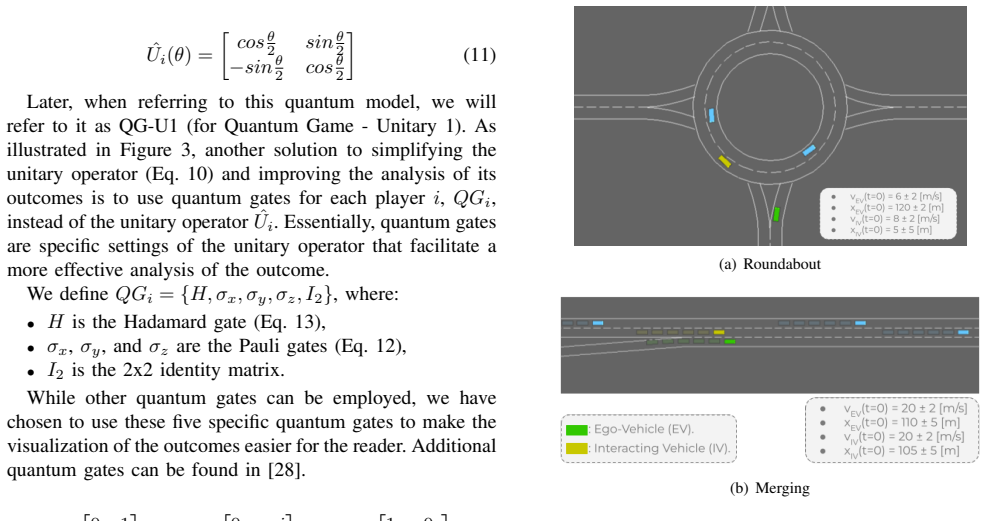
Summary. The paper proposes two quantum game models, QG-U1 and QG-G4, based on the Eisert-Wilkens-Lewenstein protocol, for two-player two-strategy decision-making in automated driving. The models are evaluated in highway-env merging and roundabout scenarios against classical game-theoretic baselines (CG-EPD, CG-MS) and conventional driving models (COR-MP, MOBIL, IDM). The central claim is that QG-G4, configured with the ego vehicle playing the identity gate and entanglement γ = π/2, achieves lower collision rates and higher success rates than all compared methods, with collision rates of 2.8% and 1.3% and success rates of 90.15% and 98.7% in the two scenarios.
Significance. If the reported empirical results were reproducible, the paper would provide a concrete, classically simulable application of quantum game theory to an important engineering problem. The circuit algebra is standard and the authors correctly identify that the models require no quantum hardware. However, the central quantitative claim is undermined by a severe internal inconsistency in the evaluation protocol: the reported collision and success rates for QG-G4 cannot be obtained under the stated independent-uniform IV policy. The contribution is therefore not currently established, and the paper would require a substantially revised evaluation to support its conclusions.
major comments (3)
- [Section IV (Table III, Fig. 6(b), Eqs. (7)-(9))] The stated simulation protocol says that for all game models the EV decision follows the model's probabilistic output, while the IV decision is made following an equal probability distribution. This makes the IV independent of the EV. For the adopted QG-G4 configuration (EV plays I2, γ = π/2, initial state |ψ0⟩ = |10⟩), the final state depends on the unspecified IV gate, and the EV marginal merge probability is only 0, 1/2, or 1 for the five gates in QGi. With an independent uniform IV, the collision-pair (s00) probability is therefore 0%, 25%, or 50%, and the success rate cannot exceed the merge probability. Table III reports CR=2.8%, SR=90.15% (merging) and CR=1.3%, SR=98.7% (roundabout). These numbers are irreconcilable with the stated protocol; they can only arise if the IV follows the correlated quantum joint outcome, which contradicts the paper's 'uncertain IV' description. The com
- [Section IV, Figure 6 and Table III] The QG-G4 configuration is selected by maximizing E(u_EV) on the same payoff matrices (Tables I and II) that are later used in the evaluation. The claim that QG-G4 'achieves higher expected payoffs than classical game approaches' is then partly a consequence of the tuning procedure rather than an intrinsic property of the model. A fair algorithmic comparison would require a pre-specified configuration rule, a held-out payoff matrix, or sensitivity analysis across parameter variations. As written, the reported advantage of QG-G4 over CG-EPD and CG-MS is confounded by in-sample parameter selection.
- [Section IV (Table III)] The evaluation lacks essential reproducibility details: the number of episodes, random seeds, initial position and speed distributions, the trajectory planner used to execute high-level decisions, and the IV gate/strategy used for QG-G4 are never specified. The paper states 'thousands of times' but reports only point percentages without confidence intervals or standard deviations. Without these details, the headline numbers cannot be independently checked, and the missing IV gate is the exact parameter that controls the discrepancy described above.
minor comments (5)
- [Section II-B] Typo: 'Esiert et al.' should be 'Eisert et al.'.
- [Section IV, Figure 5] The caption says the blue plot corresponds to fully entangled and orange to non-entangled, but the legend colors are not clearly described in the text; consider making the figure self-contained.
- [Section IV, Table III] No number of simulation runs, standard deviations, or confidence intervals are given; adding these would improve interpretability.
- [Section IV] The statement that QG-G4 'reaches Nash Equilibrium more often than other models' is not quantified or formally defined; either define the metric or remove the claim.
- [Section III, Eq. (10)] The notation uses j for the imaginary unit while j is also used as an index in the state notation s_jk; this is a minor notational clash that could confuse readers.
Circularity Check
No significant circularity: the quantum-game construction is self-contained and the evaluation is an independent simulation, though a missing IV-gate detail creates a reproducibility risk.
full rationale
The paper's derivation chain is not circular. The QG-U1 and QG-G4 models are explicit implementations of the external EWL protocol (Eqs. 5-13), with gates and parameters stated. The parameter choices (QG-U1-1, QG-U1-2, QG-G4) are described as the result of maximizing/minimizing expected payoff on the given payoff matrix; this is a stated design choice rather than a hidden fit, and the subsequent highway-env simulation is an independent evaluation. The fact that QG-U1-1—the configuration selected to maximize expected payoff—performs poorly in Table III (50.07% collision in merging) shows that the simulation results are not statistically forced by the payoff fit. The abstract's "higher expected payoffs under certain parameter settings" is explicitly conditional and is a direct consequence of the parameter search, not a prediction. Self-citations ([2], [3]) appear only as baselines/prior work and are not load-bearing. One important caveat, which is a correctness/reproducibility issue rather than circularity: the simulation protocol for QG-G4 does not specify which IV gate is used in the quantum circuit, and the reported low collision/high success rates are difficult to reconcile with the stated independent-uniform IV action distribution. This missing detail should be fixed, but it does not make the derivation equivalent to its inputs.
Assumptions & free parameters
free parameters (6)
- gamma (entanglement factor) =
gamma = pi/2 for QG-G4, gamma = 0 for QG-U1-1, gamma = pi/2 for QG-U1-2
- theta (superposition angle for QG-U1) =
theta_EV = pi/2 (QG-U1-1), theta_EV = 0 (QG-U1-2), theta_IV = 0
- Initial quantum state |psi0> =
Equal distribution for Fig. 5 and Fig. 6a; [0,0,1,0] for Fig. 6b,c; not specified for Table III runs
- Gate choices in QG-G4 =
EV plays I2; IV gate unspecified; gate set {H, sigma_x, sigma_y, sigma_z, I2}
- Payoff matrix entries =
Table I and Table II values (0, 10, 4, 4, 1)
- IV action distribution in simulation =
p(a1) = p(a2) = 0.5
assumptions (4)
- standard math The EWL protocol computes valid probabilities for a two-player, two-strategy game.
- domain assumption The payoff matrices in Tables I and II accurately represent driver preferences in merging and roundabout scenarios.
- ad hoc to paper The IV behaves as a uniformly random agent during evaluation.
- domain assumption Maximizing the ego vehicle's expected payoff is the appropriate criterion for selecting the model configuration.
Cite this review
Pith. "Pith review of Quantum game models for interaction-aware decision-making in automated driving." pith.science (2026). https://pith.science/paper/U4MYILGN
@misc{pith2026250901582,
  author       = {Pith},
  title        = {Pith review of: Quantum game models for interaction-aware decision-making in automated driving},
  year         = {2026},
  howpublished = {\url{https://pith.science/paper/U4MYILGN}},
  note         = {Machine review of arXiv:2509.01582}
}
read the original abstract
Decision-making in automated driving must consider interactions with surrounding agents to be effective. However, traditional methods often neglect or oversimplify these interactions because they are difficult to model and solve, which can lead to overly conservative behavior of the ego vehicle. To address this gap, we propose two quantum game models, QG-U1 (Quantum Game - Unitary 1) and QG-G4 (Quantum Game - Gates 4), for interaction-aware decision-making. These models extend classical game theory by incorporating principles of quantum mechanics, such as superposition, interference, and entanglement. Specifically, QG-U1 and QG-G4 are designed for two-player games with two strategies per player and can be executed in real time on a standard computer without requiring quantum hardware. We evaluate both models in merging and roundabout scenarios and compare them with classical game-theoretic methods and baseline approaches (IDM, MOBIL, and a utility-based technique). Results show that QG-G4 achieves lower collision rates and higher success rates compared to baseline methods, while both quantum models yield higher expected payoffs than classical game approaches under certain parameter settings.
Figures


Figures from the paper (4 more)


Reference graph
Works this paper leans on
-
[1]
L. Haj Meftah and A. Cherif, “Exploring Autonomous Vehicle Tech- nology: Advancements, Challenges, and the Critical Role of Simu- lation,” Asma, Exploring Autonomous Vehicle Technology: Advance- ments, Challenges, and the Critical Role of Simulation
-
[2]
COR-MP: Conservation of Resources Model for Maneuver Planning,
K. Essalmi, F. Garrido, and F. Nashashibi, “COR-MP: Conservation of Resources Model for Maneuver Planning,” in 2024 IEEE 20th International Conference on Intelligent Computer Communication and Processing (ICCP). IEEE, 2024, pp. 1–8
work page 2024
-
[3]
An Extended Horizon Tactical Decision-Making for Automated Driving Based on Monte Carlo Tree Search,
——, “An Extended Horizon Tactical Decision-Making for Automated Driving Based on Monte Carlo Tree Search,” in IV 2025-36th IEEE Intelligent Vehicles Symposium, 2025
work page 2025
-
[4]
Theory of games and economic behavior: 60th anniversary commemorative edition,
J. V on Neumann and O. Morgenstern, “Theory of games and economic behavior: 60th anniversary commemorative edition,” in Theory of games and economic behavior . Princeton university press, 2007
work page 2007
-
[5]
Game theory: Concepts, applications, and insights from operations research,
C. Che and J. Tian, “Game theory: Concepts, applications, and insights from operations research,” Journal of Computer Technology and Applied Mathematics , vol. 1, no. 4, pp. 53–59, 2024
work page 2024
-
[6]
Quantum decision making in automatic driving,
Q. Song, W. Fu, W. Wang, Y . Sun, D. Wang, and J. Zhou, “Quantum decision making in automatic driving,” Scientific reports, 2022
work page 2022
-
[7]
Learning mixed strategies in quantum games with imperfect information,
A. Silva, O. G. Zabaleta, and C. M. Arizmendi, “Learning mixed strategies in quantum games with imperfect information,” Quantum Reports, vol. 4, no. 4, pp. 462–475, 2022
work page 2022
-
[8]
A Subjective Model of Human Decision Making Based on Quantum Decision Theory
C. Zhang and H. Kjellstr ¨om, “A subjective model of human de- cision making based on quantum decision theory,” arXiv preprint arXiv:2101.05851, 2021
work page Pith review arXiv 2021
Show all 32 references
-
[9]
Research on quantum cognition in autonomous driving,
Q. Song, W. Wang, W. Fu, Y . Sun, D. Wang, and Z. Gao, “Research on quantum cognition in autonomous driving,” Scientific reports, 2022
2022
-
[10]
Nav-Q: quantum deep reinforcement learning for collision-free navigation of self-driving cars,
A. Sinha, A. Macaluso, and M. Klusch, “Nav-Q: quantum deep reinforcement learning for collision-free navigation of self-driving cars,” Quantum Machine Intelligence , vol. 7, no. 1, pp. 1–20, 2025
2025
-
[11]
Review of decision-making and planning approaches in automated driving,
F. Garrido and P. Resende, “Review of decision-making and planning approaches in automated driving,” IEEE Access, 2022
2022
-
[12]
A compre- hensive review of hybrid game theory techniques and multi-criteria decision-making methods,
M. A. R. Ibrahim, N. I. Jaini, and K. M. N. K. Khalif, “A compre- hensive review of hybrid game theory techniques and multi-criteria decision-making methods,” in Journal of Physics: Conference Series , 2021
2021
-
[13]
GTP-UDrive: Unified Game-Theoretic Trajectory Planner and Decision-Maker for Autonomous Driving in Mixed Traffic Environments,
N. Naidja, M. Revilloud, S. Font, and G. Sandou, “GTP-UDrive: Unified Game-Theoretic Trajectory Planner and Decision-Maker for Autonomous Driving in Mixed Traffic Environments,” in 2024 IEEE Intelligent Vehicles Symposium (IV) . IEEE, 2024, pp. 3262–3268
2024
-
[14]
A three-level game-theoretic decision-making framework for autonomous vehicles,
M. Liu, Y . Wan, F. L. Lewis, S. Nageshrao, and D. Filev, “A three-level game-theoretic decision-making framework for autonomous vehicles,” IEEE Transactions on Intelligent Transportation Systems , 2022
2022
-
[15]
Interaction- aware game-theoretic motion planning for automated vehicles using bi-level optimization,
C. Burger, J. Fischer, F. Bieder, ¨O. S ¸. Tas ¸, and C. Stiller, “Interaction- aware game-theoretic motion planning for automated vehicles using bi-level optimization,” in 2022 IEEE 25th International Conference on Intelligent Transportation Systems (ITSC) . IEEE, 2022
2022
-
[16]
Game theoretic decision making for autonomous vehicles’ merge manoeuvre in high traffic scenarios,
M. Garz ´on and A. Spalanzani, “Game theoretic decision making for autonomous vehicles’ merge manoeuvre in high traffic scenarios,” in 2019 IEEE Intelligent Transportation Systems Conference (ITSC) . IEEE, 2019, pp. 3448–3453
2019
-
[17]
Scalable game-theoretic decision- making for self-driving cars at unsignalized intersections,
M. Yuan, J. Shan, and H. Schofield, “Scalable game-theoretic decision- making for self-driving cars at unsignalized intersections,” IEEE Transactions on Industrial Electronics , 2023
2023
-
[18]
Towards Self-Organizing connected and autonomous Vehicles: A coalitional game theory approach for coop- erative Lane-Changing decisions,
S. Heshami and L. Kattan, “Towards Self-Organizing connected and autonomous Vehicles: A coalitional game theory approach for coop- erative Lane-Changing decisions,” Transportation Research Part C: Emerging Technologies, vol. 166, p. 104789, 2024
2024
-
[19]
Integrated Decision Mak- ing and Trajectory Planning for Autonomous Driving Under Multi- modal Uncertainties: A Bayesian Game Approach,
Z. Huang, T. Li, S. Shen, and J. Ma, “Integrated Decision Mak- ing and Trajectory Planning for Autonomous Driving Under Multi- modal Uncertainties: A Bayesian Game Approach,” arXiv preprint arXiv:2409.13993, 2024
2024 arXiv
-
[20]
Game-Theoretic Driver Modeling and Decision-Making for Autonomous Driving with Temporal-Spatial Attention-Based Deep Q-Learning,
X. Zhou, Z. Peng, Y . Xie, M. Liu, and J. Ma, “Game-Theoretic Driver Modeling and Decision-Making for Autonomous Driving with Temporal-Spatial Attention-Based Deep Q-Learning,” IEEE Transac- tions on Intelligent Vehicles , 2024
2024
-
[21]
Deep reinforcement learning based game-theoretic decision-making for autonomous vehicles,
M. Yuan, J. Shan, and K. Mi, “Deep reinforcement learning based game-theoretic decision-making for autonomous vehicles,” IEEE Robotics and Automation Letters , vol. 7, no. 2, pp. 818–825, 2021
2021
-
[22]
Quantum Games and Game Strategy
E. Price, “Quantum Games and Game Strategy.”
-
[23]
Quantum game theory
Wikipedia contributors, “Quantum game theory.” [Online]. Available: https://en.wikipedia.org/wiki/Quantum game theory
-
[24]
Quantum games and quantum strategies,
J. Eisert, M. Wilkens, and M. Lewenstein, “Quantum games and quantum strategies,” Physical Review Letters , 1999
1999
-
[25]
An introduction to quantum game theory,
A. P. Flitney and D. Abbott, “An introduction to quantum game theory,” Fluctuation and Noise Letters , 2002
2002
-
[26]
Quantum Advantage in Trading: A Game-Theoretic Approach,
F. S. Khan, N. M. Linke, A. T. Than, and D. Baron, “Quantum Advantage in Trading: A Game-Theoretic Approach,” 2025
2025
-
[27]
A quantum probability explanation for violations of ‘rational’decision theory,
E. M. Pothos and J. R. Busemeyer, “A quantum probability explanation for violations of ‘rational’decision theory,” Proceedings of the Royal Society B: Biological Sciences , 2009
2009
-
[28]
Introduction to quantum information science II lecture notes,
S. Aaronson, “Introduction to quantum information science II lecture notes,” 2022
2022
-
[29]
An Environment for Autonomous Driving Decision- Making,
E. Leurent, “An Environment for Autonomous Driving Decision- Making,” https://github.com/eleurent/highway-env, 2018
2018
-
[30]
The expected utility model: Its variants, purposes, evidence and limitations,
P. J. Schoemaker, “The expected utility model: Its variants, purposes, evidence and limitations,” Journal of economic literature , 1982
1982
-
[31]
General lane-changing model MOBIL for car-following models,
A. Kesting, M. Treiber, and D. Helbing, “General lane-changing model MOBIL for car-following models,” Transportation Research Record , vol. 1999, 2007
1999
-
[32]
Congested traffic states in empirical observations and microscopic simulations,
M. Treiber, A. Hennecke, and D. Helbing, “Congested traffic states in empirical observations and microscopic simulations,” Physical review E, 2000
2000
Reviewed August 5, 2026 · model on record in the stance chip above.
Discussion (0). Continue with ORCID to comment.