REVIEW 5 major objections 5 minor 69 references
The interplay of electron-photon and cavity-environment coupling on the electron transport through a quantum dot system
T0 review · 5 major / 5 minor · reviewed 2026-08-14 · deepseek-v4-flash
Pith's one-line read The paper shows that steady electron current through a quantum dot coupled to a photon cavity is set by the ratio of electron-photon to cavity-environment coupling and by photon polarization, with strong x-polarized coupling suppressing…
desk verdict A systematic parameter study of QD-cavity transport extending a known method to strong coupling; the claimed x-polarization current suppression is plausible but rests on an unexamined Markovian master equation. read the letter →
The pith
A machine-rendered reading of the paper's core claim, the machinery that carries it, and where it could break.
The reading
What carries the argument
The argument is carried by the multi-level many-body Hamiltonian of a quantum dot in a wire coupled to a single cavity mode, including both paramagnetic and diamagnetic electron-photon terms, solved by exact numerical diagonalization of the Coulomb interaction and combined with a Markovian quantum master equation for the reduced density operator after tracing out the electron leads and the photon reservoir. The states that do the work are the photon replica states—many-body states containing one or more cavity photons, such as $1\gamma_0$ and $2\gamma_0$—whose positions relative to the bias window $\mu_L - \mu_R$ determine whether they contribute to the current. The weak-versus-strong distinction is the ratio $g_\gamma/\kappa$: when $g_\gamma \le \kappa$ the environment broadens the replicas and the Purcell effect enhances transport, while for $g_\gamma > \kappa$ strong x-polarized coupling shifts $1\gamma_0$ out of the bias window and the replicas stop carrying current.
What would settle it
Recompute the steady-state current with a non-Markovian or numerically exact transport method at the same parameters, and check whether the x-polarized current still decreases as $g_\gamma$ is raised above $\kappa$; if it instead keeps increasing, the predicted suppression is an artifact of the Markovian approximation.
Extended reading notes
Core claim
The central discovery is that the steady-state current through the quantum-dot cavity system is not a monotone function of the electron-photon coupling strength, and the non-monotonicity is polarization-specific. In the weak coupling regime $g_\gamma \le \kappa$, the current increases with both $g_\gamma$ and the cavity-environment coupling $\kappa$, for both x- and y-polarized photon fields; the $\kappa$-dependence is the Purcell effect, and the $g_\gamma$-dependence comes from photon replica states entering the transport via intraband transitions. In the strong coupling regime $g_\gamma > \kappa$, the x-polarized field shifts the one-photon replica of the ground state, $1\gamma_0$, out of the bias window set by the lead chemical potentials, depopulating the photon-replica transport channel, and the current is suppressed as $g_\gamma$ increases even though it continues to increase with $\kappa$. The y-polarized field does not produce this energy shift, so its current keeps rising with $g_\gamma$. The suppression is thus tied to the dressed-state spectrum, not simply to the overall coupling strength.
Load-bearing premise
The load-bearing assumption is that the Markovian master equation stays valid when the electron-photon coupling exceeds the cavity-environment coupling, since the paper uses it to compute the very currents whose suppression defines the strong-coupling result.
Editorial extensions
If this is right
- In the weak coupling regime, raising either $g_\gamma$ or $\kappa$ increases the current, so the Purcell-type enhancement survives when the photon bath is the stronger dissipative channel.
- In the strong coupling regime with x-polarized light, further increasing $g_\gamma$ moves photon replica states out of the bias window, so the current versus $g_\gamma$ is non-monotonic with a maximum near the weak-to-strong transition.
- The current continues to rise with $\kappa$ even for $g_\gamma > \kappa$, so cavity-environment coupling remains a useful control knob after electron-photon coupling saturates.
- The polarization asymmetry means the transport measurement itself can reveal which cavity mode is active: an x-polarized strong-coupling field suppresses current, while a y-polarized field does not.
Reading between the lines
- The authors do not draw this conclusion, but the sharp dependence on the $g_\gamma/\kappa$ boundary suggests the same device could act as a photon-controlled current switch, turning transport off by tuning a single cavity mode from weak to strong coupling.
- A testable corollary the authors leave implicit is that the suppressing polarization should follow the dot's orbital anisotropy: if the confining potential is rotated, the polarization that suppresses current should rotate with it.
- If the suppression survives a non-Markovian treatment, the current drop becomes an electrical spectroscopic probe of the dressed-state level crossing, locating where $1\gamma_0$ leaves the bias window.
Signed reviews
Editorial analysis
A structured set of objections, weighed in public.
Referee Report
Summary. The paper studies steady-state electron transport through a quantum dot embedded in a quantum wire and coupled to a photon cavity and a photon reservoir. Using exact diagonalization for the electron-electron and electron-photon interactions and a Markovian quantum master equation for the open system, the authors compare weak coupling (gγ ≤ κ) and strong coupling (gγ > κ) for x- and y-polarized cavity photons. They report that in the weak coupling regime the current is enhanced with both the electron-photon coupling gγ and the cavity-environment coupling κ for both polarizations, which they attribute to the Purcell effect and to photon replica states contributing to transport. In the strong coupling regime with x-polarized photons, they find that the current is suppressed with increasing gγ but still increases with κ, and they attribute this to the one-photon replica state 1γ0 shifting out of the bias window and to the depopulation of photon replica states. The paper emphasizes the comparison between the two coupling regimes and the dependence on photon polarization.
Significance. If the central result is correct, the paper makes a concrete and falsifiable prediction: in the strong-coupling regime, x-polarized cavity photons suppress the steady-state current as gγ increases while y-polarized photons do not, and the current remains an increasing function of κ in both cases. The use of exact diagonalization for Coulomb interactions and a fully quantized photon field is a strength, as is the explicit comparison between weak and strong coupling regimes. However, the paper is a parameter study with hand-picked inputs, no experimental data, and no independent code or data provided; the central current-suppression claim rests on a Markovian master equation whose validity in the strong-coupling regime is not established. Several inconsistencies, especially in the gate voltage, must be resolved before the reported effects can be trusted as physical rather than artifacts of the approximation or of a typo.
major comments (5)
- [§II, Eq. (3)] The master equation that defines the dynamics is never written down. Section II mentions a Markovian master equation based on the projection formalism, and Eq. (3) defines the reduced density operator, but the Liouvillian, the lead coupling operators, and the photon-reservoir dissipator are not given. Since the results in Figs. 2 and 5 are presented as functions of κ, which enters only through the cavity-environment dissipator, the reader cannot reproduce the calculation or determine whether the dissipator is written in the bare photon basis or in the dressed electron-photon basis. Please provide the explicit master equation and the form of the dissipator.
- [§III, Figs. 1–5] The gate voltage is inconsistent. The text before Fig. 1 states eVg = 0.615 eV (presumably meV), while the captions of Figs. 1–6 and the subsequent discussion use eVg = 0.651 meV. The position of the 1γ0 replica relative to the chemical potentials µL = 1.25 meV and µR = 1.15 meV is the central mechanism for the reported current suppression, and a 0.036 meV difference is a substantial fraction of the 0.1 meV bias window. The authors must state which value was actually used and confirm that all current and occupation data correspond to that value.
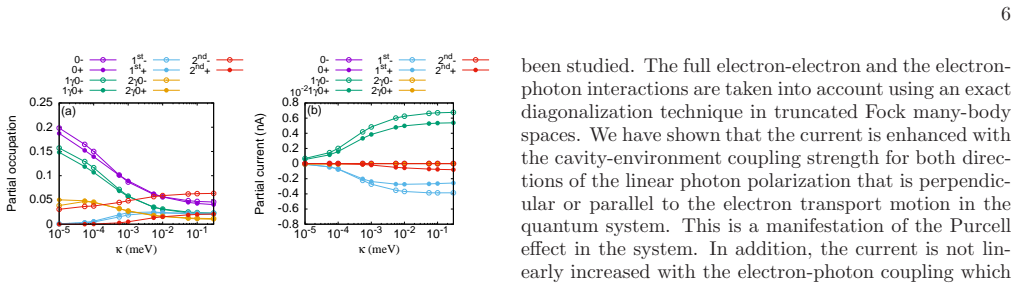
- [§III.B, Figs. 4–6] The claim that current suppression in the strong-coupling x-polarized case is caused by the 1γ0 replica moving out of the bias window is not quantitatively supported. Fig. 4 shows the closed-system spectrum, which is κ-independent and has no broadening, while the current is computed in the open system; no quantitative comparison of the position of 1γ0 with µL and µR is given for the gγ values used in Fig. 5, and the occupation of 1γ0 is not shown as a function of gγ. Please provide this quantitative link between the energy shift and the transport suppression, e.g., a plot of the 1γ0 level position versus gγ together with the chemical potentials.
- [§II and §III.B] The Markovian master equation is used in the strong-coupling regime gγ > κ without justification. When the coherent electron-photon coupling exceeds the cavity-environment coupling, the standard Born-Markov assumption for the photon reservoir is not obviously valid; if the reservoir dissipator is expressed in the bare photon basis, the level broadening and the current dependence on κ may be inaccurate. As a concrete test, the authors should either justify the Markovian approximation by working in the dressed-state basis, compare with a non-Markovian or pseudomode treatment for a representative parameter set, or identify a small parameter that controls the validity of the approximation.
- [§III, numerical details] No convergence tests are reported for the truncated photon Fock space or for the number of many-body states retained in the exact diagonalization. Since the diamagnetic term in Eq. (1) contains a†a† + aa and the interpretation relies on photon replica states up to 2γ0, the truncation could affect the computed occupations and currents. Please state the truncation cutoffs and show that the observables in Figs. 2 and 5 are converged with respect to both cutoffs.
minor comments (5)
- [Abstract] The abstract contains a typo: "a two-dimensionala quantum dot" should read "a two-dimensional quantum dot."
- [§III] The gate voltage is written as "eVg = 0.615 eV" in the main text, but all figure captions use "eVg = 0.651 meV"; the unit and value should be made consistent throughout.
- [Fig. 6 caption] The caption describes panels "(a,b) and (c,d)" and refers to x-polarization as the top panel and y-polarization as the lower panel, but the figure as displayed has only panels (a) and (b). Please correct the caption to match the actual layout.
- [Eq. (1)] The notation in the diamagnetic term "g2γ ℏΩ w" is unclear; please clarify whether the subscript w is intended and define ℏΩ0, which is used in the figure captions, in the formalism section.
- [§III.A] The sentence "The gate voltage, eVg = 0.615 meV, moves up the 1γ0 into the bias window" uses "moves up" where "shifts" or "raises" would be clearer, and the value should be double-checked against the figure captions.
Circularity Check
No significant circularity: the current versus gγ and κ results are computed from a specified Hamiltonian and a standard Markovian master equation; no fitted parameter is relabeled as a prediction and no self-citation carries the central claim.
full rationale
The paper is a computational parameter study, not a derivation that feeds its conclusion back into its assumptions. Eq. (1) fixes the model Hamiltonian with the electron-photon coupling gγ and photon energy; the many-body spectrum is obtained by exact numerical diagonalization; the steady-state current is defined by Eq. (4) through a Markovian master equation with standard references (Nakajima-Zwanzig, Lax, Gardiner-Collett). No parameter is fitted to the quantity later reported as a result: gγ and κ are swept independently, and the currents in Figs. 2 and 5 are computed outputs of the stated trace formula, not hand-imposed trends. The central claim—that x-polarized strong coupling suppresses current while y-polarized does not—is traced to the gγ-dependent Hamiltonian spectrum (Fig. 4) and to computed occupations and partial currents (Fig. 6), so it is an emergent consequence rather than an input. The gate voltage is indeed chosen to place the 1γ0 photon replica in the bias window, but this only selects an operating point; the subsequent dependence of the current on gγ and κ is not postulated. The frequent self-citations concern the numerical method and Hamiltonian form, while the underlying master-equation formalism is externally grounded in standard references; no uniqueness theorem or ansatz is imported from the authors' earlier work to exclude alternatives. The question whether the Markovian approximation remains quantitatively valid for gγ > κ is a correctness or validity issue, not a circularity: an approximation can be outside its established regime without the argument reducing to its own inputs. The paper therefore shows no significant circularity.
Assumptions & free parameters
free parameters (9)
- Electron-photon coupling strength gγ =
0.001, 0.05, 0.1, 0.15, 0.2, 0.25, 0.3 meV
- Cavity-environment coupling κ =
10^-5 to 0.1 meV (range)
- Photon energy ℏωγ =
1.31 meV
- Gate voltage eVg =
0.651 meV (text also states 0.615 meV)
- Mean photon number in reservoir nR =
1
- Lead chemical potentials μL, μR =
1.25 and 1.15 meV
- Confinement energy ℏΩ0 =
2.0 meV
- Temperature T =
0.5 K
- Perpendicular magnetic field B =
0.1 T
assumptions (4)
- domain assumption The Hamiltonian in Eq. (1) with the Coulomb interaction, Zeeman term, and paramagnetic and diamagnetic electron-photon couplings fully describes the QD-cavity system.
- domain assumption The Markovian master equation (Eq. (3)) with the projection formalism correctly yields the steady-state density operator and currents.
- domain assumption The exact numerical diagonalization in a truncated many-body Fock space converges to the true spectrum and transport properties.
- domain assumption The cavity-environment coupling is fully described by a single dissipation rate κ and a reservoir mean photon number nR = 1.
Cite this review
Pith. "Pith review of The interplay of electron-photon and cavity-environment coupling on the electron transport through a quantum dot system." pith.science (2026). https://pith.science/paper/U4OM5WA4
@misc{pith2026190805712,
  author       = {Pith},
  title        = {Pith review of: The interplay of electron-photon and cavity-environment coupling on the electron transport through a quantum dot system},
  year         = {2026},
  howpublished = {\url{https://pith.science/paper/U4OM5WA4}},
  note         = {Machine review of arXiv:1908.05712}
}
abstract
We theoretically investigate the characteristics of the electron transport through a two-dimensionala quantum dot system in the $xy$-plane coupled to a photon cavity and a photon reservoir, the environment. The electron-photon coupling, $g_{\gamma}$, and the cavity-reservoir coupling, $\kappa$, are tuned to study the system in the weak, $g_{\gamma} \leq \kappa$, and the strong coupling regime, $g_{\gamma} > \kappa$. An enhancement of current is both seen with increasing $g_{\gamma}$ and $\kappa$ in the weak coupling regime for both $x$- and $y$-polarization of the photon field. This is a direct consequence of the Purcell effect. The current enhancement is due to the contribution of the photon replica states to the electron transport in which intraband transitions play an important role. The properties of the electron transport are drastically changed in the strong coupling regime with an $x$-polarized photon field in which the current is suppressed with increasing $g_{\gamma}$, but it is still increasing with $\kappa$. This behavior of the current is related to the population of purely electronic states and depopulation of photon replica states.
Figures


Figures from the paper (2 more)

Reference graph
Works this paper leans on
-
[1]
) and the diamagnetic Hamiltonian (third line of Eq. ( 1)) with gij the dimensionless electron-photon coupling matrix, and ˆNγ the photon number operator [ 45]. The electron- photon coupling strength can be represented by gγ and Ω w is the electron effective confinement frequency. To investigate the evolution of the electrons in the QD system in the steady ...
-
[2]
The cavity- 0 0.5 1 1.5 2 2.5 0 1γ0 1st 2γ0 MB-energy spectrum (meV) 0ES 1ES 2ES µL µR FIG. 1. The many-Body energy spectrum of the closed QD system coupled to the photon field, where 0ES (blue squares) are zero-electron states, 1ES (red circles) are one-electr on state, and 2ES are two-electron states (golden triangles). The photon energy is ℏω γ = 1 . 31...
-
[3]
15 meV (blue line). The magnetic field is B = 0 . 1 T, eVg = 0. 651 meV, TL, R = 0. 5 K, and ℏΩ 0 = 2. 0 meV. environment coupling parameter, κ, is included in the Markovian master equation that is used to investigate the electron motion through the QD system here [ 43]. The energy spectrum of the closed system displayed in Fig. 1 is independent of κ. The ...
-
[4]
1 meV (blue circles) in the x- (a) and y-polarized of the photon field. The photon energy is ℏω γ = 1 . 31 meV, and nR = 1. The chemical potential of the left lead is µ L =
-
[5]
25 meV and the right lead is µ R = 1. 15 meV. The magnetic field is B = 0 . 1 T, eVg = 0 . 651 meV, TL, R = 0 . 5 K, and ℏΩ 0 = 2. 0 meV that the current in the x-polarized photon field is ten times larger than for the y-polarization for gγ = 0 . 05 and 0. 1 meV. This is due to the fact that the states of the QD system are more polarizable in the x-directio...
-
[6]
2 (blue star), 0 . 25 (black cross), and 0 . 3 meV (red), which are all greater than the selected range of κ. The characteristics of the current in the system is drastically changed for the x-polarization in the strong coupling regime. The current is suppressed with increasing gγ for the x-polarization (Fig. 5(a)) throughout all values of κ while it is en...
-
[7]
25 meV and the right lead is µ R = 1. 15 meV. The magnetic field is B = 0 . 1 T, eVg = 0 . 651 meV, TL, R = 0 . 5 K, and ℏΩ 0 = 2. 0 meV tial occupation (a) and the partial current (b) for the x-polarization in Fig. 6. We start with the x-polarized photon field with gγ =
-
[8]
3 meV (Fig. 6(a)), in which the occupation of the pure electronic states, 1 st (blue) and 2 nd (red), is much en- hanced throughout the values of κ comparing to the case of low coupling regime when gγ = 0. 1 meV shown in Fig. 3(b). It supports the view that the lifetime of the pure electronic states, 1 st and 2nd, is much longer in the strong coupling reg...
Show all 69 references
-
[9]
Decker, I
M. Decker, I. Staude, I. I. Shishkin, K. B. Samusev, P. Parkinson, V. K. A. Sreenivasan, A. Minovich, A. E. Miroshnichenko, A. Zvyagin, C. Jagadish, D. N. Neshev, and Y. S. Kivshar, Nature Communications 4, 2949 EP (2013), article
2013
-
[10]
Rahmani and G
A. Rahmani and G. Bryant, physica status solidi (b) 224, 807
-
[11]
Lodahl, A
P. Lodahl, A. Floris van Driel, I. S. Nikolaev, A. Irman, K. Overgaag, D. Vanmaekelbergh, and W. L. Vos, Na- ture 430, 654 (2004)
2004
-
[12]
A. Kuhn, M. Hennrich, and G. Rempe, Phys. Rev. Lett. 89, 067901 (2002)
2002
-
[13]
De Greve, L
K. De Greve, L. Yu, P. L. McMahon, J. S. Pelc, C. M. Natarajan, N. Y. Kim, E. Abe, S. Maier, C. Schneider, M. Kamp, S. H¨ ofling, R. H. Hadfield, A. Forchel, M. M. Fejer, and Y. Yamamoto, Nature 491, 421 EP (2012)
2012
-
[14]
Frisk Kockum, A
A. Frisk Kockum, A. Miranowicz, S. De Liberato, S. Savasta, and F. Nori, Nature Reviews Physics 1, 19 (2019)
2019
-
[15]
Gr¨ atzel,Nature 414, 338 (2001)
M. Gr¨ atzel,Nature 414, 338 (2001)
2001
-
[16]
S. Noda, M. Yokoyama, M. Imada, A. Chuti- nan, and M. Mochizuki, Science 293, 1123 (2001) , https://science.sciencemag.org/content/293/5532/1123.full.pdf
2001
-
[17]
E. M. Purcell, H. C. Torrey, and R. V. Pound, Phys. Rev. 69, 37 (1946)
1946
-
[18]
Kiraz, C
A. Kiraz, C. Reese, B. Gayral, L. Zhang, W. V. Schoen- feld, B. D. Gerardot, P. M. Petroff, E. L. Hu, and A. Imamoglu, Journal of Optics B: Quantum and Semi- classical Optics 5, 129 (2003)
2003
-
[19]
Landi, J
M. Landi, J. Zhao, W. E. Prather, Y. Wu, and L. Zhang, Phys. Rev. Lett. 120, 114301 (2018)
2018
-
[20]
L. Li, C. J. Mathai, S. Gangopadhyay, X. Yang, and J. Gao, Scientific Reports 9, 8473 (2019)
2019
-
[21]
Q. Ren, J. Lu, H. H. Tan, S. Wu, L. Sun, W. Zhou, W. Xie, Z. Sun, Y. Zhu, C. Jagadish, S. C. Shen, and Z. Chen, Nano Letters 12, 3455 (2012) , pMID: 22698083, https://doi.org/10.1021/nl3008083
2012 doi
-
[22]
T. Wilk, S. C. Webster, H. P. Specht, G. Rempe, and A. Kuhn, Phys. Rev. Lett. 98, 063601 (2007)
2007
-
[23]
Press, S
D. Press, S. G¨ otzinger, S. Reitzenstein, C. Hofmann, A. L¨ offler, M. Kamp, A. Forchel, and Y. Yamamoto, Phys. Rev. Lett. 98, 117402 (2007)
2007
-
[24]
Weisskopf and E
V. Weisskopf and E. Wigner, Zeitschrift f¨ ur Physik63, 54 (1930)
1930
-
[25]
Pelton, Nature Photonics 9, 427 EP (2015) , review Article
M. Pelton, Nature Photonics 9, 427 EP (2015) , review Article
2015
-
[26]
W. Wei, X. Yan, J. Liu, B. Shen, W. Luo, X. Ma, and X. Zhang, Nanomaterials 9 (2019), 10.3390/nano9050671
2019 doi
-
[27]
Aspuru-Guzik and P
A. Aspuru-Guzik and P. Walther, Nature Physics 8, 285 EP (2012) , review Article
2012
-
[28]
Cialdi, M
S. Cialdi, M. A. C. Rossi, C. Benedetti, B. Vac- chini, D. Tamascelli, S. Olivares, and M. G. A. Paris, Applied Physics Letters 110, 081107 (2017) , 7 https://doi.org/10.1063/1.4977023
2017 doi
-
[29]
E. A. Muljarov and W. Langbein, Phys. Rev. B 94, 235438 (2016)
2016
-
[30]
Cottet, T
A. Cottet, T. Kontos, and B. Dou¸ cot, Phys. Rev. B 91, 205417 (2015)
2015
-
[31]
S. J. Dewhurst, D. Granados, D. J. P. Ellis, A. J. Bennett , R. B. Patel, I. Farrer, D. Anderson, G. A. C. Jones, D. A. Ritchie, and A. J. Shields, Applied Physics Letters 96, 031109 (2010) , https://doi.org/10.1063/1.3294298
2010 doi
-
[32]
del Valle and F
E. del Valle and F. Laussy, Superlattices and Microstruc- tures 49, 241 (2011) , special issue: Proceedings of the 10th International Conference on the Physics of Light–Matter Coupling in Nanostructures, PLMCN 2010 (Cuernavaca, Mexico), 12–16 April, 2010
2011
-
[33]
H. J. Snijders, J. A. Frey, J. Norman, H. Flayac, V. Savona, A. C. Gossard, J. E. Bowers, M. P. van Exter, D. Bouwmeester, and W. L¨ offler, Phys. Rev. Lett. 121, 043601 (2018)
2018
-
[34]
M¨ uller, A
K. M¨ uller, A. Rundquist, K. A. Fischer, T. Sarmiento, K. G. Lagoudakis, Y. A. Kelaita, C. S´ anchez Mu˜ noz, E. del Valle, F. P. Laussy, and J. Vuˇ ckovi´ c, Phys. Rev. Lett. 114, 233601 (2015)
2015
-
[35]
Dousse, L
A. Dousse, L. Lanco, J. Suffczy´ nski, E. Semenova, A. Mi- ard, A. Lema ˆ ıtre, I. Sagnes, C. Roblin, J. Bloch, and P. Senellart, Phys. Rev. Lett. 101, 267404 (2008)
2008
-
[36]
H. Leng, B. Szychowski, M.-C. Daniel, and M. Pelton, Nature Communications 9, 4012 (2018)
2018
-
[37]
Cirio, S
M. Cirio, S. De Liberato, N. Lambert, and F. Nori, Phys. Rev. Lett. 116, 113601 (2016)
2016
-
[38]
Gudmundsson, N
V. Gudmundsson, N. R. Abdulla, A. Sitek, H.-S. Goan, C.-S. Tang, and A. Manolescu, Annalen der Physik 530, 1700334 (2018)
2018
-
[39]
Eichler, C
C. Eichler, C. Lang, J. M. Fink, J. Govenius, S. Filipp, and A. Wallraff, Phys. Rev. Lett. 109, 240501 (2012)
2012
-
[40]
C. Lang, D. Bozyigit, C. Eichler, L. Steffen, J. M. Fink, A. A. Abdumalikov, M. Baur, S. Filipp, M. P. da Silva, A. Blais, and A. Wallraff, Phys. Rev. Lett. 106, 243601 (2011)
2011
-
[41]
Faraon, I
A. Faraon, I. Fushman, D. Englund, N. Stoltz, P. Petroff, and J. Vuckovic, Nature Physics 4, 859 EP (2008)
2008
-
[42]
Gudmundsson, A
V. Gudmundsson, A. Sitek, P.-y. Lin, N. R. Abdullah, C.-S. Tang, and A. Manolescu, ACS Photonics 2, 930 (2015)
2015
-
[43]
M. A. Sillanp¨ a¨ a, J. I. Park, and R. W. Simmonds,Nature 449, 438 EP (2007)
2007
-
[44]
Majer, J
J. Majer, J. M. Chow, J. M. Gambetta, J. Koch, B. R. Johnson, J. A. Schreier, L. Frunzio, D. I. Schuster, A. A. Houck, A. Wallraff, A. Blais, M. H. Devoret, S. M. Girvin, and R. J. Schoelkopf, Nature 449, 443 EP (2007)
2007
-
[45]
Y. Wu, Y. Wang, X. Qin, X. Rong, and J. Du, npj Quantum Information 5, 9 (2019)
2019
-
[46]
Hanschke, K
L. Hanschke, K. A. Fischer, S. Appel, D. Lukin, J. Wierzbowski, S. Sun, R. Trivedi, J. Vuckovic, J. J. Finley, and K. M¨ uller, npj Quantum Information 4, 43 (2018)
2018
-
[47]
Lin and B
Q. Lin and B. He, Scientific Reports 5, 12792 EP (2015) , article
2015
-
[48]
Giannelli, T
L. Giannelli, T. Schmit, T. Calarco, C. P. Koch, S. Ritte r, and G. Morigi, New Journal of Physics 20, 105009 (2018)
2018
-
[49]
Kreinberg, T
S. Kreinberg, T. Grbesic, M. Strauß, A. Carmele, M. Em- merling, C. Schneider, S. H¨ ofling, X. Porte, and S. Re- itzenstein, Light: Science & Applications 7, 41 (2018)
2018
-
[50]
N. R. Abdullah, C. S. Tang, A. Manolescu, and V. Gud- mundsson, Physica E 64, 254 (2014)
2014
-
[51]
Gudmundsson, H
V. Gudmundsson, H. Gestsson, N. R. Abdullah, C.-S. Tang, A. Manolescu, and V. Moldoveanu, Beilstein J. Nanotechnol. 10, 606 (2019)
2019
-
[52]
N. R. Abdullah, C. S. Tang, A. Manolescu, and V. Gud- mundsson, Journal of physics: Condensed matter 27, 015301 (2015)
2015
-
[53]
Gudmundsson, O
V. Gudmundsson, O. Jonasson, C.-S. Tang, H.-S. Goan, and A. Manolescu, Phys. Rev. B 85, 075306 (2012)
2012
-
[54]
N. R. Abdullah, C.-S. Tang, A. Manolescu, and V. Gud- mundsson, Physica E: Low-dimensional Systems and Nanostructures , (2017)
2017
-
[55]
Zhang, M
Q. Zhang, M. Lou, X. Li, J. L. Reno, W. Pan, J. D. Watson, M. J. Manfra, and J. Kono, Nature Physics 12, 1005 EP (2016)
2016
-
[56]
T. H. Jonsson, A. Manolescu, H.-S. Goan, N. R. Abdul- lah, A. Sitek, C.-S. Tang, and V. Gudmundsson, Com- puter Physics Communications 220, 81 (2017)
2017
-
[57]
N. R. Abdullah, C.-S. Tang, A. Manolescu, and V. Gud- mundsson, Physica E: Low-dimensional Systems and Nanostructures 84, 280 (2016)
2016
-
[58]
N. R. Abdullah, C.-S. Tang, A. Manolescu, and V. Gudmundsson, Nanomaterials 9 (2019), 10.3390/nano9050741
2019 doi
-
[59]
Gudmundsson, A
V. Gudmundsson, A. Sitek, N. R. Abdullah, C.-S. Tang, and A. Manolescu, Annalen der Physik 528, 394 (2016)
2016
-
[60]
Arnold, C.-S
T. Arnold, C.-S. Tang, A. Manolescu, and V. Gud- mundsson, Journal of Optics 17, 015201 (2015)
2015
-
[61]
Gudmundsson, N
V. Gudmundsson, N. R. Abdullah, A. Sitek, H.-S. Goan, C.-S. Tang, and A. Manolescu, Physics Letters A 382, 1672 (2018)
2018
-
[62]
Gudmundsson, O
V. Gudmundsson, O. Jonasson, T. Arnold, C.-S. Tang, H.-S. Goan, and A. Manolescu, Fortschr. Phys. 61, 305 (2013)
2013
-
[63]
Yannouleas and U
C. Yannouleas and U. Landman, Rep. Prog. Phys 70, 2067 (2007)
2007
-
[64]
Zwanzig, The Journal of Chemical Physics 33, 1338 (1960)
R. Zwanzig, The Journal of Chemical Physics 33, 1338 (1960)
1960
-
[65]
Nakajima, Prog
S. Nakajima, Prog. of Theor. Phys. 20, 948 (1958)
1958
-
[66]
Lax, Phys
M. Lax, Phys. Rev. 129, 2342 (1963)
1963
-
[67]
C. W. Gardiner and M. J. Collett, Phys. Rev. A 31, 3761 (1985)
1985
-
[68]
Beaudoin, J
F. Beaudoin, J. M. Gambetta, and A. Blais, Phys. Rev. A 84, 043832 (2011)
2011
-
[69]
N. R. Abdullah, C.-S. Tang, A. Manolescu, and V. Gud- mundsson, arXiv:1904.04888 (2019)
2019 arXiv
Reviewed August 14, 2026 · model on record in the stance chip above.
Discussion (0). Continue with ORCID to comment.