On-chip detection of anisotropic thermopolarization in quartz
Pith reviewed 2026-05-19 23:26 UTC · model grok-4.3
The pith
Heating quartz crystals produces electrical currents through thermally generated mechanical stress and piezoelectric coupling.
A machine-rendered reading of the paper's core claim, the machinery that carries it, and where it could break.
Core claim
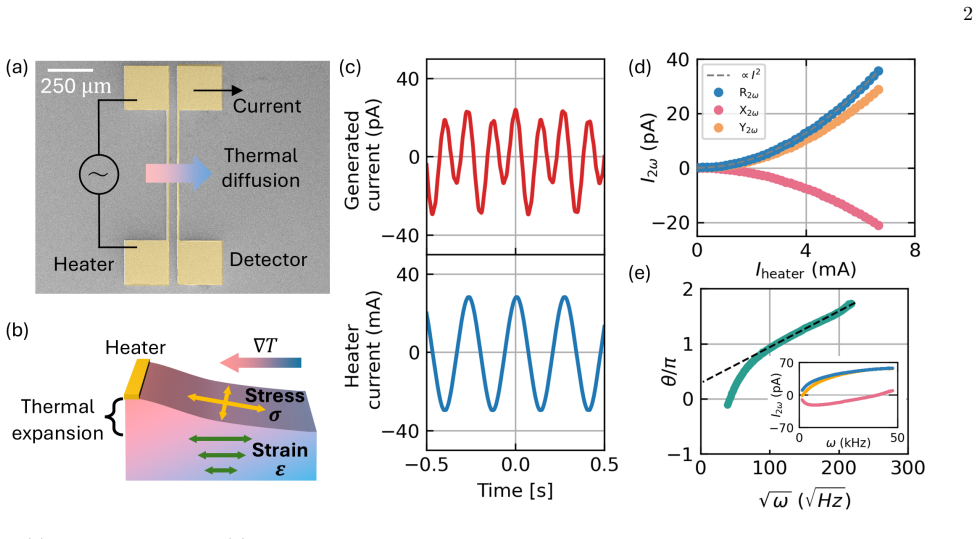
The authors establish that local heating in quartz inherently produces mechanical stress through thermal expansion, which couples to the piezoelectric tensor and generates detectable electrical currents and voltages. Using an on-chip geometry, they show that the thermally generated current exhibits twofold rotational symmetry in X-cut quartz and threefold symmetry in Z-cut quartz, directly reflecting the anisotropy of the piezoelectric response. This reveals a thermomechanical pathway for heat-to-charge conversion that operates alongside conventional thermoelectric effects.
What carries the argument
Piezoelectric coupling to stress induced by thermal expansion, measured on-chip to reveal the symmetry of the piezoelectric tensor in different crystal cuts.
If this is right
- The thermomechanical response appears in both current and voltage detection modes.
- The method supplies a general on-chip platform for electrically probing thermomechanical behavior in insulating materials.
- Heat-to-charge conversion occurs through stress generated by thermal expansion in any piezoelectric system.
- The symmetry of the thermally generated current directly encodes the anisotropy of the piezoelectric tensor.
Where Pith is reading between the lines
- Similar on-chip heating could be used to characterize piezoelectric coefficients in other materials without applying external mechanical loads.
- Circuit designers working with temperature gradients in piezoelectric or insulating layers may need to include thermomechanical contributions when calculating total output signals.
- The approach could be extended to map how signal strength scales with heating power or film thickness to improve sensitivity in future devices.
Load-bearing premise
The measured electrical signals arise from piezoelectric response to thermally generated stress rather than from thermoelectric, pyroelectric, or contact-related effects.
What would settle it
If rotating the crystal orientation while keeping the temperature gradient fixed eliminates the current or changes its symmetry in a way that no longer matches the known piezoelectric tensor, or if identical heating produces signals in a non-piezoelectric insulator, the thermomechanical interpretation would be falsified.
Figures


read the original abstract
Temperature gradients are widely used to drive and probe transport phenomena in solids, forming the basis of heat-to-charge conversion processes. In typical experiments, local heating is introduced to generate a temperature gradient, and the resulting electrical response is detected by separate electrodes. Such measurements usually regard heating purely as a source of thermal excitation. Here, we show that heating inherently generates mechanical stress through thermal expansion, which in turn produces measurable electrical signals via electromechanical coupling. Using quartz as a model piezoelectric system, we demonstrate that heat can be converted to electrical currents via thermally generated stress. The on-chip device used in our experiment enables us to probe the anisotropy of the piezoelectric tensor through the thermally generated current, exhibiting twofold and threefold responses for X-cut and Z-cut crystals, respectively. We further show that the response can be detected in both current and voltage modes. These results reveal a thermomechanical pathway for heat-to-charge conversion and establish a general platform for electrically probing thermomechanical responses in insulating materials.
Editorial analysis
A structured set of objections, weighed in public.
Referee Report
Summary. The manuscript reports an on-chip experiment on quartz in which local heating produces mechanical stress via thermal expansion; the resulting strain couples to the piezoelectric tensor to generate measurable electrical current or voltage. Angular scans show twofold symmetry on X-cut and threefold symmetry on Z-cut samples, which the authors interpret as direct evidence of the thermomechanical (piezoelectric) pathway for heat-to-charge conversion, observable in both current and voltage modes.
Significance. If the attribution to piezoelectric response is confirmed, the work identifies a thermomechanical contribution that must be considered whenever temperature gradients are applied to piezoelectric or insulating solids. The on-chip geometry offers a compact platform for mapping electromechanical anisotropy without separate mechanical loading, which could be useful for characterizing other non-centrosymmetric materials.
major comments (2)
- [Results and Discussion (angular-dependence data)] The central claim that the measured currents arise from piezoelectric coupling to thermally generated stress is not quantitatively supported. No forward calculation is presented that combines the known thermal-expansion coefficients, elastic constants, piezoelectric d_ij values, device dimensions, and observed temperature difference to predict the expected current amplitude. Without this estimate, the twofold and threefold angular dependences, while consistent with quartz symmetry, do not exclude contact potentials, temperature-dependent barrier heights, or residual pyroelectric-like interface effects at the reported signal levels.
- [Methods and Experimental Controls] The manuscript does not describe control experiments that would bound alternative mechanisms. A non-piezoelectric reference sample (e.g., fused silica) or a direct stress measurement under identical heating conditions would strengthen the attribution; their absence leaves the interpretation reliant on symmetry matching alone.
minor comments (2)
- [Title and Abstract] The abstract and introduction use 'thermopolarization' in the title but the text consistently refers to piezoelectric response to thermal stress; a brief clarification of the terminology would avoid confusion with pyroelectric or thermoelectric polarization.
- [Figures] Figure captions should explicitly state the temperature difference, electrode spacing, and heating power used for each angular scan so that readers can assess signal magnitudes directly.
Simulated Author's Rebuttal
We thank the referee for the constructive comments and for recognizing the significance of identifying a thermomechanical pathway in heat-to-charge conversion. We address each major comment below and indicate the revisions made to the manuscript.
read point-by-point responses
-
Referee: [Results and Discussion (angular-dependence data)] The central claim that the measured currents arise from piezoelectric coupling to thermally generated stress is not quantitatively supported. No forward calculation is presented that combines the known thermal-expansion coefficients, elastic constants, piezoelectric d_ij values, device dimensions, and observed temperature difference to predict the expected current amplitude. Without this estimate, the twofold and threefold angular dependences, while consistent with quartz symmetry, do not exclude contact potentials, temperature-dependent barrier heights, or residual pyroelectric-like interface effects at the reported signal levels.
Authors: We agree that a quantitative estimate would strengthen the attribution. In the revised manuscript we have added an order-of-magnitude forward calculation that combines the known thermal-expansion coefficients, elastic constants, piezoelectric d_ij values, device dimensions, and the measured temperature difference. The resulting estimate lies within a factor of approximately two of the observed current amplitudes, consistent with uncertainties in the local temperature profile. We maintain that the observed twofold (X-cut) and threefold (Z-cut) angular symmetries constitute the primary evidence, because alternative mechanisms such as contact potentials or barrier-height variations lack this specific crystallographic dependence; the added estimate nevertheless addresses the concern about absolute signal levels. revision: yes
-
Referee: [Methods and Experimental Controls] The manuscript does not describe control experiments that would bound alternative mechanisms. A non-piezoelectric reference sample (e.g., fused silica) or a direct stress measurement under identical heating conditions would strengthen the attribution; their absence leaves the interpretation reliant on symmetry matching alone.
Authors: We acknowledge the utility of explicit controls. In the revised manuscript we have added data acquired on a fused-silica reference sample under identical heating conditions; this sample produces no measurable current or voltage above the noise floor, helping to exclude thermoelectric or interface-related contributions. A direct stress measurement was not performed, as it would require a separate mechanical metrology setup not available in the present on-chip configuration; the combination of the non-piezoelectric reference and the symmetry analysis nevertheless provides a sufficient bound on alternative mechanisms. revision: partial
Circularity Check
No circularity: experimental symmetry observations are independent of inputs
full rationale
The manuscript reports direct experimental measurements of thermally generated currents in quartz crystals, with observed twofold and threefold angular dependencies matching the known piezoelectric tensor symmetries for X-cut and Z-cut orientations. No derivation chain, parameter fitting, or first-principles prediction is claimed that reduces by construction to the measured data or to self-citations. The central result is an empirical demonstration of a thermomechanical pathway, supported by device geometry and control of heating, without any self-definitional or load-bearing self-citation steps. The absence of a quantitative forward model is a limitation on mechanism exclusion but does not constitute circularity.
Axiom & Free-Parameter Ledger
axioms (1)
- domain assumption Quartz is piezoelectric with a tensor that produces twofold symmetry for X-cut and threefold symmetry for Z-cut orientations under stress.
Lean theorems connected to this paper
-
IndisputableMonolith/Foundation/AlexanderDuality.leanalexander_duality_circle_linking unclear?
unclearRelation between the paper passage and the cited Recognition theorem.
exhibiting twofold and threefold responses for X-cut and Z-cut crystals respectively... piezoelectric tensor d of α-quartz
-
IndisputableMonolith/Cost/FunctionalEquation.leanwashburn_uniqueness_aczel unclear?
unclearRelation between the paper passage and the cited Recognition theorem.
I∝dP/dt=∂P/∂σ ∂σ/∂T ∂T/∂t ... finite-element calculations... thermal stress
What do these tags mean?
- matches
- The paper's claim is directly supported by a theorem in the formal canon.
- supports
- The theorem supports part of the paper's argument, but the paper may add assumptions or extra steps.
- extends
- The paper goes beyond the formal theorem; the theorem is a base layer rather than the whole result.
- uses
- The paper appears to rely on the theorem as machinery.
- contradicts
- The paper's claim conflicts with a theorem or certificate in the canon.
- unclear
- Pith found a possible connection, but the passage is too broad, indirect, or ambiguous to say the theorem truly supports the claim.
Reference graph
Works this paper leans on
-
[1]
N. W. Ashcroft and N. D. Mermin,Solid State Physics (Saunders College, Philadelphia, 1976)
work page 1976
-
[2]
A. von Ettingshausen and W. Nernst, Annalen der Physik265, 343 (1886)
-
[3]
H. Arisawa, Y. Fujimoto, T. Kikkawa, and E. Saitoh, Nature Communications15, 6912 (2024)
work page 2024
- [4]
-
[5]
H. Fangohr, D. S. Chernyshenko, M. Franchin, T. Fis- chbacher, and G. Meier, Phys. Rev. B84, 054437 (2011)
work page 2011
-
[6]
W. P. Mason and H. Baerwald,Piezoelectric Crystals and their Applications to Ultrasonics(D. Van Nostrand Com- pany, 1950)
work page 1950
- [8]
-
[9]
J. Liu, M. V. Fern´ andez-Serra, and P. B. Allen, Physical Review B93, 081205 (2016)
work page 2016
-
[10]
A. Jain, D. Mandal, and C. Beral, Journal of Physics: Condensed Matter35, 415401 (2023)
work page 2023
- [11]
-
[12]
Y. M. Poplavko, L. P. Pereverzeva, N.-I. Cho, Y. S. You, and H. G. Nam, Japanese Journal of Applied Physics37, 4041 (1998)
work page 1998
-
[13]
Y. M. Poplavko, APL Materials13, 061113 (2025)
work page 2025
- [14]
-
[15]
P. Lab´ eguerie, M. Harb, I. Baraille, and M. R´ erat, Phys. Rev. B81, 045107 (2010)
work page 2010
-
[16]
A. J. Angstr¨ om, The London, Edinburgh, and Dublin Philosophical Magazine and Journal of Science25, 130 (1863)
-
[17]
J. Morikawa and T. Hashimoto, Japanese Journal of Ap- plied Physics37, L1484 (1998). 8
work page 1998
-
[18]
J. Morikawa and T. Hashimoto, Journal of Applied Physics105, 113506 (2009)
work page 2009
-
[19]
J. Ordonez-Miranda, L. Jalabert, Y. Wu, S. Volz, and M. Nomura, Journal of Applied Physics133, 205104 (2023)
work page 2023
- [20]
- [21]
-
[22]
Landauer, Journal of Applied Physics28, 227 (1957)
R. Landauer, Journal of Applied Physics28, 227 (1957)
work page 1957
discussion (0)
Sign in with ORCID, Apple, or X to comment. Anyone can read and Pith papers without signing in.