REVIEW 2 major objections 15 references
Technical Health Check For Cloud Service Providers
T0 review · 2 major / 0 minor · reviewed 2026-05-25 · grok-4.3
Pith's one-line read Cloud providers can assess IT infrastructure health in real time by monitoring operational data.
desk verdict This paper describes a monitoring approach for cloud health checks but lacks details and validation to support its claims. read the letter →
The pith
A machine-rendered reading of the paper's core claim, the machinery that carries it, and where it could break.
The reading
What carries the argument
The technical health check process that monitors, assesses, and visualizes operational data in real time.
What would settle it
A side-by-side comparison where the data-driven health check and a traditional expert site visit produce differing conclusions on the same infrastructure.
Extended reading notes
Core claim
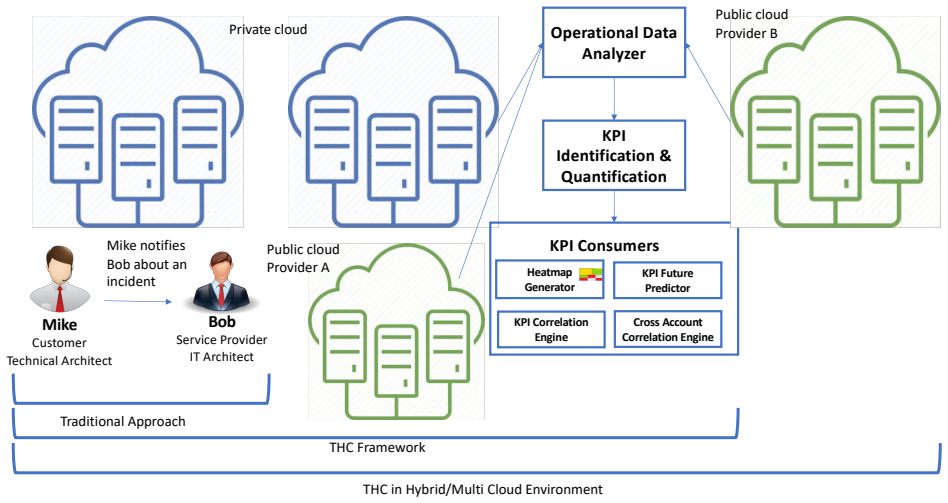
The paper presents a technical health check system for cloud providers that monitors operational data, assesses it, and depicts the current health of an IT infrastructure in real time, contrasting it with traditional subjective methods.
Load-bearing premise
Operational data alone suffices to produce an objective and accurate assessment of IT infrastructure health.
Editorial extensions
If this is right
- Real-time depiction of infrastructure health becomes possible without site visits.
- Assessments can be more objective by relying on data rather than expert judgment.
- Challenges in hybrid cloud environments can be identified and discussed.
- Opportunities for improved IT service management arise from continuous monitoring.
Reading between the lines
- This could lead to automated alerts for potential issues before they become critical.
- Integration with predictive analytics might extend the method beyond current real-time assessment.
- Data privacy concerns in operational monitoring could emerge as a new issue in hybrid setups.
Signed reviews
Editorial analysis
A structured set of objections, weighed in public.
Referee Report
Summary. The paper claims to present a technical health check system for cloud service providers. It contrasts traditional reactive and subjective methods (physical site visits by subject matter experts or periodic surveys of technical architects) with a new approach that monitors operational data, assesses it, and depicts the current health of an IT infrastructure in real time. The manuscript also discusses challenges and opportunities specific to hybrid cloud environments.
Significance. If implemented with concrete methods and validated, the work could meaningfully advance IT service management by shifting from periodic, human-dependent checks to automated, real-time, data-driven assessments. This would be especially relevant for hybrid clouds where physical access is limited. The discussion of hybrid-cloud-specific issues provides useful context, but the absence of technical substance prevents any such contribution from being realized.
major comments (2)
- [Abstract] Abstract: the central claim that the system 'monitors, assesses operational data and depicts the current health of an IT infrastructure in real time' is stated without any description of the data sources collected, the metrics or thresholds applied, the assessment or aggregation logic, or the visualization method. This directly undermines the assertion that operational data alone is sufficient for an objective, accurate, and actionable health assessment.
- [Abstract] Abstract: no validation data, error analysis, case studies, or comparison against traditional site-visit or survey results is supplied to test whether the (unspecified) assessment produces reliable health depictions. The premise that operational data suffices without expert judgment or physical inspection therefore remains untested and load-bearing for the paper's contribution.
Simulated Author's Rebuttal
We thank the referee for the review and the opportunity to respond. The manuscript is a conceptual discussion paper that contrasts traditional health-check methods with a real-time operational-data approach and highlights hybrid-cloud issues; it does not claim to deliver a fully specified or validated implementation. We address the two abstract-related comments below.
read point-by-point responses
-
Referee: [Abstract] Abstract: the central claim that the system 'monitors, assesses operational data and depicts the current health of an IT infrastructure in real time' is stated without any description of the data sources collected, the metrics or thresholds applied, the assessment or aggregation logic, or the visualization method. This directly undermines the assertion that operational data alone is sufficient for an objective, accurate, and actionable health assessment.
Authors: We agree the abstract states the claim at a high level without enumerating data sources, metrics, thresholds, aggregation logic or visualization. The manuscript's contribution is the framing of the paradigm shift and the hybrid-cloud challenges rather than an implementation specification; concrete metrics and logic are provider-specific and therefore omitted. We will revise the abstract to explicitly characterize the work as conceptual and to avoid implying a ready-to-deploy system. revision: partial
-
Referee: [Abstract] Abstract: no validation data, error analysis, case studies, or comparison against traditional site-visit or survey results is supplied to test whether the (unspecified) assessment produces reliable health depictions. The premise that operational data suffices without expert judgment or physical inspection therefore remains untested and load-bearing for the paper's contribution.
Authors: The manuscript contains no validation data, error analysis or case studies because it is not an empirical evaluation paper. We therefore cannot supply such material without performing new experiments that lie outside the stated scope. The contribution is limited to identifying the opportunity and the hybrid-cloud considerations; any claim of reliability would indeed require the validation the referee correctly notes is absent. revision: no
Circularity Check
No significant circularity; declarative system description with no derivations or self-referential reductions
full rationale
The paper presents a conceptual technical health check system that monitors operational data for real-time IT infrastructure assessment in cloud and hybrid environments. It contains no equations, fitted parameters, predictions derived from inputs, or load-bearing self-citations. The description contrasts traditional site visits/surveys with the proposed monitoring approach but does not reduce any claim to a self-definition, renamed known result, or ansatz smuggled via citation. The central claim remains a high-level proposal without mathematical or statistical reductions that could exhibit circularity by construction.
Assumptions & free parameters
assumptions (1)
- domain assumption Operational data from IT infrastructure can be used to objectively assess its health in real time without subjective input
Cite this review
Pith. "Pith review of Technical Health Check For Cloud Service Providers." pith.science (2026). https://pith.science/paper/U55S5STS
@misc{pith2026190611607,
  author       = {Pith},
  title        = {Pith review of: Technical Health Check For Cloud Service Providers},
  year         = {2026},
  howpublished = {\url{https://pith.science/paper/U55S5STS}},
  note         = {Machine review of arXiv:1906.11607}
}
read the original abstract
Understanding the overall health of an IT Infrastructure is a key part of IT Service Management. Traditional approach to perform technical health check is by visiting customer's physical site and rigorously examining the IT infrastructure with Subject Matter Experts. Alternatively, periodic surveys are sent to Technical Architects who are responsible for the managed IT infrastructure. In essence, both site visits and surveys suffer from reactive nature, and subjective assessment. In this paper, we present technical health check for cloud providers, that monitors, assesses operational data and depicts the current health of an IT infrastructure in real time. We also discuss challenges and opportunities of technical health check in Hybrid Cloud Environment.
Figures
Figures from the paper (1 more)
Reference graph
Works this paper leans on
-
[1]
Cloud application monitoring: The mosaic approach,
M. Rak, S. Venticinque, G. Echevarria, G. Esnal et al. , “Cloud application monitoring: The mosaic approach,” in Cloud Computing Technology and Science (CloudCom), 2011 IEEE Third International Conference on . IEEE, 2011, pp. 758–763
work page 2011
-
[2]
Clams: Cross-layer multi- cloud application monitoring-as-a-service framework,
K. Alhamazani, R. Ranjan, K. Mitra, P. P. Jayaraman, Z. Huang, L. Wang, and F. Rabhi, “Clams: Cross-layer multi- cloud application monitoring-as-a-service framework,” in Ser- vices Computing (SCC), 2014 IEEE International Conference on. IEEE, 2014, pp. 283–290
work page 2014
-
[3]
G. Aceto, A. Botta, W. De Donato, and A. Pescap `e, “Cloud monitoring: A survey,” Computer Networks , vol. 57, no. 9, pp. 2093–2115, 2013
-
[4]
“Amazon cloudwatch,” https://aws.amazon.com/cloudwatch, accessed: 04-Jan-2019
work page 2019
-
[5]
Rule-based problem classification in it service management,
Y . Diao, H. Jamjoom, and D. Loewenstern, “Rule-based problem classification in it service management,” in 2009 IEEE International Conference on Cloud Computing . IEEE, 2009, pp. 221–228
work page 2009
-
[6]
Knowledge guided hierarchical multi-label classification over ticket data,
C. Zeng, W. Zhou, T. Li, L. Shwartz, and G. Y . Grabarnik, “Knowledge guided hierarchical multi-label classification over ticket data,” IEEE Trans. Network and Service Man- agement, vol. 14, no. 2, pp. 246–260, 2017
work page 2017
-
[7]
STAR: A system for ticket analysis and resolution,
W. Zhou, W. Xue, R. Baral, Q. Wang, C. Zeng, T. Li, J. Xu, Z. Liu, L. Shwartz, and G. Y . Grabarnik, “STAR: A system for ticket analysis and resolution,” in Proceedings of the 23rd ACM SIGKDD International Conference on Knowledge Discovery and Data Mining, Halifax, NS, Canada, August 13 - 17, 2017 , 2017, pp. 2181–2190
work page 2017
-
[8]
Automatic classification of change requests for improved it service quality,
C. Kadar, D. Wiesmann, J. Iria, D. Husemann, and M. Lucic, “Automatic classification of change requests for improved it service quality,” in SRII Global Conference (SRII), 2011 Annual. IEEE, 2011, pp. 430–439
work page 2011
Show all 15 references
-
[9]
Cataloger: Catalog recommendation service for IT change requests,
A. K. Kalia, J. Xiao, M. F. Bulut, M. Vukovic, and N. Aner- ousis, “Cataloger: Catalog recommendation service for IT change requests,” in Service-Oriented Computing - 15th Inter- national Conference, ICSOC 2017, Malaga, Spain, November 13-16, 2017, Proceedings , 2017, pp. 545–560
2017
-
[10]
To- wards establishing causality between change and incident,
S. Guven, K. Murthy, L. Shwartz, and A. M. Paradkar, “To- wards establishing causality between change and incident,” in 2016 IEEE/IFIP Network Operations and Management Symposium, NOMS 2016, Istanbul, Turkey, April 25-29, 2016, 2016, pp. 937–942
2016
-
[11]
Continuous compliance: Experi- ences, challenges, and opportunities,
R. Filepp, C. Adam, M. Hernandez, M. Vukovic, N. Aner- ousis, and G. Q. Zhang, “Continuous compliance: Experi- ences, challenges, and opportunities,” in 2018 IEEE World Congress on Services, SERVICES 2018, San Francisco, CA, USA, July 2-7, 2018 , 2018, pp. 31–32
2018
-
[12]
R. L. Krutz and R. D. Vines, Cloud Security: A Comprehen- sive Guide to Secure Cloud Computing . Wiley Publishing, 2010
2010
-
[13]
A semantic approach to cloud security and compliance,
A. Hendre and K. P. Joshi, “A semantic approach to cloud security and compliance,” in Cloud Computing (CLOUD), 2015 IEEE 8th International Conference on . IEEE, 2015, pp. 1081–1084
2015
-
[14]
An assessment of security requirements compliance of cloud providers,
N. Bhensook and T. Senivongse, “An assessment of security requirements compliance of cloud providers,” in Cloud Com- puting Technology and Science (CloudCom), 2012 IEEE 4th International Conference on . IEEE, 2012, pp. 520–525
2012
-
[15]
Ibm institue for business value,
“Ibm institue for business value,” https://www.ibm.com/ thought-leadership/institute-business-value/report/multicloud, accessed: 21-Jan-2019
2019
Reviewed May 25, 2026 · model on record in the stance chip above.
Discussion (0). Continue with ORCID to comment.