Spectral boundaries of deterministic matrices deformed by rotationally invariant random non-Hermitian ensembles
Pith reviewed 2026-05-15 20:45 UTC · model grok-4.3
The pith
The complex eigenvalues of a deterministic matrix plus a rotationally invariant random matrix lie inside boundaries given by simple equations from the R1 and R2 transforms of the random matrix.
A machine-rendered reading of the paper's core claim, the machinery that carries it, and where it could break.
Core claim
In the large-N limit, the complex eigenvalue distribution of A + B satisfies remarkably simple boundary equations that depend on the R1 and R2 transforms of B.
What carries the argument
The R1 and R2 transforms of the rotationally invariant random matrix B, which encode its eigenvalue statistics in the complex plane and enter directly into the equations that locate the boundary of the eigenvalue support.
Load-bearing premise
The random matrix B must belong to a rotationally invariant ensemble so that its statistics are completely captured by the R1 and R2 transforms.
What would settle it
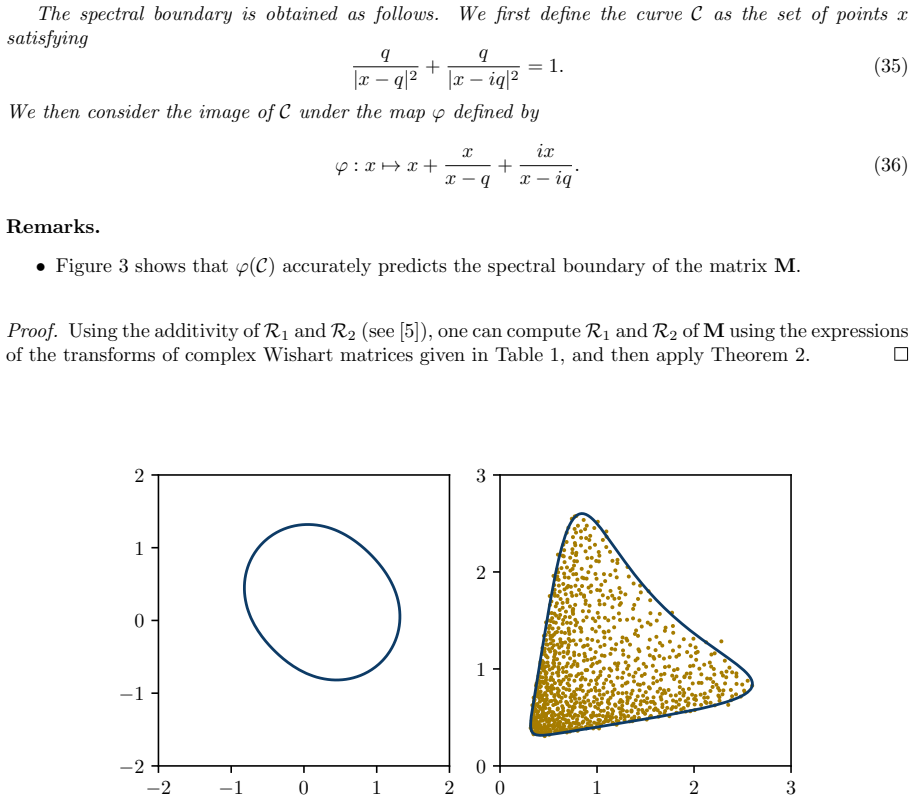
Compute the R1 and R2 transforms for a concrete rotationally invariant ensemble such as the Ginibre ensemble, derive the predicted boundary curves, and check whether large-N numerical eigenvalue scatter plots fall inside those curves to within sampling error.
Figures




read the original abstract
One of the great miracles of random matrix theory is that, in the $N \to \infty$ limit, many otherwise intractable matrix problems with horrendously complicated finite-$N$ expressions admit remarkably simple and elegant asymptotic solutions. In this paper, we illustrate this phenomenon in the context of spectral boundaries (or spectral edges) for deformed random matrices. Specifically, we consider matrices of the form $\mathbf{A} + \mathbf{B}$, where $\mathbf{A}$ is a deterministic $N\times N$ matrix (not necessarily Hermitian) and $\mathbf{B}$ is a rotationally invariant random matrix. In the large-$N$ limit, we show that the complex eigenvalue distribution of $\mathbf{A} + \mathbf{B}$ satisfies remarkably simple boundary equations that depend on the $\mathcal{R}_1$ and $\mathcal{R}_2$ transforms of $\mathbf{B}$. We illustrate our results on several explicit random matrix ensembles and support them with numerical simulations.
Editorial analysis
A structured set of objections, weighed in public.
Referee Report
Summary. The manuscript claims that in the large-N limit, the complex eigenvalue distribution of a deterministic matrix A plus a rotationally invariant random non-Hermitian matrix B obeys simple boundary equations determined by the R1 and R2 transforms of B. The result is illustrated on explicit ensembles and backed by numerical simulations.
Significance. If the derivation holds, the work supplies an elegant, parameter-free method for locating spectral boundaries in non-Hermitian deformations via free-probability tools, extending subordination relations to the complex plane. This could streamline analysis in disordered systems and non-Hermitian physics where such sums arise.
minor comments (2)
- Abstract: the phrase 'remarkably simple boundary equations' is used without displaying the equations themselves; inserting the explicit forms (even in compact notation) would improve immediate readability.
- Section on numerical simulations: error bars or convergence diagnostics for the large-N asymptotics are not described; adding a brief statement on finite-N scaling would strengthen the validation.
Simulated Author's Rebuttal
We thank the referee for the positive assessment of our work, the recognition of its potential utility in non-Hermitian random matrix problems, and the recommendation for minor revision. No major comments were raised in the report.
Circularity Check
No significant circularity in the derivation chain
full rationale
The paper derives the boundary equations for the eigenvalue support of A + B in the large-N limit from standard subordination and free-convolution relations involving the R1 and R2 transforms of the rotationally invariant ensemble B, together with the deterministic resolvent of A. These transforms are external inputs from free probability theory and are not fitted or redefined within the paper to produce the claimed boundaries. No load-bearing step reduces by construction to a self-citation, ansatz smuggled via citation, or renaming of a known result; the central claim remains independent of the paper's own outputs.
Axiom & Free-Parameter Ledger
axioms (2)
- domain assumption Large-N limit exists and eigenvalue distribution converges to a deterministic shape
- domain assumption B is rotationally invariant so its law is determined by R1 and R2 transforms
Lean theorems connected to this paper
-
IndisputableMonolith/Foundation/RealityFromDistinction.leanreality_from_one_distinction unclear?
unclearRelation between the paper passage and the cited Recognition theorem.
the complex eigenvalue distribution of A + B satisfies remarkably simple boundary equations that depend on the R1 and R2 transforms of B
-
IndisputableMonolith/Cost/FunctionalEquation.leanwashburn_uniqueness_aczel unclear?
unclearRelation between the paper passage and the cited Recognition theorem.
∂αR1,B(0,gA(x)) = 1/hA(x) under the map x ↦ x + R2,B(0,gA(x))
What do these tags mean?
- matches
- The paper's claim is directly supported by a theorem in the formal canon.
- supports
- The theorem supports part of the paper's argument, but the paper may add assumptions or extra steps.
- extends
- The paper goes beyond the formal theorem; the theorem is a base layer rather than the whole result.
- uses
- The paper appears to rely on the theorem as machinery.
- contradicts
- The paper's claim conflicts with a theorem or certificate in the canon.
- unclear
- Pith found a possible connection, but the passage is too broad, indirect, or ambiguous to say the theorem truly supports the claim.
Reference graph
Works this paper leans on
-
[1]
Hari Bercovici and Ping Zhong. The Brown measure of a sum of two free random variables, one of which is R-diagonal.arXiv preprint arXiv:2209.12379, 2022
-
[2]
Computation of some examples of Brown's spectral measure in free probability
Philippe Biane and Franz Lehner. Computation of some examples of Brown’s spectral measure in free probability.arXiv preprint math/9912242, 1999
work page internal anchor Pith review Pith/arXiv arXiv 1999
-
[3]
Philippe Biane and Franz Lehner. Computation of some examples of Brown’s spectral measure in free probability.Colloquium Mathematicae, 90(2):181–211, 2001
work page 2001
-
[4]
Pierre Bousseyroux and Marc Potters. The eigenvalues and eigenvectors of finite-rank normal per- turbations of large rotationally invariant non-hermitian matrices.arXiv preprint arXiv:2601.10427, 2026
work page internal anchor Pith review Pith/arXiv arXiv 2026
-
[5]
Pierre Bousseyroux and Marc Potters.R-transforms for non-hermitian matrices: A spherical integral approach.arXiv preprint arXiv:2601.09360, 2026
work page internal anchor Pith review Pith/arXiv arXiv 2026
-
[6]
Lidskii’s theorem in the type II case, Geometric methods in operator algebras (Kyoto 1983), H
LG Brown. Lidskii’s theorem in the type II case, Geometric methods in operator algebras (Kyoto 1983), H. Araki and E. Effros (Eds.) Pitman Res. notes in Math. Ser 123, 1986
work page 1983
-
[7]
J. T. Chalker and Z. Jane Wang. Diffusion in a random velocity field: spectral properties.Phys. Rev. Lett., 79:1797–1800, 1997
work page 1997
-
[8]
J. Feinberg and A. Zee. Non-Gaussian non-Hermitian random matrix theory: Phase transition and addition formalism.Nucl. Phys. B, 501:643–669, 1997
work page 1997
-
[9]
J. Feinberg and A. Zee. Non-Hermitian random matrix theory: Method of hermitization.Nucl. Phys. B, 504:579–608, 1997
work page 1997
-
[10]
V. L. Girko. Circular law.Theory of Probability & Its Applications, 29(4):694–706, 1985. Original: Teor. Veroyatnost. i Primenen. 29 (1984)
work page 1985
-
[11]
Elliptic law.Theory of Probability & Its Applications, 30(4):677–690, 1986
VL Girko. Elliptic law.Theory of Probability & Its Applications, 30(4):677–690, 1986
work page 1986
-
[12]
Circular law.Theory of Probability & Its Applications, 29(4):694–706, 1985
Vyacheslav L Girko. Circular law.Theory of Probability & Its Applications, 29(4):694–706, 1985
work page 1985
-
[13]
The single ring theorem.Annals of mathematics, pages 1189–1217, 2011
Alice Guionnet, Manjunath Krishnapur, and Ofer Zeitouni. The single ring theorem.Annals of mathematics, pages 1189–1217, 2011
work page 2011
-
[14]
Uffe Haagerup and Flemming Larsen. Brown’s spectral distribution measure for R-diagonal elements in finite von Neumann algebras.Journal of Functional Analysis, 176(2):331–367, 2000
work page 2000
-
[15]
Uffe Haagerup and Hanne Schultz. Brown measures of unbounded operators affiliated with a finite von Neumann algebra.Mathematica Scandinavica, pages 209–263, 2007
work page 2007
-
[16]
Brian C. Hall and Ching-Wei Ho. The Brown measure of the sum of a self-adjoint element and an imaginary multiple of a semicircular element.Letters in Mathematical Physics, 112, 2022. Paper No. 19, 61 pp
work page 2022
-
[17]
The Brown measure of the sum of a self-adjoint element and an elliptic element
Ching-Wei Ho. The Brown measure of the sum of a self-adjoint element and an elliptic element. Electronic Journal of Probability, 27:1–32, 2022
work page 2022
-
[18]
Outlier eigenvalues for full rank deformed single ring random matrices.arXiv preprint, 2025
Ching-Wei Ho, Zhi Yin, and Ping Zhong. Outlier eigenvalues for full rank deformed single ring random matrices.arXiv preprint, 2025
work page 2025
-
[19]
Deformed single ring theorems.Journal of Functional Analysis, 288(5):110797, 2025
Ching-Wei Ho and Ping Zhong. Deformed single ring theorems.Journal of Functional Analysis, 288(5):110797, 2025. Issue date: 1 Mar 2025
work page 2025
-
[20]
R. A. Janik, M. A. Nowak, G. Papp, J. Wambach, and I. Zahed. Aspect of non-Hermitian random matrix models.Phys. Rev. E, 55:4100–4107, 1997. 12
work page 1997
-
[21]
Non-hermitian random matrix models.Nuclear Physics B, 501(3):603–642, 1997
Romuald A Janik, Maciej A Nowak, Gabor Papp, and Ismail Zahed. Non-hermitian random matrix models.Nuclear Physics B, 501(3):603–642, 1997
work page 1997
-
[22]
Vladimir Alexandrovich Marchenko and Leonid Andreevich Pastur. Distribution of eigenvalues for some sets of random matrices.Matematicheskii Sbornik, 114(4):507–536, 1967
work page 1967
- [23]
-
[24]
J.-P. Bouchaud M.Potters.A First Course in Random Matrix Theory: For Physicists, Engineers and Data Scientists. Cambridge University Press, 2020
work page 2020
-
[25]
G. J. Rodgers. Non-Hermitian random matrices and Brown measures.J. Math. Phys., 51:093304, 2010
work page 2010
-
[26]
Spectrum of large random asymmetric matrices.Physical review letters, 60(19):1895, 1988
Hans Juergen Sommers, Andrea Crisanti, Haim Sompolinsky, and Yaakov Stein. Spectrum of large random asymmetric matrices.Physical review letters, 60(19):1895, 1988
work page 1988
-
[27]
Dan Voiculescu. Addition of certain non-commuting random variables.Journal of functional anal- ysis, 66(3):323–346, 1986
work page 1986
-
[28]
John Wishart. The generalised product moment distribution in samples from a normal multivariate population.Biometrika, 20(1/2):32–52, 1928
work page 1928
-
[29]
Ping Zhong. Brown measure of the sum of an elliptic operator and a free random variable in a finite von Neumann algebra.arXiv preprint, 2021. v5 (Aug 2025); to appear in American Journal of Mathematics. 13 A APPENDICES A.1 Proof of the first theorem Once again, we strongly encourage the reader to consult [5], where the notions we will use here are develop...
work page 2021
-
[30]
First case.We assume here that∂ αR1,B(0,g M(z′)) exists
Taking the limitω→0 in (55) yields: GM(0, z) =G A − R1,B ioM(z),g M(z) , z− R 2,B ioM(z),g M(z) .(56) We now consider two cases. First case.We assume here that∂ αR1,B(0,g M(z′)) exists. Then using (56), we get GM(0, z) = z→z ′ GA(−∂αR1,B(0,g M(z′))io M(z), z ′ − R2,B(0,g M(z′))).(57) Looking only at the upper-left coefficient, we obtain: io(z) = z→z ′ g1(...
discussion (0)
Sign in with ORCID, Apple, or X to comment. Anyone can read and Pith papers without signing in.