REVIEW 3 major objections 4 minor 49 references
DriveFace: A Cross-Spectral Through-Glass Face Dataset for On-the-Move Vehicular Border Control
T0 review · 3 major / 4 minor · reviewed 2026-08-02 · deepseek-v4-flash
Pith's one-line read DriveFace, a new public dataset, pairs visible-spectrum smartphone enrollment with near-infrared in-vehicle probes captured through automotive glass, and its baseline evaluations show current face recognition models degrade markedly under t
desk verdict A genuinely new public dataset for through-glass NIR face recognition with honest baselines, but the cross-session protocol needs to be spelled out before the headline numbers can be trusted. read the letter →
The pith
A machine-rendered reading of the paper's core claim, the machinery that carries it, and where it could break.
The reading
What carries the argument
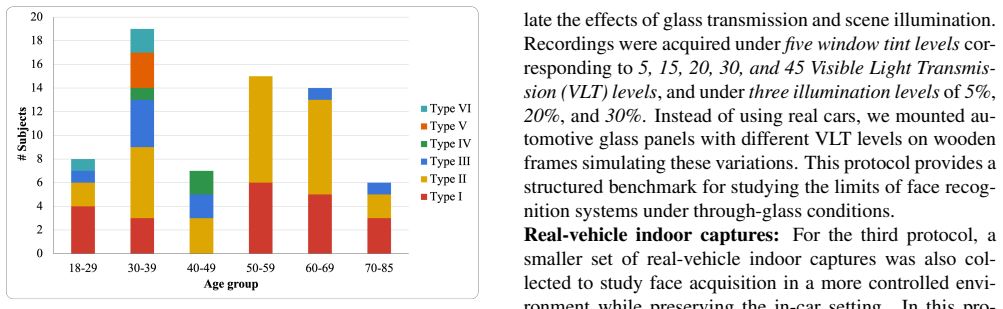
The central object is the DriveFace dataset itself: 70 consenting subjects captured over two sessions, with visible-spectrum enrollment videos from two consumer smartphones and near-infrared probes from an infrared sensor under three protocols (real-vehicle outdoor, real-vehicle indoor, and indoor simulated window with five tint levels). The benchmark's machinery is the paired acquisition design and per-acquisition metadata (tint, illumination, pose, speed) that enable per-factor analysis. For face recognition, the evaluation uses a 60/40 identity split with cross-session enrollment/probe separation; for presentation attack detection, it defines grandtest, unseen-print, and unseen-mask proto
What would settle it
Inspect the released metadata to determine the exact mapping from reference session to probe protocol. If the outdoor protocol always enrolls from the reference session temporally closest to the outdoor capture while the simulation protocol enrolls from the farther session, the Table 4 ranking collapses; re-evaluating with balanced or randomized session pairing would then be required to validate the benchmark's cross-session claim.
Extended reading notes
Core claim
The paper's discovery is that existing face recognition technology, including strong pretrained models, is not yet reliable for on-the-move vehicular border control. Using the new DriveFace dataset, the authors show that verification error rates range from 2.69% EER on outdoor clear-glass captures to 8.09–11.73% EER on indoor simulated tinted-window captures, and that recognition accuracy degrades monotonically as window tint darkens. They also show that presentation attack detection models that work well on known attacks fail on unseen attacks, with error rates as high as 45.8% ACER for unseen masks. These results establish DriveFace as a challenging benchmark that isolates the combined eff
Load-bearing premise
The load-bearing premise is that the enrollment and probe images are genuinely cross-session in a way that makes protocol comparisons fair; the paper does not state which of the two reference sessions (captured about two months apart) is paired with each probe session, so if the pairing is imbalanced across protocols, the reported differences could be confounded by enrollment–probe time gaps rather than by glass and tint conditions.
Editorial extensions
If this is right
- DriveFace gives researchers a public testbed where cross-spectral matching, glass tint, motion, and illumination can be studied together, something existing public benchmarks do not offer.
- The reported error rates (up to about 11.7% EER on the simulation protocol) quantify how far current recognition is from on-the-move border deployment and set reference numbers for future methods.
- The monotone improvement in accuracy as window tint lightens shows tint is a first-order controllable factor, implying that operational tint limits could measurably affect recognition accuracy.
- The consistent gains of the cross-spectral-adapted model over its RGB-only backbone indicate explicit domain adaptation is a productive direction for this setting.
- PAD results show known attacks are nearly solved (ACER as low as 0.50%) but unseen masks remain open (ACER up to 45.8%), steering anti-spoofing research toward generalization rather than known-attack fitting.
Reading between the lines
- The controlled simulation protocol, which varies only tint and illumination, could support a quantitative model linking VLT percentage to expected recognition error; one could test whether error rates scale predictably with transmission.
- Outdoor real-vehicle captures achieved lower errors than indoor simulation, suggesting natural lighting and motion may hurt less than controlled low illumination and tint; a direct stationary-versus-moving outdoor comparison could isolate the true cost of motion.
- The metadata could support a per-factor error decomposition (pose, tint, illumination, speed), letting border authorities choose acquisition policies—camera angle, illuminator power, or tint regulation—that optimize recognition within operational constraints.
- The unseen-attack protocols could be extended to 3D-printed or high-fidelity silicone masks; given the very high errors on masks, such attacks would likely remain a serious vulnerability.
Editorial analysis
A structured set of objections, weighed in public.
Referee Report
Summary. The paper introduces DriveFace, a publicly released dataset for cross-spectral, through-glass face recognition in vehicular border-control scenarios. It pairs VIS smartphone pre-enrollment videos with NIR in-vehicle probes acquired through automotive windows, under outdoor, indoor-car, and indoor simulated-tint protocols, and adds a presentation-attack subset (DriveFace-PAD). The authors provide standardized FR and PAD protocols, evaluate several public baselines (AdaFace, LVFace, EdgeFace, xEdgeFace for FR; DeepPixBiS, CLIP, DinoV2, EfficientNet, ConvNeXtV2 for PAD), and report that performance degrades most in the simulated-tint protocol and in unseen-attack PAD scenarios. The dataset includes rich metadata (tint level, illumination, pose, speed) and is offered as a benchmark for future research.
Significance. If the protocol issues are resolved, DriveFace fills a genuine gap: existing public NIR-VIS and in-vehicle datasets do not jointly capture external-view, through-glass, cross-spectral acquisition with motion and pose variation. The metadata granularity and the inclusion of a through-glass PAD subset are valuable assets. The paper is transparent about poor unseen-attack PAD results, reports standard metrics, and uses external, publicly available baselines, which supports reproducibility. The main scientific contribution is the benchmark itself and the reference numbers it establishes; the observed protocol-ranking and tint-level trends would be useful evidence for the field if presented with appropriate uncertainty quantification.
major comments (3)
- [Sec. 4.1 and Sec. 3.5] The cross-session protocol is under-specified and potentially confounded. Sec. 4.1 states that 'samples from different sessions are used for enrollment and probe sets to ensure cross-session evaluation,' but Sec. 3.5 defines probe 'session 1' as outdoor and 'session 2' as indoor, while the two reference sessions are smartphone captures roughly two months apart. The paper never states which reference session is paired with which probe session for each protocol. If enrollment for outdoor probes always uses the temporally closer reference session and enrollment for indoor/simulation probes uses the farther one, the protocol ranking in Table 4 (outdoor EER 2.69%, indoor car 3.11%, simulation 8.09-11.73%) could reflect unequal enrollment-probe time gaps rather than through-glass or illumination difficulty. Please specify the exact pairing and, if needed, re-run with a balanced design, or expl
- [Tables 4 and 5] All FR metrics are point estimates computed on only 28 test identities, with no confidence intervals or per-subject variability. The differences used to support the protocol-difficulty ranking, e.g., outdoor EER 2.69% vs. indoor car 3.11%, and the tint-level AUC differences in Table 5 (98.36 vs. 98.72 for T05 vs. T15) are likely within sampling noise. Please provide bootstrap confidence intervals by subject, or report per-protocol and per-tint distributions. Without this, the central quantitative claims about which conditions are most challenging and about monotonic tint effects are not supported beyond the point estimates.
- [Abstract and Sec. 5] The paper's central claim is that 'state-of-the-art models show clear performance limitations under these realistic conditions.' The FR results in Table 4 show strong performance for outdoor (EER 2.69%) and indoor car (EER 3.11%), with clear degradation only in the simulation protocol. If the cross-session pairing issue in Major Comment 1 is real, the simulation-protocol degradation may be inflated by an enrollment-probe time gap, which would weaken the headline claim. Please clarify or temper the claim, or provide additional evidence that the simulation protocol is intrinsically harder independent of session pairing.
minor comments (4)
- [Table 6] The Table 6 column definitions are unclear: the 'Attack' column exceeds Print+Mask counts (e.g., grandtest train: 3,519 vs. 9,856), yet replay attacks are stated in Sec. 4.2 to be excluded. Clarify whether replay frames are included in the Attack totals, and define each column precisely.
- [Sec. 3.5] Using the term 'session' for both temporal capture sessions and probe acquisition conditions (outdoor vs. indoor) is confusing. Consider renaming the probe labels to 'condition' or 'protocol' (e.g., P1/P2) to avoid the ambiguity that underlies Major Comment 1.
- [Sec. 3.1 and Sec. 4.1] The paper says 'the two sessions were collected approximately two months apart' but does not state whether this holds for all 70 subjects or whether some subjects had different intervals. Also, the description of selecting 'up to 10 samples per subject from each video' should clarify whether these are independent frames or a single tracklet; correlated samples can artificially reduce variance.
- [Sec. 7 and Sec. 4.3] The ethics statement is brief. Please include details about data anonymization, access controls, and intended data-use agreement. In Sec. 4.3, the xEdgeFace adaptation protocol is described only by reference to [14]; provide the key hyperparameters or state that code will be released to ensure reproducibility.
Circularity Check
No circularity: DriveFace is a dataset/benchmark contribution whose baseline results are measured with external models on held-out splits, not derived from its own definitions.
full rationale
DriveFace's central claim is the introduction of a dataset and the measurement of baseline FR/PAD performance. The FR baselines are publicly available pretrained models (AdaFace, LVFace, EdgeFace) or are fine-tuned on the DriveFace training split and evaluated on a disjoint test split (xEdgeFace); the PAD baselines (DeepPixBiS, CLIP, DinoV2, EfficientNet, ConvNeXtV2) are likewise trained/evaluated under standard splits. None of the reported EER/AUC values are obtained by substituting the definition of the quantity being predicted; there is no equation in the paper that reduces a claimed result to its input, and no fitted parameter is renamed as a prediction. The self-citations to EdgeFace [10], xEdgeFace [14], DeepPixBiS [11], VFPAD [22], iCarB [23], and the NIR replay-attack observation [13] are used as method descriptions or prior empirical observations, not as a load-bearing uniqueness/derivation chain; the dataset's value and the baseline numbers stand on the external evaluations themselves. The only notable methodological ambiguity is that Sec. 4.1 asserts 'samples from different sessions are used for enrollment and probe sets to ensure cross-session evaluation,' while Sec. 3.5 labels probe session 1 as outdoor and session 2 as indoor without stating the reference-session pairing; this is a potential experimental confound for the protocol comparison in Table 4, but it is not a circularity because the reported performance differences are not forced by construction. Accordingly, no circular step is identified.
Assumptions & free parameters
assumptions (4)
- domain assumption Face detection and alignment pretrained on VIS images (SCRFD) succeed on NIR through-glass images, so misalignment is not the dominant source of reported errors.
- domain assumption Identity ground truth and the human-in-the-loop bystander removal are correct, and metadata (tint, VLT, illuminator power, pose, speed) match acquisition logs.
- domain assumption The cross-session enrollment/probe pairing is balanced across protocols so that 'cross-session' means the same time gap everywhere.
- domain assumption The RGB-NIR modality gap is small enough that transferring RGB-trained networks to NIR probes yields meaningful face representations.
Cite this review
Pith. "Pith review of DriveFace: A Cross-Spectral Through-Glass Face Dataset for On-the-Move Vehicular Border Control." pith.science (2026). https://pith.science/paper/U5IFF6MP
@misc{pith2026260713515,
  author       = {Pith},
  title        = {Pith review of: DriveFace: A Cross-Spectral Through-Glass Face Dataset for On-the-Move Vehicular Border Control},
  year         = {2026},
  howpublished = {\url{https://pith.science/paper/U5IFF6MP}},
  note         = {Machine review of arXiv:2607.13515}
}
read the original abstract
The continuous growth in cross-border mobility places increasing pressure on existing border control infrastructures, motivating on-the-move biometric authentication, in which travellers are identified directly inside their vehicles at checkpoints. Face recognition is well-suited to this setting, as it can be acquired passively and at a distance. Its development, however, is hindered by the lack of representative datasets: existing benchmarks are collected in controlled environments and do not capture the challenges inherent to vehicular acquisition, including motion blur, variable illumination, occlusions, and cross-spectral enrollment. To address this gap, we introduce a dataset for on-the-move face recognition in border-control scenarios, comprising NIR vehicle-crossing videos paired with smartphone-based pre-enrollment data. Baseline evaluations with state-of-the-art models show clear performance limitations under these realistic conditions, highlighting the need for dedicated methods to advance the field.
Figures


Figures from the paper (1 more)

Reference graph
Works this paper leans on
-
[1]
ISO/IEC 30107-3:2023 Information technology — Biomet- ric presentation attack detection — Part 3: Testing and re- porting, 2023
2023
-
[2]
Adaptive Recognition Inc., Nov
Adaptive Recognition Inc.VIDAR User Manual. Adaptive Recognition Inc., Nov. 2025. Accessed: 2026-04-17
2025
-
[3]
Anghelone, C
D. Anghelone, C. Chen, A. Ross, and A. Dantcheva. Beyond the visible: A survey on cross-spectral face recognition.Neu- rocomputing, 611:128626, 2025
2025
-
[4]
J. R. Beveridge, P. J. Phillips, D. S. Bolme, B. A. Draper, G. H. Givens, Y . M. Lui, M. N. Teli, H. Zhang, W. T. Scruggs, K. W. Bowyer, P. J. Flynn, and S. Cheng. The challenge of face recognition from digital point-and-shoot cameras. In2013 IEEE Sixth International Conference on Biometrics: Theory, Applications and Systems (BTAS), pages 1–8, Sep. 2013
2013
-
[5]
Boulkenafet, J
Z. Boulkenafet, J. Komulainen, L. Li, X. Feng, and A. Hadid. OULU-NPU: A mobile face presentation attack database with real-world variations. In12th IEEE International Con- ference on Automatic Face Gesture Recognition (FG 2017), pages 612–618, 2017
2017
-
[6]
Chingovska, A
I. Chingovska, A. Anjos, and S. Marcel. On the effec- tiveness of local binary patterns in face anti-spoofing. In 2012 BIOSIG - Proceedings of the International Conference of Biometrics Special Interest Group (BIOSIG), pages 1–7, 2012
2012
-
[7]
Cornett, A
D. Cornett, A. Yen, G. Noyola, D. Montez, C. Johnson, S. Baird, H. Santos-Villalobos, and D. Bolme. Through the windshield driver recognition. Technical report, Oak Ridge National Laboratory (ORNL), Oak Ridge, TN (United States), 2018
2018
-
[8]
J. Deng, J. Guo, N. Xue, and S. Zafeiriou. Arcface: Additive angular margin loss for deep face recognition. InProceed- ings of the IEEE/CVF Conference on Computer Vision and Pattern Recognition (CVPR), June 2019
2019
Show all 49 references
-
[9]
J. Deng, J. Guo, D. Zhang, Y . Deng, X. Lu, and S. Shi. Lightweight face recognition challenge. InProceedings of the IEEE/CVF International Conference on Computer Vision (ICCV) Workshops, Oct 2019
2019
-
[10]
George, C
A. George, C. Ecabert, H. O. Shahreza, K. Kotwal, and S. Marcel. Edgeface: Efficient face recognition model for edge devices.IEEE Transactions on Biometrics, Behavior, and Identity Science, 6(2):158–168, 2024
2024
-
[11]
George and S
A. George and S. Marcel. Deep pixel-wise binary supervi- sion for face presentation attack detection. In2019 inter- national conference on biometrics (ICB), pages 1–8. IEEE, 2019
2019
-
[12]
George and S
A. George and S. Marcel. Robust face presentation attack de- tection with multi-channel neural networks. InHandbook of Biometric Anti-Spoofing: Presentation Attack Detection and Vulnerability Assessment, pages 261–286. Springer, 2023
2023
-
[13]
George and S
A. George and S. Marcel. The invisible threat: Evaluating the vulnerability of cross-spectral face recognition to presen- tation attacks.arXiv preprint arXiv:2505.00380, 2025
2025 arXiv
-
[14]
George and S
A. George and S. Marcel. xedgeface: Efficient cross- spectral face recognition for edge devices.arXiv preprint arXiv:2504.19646, 2025
2025 arXiv
-
[15]
George, A
A. George, A. Mohammadi, and S. Marcel. Prepended do- main transformer: Heterogeneous face recognition without bells and whistles.IEEE transactions on information foren- sics and security, 18:133–146, 2022
2022
-
[16]
George, Z
A. George, Z. Mostaani, D. Geissenbuhler, O. Nikisins, A. Anjos, and S. Marcel. Biometric face presentation attack detection with multi-channel convolutional neural network. IEEE Transactions on Information Forensics and Security, 15:42–55, 2020
2020
-
[17]
J. Guo, J. Deng, A. Lattas, and S. Zafeiriou. Sample and computation redistribution for efficient face detection.arXiv preprint arXiv:2105.04714, 2021
2021 arXiv
-
[18]
Y . Guo, L. Zhang, Y . Hu, X. He, and J. Gao. Ms-celeb-1m: A dataset and benchmark for large-scale face recognition. ArXiv, abs/1607.08221, 2016
2016 arXiv
-
[19]
Huang, J
D. Huang, J. Sun, and Y . Wang. The buaa-visnir face database instructions.School Comput. Sci. Eng., Bei- hang Univ., Beijing, China, Tech. Rep. IRIP-TR-12-FR-001, 3(3):8, 2012
2012
-
[20]
M. Kim, A. Jain, and X. Liu. 50 years of automated face recognition.IEEE Transactions on Pattern Analysis and Ma- chine Intelligence, 2026
2026
-
[21]
M. Kim, A. K. Jain, and X. Liu. Adaface: Quality adaptive margin for face recognition. InProceedings of the IEEE/CVF conference on computer vision and pattern recognition, pages 18750–18759, 2022
2022
-
[22]
Kotwal, S
K. Kotwal, S. Bhattacharjee, P. Abbet, Z. Mostaani, H. Wei, X. Wenkang, Z. Yaxi, and S. Marcel. Domain-specific adap- tation of cnn for detecting face presentation attacks in nir. IEEE Transactions on Biometrics, Behavior, and Identity Science, 4(1):135–147, 2022
2022
-
[23]
Krivokuca, J
V . Krivokuca, J. Maceiras, A. Komaty, P. Abbet, and S. Mar- cel. in-car biometrics (icarb) datasets for driver recognition: Face, fingerprint, and voice.arXiv, 2024
2024
-
[24]
Kuch ´ar, R
P. Kuch ´ar, R. Pirn´ık, J. ˇDuriˇsov´a, M. Skuba, T. Mizera, and J. Kafkov´a. Effect of window tinting on passenger detection and enforcement in road transport.Transportation Research Procedia, 74:938–945, 2023
2023
-
[25]
R. D. Labati, A. Genovese, E. Mu ˜noz, V . Piuri, F. Scotti, and G. Sforza. Biometric recognition in automated border con- trol: a survey.ACM Computing Surveys (CSUR), 49(2):1–39, 2016
2016
-
[26]
B. Lee, M. Hasegawa-Johnson, C. Goudeseune, S. Kamdar, S. Borys, M. Liu, and T. Huang. A VICAR: audio-visual speech corpus in a car environment. InInterspeech 2004, pages 2489–2492, 2004
2004
-
[27]
S. Li, D. Yi, Z. Lei, and S. Liao. The casia nir-vis 2.0 face database. InProceedings of the IEEE conference on com- puter vision and pattern recognition workshops, pages 348– 353, 2013
2013
-
[28]
A. Liu, Z. Tan, J. Wan, S. Escalera, G. Guo, and S. Z. Li. Casia-surf cefa: A benchmark for multi-modal cross-ethnicity face anti-spoofing. InProceedings of the IEEE/CVF Winter Conference on Applications of Computer Vision (WACV), pages 1179–1187, January 2021
2021
-
[29]
A. Liu, C. Zhao, Z. Yu, J. Wan, A. Su, X. Liu, Z. Tan, S. Es- calera, J. Xing, Y . Liang, et al. Contrastive context-aware learning for 3d high-fidelity mask face presentation attack detection.IEEE Transactions on Information Forensics and Security, 2022
2022
-
[30]
Y . Liu, A. Jourabloo, and X. Liu. Learning deep mod- els for face anti-spoofing: Binary or auxiliary supervision. 2018 IEEE/CVF Conference on Computer Vision and Pat- tern Recognition, pages 389–398, 2018
2018
-
[31]
Martin, A
M. Martin, A. Roitberg, M. Haurilet, M. Horne, S. Reiß, M. V oit, and R. Stiefelhagen. Drive&act: A multi-modal dataset for fine-grained driver behavior recognition in au- tonomous vehicles. InThe IEEE International Conference on Computer Vision (ICCV), Oct 2019
2019
-
[32]
Oquab, T
M. Oquab, T. Darcet, T. Moutakanni, H. V o, M. Szafraniec, V . Khalidov, P. Fernandez, D. Haziza, F. Massa, A. El- Nouby, et al. Dinov2: Learning robust visual features with- out supervision.arXiv preprint arXiv:2304.07193, 2023
2023 arXiv
-
[33]
J. D. Ortega, N. Kose, P. Ca ˜nas, M.-A. Chao, A. Unnervik, M. Nieto, O. Otaegui, and L. Salgado. Dmd: A large-scale multi-modal driver monitoring dataset for attention and alert- ness analysis. InComputer Vision – ECCV 2020 Workshops: Glasgow, UK, August 23–28, 2020, Proceedi...
2020
-
[34]
Othman, A
W. Othman, A. Kashevnik, A. Ali, and N. Shilov. Drivermvt: In-cabin dataset for driver monitoring including video and vehicle telemetry information.Data, 7(5), 2022
2022
-
[35]
Panetta, Q
K. Panetta, Q. Wan, S. Agaian, S. Rajeev, S. Kamath, R. Ra- jendran, S. P. Rao, A. Kaszowska, H. A. Taylor, A. Samani, and X. Yuan. A comprehensive database for benchmarking imaging systems.IEEE Transactions on Pattern Analysis and Machine Intelligence, 42(3):509–520, 2020
2020
-
[36]
Radford, J
A. Radford, J. W. Kim, C. Hallacy, A. Ramesh, G. Goh, S. Agarwal, G. Sastry, A. Askell, P. Mishkin, J. Clark, et al. Learning transferable visual models from natural language supervision. InInternational conference on machine learn- ing, pages 8748–8763. PmLR, 2021
2021
-
[37]
Tan and Q
M. Tan and Q. Le. Efficientnet: Rethinking model scaling for convolutional neural networks. InInternational conference on machine learning, pages 6105–6114. PMLR, 2019
2019
-
[38]
Trinh, P
L. Trinh, P. Pham, H. Trinh, N. Bach, D. Nguyen, G. Nguyen, and H. Nguyen. Pp4av: A benchmarking dataset for privacy-preserving autonomous driving. In2023 IEEE/CVF Winter Conference on Applications of Computer Vision (WACV), pages 1206–1215, 2023
2023
-
[39]
R. Wan, B. Shi, H. Li, L.-Y . Duan, and A. C. Kot. Face Im- age Reflection Removal.International Journal of Computer Vision, 129(2):385–399, Feb. 2021
2021
-
[40]
D. Wen, H. Han, and A. K. Jain. Face Spoof Detection With Image Distortion Analysis.IEEE Transactions on Informa- tion Forensics and Security, 10(4):746–761, Apr. 2015
2015
-
[41]
S. Woo, S. Debnath, R. Hu, X. Chen, Z. Liu, I. S. Kweon, and S. Xie. Convnext v2: Co-designing and scaling convnets with masked autoencoders. InProceedings of the IEEE/CVF conference on computer vision and pattern recognition, pages 16133–16142, 2023
2023
-
[42]
J. You, S. Li, Y . Sun, J. Wei, M. Guo, C. Feng, and J. Ran. Lvface: Progressive cluster optimization for large vision models in face recognition. InProceedings of the IEEE/CVF International Conference on Computer Vision, pages 11840– 11849, 2025
2025
-
[43]
A. Yu, H. Wu, H. Huang, Z. Lei, and R. He. Lamp-hq: A large-scale multi-pose high-quality database and benchmark for nir-vis face recognition.International Journal of Com- puter Vision, 129:1467 – 1483, 2019
2019
-
[44]
Zhang, L
B. Zhang, L. Zhang, D. Zhang, and L. Shen. Directional binary code with application to polyu near-infrared face database.Pattern Recognition Letters, 31(14):2337–2344, 2010
2010
-
[45]
Zhang, A
S. Zhang, A. Liu, J. Wan, Y . Liang, G. Guo, S. Escalera, H. J. Escalante, and S. Z. Li. Casia-surf: A large-scale multi- modal benchmark for face anti-spoofing.IEEE Transactions on Biometrics, Behavior, and Identity Science, 2(2):182–193, 2020
2020
-
[46]
Zhang, Z
Y . Zhang, Z. Yin, Y . Li, G. Yin, J. Yan, J. Shao, and Z. Liu. Celeba-spoof: Large-scale face anti-spoofing dataset with rich annotations. InComputer Vision – ECCV 2020: 16th European Conference, Glasgow, UK, August 23–28, 2020, Proceedings, Part XII, page 70–85, Berlin, Heid...
2020
-
[47]
Zhang, J
Z. Zhang, J. Yan, S. Liu, Z. Lei, D. Yi, and S. Z. Li. A face antispoofing database with diverse attacks. In2012 5th IAPR International Conference on Biometrics (ICB), pages 26–31, 2012
2012
-
[48]
G. Zhao, X. Huang, M. Taini, S. Z. Li, and M. Pietik ¨aInen. Facial expression recognition from near-infrared videos.Im- age and vision computing, 29(9):607–619, 2011
2011
-
[49]
Z. Zhu, G. Huang, J. Deng, Y . Ye, J. Huang, X. Chen, J. Zhu, T. Yang, J. Lu, D. Du, et al. Webface260m: A benchmark unveiling the power of million-scale deep face recognition. InProceedings of the IEEE/CVF Conference on Computer Vision and Pattern Recognition, pages 10492–10502, 2021
2021
Reviewed August 2, 2026 · model on record in the stance chip above.
Discussion (0). Sign in to comment.