REVIEW 4 major objections 4 minor 28 references
Reframing Dense Action Detection (RefDense): A Paradigm Shift in Problem Solving & a Novel Optimization Strategy
T0 review · 4 major / 4 minor · reviewed 2026-08-09 · deepseek-v4-flash
Pith's one-line read Decomposing dense actions into unambiguous entity and motion sub-concepts, detected by separate sub-networks and trained with a contrastive language-video loss, outperforms state-of-the-art dense action detection.
desk verdict Useful decomposition and a transferable loss, but the SOTA comparison is confounded by added CLIP features; internal ablations partially rescue the causal claim. read the letter →
The pith
A machine-rendered reading of the paper's core claim, the machinery that carries it, and where it could break.
The reading
What carries the argument
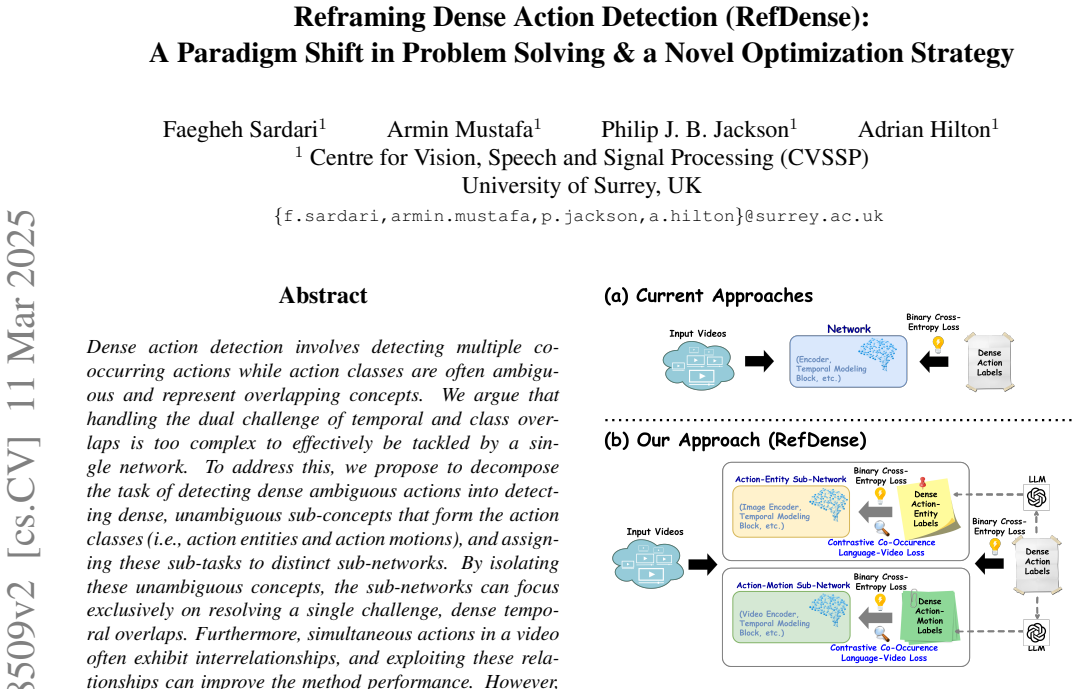
The central mechanism is task decomposition plus contrastive co-occurrence alignment. Concretely, a frozen GPT-4 large language model (with prompts) converts action class labels into two label sets, dense action-entity and dense action-motion labels, preserving temporal boundaries. Two sub-networks share the same input: Action-Entity uses a frozen CLIP image encoder plus a lightweight self-attention transformer; Action-Motion uses a frozen I3D video encoder plus a multi-scale transformer (PAT) augmented with cross-attention that conditions on the entity sub-network's features. The learned entity and motion representations are concatenated and passed through a 1D convolutional head for final action probabilities. The total loss is the sum of BCE losses on the original labels and sub-labels, plus the contrastive co-occurrence language-video loss that matches each segment's video feature to the CLIP text features of every co-occurring class in that segment, using a noise contrastive estimation formulation.
What would settle it
Compare RefDense's per-frame mAP when the entity and motion sub-labels are produced by GPT-4 versus when the same labels are produced by human annotators on a sample of Charades and MultiTHUMOS action classes; if performance does not drop with the clean human labels, the decomposition is not the source of the gain, and if it drops, the method is hostage to LLM label quality.
Extended reading notes
Core claim
The paper claims that the complexity of dense action detection is reducible: instead of detecting dense ambiguous actions directly, the task can be reframed as detecting dense, unambiguous sub-concepts (action entities and action motions) and letting separate sub-networks handle each. The authors argue that this separation removes class ambiguity from each sub-task, leaving each sub-network to concentrate on dense temporal overlap, which is the remaining hard part. In addition, they introduce the Contrastive Co-occurrence Language-Video loss $L_{\mathrm{RD}}^{\mathrm{CoLV}}$, which aligns video segment representations with text features of all co-occurring classes in the video, providing explicit supervision on concept relationships that BCE loss cannot capture. The paper reports state-of-the-art results on Charades and MultiTHUMOS, with per-frame mAP of 33.4% and 46.6%, and shows that the contrastive loss transfers to the existing PAT network, improving its mAP by 1.1 points on both datasets.
Load-bearing premise
The entity and motion decomposition labels come from GPT-4 prompts, so if those splits are inconsistent or ambiguous, the sub-networks are not actually solving an ambiguity-free problem and the central decomposition argument weakens.
Editorial extensions
If this is right
- RefDense achieves state-of-the-art per-frame mAP on Charades (33.4%) and MultiTHUMOS (46.6%) with RGB inputs, surpassing previous best methods by 1.4 and 1.1 points.
- On action-conditional metrics, RefDense reports average improvements of 4.1% on Charades and 1.8% on MultiTHUMOS, indicating better modeling of inter-class co-occurrence dependencies.
- The contrastive co-occurrence language-video loss improves an existing network (PAT) across all metrics without changing its architecture, raising its mAP by 1.1 points on both datasets.
- Removing either the entity or motion sub-labels from training causes a performance drop, confirming that the decomposed supervision carries part of the improvement.
- The decomposition paradigm, as the paper states, can benefit other dense computer vision problems such as dense captioning.
Reading between the lines
- A testable consequence of the decomposition claim is that per-class gains should concentrate on classes whose entity and motion are most reliably separated by the LLM; if gains appear uniformly across all classes, the improvement may come from added parameters or the contrastive loss rather than ambiguity removal.
- The contrastive co-occurrence loss could be applied as a drop-in replacement for BCE in other multi-label prediction settings (e.g., audio tagging or multi-object detection), providing co-occurrence supervision in embedding space without architectural change.
- Because the entity/motion decomposition depends on GPT-4 prompts, results may shift if the LLM is updated or re-prompted; converting the decomposition to a deterministic, human-verified dictionary would make the method's gains more portable and reproducible.
- The cross-attention from Action-Entity into Action-Motion suggests that entity information acts as an attentional prior; swapping the guidance direction (motion guiding entity) could test whether the entity-first ordering is essential or merely beneficial.
Signed reviews
Editorial analysis
A structured set of objections, weighed in public.
Referee Report
Summary. The paper proposes RefDense, a dense action detection method that decomposes the multi-label action classification problem into two sub-problems—predicting action-entity and action-motion concepts—assigned to separate sub-networks (a CLIP image encoder with a lightweight transformer, and an I3D encoder with a PAT-style multi-scale transformer augmented by cross-attention). The sub-networks are supervised with GPT-4-generated entity and motion labels, and a contrastive co-occurrence language-video loss aligns video representations with text embeddings of co-occurring classes. On Charades and MultiTHUMOS with RGB inputs, RefDense reports 33.4 and 46.6 per-frame mAP respectively, versus 32.0 and 45.5 for prior best methods, with improvements also reported on action-conditional metrics. Ablations study each component, and the contrastive loss is shown to improve the PAT backbone.
Significance. If the causal claim were established, the decomposition idea would be a useful contribution to dense action detection and potentially to other dense prediction tasks. The paper includes careful multi-metric evaluation and an extensive ablation set, and the CoLV loss applied to PAT in Table 6 is a clean, transferable result. However, the main empirical comparison conflates task decomposition with a change from I3D-only features to I3D+CLIP features, and the GPT-4 label decomposition is not directly validated. The reported gains are therefore not yet sufficient to support the 'paradigm shift' framing, though the method remains promising.
major comments (4)
- [§4.2, Table 3 (cf. §4.1, Table 1)] The headline comparison overstates the role of task decomposition because RefDense uses both I3D and CLIP image features while most baselines, including PAT, use only I3D. The 'Action-Motion' row in Table 3 is a single-network baseline with I3D and CLIP features concatenated and reaches 30.4 mAP on Charades, already 3.9 points above PAT's 26.5, whereas RefDense reaches 33.4, only 3.0 points higher than that baseline. Thus roughly half of the improvement over PAT is attributable to the added CLIP encoder, not to task decomposition. Please add a single-network baseline with the same two encoders, comparable capacity/GFLOPs, and the same training setup, and ablate the decomposition from that baseline.
- [§3.2] The GPT-4-based entity/motion label decomposition is load-bearing but is not directly evaluated. The paper states that these labels are extracted via specific prompts and GPT-4, with details in the supplementary, but provides no measure of decomposition quality, ambiguity, or completeness. If many action classes decompose inconsistently, the sub-networks are not actually solving an ambiguity-free task, and the central claim would be weakened. Please add a decomposition-quality analysis (for example, human agreement on a sample, per-class ambiguity statistics, and an error analysis of label noise), and ideally compare the proposed decomposition with an alternative deterministic decomposition.
- [§3.2, Eq. (11)] The contrastive co-occurrence loss is written with a denominator that sums only over classes not in β(t), omitting the positive class terms. As written, the normalization is not a standard contrastive loss for multi-label positive sets, and the loss definition is internally inconsistent with the stated objective of aligning video features with all co-occurring class texts. Please correct Eq. (11) to sum over all classes (or otherwise clarify the intended normalization), and verify that the implementation matches the corrected equation.
- [§4.2, Tables 3–7] The ablation study reports no error bars or significance tests. Several claimed improvements are small—for example, Table 6 reports +0.4 F1@ac on MultiTHUMOS and Table 7 reports +0.7 F1@ac on MultiTHUMOS—and without variance across seeds or statistical tests the reader cannot assess whether the component-wise improvements are reliable. Please report results over multiple runs with standard deviations, or an equivalent significance analysis, for the main ablations.
minor comments (4)
- [§2] There is a grammatical error in the sentence 'We addresses this by eliminating one of the overlaps'; it should be 'We address this'.
- [§3.2] In the paragraph after defining the sub-labels, the phrase 'dense motion-entity labels' should likely be 'dense action-motion labels' for consistency with the rest of the paper.
- [§4.1, Table 2] The conditional-metric numbers for prior methods were recomputed by the authors without releasing the evaluation code or predictions. Please make the evaluation code and model predictions available to verify these recomputed numbers.
- [§4.2, Table 3] The caption 'Ablation studies on network design' does not make explicit that the sub-network baselines already use concatenated I3D and CLIP features; please state this in the caption for clarity.
Circularity Check
No circularity: the proposed decomposition and contrastive loss are auxiliary supervised objectives, not by-construction predictions; the self-cited PAT is a prior published backbone/baseline and does not force the result.
full rationale
The derivation chain is empirical and self-contained against external benchmarks. The decomposed entity/motion labels are generated from the action ground-truth labels via GPT-4 and used only as auxiliary BCE/contrastive supervision (Eqs. 9-12); the final action probabilities are produced by a learned 1D convolution over concatenated sub-network features (Eq. 8) and are not defined as a deterministic function of Y^ent/Y^mot. No fitted parameter is renamed as a prediction. The contrastive co-occurrence loss supervises video embeddings with text features of co-occurring classes; this is a standard use of labels during training, and its effect is ablated (Tables 5-6). The main self-citation is to PAT [21], the authors' prior ICCVW paper, used as the temporal backbone and as a baseline; PAT is a published, externally reported method, not an unverified premise invoked to force the conclusion. The reviewer concern that adding CLIP image features explains part of the gain over I3D-only baselines is a possible experimental confound, not a by-construction circularity, because the baselines and ablations are externally measurable and the method's predictions are not equal to its inputs by definition.
Assumptions & free parameters
free parameters (3)
- Temperature tau in contrastive loss =
not reported
- Number of entity/motion classes =
Charades: 38/38; MultiTHUMOS: 28/50
- Loss weights for BCE and contrastive losses =
not reported
assumptions (5)
- domain assumption GPT-4 decomposition maps each action class to a complete, mutually unambiguous set of entity and motion concepts
- domain assumption Frozen CLIP text encoder embeddings are semantically aligned with the learned video features
- ad hoc to paper BCE loss prevents learning class co-occurrence relationships
- domain assumption I3D and CLIP features provide sufficient signal for separate entity and motion detection
- standard math Noise contrastive estimation (InfoNCE) is a valid objective for aligning positive and negative pairs
invented entities (1)
-
Action-Entity and Action-Motion sub-concept label spaces
Cite this review
Pith. "Pith review of Reframing Dense Action Detection (RefDense): A Paradigm Shift in Problem Solving & a Novel Optimization Strategy." pith.science (2026). https://pith.science/paper/U5Y64MPV
@misc{pith2026250118509,
  author       = {Pith},
  title        = {Pith review of: Reframing Dense Action Detection (RefDense): A Paradigm Shift in Problem Solving & a Novel Optimization Strategy},
  year         = {2026},
  howpublished = {\url{https://pith.science/paper/U5Y64MPV}},
  note         = {Machine review of arXiv:2501.18509}
}
read the original abstract
Dense action detection involves detecting multiple co-occurring actions while action classes are often ambiguous and represent overlapping concepts. We argue that handling the dual challenge of temporal and class overlaps is too complex to effectively be tackled by a single network. To address this, we propose to decompose the task of detecting dense ambiguous actions into detecting dense, unambiguous sub-concepts that form the action classes (i.e., action entities and action motions), and assigning these sub-tasks to distinct sub-networks. By isolating these unambiguous concepts, the sub-networks can focus exclusively on resolving a single challenge, dense temporal overlaps. Furthermore, simultaneous actions in a video often exhibit interrelationships, and exploiting these relationships can improve the method performance. However, current dense action detection networks fail to effectively learn these relationships due to their reliance on binary cross-entropy optimization, which treats each class independently. To address this limitation, we propose providing explicit supervision on co-occurring concepts during network optimization through a novel language-guided contrastive learning loss. Our extensive experiments demonstrate the superiority of our approach over state-of-the-art methods, achieving substantial improvements of 3.8% and 1.7% on average across all metrics on the challenging benchmark datasets, Charades and MultiTHUMOS.
Figures


Figures from the paper (1 more)

Reference graph
Works this paper leans on
-
[1]
LOCVTP: Video-Text Pre-training for Temporal Localization
Meng Cao, Tianyu Yang, Junwu Weng, Can Zhang, Jue Wang, and Yuexian Zou. LOCVTP: Video-Text Pre-training for Temporal Localization. In European Conference on Computer Vision, pages 38–56. Springer, 2022. 3
work page 2022
-
[2]
End-to- end Object Detection with Transformers
Nicolas Carion, Francisco Massa, Gabriel Synnaeve, Nicolas Usunier, Alexander Kirillov, and Sergey Zagoruyko. End-to- end Object Detection with Transformers. In European con- ference on computer vision , pages 213–229. Springer, 2020. 3
work page 2020
-
[3]
Quo vadis, Action Recognition? a New Model and the Kinetics Dataset
Joao Carreira and Andrew Zisserman. Quo vadis, Action Recognition? a New Model and the Kinetics Dataset. In proceedings of the IEEE Conference on Computer Vision and Pattern Recognition, pages 6299–6308, 2017. 1, 6
work page 2017
-
[4]
CTRN: Class- Temporal Relational Network for Action Detection
Rui Dai, Srijan Das, and Francois Bremond. CTRN: Class- Temporal Relational Network for Action Detection. British Machine Vision Conference, 2021. 1, 7, 8
work page 2021
-
[5]
PDAN: Pyramid Dilated Attention Network for Action Detection
Rui Dai, Srijan Das, Luca Minciullo, Lorenzo Garattoni, Gi- anpiero Francesca, and Francois Bremond. PDAN: Pyramid Dilated Attention Network for Action Detection. InProceed- ings of the IEEE Winter Conference on Applications of Com- puter Vision, pages 2970–2979, 2021. 3, 7
work page 2021
-
[6]
MS-TCT: Multi-Scale Temporal ConvTransformer for Action Detection
Rui Dai, Srijan Das, Kumara Kahatapitiya, Michael S Ryoo, and Francois Bremond. MS-TCT: Multi-Scale Temporal ConvTransformer for Action Detection. In Proceedings of the IEEE Conference on Computer Vision and Pattern Recognition, pages 20041–20051, 2022. 1, 2, 3, 7, 8
work page 2022
-
[7]
Toyota Smarthome Untrimmed: Real-World Untrimmed Videos for Activity Detection
Rui Dai, Srijan Das, Saurav Sharma, Luca Minciullo, Lorenzo Garattoni, Francois Bremond, and Gianpiero Francesca. Toyota Smarthome Untrimmed: Real-World Untrimmed Videos for Activity Detection. IEEE Transac- tions on Pattern Analysis and Machine Intelligence , 45(2): 2533–2550, 2022. 6
work page 2022
-
[8]
AAN: Attributes-Aware Network for Temporal Action De- tection
Rui Dai, Srijan Das, Michael Ryoo, and Francois Bremond. AAN: Attributes-Aware Network for Temporal Action De- tection. In British Machine Vision Conference, 2023. 1, 2, 3, 6, 7, 8
work page 2023
Show all 28 references
-
[9]
TAN: Temporal Aggregation Network for Dense Multi-Label Action Recognition
Xiyang Dai, Bharat Singh, Joe Yue-Hei Ng, and Larry Davis. TAN: Temporal Aggregation Network for Dense Multi-Label Action Recognition. In 2019 IEEE Winter Con- ference on Applications of Computer Vision, pages 151–160. IEEE, 2019. 1, 2
2019
-
[10]
PLOT- TAL–Prompt Learning with Optimal Transport for Few- Shot Temporal Action Localization
Edward Fish, Jon Weinbren, and Andrew Gilbert. PLOT- TAL–Prompt Learning with Optimal Transport for Few- Shot Temporal Action Localization. arXiv preprint arXiv:2403.18915, 2024. 3
2024 arXiv
-
[11]
THUMOS Challenge: Action Recognition with a Large Number of Classes, 2014
Yu-Gang Jiang, Jingen Liu, A Roshan Zamir, George Toderici, Ivan Laptev, Mubarak Shah, and Rahul Sukthankar. THUMOS Challenge: Action Recognition with a Large Number of Classes, 2014. 6
2014
-
[12]
Dis- tilling Vision-Language Pre-training to Collaborate with Weakly-Supervised Temporal Action Localization
Chen Ju, Kunhao Zheng, Jinxiang Liu, Peisen Zhao, Ya Zhang, Jianlong Chang, Qi Tian, and Yanfeng Wang. Dis- tilling Vision-Language Pre-training to Collaborate with Weakly-Supervised Temporal Action Localization. In Pro- ceedings of the IEEE/CVF Conference on Computer Vision a...
2023
-
[13]
Coarse-Fine Net- works for Temporal Activity Detection in Videos
Kumara Kahatapitiya and Michael S Ryoo. Coarse-Fine Net- works for Temporal Activity Detection in Videos. In Pro- ceedings of the IEEE Conference on Computer Vision and Pattern Recognition, pages 8385–8394, 2021. 2, 6, 7
2021
-
[14]
DeTAL: Open-V ocabulary Temporal Action Localization with Decoupled Networks
Zhiheng Li, Yujie Zhong, Ran Song, Tianjiao Li, Lin Ma, and Wei Zhang. DeTAL: Open-V ocabulary Temporal Action Localization with Decoupled Networks. IEEE Transactions on Pattern Analysis and Machine Intelligence , 2024. 3
2024
-
[15]
Test-Time Zero-Shot Temporal Action Localization
Benedetta Liberatori, Alessandro Conti, Paolo Rota, Yim- ing Wang, and Elisa Ricci. Test-Time Zero-Shot Temporal Action Localization. In Proceedings of the IEEE/CVF Con- ference on Computer Vision and Pattern Recognition , pages 18720–18729, 2024
2024
-
[16]
Zero-Shot Temporal Action Detection via Vision-Language Prompting
Sauradip Nag, Xiatian Zhu, Yi-Zhe Song, and Tao Xiang. Zero-Shot Temporal Action Detection via Vision-Language Prompting. In European Conference on Computer Vision , pages 681–697. Springer, 2022. 3
2022
-
[17]
Temporal Gaussian Mixture Layer for Videos
AJ Piergiovanni and Michael Ryoo. Temporal Gaussian Mixture Layer for Videos. In International Conference on Machine learning, pages 5152–5161. PMLR, 2019. 2, 7
2019
-
[18]
Learning Latent Super-Events to Detect Multiple Activities in Videos
AJ Piergiovanni and Michael S Ryoo. Learning Latent Super-Events to Detect Multiple Activities in Videos. InPro- ceedings of the IEEE Conference on Computer Vision and Pattern Recognition, pages 5304–5313, 2018. 2, 7
2018
-
[19]
Learn- ing Transferable Visual Models from Natural Language Su- pervision
Alec Radford, Jong Wook Kim, Chris Hallacy, Aditya Ramesh, Gabriel Goh, Sandhini Agarwal, Girish Sastry, Amanda Askell, Pamela Mishkin, Jack Clark, et al. Learn- ing Transferable Visual Models from Natural Language Su- pervision. In International Conference on Machine learning...
2021
-
[20]
Token Turing Machines
Michael S Ryoo, Keerthana Gopalakrishnan, Kumara Kahat- apitiya, Ted Xiao, Kanishka Rao, Austin Stone, Yao Lu, Ju- lian Ibarz, and Anurag Arnab. Token Turing Machines. In Proceedings of the IEEE/CVF Conference on Computer Vi- sion and Pattern Recognition, pages 19070–19081, 2023. 7
2023
-
[21]
PAT: Position-Aware Transformer for Dense Multi-Label Action Detection
Faegheh Sardari, Armin Mustafa, Philip JB Jackson, and Adrian Hilton. PAT: Position-Aware Transformer for Dense Multi-Label Action Detection. In Proceedings of the IEEE International Conference on Computer Vision - Workshop , pages 2988–2997, 2023. 1, 2, 3, 5, 6, 7, 8
2023
-
[22]
Hollywood in Homes: Crowdsourcing Data Collection for Activity Under- standing
Gunnar A Sigurdsson, G ¨ul Varol, Xiaolong Wang, Ali Farhadi, Ivan Laptev, and Abhinav Gupta. Hollywood in Homes: Crowdsourcing Data Collection for Activity Under- standing. In Proceedings of the European Conference on Computer Vision, pages 510–526, 2016. 2, 6
2016
-
[23]
PointTAD: Multi-Label Temporal Action Detection with Learnable Query Points
Jing Tan, Xiaotong Zhao, Xintian Shi, Bin Kang, and Limin Wang. PointTAD: Multi-Label Temporal Action Detection with Learnable Query Points. In Advances in Neural Infor- mation Processing Systems, 2022. 3, 7
2022
-
[24]
Modeling Multi-Label Action Dependen- cies for Temporal Action Localization
Praveen Tirupattur, Kevin Duarte, Yogesh S Rawat, and Mubarak Shah. Modeling Multi-Label Action Dependen- cies for Temporal Action Localization. InProceedings of the IEEE Conference on Computer Vision and Pattern Recogni- tion, pages 1460–1470, 2021. 1, 2, 3, 6, 7, 8
2021
-
[25]
R-C3D: Region Convolutional 3D Network for Temporal Activity Detec- tion
Huijuan Xu, Abir Das, and Kate Saenko. R-C3D: Region Convolutional 3D Network for Temporal Activity Detec- tion. In Proceedings of the IEEE International Conference on Computer Vision, pages 5783–5792, 2017. 7
2017
-
[26]
Contrastive Language-Action Pre-training for Temporal Localization
Mengmeng Xu, Erhan Gundogdu, Maksim Lapin, Bernard Ghanem, Michael Donoser, and Loris Bazzani. Contrastive Language-Action Pre-training for Temporal Localization. arXiv preprint arXiv:2204.12293, 2022. 3
2022 arXiv
-
[27]
Every Moment Counts: Dense Detailed Labeling of Actions in Complex Videos
Serena Yeung, Olga Russakovsky, Ning Jin, Mykhaylo An- driluka, Greg Mori, and Li Fei-Fei. Every Moment Counts: Dense Detailed Labeling of Actions in Complex Videos. In- ternational Journal of Computer Vision , 126(2):375–389,
-
[28]
Dual DETRs for Multi-Label Temporal Action Detection
Yuhan Zhu, Guozhen Zhang, Jing Tan, Gangshan Wu, and Limin Wang. Dual DETRs for Multi-Label Temporal Action Detection. In Proceedings of the IEEE Conference on Com- puter Vision and Pattern Recognition , pages 18559–18569,
Reviewed August 9, 2026 · model on record in the stance chip above.
Discussion (0). Continue with ORCID to comment.