REVIEW 3 major objections 4 minor 111 references
Gravitational decoupling and regular hairy black holes: Geodesic stability, quasinormal modes, and thermodynamic properties
T0 review · 3 major / 4 minor · reviewed 2026-08-03 · deepseek-v4-flash
Pith's one-line read A single hair parameter governs orbits, ringdown, and thermodynamic stability of a regular hairy black hole built by gravitational decoupling.
desk verdict Solid but mechanically applied black-hole observables for one GD metric; the Kerr-mimic claim and the Lyapunov formula need fixing before the results can be trusted. read the letter →
The pith
A machine-rendered reading of the paper's core claim, the machinery that carries it, and where it could break.
The reading
What carries the argument
The load-bearing object is the metric function $f(r,\beta)$ in Eq. (29), obtained from gravitational decoupling with a tensor vacuum and the weak energy condition. The hair parameter $\beta$ enters through a decaying exponential with a polynomial prefactor, producing a regular, non-singular geometry with a critical value $\beta_{\text{crit}}\approx 0.39$ that separates two-horizon, extremal, and horizonless configurations. All subsequent results—Lyapunov exponents of circular orbits, third-order WKB quasinormal frequencies, Hawking temperature and heat capacity, Rényi versus Bekenstein–Hawking entropy, and the energy emission rate—are computed from this single metric function.
What would settle it
Measure the quasinormal ringdown of a candidate black hole with high signal-to-noise and compare the inferred ($\omega_{\text{real}}, |\text{Im} \omega|$) against the $\beta=0.39$ rows of Tables IV–VI; the paper predicts shifts in $|\text{Im} \omega|$ of roughly 15–20% relative to Schwarzschild for low multipoles, so a match to Schwarzschild would refute the strong-hair predictions. A complementary check is to recompute the Lyapunov exponents from the geodesic equations using the standard second derivative of $(\dot{r}^2)$; if the printed $\lambda_0$ and $\lambda_p$ values do not follow from those equations, the quantitative tables would need revision.
Extended reading notes
Core claim
The central object is the spherically symmetric metric $f(r,\beta)=1-\frac{2}{r}+\frac{2}{r}e^{-r/\beta}\left(1+\frac{r}{\beta}+\frac{r^2}{2\beta^2}\right)$, which reduces to Schwarzschild as $\beta \to 0$ and to flat space as $\beta \to \infty$. The paper's discovery is that $\beta$ acts as a gravitational dial: increasing it shifts the photon sphere and ISCO inward toward the horizon, extends the radial interval containing unstable null circular orbits, and lowers the imaginary part of quasinormal frequencies, meaning perturbations decay more slowly. In the canonical ensemble, the heat capacity becomes positive for horizon radii below a $\beta$-dependent threshold, so small regular hairy black holes are locally thermodynamically stable, a behavior absent in the Schwarzschild solution
Load-bearing premise
The results rest on the assumption that the metric in Eq. (29), imported from a gravitational-decoupling construction with a tensor vacuum and the weak energy condition, describes a physically realizable regular black hole exterior; if that construction is unphysical, the Lyapunov, quasinormal-mode, and thermodynamic predictions do not follow.
Editorial extensions
If this is right
- Black hole shadows: the wider instability interval for null orbits implies that photon rings and shadow features of these hairy black holes will differ measurably from Schwarzschild for β near the critical value.
- Gravitational-wave ringdown: quasinormal modes with smaller |Im ω| mean longer-lived oscillations, so ringdown templates based on Schwarzschild could misclassify a hairy black hole source.
- Thermodynamic stability: the stable small-horizon phase in the canonical ensemble suggests that regular hairy black holes could evade the usual Schwarzschild instability and potentially survive as remnants.
- Kerr mimickers: a source whose ISCO and photon sphere fit a high-spin Kerr parameter might instead be a non-rotating hairy black hole with β in [0.0043,0.39], complicating spin estimates.
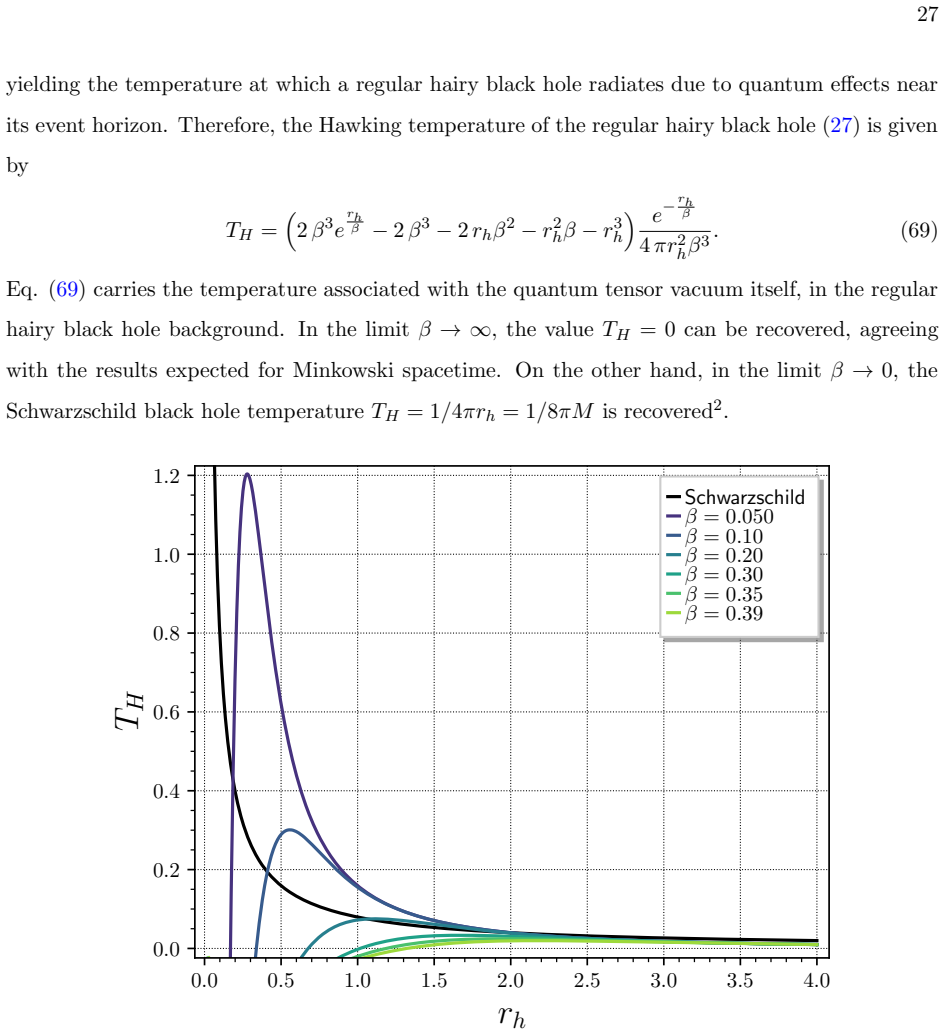
- Evaporation: higher β lowers the Hawking temperature and energy emission rate, which would lengthen evaporation timescales and alter predicted primordial black hole abundances.
Reading between the lines
- The paper's eikonal quasinormal-mode formula assumes a geometric-optics correspondence; a direct re-derivation of the Lyapunov exponents from the geodesic equations using the exact second derivative of (\dot{r}²) would test whether the quantitative decay rates reported are precise or affected by the printed derivative order.
- The mimicry range β∈[0.0043,0.39] is established from ISCO and photon-sphere radii; an extension would compare full shadow images and ringdown spectra against Event Horizon Telescope and gravitational-wave observations to see whether the degeneracy between hair and spin survives.
- Because the Rényi and Bekenstein–Hawking entropies give qualitatively different stability verdicts for Schwarzschild but similar ones for this hairy solution, a future independent probe of black hole entropy could distinguish the hairy geometry from the vacuum one.
- The metric's regularity relies on the tensor-vacuum condition P_r = −E; repeating the analysis under other gravitational-decoupling sources would reveal which of the reported features are generic to regular hairy black holes and which are specific to this construction.
Editorial analysis
A structured set of objections, weighed in public.
Referee Report
Summary. The paper studies a regular hairy black hole metric obtained via gravitational decoupling, f(r,β)=1−2/r+2e^{−r/β}/r(1+r/β+r²/2β²), and computes geodesic Lyapunov exponents for timelike and null circular orbits, the ISCO and photon-sphere radii, quasinormal modes (WKB and eikonal), thermodynamic quantities in both Bekenstein-Hawking and Rényi entropy prescriptions, and the energy emission rate. The main claims are that increasing the hair parameter β moves the ISCO and photon sphere closer to the horizon, enlarges the null instability interval, decreases the damping rate of quasinormal modes, produces a stable small-horizon phase in the canonical ensemble, and allows β to mimic aspects of Kerr black-hole spin.
Significance. If the results hold, they provide a systematic phenomenology of a specific regular hairy black hole, with analytic expressions and numerical tables that can be used for comparison with strong-field observations. The monotonic β-trends in the ISCO, photon sphere, QNM damping, and emission rate are clearly presented and constitute a useful contribution. However, two headline claims currently undermine the paper: the printed Lyapunov definitions are inconsistent with the circular-orbit condition, and the Kerr-mimicking claim is not supported by the paper's own numerics. The core derivation may be salvageable after correcting these points.
major comments (3)
- [III, Eqs. (34)–(35)] The printed definitions of the Lyapunov exponents use a single derivative of ṙ². For circular orbits the condition ṙ²=(ṙ²)'=0 holds, so Eqs. (34)–(35) vanish identically and cannot distinguish stable from unstable orbits. The text preceding Eq. (34) correctly identifies the second derivative of the effective potential as the stability criterion. The definitions should involve the second derivative at r_c, which is what the long expressions (46)–(53) presumably implement. Please correct Eqs. (34)–(35) and explain their relation to the computed formulas; as printed, Section III cannot be reproduced.
- [III.C, Eq. (55), Tables I–II, Fig. 7] The Kerr-mimic claim is not supported by the paper's own numbers. Eq. (55) has a typo: the coefficient 4 in (4+Z1+2Z2) should be 3, since the standard Kerr ISCO formula gives r_ISCO(a=1)=1, not 0.757. More importantly, at β_crit≈0.39 the hairy ISCO is 5.97673 and the photon sphere is 2.76774. Matching the ISCO to Kerr gives a≈0.01, for which the Kerr photon sphere is ≈3.0, not 2.77; matching the photon sphere gives a≈0.19, for which the Kerr ISCO is ≈5.3, not 5.98. Thus no single Kerr spin reproduces both observables for β>0; exact coincidence occurs only at β=0. The two-branch behavior described in Fig. 7 and Sec. III.C should be retracted or heavily qualified.
- [II, Eqs. (25)–(29)] All subsequent results depend on the metric (29), whose physical viability is imported from Ref. [64] without display of the associated stress-energy tensor. The paper states the tensor-vacuum condition P_r=−E and cites the WEC, but it does not show explicitly that the WEC (or other relevant energy conditions) hold for β∈(0,β_crit). Since a violation would make the geodesic, QNM, and thermodynamic results physically moot, please include a short self-contained verification, or state explicitly which conditions are being assumed from Ref. [64].
minor comments (4)
- [Fig. 5 caption] The caption describes the effective potential for 'timelike' geodesics, but Eq. (50) and the surrounding text concern null geodesics (ε=0). Please correct.
- [Eqs. (46)–(48)] Several displayed formulas have unbalanced parentheses and ambiguous terms (e.g., the denominator in Eq. (46) is not clearly delimited). Please re-check the typesetting; this hampers numerical reproduction.
- [Table III heading] The heading should read 'Range of instability for circular null orbits', not 'unstability'.
- [IV.A] The WKB table entries are reported to five or six significant figures, but no error estimate or comparison with a higher-order WKB/time-domain method is given. A brief accuracy statement would help the reader judge the β-dependence.
Circularity Check
No significant circularity: the paper is a parameter study of an imported metric using standard external formulas; the hair parameter is scanned, not fitted to any target observable.
full rationale
The derivation chain is not circular. The central object, the regular hairy black hole metric f(r, beta) in Eq. (29), is imported from Ref. [64] (Ovalle-Casadio-Giusti, which does not overlap with the present authors), and the paper does not define the hair parameter beta in terms of the ISCO, photon sphere, quasinormal frequencies, or thermodynamic quantities it later computes. The Lyapunov exponents, ISCO and photon-sphere radii, QNMs via the third-order WKB method, Hawking temperature, entropies, heat capacities, and emission rates are all computed from this metric using standard external formulas (Cardoso et al., Iyer-Will, Bekenstein-Hawking, etc.). Beta is a free model parameter scanned over (0, beta_crit); it is never fitted to observational data and then relabeled as a prediction. The Kerr-mimic discussion in Sec. III C is a comparison of the derived ISCO/photon-sphere radii with the Kerr expressions, not a fit of beta to a chosen spin; even if the printed Kerr formula in Eq. (55) contains a coefficient error, that is a numerical/correctness issue, not a circular reduction. The paper cites its own prior work in several places (e.g., Refs. [47,48,51,52,95-97]), but those citations are contextual or for technique and are not load-bearing for the central results. Eqs. (34)-(35) also appear to omit a derivative order relative to the standard Lyapunov formula, but this affects internal consistency, not circularity. The derivation is self-contained once the imported metric is accepted as an input, so no circular step can be exhibited.
Assumptions & free parameters
free parameters (2)
- β (hair parameter) =
0.05, 0.10, 0.20, 0.30, 0.35, 0.39 (scanned values; β_crit≈0.39)
- λ (Rényi parameter) =
0.5 (illustrative choice in Figs. 13–14)
assumptions (6)
- domain assumption Einstein equations with split source T+Θ and conservation ∇_μ(T+Θ)=0 (Sec. II, Eqs. 1–3)
- domain assumption Metric (29) from Ref. [64] is a regular hairy black hole solution, obtained by imposing tensor vacuum P_r=−E and WEC (Sec. II, Eq. 25)
- standard math Lyapunov exponent definitions Eqs. (33)–(35) from Refs. [66–68] for circular geodesics
- standard math Third-order WKB formulas Eqs. (61)–(63) from Iyer-Will/Berti et al.
- domain assumption Eikonal correspondence ω=ℓΩ_c − i(n+1/2)|λ_0| (Eq. 66)
- domain assumption Rényi entropy S_R = (1/λ)ln(1+λS_BH) (Eq. 74)
Cite this review
Pith. "Pith review of Gravitational decoupling and regular hairy black holes: Geodesic stability, quasinormal modes, and thermodynamic properties." pith.science (2026). https://pith.science/paper/U673M32L
@misc{pith2026251214920,
  author       = {Pith},
  title        = {Pith review of: Gravitational decoupling and regular hairy black holes: Geodesic stability, quasinormal modes, and thermodynamic properties},
  year         = {2026},
  howpublished = {\url{https://pith.science/paper/U673M32L}},
  note         = {Machine review of arXiv:2512.14920}
}
read the original abstract
The stability of geodesic orbits around a regular hairy black hole, in the gravitational decoupling setup, is investigated by employing Lyapunov exponents, which quantify the divergence rate of nearby trajectories in dynamical systems. Both timelike and null geodesics are addressed, probing the effect of the hair parameter on orbital stability. Deviations from the Schwarzschild solution have a significant influence on orbit stability, potentially providing observational signatures. We compute the quasinormal modes of regular hairy black holes and discuss their thermodynamic properties, contrasting the R\'enyi and Bekenstein-Hawking entropy prescriptions. The results can provide insight into gravitational dynamics in the strong-field regime and potentially contribute to ongoing developments in modified gravity theories.
Figures


Figures from the paper (12 more)




Reference graph
Works this paper leans on
-
[64]
Ovalle J, Casadio R and Giusti A 2023Phys. Lett. B844138085 (Preprint2304.03263)
-
[1]
Abbott B Pet al.(LIGO Scientific, Virgo) 2016Phys. Rev. Lett.116221101 [Erratum: Phys.Rev.Lett. 121, 129902 (2018)] (Preprint1602.03841)
arXiv 2018
-
[2]
Abbott B Pet al.(LIGO Scientific, Virgo) 2019Phys. Rev. D100104036 (Preprint1903.04467)
-
[3]
Ovalle J 2017Phys. Rev. D95104019 (Preprint1704.05899)
-
[4]
Ovalle J 2019Phys. Lett. B788213–218 (Preprint1812.03000)
-
[5]
Dark Univ.46101665
Maurya S K, Jasim M K, Errehymy A, Boshkayev K, Mustafa G and Dayanandan B 2024Phys. Dark Univ.46101665
-
[6]
Dark Univ.28100543 (Preprint1907.04892)
Linares Cede˜ no F X and Contreras E 2020Phys. Dark Univ.28100543 (Preprint1907.04892)
-
[7]
Tello-Ortiz F 2020Eur. Phys. J. C80413
Show all 111 references
-
[8]
Maurya S K, Kiroriwal S, Kumar J and Aziz A 2025Eur. Phys. J. C85456
-
[9]
Pradhan S, Bhar P, Mandal S, Sahoo P K and Bamba K 2025Eur. Phys. J. C85127 (Preprint 2408.03967)
-
[10]
Dark Univ.46101629 (Preprint2408.12132) 36
Yousaf Z, Bamba K, Almutairi B, Hashimoto Y and Khan S 2024Phys. Dark Univ.46101629 (Preprint2408.12132) 36
-
[11]
J.972 175
Maurya S K, Errehymy A, Newton Singh K, Aziz A, Hansraj S and Ray S 2024Astrophys. J.972 175
-
[12]
da Rocha R and Tomaz A A 2020Eur. Phys. J. C80857 (Preprint2005.02980)
-
[13]
da Rocha R and Tomaz A A 2019Eur. Phys. J. C791035 (Preprint1905.01548)
-
[14]
Casadio R and da Rocha R 2023Eur. Phys. J. C83537 (Preprint2305.15752)
-
[15]
Estrada M 2019Eur. Phys. J.C79918 (Preprint1905.12129)
-
[16]
Gabbanelli L, Ovalle J, Sotomayor A, Stuchlik Z and Casadio R 2019Eur. Phys. J.C79486 (Preprint 1905.10162)
1905 arXiv
-
[17]
Leon P and Las Heras C 2023Eur. Phys. J. C83260
-
[18]
Ramos A, Arias C, Fuenmayor E and Contreras E 2021Eur. Phys. J. C81203 (Preprint2103.05039)
-
[19]
Rinc´ on A, Gabbanelli L, Contreras E and Tello-Ortiz F 2019Eur. Phys. J. C79873 (Preprint 1909.00500)
1909 arXiv
-
[20]
Panotopoulos G and Rinc´ on A 2018Eur. Phys. J.C78851 (Preprint1810.08830)
-
[21]
Singh K N, Maurya S K, Jasim M K and Rahaman F 2019Eur. Phys. J. C79851
-
[22]
Ovalle J, Casadio R, da Rocha R, Sotomayor A and Stuchlik Z 2018EPL12420004 (Preprint 1811.08559)
-
[23]
P´ erez Graterol R 2018Eur. Phys. J. Plus133244
-
[24]
Phys.661800036 (Preprint1804.06874)
Heras C L and Leon P 2018Fortsch. Phys.661800036 (Preprint1804.06874)
-
[25]
Torres-S´ anchez V A and Contreras E 2019Eur. Phys. J.C79829 (Preprint1908.08194)
-
[26]
Tello-Ortiz F, Maurya S K and Bargue˜ no P 2021Eur. Phys. J. C81426
-
[27]
Zubair M, Azmat H and Jameel H 2023Eur. Phys. J. C83905
-
[28]
Bamba K, Bhatti M Z, Yousaf Z and Shoukat Z 2023Eur. Phys. J. C831033 (Preprint2307.10399)
-
[29]
Dark Univ.42 101284
Maurya S K, Mustafa G, Ray S, Dayanandan B, Aziz A and Errehymy A 2023Phys. Dark Univ.42 101284
-
[30]
Iqbal N, Amir M, Alshammari M, Mohammed W W and Ilyas M 2025Eur. Phys. J. C85428
-
[31]
Contreras E and Fuenmayor E 2021Phys. Rev. D103124065 (Preprint2107.01140)
-
[32]
Sharif M and Majid A 2020Chin. J. Phys.68406–418
-
[33]
Meert P and da Rocha R 2021Nucl. Phys. B967115420 (Preprint2006.02564)
-
[34]
da Rocha R and Hoff da Silva J M 2014EPL10750001 (Preprint1408.2402)
-
[35]
Babichev E and Charmousis C 2014JHEP08106 (Preprint1312.3204)
-
[36]
Sotiriou T P and Zhou S Y 2014Phys. Rev. Lett.112251102 (Preprint1312.3622)
-
[37]
Antoniou G, Bakopoulos A and Kanti P 2018Phys. Rev. Lett.120131102 (Preprint1711.03390)
-
[38]
Hayward S A 2006Phys. Rev. Lett.96031103 (Preprintgr-qc/0506126)
-
[39]
Dark Univ.31100744 (Preprint 2006.06735)
Ovalle J, Casadio R, Contreras E and Sotomayor A 2021Phys. Dark Univ.31100744 (Preprint 2006.06735)
2006 arXiv
-
[40]
Liang Y, Lyu X and Tao J 2024Commun. Theor. Phys.76085402
-
[41]
Phys.20232200171 (Preprint2303.04119) 37
Avalos R, Bargue˜ no P and Contreras E 2023Fortsch. Phys.20232200171 (Preprint2303.04119) 37
-
[42]
Zhang C M, Zhang M and Zou D C 2023Chin. Phys. C47015106 (Preprint2208.06830)
-
[43]
Dark Univ.42101345
Ditta A, Javed F, Maurya S K, Mustafa G and Atamurotov F 2023Phys. Dark Univ.42101345
-
[44]
Dark Univ.39101172 (Preprint2208.05796)
Mahapatra S and Banerjee I 2023Phys. Dark Univ.39101172 (Preprint2208.05796)
-
[45]
Albalahi A M, Yousaf Z, Ali A and Khan S 2024Eur. Phys. J. C849
-
[46]
Dark Univ.46101717 (Preprint2405.05370)
Misyura M, Rincon A and Vertogradov V 2024Phys. Dark Univ.46101717 (Preprint2405.05370)
-
[47]
Cavalcanti R T, da Silva A G and da Rocha R 2016Class. Quant. Grav.33215007 (Preprint 1605.01271)
-
[48]
Cavalcanti R T, de Paiva R C and da Rocha R 2022Eur. Phys. J. Plus1371185 (Preprint2203.08740)
-
[49]
Yang Y, Liu D, ¨Ovg¨ un A, Long Z W and Xu Z 2023Phys. Rev. D107064042 (Preprint2203.11551)
-
[50]
Li Z 2023Phys. Lett. B841137902 (Preprint2212.08112)
-
[51]
Cavalcanti R T, Alves K d S and Hoff da Silva J M 2022Universe8363 (Preprint2207.03995)
-
[52]
Guimar˜ aes V F, Cavalcanti R T and da Rocha R 2025Class. Quant. Grav.42175011 (Preprint 2506.20044)
-
[53]
Avalos R and Contreras E 2023Eur. Phys. J. C83155 (Preprint2302.09148)
-
[54]
Dark Univ.46101547
Tello-Ortiz F, Avalos R, G´ omez-Leyton Y and Contreras E 2024Phys. Dark Univ.46101547
-
[55]
da Rocha R 2017Phys. Rev. D95124017 (Preprint1701.00761)
-
[56]
Casadio R, Nicolini P and da Rocha R 2018Class. Quant. Grav.35185001 (Preprint1709.09704)
-
[57]
Poisson E and Israel W 1990Phys. Rev. D411796–1809
-
[58]
Bonanno A, Khosravi A P and Saueressig F 2023Phys. Rev. D107024005 (Preprint2209.10612)
-
[59]
Carballo-Rubio R, Di Filippo F, Liberati S, Pacilio C and Visser M 2022JHEP09118 (Preprint 2205.13556)
-
[60]
Tang C, Ling Y, Jiang Q Q and Li G P 2024Eur. Phys. J. C841296 (Preprint2411.01764)
-
[61]
Stashko O 2024Phys. Rev. D110084016 (Preprint2407.07892)
-
[62]
Konoplya R A and Zhidenko A 2024Phys. Rev. D109104005 (Preprint2403.07848)
-
[63]
Phys.712300075 (Preprint2309.01910)
Balart L, Panotopoulos G and Rinc´ on A 2023Fortsch. Phys.712300075 (Preprint2309.01910)
-
[65]
Akiyama Ket al.(Event Horizon Telescope) 2022Astrophys. J. Lett.930L12 (Preprint2311.08680)
-
[66]
Cardoso V, Miranda A S, Berti E, Witek H and Zanchin V T 2009Phys. Rev. D79064016 (Preprint 0812.1806)
-
[67]
Giri S, Nandan H, Joshi L K and Maharaj S D 2022Eur. Phys. J. Plus137181 (Preprint2204.09006)
-
[68]
Mondal M, Pradhan P, Rahaman F and Karar I 2020Mod. Phys. Lett. A352050249 (Preprint 2008.11022)
2008 arXiv
-
[69]
Olmo G J, Rosa J L, Rubiera-Garcia D and Saez-Chillon Gomez D 2023Class. Quant. Grav.40 174002 (Preprint2302.12064)
-
[70]
Shukla B, Das P P, Dudal D and Mahapatra S 2024Phys. Rev. D110024068 (Preprint2404.02095)
-
[71]
Das A, Roy Chowdhury A and Gangopadhyay S 2024Class. Quant. Grav.41015018 (Preprint 2306.00646) 38
-
[72]
Du Y Z, Li H F, Ma Y B and Gu Q 2025Eur. Phys. J. C8578 (Preprint2403.20083)
-
[73]
Gogoi N J, Acharjee S and Phukon P 2024Eur. Phys. J. C841144 (Preprint2404.03947)
-
[74]
Barreto W and da Rocha R 2022Phys. Rev. D105064049 (Preprint2201.08324)
-
[75]
Lett.551082
Sano M and Sawada Y 1985Physical Rev. Lett.551082
-
[76]
Cornish N J and Levin J J 2003Class. Quant. Grav.201649–1660 (Preprintgr-qc/0304056)
-
[77]
Bambi Cet al.2025 Black hole mimickers: from theory to observation (Preprint2505.09014)
2025 arXiv
-
[78]
Casadio R, Kamenshchik A and Ovalle J 2024Phys. Rev. D109024042 (Preprint2401.03980)
-
[79]
Yang Y, Liu D, ¨Ovg¨ un A, Lambiase G and Long Z W 2024Phys. Rev. D109024002 (Preprint 2307.09344)
-
[80]
Mazza J, Franzin E and Liberati S 2021JCAP04082 (Preprint2102.01105)
-
[81]
Ramos A, Arias C, Avalos R and Contreras E 2021Annals Phys.431168557 (Preprint2107.01146)
-
[82]
Daghigh R G, Green M D and Morey J C 2023Phys. Rev. D107024023 (Preprint2209.09324)
-
[83]
Berti E, Cardoso V and Starinets A O 2009Class. Quant. Grav.26163001 (Preprint0905.2975)
-
[84]
Cardoso V and Lemos J P S 2001Phys. Rev. D64084017 (Preprintgr-qc/0105103)
-
[85]
Konoplya R A and Zhidenko A 2011Rev. Mod. Phys.83793–836 (Preprint1102.4014)
-
[86]
Santos E C, Fabris J C and de Freitas Pacheco J A 2019 (Preprint1903.04874)
2019 arXiv
-
[87]
Iyer S and Will C M 1987Phys. Rev. D353621
-
[88]
Konoplya R A, Zhidenko A and Zinhailo A F 2019Class. Quant. Grav.36155002 (Preprint 1904.10333)
1904 arXiv
-
[89]
Churilova M S 2019Eur. Phys. J. C79629 (Preprint1905.04536)
-
[90]
Konoplya R A and Zhidenko A 2023Class. Quant. Grav.40245005 (Preprint2309.02560)
-
[91]
Carlip S 2014Int. J. Mod. Phys. D231430023 (Preprint1410.1486)
-
[92]
Rel.46 (Preprintgr-qc/9912119)
Wald R M 2001Living Rev. Rel.46 (Preprintgr-qc/9912119)
-
[93]
Today3324–31
Bekenstein J D 1980Phys. Today3324–31
-
[94]
Hawking S W 1976Phys. Rev. D13191–197
-
[95]
Feng W, da Rocha R and Casadio R 2024Eur. Phys. J. C84586 (Preprint2401.14540)
-
[96]
Casadio R, da Rocha R, Giusti A and Meert P 2024Phys. Lett. B849138466 (Preprint2310.07505)
-
[97]
Casadio R, da Rocha R, Meert P, Tabarroni L and Barreto W 2023Class. Quant. Grav.40075014 (Preprint2206.10398)
-
[98]
Promsiri C, Hirunsirisawat E and Liewrian W 2020Phys. Rev. D102064014 (Preprint2003.12986)
-
[99]
Dey A, Roy P and Sarkar T 2018JHEP04098 (Preprint1609.02290)
-
[100]
Czinner V G and Iguchi H 2016Phys. Lett. B752306–310 (Preprint1511.06963)
-
[101]
Czinner V G and Iguchi H 2017Eur. Phys. J. C77892 (Preprint1702.05341)
-
[102]
Abreu E M C and Neto J A 2021EPL13510001 (Preprint2009.05012)
-
[103]
Nakarachinda R, Hirunsirisawat E, Tannukij L and Wongjun P 2021Phys. Rev. D104064003 (Preprint2106.02838)
-
[104]
Dark Univ.42101345 39
Ditta A, Javed F, Maurya S K, Mustafa G and Atamurotov F 2023Phys. Dark Univ.42101345 39
-
[105]
Hawking S W 1975Commun. Math. Phys.43199–220 [Erratum: Commun.Math.Phys. 46, 206 (1976)]
1976
-
[106]
Wei S W and Liu Y X 2013JCAP11063 (Preprint1311.4251)
-
[107]
Mashhoon B 1973Phys. Rev. D72807–2814
-
[108]
Ditta A, Tiecheng X, Ali R, Atamurotov F, Mahmood A and Mumtaz S 2023Annals Phys.453 169326
-
[109]
Ditta A, Tiecheng X, Mustafa G, Yasir M and Atamurotov F 2022Eur. Phys. J. C82756
-
[110]
Eslam Panah B, Jafarzade K and Hendi S H 2020Nucl. Phys. B961115269 (Preprint2004.04058)
-
[111]
Chen H, Dong S H, Hassanabadi S, Heidari N and Hassanabadi H 2024Chin. Phys. C48085105
Reviewed August 3, 2026 · model on record in the stance chip above.
Discussion (0). Continue with ORCID to comment.