REVIEW 3 major objections 3 minor 37 references
Agentic drug-discovery frameworks fail at peptide, in vivo, ML-training, small-team, and multi-objective workflows; the paper shows the bottleneck is architectural, not a lack of model knowledge.
Reviewed by Pith at T0; open to challenge. T0 means a machine referee read the full paper against a public rubric. the ladder, T0–T4 →
T0 review · deepseek-v4-flash
2026-08-03 02:45 UTC pith:U6CU3YP4
load-bearing objection Useful practitioner-grounded gap analysis with a genuinely new diagnostic probe, but the 'architectural rather than epistemic' conclusion outruns the evidence. the 3 major comments →
Beyond SMILES: Evaluating Agentic Systems for Drug Discovery
The pith
A machine-rendered reading of the paper's core claim, the machinery that carries it, and where it could break.
Core claim
On its own terms, the paper's central discovery is a diagnosis: the six leading agentic frameworks, assessed against a capability matrix of 15 drug-discovery task classes, show zero full support for any class and coverage scores between 0 and 16.7 percent. Five gaps emerge: small-molecule representation bias (no protein language models or peptide prediction), no bridge between in vivo and in silico data, no support for ML training or reinforcement learning as first-class operations, resource assumptions tied to large pharma, and single-objective optimization that ignores Pareto trade-offs. The paired probe shows the models are not the limiting factor: across 200 matched question pairs, pepti
What carries the argument
The carrying mechanism is a two-part evaluation: (1) a capability matrix that scores six agent frameworks against 15 task classes (from peptide bioactivity prediction to behavioral phenotyping) across five dimensions—molecular representation, computational paradigm support, data modality integration, resource assumptions, and optimization framework—with full/partial/not-supported ratings; and (2) a paired knowledge-probing experiment in which four frontier LLMs answer 50 matched small-molecule/peptide question pairs scored on a 0–3 rubric. The matrix establishes that the gaps are systemic clusters of zero coverage; the probe establishes that the underlying models already possess the relevant
Load-bearing premise
The conclusion that the bottleneck is architectural rather than epistemic assumes that an LLM's correct answers to short peptide questions would translate into successful multi-step tool orchestration if the tools existed; the probe never exercises tool use, and its own authors note the 50-pair design has limited statistical power.
What would settle it
Give one agent framework two matched arms—the same LLM and the same 15 task classes, one arm with only small-molecule tools and one arm with peptide tools, protein language models, and an ML training loop—and compare end-to-end completion rates. If completion rates on peptide task classes remain near zero even after the framework is given peptide-aware tools and fine-tuning primitives, while the LLM's peptide Q&A scores stay high, then missing tools were not the whole story and the diagnosis needs revision; if completion rates rise, the paper's claim is supported.
If this is right
- If the diagnosis is right, improving agents means building integration pipelines—protein-language-model fine-tuning, ML/RL training loops, workflow graphs, active-learning loops—rather than training larger or better foundation models.
- The capability matrix can serve as a practical benchmark: any practitioner can score a framework against the 15 task classes and see immediately where it will fail in peptide or in vivo work.
- Small-biotech users should expect few-shot, transfer, and active-learning support plus batch-mode operation as prerequisites; agents that assume pharma-scale data and compute will not generalize to their workflows.
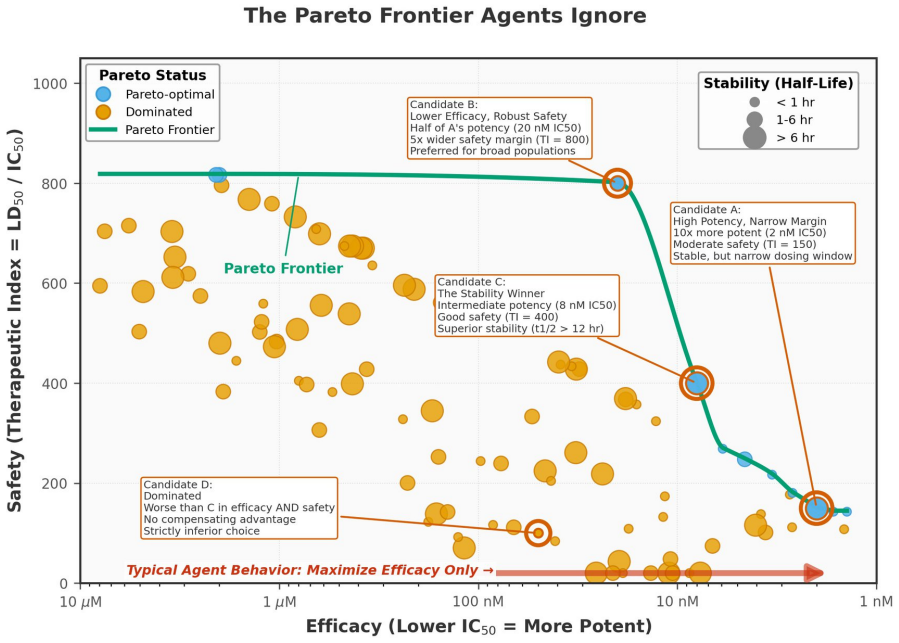
- Multi-objective support is not optional: single-objective or weighted-sum optimization hides the safety-efficacy-stability trade-offs that actually drive candidate selection, so next-generation agents must expose Pareto frontiers and uncertainty.
- Because peptide knowledge is already in the models, closing the first gap does not require retraining; it requires architectures that surface peptide-aware tools and sequence-native workflows.
Where Pith is reading between the lines
- Editorial inference: the probe tests static question-answering, not multi-step agent execution; a sharper test would give an agent peptide-aware tools and see whether end-to-end task completion rises. Until then, "architectural rather than epistemic" is best read as "the models are not the demonstrated bottleneck in short-answer reasoning."
- Editorial inference: the same probe design could be extended to other under-supported modalities named in the paper—antibody CDR loops, nucleic-acid therapeutics, imaging phenotypes—to see whether the stranded-knowledge pattern generalizes.
- Editorial inference: the capability matrix could be repurposed as a living community benchmark, with the 15 task classes scored by multiple raters and updated as frameworks add support; the paper itself notes single-rater assessment as a limitation, and independent scoring would sharpen the gap analysis.
- Editorial inference: if the active-learning result (roughly one-third fewer assays in the author's peptide projects) holds up, then architecture-level fixes have a directly monetizable consequence—fewer synthesis-and-assay cycles per lead—which gives small biotechs a concrete incentive to demand these features.
Editorial analysis
A structured set of objections, weighed in public.
Referee Report
Summary. The paper evaluates six existing agentic drug-discovery frameworks (ChemCrow, Coscientist, PharmAgents, ChatInvent, MADD, DiscoVerse) against 15 task classes drawn from peptide therapeutics, in vivo pharmacology, and resource-constrained small-biotech practice. It reports a capability matrix and identifies five gaps: small-molecule representation bias, absence of in vivo–in silico integration, limited ML/RL paradigm support, large-pharma resource assumptions, and single-objective optimization. A paired knowledge-probing experiment on four frontier LLMs is used to argue that the bottleneck is architectural rather than epistemic, because the LLMs answer peptide questions at least as well as small-molecule questions. The paper then derives five design requirements and proposes a capability matrix for next-generation frameworks.
Significance. The paper is a useful practitioner-driven gap analysis. Its main potential contribution is to refocus the field from retraining foundation models toward building integration pipelines. The task taxonomy and the paired knowledge-probing design are concrete, and the supplementary release of questions, raw responses, and scoring data supports reproducibility. The detailed per-framework evidence in Appendix B is also valuable. However, the central 'architectural rather than epistemic' inference is supported only indirectly, and the capability matrix rests on a single rater's subjective assessment. If the claims are carefully scoped to the chosen task set and to the probed LLMs, the design requirements form a plausible roadmap; as written, the paper overgeneralizes.
major comments (3)
- [§2.5, §3.1.2] The diagnostic that underpins the 'architectural rather than epistemic' conclusion is mismatched to the systems it diagnoses. The probe tested Kimi K2.5, DeepSeek V3.2, Qwen 3 Next 80B, and Gemini 3 Flash, but the six frameworks are not shown to use these models; ChemCrow and Coscientist are documented with GPT-4 (refs [1,2]) and the others do not disclose model versions. The sentence 'The knowledge exists; no current agent provides a pathway to surface it' (§3.1.2) therefore overgeneralizes: for an agent running an older or less peptide-capable model, the observed zero coverage could be epistemic, not architectural. Moreover, the probe is a static short-answer Q&A task, not an agentic multi-step tool-orchestration task; a null peptide deficit in Q&A does not rule out bottlenecks in tool availability, planning, or execution. Please reframe the conclusion as applying to the probed frontie
- [§2.2, §2.4, Table 2] The five gaps are substantially predetermined by the evaluation design. §2.2 states that task classes where agents already perform well were deliberately excluded, and the 15 classes are drawn from the author's peptide/in vivo/resource-constrained workflows. The capability matrix then reports zero coverage for many of these classes, and the five gaps are clusters of that zero coverage. As a scoped gap analysis ('unsupported task classes in this practitioner-derived set') this is coherent, but the paper's language of 'five systematic capability gaps' in agentic drug discovery (Abstract, §3) overstates the generality. The single-rater assessment (§2.4, §5.1) further limits the matrix as evidence. Please either broaden the task-class selection to include known-positive controls and independent raters, or revise the claims to match the deliberately selective scope.
- [§5.1, Table 17] The knowledge-probing result depends on LLM-as-judge scores whose expert agreement is low (quadratic-weighted κ=0.22). The paper argues that the paired within-model comparisons are robust to calibration differences because disagreements concentrate at the 2/3 boundary and are balanced across domains, but it does not report the expert-only paired statistics. Please provide the aggregate gap and Wilcoxon results on the expert-scored 80-response subset (or on a fully expert-scored set) to substantiate the robustness claim. The Opus sensitivity check (κ=0.78) shows judge-model stability but is still an LLM judge, not independent ground truth.
minor comments (3)
- [§3.1.2, Table 3, Table 16] The sign convention for the aggregate gap is inconsistent. Table 3 defines Gap = peptide − SM (positive indicates peptide advantage); Table 16 defines Gap = SM − peptide (negative indicates peptide advantage). The text reports −0.115 as 'peptide marginally higher', which matches only the Table 16 convention. Please harmonize the definition across the text, tables, and Figure 2 caption.
- [§3.4.3] The text 'A 70' at the end of the transfer-learning paragraph appears truncated; it should be completed or removed.
- [Figure 2 caption] The caption states 'aggregate gap = −0.115, 95% CI: [−0.255, 0.02]' and 'at or above small-molecule levels'. Under the Table 3 convention, a negative gap means peptide scores are slightly lower; reconcile the caption with the chosen sign convention.
Circularity Check
Five capability gaps are entailed by task selection; 'architectural bottleneck' rests on a mismatched knowledge probe.
specific steps
-
self definitional
[§2.2 Task Class Definition; §3 Results: Five Capability Gaps (Table 2 intro)]
"We deliberately exclude task classes where agents already perform well, such as literature synthesis, retrosynthesis planning, and molecular property lookup, focusing instead on capabilities that remain unsupported. ... The five gaps identified in the following subsections emerge directly from this matrix: clusters of zero-coverage task classes that share underlying architectural limitations."
The central result, the five capability gaps, is not an independent discovery but a consequence of the evaluation design. §2.4 defines gaps as 'task classes with zero or minimal framework coverage,' and §2.2 constructs the 15 task classes as capabilities that are already 'unsupported' by construction, explicitly excluding areas where agents perform well. Therefore the finding that all six frameworks show zero or near-zero coverage for the selected tasks is forced: the input task set was chosen to contain only tasks expected to be unsupported, and the output is a clustering of those zero-coverage cells. The matrix documents genuine coverage details, but the headline conclusion that current agentic systems have systematic capability gaps—and the corresponding design requirements—are built in
full rationale
The paper's gap taxonomy is circular in a structural sense: the 15 task classes were deliberately selected to exclude tasks where agents already perform well, and gaps were then identified as zero-coverage clusters among those same classes. This makes the five 'critical capability gaps' a re-description of the task-selection criteria rather than an empirically discovered generalization. The knowledge-probing experiment is an independent, welcome check on one premise (frontier LLMs know peptide pharmacology), but it does not break the circularity: it tests Kimi K2.5, DeepSeek V3.2, Qwen 3 Next 80B, and Gemini 3 Flash, whereas the six evaluated frameworks largely used different models (e.g., GPT-4 in ChemCrow/Coscientist), so the inference that 'no current agent provides a pathway to surface it' assumes without evidence that the agent-internal LLMs share the probed models' peptide competence. Additional concerns—single-rater capability assessments, low expert–automated scorer agreement (κ=0.22), and the sign inconsistency in the aggregate gap (−0.115 reported as pro-peptide while Table 3's convention gives positive as peptide advantage)—affect reliability but are not themselves circularity. No load-bearing self-citation chain or imported uniqueness theorem was found; the circularity is concentrated in the task-selection-to-gap inference. Score 6 reflects that the five-gap result is partially forced by construction, while the matrix itself and the probe retain some independent evidentiary content.
Axiom & Free-Parameter Ledger
free parameters (3)
- Partial-support weight =
0.5
- Expert-validation subset size =
80 (20%)
- Sensitivity-check subset size =
40 responses
axioms (6)
- domain assumption The 15 task classes are representative of real-world drug discovery workflows.
- domain assumption Single-rater capability assessments are accurate.
- ad hoc to paper LLM Q&A probing measures the epistemic bottleneck for agentic workflows.
- domain assumption The six selected frameworks represent the space of agentic drug-discovery systems.
- ad hoc to paper Excluding task classes where agents already perform well is appropriate for a gap analysis.
- ad hoc to paper LLM-as-judge scores are valid despite low expert agreement.
read the original abstract
Agentic systems for drug discovery have demonstrated autonomous synthesis planning, literature mining, and molecular design. We ask how well they generalize. Evaluating six frameworks against 15 task classes drawn from peptide therapeutics, in vivo pharmacology, and resource-constrained settings, we find five capability gaps: no support for protein language models or peptide-specific prediction, no bridges between in vivo and in silico data, reliance on LLM inference with no pathway to ML training or reinforcement learning, assumptions tied to large-pharma resources, and single-objective optimization that ignores safety-efficacy-stability trade-offs. A paired knowledge-probing experiment suggests the bottleneck is architectural rather than epistemic: four frontier LLMs reason about peptides at levels comparable to small molecules, yet no framework exposes this capability. We propose design requirements and a capability matrix for next-generation frameworks that function as computational partners under realistic constraints.
Figures



Reference graph
Works this paper leans on
-
[1]
Boiko, Robert MacKnight, Ben Kline, and Gabe Gomes
Daniil A. Boiko, Robert MacKnight, Ben Kline, and Gabe Gomes. Autonomous chem- ical research with large language models.Nature, 624:570–578, 2023. doi: 10.1038/ s41586-023-06792-0. Coscientist system for autonomous synthesis planning and execution
2023
-
[2]
Bran, Sam Cox, Oliver Schilter, Carlo Baldassari, Andrew D
Andres M. Bran, Sam Cox, Oliver Schilter, Carlo Baldassari, Andrew D. White, and Philippe Schwaller. ChemCrow: Augmenting large-language models with chemistry tools.Nature Machine Intelligence, 6:525–535, 2024. doi: 10.1038/s42256-024-00832-8. arXiv:2304.05376 (preprint April 2023). GPT-4 orchestrating 18 chemistry tools
Pith/arXiv arXiv 2024
-
[3]
Jiazhen He et al. Democratising real-world drug discovery through agentic AI.Drug Discovery Today, 31(2):104605, January 2026. doi: 10.1016/j.drudis.2026.104605. PMID: 41548711. ChatInvent system deployed at AstraZeneca
arXiv 2026
-
[4]
PharmAgents: Building a virtual pharma with large language model agents
Bowen Gao, Yanwen Huang, Yiqiao Liu, Wenxuan Xie, Wei-Ying Ma, Ya-Qin Zhang, and Yanyan Lan. PharmAgents: Building a virtual pharma with large language model agents. arXiv preprint arXiv:2503.22164, March 2025. Multi-agent system for target identification and compound selection. 30
Pith/arXiv arXiv 2025
-
[5]
Jaeger, Fan Zhang, Rory Pilgrim, Yossi Matias, Joelle Barral, David Fleet, and Shekoofeh Azizi
Eric Wang, Samuel Schmidgall, Paul F. Jaeger, Fan Zhang, Rory Pilgrim, Yossi Matias, Joelle Barral, David Fleet, and Shekoofeh Azizi. TxGemma: Efficient and agentic LLMs for thera- peutics.arXiv preprint arXiv:2504.06196, April 2025. Google Research therapeutics-focused language model
Pith/arXiv arXiv 2025
-
[6]
Gleb V. Solovev, Alina B. Zhidkovskaya, Anastasia Orlova, et al. MADD: Multi-agent drug discovery orchestra.arXiv preprint arXiv:2511.08217, November 2025. Accepted to EMNLP 2025 Findings. Multi-agent collaboration for molecular design
arXiv 2025
- [7]
-
[8]
Shaheen E. Lakhan. The agentic era: Why biopharma must embrace artificial intelligence that acts, not just informs.Cureus, 17(5), May 2025. doi: 10.7759/cureus.83390. PMID: 40322603. Editorial on agentic AI in pharmaceutical industry
-
[9]
AI agents in drug discovery.arXiv preprint arXiv:2510.27130, October 2025
Srijit Seal et al. AI agents in drug discovery.arXiv preprint arXiv:2510.27130, October 2025. Comprehensive 45-page survey of agentic AI systems
arXiv 2025
-
[10]
Zeming Lin, Halil Akin, et al. Evolutionary-scale prediction of atomic-level protein structure with a language model.Science, 379(6637):1123–1130, 2023. doi: 10.1126/science.ade2574. PMID: 36927031
-
[11]
Ahmed Elnaggar et al. ProtTrans: Toward understanding the language of life through self- supervised learning.IEEE Transactions on Pattern Analysis and Machine Intelligence, 44(10): 7112–7127, 2022. doi: 10.1109/TPAMI.2021.3095381. Online July 2021, print October 2022
arXiv 2022
-
[12]
Odhran O’Donoghue, Aleksandar Shtedritski, John Ginger, Ralph Abboud, Ali Ghareeb, and Samuel G. Rodriques. BioPlanner: Automatic evaluation of LLMs on protocol planning in biology. InProceedings of EMNLP 2023, pages 2676–2694, 2023. doi: 10.18653/v1/2023. emnlp-main.162. arXiv:2310.10632
Pith/arXiv arXiv 2023
-
[13]
Baker, Ziru Chen, Garrett Herb, Boyu Gou, Daniel Adu-Ampratwum, Xia Ning, and Huan Sun
Botao Yu, Frazier N. Baker, Ziru Chen, Garrett Herb, Boyu Gou, Daniel Adu-Ampratwum, Xia Ning, and Huan Sun. ChemToolAgent: The impact of tools on language agents for chemistry problem solving.arXiv preprint arXiv:2411.07228, November 2024. Accepted to NAACL 2025 Findings
Pith/arXiv arXiv 2024
-
[14]
Vlastimil Martinek, Andrea Gariboldi, Dimosthenis Tzimotoudis, Mark Galea, Elissavet Zacharopoulou, Aitor Alberdi Escudero, Edward Blake, David ˇCech´ ak, Luke Cassar, Alessan- dro Balestrucci, and Panagiotis Alexiou. Agentomics: An agentic system that autonomously develops novel state-of-the-art solutions for biomedical machine learning tasks.bioRxiv, 20...
-
[15]
Zexi Liu, Jingyi Chai, Xinyu Zhu, Shuo Tang, Rui Ye, Bo Zhang, Lei Bai, and Siheng Chen. ML-Agent: Reinforcing LLM agents for autonomous machine learning engineering.arXiv preprint arXiv:2505.23723, 2025. doi: 10.48550/arXiv.2505.23723. Online RL training of LLM agents for autonomous ML engineering
-
[16]
Petra Schneider et al. Rethinking drug design in the artificial intelligence era.Nature Reviews Drug Discovery, 19:353–364, 2020. doi: 10.1038/s41573-019-0050-3. PMID: 31801986
-
[17]
Jessica Vamathevan, Dominic Clark, Paul Czodrowski, Ian Dunham, Edgardo Ferran, George Lee, Bin Li, Anant Madabhushi, Parantu Shah, Michaela Spitzer, and Shanrong Zhao. Applica- tions of machine learning in drug discovery and development.Nature Reviews Drug Discovery, 18(6):463–477, 2019. doi: 10.1038/s41573-019-0024-5. PMID: 30976107
-
[18]
Xing, Hao Zhang, Joseph E
Lianmin Zheng, Wei-Lin Chiang, Ying Sheng, Siyuan Zhuang, Zhanghao Wu, Yonghao Zhuang, Zi Lin, Zhuohan Li, Dacheng Li, Eric P. Xing, Hao Zhang, Joseph E. Gonzalez, and Ion Stoica. Judging LLM-as-a-Judge with MT-Bench and Chatbot Arena. InAdvances in Neural Information Processing Systems, volume 36, 2023
2023
-
[19]
Ali Madani et al. Large language models generate functional protein sequences across diverse families.Nature Biotechnology, 41:1099–1106, 2023. doi: 10.1038/s41587-022-01618-2
-
[20]
PepTune: De novo generation of ther- apeutic peptides with multi-objective-guided discrete diffusion
Sophia Tang, Yinuo Zhang, and Pranam Chatterjee. PepTune: De novo generation of ther- apeutic peptides with multi-objective-guided discrete diffusion. InProceedings of the 42nd International Conference on Machine Learning (ICML), volume 267 ofProceedings of Ma- chine Learning Research. PMLR, 2025. doi: 10.48550/arXiv.2412.17780. Masked discrete diffusion ...
-
[21]
DeLisa, Jen-Tsan Ashley Chi, Ray Truant, Hector C
Leo Tianlai Chen, Zachary Quinn, Madeleine Dumas, Christina Peng, Lauren Hong, Moi- ses Lopez-Gonzalez, Alexander Mestre, Rio Watson, Sophia Vincoff, Lin Zhao, Jianli Wu, Audrey Stavrand, Mayumi Schaepers-Cheu, Tian Zi Wang, Divya Srijay, Connor Monticello, Pranay Vure, Rishab Pulugurta, Sarah Pertsemlidis, Kseniia Kholina, Shrey Goel, Matthew P. DeLisa, ...
2025
-
[22]
ProtGPT2 is a deep unsupervised lan- guage model for protein design.Nature Communications, 13:4348, 2022
Noelia Ferruz, Steffen Schmidt, and Birte H¨ ocker. ProtGPT2 is a deep unsupervised lan- guage model for protein design.Nature Communications, 13:4348, 2022. doi: 10.1038/ s41467-022-32007-7. 32
2022
-
[23]
Highly accurate protein structure prediction with AlphaFold.Nature, 596: 583–589, 2021
John Jumper et al. Highly accurate protein structure prediction with AlphaFold.Nature, 596: 583–589, 2021. doi: 10.1038/s41586-021-03819-2. PMID: 34265844
-
[24]
Alexander Mathis et al. DeepLabCut: markerless pose estimation of user-defined body parts with deep learning.Nature Neuroscience, 21:1281–1289, 2018. doi: 10.1038/s41593-018-0209-y. PMID: 30127430
-
[25]
Minoru Kanehisa, Miho Furumichi, Yoko Sato, Masayuki Kawashima, and Mari Ishiguro- Watanabe. KEGG for taxonomy-based analysis of pathways and genomes.Nucleic Acids Research, 51(D1):D587–D592, 2023. doi: 10.1093/nar/gkac963. PMID: 36300620
-
[26]
Aravind Subramanian et al. Gene set enrichment analysis: a knowledge-based approach for interpreting genome-wide expression profiles.Proceedings of the National Academy of Sciences, 102(43):15545–15550, 2005. doi: 10.1073/pnas.0506580102. PMID: 16199517
-
[27]
Pengwei Sui, Michelle M. Li, Shanghua Gao, Wanxiang Shen, Valentina Giunchiglia, Andrew Shen, Yepeng Huang, Zhenglun Kong, and Marinka Zitnik. Medea: An omics AI agent for therapeutic discovery.bioRxiv, 2026. doi: 10.64898/2026.01.16.696667. Omics AI agent with 20 tools for transcriptomics, protein networks, and pathway analysis
-
[28]
Joseph A. DiMasi, Henry G. Grabowski, and Ronald W. Hansen. Innovation in the pharma- ceutical industry: new estimates of R&D costs.Journal of Health Economics, 47:20–33, 2016. doi: 10.1016/j.jhealeco.2016.01.012. PMID: 26928437
-
[29]
Jonathan M. Stokes et al. A deep learning approach to antibiotic discovery.Cell, 180(4): 688–702.e13, 2020. doi: 10.1016/j.cell.2020.01.021. PMID: 32084340
-
[30]
Francesca Grisoni et al. Combining generative artificial intelligence and on-chip synthesis for de novo drug design.Science Advances, 7(24), 2021. doi: 10.1126/sciadv.abg3338. PMID: 34117066
-
[31]
Tan, Yang Liu, and Lei Xie
Ryan K. Tan, Yang Liu, and Lei Xie. Reinforcement learning for systems pharmacology- oriented and personalized drug design.Expert Opinion on Drug Discovery, 17(8):849–863,
-
[32]
Daniel Reker, Petra Schneider, Gisbert Schneider, and J. B. Brown. Active learning for computational chemogenomics.Future Medicinal Chemistry, 9(4):381–402, 2017. doi: 10.4155/fmc-2016-0197. PMID: 28263088
-
[33]
G. Richard Bickerton, Gaia V. Paolini, J´ er´ emy Besnard, Sorel Muresan, and Andrew L. Hop- kins. Quantifying the chemical beauty of drugs.Nature Chemistry, 4:90–98, 2012. doi: 10.1038/nchem.1243. PMID: 22270643
-
[34]
Yifei Liu, Yiheng Zhu, Jike Wang, Renling Hu, Chao Shen, Wanglin Qu, Gaoang Wang, Qun Su, Yuchen Zhu, Yu Kang, Peichen Pan, Chang-Yu Hsieh, and Tingjun Hou. A multi-objective 33 molecular generation method based on Pareto algorithm and Monte Carlo tree search.Ad- vanced Science, 12(20):2410640, 2025. doi: 10.1002/advs.202410640. Pareto MCTS achieving 51.6...
-
[35]
Preferential Multi-Objective Bayesian Optimization for Drug Discovery
Tai Dang, Long-Hung Pham, Sang T. Truong, Ari Glenn, Wendy Nguyen, Edward A. Pham, Jeffrey S. Glenn, Sanmi Koyejo, and Thang Luong. Preferential multi-objective Bayesian optimization for drug discovery.arXiv preprint arXiv:2503.16841, 2025. doi: 10.48550/arXiv.2503.16841. Human-guided preferential multi-objective Bayesian optimization for virtual screenin...
work page internal anchor Pith review Pith/arXiv arXiv doi:10.48550/arxiv.2503.16841 2025
- [2022]
-
[2025]
Roche-affiliated researchers
discussion (0)
Sign in with ORCID, Apple, or X to comment. Anyone can read and Pith papers without signing in.