REVIEW 5 major objections 5 minor 1 cited by
SWE-Flow: Synthesizing Software Engineering Data in a Test-Driven Manner
T0 review · 5 major / 5 minor · reviewed 2026-08-07 · deepseek-v4-flash
Pith's one-line read SWE-Flow synthesizes fully verifiable test-driven software engineering data from unit tests alone, and fine-tuning a 32B open code model on that data lifts it past most closed models on incremental coding tasks.
desk verdict A genuinely new pipeline for synthesizing incremental TDD data from unit tests, with honest limitations, but the 'fully verifiable' guarantee is asserted rather than demonstrated and the benchmark is self-referential. read the letter →
The pith
A machine-rendered reading of the paper's core claim, the machinery that carries it, and where it could break.
The reading
What carries the argument
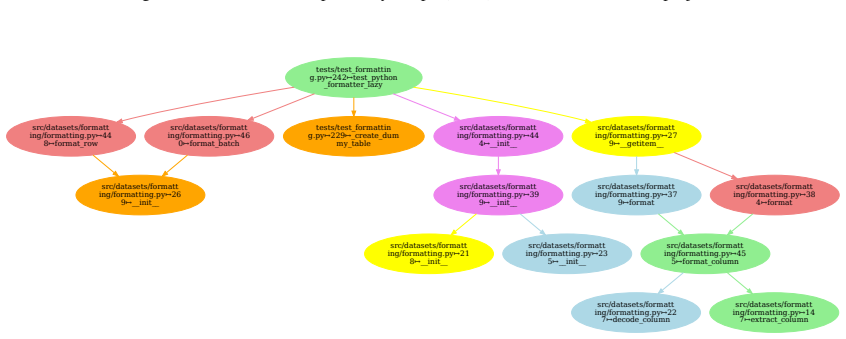
The Runtime Dependency Graph (RDG), built by SWE-Flow-Trace: a directed graph whose nodes are project functions invoked during unit test execution and whose edges are direct caller-callee pairs recorded from the function call stack, with calls outside the project filtered out. SWE-Flow-Schedule consumes the RDG, groups target test functions by the core functions they cover, sorts the groups by coverage size, and merges already-covered functions into earlier groups, producing a development schedule that respects dependency order. Skeletonization then turns each schedule step into a task: target core functions have their bodies removed and replaced by an LLM-generated docstring, while dependent core functions are deleted entirely, and the diff between the skeletonized and original codebases becomes the ground-truth solution.
What would settle it
Run SWE-Flow on a project that uses asyncio, multiprocessing, or callback-heavy patterns; for every scheduled step, apply the step's ground-truth patch to the skeletonized codebase and run that step's unit tests. If any step fails its own tests or fails to import because a needed function is missing, the RDG missed an edge and the verifiability claim is broken — the pattern the authors themselves flag in their limitations section.
Extended reading notes
Core claim
The central claim is that the incremental development history of a codebase can be reconstructed from its unit tests: each test is treated as a requirement, the functions it invokes form a Runtime Dependency Graph (RDG), and the topological order of that graph yields a natural development schedule. SWE-Flow-Trace captures the graph by monitoring the live function call stack while all passing tests run, filtering out calls outside the project; SWE-Flow-Schedule then merges tests that cover the same core functions and sorts them by the number of core functions involved, so each scheduled step rests only on functions developed in earlier steps. The paper maintains that every synthesized task is fully verifiable because correctness is decided by executing the step's unit tests in a containerized environment, and that this verifiability, together with automatic inference from real projects, removes the reliance on curated human issue reports. The empirical claim is that fine-tuning Qwen2.5-Coder-32B-Instruct on this data produces a model whose pass rates on SWE-Flow-Bench (Lite) improve on the base model and exceed those of most evaluated closed models in both the replace and patch solution formats.
Load-bearing premise
The load-bearing premise is that the Runtime Dependency Graph captured from the complete, passing test suite reflects every function interaction needed to rebuild the project incrementally, so that each scheduled step's partial codebase is buildable and its tests are passable.
Editorial extensions
If this is right
- Fine-tuning open code models on SWE-Flow data improves their performance on unseen development tasks drawn from different projects, in both the replace and patch output formats.
- Any GitHub project with an installable environment and a passing unit test suite becomes a source of verifiable training data, removing the dependence on human-submitted issues and manual filtering.
- Because every task is verified by executing unit tests, the same pipeline can supply verifiable reward signals for reinforcement learning and large corpora for pre-training code models.
- Merging consecutive schedule steps yields harder tasks, up to building an entire project from scratch, giving a configurable difficulty control for training and evaluation.
- SWE-Flow-Bench grades incremental, test-guided development steps, complementing SWE-Bench's issue-patch evaluation and Commit0's one-shot full-library generation.
Reading between the lines
- Editorial inference: part of the fine-tuning gain on SWE-Flow-Bench (Lite) could come from memorization, since the tasks are derived from real open-source code that the base model may already have seen; a contamination-controlled split using recently written or private projects would isolate the benefit of the data format itself.
- Editorial inference: the runtime-tracing machinery is not Python-specific in principle, so porting the hook approach to other runtimes with call-stack inspection (e.g., a JavaScript engine inspector) would test whether the RDG-schedule recipe transfers to other ecosystems.
- Editorial inference: the quality of a generated requirement document is bounded by the expressiveness of the unit test, so tests relying on mocking, fixtures, or external services may yield specifications that are under- or over-constrained relative to the intended function.
- Editorial inference: a direct probe of the framework's core claim is to delete one dependency edge from the RDG before scheduling and check whether any step becomes unsolvable; the fraction of failures would quantify how much verifiability depends on graph completeness.
Editorial analysis
A structured set of objections, weighed in public.
Referee Report
Summary. The paper proposes SWE-Flow, a framework that synthesizes test-driven development (TDD) training and evaluation data from real-world GitHub repositories. The framework executes a project's unit tests under a Python tracing hook to build a Runtime Dependency Graph (RDG), derives a development schedule that orders function implementations by dependency size, and then skeletonizes the original codebase for each step by removing the implementations of target and dependent core functions. For each step it generates a requirement document, a partial codebase, and ground-truth patches in both replace and patch formats. The authors release 16,061 training instances and 2,020 test instances, introduce SWE-Flow-Bench, and fine-tune Qwen2.5-Coder-32B-Instruct on the synthesized data. They report that the fine-tuned model, SF-Coder-32B-Instruct, outperforms the base model and most closed models on SWE-Flow-Bench (Lite) in both replace and patch formats, and they claim that the synthesized data are fully verifiable because correctness is checked by executing unit tests.
Significance. If the central claims hold, SWE-Flow addresses a real bottleneck in software engineering data: the dependence on human-submitted issue reports. The idea of deriving incremental development steps from unit tests and using execution-based verification is timely and potentially scalable, and the public release of code, datasets, models, and Docker images is a concrete asset to the community. The paper also provides explicit algorithms (Algorithm 1 and Algorithm 2), which makes the method reproducible in principle. However, the current evidence does not fully support the 'fully verifiable' claim, the patch-format evaluation is weakened by a post-processing conversion, and the fine-tuning gains are measured only on a benchmark generated by the same pipeline as the training data. These issues are fixable with additional validation and clearer reporting, but they are load-bearing for the paper's main conclusions.
major comments (5)
- [Section 3.7 and Algorithm 1] The claim that every SWE-Flow task is 'fully verifiable' is not directly validated. The statement 'We only keep the unit tests that pass' (Section 3.7) refers to tests executed on the original full codebase, not to tests executed on each skeletonized codebase after applying the ground-truth patch. Because skeletonization removes entire function definitions (DCFNs) and replaces TCFN bodies with LLM-generated docstrings, the skeletonized codebase may fail to import or may otherwise not be re-executable even after the reference patch is applied. Please report, for every benchmark task, the result of applying the reference patch to the skeletonized codebase and running the step's unit tests, along with the number of tasks discarded due to import errors or undeclared dependencies. Without this measurement, the 'fully verifiable' property is an assumption rather than a demonstrated fact.
- [Section 4.1 and Appendix E.1] The 'Patch Format' results do not measure the quality of generated patches as patches. Appendix E.1 states that generated patches are 'almost entirely incompatible with system tools such as Linux's patch utility' and that the evaluation applies a post-processing step that converts generated patches into replace format before modifying the codebase. This means the patch-format pass rates in Table 5 and Figure 4 reflect the success of an internal repair/conversion process, not the model's ability to produce an applicable unified diff. Either evaluate patch-format outputs with an actual patch application tool that performs context matching, or clearly relabel the metric and report how often the conversion changes the outcome.
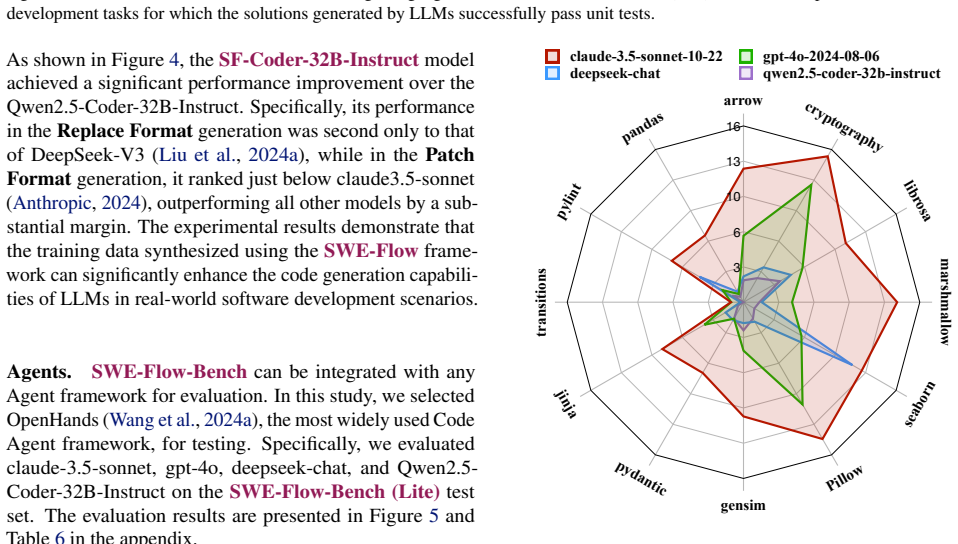
- [Section 5.2 and Section 4.1] The empirical validation of fine-tuning is circular in an important sense: SWE-Flow-Bench is generated by the same SWE-Flow pipeline that produced the training data. The test projects are disjoint from training projects, which mitigates direct memorization, but the task distribution, prompt format, skeletonization style, and requirement-document generation are identical. The reported improvement therefore demonstrates that the model learns the SWE-Flow task distribution, not that it improves general TDD-based coding ability. A comparison on an external benchmark such as SWE-Bench, Commit0, or a human-validated subset of real development tasks would substantially strengthen the claim that the synthesized data improve software engineering capability beyond the synthetic distribution.
- [Section 3.5] Skeletonization of Dependent Core Function Nodes removes both the function definition and its contents. A removed function that is referenced at module import time by code outside the current step (for example, as a decorator, a default argument, or a module-level assignment) will cause the skeletonized codebase to fail import, and no patch that only re-implements the current step's new functions can repair that. This is a concrete failure mode that is not captured by running tests on the original codebase and is not discussed in Section F.1, which lists only asyncio and multi-process limitations. The proposed per-task import-and-test validation in Section 3.7 would directly expose this issue.
- [Section F.1 and Table 3] The paper acknowledges that the RDG is incomplete for asynchronous and multi-process programs, but it never quantifies how often such incompleteness affects the synthesized tasks. Table 3 reports dependency depth and function counts, none of which measure missed-edge rates. Please provide a quantitative analysis of RDG completeness, for example by comparing the runtime graph against a static call graph (with appropriate caveats) or by reporting the number of steps whose tests fail on the skeletonized codebase even after the reference patch is applied. This is needed to assess the reliability of the development schedule and the 'fully verifiable' claim.
minor comments (5)
- [Section 5.2 and Figure 4] The model name is inconsistent: the text refers to SF-Coder-32B-Instruct, while Figure 4 uses both UF-Coder-32B-Instruct and UF-Coder-v4.0-iters-32. Please unify the naming across the paper.
- [Abstract and Section 3.7] The benchmark is called SWE-Flow-Eval in the abstract but SWE-Flow-Bench throughout the body. Please use one name consistently.
- [Table 3] The pylint Full Context Tokens value is listed as '23,76', which appears to be a typo for '2,376'.
- [Table 2] The marshmallow entry lists 'Last Commit' as 2025.11.06, which is later than the paper's June 2025 revision date; this is likely a typo and should be corrected.
- [Appendix C.1] The development-document example is attributed to the tiktoken project, but tiktoken does not appear in the project list in Table 2; please clarify which project this example comes from.
Circularity Check
No significant circularity: the synthesized tasks are constructive data-generation outputs, and the fine-tuning gain is an in-distribution empirical result rather than a quantity forced by definition.
full rationale
SWE-Flow's derivation chain is constructive: Algorithm 1 executes the project's own passing unit tests and records caller-callee edges; Algorithm 2 orders tasks by the RDG; Section 3.5 builds each partial codebase by deleting TCFN implementations and DCFN definitions; Section 3.6 defines the ground-truth patch as the diff between original and skeletonized code. Verifiability is therefore guaranteed for the reference patch by construction, but this is the intended data-generation mechanism, not a circular inference — the LLM is not given the patch and must reimplement the deleted functions. The fine-tuning evaluation on SWE-Flow-Bench (Lite) uses 12 projects disjoint from the 62 training projects, so the pass-rate improvement measures transfer to held-out tasks from the same generator; it is an empirical, in-distribution measurement, not a fitted parameter renamed as a prediction. The use of Qwen2.5-Coder-32B-Instruct both for generating requirement documents/docstrings and as the base for fine-tuning is a mild same-team self-citation, but the model is open-source and externally available, and the cited technical report is not invoked to forbid alternatives or to supply the central result. Section F.1 candidly acknowledges that the RDG may be incomplete for asyncio and multi-process code; this is a correctness risk about the load-bearing completeness assumption, not a circularity, because the paper does not redefine dependency to make its conclusion true by definition.
Assumptions & free parameters
assumptions (4)
- domain assumption Unit tests that pass in the complete codebase are sufficient and faithful specifications of the required functionality for each development step.
- domain assumption The runtime dependency graph constructed from the complete, passing test suite fully captures the function interactions required for incremental development.
- domain assumption Skeletonization that removes function bodies and dependent function definitions leaves a syntactically valid partial codebase that accurately simulates an intermediate development state.
- domain assumption LLM-generated requirement documents from unit tests are faithful, complete specifications of the intended behavior.
Cite this review
Pith. "Pith review of SWE-Flow: Synthesizing Software Engineering Data in a Test-Driven Manner." pith.science (2026). https://pith.science/paper/U75YBUGW
@misc{pith2026250609003,
  author       = {Pith},
  title        = {Pith review of: SWE-Flow: Synthesizing Software Engineering Data in a Test-Driven Manner},
  year         = {2026},
  howpublished = {\url{https://pith.science/paper/U75YBUGW}},
  note         = {Machine review of arXiv:2506.09003}
}
read the original abstract
We introduce **SWE-Flow**, a novel data synthesis framework grounded in Test-Driven Development (TDD). Unlike existing software engineering data that rely on human-submitted issues, **SWE-Flow** automatically infers incremental development steps directly from unit tests, which inherently encapsulate high-level requirements. The core of **SWE-Flow** is the construction of a Runtime Dependency Graph (RDG), which precisely captures function interactions, enabling the generation of a structured, step-by-step *development schedule*. At each step, **SWE-Flow** produces a partial codebase, the corresponding unit tests, and the necessary code modifications, resulting in fully verifiable TDD tasks. With this approach, we generated 16,061 training instances and 2,020 test instances from real-world GitHub projects, creating the **SWE-Flow-Eval** benchmark. Our experiments show that fine-tuning open model on this dataset significantly improves performance in TDD-based coding. To facilitate further research, we release all code, datasets, models, and Docker images at [Github](https://github.com/Hambaobao/SWE-Flow).
Figures


Figures from the paper (10 more)





Forward citations
Cited by 1 Pith paper
-
SWE-Perf: Can Language Models Optimize Code Performance on Real-World Repositories?
A repository-level benchmark shows LLMs and agents currently achieve far smaller, statistically verified speedups than expert human patches on 140 real-world Python performance tasks.
Reference graph
Works this paper leans on
-
[1]
Anthropic. Claude 3 family, 2024. URL https://www.anthropic.com/news/claude-3-family. Accessed: 2025-01-30
work page 2024
-
[2]
Program synthesis with large language models
Austin, J., Odena, A., Nye, M., Bosma, M., Michalewski, H., Dohan, D., Jiang, E., Cai, C., Terry, M., Le, Q., et al. Program synthesis with large language models. arXiv preprint arXiv:2108.07732, 2021
arXiv 2021
-
[3]
Efficient training of language models to fill in the middle
Bavarian, M., Jun, H., Tezak, N., Schulman, J., McLeavey, C., Tworek, J., and Chen, M. Efficient training of language models to fill in the middle. arXiv preprint arXiv:2207.14255, 2022
arXiv 2022
-
[4]
Test Driven Development: By Example
Beck, K. Test Driven Development: By Example. Addison-Wesley Longman Publishing Co., Inc., 2002
work page 2002
-
[5]
Cassano, F., Gouwar, J., Nguyen, D., Nguyen, S., Phipps-Costin, L., Pinckney, D., Yee, M.-H., Zi, Y., Anderson, C. J., Feldman, M. Q., Guha, A., Greenberg, M., and Jangda, A. Multipl-e: A scalable and polyglot approach to benchmarking neural code generation. IEEE Transactions on Software Engineering, 49 0 (7): 0 3675--3691, 2023. doi:10.1109/TSE.2023.3267446
arXiv 2023
-
[6]
Mceval: Massively multilingual code evaluation
Chai, L., Liu, S., Yang, J., Yin, Y., Jin, K., Liu, J., Sun, T., Zhang, G., Ren, C., Guo, H., et al. Mceval: Massively multilingual code evaluation. arXiv preprint arXiv:2406.07436, 2024
arXiv 2024
-
[7]
Code alpaca: An instruction-following llama model for code generation
Chaudhary, S. Code alpaca: An instruction-following llama model for code generation. https://github.com/sahil280114/codealpaca, 2023
work page 2023
-
[8]
Chen, M., Tworek, J., Jun, H., Yuan, Q., Pinto, H. P. D. O., Kaplan, J., Edwards, H., Burda, Y., Joseph, N., Brockman, G., et al. Evaluating large language models trained on code. arXiv preprint arXiv:2107.03374, 2021
arXiv 2021
Show all 59 references
-
[9]
Fullstack bench: Evaluating llms as full stack coders
Cheng, Y., Chen, J., Chen, J., Chen, L., Chen, L., Chen, W., Chen, Z., Geng, S., Li, A., Li, B., et al. Fullstack bench: Evaluating llms as full stack coders. arXiv e-prints, pp.\ arXiv--2412, 2024
2024
-
[10]
Gu, A., Rozi \`e re, B., Leather, H., Solar-Lezama, A., Synnaeve, G., and Wang, S. I. Cruxeval: A benchmark for code reasoning, understanding and execution. 2024
2024
-
[11]
Deepseek-coder: When the large language model meets programming--the rise of code intelligence
Guo, D., Zhu, Q., Yang, D., Xie, Z., Dong, K., Zhang, W., Chen, G., Bi, X., Wu, Y., Li, Y., et al. Deepseek-coder: When the large language model meets programming--the rise of code intelligence. arXiv preprint arXiv:2401.14196, 2024. URL https://arxiv.org/abs/2401.14196
2024 arXiv
-
[12]
Deepseek-r1: Incentivizing reasoning capability in llms via reinforcement learning
Guo, D., Yang, D., Zhang, H., Song, J., Zhang, R., Xu, R., Zhu, Q., Ma, S., Wang, P., Bi, X., et al. Deepseek-r1: Incentivizing reasoning capability in llms via reinforcement learning. arXiv preprint arXiv:2501.12948, 2025
2025 arXiv
-
[13]
Hong, S., Zheng, X., Chen, J., Cheng, Y., Wang, J., Zhang, C., Wang, Z., Yau, S. K. S., Lin, Z., Zhou, L., et al. Metagpt: Meta programming for multi-agent collaborative framework. arXiv preprint arXiv:2308.00352, 2023
2023 arXiv
-
[14]
Cosqa: 20,000+ web queries for code search and question answering
Huang, J., Tang, D., Shou, L., Gong, M., Xu, K., Jiang, D., Zhou, M., and Duan, N. Cosqa: 20,000+ web queries for code search and question answering. 2021
2021
-
[15]
K., Hao, J., Song, L., Xu, Y., Yang, J., Liu, J., Zhang, C., Chai, L., et al
Huang, S., Cheng, T., Liu, J. K., Hao, J., Song, L., Xu, Y., Yang, J., Liu, J., Zhang, C., Chai, L., et al. Opencoder: The open cookbook for top-tier code large language models. arXiv preprint arXiv:2411.04905, 2024
2024 arXiv
-
[16]
Hui, B., Yang, J., Cui, Z., Yang, J., Liu, D., Zhang, L., Liu, T., Zhang, J., Yu, B., Dang, K., et al. Qwen2. 5-coder technical report. arXiv preprint arXiv:2409.12186, 2024
2024 arXiv
-
[17]
Huq, F., Hasan, M., Haque, M. M. A., Mahbub, S., Iqbal, A., and Ahmed, T. Review4repair: Code review aided automatic program repairing. 143: 0 106765, 2022
2022
-
[18]
P., Perelman, A., Ramesh, A., Clark, A., Ostrow, A., Welihinda, A., Hayes, A., Radford, A., et al
Hurst, A., Lerer, A., Goucher, A. P., Perelman, A., Ramesh, A., Clark, A., Ostrow, A., Welihinda, A., Hayes, A., Radford, A., et al. Gpt-4o system card. arXiv preprint arXiv:2410.21276, 2024
2024 arXiv
-
[19]
Codesearchnet challenge: Evaluating the state of semantic code search
Husain, H., Wu, H., Gazit, T., Allamanis, M., and Brockschmidt, M. Codesearchnet challenge: Evaluating the state of semantic code search. arXiv preprint arXiv:1909.09436, abs/1909.09436, 2019. URL http://arxiv.org/abs/1909.09436
1909 arXiv
-
[20]
Openai o1 system card
Jaech, A., Kalai, A., Lerer, A., Richardson, A., El-Kishky, A., Low, A., Helyar, A., Madry, A., Beutel, A., Carney, A., et al. Openai o1 system card. arXiv preprint arXiv:2412.16720, 2024
2024 arXiv
-
[21]
Livecodebench: Holistic and contamination free evaluation of large language models for code
Jain, N., Han, K., Gu, A., Li, W.-D., Yan, F., Zhang, T., Wang, S., Solar-Lezama, A., Sen, K., and Stoica, I. Livecodebench: Holistic and contamination free evaluation of large language models for code. arXiv preprint arXiv:2403.07974, 2024
2024 arXiv
-
[22]
E., Yang, J., Wettig, A., Yao, S., Pei, K., Press, O., and Narasimhan, K
Jimenez, C. E., Yang, J., Wettig, A., Yao, S., Pei, K., Press, O., and Narasimhan, K. Swe-bench: Can language models resolve real-world github issues? arXiv preprint arXiv:2310.06770, 2023
2023 arXiv
-
[23]
Ds-1000: A natural and reliable benchmark for data science code generation
Lai, Y., Li, C., Wang, Y., Zhang, T., Zhong, R., Zettlemoyer, L., Yih, W.-T., Fried, D., Wang, S., and Yu, T. Ds-1000: A natural and reliable benchmark for data science code generation. ArXiv, abs/2211.11501, 2022
2022 arXiv
-
[24]
B., Zi, Y., Muennighoff, N., Kocetkov, D., Mou, C., Marone, M., Akiki, C., Li, J., Chim, J., Liu, Q., Zheltonozhskii, E., Zhuo, T
Li, R., Allal, L. B., Zi, Y., Muennighoff, N., Kocetkov, D., Mou, C., Marone, M., Akiki, C., Li, J., Chim, J., Liu, Q., Zheltonozhskii, E., Zhuo, T. Y., Wang, T., Dehaene, O., Davaadorj, M., Lamy - Poirier, J., Monteiro, J., Shliazhko, O., Gontier, N., Meade, N., Zebaze, A., Y...
-
[25]
Autokaggle: A multi-agent framework for autonomous data science competitions
Li, Z., Zang, Q., Ma, D., Guo, J., Zheng, T., Niu, X., Yue, X., Wang, Y., Yang, J., Liu, J., et al. Autokaggle: A multi-agent framework for autonomous data science competitions. arXiv preprint arXiv:2410.20424, 2024
2024 arXiv
-
[26]
Deepseek-v3 technical report
Liu, A., Feng, B., Xue, B., Wang, B., Wu, B., Lu, C., Zhao, C., Deng, C., Zhang, C., Ruan, C., et al. Deepseek-v3 technical report. arXiv preprint arXiv:2412.19437, 2024 a
2024 arXiv
-
[27]
S., Wang, Y., and Zhang, L
Liu, J., Xia, C. S., Wang, Y., and Zhang, L. Is your code generated by chatgpt really correct? rigorous evaluation of large language models for code generation. arXiv preprint arXiv:2305.01210, abs/2305.01210, 2023. URL https://arxiv.org/abs/2305.01210
2023 arXiv
-
[28]
M2rc-eval: Massively multilingual repository-level code completion evaluation
Liu, J., Deng, K., Liu, C., Yang, J., Liu, S., Zhu, H., Zhao, P., Chai, L., Wu, Y., Jin, K., et al. M2rc-eval: Massively multilingual repository-level code completion evaluation. arXiv preprint arXiv:2410.21157, 2024 b
2024 arXiv
-
[30]
Mdeval: Massively multilingual code debugging
Liu, S., Chai, L., Yang, J., Shi, J., Zhu, H., Wang, L., Jin, K., Zhang, W., Zhu, H., Guo, S., et al. Mdeval: Massively multilingual code debugging. arXiv preprint arXiv:2411.02310, 2024 d
2024 arXiv
-
[31]
B., Cassano, F., Lamy-Poirier, J., Tazi, N., Tang, A., Pykhtar, D., Liu, J., Wei, Y., et al
Lozhkov, A., Li, R., Allal, L. B., Cassano, F., Lamy-Poirier, J., Tazi, N., Tang, A., Pykhtar, D., Liu, J., Wei, Y., et al. Starcoder 2 and the stack v2: The next generation. arXiv preprint arXiv:2402.19173, 2024
2024 arXiv
-
[32]
K., Fu, S., and LIU, S
Lu, S., Guo, D., Ren, S., Huang, J., Svyatkovskiy, A., Blanco, A., Clement, C., Drain, D., Jiang, D., Tang, D., Li, G., Zhou, L., Shou, L., Zhou, L., Tufano, M., GONG, M., Zhou, M., Duan, N., Sundaresan, N., Deng, S. K., Fu, S., and LIU, S. Code XGLUE : A machine learning benc...
2021
-
[33]
Wizardcoder: Empowering code large language models with evol-instruct
Luo, Z., Xu, C., Zhao, P., Sun, Q., Geng, X., Hu, W., Tao, C., Ma, J., Lin, Q., and Jiang, D. Wizardcoder: Empowering code large language models with evol-instruct. CoRR, abs/2306.08568, 2023. doi:10.48550/ARXIV.2306.08568. URL https://doi.org/10.48550/arXiv.2306.08568
-
[34]
Training language models to follow instructions with human feedback
Ouyang, L., Wu, J., Jiang, X., Almeida, D., Wainwright, C., Mishkin, P., Zhang, C., Agarwal, S., Slama, K., Ray, A., et al. Training language models to follow instructions with human feedback. Advances in neural information processing systems, 35: 0 27730--27744, 2022 a
2022
-
[35]
L., Mishkin, P., Zhang, C., Agarwal, S., Slama, K., Ray, A., Schulman, J., Hilton, J., Kelton, F., Miller, L., Simens, M., Askell, A., Welinder, P., Christiano, P
Ouyang, L., Wu, J., Jiang, X., Almeida, D., Wainwright, C. L., Mishkin, P., Zhang, C., Agarwal, S., Slama, K., Ray, A., Schulman, J., Hilton, J., Kelton, F., Miller, L., Simens, M., Askell, A., Welinder, P., Christiano, P. F., Leike, J., and Lowe, R. Training language models t...
2022
-
[36]
Training software engineering agents and verifiers with swe-gym
Pan, J., Wang, X., Neubig, G., Jaitly, N., Ji, H., Suhr, A., and Zhang, Y. Training software engineering agents and verifiers with swe-gym. arXiv preprint arXiv:2412.21139, 2024
2024 arXiv
-
[37]
E., Adi, Y., Liu, J., Remez, T., Rapin, J., et al
Rozi \`e re, B., Gehring, J., Gloeckle, F., Sootla, S., Gat, I., Tan, X. E., Adi, Y., Liu, J., Remez, T., Rapin, J., et al. Code Llama : Open foundation models for code. arXiv preprint arXiv:2308.12950, 2023. URL https://arxiv.org/abs/2308.12950
2023 arXiv
-
[38]
Toolformer: Language models can teach themselves to use tools
Schick, T., Dwivedi-Yu, J., Dess \` , R., Raileanu, R., Lomeli, M., Hambro, E., Zettlemoyer, L., Cancedda, N., and Scialom, T. Toolformer: Language models can teach themselves to use tools. Advances in Neural Information Processing Systems, 36: 0 68539--68551, 2023
2023
-
[39]
Megatron-lm: Training multi-billion parameter language models using model parallelism
Shoeybi, M., Patwary, M., Puri, R., LeGresley, P., Casper, J., and Catanzaro, B. Megatron-lm: Training multi-billion parameter language models using model parallelism. arXiv preprint arXiv:1909.08053, 2019
1909 arXiv
-
[40]
Tablegpt2: A large multimodal model with tabular data integration
Su, A., Wang, A., Ye, C., Zhou, C., Zhang, G., Zhu, G., Wang, H., Xu, H., Chen, H., Li, H., et al. Tablegpt2: A large multimodal model with tabular data integration. arXiv preprint arXiv:2411.02059, 2024
2024 arXiv
-
[41]
and Nadiri, A
Talebirad, Y. and Nadiri, A. Multi-agent collaboration: Harnessing the power of intelligent llm agents. arXiv preprint arXiv:2306.03314, 2023
2023 arXiv
-
[42]
Debugbench: Evaluating debugging capability of large language models
Tian, R., Ye, Y., Qin, Y., Cong, X., Lin, Y., Liu, Z., and Sun, M. Debugbench: Evaluating debugging capability of large language models. 2024
2024
-
[44]
F., Tang, X., Zhuge, M., Pan, J., Song, Y., Li, B., Singh, J., et al
Wang, X., Li, B., Song, Y., Xu, F. F., Tang, X., Zhuge, M., Pan, J., Song, Y., Li, B., Singh, J., et al. Opendevin: An open platform for ai software developers as generalist agents. arXiv preprint arXiv:2407.16741, 2024 b
2024 arXiv
-
[45]
A., Khashabi, D., and Hajishirzi, H
Wang, Y., Kordi, Y., Mishra, S., Liu, A., Smith, N. A., Khashabi, D., and Hajishirzi, H. Self-instruct: Aligning language models with self-generated instructions. In Rogers, A., Boyd - Graber, J. L., and Okazaki, N. (eds.), Proceedings of the 61st Annual Meeting of the Associa...
2023 doi
- [46]
-
[47]
Tablebench: A comprehensive and complex benchmark for table question answering
Wu, X., Yang, J., Chai, L., Zhang, G., Liu, J., Du, X., Liang, D., Shu, D., Cheng, X., Sun, T., et al. Tablebench: A comprehensive and complex benchmark for table question answering. arXiv preprint arXiv:2408.09174, 2024
2024 arXiv
-
[48]
Codetransocean: A comprehensive multilingual benchmark for code translation
Yan, W., Tian, Y., Li, Y., Chen, Q., and Wang, W. Codetransocean: A comprehensive multilingual benchmark for code translation. 2023
2023
-
[49]
Yang, A., Yang, B., Zhang, B., Hui, B., Zheng, B., Yu, B., Li, C., Liu, D., Huang, F., Wei, H., et al. Qwen2. 5 technical report. arXiv preprint arXiv:2412.15115, 2024 a
2024 arXiv
-
[50]
E., Wettig, A., Lieret, K., Yao, S., Narasimhan, K., and Press, O
Yang, J., Jimenez, C. E., Wettig, A., Lieret, K., Yao, S., Narasimhan, K., and Press, O. Swe-agent: Agent-computer interfaces enable automated software engineering. arXiv preprint arXiv:2405.15793, 2024 b
2024 arXiv
-
[51]
Evaluating and aligning codellms on human preference
Yang, J., Yang, J., Jin, K., Miao, Y., Zhang, L., Yang, L., Cui, Z., Zhang, Y., Hui, B., and Lin, J. Evaluating and aligning codellms on human preference. arXiv preprint arXiv:2412.05210, 2024 c
2024 arXiv
-
[52]
Execrepobench: Multi-level executable code completion evaluation
Yang, J., Zhang, J., Yang, J., Jin, K., Zhang, L., Peng, Q., Deng, K., Miao, Y., Liu, T., Cui, Z., et al. Execrepobench: Multi-level executable code completion evaluation. arXiv preprint arXiv:2412.11990, 2024 d
2024 arXiv
-
[53]
Codereval: A benchmark of pragmatic code generation with generative pre-trained models
Yu, H., Shen, B., Ran, D., Zhang, J., Zhang, Q., Ma, Y., Liang, G., Li, Y., Wang, Q., and Xie, T. Codereval: A benchmark of pragmatic code generation with generative pre-trained models. In Proceedings of the 46th IEEE/ACM International Conference on Software Engineering, pp.\ ...
2024
-
[54]
Wavecoder: Widespread and versatile enhanced instruction tuning with refined data generation
Yu, Z., Zhang, X., Shang, N., Huang, Y., Xu, C., Zhao, Y., Hu, W., and Yin, Q. Wavecoder: Widespread and versatile enhanced instruction tuning with refined data generation. CoRR, abs/2312.14187, 2023. doi:10.48550/ARXIV.2312.14187. URL https://doi.org/10.48550/arXiv.2312.14187
-
[55]
RepoCoder : Repository-level code completion through iterative retrieval and generation
Zhang, F., Chen, B., Zhang, Y., Liu, J., Zan, D., Mao, Y., Lou, J., and Chen, W. RepoCoder : Repository-level code completion through iterative retrieval and generation. arXiv preprint arXiv:2303.12570, abs/2303.12570, 2023 a . doi:10.48550/arXiv.2303.12570. URL https://doi.or...
-
[56]
Di-bench: Benchmarking large language models on dependency inference with testable repositories at scale
Zhang, L., Wang, J., He, S., Zhang, C., Kang, Y., Li, B., Wen, J., Xie, C., Wang, M., Huang, Y., et al. Di-bench: Benchmarking large language models on dependency inference with testable repositories at scale. arXiv preprint arXiv:2501.13699, 2025
2025 arXiv
-
[57]
Llama-adapter: Efficient fine-tuning of language models with zero-init attention
Zhang, R., Han, J., Zhou, A., Hu, X., Yan, S., Lu, P., Li, H., Gao, P., and Qiao, Y. Llama-adapter: Efficient fine-tuning of language models with zero-init attention. CoRR, abs/2303.16199, 2023 b . doi:10.48550/ARXIV.2303.16199. URL https://doi.org/10.48550/arXiv.2303.16199
-
[58]
Naturalcodebench: Examining coding performance mismatch on humaneval and natural user queries
Zhang, S., Zhao, H., Liu, X., Zheng, Q., Qi, Z., Gu, X., Dong, Y., and Tang, J. Naturalcodebench: Examining coding performance mismatch on humaneval and natural user queries. In Findings of the Association for Computational Linguistics, ACL 2024, Bangkok, Thailand and virtual ...
2024
-
[59]
T., Cardie, C., Gall \'e , M., and Rush, A
Zhao, W., Jiang, N., Lee, C., Chiu, J. T., Cardie, C., Gall \'e , M., and Rush, A. M. Commit0: Library generation from scratch. arXiv preprint arXiv:2412.01769, 2024
2024 arXiv
-
[60]
Y., Vu, M
Zhuo, T. Y., Vu, M. C., Chim, J., Hu, H., Yu, W., Widyasari, R., Yusuf, I. N. B., Zhan, H., He, J., Paul, I., et al. Bigcodebench: Benchmarking code generation with diverse function calls and complex instructions. arXiv preprint arXiv:2406.15877, 2024
2024 arXiv
-
[61]
write newline
" write newline "" before.all 'output.state := FUNCTION n.dashify 't := "" t empty not t #1 #1 substring "-" = t #1 #2 substring "--" = not "--" * t #2 global.max substring 't := t #1 #1 substring "-" = "-" * t #2 global.max substring 't := while if t #1 #1 substring * t #2 gl...
Reviewed August 7, 2026 · model on record in the stance chip above.
Discussion (0). Sign in to comment.