REVIEW 4 major objections 5 minor 1 cited by
Electric-Field Driven Nuclear Dynamics of Liquids and Solids from a Multi-Valued Machine-Learned Dipolar Model
T0 review · 4 major / 5 minor · reviewed 2026-08-09 · deepseek-v4-flash
Pith's one-line read By treating the dipole as multi-valued and encoding atomic oxidation numbers into the model, this paper makes machine-learned electric-field-driven molecular dynamics accurate for periodic systems far from equilibrium, demonstrated on…
desk verdict The multi-valued dipole construction is the real advance here; the water and LiNbO3 applications are compelling but lean on a linear-coupling approximation that deserves scrutiny. read the letter →
The pith
A machine-rendered reading of the paper's core claim, the machinery that carries it, and where it could break.
The reading
What carries the argument
The load-bearing object is a multi-valued dipole model: a dipole function $\tilde{\mu}_{\mathrm{MV}}(\mathbf{R})$ that is allowed to take different values at periodically equivalent atomic positions, with the branch structure encoded through atomic oxidation numbers $N_I$ via $\tilde{\mu}_{\mathrm{MV}}=\tilde{\mu}(\mathbf{A})+e\sum_I N_I\mathbf{R}_I$. The first term is learned by an equivariant message-passing neural network; the second term supplies the non-periodic part whose gradient gives the $N_I\mathbf{1}_{3\times3}$ contribution to the Born effective charges. This construction makes the dipole continuous along paths where atoms cross cell boundaries, lets training include strongly out-of-equilibrium structures, and guarantees charge conservation and translation invariance.
What would settle it
Take the water or LiNbO$_3$ configurations from a field-driven trajectory and recompute the dipole with first-principles finite-field or Berry-phase methods at applied fields 0.05–0.30 V/Å; if $\boldsymbol{\mu}(\mathbf{E})$ deviates from $\boldsymbol{\mu}(0)+\mathbf{Z}^*\cdot\mathbf{E}$ beyond the model's training error, or if a second-order coupling term is needed to recover the experimentally reported ~1000 cm$^{-1}$ water band, the quantitative predictions of the method would need revision in that regime.
Extended reading notes
Core claim
The paper's central claim is that incorporating the multi-valued nature of the dipole makes machine-learned electric-field-driven molecular dynamics generally applicable to molecules, liquids, solids, and disordered systems, in and out of equilibrium. Standard equivariant models treat the dipole as a single-valued function of the atomic environment, which forces a discontinuous branch switch across periodic boundaries and causes autodifferentiated Born effective charges to deviate once displacements are large. The paper instead writes the modeled dipole as $\tilde{\mu}_{\mathrm{MV}}(\mathbf{R})=\tilde{\mu}(\mathbf{A})+e\sum_I N_I \mathbf{R}_I$, with the oxidation numbers $N_I$ fixed by a line integral of the dipole around a closed path, so equivalent atomic positions can carry different dipole values on the same smooth branch. Automatic differentiation then gives $\mathbf{Z}^*_I = \frac{1}{e}\frac{\partial \tilde{\mu}}{\partial \mathbf{R}_I} + N_I \mathbf{1}_{3\times3}$, which preserves the acoustic sum rule and translation invariance. The demonstration is that this model, coupled to the linear-coupling Hamiltonian $H=T+V-\mathbf{E}\cdot\boldsymbol{\mu}$, reproduces water's dielectric dispersion and electrofreezing and LiNbO$_3$'s phase transition and non-equilibrium phonon dynamics over nanoseconds.
Load-bearing premise
The load-bearing premise is that the linear electric-dipole coupling in $H=T+V-\mathbf{E}\cdot\boldsymbol{\mu}$, with field-independent Born effective charges, remains a faithful description of the nuclear dynamics up to field strengths of 0.30 V/Å and frequencies of 18 THz; if nonlinear polarizability or field-dependent charge responses become important at these intensities, the quantitative field-driven results for water and LiNbO$_3$ would shift, even though the multi-valued dipole architecture itself would keep working.
Editorial extensions
If this is right
- For liquid water, the approach yields a dielectric function spanning 0.001–135 THz with a simulated onset of Debye relaxation that tracks experiment, plus IR spectra whose field-induced shifts (libration blue-shift, OH red-shift) reflect a Stark-like response.
- Nuclear quantum effects, included via path-integral dynamics, make water easier to polarize under an applied field and strengthen the electrofreezing signature at larger intensities, reversing the zero-field ordering of diffusion coefficients.
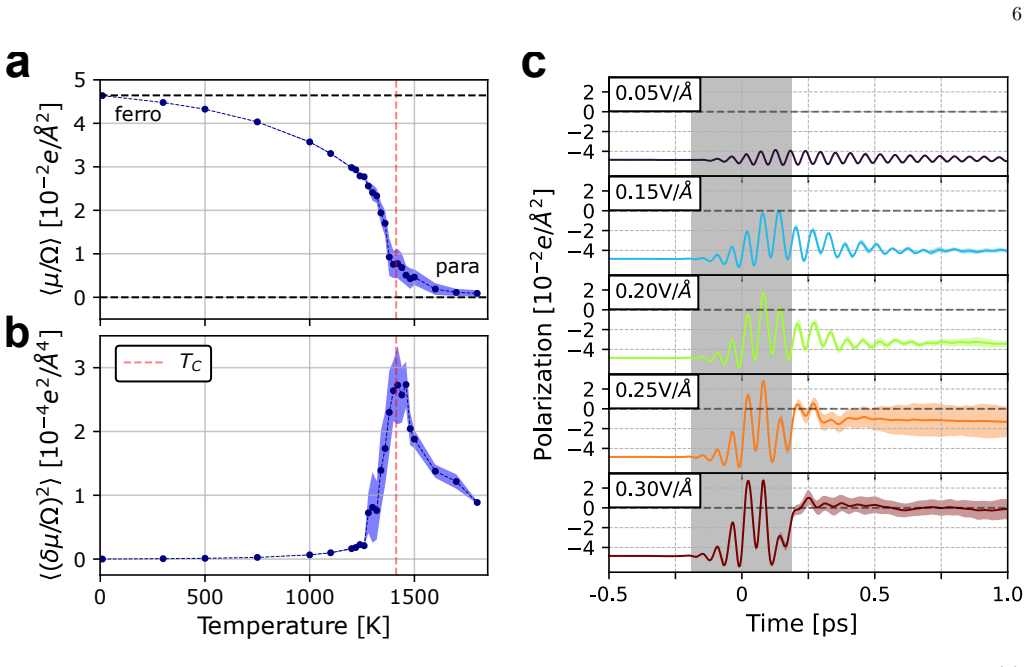
- For LiNbO$_3$, the model reproduces a second-order ferroelectric-to-paraelectric transition with a Curie temperature close to the experimental 1413 K, and ab initio-quality phonon bands over the full Brillouin zone.
- Under ultrafast 18 THz pulses, the simulations show non-linear coupling of the driven QIR mode to the 7.4 THz polarization-reversal mode and only three other $A_1$ modes; the polarization is transiently driven to zero at 0.15–0.20 V/Å and relaxes in about 300 fs, while at 0.25–0.30 V/Å the system heats above $T_C$ and no full coherent switch occurs.
- Because the model learns only the dipole and autodifferentiates, the acoustic sum rule and translational invariance of the Born effective charges are satisfied by construction, extending previous dipole and Born-charge ML models to cases where atoms diffuse or move far from equilibrium.
Reading between the lines
- A reader can push further: the missing ~1000 cm$^{-1}$ water libration band at high fields, which the paper attributes to neglected second-order field coupling, is a concrete spectral test of the linear-coupling approximation; a finite-field DFT calculation of the dipole along the same trajectories would reveal whether $\mathbf{Z}^*$ changes appreciably at these intensities.
- The same oxidation-number construction should transfer to other polar and superionic systems, such as nanoconfined water or superionic ice, where electric-field tuning of proton transport is of interest; the paper's own discussion points in this direction.
- The topological character of the line integral behind $N_I$ connects this ML architecture to the modern theory of polarization and quantized charge transport, so the recipe may also be used to enforce correct branch behavior in ML models of Wannier centers, dielectric tensors, and higher-order multipoles.
- A direct test of the method's generality would be to train the multi-valued dipole on a known ionic conductor, run field-driven dynamics, and compare predicted ionic conductivity with experiment; success would confirm that the framework is not limited to water-like or ferroelectric polarizations.
Signed reviews
Editorial analysis
A structured set of objections, weighed in public.
Referee Report
Summary. The manuscript presents a machine-learning framework for electric-field-driven nuclear dynamics in liquids and solids. The key methodological contribution is a multi-valued dipole model: for periodic systems, the dipole is written as mu_tilde_MV(R) = mu_tilde(A) + e sum_I N_I R_I (Eq. 4), where the residual term mu_tilde depends on the local atomic environment and the oxidation-number term accounts for the branch structure of the polarization. The model is autodifferentiated to obtain Born effective charges. The authors showcase the approach on liquid water, computing the GHz-THz dielectric function, field-dependent IR spectra, electrofreezing, and nuclear quantum effects, and on LiNbO3, computing the ferroelectric-paraelectric transition and THz-driven phonon dynamics. They report that the method enables nanosecond-scale simulations and that a full polarization switch in LiNbO3 is not achieved.
Significance. If the quantitative claims hold, the multi-valued dipole construction is a genuine and useful contribution: it addresses a known failure mode of single-valued ML dipole models in periodic systems with ionic transport or large displacements, and the learning-curve evidence in Supplementary Section S1 is compelling. The autodifferentiation of the model preserves the acoustic sum rule and avoids separate BEC fitting. The applications to water and LiNbO3 are ambitious and demonstrate a promising simulation capability. However, several load-bearing aspects of the validation and of the physical approximations need to be strengthened before the quantitative conclusions can be accepted.
major comments (4)
- [Section II.B and Eq. (6)] The field-driven simulations use the linear-coupling Hamiltonian H = T + V - E·mu with field-independent Born effective charges obtained from a model trained on zero-field DFT data. This approximation is applied at fields up to 0.15 V/angstrom for water and up to 0.30 V/angstrom for LiNbO3. At these intensities the electronic polarizability is not negligible: an induced dipole of roughly 0.14 D at 0.3 V/angstrom is about 8% of the permanent dipole of a water molecule, and in LiNbO3 the electronic dielectric response is comparable to the transient polarization changes shown in Fig. 3c. The authors themselves note in Section II.B that omission of second-order electric-field coupling may explain the missing ~1000 cm^-1 band in the high-field water IR spectra. This concern directly affects the quantitative claims for the Stark shifts, electrofreezing rates, and phonon-driving dynamics. Please provide a quantitative estimate of the nonlinear field response, for example by computing dipoles and Born effective charges with finite-field DFT at the field strengths used, or clearly restrict the conclusions to the linear-response regime.
- [Table III and Section IV.C] Table III reports water energy and force RMSE values marked with an asterisk, and the caption states that these are RMSE on the training dataset rather than on a held-out test set. The abstract and introduction claim 'quantum-mechanical accuracy', but for water only the dipole error is a test-set error. Training-set RMSE does not provide a valid estimate of generalization error. Please provide test-set errors for the water energy and forces, and state how the test set was constructed and whether any structures generated under applied electric fields were included in the test set.
- [Section IV.C and Supplementary Section S3] The water dipole model used for the main-text dielectric function and IR spectra was trained on dipoles of aperiodic water droplets computed with the revPBE functional. Supplementary Section S3 shows that a dipole model trained on periodic bulk-water dipoles yields a static dielectric constant closer to experiment and better reproduces previous ab initio results. The main-text quantitative analysis of the dielectric function and electrofreezing therefore uses the less accurate droplet-trained model. The authors should present the main-text results obtained with the periodic-data model, or quantify the differences and justify the choice of the droplet-trained model for the central claims.
- [Section IV.C (water computational details)] The water dipole model is trained on dipoles computed with the revPBE functional on droplet structures, whereas the MLIP interatomic potential is trained on energies and forces from revPBE0-D3 using the data of Ref. [75]. Since the field-dependent forces in Eq. (7) combine V and mu from different electronic-structure descriptions, the consistency of this mixed-functional approach is not established. A validation on bulk water configurations with dipoles computed at the revPBE0-D3 level would help rule out systematic biases in the Born effective charges and hence in the field-induced forces.
minor comments (5)
- [Eq. (1)] The right-hand side of Eq. (1) is typeset as 'el'; it should read 'e l', where e is the elementary charge and l is a lattice vector.
- [Eq. (3)] The text after Eq. (3) contains a duplicated word: 'the more general case case where Nat atoms...'.
- [Section IV.C and Supplementary Section S4] The main text states that PIMD simulations use 8 ring-polymer replicas, while Supplementary Section S4 refers to 'the mean over the 32 beads' for the quantum IR spectra. Please clarify the number of beads used for each set of simulations and explain any difference.
- [Fig. 2a] The experimental data in Fig. 2a are at 20°C while the simulations are at 300 K; this temperature difference should be stated explicitly in the caption or text.
- [References] Reference [81] is given as a GitHub release name without a version or DOI; please provide a citable version or a repository URL with a stable identifier.
Circularity Check
No significant circularity: the central multi-valued dipole construction is an ML fit to independent DFT data, and the showcased predictions are benchmarked against experiment and prior ab initio results.
full rationale
The paper's central derivation chain is not circular. Eq. (4) defines the multi-valued dipole as an environment-dependent ML term plus a DFT-derived oxidation-number term e sum_I N_I R_I; the N_I are obtained by displacing atoms in DFT and evaluating the polarization quantum (Eqs. 1-3), not by fitting to the target observables. The BEC in Eq. (5) follows by autodifferentiation and is validated against DFT in Table III and Fig. S1. All quantitative claims (dielectric function, IR shifts, electrofreezing, LiNbO3 phase transition and phonon driving) are computed by propagating the Hamiltonian of Eq. (6) and comparing against experimental dielectric data, previous ab initio spectra, phonon band structures, and literature simulations; none of these targets is used as a training label. The linear-coupling Hamiltonian is a stated physical approximation (EDA), and the authors explicitly attribute the missing ~1000 cm^-1 water band to possible second-order field coupling, which is a limitation rather than a circular step. Self-citations to i-PI 3.0 (Ref. 67) and the Berry-phase implementation (Ref. 74) point to published/open-source codes and standard methods; they are not load-bearing uniqueness arguments. The agreement of the computed Curie temperature with experiment is even flagged as partly fortuitous. No step reduces by construction to its own input.
Assumptions & free parameters
free parameters (3)
- MACE model weights for MLIP and dipole =
Not disclosed; trained on DFT datasets
- MACE hyperparameters =
Cutoff 6 Å, 2 layers, 64 embedding channels, l_max 2 or 3, L=0, correlation order 3
- Number of ring-polymer beads =
8
assumptions (6)
- domain assumption Electric-dipole approximation with linear coupling: H = T + V - E dot mu, and field-independent Born effective charges (Eqs. 6-8)
- domain assumption Oxidation numbers N_I are fixed integers determined from DFT branch analysis and remain constant along every trajectory, including strongly non-equilibrium and phase-transition paths (Eqs. 1-5)
- ad hoc to paper The residual dipole mu_tilde(A) in Eq. 4 is single-valued and representable by the MACE network over the sampled atomic environments
- standard math Modern theory of polarization (Berry phase) gives the correct dipole in periodic systems, and branch-matching is unambiguous (Section IV B, SI S10)
- domain assumption DFT references are accurate enough: revPBE for water dipoles, revPBE0-D3 for water forces, PBEsol for LiNbO3
- domain assumption Eight ring-polymer beads with PIGLET thermostat capture nuclear quantum effects at 300 K
Cite this review
Pith. "Pith review of Electric-Field Driven Nuclear Dynamics of Liquids and Solids from a Multi-Valued Machine-Learned Dipolar Model." pith.science (2026). https://pith.science/paper/U7I4A2UT
@misc{pith2026250202413,
  author       = {Pith},
  title        = {Pith review of: Electric-Field Driven Nuclear Dynamics of Liquids and Solids from a Multi-Valued Machine-Learned Dipolar Model},
  year         = {2026},
  howpublished = {\url{https://pith.science/paper/U7I4A2UT}},
  note         = {Machine review of arXiv:2502.02413}
}
abstract
The driving of vibrational motion by external electric fields is a topic of continued interest, due to the possibility of assessing new or metastable material phases with desirable properties. Here, we combine ab initio molecular dynamics within the electric-dipole approximation with machine-learning neural networks (NNs) to develop a general, efficient and accurate method to perform electric-field-driven nuclear dynamics for molecules, solids, and liquids. We train equivariant and autodifferentiable NNs for the interatomic potential and the dipole, modifying the model infrastructure to account for the multi-valued nature of the latter in periodic systems. We showcase the method by addressing property modifications induced by electric field interactions in a polar liquid and a polar solid from nanosecond-long molecular dynamics simulations with quantum-mechanical accuracy. For liquid water, we present a calculation of the dielectric function in the GHz to THz range and the electrofreezing transition, showing that nuclear quantum effects enhance this phenomenon. For the ferroelectric perovskite LiNbO$_3$, we simulate the ferroelectric to paraelectric phase transition and the non-equilibrium dynamics of driven phonon modes related to the polarization switching mechanisms, showing that a full polarization switch is not achieved in the simulations.
Figures


Forward citations
Cited by 1 Pith paper
-
Machine Learning the Energetics of Electrified Solid/Liquid Interfaces
RAZOR machine-learns the work function and Born charges of electrified interfaces, enabling bias-dependent molecular dynamics that predicts a pH-driven OH adsorption site switch on Cu(100).
Reference graph
Works this paper leans on
- [75]
-
[1]
B. I. Weintrub, Y.-L. Hsieh, S. Kovalchuk, J. N. Kirch- hof, K. Greben, and K. I. Bolotin, Generating intense electric fields in 2D materials by dual ionic gating, Na- ture Communications 13, 6601 (2022)
2022
-
[2]
S. D. Fried and S. G. Boxer, Electric fields and enzyme catalysis, Annual Review of Biochemistry 86, 387 (2017)
2017
-
[3]
Sal´ en, M
P. Sal´ en, M. Basini, S. Bonetti, J. Hebling, M. Krasil- nikov, A. Y. Nikitin, G. Shamuilov, Z. Tibai, V. Zhauner- chyk, and V. Goryashko, Matter manipulation with ex- treme terahertz light: Progress in the enabling THz tech- nology, Physics Reports 836-837, 1 (2019)
2019
-
[4]
Ultrafast quantum dynamics in $\mathbf{\mathrm{SrTiO_3}}$ under impulsive THz radiation
F. Libbi, A. Johansson, B. Kozinsky, and L. Monacelli, Ultrafast quantum dynamics in srtio 3 under impulsive thz radiation (2024), arXiv:2408.12421 [cond-mat.mtrl- sci]
work page Pith review arXiv 2024
-
[5]
Feng, H.-C
N. Feng, H.-C. Thong, K. Wang, K. Bi, and B. Xu, Atomic-scale polarization switching driven by terahertz light in ferroelectric knbo 3, Phys. Rev. B 111, 024305 (2025)
2025
-
[6]
Nicoletti and A
D. Nicoletti and A. Cavalleri, Nonlinear light–matter in- teraction at terahertz frequencies, Adv. Opt. Photon. 8, 401 (2016)
2016
-
[7]
Stengel, N
M. Stengel, N. A. Spaldin, and D. Vanderbilt, Electric displacement as the fundamental variable in electronic- structure calculations, Nature Physics 5, 304 (2009)
2009
Show all 95 references
-
[8]
Umari and A
P. Umari and A. Pasquarello, Ab initio Molecular Dy- namics in a Finite Homogeneous Electric Field, Physical Review Letters 89, 157602 (2002)
2002
-
[9]
Souza, J
I. Souza, J. ´I˜ niguez, and D. Vanderbilt, First-principles approach to insulators in finite electric fields, Phys. Rev. Lett. 89, 117602 (2002)
2002
-
[10]
H. J. Kulik, T. Hammerschmidt, J. Schmidt, S. Botti, M. A. L. Marques, M. Boley, M. Scheffler, M. Todor- ovi´ c, P. Rinke, C. Oses, A. Smolyanyuk, S. Curtarolo, A. Tkatchenko, A. P. Bart´ ok, S. Manzhos, M. Ihara, T. Carrington, J. Behler, O. Isayev, M. Veit, A. Grisafi, J. Nigam...
2022
-
[11]
Jacobs, D
R. Jacobs, D. Morgan, S. Attarian, J. Meng, C. Shen, Z. Wu, C. Xie, J. H. Yang, N. Artrith, B. Blaiszik, G. Ceder, K. Choudhary, G. Csanyi, B. Deng, R. Drautz, J. Godwin, V. Honavar, O. Isayev, A. Johansson, S. Mar- tiniani, S. P. Ong, I. Poltavsky, K. Schmidt, S. Takamoto, A....
-
[12]
Schmiedmayer and G
B. Schmiedmayer and G. Kresse, Derivative learning of tensorial quantities—predicting finite temperature in- frared spectra from first principles, The Journal of Chem- ical Physics 161, 084703 (2024)
2024
-
[13]
Gigli, M
L. Gigli, M. Veit, M. Kotiuga, G. Pizzi, N. Marzari, and M. Ceriotti, Thermodynamics and dielectric response of BaTiO3 by data-driven modeling, npj Computational Materials 8, 209 (2022) . 11
2022
-
[15]
Litman, J
Y. Litman, J. Lan, Y. Nagata, and D. M. Wilkins, Fully First-Principles Surface Spectroscopy with Machine Learning, The Journal of Physical Chemistry Letters 14, 8175 (2023)
2023
-
[16]
Shimizu, R
K. Shimizu, R. Otsuka, M. Hara, E. Minamitani, and S. Watanabe, Prediction of Born effective charges us- ing neural network to study ion migration under electric fields: applications to crystalline and amorphous Li 3PO4, Science and Technology of Advanced Materials: Methods 3, 2...
2023
-
[17]
Falletta, A
S. Falletta, A. Cepellotti, A. Johansson, C. W. Tan, A. Musaelian, C. J. Owen, and B. Kozinsky, Unified dif- ferentiable learning of electric response (2024)
2024
-
[18]
Knijff and C
L. Knijff and C. Zhang, Machine learning inference of molecular dipole moment in liquid water, Machine Learn- ing: Science and Technology 2, 03LT03 (2021)
2021
-
[19]
M. Veit, D. M. Wilkins, Y. Yang, J. DiStasio, Robert A., and M. Ceriotti, Predicting molecular dipole moments by combining atomic partial charges and atomic dipoles, The Journal of Chemical Physics 153, 024113 (2020)
2020
-
[20]
K. Joll, P. Schienbein, K. M. Rosso, and J. Blumberger, Machine learning the electric field response of condensed phase systems using perturbed neural network potentials, Nature Communications 15, 8192 (2024)
2024
-
[21]
Zhang, M
L. Zhang, M. Chen, X. Wu, H. Wang, W. E, and R. Car, Deep neural network for the dielectric response of insu- lators, Phys. Rev. B 102, 041121 (2020)
2020
-
[22]
Gastegger, J
M. Gastegger, J. Behler, and P. Marquetand, Machine learning molecular dynamics for the simulation of in- frared spectra, Chemical science 8, 6924 (2017)
2017
-
[23]
Weis and T
R. Weis and T. Gaylord, Lithium niobate: Summary of physical properties and crystal structure, Applied Physics A 37, 191 (1985)
1985
-
[24]
Artemov, The electrodynamics of water and ice , Vol
V. Artemov, The electrodynamics of water and ice , Vol. 124 (Springer, 2021)
2021
-
[25]
Peleg, A
Y. Peleg, A. Yoffe, D. Ehre, M. Lahav, and I. Lubomirsky, The role of the electric field in elec- trofreezing, The Journal of Physical Chemistry C 123, 30443 (2019)
2019
-
[26]
Cassone and F
G. Cassone and F. Martelli, Electrofreezing of liquid wa- ter at ambient conditions, Nature Communications 15, 1856 (2024)
2024
-
[27]
Cassone, J
G. Cassone, J. Sponer, S. Trusso, and F. Saija, Ab initio spectroscopy of water under electric fields, Phys. Chem. Chem. Phys. 21, 21205 (2019)
2019
-
[28]
Nassau and H
K. Nassau and H. J. Levinstein, Ferroelectric behavior of lithium niobate, Applied Physics Letters 7, 69 (1965)
1965
-
[29]
Chen, J.-J
Y.-L. Chen, J.-J. Xu, X.-J. Chen, Y.-F. Kong, and G.-Y. Zhang, Domain reversion process in near-stoichiometric LiNbO3 crystals, Optics Communications 188, 359 (2001)
2001
-
[30]
G. A. Smolenskii, N. N. Krainik, N. P. Khuchua, V. V. Zhdanova, and I. E. Mylnikova, The Curie Temperature of LiNbO 3, physica status solidi (b) 13, 309 (1966)
1966
-
[31]
Nakamura, S
M. Nakamura, S. Takekawa, S. Kumaragurubaran, and K. Kitamura, Curie Temperature and [Li]/([Li] + [Nb]) Ratio of Near-Stoichiometric LiNbO 3 Crystal Grown from Different Li-Rich Solutions, Japanese Journal of Ap- plied Physics 47, 3476 (2008)
2008
-
[32]
Mankowsky, A
R. Mankowsky, A. von Hoegen, M. F¨ orst, and A. Caval- leri, Ultrafast Reversal of the Ferroelectric Polarization, Phys. Rev. Lett. 118, 197601 (2017)
2017
-
[33]
von Hoegen, R
A. von Hoegen, R. Mankowsky, M. Fechner, M. F¨ orst, and A. Cavalleri, Probing the interatomic potential of solids with strong-field nonlinear phononics, Nature 555, 79 (2018)
2018
-
[34]
V. A. Abalmasov, Ultrafast reversal of the ferroelectric polarization by a midinfrared pulse, Phys. Rev. B 101, 014102 (2020)
2020
-
[35]
Jiang, S
L. Jiang, S. V. Levchenko, and A. M. Rappe, Rigorous definition of oxidation states of ions in solids, Phys. Rev. Lett. 108, 166403 (2012)
2012
-
[36]
French, S
M. French, S. Hamel, and R. Redmer, Dynamical screen- ing and ionic conductivity in water from ab initio simu- lations, Phys. Rev. Lett. 107, 185901 (2011)
2011
-
[37]
Grasselli and S
F. Grasselli and S. Baroni, Topological quantization and gauge invariance of charge transport in liquid insulators, Nature Physics 15, 967 (2019)
2019
-
[38]
Riebesell, R
J. Riebesell, R. E. A. Goodall, P. Benner, Y. Chiang, B. Deng, G. Ceder, M. Asta, A. A. Lee, A. Jain, and K. A. Persson, Matbench Discovery – A framework to evaluate machine learning crystal stability predictions (2024)
2024
-
[39]
Batatia, D
I. Batatia, D. P. Kovacs, G. N. C. Simm, C. Ortner, and G. Csanyi, MACE: Higher order equivariant message passing neural networks for fast and accurate force fields, in Advances in Neural Information Processing Systems , edited by A. H. Oh, A. Agarwal, D. Belgrave, and K. Cho (2022)
2022
-
[40]
Batatia, S
I. Batatia, S. Batzner, D. P. Kov´ acs, A. Musaelian, G. N. C. Simm, R. Drautz, C. Ortner, B. Kozinsky, and G. Cs´ anyi, The Design Space of E(3)-Equivariant Atom- Centered Interatomic Potentials (2022)
2022
-
[41]
Kapil, D
V. Kapil, D. M. Wilkins, J. Lan, and M. Ceriotti, In- expensive modeling of quantum dynamics using path in- tegral generalized Langevin equation thermostats, The Journal of Chemical Physics 152, 124104 (2020)
2020
-
[42]
Grisafi, D
A. Grisafi, D. M. Wilkins, G. Cs´ anyi, and M. Ceriotti, Symmetry-adapted machine learning for tensorial prop- erties of atomistic systems, Phys. Rev. Lett. 120, 036002 (2018)
2018
-
[43]
O. T. Unke and M. Meuwly, Physnet: A neural network for predicting energies, forces, dipole moments, and par- tial charges, Journal of Chemical Theory and Computa- tion 15, 3678 (2019)
2019
-
[44]
R. M. Pick, M. H. Cohen, and R. M. Martin, Microscopic theory of force constants in the adiabatic approximation, Phys. Rev. B 1, 910 (1970)
1970
-
[45]
Ceriotti, W
M. Ceriotti, W. Fang, P. G. Kusalik, R. H. McKenzie, A. Michaelides, M. A. Morales, and T. E. Markland, Nu- clear quantum effects in water and aqueous systems: Ex- periment, theory, and current challenges, Chemical Re- views 116, 7529 (2016) , pMID: 27049513
2016
-
[46]
D. C. Elton, The origin of the Debye relaxation in liq- uid water and fitting the high frequency excess response, Physical Chemistry Chemical Physics 19, 18739 (2017) , 1704.01667
2017 arXiv
-
[47]
Woodcox, A
M. Woodcox, A. Mahata, A. Hagerstrom, A. Stelson, C. Muzny, R. Sundararaman, and K. Schwarz, Simulating dielectric spectra: A demonstration of the direct electric field method and a new model for the nonlinear dielectric response, The Journal of Chemical Physics 158, 124122 (2023). 12
2023
-
[48]
Ponomareva, L
I. Ponomareva, L. Bellaiche, T. Ostapchuk, J. Hlinka, and J. Petzelt, Terahertz dielectric response of cubic BaTiO3, Phys. Rev. B 77, 012102 (2008)
2008
-
[49]
H¨ olzl, H
C. H¨ olzl, H. Forbert, and D. Marx, Dielectric relax- ation of water: assessing the impact of localized modes, translational diffusion, and collective dynamics, Physical Chemistry Chemical Physics 23, 20875 (2021)
2021
-
[50]
Chattopadhyay and S
A. Chattopadhyay and S. G. Boxer, Vibrational Stark Effect Spectroscopy, Journal of the American Chemical Society 117, 1449 (1995)
1995
-
[51]
Futera and N
Z. Futera and N. J. English, Communication: Influence of external static and alternating electric fields on water from long-time non-equilibrium ab initio molecular dy- namics, The Journal of Chemical Physics 147, 031102 (2017)
2017
-
[53]
Habershon, T
S. Habershon, T. E. Markland, and D. E. Manolopoulos, Competing quantum effects in the dynamics of a flexible water model, J Chem Phys 131, 024501 (2009)
2009
-
[54]
Rossi, M
M. Rossi, M. Ceriotti, and D. E. Manolopoulos, How to remove the spurious resonances from ring polymer molec- ular dynamics, The Journal of Chemical Physics 140, 234116 (2014)
2014
-
[55]
J. R. Carruthers, G. E. Peterson, M. Grasso, and P. M. Bridenbaugh, Nonstoichiometry and crystal growth of lithium niobate, Journal of Applied Physics 42, 1846 (1971)
1971
-
[56]
Bernhardt, L
F. Bernhardt, L. M. Verhoff, N. A. Sch¨ afer, A. Kapp, C. Fink, W. A. Nachwati, U. Bashir, D. Klimm, F. E. Azzouzi, U. Yakhnevych, Y. Suhak, H. Schmidt, K.-D. Becker, S. Ganschow, H. Fritze, and S. Sanna, Ferroelec- tric to paraelectric structural transition in LiTaO 3 and LiNb...
2024
-
[57]
Friedrich, A
M. Friedrich, A. Schindlmayr, W. G. Schmidt, and S. Sanna, LiTaO phonon dispersion and ferroelectric transition calculated from first principles, physica status solidi (b) 253, 683 (2016)
2016
-
[58]
Subedi, Proposal for ultrafast switching of ferro- electrics using midinfrared pulses, Phys
A. Subedi, Proposal for ultrafast switching of ferro- electrics using midinfrared pulses, Phys. Rev. B 92, 214303 (2015)
2015
-
[59]
Ultrafast Reversal of the Ferroelectric Polarization
T. Mertelj and V. V. Kabanov, Comment on “Ultrafast Reversal of the Ferroelectric Polarization”, Phys. Rev. Lett. 123, 129701 (2019)
2019
-
[60]
P. Chen, C. Paillard, H. J. Zhao, J. ´I˜ niguez, and L. Bel- laiche, Deterministic control of ferroelectric polarization by ultrafast laser pulses, Nature Communications 13, 2566 (2022)
2022
-
[61]
Ravindra, X
P. Ravindra, X. R. Advincula, B. X. Shi, S. W. Coles, A. Michaelides, and V. Kapil, Nuclear quantum effects induce superionic proton transport in nanoconfined water (2024), arXiv:2410.03272 [cond-mat.mtrl-sci]
2024 arXiv
-
[62]
Futera, J
Z. Futera, J. S. Tse, and N. J. English, Possibility of realizing superionic ice vii in external electric fields of planetary bodies, Science Advances 6, eaaz2915 (2020)
2020
-
[63]
Kapil, D
V. Kapil, D. P. Kov´ acs, G. Cs´ anyi, and A. Michaelides, First-principles spectroscopy of aqueous interfaces using machine-learned electronic and quantum nuclear effects, Faraday Discuss. 249, 50 (2024)
2024
-
[64]
Baroni, S
S. Baroni, S. de Gironcoli, A. Dal Corso, and P. Gi- annozzi, Phonons and related crystal properties from density-functional perturbation theory, Rev. Mod. Phys. 73, 515 (2001)
2001
-
[65]
Gonze and C
X. Gonze and C. Lee, Dynamical matrices, Born effective charges, dielectric permittivity tensors, and interatomic force constants from density-functional perturbation the- ory, Phys. Rev. B 55, 10355 (1997)
1997
-
[66]
A. G. Baydin, B. A. Pearlmutter, A. A. Radul, and J. M. Siskind, Automatic differentiation in machine learning: A survey, J. Mach. Learn. Res. 18, 5595–5637 (2017)
2017
-
[67]
Litman, V
Y. Litman, V. Kapil, Y. M. Y. Feldman, D. Tisi, T. Beguˇ si´ c, K. Fidanyan, G. Fraux, J. Higer, M. Kellner, T. E. Li, E. S. P´ os, E. Stocco, G. Trenins, B. Hirshberg, M. Rossi, and M. Ceriotti, i-PI 3.0: A flexible and effi- cient framework for advanced atomistic simulations, T...
2024
-
[68]
N. A. Spaldin, A beginner’s guide to the modern theory of polarization, Journal of Solid State Chemistry 195, 2 (2012), polar Inorganic Materials: Design Strategies and Functional Properties
2012
-
[69]
R. D. King-Smith and D. Vanderbilt, Theory of polariza- tion of crystalline solids, Phys. Rev. B 47, 1651 (1993)
1993
-
[70]
Resta and D
R. Resta and D. Vanderbilt, Theory of polarization: A modern approach, in Physics of Ferroelectrics: A Modern Perspective (Springer Berlin Heidelberg, Berlin, Heidel- berg, 2007) pp. 31–68
2007
-
[71]
Marzari and D
N. Marzari and D. Vanderbilt, Maximally localized gen- eralized wannier functions for composite energy bands, Phys. Rev. B 56, 12847 (1997)
1997
-
[72]
van Lenthe, E
E. van Lenthe, E. J. Baerends, and J. G. Snijders, Rel- ativistic total energy using regular approximations, The Journal of Chemical Physics 101, 9783 (1994)
1994
-
[73]
V. Blum, R. Gehrke, F. Hanke, P. Havu, V. Havu, X. Ren, K. Reuter, and M. Scheffler, Ab initio molecular simulations with numeric atom-centered orbitals, Com- puter Physics Communications 180, 2175 (2009)
2009
-
[74]
Carbogno, N
C. Carbogno, N. Rybin, S. P. Jand, A. Akkoush, C. M. Acosta, Z. Yuan, and M. Rossi, Polarisation, Born Ef- fective Charges, and Topological Invariants via a Berry- Phase Approach (2025)
2025
-
[76]
Grimme, J
S. Grimme, J. Antony, S. Ehrlich, and H. Krieg, A con- sistent and accurate ab initio parametrization of den- sity functional dispersion correction (DFT-D) for the 94 elements H-Pu, The Journal of Chemical Physics 132, 154104 (2010)
2010
-
[77]
Grimme, S
S. Grimme, S. Ehrlich, and L. Goerigk, Effect of the damping function in dispersion corrected density func- tional theory, Journal of Computational Chemistry 32, 1456 (2011)
2011
-
[78]
Bussi, D
G. Bussi, D. Donadio, and M. Parrinello, Canonical sam- pling through velocity rescaling, The Journal of Chemical Physics 126, 014101 (2007)
2007
-
[79]
Musil, M
F. Musil, M. Veit, A. Goscinski, G. Fraux, M. J. Willatt, M. Stricker, T. Junge, and M. Ceriotti, Efficient imple- mentation of atom-density representations, The Journal of Chemical Physics 154, 114109 (2021)
2021
-
[80]
R. K. Cersonsky, B. A. Helfrecht, E. A. Engel, S. Kli- avinek, and M. Ceriotti, Improving sample and feature selection with principal covariates regression, Machine Learning: Science and Technology 2, 035038 (2021)
2021
-
[81]
Stocco, EliaStocco/mace:release (2024)
E. Stocco, EliaStocco/mace:release (2024)
2024
-
[82]
McQuarrie, Statistical Mechanics (University Science Books, 2000)
D. McQuarrie, Statistical Mechanics (University Science Books, 2000). 13
2000
-
[83]
dissociated
M. Ceriotti, D. E. Manolopoulos, and M. Parrinello, Ac- celerating the convergence of path integral dynamics with a generalized langevin equation, The Journal of Chemical Physics 134, 084104 (2011) . Electric-Field Driven Nuclear Dynamics of Liquids and Solids from a Multi-V a...
2011
-
[84]
McQuarrie, Statistical Mechanics (University Science Books, 2000)
D. McQuarrie, Statistical Mechanics (University Science Books, 2000)
2000
-
[85]
B. J. Braams, T. F. Miller, and D. E. Manolopoulos, Sum rule con straints on kubo-transformed correlation functions, Chemical Physics Letters 418, 179 (2006)
2006
-
[86]
Rossi, M
M. Rossi, M. Ceriotti, and D. E. Manolopoulos, How to remove t he spurious resonances from ring polymer molecular dynamics, The Journal of Chemical Physics 140, 234116 (2014)
2014
-
[87]
Ceriotti, M
M. Ceriotti, M. Parrinello, T. E. Markland, and D. E. Manolopou los, Efficient stochastic thermostatting of path in- tegral molecular dynamics, The Journal of Chemical Physics 133, 124104 (2010) , https://pubs.aip.org/aip/jcp/article- pdf/doi/10.1063/1.3489925/13343002/124104 1 ...
2010 doi
-
[88]
Bernhardt, L
F. Bernhardt, L. M. Verhoff, N. A. Sch¨ afer, A. Kapp, C. Fink, W. A . Nachwati, U. Bashir, D. Klimm, F. E. Azzouzi, U. Yakhnevych, Y. Suhak, H. Schmidt, K.-D. Becker, S. Ganschow , H. Fritze, and S. Sanna, Ferroelectric to paraelectric structural transition in LiTaO 3 and LiNb...
2024
-
[89]
Paschotta, Fluence, RP Photonics Encyclopedia
R. Paschotta, Fluence, RP Photonics Encyclopedia
-
[90]
A. Togo, L. Chaput, T. Tadano, and I. Tanaka, Implementat ion strategies in phonopy and phono3py, J. Phys. Condens. Matter 35, 353001 (2023)
2023
-
[91]
Togo, First-principles phonon calculations with phono py and phono3py, J
A. Togo, First-principles phonon calculations with phono py and phono3py, J. Phys. Soc. Jpn. 92, 012001 (2023)
2023
-
[92]
Mankowsky, A
R. Mankowsky, A. von Hoegen, M. F¨ orst, and A. Cavalleri, Ul trafast Reversal of the Ferroelectric Polarization, Phys. Rev. Lett. 118, 197601 (2017)
2017
-
[93]
Rigamonti and P
A. Rigamonti and P. Carretta, Structure of matter (Springer, 2007)
2007
-
[94]
N. W. Ashcroft, N. D. Mermin, and S. Rodriguez, Solid state phy sics, American Journal of Physics 46, 116 (1978)
1978
-
[95]
Hinuma, G
Y. Hinuma, G. Pizzi, Y. Kumagai, F. Oba, and I. Tanaka, Ba nd structure diagram paths based on crystallography, Computational Materials Science 128, 140 (2017)
2017
-
[96]
Gigli, M
L. Gigli, M. Veit, M. Kotiuga, G. Pizzi, N. Marzari, and M. C eriotti, Thermodynamics and dielectric response of BaTiO 3 by data-driven modeling, npj Computational Materials 8, 209 (2022)
2022
-
[97]
A. Jana, S. Shepherd, Y. Litman, and D. M. Wilkins, Learning electronic polarizations in aqueous systems, Journal of Chemical Information and Modeling 10.1021/acs.jcim.4c00421 (2024)
2024 doi
Reviewed August 9, 2026 · model on record in the stance chip above.
Discussion (0). Continue with ORCID to comment.