Developing an AI-Powered UX Research Point of View for Digital Health in A Regulatory Context: An Exemplar Case from MSM and Transgender HIV Care in Nigeria
Pith reviewed 2026-06-28 21:16 UTC · model grok-4.3
The pith
A Generative AI-augmented four-stage UXR process produces ten Play Cards for designing psychologically safe digital health tools for MSM and transgender people with HIV in Nigeria.
A machine-rendered reading of the paper's core claim, the machinery that carries it, and where it could break.
Core claim
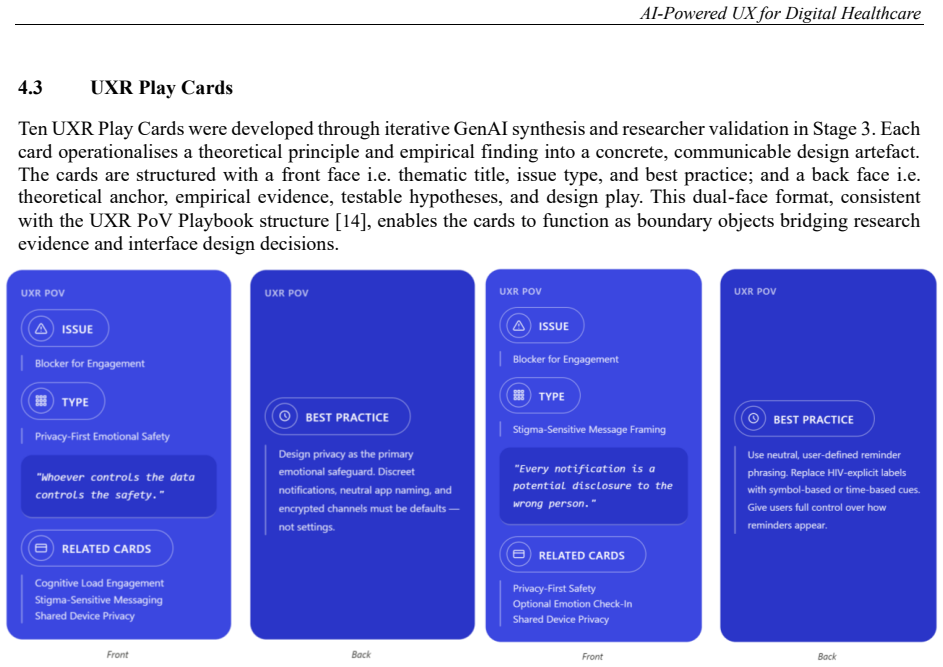
The authors present a Generative AI-augmented UXR methodology grounded in the UXR Point of View Playbook. It follows a four-stage process: AI-supported hypothesis generation, foundational planning, insight generation via Building Blocks, and construction of stakeholder-specific PoV narratives. This yields ten theory-informed UXR Play Cards, each with tasks, AI approaches, and ethical guardrails for research with marginalised populations.
What carries the argument
The four-stage UXR process that uses AI for hypothesis and insight generation while applying ethical guardrails, operationalised into ten UXR Play Cards.
If this is right
- Digital health platforms for HIV care can be designed with lower cognitive load and higher psychological safety for users.
- The framework enables replicable, privacy-centred UXR practices across similar regulatory contexts.
- AI use in research is constrained by built-in filters for accuracy, bias, and stigma awareness.
- Stakeholder-specific narratives improve the translation of empirical findings into design guidance.
Where Pith is reading between the lines
- Applying the Play Cards to other marginalised health contexts, such as mental health or reproductive care, could test their generalisability.
- Independent replication of the workshops with different AI models would reveal how sensitive the outputs are to the choice of generative system.
- The Play Cards might reduce the time and expertise needed for ethical UXR in low-resource settings.
- Future work could measure whether interventions based on these cards show higher uptake or retention rates in real deployments.
Load-bearing premise
The authors' co-design workshops, thematic analysis, and requirements engineering provide sufficient, unbiased grounding for the AI-augmented process and Play Cards without external validation or detailed bias filtering.
What would settle it
An independent team applying the four-stage process to the same population and comparing the resulting Play Cards for consistency and external expert review of their ethical alignment.
Figures
read the original abstract
User Experience Research (UXR) in a legal and regulatory contexts presents unique challenges that require specialised approaches to protect vulnerable populations whilst generating actionable insights. Digital consultation, appointment booking, and medication delivery platforms show promise for extending care access; however, their real-world effectiveness is curtailed by an absence of theoretically grounded user experience research (UXR) methodologies that adequately account for the psychosocial conditions of these populations. This paper introduces a Generative AI-augmented UXR methodology, grounded in the UXR Point of View (PoV) Playbook, to guide the design of psychologically safe, low-cognitive-load digital health interventions for MSM and transgender individuals living with HIV/AIDS in Nigeria. Drawing from empirical research involving co-design workshops, thematic analysis, and requirements engineering, the methodology is operationalised through a four-stage UXR process encompassing AI-supported hypothesis generation, foundational planning, insight generation via Building Blocks, and the construction of stakeholder-specific PoV narratives. This process results in ten theory-informed UXR Play Cards that translate psychological mechanisms and empirical findings into actionable design guidance. Each play contains actionable tasks, AI-augmented approaches, and ethical guardrails tailored for research with marginalised populations. The output is a set of ten theory-informed UXR Play Cards translating psychological insight and empirical evidence into actionable design guidance. The core contribution is a replicable, stigma-aware, and privacy-centred framework for responsible GenAI use in UXR practice, advancing human-centred digital health design for marginalised communities.
Editorial analysis
A structured set of objections, weighed in public.
Referee Report
Summary. The paper claims to introduce a Generative AI-augmented UXR methodology, grounded in the UXR PoV Playbook, for designing psychologically safe digital health interventions for MSM and transgender individuals living with HIV/AIDS in Nigeria. It operationalises this via a four-stage process (AI-supported hypothesis generation, foundational planning, Building Blocks insight generation, and PoV narratives) that produces ten theory-informed UXR Play Cards containing actionable tasks, AI approaches, and ethical guardrails; the core contribution is presented as a replicable, stigma-aware, privacy-centred framework for responsible GenAI use in UXR.
Significance. If the central claim held with external validation, the work could supply a concrete, theory-informed template for applying GenAI to UXR in regulated, high-stigma health domains. The explicit inclusion of ethical guardrails and the translation of psychological mechanisms into Play Cards would be a practical strength for human-centred design in marginalised populations.
major comments (3)
- [Abstract / Methodology] Abstract and methodology description: the claim that the four-stage process and resulting Play Cards constitute a 'replicable' and 'empirically grounded' framework rests entirely on the authors' own co-design workshops, thematic analysis, and requirements engineering; no sample sizes, inter-rater reliability statistics, external validation data, or comparison against existing UXR baselines are reported.
- [Four-stage UXR process] Four-stage process (hypothesis generation through PoV narratives): no explicit protocol is described for filtering GenAI suggestions (e.g., hallucination detection, demographic bias audits, or stakeholder review of AI-generated hypotheses), which directly undermines the 'stigma-aware' and 'privacy-centred' guarantees asserted for the Play Cards.
- [UXR Play Cards] Play Cards section: the ten cards are derived directly from the authors' internal workshops and thematic outputs without independent external benchmarks or falsifiable tests; this circularity means the 'theory-informed' status and actionability claims cannot be assessed independently of the input data.
minor comments (1)
- [Abstract] The abstract repeats the sentence describing the output of the Play Cards; a single concise statement would improve readability.
Simulated Author's Rebuttal
We thank the referee for the constructive and detailed feedback. We address each major comment below, indicating where revisions will strengthen the manuscript and noting areas where the current scope limits what can be provided.
read point-by-point responses
-
Referee: [Abstract / Methodology] Abstract and methodology description: the claim that the four-stage process and resulting Play Cards constitute a 'replicable' and 'empirically grounded' framework rests entirely on the authors' own co-design workshops, thematic analysis, and requirements engineering; no sample sizes, inter-rater reliability statistics, external validation data, or comparison against existing UXR baselines are reported.
Authors: We agree that the abstract and methodology sections lack these quantitative details. The empirical basis is described qualitatively in the full text via the co-design workshops and thematic analysis. We will revise to report available sample sizes, number of participants, and thematic analysis procedures (including any inter-rater processes used). We will also add an explicit limitations subsection clarifying that external validation and baseline comparisons were outside the scope of this initial framework-development study. This addresses the replicability claim by making the empirical foundation more transparent. revision: yes
-
Referee: [Four-stage UXR process] Four-stage process (hypothesis generation through PoV narratives): no explicit protocol is described for filtering GenAI suggestions (e.g., hallucination detection, demographic bias audits, or stakeholder review of AI-generated hypotheses), which directly undermines the 'stigma-aware' and 'privacy-centred' guarantees asserted for the Play Cards.
Authors: This observation is correct; the four-stage description emphasises ethical guardrails within the Play Cards but does not detail the upstream filtering steps applied to GenAI outputs. We will insert a new subsection under the four-stage process that specifies the protocols employed, including hallucination detection methods, demographic bias audits, and multi-stakeholder review procedures. These additions will directly support the stigma-aware and privacy-centred claims. revision: yes
-
Referee: [UXR Play Cards] Play Cards section: the ten cards are derived directly from the authors' internal workshops and thematic outputs without independent external benchmarks or falsifiable tests; this circularity means the 'theory-informed' status and actionability claims cannot be assessed independently of the input data.
Authors: We acknowledge the circularity concern. The cards translate workshop findings through established psychological theories (e.g., stigma and psychological safety frameworks). We will revise the Play Cards section to cite the independent theoretical sources more explicitly for each card and add a forward-looking paragraph on planned falsifiable tests and external benchmarking in future work. The initial derivation necessarily relies on the internal empirical process, which we will state more clearly as a boundary condition of the current contribution. revision: partial
- External validation data and direct comparisons against existing UXR baselines, as these were not part of the study design for this initial framework-development paper.
Circularity Check
No significant circularity; derivation follows standard empirical qualitative research
full rationale
The paper derives its four-stage GenAI-augmented UXR process and ten Play Cards directly from the authors' co-design workshops, thematic analysis, and requirements engineering. This is a conventional case-study approach in which outputs are generated from collected data rather than any self-definitional loop, fitted parameter renamed as prediction, or load-bearing self-citation. No equations, uniqueness theorems, or ansatzes are invoked that reduce the central claim to its inputs by construction. The framework is presented as replicable on the basis of the described empirical grounding, which constitutes independent content rather than tautology. Lack of external validation is a methodological limitation but does not meet the criteria for circularity.
Axiom & Free-Parameter Ledger
axioms (1)
- domain assumption Co-design workshops with MSM and transgender participants living with HIV yield reliable, unbiased insights into psychological mechanisms and design requirements.
invented entities (2)
-
UXR Play Cards
no independent evidence
-
Building Blocks
no independent evidence
Reference graph
Works this paper leans on
-
[1]
[1]. Oluokun, E. O., Adedoyin, F. F., Dogan, H., & Jiang, N. (2024). Digital interventions for managing medication and health care service delivery in West Africa: systematic review. Journal of medical Internet research, 26, e44294. doi: 10.2196/44294 [2]. Federal Republic of Nigeria,
-
[2]
Official Gazette, 101(2). [3]. Schwartz, S. R., Nowak, R. G., Orazulike, I., Keshinro, B., Ake, J., Kennedy, S., ... & Baral, S. D. (2015). The immediate effect of the Same -Sex Marriage Prohibition Act on stigma, discrimination, and engagement on HIV prevention and treatment services in men who have sex with men in Nigeria: analysis of prospective data f...
-
[3]
https://doi.org/10.1145/3772363.3778773
ACM. https://doi.org/10.1145/3772363.3778773 [15]. Dogan, H., Barsoum, R. M., Giff, S., Dix, A., & Churchill, E. (2025). Defining a UX Research Point of View (POV). In CHI EA 2025 - Extended Abstracts of the CHI Conference. ACM. https://doi.org/10.1145/3706599.3706712. [16]. Shneiderman, B. (2022). Human-centered artificial intelligence: Reliable, safe & ...
discussion (0)
Sign in with ORCID, Apple, or X to comment. Anyone can read and Pith papers without signing in.