REVIEW 6 major objections 5 minor 50 references
An End-to-End Real-World Camera Imaging Pipeline
T0 review · 6 major / 5 minor · reviewed 2026-08-12 · deepseek-v4-flash
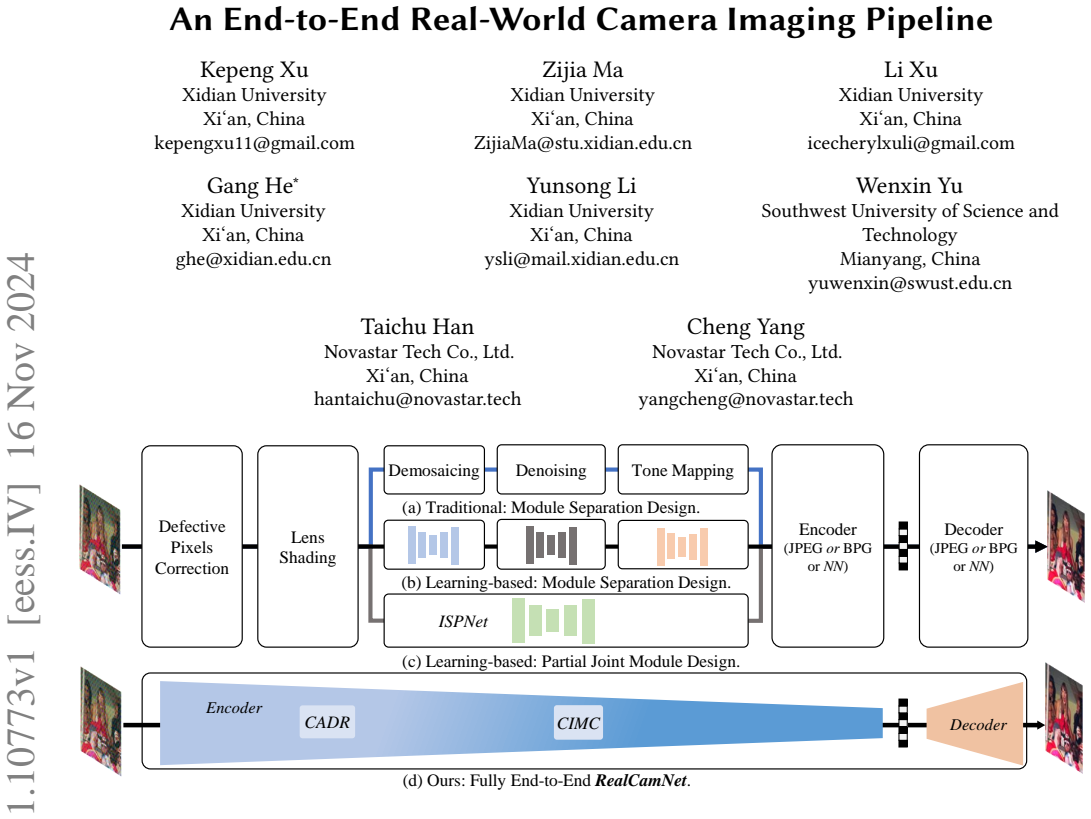
Pith's one-line read RealCamNet is a single jointly trained network that turns RAW sensor data into a compressed RGB image, doing the work of a staged ISP plus codec with better quality and speed.
desk verdict RealCamNet is a sensible end-to-end RAW-to-compressed-RGB design with one genuinely useful trick (absolute-coordinate distortion restoration), but the evaluation does not support 'best rate-distortion' because the only real end-to-end competitor is missing and the baselines are uncontrolled. read the letter →
The pith
A machine-rendered reading of the paper's core claim, the machinery that carries it, and where it could break.
The reading
What carries the argument
The load-bearing mechanism is the pair of modules CADR and CIMC inside the encoder. CADR computes the absolute coordinates $c^a_{i,j}=((i+m)/H,(j+n)/W)$ of every pixel relative to the full RAW image rather than the cropped patch, passes these coordinates through a small convolution-ReLU embedding, and multiplies the embedding into the feature map so the network can learn fixed position-dependent artifacts. CIMC interleaves Channel-Spatial Attention with Local and Global Feature Transformations, both of the form $y=\alpha x+\beta$, using color priors from a downsampled full image and from the local crop; this performs tone mapping, denoising, demosaicing, and compression in one coordinate-independent path. A Color Prior Extraction module supplies the global and local priors, and the decoder uses the same attention building blocks with an entropy-coded latent to reconstruct the RGB image.
What would settle it
Test the same network on a fresh, independently validated RAW-RGB set from a different camera with its own vignetting and shading; if the reported BD-PSNR advantage over the best separated ISP-plus-codec pipeline shrinks to zero or reverses, the central claim fails. A cheaper control is to retrain with relative coordinates in place of absolute coordinates in CADR; if BD-PSNR does not drop, the coordinate-awareness mechanism is not what is carrying the gain.
Extended reading notes
Core claim
On the paper's own terms, the central discovery is that an end-to-end network that jointly optimizes RAW-to-RGB conversion and compression can outperform the current practice of chaining a learned ISP network to a separate codec. The mechanism is a deliberate split: the Coordinate-Aware Distortion Restoration (CADR) module feeds absolute pixel coordinates into the encoder so that fixed position-dependent optical and sensor defects such as vignetting and dark shading can be learned and removed, while the Coordinate-Independent Mapping Compression (CIMC) module combines global and local tone mapping, denoising, demosaicing, and compact latent compression in a single flow. Trained with a rate-distortion loss and evaluated against combinations of three learned ISP baselines with three codecs, RealCamNet is reported to gain 2.26 dB in BD-PSNR over the strongest separated pipeline, to reduce BD-Rate by 9.53 percent, and to decode 1024x1024 images at 16.8 frames per second while using fewer parameters and FLOPs.
Load-bearing premise
The paper's evaluation rests on its privately collected RAW-RGB pairs being correctly aligned and representative; the construction, alignment, and ground-truth generation of this dataset are deferred to an appendix, and if those pairs are biased or misaligned the reported quality gains may not transfer to other cameras or scenes.
Editorial extensions
If this is right
- A camera system built around one trained network could skip the separate ISP and codec stages, saving both computation and tuning effort while improving image quality at a given bitrate.
- The absolute-coordinate embedding gives the network a way to correct lens shading and dark shading without explicit calibration data, because the network can memorize the spatial pattern of the sensor.
- Because global color priors are extracted from the full image, tone mapping can remain consistent across large scenes while local feature transforms refine detail; the paper reports this improves color fidelity as measured by $\Delta E$.
- Joint optimization transfers quality gains across the whole pipeline: the ablation attributes a BD-PSNR improvement of over 3 dB to the full configuration relative to the base network.
- At deployment the model decodes 1024x1024 images at 16.8 fps on a single consumer GPU, suggesting that the end-to-end approach is not only a quality claim but also a practical speed claim.
Reading between the lines
- The paper does not explore it, but the same absolute-coordinate embedding could also handle other fixed-pattern defects such as column noise, stuck pixels, or sensor-specific nonuniformity, effectively teaching the network the camera's spatial fingerprint.
- The paper does not run this control, but a jointly trained version of a separated architecture with the same parameter budget would isolate how much of the reported gain is due to joint optimization itself rather than the CADR and CIMC modules.
- The paper's dataset argument implies that a shared, carefully aligned RAW-RGB benchmark from real cameras could shift how ISP and compression are evaluated together; the authors' dataset, if released, would be the natural starting point.
Signed reviews
Editorial analysis
A structured set of objections, weighed in public.
Referee Report
Summary. The paper presents RealCamNet, an end-to-end neural camera imaging pipeline that maps RAW captures to compressed RGB through a single jointly optimized encoder-entropy-decoder network. The encoder combines a Coordinate-Aware Distortion Restoration (CADR) module that uses absolute pixel coordinates with a Coordinate-Independent Mapping Compression (CIMC) module that performs tone mapping, denoising, demosaicing, and feature compression via channel-spatial attention and global/local feature transforms. The authors introduce a self-collected RAW-RGB dataset of 4507 image pairs and report rate-distortion comparisons against PyNet, LiteISPNet, and MwISPNet combined with VTM, TCM, and MLIC, claiming superior BD-PSNR, BD-MS-SSIM, BD-ΔE, BD-LPIPS, and BD-Rate with lower inference time.
Significance. If the central claim held, the paper would provide evidence that a single jointly optimized network can outperform multi-stage ISP-then-codec pipelines on real-world captures, and the CADR absolute-coordinate embedding is a simple, plausible mechanism for correcting fixed-pattern optical distortions. The manuscript also supplies useful complexity measurements and a receptive-field analysis. However, the evaluation is not presently reproducible or controlled: the companion dataset details and appendix are absent, the closest end-to-end competitor is not compared, and internal numeric inconsistencies prevent the reader from accepting the quantitative claims at face value. With the missing controls supplied, the work could be a useful contribution to learned ISP-plus-compression systems.
major comments (6)
- [§4.3 / Table 1] The text reports improvements of 2.26 dB in PSNR, 0.71 dB in MS-SSIM, 0.01 in LPIPS, 0.9187 in ΔE, and a 9.53% BD-Rate improvement relative to PyNet+VTM, while Table 1 lists BD-PSNR of 2.9603 dB, BD-MSSSIM of 1.6392 dB, BD-LPIPS of -0.0162, BD-ΔE of -1.1709, and BD-Rate of -39.0842%. These are not rounding differences; the paper must reconcile the text and table before the central rate-distortion claim can be evaluated.
- [§2.2 / Table 1 / Fig. 6(a)] RAWtoBit [21], identified in §2.2 as a fully end-to-end camera ISP network, is absent from Table 1 and Fig. 6(a). Because the abstract claims 'best rate-distortion performance,' the closest architectural competitor should be included in the comparison, or the omission should be explicitly justified.
- [§4.3 / Table 1] The manuscript never states whether PyNet, LiteISPNet, and MwISPNet were retrained or fine-tuned on the authors' private RAW-RGB training pairs or used with published weights. If published weights were used, the reported gains conflate end-to-end joint optimization with cross-dataset and sensor mismatch; the baseline training protocol must be documented.
- [§4.1 / §3.4 / §4.8 / Appendix] Dataset construction, alignment, ground-truth generation, and visual results are deferred to an appendix that is absent from arXiv v1. The entire evaluation depends on this private dataset, so without those details—and preferably a public release—the RAW-RGB reference pairs cannot be checked for alignment, tone-curve consistency, or independence from the training targets.
- [Table 2 / §4.4-4.5] The ablation in Table 2 does not isolate end-to-end joint training. It adds CADR, CSA, GFT, and LFT one by one, but never trains the same set of modules with stage-wise ISP and compression losses. Consequently, the claimed 'performance improvements from end-to-end joint optimization' are not supported by the presented experiments; a stage-wise trained control is needed.
- [Table 1 / Fig. 6] No error bars, confidence intervals, or significance tests are reported for any BD metric, despite the metrics being computed on a private 450-image test set. Given the small test set and the sensitivity of BD-PSNR and BD-Rate to the fitted RD curves, the authors should report variance across multiple training runs or bootstrap estimates.
minor comments (5)
- [Table 1] The header contains 'BD-LPPHS,' which should presumably be 'BD-LPIPS.'
- [§4.6] The reference to 'Table6(a)' should be 'Fig. 6(a)' or a properly labeled table.
- [§4.2 / Table 1] The ΔE sign convention should be defined explicitly; in Table 1 negative BD-ΔE is favorable, but §4.3 reports a positive value without a sign convention.
- [§4.2] The conversion of MS-SSIM to −10 log10(1−MS-SSIM) should be clarified: state whether the BD-MSSSIM values in Table 1 are in these converted dB units and identify the anchor curve used for the Bjøntegaard calculation.
- [Fig. 3 and Fig. 6] Several labels in Fig. 3 contain typographical artifacts ('restorate', inconsistent CIMC formatting), and the text in Fig. 6(b) is small and hard to read; higher-quality figures would improve the presentation.
Circularity Check
No significant circularity: the paper's claims are empirical, learned, and not defined in terms of their own outputs.
full rationale
The paper's central claim is that RealCamNet achieves better rate-distortion performance than multi-stage ISP-plus-codec baselines. This is an empirical result obtained by training a neural network with a standard rate-distortion loss and evaluating it on held-out test pairs; no equation defines the output in terms of the target, and no fitted parameter is relabeled as a prediction. The CADR module uses absolute pixel coordinates as an additional input feature, but the distortion restoration is learned from the paired data, not imposed by construction. The CPE module extracts global and local color priors from the input RAW image, which is a legitimate architectural choice rather than a circular derivation. The dataset is self-collected and the appendix describing its construction is missing, and the comparison omits the closest end-to-end competitor RAWtoBit; these are evidence and completeness concerns, not circularity. The duplicate citations of the same ICCV 2021 work as [49] and [50], and of the same CVPR 2020 work as [19] and [20], are citation errors and are not load-bearing self-citations that reduce any argument to an unverified premise. No step in the derivation chain equates an output with an input by definition, so the circularity score is 0.
Assumptions & free parameters
free parameters (4)
- Rate-distortion tradeoff lambda =
[0.1, 0.025, 0.01, 0.005]
- Global prior downsample resolution =
256x256
- Crop size for training and local prior =
256x256
- Batch size =
8
assumptions (4)
- domain assumption Paired RAW-RGB images in the new dataset are correctly aligned and the RGB target is a reliable reference.
- domain assumption Coordinate-dependent distortions (vignetting, dark shading) are fully characterized by the absolute pixel position in the original RAW.
- ad hoc to paper End-to-end joint optimization is the cause of the observed gains.
- domain assumption The learning-based compression baselines (TCM, MLIC) and ISP baselines (PyNet, LiteISP, MwISP) are representative and were configured fairly, even though they are not retrained on the new dataset.
Cite this review
Pith. "Pith review of An End-to-End Real-World Camera Imaging Pipeline." pith.science (2026). https://pith.science/paper/UA2AONIJ
@misc{pith2026241110773,
  author       = {Pith},
  title        = {Pith review of: An End-to-End Real-World Camera Imaging Pipeline},
  year         = {2026},
  howpublished = {\url{https://pith.science/paper/UA2AONIJ}},
  note         = {Machine review of arXiv:2411.10773}
}
read the original abstract
Recent advances in neural camera imaging pipelines have demonstrated notable progress. Nevertheless, the real-world imaging pipeline still faces challenges including the lack of joint optimization in system components, computational redundancies, and optical distortions such as lens shading.In light of this, we propose an end-to-end camera imaging pipeline (RealCamNet) to enhance real-world camera imaging performance. Our methodology diverges from conventional, fragmented multi-stage image signal processing towards end-to-end architecture. This architecture facilitates joint optimization across the full pipeline and the restoration of coordinate-biased distortions. RealCamNet is designed for high-quality conversion from RAW to RGB and compact image compression. Specifically, we deeply analyze coordinate-dependent optical distortions, e.g., vignetting and dark shading, and design a novel Coordinate-Aware Distortion Restoration (CADR) module to restore coordinate-biased distortions. Furthermore, we propose a Coordinate-Independent Mapping Compression (CIMC) module to implement tone mapping and redundant information compression. Existing datasets suffer from misalignment and overly idealized conditions, making them inadequate for training real-world imaging pipelines. Therefore, we collected a real-world imaging dataset. Experiment results show that RealCamNet achieves the best rate-distortion performance with lower inference latency.
Figures


Figures from the paper (5 more)


Reference graph
Works this paper leans on
-
[21]
Wooseok Jeong and Seung-Won Jung. 2022. RAWtoBit: A Fully End-to-end Camera ISP Network. In European Conference on Computer Vision . Springer, 497– 513
work page 2022
-
[1]
Versatile Video Coding (H.266/VVC)
2020. Versatile Video Coding (H.266/VVC). Technical Report. Joint Video Experts Team (JVET). ITU-T Recommendation H.266 and ISO/IEC 23090-3
work page 2020
-
[2]
Theo Adrai, Guy Ohayon, Michael Elad, and Tomer Michaeli. 2024. Deep optimal transport: A practical algorithm for photo-realistic image restoration. Advances in Neural Information Processing Systems 36 (2024)
work page 2024
-
[3]
Johannes Ballé, Valero Laparra, and Eero P Simoncelli. 2016. End-to-end optimized image compression. arXiv preprint arXiv:1611.01704 (2016)
arXiv 2016
-
[4]
Johannes Ballé, David Minnen, Saurabh Singh, Sung Jin Hwang, and Nick John- ston. 2018. Variational image compression with a scale hyperprior.arXiv preprint arXiv:1802.01436 (2018)
arXiv 2018
-
[5]
Jean Bégaint, Fabien Racapé, Simon Feltman, and Akshay Pushparaja. 2020. Com- pressai: a pytorch library and evaluation platform for end-to-end compression research. arXiv preprint arXiv:2011.03029 (2020)
arXiv 2020
-
[6]
Antoni Buades, Bartomeu Coll, and Jean-Michel Morel. 2011. Non-local means denoising. Image Processing On Line 1 (2011), 208–212
work page 2011
-
[7]
Zhengxue Cheng, Heming Sun, Masaru Takeuchi, and Jiro Katto. 2020. Learned image compression with discretized gaussian mixture likelihoods and attention modules. In Proceedings of the IEEE/CVF conference on computer vision and pattern recognition. 7939–7948
work page 2020
Show all 50 references
-
[8]
Commission Internationale de l’Eclairage (CIE). 2004. Colorimetry. CIE 15:2004. Technical Report, 3rd edition
2004
-
[9]
Jonathan W Cunningham, Pulkit Singh, Christopher Reeder, Brian Claggett, Pablo M Marti-Castellote, Emily S Lau, Shaan Khurshid, Puneet Batra, Steven A Lubitz, Mahnaz Maddah, et al. 2024. Natural language processing for adjudication of heart failure in a multicenter clinical tr...
2024
-
[10]
Linhui Dai, Xiaohong Liu, Chengqi Li, and Jun Chen. 2020. Awnet: Attentive wavelet network for image isp. In Computer Vision–ECCV 2020 Workshops: Glas- gow, UK, August 23–28, 2020, Proceedings, Part III 16 . Springer, 185–201
2020
-
[11]
Paul Debevec and Simon Gibson. 2002. A tone mapping algorithm for high contrast images. In 13th eurographics workshop on rendering: Pisa, Italy. Citeseer
2002
-
[12]
Emilien Dupont, Hrushikesh Loya, Milad Alizadeh, Adam Goliński, Yee Whye Teh, and Arnaud Doucet. 2022. Coin++: Neural compression across modalities. arXiv preprint arXiv:2201.12904 (2022)
2022 arXiv
-
[13]
Fredo Durand and Julie Dorsey. 2000. Interactive tone mapping. In Rendering Techniques 2000: Proceedings of the Eurographics Workshop in Brno, Czech Republic, June 26–28, 2000 11 . Springer, 219–230
2000
-
[14]
Burhan Ergen. 2012. Signal and image denoising using wavelet transform . InTech London, UK
2012
-
[15]
Hansen Feng, Lizhi Wang, Yuzhi Wang, and Hua Huang. 2022. Learnability Enhancement for Low-light Raw Denoising: Where Paired Real Data Meets Noise Modeling. In Proceedings of the 30th ACM International Conference on Multimedia (<conf-loc>, <city>Lisboa</city>, <country>Portuga...
2022
-
[16]
Hansen Feng, Lizhi Wang, Yuzhi Wang, and Hua Huang. 2022. Learnability enhancement for low-light raw denoising: Where paired real data meets noise modeling. In Proceedings of the 30th ACM International Conference on Multimedia . 1436–1444
2022
-
[17]
Dailan He, Yaoyan Zheng, Baocheng Sun, Yan Wang, and Hongwei Qin. 2021. Checkerboard context model for efficient learned image compression. In Pro- ceedings of the IEEE/CVF Conference on Computer Vision and Pattern Recognition . 14771–14780
2021
-
[18]
Andrey Ignatov, Radu Timofte, Zhilu Zhang, Ming Liu, Haolin Wang, Wangmeng Zuo, Jiawei Zhang, Ruimao Zhang, Zhanglin Peng, Sijie Ren, et al. 2020. Aim 2020 challenge on learned image signal processing pipeline. InComputer Vision–ECCV 2020 Workshops: Glasgow, UK, August 23–28, ...
2020
-
[20]
Andrey Ignatov, Luc Van Gool, and Radu Timofte. 2020. Replacing mobile camera isp with a single deep learning model. In Proceedings of the IEEE/CVF Conference on Computer Vision and Pattern Recognition Workshops . 536–537
2020
-
[22]
Wei Jiang, Jiayu Yang, Yongqi Zhai, Peirong Ning, Feng Gao, and Ronggang Wang
-
[23]
Xin Jin, Jia-Wen Xiao, Ling-Hao Han, Chunle Guo, Ruixun Zhang, Xialei Liu, and Chongyi Li. 2023. Lighting every darkness in two pairs: A calibration-free pipeline for raw denoising. InProceedings of the IEEE/CVF International Conference on Computer Vision. 13275–13284
2023
-
[24]
Aditya Joshi, Raj Dabre, Diptesh Kanojia, Zhuang Li, Haolan Zhan, Gholamreza Haffari, and Doris Dippold. 2024. Natural language processing for dialects of a language: A survey. arXiv preprint arXiv:2401.05632 (2024)
2024 arXiv
-
[25]
Diederik P Kingma and Jimmy Ba. 2014. Adam: A method for stochastic opti- mization. arXiv preprint arXiv:1412.6980 (2014)
2014 arXiv
-
[26]
Ann-Christin Klemenz, Lasse Albrecht, Mathias Manzke, Antonia Dalmer, Ben- jamin Böttcher, Alexey Surov, Marc-André Weber, and Felix G Meinel. 2024. Improved image quality in CT pulmonary angiography using deep learning- based image reconstruction. Scientific Reports 14, 1 (20...
2024
-
[27]
Rakesh Kumar, Pooja Kumbharkar, Sandeep Vanam, and Sanjeev Sharma. 2024. Medical images classification using deep learning: a survey. Multimedia Tools and Applications 83, 7 (2024), 19683–19728
2024
-
[28]
Marc Lebrun. 2012. An analysis and implementation of the BM3D image denoising method. Image Processing On Line 2 (2012), 175–213
2012
-
[29]
Xin Li, Bahadir Gunturk, and Lei Zhang. 2008. Image demosaicing: A systematic survey. In Visual Communications and Image Processing 2008 , Vol. 6822. SPIE, 489–503
2008
-
[30]
Zhetong Liang, Jianrui Cai, Zisheng Cao, and Lei Zhang. 2021. Cameranet: A two-stage framework for effective camera isp learning. IEEE Transactions on Image Processing 30 (2021), 2248–2262
2021
-
[31]
Jinming Liu, Heming Sun, and Jiro Katto. 2023. Learned Image Compression with Mixed Transformer-CNN Architectures. In Proceedings of the IEEE/CVF Conference on Computer Vision and Pattern Recognition . 1–10
2023
-
[32]
Fabian Mentzer, Eirikur Agustsson, Michael Tschannen, Radu Timofte, and Luc Van Gool. 2018. Conditional probability models for deep image compression. In Proceedings of the IEEE Conference on Computer Vision and Pattern Recognition . 4394–4402
2018
-
[33]
David Minnen, Johannes Ballé, and George D Toderici. 2018. Joint autoregressive and hierarchical priors for learned image compression. Advances in neural information processing systems 31 (2018)
2018
-
[34]
Behnoosh Mohammadzadeh, Jules Françoise, Michèle Gouiffès, and Baptiste Caramiaux. 2024. Studying Collaborative Interactive Machine Teaching in Image Classification. In Proceedings of the 29th International Conference on Intelligent User Interfaces. 195–208
2024
-
[35]
Shiyu Ning, Hongteng Xu, Li Song, Rong Xie, and Wenjun Zhang. 2018. Learning an inverse tone mapping network with a generative adversarial regularizer. In 2018 IEEE International Conference on Acoustics, Speech and Signal Processing (ICASSP). IEEE, 1383–1387
2018
-
[36]
DN Kiran Pandiri, R Murugan, and Tripti Goel. 2024. Smart soil image classifi- cation system using lightweight convolutional neural network. Expert Systems with Applications 238 (2024), 122185
2024
-
[37]
Priyanshu Priya, Mauajama Firdaus, and Asif Ekbal. 2024. Computational Polite- ness in Natural Language Processing: A Survey. Comput. Surveys (2024)
2024
-
[38]
Maik Riechert. [n. d.]. rawpy: RAW image processing for Python. https://pypi. org/project/rawpy/
-
[39]
David Salomon. 2004. Data Compression: The Complete Reference (4 ed.). Springer. Chapter on Image Compression, specifically the section on PSNR
2004
-
[40]
Alireza Shamshiri, Kyeong Rok Ryu, and June Young Park. 2024. Text mining and natural language processing in construction. Automation in Construction 158 (2024), 105200
2024
-
[41]
Ling Shao and Amin Ur Rehman. 2014. Image demosaicing using content and colour-correlation analysis. Signal processing 103 (2014), 84–91
2014
-
[42]
Anthony A Tanbakuchi, Arjen van der Sijde, Bart Dillen, Albert JP Theuwissen, and Wim de Haan. 2003. Adaptive pixel defect correction. In Sensors and Camera Systems for Scientific, Industrial, and Digital Photography Applications IV, Vol. 5017. SPIE, 360–370
2003
-
[43]
Zhou Wang, Eero P Simoncelli, and Alan C Bovik. 2003. Multiscale structural similarity for image quality assessment. The Thrity-Seventh Asilomar Conference on Signals, Systems & Computers, 2003 2 (2003), 1398–1402
2003
-
[44]
Blake Woodworth, Kumar Kshitij Patel, Sebastian Stich, Zhen Dai, Brian Bullins, Brendan Mcmahan, Ohad Shamir, and Nathan Srebro. 2020. Is local SGD better than minibatch SGD?. In International Conference on Machine Learning . PMLR, 10334–10343
2020
-
[45]
Yifan Xu, Mengdan Zhang, Chaoyou Fu, Peixian Chen, Xiaoshan Yang, Ke Li, and Changsheng Xu. 2024. Multi-modal queried object detection in the wild. Advances in Neural Information Processing Systems 36 (2024)
2024
-
[46]
Sai Harsha Yelleni, Deepshikha Kumari, PK Srijith, et al . 2024. Monte Carlo DropBlock for modeling uncertainty in object detection. Pattern Recognition 146 MM ’24, October 28-November 1, 2024, Melbourne, VIC, Australia Kepeng Xu et al. (2024), 110003
2024
-
[47]
Quan Zhang, Xiaoyu Liu, Wei Li, Hanting Chen, Junchao Liu, Jie Hu, Zhiwei Xiong, Chun Yuan, and Yunhe Wang. 2024. Distilling semantic priors from sam to efficient image restoration models. arXiv preprint arXiv:2403.16368 (2024)
2024 arXiv
-
[48]
Richard Zhang, Phillip Isola, Alexei A Efros, Eli Shechtman, and Oliver Wang
-
[50]
Zhilu Zhang, Haolin Wang, Ming Liu, Ruohao Wang, Jiawei Zhang, and Wang- meng Zuo. 2021. Learning raw-to-srgb mappings with inaccurately aligned supervision. In Proceedings of the IEEE/CVF International Conference on Computer Vision. 4348–4358
2021
-
[2018]
In Proceedings of the IEEE Conference on Computer Vision and Pattern Recognition
The Unreasonable Effectiveness of Deep Features as a Perceptual Metric. In Proceedings of the IEEE Conference on Computer Vision and Pattern Recognition . 586–595
-
[2023]
In Proceedings of the 31st ACM International Conference on Multimedia
Mlic: Multi-reference entropy model for learned image compression. In Proceedings of the 31st ACM International Conference on Multimedia . 7618–7627
Reviewed August 12, 2026 · model on record in the stance chip above.
Discussion (0). Continue with ORCID to comment.