REVIEW 3 major objections 5 minor 25 references
Human Gait Symmetry Assessment using a Depth Camera and Mirrors
T0 review · 3 major / 5 minor · reviewed 2026-08-14 · deepseek-v4-flash
Pith's one-line read Gait symmetry can be measured from 3D point clouds captured by one depth camera and two mirrors, without skeletons or gait-cycle detection.
desk verdict A genuinely new feature representation for markerless gait symmetry, with a real reproducibility gap around the cylinder-rotation step and evidence limited to simulated asymmetries. read the letter →
The pith
A machine-rendered reading of the paper's core claim, the machinery that carries it, and where it could break.
The reading
What carries the argument
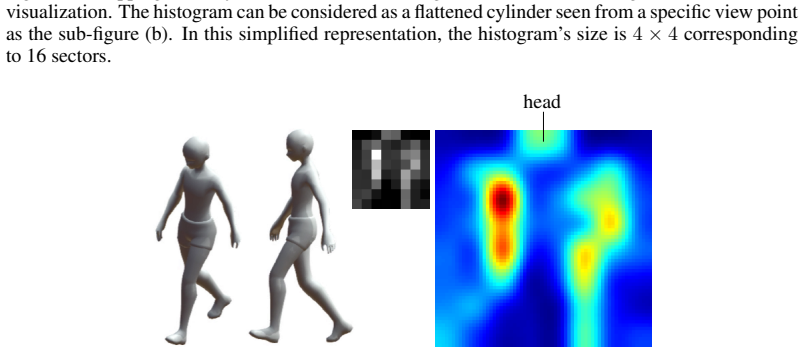
The central object is the cylindrical histogram: each 3D point cloud is binned by height and by azimuth around a vertical axis through the body centroid, giving an h×w matrix in which the body appears as a self-symmetric pattern with the head at the center. The method splits each histogram along its width into two h×(w/2) sub-histograms, one per half-body, and runs a cross-correlation using the L1 distance between the left sequence and the horizontally flipped right sequence over a set of delays ([−50,50]); the minimal mean distance over delays is the symmetry score. This split-and-shift step is what carries the argument, because it turns postural symmetry into a temporal alignment problem that needs neither gait cycles nor skeleton joints.
What would settle it
Take a recorded point-cloud sequence of a known asymmetric walker and rotate the cylinder by small angles (1°, 3°, 5°) about the vertical axis before splitting and cross-correlation; if the normal-versus-asymmetric classification flips at these rotations, the symmetry index is dominated by orientation calibration rather than by gait asymmetry.
Extended reading notes
Core claim
The paper's central claim is that a single ToF depth camera plus two mirrors can produce a whole-body 3D point cloud whose per-frame cylindrical histograms carry enough left–right structure to measure gait symmetry over time. By cutting each histogram into two halves along the angular dimension and cross-correlating the sequence of left halves with the horizontally flipped sequence of right halves, searching over delays from −50 to +50 frames, the method yields a symmetry index without fitting a skeleton or detecting gait cycles. In the reported dataset of nine subjects and nine gait types (normal walking plus 5/10/15 cm sole lifts and 4 kg ankle weights on either side), the mean of ten segment scores separated normal from asymmetric walking, with a full-sequence error of 0.000 on the four held-out subjects under leave-one-out evaluation and 0.037 on all subjects, lower than the HMM skeleton method and the SVM silhouette methods it was compared with.
Load-bearing premise
The method assumes the body coordinate system is aligned well enough that splitting the cylinder's circumference in half separates the left half of the body from the right half; if the walking direction is even a few degrees off, each half mixes both sides and the symmetry score becomes an artefact of calibration rather than a measure of gait symmetry.
Editorial extensions
If this is right
- Because no skeleton or gait-cycle detection is required, the same pipeline should work on pathological gaits where cycle boundaries are ambiguous and self-occlusions deform skeleton fits.
- The reported normal range (mean scores around 0.30–0.44) and higher asymmetric scores support a screening test, provided each person is compared with their own baseline rather than a fixed population threshold.
- In the comparison, full-sequence mean scores beat short segment scores, so longer observation windows give more confident symmetry assessments.
- The resolution experiment indicates that increasing angular resolution slightly hurts accuracy while height resolution above a threshold has little effect, so a moderate histogram size is preferable.
Reading between the lines
- A direct next step would be automatic cylinder alignment: the paper notes a slight rotation 'might be necessary' but never specifies how to find it, so optimizing the rotation to maximize left–right correlation is a natural, testable extension.
- The half-body split is not specific to legs: restricting the cylindrical histogram to upper-body height ranges could quantify shoulder or trunk asymmetry with the same machinery.
- Because the protocol uses a treadmill at 1.28 km/h and a fixed camera-and-mirror geometry, translating the method to a home setting would require either a controlled walking spot or a way to handle variable walking speeds.
- The scores tend to increase with sole thickness (e.g., 15 cm vs 10 cm) for most subjects, suggesting the index may quantify asymmetry severity rather than only classify it; that could be checked against clinically measured leg-length discrepancy.
Signed reviews
Editorial analysis
A structured set of objections, weighed in public.
Referee Report
Summary. The paper proposes a method for assessing human gait symmetry from 3D point clouds acquired with a single Time-of-Flight depth camera and two mirrors. The method reconstructs a sequence of whole-body point clouds, computes a cylindrical histogram for each frame, splits the histogram into left and right half-body sub-histograms, and applies a time-shifted cross-correlation between the two sub-sequences to produce a symmetry index. Experiments on 9 subjects performing normal walking and 8 simulated asymmetric gaits (sole padding of 5/10/15 cm and a 4 kg ankle weight) show that the index separates normal from asymmetric gaits, with reported equal error rates (EER) of 0.000 for full-sequence classification in the held-out test set. The paper also compares the method to skeleton-based HMM and silhouette-based SVM approaches, reporting lower EERs for the proposed method.
Significance. If the proposed index is robust and the reported results are reproducible, the method offers a low-cost, markerless gait symmetry assessment that avoids skeleton extraction and gait cycle detection, which are known difficulties for pathological gaits. The use of mirrors with a single depth camera to obtain full-body point clouds without multi-camera synchronization is an elegant idea, and the authors share their dataset, contributing to reproducibility. The reported improvements over skeleton- and silhouette-based baselines are promising and clinically relevant for monitoring recovery after surgery or stroke. However, the small sample size (9 subjects) and the absence of an external gold-standard symmetry measure temper the strength of the clinical claim; the current experiments demonstrate binary separation between normal and simulated asymmetric conditions rather than validation of a continuous symmetry index.
major comments (3)
- [Section 2.2.2, Eq. (1)] The paper states that 'a slight rotation of the cylinder might be necessary' to center the body in the cylindrical histogram, but it never specifies how this rotation is determined, whether it is per-subject or per-sequence, and what anatomical criterion is used. Because the symmetry index is computed by splitting the cylindrical histogram into left and right halves, any misalignment of the angular origin with the body's mid-sagittal plane mixes both body sides in each sub-histogram, making the index an artifact of calibration rather than a pure measure of gait symmetry. As described, the low EERs in Table 1 could reflect per-subject alignment tuning rather than the intrinsic discriminative power of the method. The authors must describe the rotation procedure, its parameters, and its sensitivity to be reproducible.
- [Section 3.4, Table 1] The decision rule for 'our method' is not specified. The paper does not state what score is used to construct the ROC curves for the 'short-term' and 'full sequence' evaluations. In particular, it is unclear whether the short-term EER is computed by treating each of the 10 segment-level symmetry indices as independent samples (which would inflate the effective sample size and ignore within-subject correlation) or by some other aggregation, and whether the full-sequence EER is obtained by thresholding the per-subject mean index. Without a precise definition of the score and threshold-selection rule, the reported error rates in Table 1 cannot be reproduced or meaningfully compared with the baselines.
- [Section 3.3, Fig. 10] The proposed decision procedure based on a 'normal range' of mean symmetry indices is defined using the same data that is later evaluated, and no cross-validation of the threshold is described. The paper acknowledges that an asymmetric gait of one subject can fall inside the normal range of another, but it does not quantify the reliability of the within-subject comparison or provide confidence intervals for the reported separation. A proper leave-one-out or cross-validated threshold-selection procedure is needed to support the claim that the system reliably distinguishes normal from asymmetric gaits.
minor comments (5)
- [Eq. (1)] The definition of ⃗v(i) as 'a 2D vector computed from the y-axis to the point P(i)' is ambiguous; the vector should be defined explicitly in terms of the projected coordinates in the x-z plane.
- [Section 3.2] The sensitivity analysis in Section 3.5 only considers the histogram size; the segment length (120 frames) and the delay range [−50, 50] are fixed without any discussion of their effect on the results.
- [Fig. 11] The boxplot figure is difficult to read because the vertical axis is truncated to the range 0.4–1.0 and the horizontal labels are crowded; a larger figure or a table of summary statistics would improve clarity.
- [Section 3.1] The paper does not report demographic details of the 9 volunteers (sex, age, height, weight), which limits the generalizability of the findings and would be expected for a clinical assessment study.
- [References] Reference [21] appears to be a web resource without a clear citation format and should be formatted consistently with the other references.
Circularity Check
No significant circularity: the symmetry index is computed from raw point-cloud histograms and validated against externally defined experimental gait labels.
full rationale
The paper's central claim is that a cylindrical-histogram cross-correlation score, computed directly from ToF depth point clouds, separates normal from experimentally induced asymmetric gaits. The derivation chain is self-contained: the body coordinate system comes from treadmill markers, the cylindrical histogram is a direct geometric encoding of the point cloud, and the symmetry index is defined by cross-correlating left/right half-histograms. No fitted parameter is later renamed as a prediction; the only tuned quantities are histogram size, segment length, Lag range, and the L1 norm, and these are evaluated by AUC/EER against independent experimental labels (sole thickness and ankle weight). The paper does rely on the authors' earlier work for 3D point-cloud reconstruction from mirrors ([11], [16]) and for the gait dataset ([12]), but those are enabling resources, not restatements of the symmetry-assessment result, and the comparison against HMM and SVM baselines provides external grounding. The concern about an unspecified 'slight rotation of the cylinder' affects calibration robustness and reproducibility, not circularity, since the rotation is not fit to the symmetry labels. Therefore no prediction reduces by construction to its inputs, and no load-bearing argument reduces to a self-citation chain.
Assumptions & free parameters
free parameters (5)
- Cylindrical histogram size (h x w) =
16 x 16
- Segment length for cross-correlation =
120 frames (approx 9 s)
- Shifting delay range D =
[-50, 50]
- Distance metric for Diff =
L1 norm
- Classification threshold for Table 1 errors =
Not disclosed
assumptions (7)
- domain assumption The two-mirror ToF camera setup produces an accurate full-body 3D point cloud after removing unreliable points.
- domain assumption The body coordinate system is calibrated correctly: y normal to treadmill, x along walking direction, z left-right.
- domain assumption The person is centered in the cylinder and the cylinder split at half-width separates true anatomical left/right halves.
- domain assumption Walking on a treadmill at 1.28 km/h produces a periodic motion where the cross-correlation minimum over delays in [-50,50] captures the true phase lag between sides.
- domain assumption Simulated asymmetries (sole thickness, ankle weight) monotonically increase true gait asymmetry.
- domain assumption Cross-correlation with L1 distance is a valid measure of symmetry between two body-half distributions.
- standard math The cross-correlation formula in eq. (2) and L1 distance are standard mathematical tools.
Cite this review
Pith. "Pith review of Human Gait Symmetry Assessment using a Depth Camera and Mirrors." pith.science (2026). https://pith.science/paper/UA2G3DYB
@misc{pith2026190807422,
  author       = {Pith},
  title        = {Pith review of: Human Gait Symmetry Assessment using a Depth Camera and Mirrors},
  year         = {2026},
  howpublished = {\url{https://pith.science/paper/UA2G3DYB}},
  note         = {Machine review of arXiv:1908.07422}
}
read the original abstract
This paper proposes a reliable approach for human gait symmetry assessment using a depth camera and two mirrors. The input of our system is a sequence of 3D point clouds which are formed from a setup including a Time-of-Flight (ToF) depth camera and two mirrors. A cylindrical histogram is estimated for describing the posture in each point cloud. The sequence of such histograms is then separated into two sequences of sub-histograms representing two half-bodies. A cross-correlation technique is finally applied to provide values describing gait symmetry indices. The evaluation was performed on 9 different gait types to demonstrate the ability of our approach in assessing gait symmetry. A comparison between our system and related methods, that employ different input data types, is also provided.
Figures


Figures from the paper (8 more)




Reference graph
Works this paper leans on
-
[1]
E. Auvinet, J. Meunier, and F. Multon. Multiple depth cameras calibration and body vol- ume reconstruction for gait analysis. In Information Science, Signal Processing and their Applications (ISSPA), 2012 11th International Conference on , pp. 478–483, July 2012. doi: 10.1109/ISSPA.2012.6310598. 11 This is a pre-print of an article published in Computers ...
arXiv 2012
-
[2]
New lower-limb gait asymmetry indices based on a depth camera
Edouard Auvinet, Franck Multon, and Jean Meunier. New lower-limb gait asymmetry indices based on a depth camera. Sensors, 15(3):4605–4623, 2015. ISSN 1424-8220. doi: 10.3390/ s150304605. URL http://www.mdpi.com/1424-8220/15/3/4605
work page 2015
-
[3]
Bauckhage, J
C. Bauckhage, J. K. Tsotsos, and F. E. Bunn. Detecting abnormal gait. In The 2nd Canadian Conference on Computer and Robot Vision (CRV’05), pp. 282–288, May 2005. doi: 10.1109/ CRV .2005.32
2005
-
[4]
Automatic detection of abnormal gait
Christian Bauckhage, John K Tsotsos, and Frank E Bunn. Automatic detection of abnormal gait. Image and Vision Computing, 27(1):108–115, 2009
2009
-
[5]
A. Amini Maghsoud Bigy, K. Banitsas, A. Badii, and J. Cosmas. Recognition of postures and freezing of gait in parkinson’s disease patients using microsoft kinect sensor. In 2015 7th International IEEE/EMBS Conference on Neural Engineering (NER) , pp. 731–734, April
work page 2015
-
[6]
Hierarchical motion history images for recognizing human motion
James W Davis. Hierarchical motion history images for recognizing human motion. In Detec- tion and Recognition of Events in Video, 2001. Proceedings. IEEE Workshop on , pp. 39–46. IEEE, 2001
work page 2001
-
[7]
Individual recognition using gait energy image
Ju Han and Bir Bhanu. Individual recognition using gait energy image. IEEE Transactions on Pattern Analysis and Machine Intelligence , 28(2):316–322, Feb 2006. ISSN 0162-8828. doi: 10.1109/TPAMI.2006.38
-
[8]
Real Time Gait Recognition System Based on Kinect Skeleton Feature, pp
Shuming Jiang, Yufei Wang, Yuanyuan Zhang, and Jiande Sun. Real Time Gait Recognition System Based on Kinect Skeleton Feature, pp. 46–57. Springer International Publishing, Cham,
Show all 25 references
-
[9]
Class energy image analysis for video sensor-based gait recognition: A review
Zhuowen Lv, Xianglei Xing, Kejun Wang, and Donghai Guan. Class energy image analysis for video sensor-based gait recognition: A review. Sensors, 15(1):932–964, 2015. ISSN 1424-
2015
-
[10]
ISBN 978-3-319-16628-5
-
[11]
T. N. Nguyen, H. H. Huynh, and J. Meunier. 3d reconstruction with time-of-flight depth camera and multiple mirrors. IEEE Access , 6:38106–38114, 2018. ISSN 2169-3536. doi: 10.1109/ACCESS.2018.2854262
2018
-
[12]
Walking gait dataset: point clouds, skeletons and silhouettes
Trong-Nguyen Nguyen and Jean Meunier. Walking gait dataset: point clouds, skeletons and silhouettes. Technical Report 1379, DIRO, University of Montreal, April 2018. URL http: //www.iro.umontreal.ca/˜labimage/GaitDataset/dataset.pdf
2018
-
[13]
T. N. Nguyen, H. H. Huynh, and J. Meunier. Assessment of gait normality using a depth camera and mirrors. In 2018 IEEE EMBS International Conference on Biomedical Health Informatics (BHI), pp. 37–41, Las Vegas, NV , USA, March 2018. doi: 10.1109/BHI.2018.8333364
2018
-
[14]
Skeleton-based abnormal gait detection
Trong-Nguyen Nguyen, Huu-Hung Huynh, and Jean Meunier. Skeleton-based abnormal gait detection. Sensors, 16(11):1792, 2016. ISSN 1424-8220. doi: 10.3390/s16111792. URL http://www.mdpi.com/1424-8220/16/11/1792
2016 doi
-
[15]
Matching-based depth camera and mirrors for 3d reconstruction
Trong-Nguyen Nguyen, Huu-Hung Huynh, and Jean Meunier. Matching-based depth camera and mirrors for 3d reconstruction. In Three-Dimensional Imaging, Visualization, and Display 2018, SPIE conference on, Orlando, FL, USA, April 2018. SPIE. accepted
2018
-
[16]
Extracting silhouette-based characteristics for human gait analysis using one camera
Trong-Nguyen Nguyen, Huu-Hung Huynh, and Jean Meunier. Extracting silhouette-based characteristics for human gait analysis using one camera. In Proceedings of the Fifth Sym- posium on Information and Communication Technology , SoICT ’14, pp. 171–177, New York, NY , USA, 2014. ...
2014
-
[17]
West, Shaw Bronner, and Jack Adam Noah
Alexandra Pfister, Alexandre M. West, Shaw Bronner, and Jack Adam Noah. Comparative abilities of microsoft kinect and vicon 3d motion capture for gait analysis. Journal of Medical Engineering & Technology, 38(5):274–280, 2014. doi: 10.3109/03091902.2014.909540. 12 This is a pre...
2014
-
[18]
Shotton, A
J. Shotton, A. Fitzgibbon, M. Cook, T. Sharp, M. Finocchio, R. Moore, A. Kipman, and A. Blake. Real-time human pose recognition in parts from single depth images. In CVPR 2011, pp. 1297–1304, June 2011. doi: 10.1109/CVPR.2011.5995316
2011
-
[19]
Using tof camera and two mirrors for 3d reconstruction of dynamic objects
Trong-Nguyen Nguyen, Huu-Hung Huynh, and Jean Meunier. Using tof camera and two mirrors for 3d reconstruction of dynamic objects. Technical Report 1380, DIRO, Univer- sity of Montreal, April 2018. URL http://www.iro.umontreal.ca/˜labimage/ GaitDataset/reconstruct3D.pdf
2018
-
[20]
Spectral analysis of signals, volume 452
Petre Stoica and Randolph L Moses. Spectral analysis of signals, volume 452. Pearson Prentice Hall Upper Saddle River, NJ, 2005
2005
-
[21]
Neurologic exam
University of Utah and University of Nebraska. Neurologic exam. http://library. med.utah.edu/neurologicexam, 2016. Accessed: 2018-22-04
2016
-
[22]
Shotton, R
J. Shotton, R. Girshick, A. Fitzgibbon, T. Sharp, M. Cook, M. Finocchio, R. Moore, P. Kohli, A. Criminisi, A. Kipman, and A. Blake. Efficient human pose estimation from single depth images. IEEE Transactions on Pattern Analysis and Machine Intelligence, 35(12):2821–2840, Dec 20...
2013 doi
-
[25]
Comparison of Kinect V1 and V2 Depth Images in Terms of Accuracy and Precision , pp
Oliver Wasenm ¨uller and Didier Stricker. Comparison of Kinect V1 and V2 Depth Images in Terms of Accuracy and Precision , pp. 34–45. Springer International Publishing, Cham, 2017. ISBN 978-3-319-54427-4. 13
2017
-
[2015]
doi: 10.1109/NER.2015.7146727
2015
-
[8220]
URL http://www.mdpi.com/1424-8220/15/1/ 932
doi: 10.3390/s150100932. URL http://www.mdpi.com/1424-8220/15/1/ 932
Reviewed August 14, 2026 · model on record in the stance chip above.
Discussion (0). Continue with ORCID to comment.