REVIEW 3 major objections 5 minor 65 references
Gravitational waves and cosmic boundary
T0 review · 3 major / 5 minor · reviewed 2026-08-12 · deepseek-v4-flash
Pith's one-line read The paper argues that a reflective cosmic boundary at redshift z>15 would be detectable through coincident gravitational-wave events from the same massive black hole, and that the TianQin+LISA network could measure the needed parameters.
desk verdict Genuinely new observable for a cosmic boundary, but the full-reflectivity assumption is unjustified and the practical rate is unquantified; worth refereeing. read the letter →
The pith
A machine-rendered reading of the paper's core claim, the machinery that carries it, and where it could break.
The reading
What carries the argument
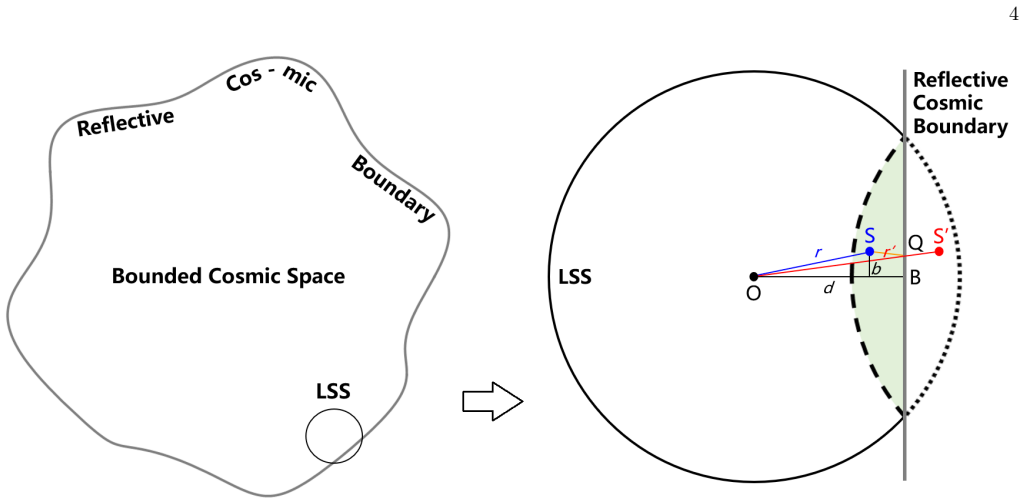
The central object is the mirror image S' of the astrophysical source S across the boundary. In comoving coordinates, S' is the virtual source whose light-cone path S'O intersects the boundary at Q, and the geometry is fixed by the boundary distance d, the source distance r, and the offset b. The key relations are the redshift connection between the image redshift $z_1$, the boundary redshift $z_q$, and the direct-event redshift $z_2$, together with the angular separation $\angle SOS'$, which the authors compute as functions of $\angle S'OB$ and $z_q$. These relations turn the detection of a cosmic boundary into a parameter-estimation problem for coincident gravitational-wave events.
What would settle it
If a full-sky survey with LISA and TianQin detects no pair of massive-black-hole mergers with angular separation under 0.5 degrees, matching the required mass hierarchy, spin-flip relation, and consistent distance, then the claim that a fully reflective cosmic boundary at $z>15$ is detectable this way would be contradicted.
Extended reading notes
Core claim
The central claim is that a fully reflective cosmic boundary (CB) at redshift $z_q>15$ can be found by looking for pairs of gravitational-wave signals produced by the same massive black hole at two different merger times. In the flat FLRW metric with a plane mirror at fixed comoving coordinates, the earlier signal reaches the observer after reflection from the CB, arriving as an "image event" S' alongside the later direct event S(t2). The geometry implies the two events are separated by less than about 0.5 degrees when $z_q>15$, and the inherited component of S(t2) has a definite mass, spin (with sign flip for the in-plane component), and distance. Using the IMRPhenomXHM waveform and the projected sensitivities of TianQin and LISA, the authors show that for black holes in the range $10^3$--$10^6 M_\odot$ the mass and luminosity distance can be measured to better than 10% and the dimensionless spin to better than 0.1, even at $z=20$.
Load-bearing premise
The boundary must be fully reflective for both light and gravitational waves and must sit at fixed comoving coordinates, so that the reflected signal is a faithful, time-delayed copy of the original event.
Editorial extensions
If this is right
- A single detected pair of coincident events would provide strong evidence for the existence of a reflective cosmic boundary.
- Multiple pairs with the same inferred boundary location would confirm the boundary and fix its orientation in the sky.
- The mass range $10^3$--$10^6 M_\odot$ makes a large variety of massive-black-hole binaries suitable sources for the search.
- Combined with the null matched-circle searches in the CMB, a positive detection would distinguish a bounded space from a multi-connected one.
- A null result would constrain or exclude the fully reflective, fixed-comoving-boundary scenario within the observable horizon.
Reading between the lines
- The same coincident-pair logic could be reused with any future detector with greater reach, extending the boundary redshift beyond 20.
- A null result would not rule out a partially absorbing or slowly evolving boundary, but it would set a lower bound on how reflective any boundary inside the last-scattering surface can be.
- Searching for "twin" events with opposite in-plane spin components may be a model-agnostic way to spot boundary reflections in the data.
- The paper's geometric relations imply that the angular separation shrinks as $z_q$ grows, so precise sky localization becomes the limiting factor for probing deeper boundaries.
Editorial analysis
A structured set of objections, weighed in public.
Referee Report
Summary. The paper studies whether future space-based gravitational-wave detectors could detect a reflective cosmic boundary (CB) at redshift z>15. The proposed signature is a coincident pair of GW events from the same massive black hole (MBH): an early merger signal reflected by the boundary (the image event, S') and a later direct merger signal from the same source (S(t2)). Using TianQin and LISA sensitivity curves with the IMRPhenomXHM waveform, the paper reports that for a CB at z_q>15 the angular separation between coincident events is below about 0.5 degrees, and that for a fiducial source at z=20 the mass, spin, and luminosity distance of the second event can be measured with fractional precision better than 10% (and spin uncertainty below 0.1) for MBH masses roughly in the range 10^3--10^6 M_sun. The paper further argues that a TianQin+LISA network substantially improves sky localization and that confirming the CB requires multiple coincident pairs. The authors explicitly acknowledge that the event-rate assessment is beyond the scope of the paper and that the chance of detecting such pairs is presumably low.
Significance. If the central conditional claim holds, the paper identifies a genuinely new observational probe of cosmic global structure: a reflective boundary at z>15 could in principle be detected through GW image pairs, a signal that is inaccessible to electromagnetic surveys. The treatment is not circular: the CB is assumed, and the authors compute whether existing and planned detectors could see the resulting image events, without fitting parameters to produce the thresholds. The paper is honest about several limitations, including the need for multiple pairs and the lack of an event-rate estimate. However, the practical significance is currently limited by an unsupported assumption about the CB's reflectivity and by the absence of any estimate of how often the required coincident pairs occur. The calculations themselves are standard Fisher/sensitivity estimates and are reproducible from public detector sensitivity curves and the stated waveform model.
major comments (3)
- [Section II] The inference from the absence of a CMB dark patch to the assumption that the CB is 'fully reflective for both light and GWs' is not valid. A partially absorbing boundary would also suppress the dark-patch contrast, and for z_q>15 the missing patch on the last-scattering surface is a small cap whose angular size shrinks as the boundary approaches the LSS; Planck limits on localized temperature decrements therefore leave substantial absorption allowed. This matters because the entire detection scheme in Section III assumes the image event is a faithful copy of the first merger, and all SNR and parameter-precision statements (Figs. 3, 5, 6; SNR=8 threshold) scale with the square root of the GW reflection coefficient. If the GW reflectivity were 0.1, the image-event SNR would drop by roughly a factor of 3 and the 10% mass/distance precision claims would fail. The paper should either derive a lower bound on the required reflectivity from the detection threshold together with CMB constraints, or present all detectability and precision results as functions of the reflection coefficient and state the minimum reflectivity needed for each claim.
- [Section III.C and Section IV] The paper states that 'a reliable assessment of the chance to detect multiple pairs of coincident events is difficult and is beyond the scope of this paper.' This is a load-bearing limitation because the abstract's fourth conclusion says that the possibility to prove or disprove the CB 'largely depends on how likely one can detect multiple pairs of coincident gravitational wave events.' Without an event-rate estimate (merger rate density at z~20, the fraction of MBHs that undergo a second merger within the time delay set by the reflected path, and the fraction satisfying the sub-degree angular coincidence), the paper cannot quantify whether the proposed scheme is merely an existence proof or a realistic observational program. The authors should either provide an order-of-magnitude event-rate estimate or explicitly reframe the central claim as: if a coincident pair is detected, then the following parameter measurements and consistency checks become possible.
- [Section III.A and Figs. 5-6] The precision forecasts are computed for a single fiducial source configuration (m1 = 1e5 M_sun, q = 1.2, iota = 0.9 rad, aligned spins s1 = 0.4 and s2 = 0.2, Tobs = 1 month) and, for the precision plots, a single redshift z = 20. The paper acknowledges in Section III.C that 'the quantitative result can become different if it is located at other redshifts' and in the caption of Fig. 6 that 'the exact shape of the contours significantly depends on the choice of the source parameters,' but the headline claims that 'a large variety of black holes ... can be used' and that mass, spin, and distance are measurable to better than 10% are based on this one configuration. The authors should demonstrate robustness over inclination, sky position, spin orientation, mass ratio, and redshift, or at least quantify the fraction of the relevant parameter space for which the 10% precision and 0.1 spin-precision requirements are satisfied.
minor comments (5)
- [Section II, Eq. (1)] Equation (1) defines the comoving distance as D_z = ∫_0^z dz'/H(z'), which is dimensionally inconsistent unless the speed of light and the H0 factor are absorbed into the definition of H(z); please specify the units or write D_z = c/H0 ∫ ... as is standard.
- [Abstract and Section I] The notation 'O(10^3 ∼ 10^6) M_sun' is unconventional; use '10^3--10^6 M_sun' or 'roughly 10^3 to 10^6 M_sun'.
- [Section I] The phrase 'they all give raise to a multi-connected universe' should be 'they all give rise to a multi-connected universe.'
- [Fig. 5 caption] The caption contains the typo 'buttom' instead of 'bottom.'
- [Section III.C] The label 'J0806'' in Fig. 6 is not defined in the text or caption; please explain what this source direction refers to.
Circularity Check
No significant circularity: the paper's detection claim is a conditional calculation, and its self-citations are explicitly non-load-bearing.
full rationale
Despite the self-citations in Section II ([55,56] and [36]), the paper's central calculation is conditional rather than circular. The detection scheme assumes the CB is fully reflective and comovingly fixed, then derives geometric and SNR consequences using standard FLRW cosmology and external detector noise curves. No parameter is fitted to the target claim; the z2 and angular-separation relations in Fig. 4 follow from the stated geometry, and the precision forecasts in Figs. 5 and 6 are Fisher-matrix projections using the IMRPhenomXHM waveform and published TianQin/LISA sensitivity curves. The conclusion 'if a reflective CB exists, then it could be detected' is a conditional statement, not a reduction of the output to the input. The CMB dark-patch argument is an assumption about the CB's reflectivity, and the paper explicitly labels it as such ('we assume that the CB is fully reflective for both light and GWs'); while the inference from the absence of a dark patch to full reflectivity is physically debatable, that is a modeling assumption and a correctness concern, not circularity. The emergent gravity motivation is explicitly non-load-bearing ('the above motivation is helpful but is not crucial to the experimental search of the CB'), so the self-citations do not carry the derivation. The paper also honestly states the key restriction that confirmation requires multiple pairs of coincident events, further showing that the claimed detection capability is not forced by the inputs.
Assumptions & free parameters
free parameters (4)
- Fiducial MBH binary parameters =
m1=1e5 Msun, q=1.2, inclination=0.9 rad, s1=0.4, s2=0.2, theta_L=phi_L=0.6 rad, Tobs=1 month
- Detection SNR threshold =
SNR = 8
- Image event redshift =
z1 = 20
- Cosmic boundary redshift z_q =
scanned over 10 to 20
assumptions (5)
- domain assumption The interior of the bounded cosmic space is described by the flat FLRW metric, ds^2 = -dt^2 + a(t)^2 (dr^2 + r^2 dOmega^2), with origin at the observer.
- ad hoc to paper The portion of the cosmic boundary inside the last-scattering surface is flat, fully reflective for light and gravitational waves, and has fixed comoving coordinates.
- domain assumption A massive black hole of non-primordial origin can produce two detectable merger events whose reflected earlier signal and direct later signal arrive at the detector concurrently.
- domain assumption IMRPhenomXHM accurately models the gravitational waveform for the mass, mass-ratio, spin, and redshift range considered.
- ad hoc to paper The hidden fluid / dry vacuum emergent gravity picture supports the physical possibility of a bounded cosmic space.
invented entities (2)
-
Cosmic Boundary (CB)
-
Hidden fluid / dry vacuum
Cite this review
Pith. "Pith review of Gravitational waves and cosmic boundary." pith.science (2026). https://pith.science/paper/UB5WOZFE
@misc{pith2026241117177,
  author       = {Pith},
  title        = {Pith review of: Gravitational waves and cosmic boundary},
  year         = {2026},
  howpublished = {\url{https://pith.science/paper/UB5WOZFE}},
  note         = {Machine review of arXiv:2411.17177}
}
abstract
Space-based gravitational wave detectors have the capability to detect signals from very high redshifts. It is interesting to know if such capability can be used to study the global structure of the cosmic space. In this paper, we focus on one particular question: if there exists a reflective cosmic boundary at the high redshift ($z>15$), is it possible to find it? We find that, with the current level of technology: 1) gravitational waves appear to be the only means with which that signatures from the cosmic boundary can possibly be detected; 2) a large variety of black holes, with masses roughly in the range $(10^3\sim 10^6) {\rm~M_\odot}$, can be used for the task; 3) in the presumably rare but physically possible case that two merger events from the growth history of a massive black hole are detected coincidentally, a detector network like TianQin+LISA is essential in help improving the chance to determine the orientation of the cosmic boundary; 4) the possibility to prove or disprove the presence of the cosmic boundary largely depends on how likely one can detect multiple pairs of coincident gravitational wave events.
Figures


Figures from the paper (3 more)


Reference graph
Works this paper leans on
-
[1]
N. Aghanim et al. (Planck), Astron. Astrophys. 641, A6 (2020), [Erratum: Astron.Astrophys. 652, C4 (2021)], arXiv:1807.06209 [astro-ph.CO]
arXiv 2020
- [2]
-
[3]
J. R. Eskilt et al. (COMPACT), JCAP 03, 036 (2024), arXiv:2306.17112 [astro-ph.CO]
arXiv 2024
-
[4]
M. Lachieze-Rey and J.-P. Luminet, Phys. Rept. 254, 135 (1995), arXiv:gr-qc/9605010
work page Pith review arXiv 1995
-
[5]
J. J. Levin, Phys. Rept. 365, 251 (2002), arXiv:gr-qc/0108043
work page Pith review arXiv 2002
-
[6]
N. J. Cornish, D. N. Spergel, and G. D. Starkman, Class. Quant. Grav. 15, 2657 (1998), arXiv:astro-ph/9801212
arXiv 1998
-
[7]
A. de Oliveira-Costa, M. Tegmark, M. Zaldarriaga, and A. Hamilton, Phys. Rev. D 69, 063516 (2004), arXiv:astro- ph/0307282
arXiv 2004
- [8]
Show all 65 references
-
[9]
Shapiro Key, N
J. Shapiro Key, N. J. Cornish, D. N. Spergel, and G. D. Starkman, Phys. Rev. D75, 084034 (2007), arXiv:astro-ph/0604616
2007 arXiv
-
[10]
B. Mota, M. J. Reboucas, and R. Tavakol, Phys. Rev. D 81, 103516 (2010), arXiv:1002.0834 [astro-ph.CO]
2010 arXiv
-
[11]
Bielewicz and A
P. Bielewicz and A. J. Banday, Mon. Not. Roy. Astron. Soc. 412, 2104 (2011), arXiv:1012.3549 [astro-ph.CO]
2011 arXiv
-
[12]
Bielewicz, A
P. Bielewicz, A. J. Banday, and K. M. Gorski, Mon. Not. Roy. Astron. Soc. 421, 1064 (2012), arXiv:1111.6046 [astro- ph.CO]. 10 FIG. 6. The expected precision of angular resolution for a source at z = 20 with TianQin, LISA and TianQin+LISA. J0806’ indicates the opposite directi...
2012 arXiv
-
[13]
P. M. Vaudrevange, G. D. Starkman, N. J. Cornish, and D. N. Spergel, Phys. Rev. D 86, 083526 (2012), arXiv:1206.2939 [astro-ph.CO]
2012 arXiv
-
[14]
Aurich and S
R. Aurich and S. Lustig, Mon. Not. Roy. Astron. Soc. 433, 2517 (2013), arXiv:1303.4226 [astro-ph.CO]
2013 arXiv
-
[15]
P. A. R. Ade et al. (Planck), Astron. Astrophys. 571, A26 (2014), arXiv:1303.5086 [astro-ph.CO]
2014 arXiv
-
[16]
P. A. R. Ade et al. (Planck), Astron. Astrophys. 594, A18 (2016), arXiv:1502.01593 [astro-ph.CO]
2016 arXiv
-
[17]
D. P. Mihaylov et al. (COMPACT), JCAP 01, 030 (2023), [Erratum: JCAP 04, E01 (2024)], arXiv:2211.02603 [astro- ph.CO]
2023 arXiv
-
[18]
Akrami et al
Y. Akrami et al. (COMPACT), Phys. Rev. Lett. 132, 171501 (2024), arXiv:2210.11426 [astro-ph.CO]
2024 arXiv
-
[19]
zhi Fang and H
L. zhi Fang and H. Sato, Communications in Theoretical Physics 2, 1055 (1983)
1983
-
[20]
H. V. Fagundes and U. F. Wichoski, the Astrophysical Journal Letters 322, L5 (1987)
1987
-
[21]
B. F. Roukema, Mon. Not. Roy. Astron. Soc. 283, 1147 (1996), arXiv:astro-ph/9603052
1996 arXiv
-
[22]
Lehoucq, M
R. Lehoucq, M. Lachieze-Rey, and J. P. Luminet, Astron. Astrophys. 313, 339 (1996), arXiv:gr-qc/9604050
1996 arXiv
-
[23]
Luminet and B
J.-P. Luminet and B. F. Roukema, in NATO Advanced Study Institute: Summer School on Theoretical and Observational Cosmology (1999) arXiv:astro-ph/9901364
1999 arXiv
-
[24]
Fujii and Y
H. Fujii and Y. Yoshii, Astron. Astrophys. 529, A121 (2011), arXiv:1103.1466 [astro-ph.CO]
2011 arXiv
-
[25]
Fujii and Y
H. Fujii and Y. Yoshii, Astrophys. J. 773, 152 (2013), arXiv:1306.2737 [astro-ph.CO]
2013 arXiv
-
[26]
B. F. Roukema, M. J. France, T. A. Kazimierczak, and T. Buchert, Mon. Not. Roy. Astron. Soc. 437, 1096 (2014), arXiv:1302.4425 [astro-ph.CO]
2014 arXiv
-
[27]
Luminet, Universe 2, 1 (2016), arXiv:1601.03884 [astro-ph.CO]
J.-P. Luminet, Universe 2, 1 (2016), arXiv:1601.03884 [astro-ph.CO]
2016 arXiv
-
[28]
S. J. Weatherley, S. J. Warren, S. M. Croom, R. J. Smith, B. J. Boyle, T. Shanks, L. Miller, and M. P. Baltovic, Monthly Notices of the Royal Astronomical Society 342, L9 (2003), arXiv:astro-ph/0304290 [astro-ph]
2003 arXiv
-
[29]
Carniani, K
S. Carniani, K. Hainline, F. D’Eugenio, D. J. Eisenstein, P. Jakobsen, J. Witstok, B. D. Johnson, J. Chevallard, R. Maiolino, J. M. Helton, C. Willott, B. Robertson, S. Alberts, S. Arribas, W. M. Baker, R. Bhatawdekar, K. Boyett, A. J. Bunker, A. J. Cameron, P. A. Cargile, S. ...
2024 arXiv
-
[30]
P. A. Seoane et al. (eLISA), (2013), arXiv:1305.5720 [astro-ph.CO]
2013 arXiv
- [31]
-
[32]
Luo et al
J. Luo et al. (TianQin), Class. Quant. Grav. 33, 035010 (2016), arXiv:1512.02076 [astro-ph.IM]
2016 arXiv
-
[33]
Y.-M. Hu, J. Mei, and J. Luo, Natl. Sci. Rev. 4, 683 (2017)
2017
-
[34]
Wang et al., Phys
H.-T. Wang et al., Phys. Rev. D 100, 043003 (2019), arXiv:1902.04423 [astro-ph.HE]
2019 arXiv
-
[35]
Mei et al
J. Mei et al. (TianQin), PTEP 2021, 05A107 (2021), arXiv:2008.10332 [gr-qc]
2021
-
[36]
Torres-Orjuela, S.-J
A. Torres-Orjuela, S.-J. Huang, Z.-C. Liang, S. Liu, H.-T. Wang, C.-Q. Ye, Y.-M. Hu, and J. Mei, Sci. China Phys. Mech. Astron. 67, 259511 (2024), arXiv:2307.16628 [gr-qc]
2024 arXiv
-
[37]
Hu and Y.-L
W.-R. Hu and Y.-L. Wu, Natl. Sci. Rev. 4, 685 (2017)
2017
-
[38]
Evans et al., (2021), arXiv:2109.09882 [astro-ph.IM]
M. Evans et al., (2021), arXiv:2109.09882 [astro-ph.IM]
2021 arXiv
-
[39]
Maggiore et al., JCAP 03, 050 (2020), arXiv:1912.02622 [astro-ph.CO]
M. Maggiore et al., JCAP 03, 050 (2020), arXiv:1912.02622 [astro-ph.CO]
2020 arXiv
-
[40]
Bailes et al., Nature Rev
M. Bailes et al., Nature Rev. Phys. 3, 344 (2021)
2021
-
[41]
Branchesi et al., JCAP 07, 068 (2023), arXiv:2303.15923 [gr-qc]
M. Branchesi et al., JCAP 07, 068 (2023), arXiv:2303.15923 [gr-qc]
2023 arXiv
-
[42]
P. A. Seoane et al. (LISA), Living Rev. Rel. 26, 2 (2023), arXiv:2203.06016 [gr-qc]
2023 arXiv
-
[43]
Dayal, E
P. Dayal, E. M. Rossi, B. Shiralilou, O. Piana, T. R. Choudhury, and M. Volonteri, Mon. Not. Roy. Astron. Soc. 486, 2336 (2019), arXiv:1810.11033 [astro-ph.GA]
2019 arXiv
-
[44]
Pacucci and A
F. Pacucci and A. Loeb, Astrophys. J. 895, 95 (2020), arXiv:2004.07246 [astro-ph.GA]
2020 arXiv
-
[45]
Piana, P
O. Piana, P. Dayal, M. Volonteri, and T. R. Choudhury, Mon. Not. Roy. Astron. Soc. 500, 2146 (2020), arXiv:2009.13505 [astro-ph.GA]
2020 arXiv
- [46]
-
[47]
B. L. Hu, J. Phys. Conf. Ser. 174, 012015 (2009), arXiv:0903.0878 [gr-qc]
2009 arXiv
-
[48]
Sindoni, SIGMA 8, 027 (2012), arXiv:1110.0686 [gr-qc]
L. Sindoni, SIGMA 8, 027 (2012), arXiv:1110.0686 [gr-qc]
2012 arXiv
- [49]
-
[50]
N. S. Linnemann and M. R. Visser, Stud. Hist. Phil. Sci. B 64, 1 (2018), arXiv:1711.10503 [physics.hist-ph]
2018 arXiv
-
[51]
Bhattacharyya, V
S. Bhattacharyya, V. E. Hubeny, S. Minwalla, and M. Rangamani, JHEP 02, 045 (2008), arXiv:0712.2456 [hep-th]
2008 arXiv
-
[52]
Rangamani, Class
M. Rangamani, Class. Quant. Grav. 26, 224003 (2009), arXiv:0905.4352 [hep-th]
2009 arXiv
-
[53]
V. E. Hubeny, S. Minwalla, and M. Rangamani, in Theoretical Advanced Study Institute in Elementary Particle Physics: String theory and its Applications: From meV to the Planck Scale(2012) pp. 348–383, arXiv:1107.5780 [hep-th]
2012 arXiv
-
[54]
J. M. Maldacena, Adv. Theor. Math. Phys. 2, 231 (1998), arXiv:hep-th/9711200
1998 arXiv
-
[55]
Mei, Eur
J. Mei, Eur. Phys. J. Plus 137, 578 (2022)
2022
- [56]
- [57]
-
[58]
Ivanov, P
P. Ivanov, P. Naselsky, and I. Novikov, Phys. Rev. D 50, 7173 (1994)
1994
-
[59]
Garcia-Bellido, A
J. Garcia-Bellido, A. D. Linde, and D. Wands, Phys. Rev. D 54, 6040 (1996), arXiv:astro-ph/9605094
1996 arXiv
- [60]
-
[61]
De Luca, G
V. De Luca, G. Franciolini, P. Pani, and A. Riotto, JCAP 04, 052 (2020), arXiv:2003.02778 [astro-ph.CO]. 12
2020 arXiv
-
[62]
Garc ´ ıa-Quir´ os, M
C. Garc ´ ıa-Quir´ os, M. Colleoni, S. Husa, H. Estell´ es, G. Pratten, A. Ramos-Buades, M. Mateu-Lucena, and R. Jaume, Phys. Rev. D 102, 064002 (2020), arXiv:2001.10914 [gr-qc]
2020 arXiv
-
[63]
Y. Gong, J. Luo, and B. Wang, Nature Astron. 5, 881 (2021), arXiv:2109.07442 [astro-ph.IM]
2021 arXiv
-
[64]
Robson, N
T. Robson, N. J. Cornish, and C. Liu, Class. Quant. Grav. 36, 105011 (2019), arXiv:1803.01944 [astro-ph.HE]
2019 arXiv
-
[65]
W.-H. Ruan, C. Liu, Z.-K. Guo, Y.-L. Wu, and R.-G. Cai, Nature Astron. 4, 108 (2020), arXiv:2002.03603 [gr-qc]
2020 arXiv
Reviewed August 12, 2026 · model on record in the stance chip above.
Discussion (0). Continue with ORCID to comment.