REVIEW 5 major objections 6 minor 1 cited by
CaO$_2$: Rectifying Inconsistencies in Diffusion-Based Dataset Distillation
T0 review · 5 major / 6 minor · reviewed 2026-08-06 · deepseek-v4-flash
Pith's one-line read CaO2 is a two-stage diffusion distillation method that claims a 2.3% average accuracy gain on ImageNet-family datasets by removing Objective and Condition Inconsistencies.
desk verdict CaO2 is a genuinely useful two-stage heuristic for diffusion-based dataset distillation, with solid empirical gains, but the conceptual framing overreaches and the reported margins should be read with a cautious eye. read the letter →
The pith
A machine-rendered reading of the paper's core claim, the machinery that carries it, and where it could break.
The reading
What carries the argument
The carrying mechanism is the two-stage refinement loop. Stage 1 generates an image pool of size $m \times \text{IPC}$ per class from a frozen conditional diffusion model and keeps only samples a lightweight pre-trained classifier assigns to the conditioned class, choosing the most confident correct samples at low IPC and the least confident correct samples at high IPC. Stage 2 fixes the diffusion model and optimizes each selected latent $x$ against the objective $\min_x \mathbb{E}_{t,\varepsilon}[\|\epsilon_\theta(x_t, \hat{c}, t) - \varepsilon\|_2^2 + \lambda\|\epsilon_\theta(x_t, \hat{c}, t) - \varepsilon\|_\infty]$, where $x_t = \sqrt{\alpha_t} x + \sqrt{1-\alpha_t}\varepsilon$ is a mildly perturbed latent and the condition $\hat{c}$ is chosen as the true class for easy tasks or the unconditional guidance label for hard tasks. This design avoids training or finetuning the generative backbone, which is why it can be transplanted onto DiT, Minimax Diffusion, and masked autoregressive backbones.
What would settle it
Two observations would settle the claim: measuring each selected latent's conditional likelihood or diffusion-classifier accuracy before and after Stage 2 — if it does not rise while downstream classifier accuracy rises, the stated mechanism is not driving the gain; or replacing Stage 2 with equal-magnitude random latent perturbations and checking whether the accuracy gain disappears.
Extended reading notes
Core claim
The paper's central claim is that current diffusion-based dataset distillation overlooks the evaluation objective, creating two mismatches: Objective Inconsistency, where generated images can be classified into a different class than their conditioning label, and Condition Inconsistency, where an empirical diffusion model assigns nonzero likelihood to a sample under conditions other than its own. The proposed remedy is a two-stage pipeline: first, generate an image pool and select, per class, the samples a lightweight pre-trained classifier confidently assigns to the conditioned class; second, keep the diffusion model frozen and optimize each selected image latent to minimize the denoising loss under a chosen condition, thereby improving the sample's conditional likelihood. The paper establishes this largely through experiments on ImageNet, ImageNet-100, ImageWoof, and ImageNette across ResNet-18/50/101, EfficientNet-B0, and MobileNet-V2, where CaO2 outperforms the best baselines by an average of 2.3% accuracy.
Load-bearing premise
The load-bearing premise is that minimizing the denoising loss of a latent under a fixed condition increases that sample's conditional likelihood, and that this makes the sample a better training example for a downstream classifier; if that link fails, Stage 2 adds nothing beyond Stage 1.
Editorial extensions
If this is right
- Distilled datasets produced by CaO2 train classifiers to higher accuracy than datasets produced by Minimax Diffusion, D4M, RDED, and SRe2L across ImageNet and its subsets, at several images-per-class budgets.
- The method improves both hard-label and soft-label evaluation settings, reporting the better of the two per configuration rather than relying on a single evaluation paradigm.
- Because the generative backbone is frozen, CaO2 acts as a plug-and-play post-processing step: applying its two stages to a Minimax Diffusion or MAR generation pipeline yields consistent accuracy gains.
- The easy-versus-hard condition choice suggests that task difficulty, not just class identity, should determine how synthetic samples are selected and refined during distillation.
- The method is computationally light enough to run on a single GPU, making the reported gains available without large-scale optimization or additional model training.
Reading between the lines
- Editorial inference: The latent-refinement step behaves like a lightweight label-alignment pass and should in principle transfer to any distilled dataset whose images were produced by a denoiser, not just to the two generative backbones tested.
- Editorial inference: The task-dependent condition switch in Eq. (5) suggests a finer-grained recipe — choosing conditions or noise budgets per class or per difficulty cluster — that the paper does not test.
- Editorial inference: Because the reported gains are often largest where samples are scarce, the 2.3% headline may understate the method's value at extreme compression ratios such as IPC=1.
Editorial analysis
A structured set of objections, weighed in public.
Referee Report
Summary. The paper proposes CaO2, a two-stage diffusion-based dataset distillation method. Stage 1 generates a pool of class-conditioned images and selects samples using a lightweight classifier's confidence, with the selection criterion (easiest vs hardest correct samples) chosen according to task difficulty. Stage 2 optimizes selected latents to minimize a denoising loss under a chosen condition, with an L-infinity regularizer, intended to increase the conditional likelihood of the sample. The authors frame the work around two 'inconsistencies' in diffusion-based distillation (Objective Inconsistency and Condition Inconsistency) and report state-of-the-art accuracy on ImageNet and its subsets, with an average improvement of 2.3% over baselines. The method is also integrated with a masked autoregressive backbone (MAR) and with Minimax Diffusion.
Significance. Strengths: the paper delivers extensive experiments across multiple datasets, architectures, and IPC settings; the gains over baselines are consistent though often modest; code is released; the method is simple, efficient, and works as a plug-and-play module on different backbones. The ablations cover pool size, selection strategy, condition choice, regularization form, stage ordering, and noise level. These are real empirical contributions. However, the conceptual claims about 'rectifying inconsistencies' are not rigorously established. Definition 2 of Condition Inconsistency is vacuous for continuous densities, and the Stage 2 likelihood-maximization mechanism is asserted rather than verified. The evaluation protocol that reports the higher of hard-label and soft-label accuracy for every method is non-standard and weakens the headline SOTA claim. The empirical method is likely useful, but the paper needs substantial revision to support its conceptual framing and to make the comparisons interpretable.
major comments (5)
- [Sec. 4.1 and Tabs. 1-2] The evaluation protocol 'report the best result for each method' between hard-label and soft-label paradigms is not a fixed benchmark. Because each reported cell is a maximum over two evaluation protocols, this can systematically inflate accuracy, and the magnitude of the inflation may differ across methods. The average +2.3% claim therefore is not interpretable without showing both hard-label and soft-label numbers separately for every method and cell. Please report both paradigms separately (or pre-register one protocol), and analyze how the ranking changes under each.
- [Sec. 3.3, Definition 2] Definition 2 states that Condition Inconsistency holds when for every i there exists j != i with p_theta(x_i0 | c_j) > 0. For any continuous density with overlapping class-conditional supports, this condition is true even for a perfectly trained diffusion model, since the likelihood of a sample under a wrong class label is generically nonzero. The definition therefore does not characterize a deficiency of empirical diffusion models or a 'mismatch' between condition and image. A quantitative definition (e.g., log-likelihood ratio p_theta(x|c_i)/p_theta(x|c_j), or the Bayes posterior p_theta(c_i|x)) is needed, or the paper should reframe this as 'suboptimal conditional likelihood' rather than an inconsistency.
- [Sec. 3.3, Eq. (4)] The mechanism claim underlying Stage 2 is not established. Minimizing the denoising loss with respect to x increases the ELBO lower bound in Eq. (2) for the current model, but it does not guarantee an increase in p_theta(x0|c) and, more importantly, no argument links the ELBO to the risk of a downstream discriminative classifier. The ablations in Tabs. 3-5 show accuracy gains, but they do not include a perturbation-matched control where x is randomly perturbed within the same norm budget. Such a control is needed to rule out the alternative explanation that the gains come from a small regularizing or data-augmentation effect rather than from likelihood alignment. Please add this control and, if possible, report a likelihood-based evaluation of the optimized samples.
- [Sec. 3.3, text vs Eq. (4)] The text introduces a constraint ||x - x||_inf <= eta, but Eq. (4) uses an L_infinity norm of the denoising error as a penalty term; no projection or clipping step is described. As written, the optimization does not enforce the stated perturbation bound. This is a mismatch between the stated design and the implemented objective, and it affects reproducibility and the interpretation of the 'imperceptible changes' in Fig. 4. Please either enforce the hard constraint explicitly (with projection) or clearly state that the L_infinity error penalty is a proxy and remove the unused eta notation.
- [Sec. 3.4 and Sec. 4.3] The choice of condition c_hat (true vs null) and the selection criterion (most vs least confident) are made per dataset based on validation accuracy, and the paper's ablations show this choice matters. This is effectively a task-level tuning knob. The paper should state explicitly how this choice is made in a new task without peeking at test accuracy, for example by a validation-set rule or a fixed default, and should report sensitivity of the main results to this choice.
minor comments (6)
- [Sec. 3.4] 'we use the size of the distilled dataset as an evidence' should read 'as evidence'.
- [Appendix Sec. 9] 'We induce that' should be 'We infer that'.
- [Appendix Tab. 7] Ours(w/o SS) is below DiT-IGD on ImageWoof IPC=10 (65.0 vs 67.7); the sentence claiming 'standalone effectiveness' of the single-stage CaO2 should be qualified to reflect this exception.
- [Algorithm 1, line 10] 'Update x using Eq. (4), Eq. (5)' is ambiguous; Eq. (5) defines the condition choice rather than an update rule. Please rephrase.
- [References] References [20] and [21] appear to be the same paper ('Prioritize Alignment in Dataset Distillation') and should be merged.
- [Sec. 4.5, Fig. 4] The statement that latent optimization introduces 'imperceptible changes' is qualitative; please include a quantitative distance metric (e.g., mean absolute difference or PSNR) to support this claim.
Circularity Check
No significant circularity: the central claim is an empirical accuracy comparison against external baselines; the two 'inconsistencies' are heuristic motivations, not derived predictions.
full rationale
The paper's central result—state-of-the-art distillation accuracy—is measured empirically against external baselines (SRe2L, Minimax Diffusion, D4M, RDED) on held-out ImageNet validation data, not derived from a fitted parameter. Stage 1 (sample selection) uses a pretrained classifier to filter generated images; this is a legitimate data-selection heuristic, and the reported accuracy is obtained by training new models from scratch on the selected images and testing on real validation images, so the evaluation does not reduce to the selection criterion by construction. Stage 2 (latent optimization) minimizes the diffusion denoising loss w.r.t. the latent (Eq. 4); while the paper's interpretation that this maximizes conditional likelihood is not rigorously justified (a lower-bound increase need not increase the exact likelihood, and Definition 2's Condition Inconsistency is trivially satisfied for continuous densities), this is a gap between motivation and mechanism, not a circular reduction. The self-citations ([22], [46], [47]) are minor and non-load-bearing; no uniqueness theorem or ansatz is imported from the authors' prior work. The use of validation accuracy to choose the condition in Eq. (5) is a hyperparameter-selection concern, not circularity, because the final numbers are still empirical measurements rather than algebraic consequences of the input. Overall, the paper's derivation chain is not circular; it is a heuristic framework validated by external benchmarks.
Assumptions & free parameters
free parameters (8)
- pool scaling factor m =
2 or 4
- regularization strength lambda =
10
- latent optimization learning rate =
0.0006
- optimization iterations =
100
- max noise time step T_hat =
T/8 (ImageWoof IPC=10), T/2 (ImageNette IPC=10)
- condition choice c_hat =
true class label or null label depending on task difficulty
- selection confidence mode =
most confident (low IPC) or least confident (high IPC)
- MAR-specific hyperparameters =
max masking ratio 0.25, learning rate 0.0001, 100 steps
assumptions (5)
- domain assumption A pre-trained DiT trained on ImageNet provides accurate conditional density estimates p_theta(x0|c) and generates representative image pools.
- domain assumption Minimizing the denoising loss with respect to a latent (Eq. 4) increases the conditional likelihood of that latent and improves its utility for downstream discriminative training.
- domain assumption The confidence of a pre-trained ResNet-18 classifier on a generated image is a valid proxy for the sample's value under the evaluation objective.
- domain assumption Reporting the higher of hard-label and soft-label evaluation accuracy is a fair comparison protocol.
- ad hoc to paper Task difficulty can be estimated by validation accuracy, and the optimal condition (true vs null) can be selected accordingly.
Cite this review
Pith. "Pith review of CaO$_2$: Rectifying Inconsistencies in Diffusion-Based Dataset Distillation." pith.science (2026). https://pith.science/paper/UB77K2KL
@misc{pith2026250622637,
  author       = {Pith},
  title        = {Pith review of: CaO$_2$: Rectifying Inconsistencies in Diffusion-Based Dataset Distillation},
  year         = {2026},
  howpublished = {\url{https://pith.science/paper/UB77K2KL}},
  note         = {Machine review of arXiv:2506.22637}
}
abstract
The recent introduction of diffusion models in dataset distillation has shown promising potential in creating compact surrogate datasets for large, high-resolution target datasets, offering improved efficiency and performance over traditional bi-level/uni-level optimization methods. However, current diffusion-based dataset distillation approaches overlook the evaluation process and exhibit two critical inconsistencies in the distillation process: (1) Objective Inconsistency, where the distillation process diverges from the evaluation objective, and (2) Condition Inconsistency, leading to mismatches between generated images and their corresponding conditions. To resolve these issues, we introduce Condition-aware Optimization with Objective-guided Sampling (CaO$_2$), a two-stage diffusion-based framework that aligns the distillation process with the evaluation objective. The first stage employs a probability-informed sample selection pipeline, while the second stage refines the corresponding latent representations to improve conditional likelihood. CaO$_2$ achieves state-of-the-art performance on ImageNet and its subsets, surpassing the best-performing baselines by an average of 2.3% accuracy.
Figures


Figures from the paper (7 more)



Forward citations
Cited by 1 Pith paper
-
Hard Labels In! Rethinking the Role of Hard Labels in Mitigating Local Semantic Drift
A soft-hard-soft training schedule uses hard labels as an intermediate anchor to correct local semantic drift and improves accuracy under 100x-reduced soft-label storage.
Reference graph
Works this paper leans on
-
[1]
Yoshua Bengio, J ´erˆome Louradour, Ronan Collobert, and Ja- son Weston. Curriculum learning. In International Confer- ence on Machine Learning, 2009. 4
work page 2009
-
[2]
George Cazenavette, Tongzhou Wang, Antonio Torralba, Alexei A. Efros, and Jun-Yan Zhu. Dataset distillation by matching training trajectories. In Proceedings of the IEEE/CVF Conference on Computer Vision and Pattern Recognition, 2022. 1, 2, 6
work page 2022
-
[3]
George Cazenavette, Tongzhou Wang, Antonio Torralba, Alexei A. Efros, and Jun-Yan Zhu. Generalizing dataset distillation via deep generative prior. In Proceedings of the IEEE/CVF Conference on Computer Vision and Pattern Recognition, 2023. 1, 2
work page 2023
-
[4]
Robust clas- sification via a single diffusion model
Huanran Chen, Yinpeng Dong, Zhengyi Wang, Xiao Yang, Chengqi Duan, Hang Su, and Jun Zhu. Robust clas- sification via a single diffusion model. arXiv preprint arXiv:2305.15241, 2023. 3, 4, 8
arXiv 2023
-
[5]
Influence-guided diffusion for dataset distillation
Mingyang Chen, Jiawei Du, Bo Huang, Yi Wang, Xiaobo Zhang, and Wei Wang. Influence-guided diffusion for dataset distillation. In The Thirteenth International Conference on Learning Representations, 2025. 2, 6
work page 2025
-
[6]
Scaling up dataset distillation to imagenet-1k with constant memory
Justin Cui, Ruochen Wang, Si Si, and Cho-Jui Hsieh. Scaling up dataset distillation to imagenet-1k with constant memory. In International Conference on Machine Learning , pages 6565–6590. PMLR, 2023. 2, 6
work page 2023
-
[7]
Imagenet: A large-scale hierarchical image database
Jia Deng, Wei Dong, Richard Socher, Li-Jia Li, Kai Li, and Li Fei-Fei. Imagenet: A large-scale hierarchical image database. In 2009 IEEE conference on computer vision and pattern recognition, pages 248–255. Ieee, 2009. 5
2009
-
[8]
Minimizing the accumulated trajectory error to improve dataset distillation
Jiawei Du, Yidi Jiang, Vincent YF Tan, Joey Tianyi Zhou, and Haizhou Li. Minimizing the accumulated trajectory error to improve dataset distillation. In Proceedings of the IEEE/CVF conference on computer vision and pattern recognition, pages 3749–3758, 2023. 2
work page 2023
Show all 55 references
-
[9]
Efficient dataset distillation via minimax diffusion
Jianyang Gu, Saeed Vahidian, Vyacheslav Kungurtsev, Hao- nan Wang, Wei Jiang, Yang You, and Yiran Chen. Efficient dataset distillation via minimax diffusion. In Proceedings of the IEEE/CVF Conference on Computer Vision and Pattern Recognition (CVPR), 2024. 1, 2, 5, 6, 7, 8
2024
-
[10]
Towards lossless dataset distillation via difficulty-aligned trajectory matching
Ziyao Guo, Kai Wang, George Cazenavette, Hui Li, Kaipeng Zhang, and Yang You. Towards lossless dataset distillation via difficulty-aligned trajectory matching. In The Twelfth In- ternational Conference on Learning Representations , 2024. 1, 2, 4, 6
2024
-
[11]
Deep residual learning for image recognition, 2015
Kaiming He, Xiangyu Zhang, Shaoqing Ren, and Jian Sun. Deep residual learning for image recognition, 2015. 6
2015
-
[12]
You only condense once: Two rules for pruning condensed datasets,
Yang He, Lingao Xiao, and Joey Tianyi Zhou. You only condense once: Two rules for pruning condensed datasets,
-
[13]
Howard, Menglong Zhu, Bo Chen, Dmitry Kalenichenko, Weijun Wang, Tobias Weyand, Marco An- dreetto, and Hartwig Adam
Andrew G. Howard, Menglong Zhu, Bo Chen, Dmitry Kalenichenko, Weijun Wang, Tobias Weyand, Marco An- dreetto, and Hartwig Adam. Mobilenets: Efficient convolu- tional neural networks for mobile vision applications, 2017. 6
2017
-
[14]
Imagenette: A smaller subset of 10 easily classified classes from imagenet, 2019
Jeremy Howard. Imagenette: A smaller subset of 10 easily classified classes from imagenet, 2019. 5
2019
-
[15]
Imagewoof: a subset of 10 classes from imagenet that aren’t so easy to classify, 2019
Jeremy Howard. Imagewoof: a subset of 10 classes from imagenet that aren’t so easy to classify, 2019. 5
2019
-
[16]
Dataset condensation via efficient synthetic- data parameterization
Jang-Hyun Kim, Jinuk Kim, Seong Joon Oh, Sangdoo Yun, Hwanjun Song, Joonhyun Jeong, Jung-Woo Ha, and Hyun Oh Song. Dataset condensation via efficient synthetic- data parameterization. In International Conference on Ma- chine Learning (ICML), 2022. 2
2022
-
[17]
Kingma and Jimmy Ba
Diederik P. Kingma and Jimmy Ba. Adam: A method for stochastic optimization, 2017. 6
2017
-
[18]
Li, Mihir Prabhudesai, Shivam Duggal, Ellis Brown, and Deepak Pathak
Alexander C. Li, Mihir Prabhudesai, Shivam Duggal, Ellis Brown, and Deepak Pathak. Your diffusion model is secretly a zero-shot classifier. In Proceedings of the IEEE/CVF In- ternational Conference on Computer Vision (ICCV) , pages 2206–2217, 2023. 3
2023
-
[19]
Autoregressive image generation without vec- tor quantization
Tianhong Li, Yonglong Tian, He Li, Mingyang Deng, and Kaiming He. Autoregressive image generation without vec- tor quantization. arXiv preprint arXiv:2406.11838, 2024. 2, 5, 8, 1
2024 arXiv
-
[20]
Prioritize alignment in dataset distillation, 2024
Zekai Li, Ziyao Guo, Wangbo Zhao, Tianle Zhang, Zhi-Qi Cheng, Samir Khaki, Kaipeng Zhang, Ahmad Sajedi, Kon- stantinos N Plataniotis, Kai Wang, and Yang You. Prioritize alignment in dataset distillation, 2024. 4
2024
-
[21]
Prioritize alignment in dataset distillation, 2024
Zekai Li, Ziyao Guo, Wangbo Zhao, Tianle Zhang, Zhi-Qi Cheng, Samir Khaki, Kaipeng Zhang, Ahmad Sajedi, Kon- stantinos N Plataniotis, Kai Wang, and Yang You. Prioritize alignment in dataset distillation, 2024. 6
2024
-
[22]
Plataniotis, Bo Zhao, Zhangyang Wang, Yang You, and Kai Wang
Zekai Li, Xinhao Zhong, Zhiyuan Liang, Yuhao Zhou, Mingjia Shi, Ziqiao Wang, Wangbo Zhao, Xuanlei Zhao, Haonan Wang, Ziheng Qin, Dai Liu, Kaipeng Zhang, Tianyi Zhou, Zheng Zhu, Kun Wang, Guang Li, Junhao Zhang, Ji- awei Liu, Yiran Huang, Lingjuan Lyu, Jiancheng Lv, Yaochu Jin,...
2024
-
[23]
Darts: Differentiable architecture search, 2019
Hanxiao Liu, Karen Simonyan, and Yiming Yang. Darts: Differentiable architecture search, 2019. 1
2019
-
[24]
Dream: Efficient dataset distillation by rep- resentative matching, 2023
Yanqing Liu, Jianyang Gu, Kai Wang, Zheng Zhu, Wei Jiang, and Yang You. Dream: Efficient dataset distillation by rep- resentative matching, 2023. 1, 2
2023
-
[25]
Reducing catas- trophic forgetting with learning on synthetic data, 2020
Wojciech Masarczyk and Ivona Tautkute. Reducing catas- trophic forgetting with learning on synthetic data, 2020. 1
2020
-
[26]
Moser, Federico Raue, Sebastian Palacio, Stanislav Frolov, and Andreas Dengel
Brian B. Moser, Federico Raue, Sebastian Palacio, Stanislav Frolov, and Andreas Dengel. Latent dataset distillation with diffusion models, 2024. 1
2024
-
[27]
Deep learning on a data diet: Finding important exam- ples early in training, 2023
Mansheej Paul, Surya Ganguli, and Gintare Karolina Dziu- gaite. Deep learning on a data diet: Finding important exam- ples early in training, 2023. 7 9
2023
-
[28]
Scalable diffusion models with transformers
William Peebles and Saining Xie. Scalable diffusion models with transformers. arXiv preprint arXiv:2212.09748, 2022. 1, 6
2022 arXiv
-
[29]
High-resolution image syn- thesis with latent diffusion models, 2021
Robin Rombach, Andreas Blattmann, Dominik Lorenz, Patrick Esser, and Bj¨orn Ommer. High-resolution image syn- thesis with latent diffusion models, 2021. 1
2021
-
[30]
Berg, and Li Fei-Fei
Olga Russakovsky, Jia Deng, Hao Su, Jonathan Krause, San- jeev Satheesh, Sean Ma, Zhiheng Huang, Andrej Karpathy, Aditya Khosla, Michael Bernstein, Alexander C. Berg, and Li Fei-Fei. Imagenet large scale visual recognition challenge,
-
[31]
Generalized large-scale data condensa- tion via various backbone and statistical matching, 2024
Shitong Shao, Zeyuan Yin, Muxin Zhou, Xindong Zhang, and Zhiqiang Shen. Generalized large-scale data condensa- tion via various backbone and statistical matching, 2024. 2, 6
2024
-
[32]
Elucidating the design space of dataset condensation,
Shitong Shao, Zikai Zhou, Huanran Chen, and Zhiqiang Shen. Elucidating the design space of dataset condensation,
-
[33]
Dˆ4m: Dataset distillation via disentangled diffu- sion model
Duo Su, Junjie Hou, Weizhi Gao, Yingjie Tian, and Bowen Tang. Dˆ4m: Dataset distillation via disentangled diffu- sion model. In Proceedings of the IEEE/CVF Conference on Computer Vision and Pattern Recognition (CVPR), pages 5809–5818, 2024. 1, 2, 6
2024
-
[34]
On the diversity and realism of distilled dataset: An efficient dataset distilla- tion paradigm
Peng Sun, Bei Shi, Daiwei Yu, and Tao Lin. On the diversity and realism of distilled dataset: An efficient dataset distilla- tion paradigm. In Proceedings of the IEEE/CVF Conference on Computer Vision and Pattern Recognition (CVPR), 2024. 5, 6, 7, 2
2024
-
[35]
Mingxing Tan and Quoc V . Le. Efficientnet: Rethinking model scaling for convolutional neural networks, 2020. 6
2020
-
[36]
Cafe: Learning to condense dataset by align- ing features
Kai Wang, Bo Zhao, Xiangyu Peng, Zheng Zhu, Shuo Yang, Shuo Wang, Guan Huang, Hakan Bilen, Xinchao Wang, and Yang You. Cafe: Learning to condense dataset by align- ing features. In Proceedings of the IEEE/CVF Conference on Computer Vision and Pattern Recognition, pages 12196– ...
2022
-
[37]
Dataset dis- tillation with neural characteristic function: A minmax per- spective, 2025
Shaobo Wang, Yicun Yang, Zhiyuan Liu, Chenghao Sun, Xuming Hu, Conghui He, and Linfeng Zhang. Dataset dis- tillation with neural characteristic function: A minmax per- spective, 2025. 4
2025
-
[38]
Tongzhou Wang, Jun-Yan Zhu, Antonio Torralba, and Alexei A. Efros. Dataset distillation, 2020. 1
2020
-
[39]
Distill gold from mas- sive ores: Bi-level data pruning towards efficient dataset dis- tillation, 2024
Yue Xu, Yong-Lu Li, Kaitong Cui, Ziyu Wang, Cewu Lu, Yu-Wing Tai, and Chi-Keung Tang. Distill gold from mas- sive ores: Bi-level data pruning towards efficient dataset dis- tillation, 2024. 1
2024
-
[40]
Dataset distillation in large data era
Zeyuan Yin and Zhiqiang Shen. Dataset distillation in large data era. arXiv preprint arXiv:2311.18838, 2023. 2
2023 arXiv
-
[41]
Squeeze, recover and relabel: Dataset condensation at imagenet scale from a new perspective
Zeyuan Yin, Eric Xing, and Zhiqiang Shen. Squeeze, recover and relabel: Dataset condensation at imagenet scale from a new perspective. In Thirty-seventh Conference on Neural Information Processing Systems, 2023. 1, 2, 6
2023
-
[42]
Dataset dis- tillation: A comprehensive review
Ruonan Yu, Songhua Liu, and Xinchao Wang. Dataset dis- tillation: A comprehensive review. IEEE Transactions on Pattern Analysis and Machine Intelligence, 2023. 1
2023
-
[43]
Dataset condensation with dis- tribution matching
Bo Zhao and Hakan Bilen. Dataset condensation with dis- tribution matching. In Proceedings of the IEEE/CVF Win- ter Conference on Applications of Computer Vision , pages 6514–6523, 2023. 2
2023
-
[44]
Dataset condensation with gradient matching
Bo Zhao, Konda Reddy Mopuri, and Hakan Bilen. Dataset condensation with gradient matching. In International Con- ference on Learning Representations, 2021. 2
2021
-
[45]
Im- proved distribution matching for dataset condensation
Ganlong Zhao, Guanbin Li, Yipeng Qin, and Yizhou Yu. Im- proved distribution matching for dataset condensation. In Proceedings of the IEEE/CVF Conference on Computer Vi- sion and Pattern Recognition, pages 7856–7865, 2023. 2
2023
-
[46]
Dataset quantization with active learning based adaptive sampling
Zhenghao Zhao, Yuzhang Shang, Junyi Wu, and Yan Yan. Dataset quantization with active learning based adaptive sampling. arXiv preprint arXiv:2407.07268, 2024. 1
2024 arXiv
-
[47]
Distilling long-tailed datasets, 2024
Zhenghao Zhao, Haoxuan Wang, Yuzhang Shang, Kai Wang, and Yan Yan. Distilling long-tailed datasets, 2024. 1
2024
-
[48]
Self-supervised dataset distillation: A good compression is all you need, 2024
Muxin Zhou, Zeyuan Yin, Shitong Shao, and Zhiqiang Shen. Self-supervised dataset distillation: A good compression is all you need, 2024. 2 10 CaO2: Rectifying Inconsistencies in Diffusion-Based Dataset Distillation Supplementary Material The supplementary material is organized...
2024
-
[49]
5 shows the pipeline of how we utilize the MAR [19] backbone for our framework
Generalizing to MAR Fig. 5 shows the pipeline of how we utilize the MAR [19] backbone for our framework. The process differs from the DiT-based pipeline in two aspects: (1) Instead of perturb- ing the input latent using Gaussian noise w.r.t. random time steps, we perturb the i...
-
[50]
Quantitative Comparison with DD Methods IPC 10 50 G-VBSM 31.4±0.5 51.8±0.4 EDC 48.6±0.3 58.0±0.2 DiT-IGD 45.5±0.5 59.8±0.3 Ours 46.1±0.2 60.0±0.0 Table 6
More Baseline Comparisons 7.1. Quantitative Comparison with DD Methods IPC 10 50 G-VBSM 31.4±0.5 51.8±0.4 EDC 48.6±0.3 58.0±0.2 DiT-IGD 45.5±0.5 59.8±0.3 Ours 46.1±0.2 60.0±0.0 Table 6. Baseline comparison on ImageNet-1K. Woof IPC=10 IPC=50 DiT-IGD 67.7±0.3 81.0±0.7 Ours(w/o S...
-
[51]
Though we ablated on the various hyperparameters, only a few need to be tuned
More Ablations Hyperparameter Recommendations. Though we ablated on the various hyperparameters, only a few need to be tuned. It is recommended to always use L∞ with λ = 10, and pool size of 2/4× IPC. Time Cost Comparison. We provide the quantitative re- sults for Fig. 1 here:...
-
[52]
Influence of different evaluation paradigms We compare the popularly used hard-label [9] and soft-label
-
[53]
13, using distilled images from Minimax Diffusion as an example
evaluation metrics in Tab. 13, using distilled images from Minimax Diffusion as an example. From the table, we show that neither of the two approaches can always obtain better performance. Setting IPC=1 WoofIPC=10 IPC=50IPC=1 NetteIPC=10 IPC=50 Hard-label [9]19.9±0.236.2±0.2 5...
2025
-
[54]
Distilled images of ImageWoof and ImageNette
Additional Visualizations We provide more visualization results here for a compre- hensive analysis of our method. Distilled images of ImageWoof and ImageNette. Fig. 6 and 8 show examples of distilled images under IPC=10 for ImageNette and ImageWoof. Three samples are shown fo...
-
[55]
DiTs can only deal with ImageNet classes)
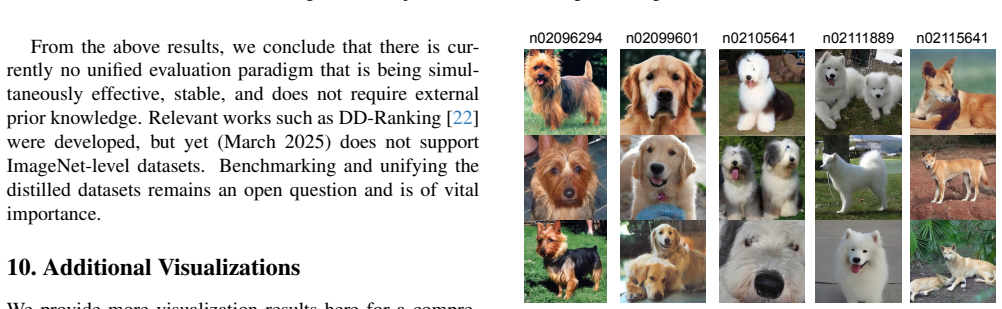
Limitations and Potential Improvements Although diffusion-based methods demonstrate strong per- formance, their applicability is constrained by the limited conditions these models can handle (e.g. DiTs can only deal with ImageNet classes). Employing text-to-image models such a...
Reviewed August 6, 2026 · model on record in the stance chip above.
Discussion (0). Sign in to comment.