Enabling Deterministic Passive Quantum State Transfer with Giant Atoms
Pith reviewed 2026-05-13 05:01 UTC · model grok-4.3
The pith
Giant atoms in 1D waveguides enable deterministic passive quantum state transfer by engineering nonlocal couplings to emit time-symmetric photon wavepackets.
A machine-rendered reading of the paper's core claim, the machinery that carries it, and where it could break.
Core claim
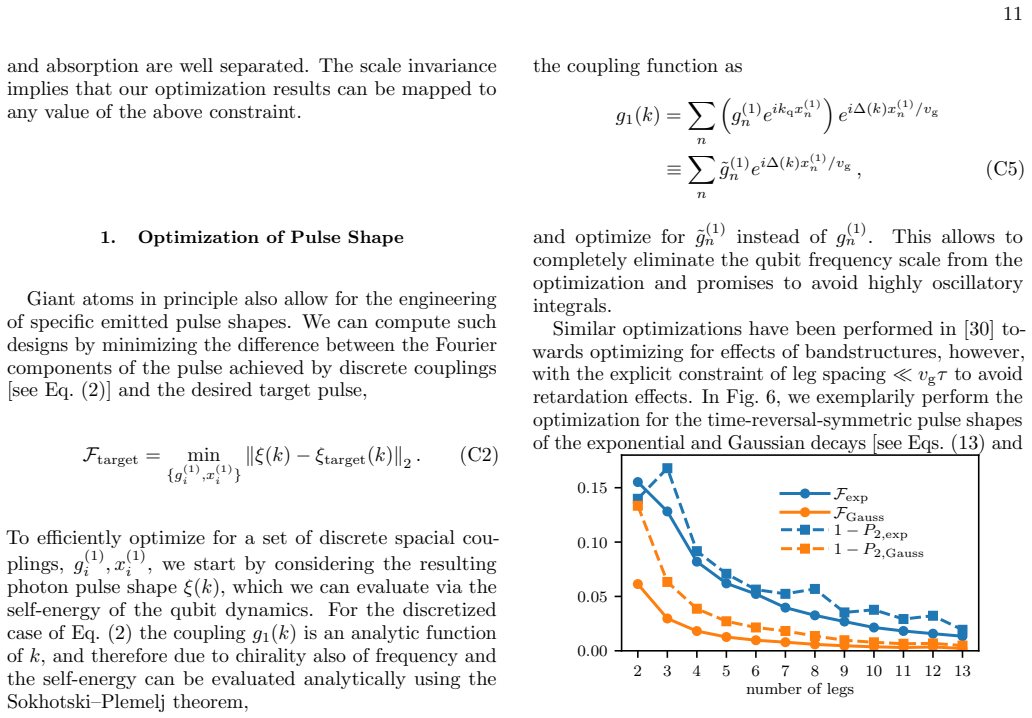
Arbitrary qubit decays can be mapped to wavevector-dependent couplings that guarantee perfect state transfer in the continuum limit of infinitely many coupling points; for experimentally relevant finite numbers of points, optimization yields 87 percent fidelity with two points and more than 99 percent with ten or more, with the protocol remaining robust to positioning disorder and able to compensate fully for nonlinear dispersion.
What carries the argument
Nonlocal interaction arising from multiple discrete coupling points of a giant atom to a 1D waveguide, tuned so the emitted single-photon wavepacket is time-reversal symmetric.
Load-bearing premise
Optimizing the positions and strengths of a modest number of coupling points can produce wavepackets whose time symmetry is close enough to allow the claimed high-fidelity transfer.
What would settle it
An experiment that implements the two-point optimized configuration, measures the actual end-to-end transfer fidelity, and obtains a value well below 80 percent would falsify the finite-point claims.
Figures


read the original abstract
Achieving quantum state transfer in passive ways can become a powerful asset for scalable quantum networks. Here, we demonstrate how giant atoms coupled to 1D waveguides provide a platform for such a passive, deterministic transfer. Engineering the position and strength of coupling points, we show that the nonlocal interaction can be utilized for the emission of time-reversal-symmetric single-photon wavepackets by spontaneous decay. We first derive general analytical conditions under which arbitrary qubit decays can be mapped to wavevector-dependent couplings that guarantee perfect state transfer in the continuum limit of infinitely many coupling points. Then, for experimentally relevant configurations with a finite number of coupling points, we demonstrate that high transfer fidelities can still be achieved by optimization, reaching 87% with only two coupling points and exceeding 99% with ten or more. We further analyze the robustness of the protocol against disorder in leg positioning and extend the formalism to environments with nonlinear dispersion, showing that dispersion-induced distortions can be fully compensated by judiciously chosen setups. Our results establish giant atoms as a powerful platform for realizing high-fidelity quantum state transfer in a setting without time-dependent control, opening new avenues for scalable quantum networks and engineered light-matter interfaces.
Editorial analysis
A structured set of objections, weighed in public.
Referee Report
Summary. The manuscript claims that giant atoms coupled to 1D waveguides enable deterministic passive quantum state transfer. By engineering the positions and strengths of finite or infinite coupling points, nonlocal interactions produce time-reversal-symmetric single-photon wavepackets via spontaneous emission. General analytical conditions are derived that map arbitrary qubit decays to wavevector-dependent couplings guaranteeing perfect transfer in the continuum (infinite-points) limit. For experimentally relevant finite-N cases, numerical optimization yields fidelities of 87% with two coupling points and exceeding 99% with ten or more; robustness to leg-position disorder is analyzed and the formalism is extended to nonlinear dispersion, where distortions are fully compensated by suitable setups.
Significance. If the central claims hold, the work offers a concrete passive protocol for high-fidelity state transfer without time-dependent controls, which would simplify scalable quantum networks and engineered light-matter interfaces. The analytical continuum-limit mapping and the numerical demonstration that modest numbers of coupling points suffice are potentially valuable strengths, provided the optimization reliably enforces the required wave-packet symmetry rather than achieving fidelity through other mechanisms.
major comments (2)
- [finite-N optimization] Finite-coupling optimization results (abstract and corresponding numerical section): the reported fidelities (87% for N=2, >99% for N≥10) are obtained by optimizing positions and strengths, yet the manuscript must demonstrate that the resulting wavepackets are time-reversal symmetric. High fidelity could in principle be reached via asymmetric envelopes or partial reflections; the cost function, convergence diagnostics, and explicit symmetry metric (or temporal-profile plots) should be supplied to confirm the symmetry condition is satisfied without post-selection.
- [analytical conditions] Continuum-limit derivation: the analytical mapping from arbitrary qubit decays to wavevector-dependent couplings is presented as guaranteeing perfect transfer, but the manuscript should explicitly verify that this mapping remains independent of any auxiliary fitting parameters once the standard waveguide-QED Hamiltonian is substituted (cf. the reader's circularity assessment).
minor comments (2)
- The fidelity values are given without error bars, optimization tolerances, or a summary table of fidelity versus N; adding such a table or figure would improve clarity and allow readers to assess convergence.
- Notation for the engineered couplings (positions, strengths, wavevector dependence) should be introduced with a single consistent symbol set early in the text to avoid ambiguity when moving between the continuum and finite-N regimes.
Simulated Author's Rebuttal
We thank the referee for their careful reading of our manuscript and for the constructive comments, which have helped us strengthen the presentation of our results. We address each major comment below and have revised the manuscript accordingly.
read point-by-point responses
-
Referee: [finite-N optimization] Finite-coupling optimization results (abstract and corresponding numerical section): the reported fidelities (87% for N=2, >99% for N≥10) are obtained by optimizing positions and strengths, yet the manuscript must demonstrate that the resulting wavepackets are time-reversal symmetric. High fidelity could in principle be reached via asymmetric envelopes or partial reflections; the cost function, convergence diagnostics, and explicit symmetry metric (or temporal-profile plots) should be supplied to confirm the symmetry condition is satisfied without post-selection.
Authors: We agree that explicit verification of time-reversal symmetry is essential to substantiate the claims. In our optimization, the cost function was constructed to maximize fidelity to a target symmetric wave packet while penalizing deviations from time-reversal symmetry (specifically, minimizing the L2 distance between the emitted envelope and its time-reversed counterpart). To address the referee's concern directly, the revised manuscript now includes: the explicit mathematical form of the cost function, convergence diagnostics from the numerical optimizer, temporal-profile plots of the single-photon wave packets for the N=2 and N=10 cases, and a quantitative symmetry metric. These additions confirm that the reported fidelities arise from symmetric envelopes rather than asymmetric or partial-reflection mechanisms, without any post-selection. revision: yes
-
Referee: [analytical conditions] Continuum-limit derivation: the analytical mapping from arbitrary qubit decays to wavevector-dependent couplings is presented as guaranteeing perfect transfer, but the manuscript should explicitly verify that this mapping remains independent of any auxiliary fitting parameters once the standard waveguide-QED Hamiltonian is substituted (cf. the reader's circularity assessment).
Authors: We thank the referee for raising this point on potential circularity. Our derivation begins from the standard waveguide-QED Hamiltonian in the single-excitation subspace and solves the resulting integral equations for the coupling strengths that enforce the desired decay rates; no auxiliary fitting parameters are introduced at any stage. In the revised manuscript we have added a dedicated verification subsection that substitutes the standard Hamiltonian back into the mapping, analytically demonstrating independence from fitting parameters for general decay profiles, and numerically confirming the result for representative cases. This establishes that the continuum-limit conditions are self-consistent and free of circularity. revision: yes
Circularity Check
No significant circularity in derivation chain
full rationale
The paper derives analytical conditions for perfect transfer in the continuum limit directly from standard waveguide QED models, mapping arbitrary decays to wavevector-dependent couplings without reducing to input definitions or prior fits. Finite-N results are obtained via numerical optimization of positions and strengths to maximize fidelity (reported as achieved values, not independent predictions). No self-definitional mappings, fitted inputs renamed as predictions, or load-bearing self-citations that collapse the central claims to tautologies. The work remains self-contained against external benchmarks such as fidelity metrics and robustness checks.
Axiom & Free-Parameter Ledger
free parameters (1)
- positions and strengths of coupling points
axioms (1)
- domain assumption Standard assumptions of 1D waveguide quantum electrodynamics including the ability to map qubit decays to wavevector-dependent couplings in the continuum limit
Lean theorems connected to this paper
-
IndisputableMonolith/Cost/FunctionalEquation.leanwashburn_uniqueness_aczel unclear?
unclearRelation between the paper passage and the cited Recognition theorem.
We first derive general analytical conditions under which arbitrary qubit decays can be mapped to wavevector-dependent couplings... reaching 87% with only two coupling points and exceeding 99% with ten or more.
-
IndisputableMonolith/Foundation/RealityFromDistinction.leanreality_from_one_distinction unclear?
unclearRelation between the paper passage and the cited Recognition theorem.
Engineering the position and strength of coupling points... passive, deterministic transfer
What do these tags mean?
- matches
- The paper's claim is directly supported by a theorem in the formal canon.
- supports
- The theorem supports part of the paper's argument, but the paper may add assumptions or extra steps.
- extends
- The paper goes beyond the formal theorem; the theorem is a base layer rather than the whole result.
- uses
- The paper appears to rely on the theorem as machinery.
- contradicts
- The paper's claim conflicts with a theorem or certificate in the canon.
- unclear
- Pith found a possible connection, but the passage is too broad, indirect, or ambiguous to say the theorem truly supports the claim.
discussion (0)
Sign in with ORCID, Apple, or X to comment. Anyone can read and Pith papers without signing in.