REVIEW 4 major objections 5 minor 46 references
Spin Seebeck effect in the layered ferromagnetic insulators CrSiTe$_3$ and CrGeTe$_3$
T0 review · 4 major / 5 minor · reviewed 2026-08-14 · deepseek-v4-flash
Pith's one-line read The paper reports that the longitudinal spin Seebeck effect in CrSiTe3 and CrGeTe3 persists above the magnetic ordering temperatures and attributes the paramagnetic signal to interlayer exchange transport of in-plane correlated moments.
desk verdict First LSSE in a van der Waals ferromagnet, with a clever but indirect case that interlayer exchange transport, not interface pumping, governs the signal above TC. read the letter →
The pith
A machine-rendered reading of the paper's core claim, the machinery that carries it, and where it could break.
The reading
What carries the argument
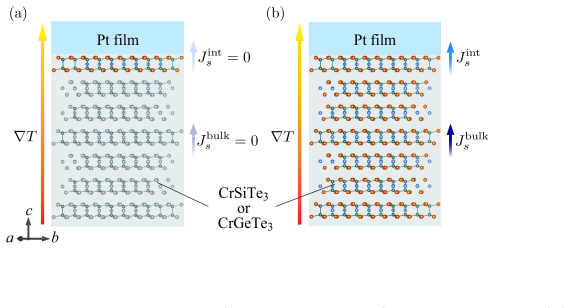
The load-bearing mechanism is the anisotropy between two exchange couplings in these quasi-two-dimensional magnets: a strong in-plane coupling $J_{ab}\sim 15$ K that sustains short-range ferromagnetic correlations in the Cr honeycomb layers up to room temperature, and a much weaker out-of-plane coupling $J_c$, more than five times smaller, that becomes ineffective above about 50 K in CrSiTe3. The paper's argument is carried by the direction of the measurement: with the temperature gradient along the c axis, the LSSE requires spin current to traverse the Cr layers, so the out-of-plane exchange acts as the conduit for the in-plane correlated moments. The numerical support is an atomistic spin-dynamics calculation of the interfacial spin-pumping amplitude based on the CrSiTe3 Hamiltonian, which isolates what the interface alone would contribute and shows that it would not reproduce the observed disappearance of the signal, leaving interlayer exchange transport as the essential ingredient.
What would settle it
Measure the LSSE on the same Pt/CrSiTe3 interface with the interlayer exchange path removed, for example on a single exfoliated CrSiTe3 layer or on a stack in which a nonmagnetic spacer interrupts the out-of-plane coupling; if a paramagnetic signal of comparable size still appears above $T_C$, the central claim that interlayer transport is essential is wrong.
Extended reading notes
Core claim
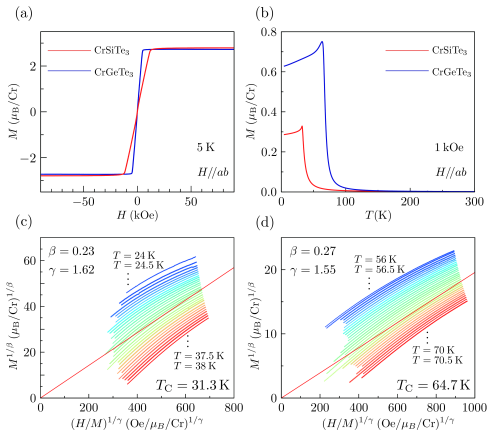
On its own terms, the paper establishes that the longitudinal spin Seebeck effect in CrSiTe3/Pt and CrGeTe3/Pt is observable not only in the ferromagnetic phase but also in the paramagnetic phase above the Curie temperature, up to roughly 50 K for CrSiTe3 and 90 K for CrGeTe3 at low fields, and to higher temperatures under applied fields up to 87 kOe. The central claim is that these high-temperature signals arise from exchange-dominated interlayer transport of in-plane paramagnetic moments: strong in-plane ferromagnetic correlations persist to much higher temperatures, and the out-of-plane exchange coupling carries these correlated moments along the temperature gradient to the Pt interface, where they are detected as a spin current. An atomistic spin-dynamics calculation of the pure interfacial spin-pumping contribution, using the magnetic parameters of CrSiTe3, shows that such pumping alone would remain sizeable far above the Curie temperature and would scale with magnetization; the authors take the experimental disappearance of the signal around 50/90 K as evidence that interlayer transport, not interface pumping, controls the response in the paramagnetic regime.
Load-bearing premise
The argument rests on the neutron-scattering result that in CrSiTe3 the in-plane magnetic correlations survive to at least 300 K while the out-of-plane correlations vanish above about 50 K, and on applying that same picture to CrGeTe3; if the out-of-plane correlation scale is actually different, or if the signal's disappearance near 50/90 K comes from a temperature-dependent interface effect rather than loss of interlayer exchange, the attribution collapses.
Editorial extensions
If this is right
- If the mechanism is right, the LSSE in a layered two-dimensional magnet provides a transport-based readout of interlayer exchange coupling: the temperature at which the signal disappears should track the scale of $J_c$, not the bulk magnetization.
- In-plane ferromagnetic correlations alone are not enough to generate a spin Seebeck signal; without an active out-of-plane exchange path, the interface sees an equilibrium magnon distribution and the voltage vanishes.
- Strong applied fields extend the measurable spin Seebeck response to temperatures well above the zero-field Curie temperature, because the Zeeman energy polarizes the paramagnetic moments and makes the interlayer transport visible.
- The same bilayer geometry can be used to study spin transport through other layered two-dimensional magnetic insulators and through heterostructures combining them with topological insulators.
- The paramagnetic LSSE in these compounds is a bulk transport phenomenon distinct from the interfacial spin-pumping contribution, so measurements of its temperature and field dependence can separate the two in a steady state.
Reading between the lines
- The paper does not itself compute the interlayer transport; an explicit calculation of the out-of-plane spin current carried by short-range correlated moments could turn the qualitative mechanism into a quantitative prediction of the paramagnetic signal's magnitude.
- If the mechanism is general, single-layer measurements of the same compounds should show no comparably sized LSSE above the ordering temperature, because the out-of-plane conduit is missing; this is a testable consequence of the paper's picture, not something the authors report.
- A complementary probe would be to vary the interlayer spacing or insert a nonmagnetic spacer layer between Cr layers: the paper's picture predicts the paramagnetic LSSE should weaken as out-of-plane exchange is reduced, even though in-plane correlations are unchanged.
Signed reviews
Editorial analysis
A structured set of objections, weighed in public.
Referee Report
Summary. Ito et al. report longitudinal spin Seebeck effect (LSSE) measurements on Pt-capped single crystals of the layered ferromagnetic insulators CrSiTe3 and CrGeTe3. They observe an antisymmetric thermovoltage that saturates with magnetic field in a way that tracks the magnetization, and, unlike in YIG, the signal persists above the Curie temperature: it disappears near 50 K for CrSiTe3 and near 90 K for CrGeTe3 at low fields, while higher fields extend the signal to higher temperatures. An atomistic spin-dynamics simulation for CrSiTe3, using magnetic parameters from the independent neutron-scattering study of Ref. [22], computes the local spin-pumping contribution in the absence of interlayer spin transport; this calculation predicts substantial paramagnetic spin pumping at temperatures where the experimental signal has vanished. The authors attribute the discrepancy to the loss of out-of-plane, exchange-mediated interlayer spin transport above these temperatures, concluding that the paramagnetic LSSE is carried by in-plane short-range ferromagnetic correlations transported along the c axis via the interlayer exchange Jc.
Significance. The experimental core is valuable: clean single crystals, a well-defined antisymmetric LSSE voltage whose field dependence tracks M, and a clear demonstration that the signal persists above TC, in contrast to conventional YIG. The proposed mechanism—exchange-dominated interlayer transport of paramagnetic moments reinforced by short-range ferromagnetic correlations and Zeeman effects—would be a new route for spin-current generation in quasi-two-dimensional magnetic insulators. The numerical support uses independently published exchange parameters rather than fits to the LSSE data, and the paper honestly records the normal-Nernst ambiguity in footnote [40]. The weakness is the logical bridge from the observations to the interlayer-transport mechanism: as detailed in the major comments, the disappearance temperature is consistent with the proposal but is not a direct test of it, and the supporting simulation does not model interlayer transport.
major comments (4)
- [Fig. 4(e) and the paragraph following it] The central claim that the paramagnetic LSSE signal is carried by Jc-mediated interlayer transport is inferred from the temperature at which the signal disappears, but neither the experiment nor the simulation directly probes interlayer transport. The atomistic spin-dynamics calculation in Fig. 4(e) computes local spin pumping without any interlayer transport, and the disagreement with experiment is interpreted as evidence that out-of-plane transport has vanished; however, no interlayer transport coefficient, spin diffusion length, or sample-thickness dependence is measured. A temperature-dependent spin-mixing conductance or a short paramagnetic spin diffusion length could produce the same disappearance without a sharp change in Jc. I request a direct test—for example, the LSSE signal versus crystal thickness, a nonlocal spin-transport measurement, or an independent calculation of the interlayer spin conductivity—or a reformulated conclusion that presents the interlayer-transport scenario as one consistent explanation rather than the demonstrated mechanism.
- [Figs. 3(a), 3(c), 4(a), 4(c), and footnote [40]] The paper uses high-field data above the temperatures at which it states the S(H) signal becomes linear in H. Footnote [40] says that above 65 K for CrSiTe3/Pt and 85 K for CrGeTe3/Pt the H-linear normal Nernst contribution cannot be distinguished from the LSSE, yet the 87-kOe curves in Figs. 4(a) and 4(c) are used to argue that S survives to roughly 80 K and that Zeeman-enhanced spin polarization is responsible. Because the 87-kOe CrSiTe3 data extend above the linearity threshold, the quantitative high-field enhancement claims are not supported unless the normal Nernst contribution is measured and subtracted. Please either perform that subtraction or restrict the high-field mechanistic discussion to temperatures below the stated threshold.
- [Text at Fig. 5 and the 'paramagnetic phase' discussion] The decoupling argument assumes that if interfacial spin pumping from in-plane correlations were the source, the LSSE signal 'would appear until 300 K'. This assumption is not established: the neutron-scattering correlations of Ref. [22] are bulk properties, and the spin-mixing conductance at the Pt interface, as well as the relevant correlation time, may be strongly temperature dependent even while the bulk in-plane susceptibility remains large. As written, the disappearance near 50 K and 90 K is consistent with loss of interlayer transport, but it does not exclude an interface-controlled or diffusion-length-controlled suppression. Please state this limitation explicitly or provide a quantitative estimate of the interfacial spin-pumping contribution versus temperature.
- [Abstract and the 'To confirm' paragraph] The numerical support is presented only for CrSiTe3, using the exchange couplings of Ref. [22], while the conclusions are extended to CrGeTe3/Pt without independent verification of its magnetic correlation anisotropy. CrGeTe3 has a substantially different Curie temperature and, presumably, a different Jab/Jc ratio, so the claim that the same interlayer-transport mechanism governs its paramagnetic LSSE is an assumption. The text should either state this assumption prominently or support the CrGeTe3 case with a calculation or with a measurement of its in-plane versus out-of-plane correlation temperatures.
minor comments (5)
- [Eq. (1)] 'Arrott-Noaks' should be spelled 'Arrott-Noakes', matching the standard literature.
- [Reference [2]] The title contains a typo: 'Spin-currnt-driven thermoelectric coating' should be 'Spin-current-driven thermoelectric coating'.
- [Crystal-growth paragraph] 'maintained at theses temperatures and then slowly cooled' should read 'maintained at these temperatures and then slowly cooled'.
- [Measurement definition of S] The definition S = (V_LSSE/ΔT)(Lz/Ly) would benefit from an explicit statement of the sign convention for V_LSSE relative to the field and magnetization directions.
- [Sentence after Fig. 4(e)] The sentence beginning 'The reason this is not seen in our experimental measurements...' is the key interpretive step; consider labeling it explicitly as an inference from the simulation rather than a direct experimental conclusion.
Circularity Check
No circularity: the numerical model uses independent neutron-scattering parameters and is not fitted to the LSSE data.
full rationale
The paper's central inference is that the LSSE signal above TC in CrSiTe3/CrGeTe3 arises from interlayer exchange transport of in-plane paramagnetic correlations, rather than from interfacial spin pumping alone. The derivation chain is: (i) LSSE is measured in the ferromagnetic and paramagnetic phases; (ii) the signal disappears near 50 K (90 K) while magnetization remains finite; (iii) independent neutron-scattering work (Ref. [22]) supplies the anisotropic exchange parameters and the picture that in-plane correlations persist to 300 K while out-of-plane correlations vanish above about 50 K; and (iv) an atomistic spin-dynamics calculation using those parameters reproduces the magnetization and computes the local (transport-free) spin pumping, which would persist well above TC. The contrast between the measured disappearance and the calculated persistence is then interpreted as evidence that interlayer transport, not interface pumping, controls the signal. None of these steps defines the conclusion into its inputs: the simulation is not fitted to the LSSE voltage, the magnetic parameters come from an independent neutron-scattering study with no author overlap, and the spin-pumping formalism of Barker and Bauer (Ref. [4]) is an established, independently used method. The self-citations to Refs. [4] and [42] are methodological and do not carry the physical conclusion by themselves. Footnote [40] explicitly limits the high-temperature, high-field data because of possible normal-Nernst contamination, but that is a stated experimental caveat, not a circular step. The weakest point is that the interlayer transport is not directly measured; the disappearance temperature is an indirect probe. That is a correctness/interpretation risk, not circularity under the standards of this review.
Assumptions & free parameters
free parameters (2)
- Exchange couplings Jab and Jc of CrSiTe3 =
Jab ≈ 15 K, Jc ≈ 3 K (from Ref. [22])
- Curie temperatures TC (modified Arrott plot fit) =
TC = 31.3 K (CrSiTe3), 64.7 K (CrGeTe3)
assumptions (4)
- domain assumption The LSSE and spin-pumping formalism of Barker and Bauer (Ref. [4], Eq. 6) applies to CrSiTe3 and CrGeTe3.
- domain assumption The magnetic correlation picture from Ref. [22] holds for both CrSiTe3 and CrGeTe3: in-plane correlations persist to at least 300 K, while out-of-plane correlations vanish above about 50 K.
- ad hoc to paper The normal Nernst effect in CrSiTe3 and CrGeTe3 is vanishingly small in the paramagnetic regime below the linear-H threshold (65 K for CrSiTe3, 85 K for CrGeTe3).
- domain assumption The antisymmetric component [V(+H) - V(-H)]/2 isolates the LSSE signal from symmetric thermoelectric backgrounds.
Cite this review
Pith. "Pith review of Spin Seebeck effect in the layered ferromagnetic insulators CrSiTe$_3$ and CrGeTe$_3$." pith.science (2026). https://pith.science/paper/UCWCSLHA
@misc{pith2026190805807,
  author       = {Pith},
  title        = {Pith review of: Spin Seebeck effect in the layered ferromagnetic insulators CrSiTe$_3$ and CrGeTe$_3$},
  year         = {2026},
  howpublished = {\url{https://pith.science/paper/UCWCSLHA}},
  note         = {Machine review of arXiv:1908.05807}
}
abstract
We have studied the longitudinal spin Seebeck effect (LSSE) in the layered ferromagnetic insulators CrSiTe$_3$ and CrGeTe$_3$ covered by Pt films in the measurement configuration where spin current traverses the ferromagnetic Cr layers. The LSSE response is clearly observed in the ferromagnetic phase and, in contrast to a standard LSSE magnet Y$_3$Fe$_5$O$_{12}$, persists above the critical temperatures in both CrSiTe$_3$/Pt and CrGeTe$_3$/Pt samples. With the help of a numerical calculation, we attribute the LSSE signals observed in the paramagnetic regime to exchange-dominated interlayer transport of in-plane paramagnetic moments reinforced by short-range ferromagnetic correlations and strong Zeeman effects.
Figures


Figures from the paper (2 more)

Reference graph
Works this paper leans on
-
[22]
R. E. Marsh, The crystal structure of Cr 2Si2Te6: Corrigendum, J. Solid State Chem. 73, 190 (1988)
work page 1988
-
[40]
D. Wesenberg, T. Liu, D. Balzar, M. Wu, and B. L. Zink, Lon g-distance spin transport in a disordered magnetic insulator, Nat. Phys. 13, 987 (2017)
work page 2017
-
[1]
5 mm (0 . 8 mm), Ly = 3 . 5 mm (4 . 4 mm), and Lz = 0 . 2 mm (75 µm) and deposited a 5-nm-thick Pt film on the surface [see Fig. 1(b)]. To ensure clean an d flat interfaces, their (as-grown) top ( ab-plane) surfaces were exfoliated using adhesive tape before the P t deposition; the resultant surface roughnesses ( Ra) of the CrSiTe 3 and CrGeTe3 samples were
-
[2]
A. Kirihara, K. Uchida, Y. Kajiwara, M. Ishida, Y. Nakamu ra, T. Manako, E. Saitoh, and S. Yorozu, Spin-currnt-driven thermoelectric coating, Nat. Mater. 11 686 (2012)
work page 2012
- [3]
-
[4]
J. Barker and G. E. W. Bauer, Thermal Spin Dynamics of Yttr ium Iron Garnet, Phys. Rev. Lett. 117, 217201 (2016)
work page 2016
-
[5]
Spin Quantum Rectification Project
4 × 10⁻² nm and 4 . 1 × 10⁻² nm, respectively, confirming the samples are very flat and smooth [see the atomic force microscope image for the CrGeTe 3 surface shown in the inset to Fig. 1(c)]. To apply a temperature gradient, ∇T , along the c axis [ z axis in Fig. 1(b)] 4 FIG. 2: (a) H dependence of M (M -H curve) for CrSiTe 3 and CrGeTe3 at 5 K. (b) T depe...
- [6]
Show all 46 references
-
[7]
J. Xiao, G. E. W. Bauer, K. Uchida, E. Saitoh, and S. Maekaw a, Theory of magnon-driven spin Seebeck effect, Phys. Rev. B 81, 214418 (2010)
2010
-
[8]
Adachi, J
H. Adachi, J. Ohe, S. Takahashi, and S. Maekawa, Phys. Rev . B 83, 094410 (2011)
2011
-
[9]
Gepr¨ ags, A
S. Gepr¨ ags, A. Kehlberger, F. D. Coletta, Z. Qiu, E.-J. G uo, T. Schulz, C. Mix, S. Meyer, A. Kamra, M. Althammer, H. Huebl, G. Jakob, Y. Ohnuma, H. Adachi , J. Barker, S. Maekawa, G. E. W. Bauer, E. Saitoh, R. Gross, S. T. B. Goennenwein, and M . Kl¨ aui, Origin of the spin...
2016
-
[10]
S. Seki, T. Ideue, M. Kubota, Y. Kozuka, R. Takagi, M. Naka mura, Y. Kaneko, M. Kawasaki, and Y. Tokura, Thermal Generation of Spin Current in an Antif erromagnet, Phys. Rev. Lett. 115, 266601 (2015)
2015
-
[11]
Shiomi, R
Y. Shiomi, R. Takashima, D. Okuyama, G. Gitgeatpong, P. P iyawongwatthana, K. Matan, T. J. Sato, and E. Saitoh, Spin Seebeck effect in the polar antif erromagnet α -Cu2V2O7, Phys. Rev. B 96, 180414(R) (2017)
2017
-
[12]
S. M. Wu, W. Zhang, A. KC, P. Borisov, J. E. Pearson, J. S. J iang, D. Lederman, A. Hoffmann, and A. Bhattacharya, Antiferromagnetic Spin Seebeck Effect, Phys. Rev. Lett. 116, 097204 (2016)
2016
-
[13]
J. Li, Z. Shi, V. H. Ortiz, M. Aldosary, C. Chen, V. Aji, P. Wei, and J. Shi, Spin Seebeck Effect from Antiferromagnetic Magnons and Critical Spin Fluc tuations in Epitaxial FeF 2 Films, Phys. Rev. Lett. 122, 217204 (2019)
2019
-
[14]
S. M. Wu, J. E. Pearson, and A. Bhattacharya, Paramagnet ic Spin Seebeck Effect, Phys. Rev. Lett. 114, 186602 (2015)
2015
-
[15]
C. Liu, S. M. Wu, J. E. Pearson, J. S. Jiang, N. d’ Ambrumen il, and A. Bhattacharya, Probing short-range magnetic order in a geometrically frustrated m agnet by means of the spin Seebeck effect, Phys. Rev. B 98, 060415(R) (2018)
2018
-
[16]
Shabbir, M
B. Shabbir, M. Nadeem, Z. Dai, M. S. Fuhrer, Q.-K. Xue, X. Wang, and Q. Bao, Long range intrinsic ferromagnetism in two dimensional materials and dissipationless future technologies, Appl. Phys. Rev. 5, 041105 (2018)
2018
-
[17]
Leb´ egue, T
S. Leb´ egue, T. Bj¨ orkman, M. Klintenberg, R. M. Nieminen, and O. Eriksson, Two-dimensional Materials from Data Filtering and Ab Initio Calculations, Phys. Rev. X 3, 031002 (2013). 11
2013
-
[18]
Li and J
X. Li and J. Yang, CrXTe 3 (X=Si, Ge) nanosheets: two dimensional intrinsic ferromag netic semiconductors, J. Mater. Chem. C 2, 7071 (2014)
2014
-
[19]
C. Gong, L. Li, Z. Li, H. Ji, A. Stern, Y. Xia, T. Cao, W. Bao , C. Wang, Y. Wang, Z. Q. Qiu, R. J. Cava, S. G. Louie, J. Xia, and X. Zhang, Discovery of intrinsic ferromagnetism in two-dimensional van der Waals crystals, Nature (London) 546, 265 (2017)
2017
-
[20]
H. Ji, R. A. Stokes, L. D. Alegria, E. C. Blomberg, M. A. Ta natar, A.Reijnders, L. M. Schoop, T. Liang, R. Prozorov, K. S. Burch, N. P. Ong, J. R. Petta, and R . J. Cava, A ferromagnetic insulating substrate for the epitaxial growth of topologic al insulators, J. Appl. Phys. ...
2013
-
[21]
Ouvrard, E
G. Ouvrard, E. Sandre, and R. Brec, Synthesis and crysta l structure of a new layered phase: The chromium hexatellurosilicate Cr 2Si2Te6, J. Solid State Chem. 73, 27 (1988)
1988
-
[23]
Carteaux, D
V. Carteaux, D. Brunet, G. Ouvrard, and G. Andr´ e, Cryst allographic, magnetic and electronic structures of a new layered ferromagnetic compound Cr 2Ge2Te6, J. Phys.: Condensed Matter 7, 69 (1995)
1995
-
[24]
T. J. Williams, A. A. Aczel, M. D. Lumsden, S. E. Nagler, a nd M. B. Stone, Magnetic correlations in the quasi-two-dimensional semiconductin g ferromagnet CrSiTe 3, Phys. Rev. B 92, 144404 (2015)
2015
-
[25]
L. D. Casto, A. J. Clune, M. O. Yokosuk, J. L. Musfeldt, T. J. Williams, H. L. Zhuang, M.- W. Lin, K. Xiao, R. G. Hennig, B. C. Sales, J.-Q. Yan, and D. Man drus, Strong spin-lattice coupling in CrSiTe 3, APL Mater. 3, 041515 (2015)
2015
-
[26]
L. D. Alegria, H. Ji, N. Yao, J. J. Clarke, R. J. Cava, and J . R. Petta, Large anomalous Hall effect in ferromagnetic insulator-topological insulator he terostructures, Appl. Phys. Lett. 105, 053512 (2014)
2014
-
[27]
Carteaux, F
V. Carteaux, F. Moussa, and M. Spiesser, 2D Ising-like f erromagnetic behaviour for the lamel- lar Cr 2Si2Te6 compound: A neutron scattering investigation, Europhys. L ett. 29, 251 (1995)
1995
-
[28]
Liu and C
Y. Liu and C. Petrovic, Critical behavior of quasi-two- dimensional semiconducting ferromag- net Cr 2Ge2Te6, Phys. Rev. B 96, 054406 (2017)
2017
-
[29]
Kikkawa, K
T. Kikkawa, K. Uchida, S. Daimon, Y. Shiomi, H. Adachi, Z . Qiu, D. Hou, X.-F. Jin, S. Maekawa, and E. Saitoh, Separation of longitudinal spin See beck effect from anomalous Nernst 12 effect: Determination of origin of transverse thermoelectri c voltage in metal/insulator junc- ...
2013
-
[30]
B. Liu, Y. Zou, L. Zhang, S. Zhou, Z. Wang, W. Wang, Z. Qu, a nd Y. Zhang, Critical behavior of the quasi-two-dimensional semiconducting ferromagnet CrSiTe3, Sci. Rep. 6, 33873 (2016)
2016
-
[31]
A. K. Pramanik and A. Banerjee, Critical behavior at par amagnetic to ferromagnetic phase transition in Pr 0. 5Sr0. 5MnO3: A bulk magnetization study, Phys. Rev. B 79, 214426 (2009)
2009
-
[32]
Uchida, T
K. Uchida, T. Kikkawa, A. Miura, J. Shiomi, and E. Saitoh , Quantitative Temperature De- pendence of Longitudinal Spin Seebeck Effect at High Temperat ures, Phys. Rev. X 4, 041023 (2014)
2014
-
[33]
Kikkawa, K
T. Kikkawa, K. Uchida, S. Daimon, Z. Qiu, Y. Shiomi, and E . Saitoh, Critical suppression of spin Seebeck effect by magnetic fields, Phys. Rev. B 92, 064413 (2015)
2015
-
[34]
H. Jin, S. R. Boona, Z. Yang, R. C. Myers, and J. P. Hereman s, Effect of the magnon dispersion on the longitudinal spin Seebeck effect in yttrium iron garnets, Phys. Rev. B 92, 054436 (2015)
2015
-
[35]
S. M. Rezende, R. L. Rodr ´ ıguez-Su´ arez, R. O. Cunha, A.R. Rodrigues, F. L. A. Machado, G. A. Fonseca Guerra, J. C. Lopez Ortiz, and A. Azevedo, Magnon s pin-current theory for the longitudinal spin-Seebeck effect, Phys. Rev. B 89, 014416 (2014)
2014
-
[36]
L. J. Cornelissen, K. J. H. Peters, G. E. W. Bauer, R. A. Du ine, and B. J. van Wees, Magnon spin transport driven by the magnon chemical potential in a m agnetic insulator, Phys. Rev. B 94, 014412 (2016)
2016
-
[37]
T. S. Seifert, S. Jaiswal, J. Barker, S. T. Weber, I. Razd olski, J. Cramer, O. Gueckstock, S. F. Maehrlein, L. Nadvornik, S. Watanabe, C. Ciccarelli, A. Mel nikov, G. Jakob, M. M¨ unzenberg, S. T. B. Goennenwein, G. Woltersdorf, B. Rethfeld, P. W. Brou wer, M. Wolf, M. Kl¨ au...
2018
-
[38]
Shiomi and E
Y. Shiomi and E. Saitoh, Paramagnetic Spin Pumping, Phy s. Rev. Lett. 113, 266602 (2014)
2014
-
[39]
H. S. Bennett and P. C. Martin, Spin diffusion in the Heisen berg paramagnet, Phys. Rev. 138, A608 (1965)
1965
-
[41]
Oyanagi, S
K. Oyanagi, S. Takahashi, L. J. Cornelissen, J. Shan, S. Daimon, T. Kikkawa, G. E. W. 13 Bauer, B. J. van Wees, and E. Saitoh, Efficient spin transport i n a paramagnetic insulator, arXiv:1811.11972 (2018)
2018 arXiv
-
[42]
3(a) and 3(c)]
S curves become linear with respect to H above 65 K for the CrSiTe 3/Pt and 85 K for CrGeTe3/Pt [see the S(H) result at 100 K shown in Figs. 3(a) and 3(c)]. Above these tem - peratures, we cannot distinguish the contribution from an H-linear normal Nernst effect to the S signal...
-
[43]
Goldenfeld, The Renormalisation Group, in Lectures on Phase Transitions and the Renor- malization Group (Perseus Books, Reading, Massachusetts, 1992), Chap
N. Goldenfeld, The Renormalisation Group, in Lectures on Phase Transitions and the Renor- malization Group (Perseus Books, Reading, Massachusetts, 1992), Chap. 9
1992
-
[44]
Barker and G
J. Barker and G. E. W. Bauer, Quantum thermodynamics of c omplex ferrimagnets, arXiv:1902.00449
1902 arXiv
-
[45]
[4] but with quantum ( Planck) statistics for the thermal fields to correctly describe magnons at these low temperatur es [42]
Using the same methodology as Ref. [4] but with quantum ( Planck) statistics for the thermal fields to correctly describe magnons at these low temperatur es [42]
-
[46]
Okamoto, Spin injection and spin transport in parama gnetic insulators, Phys
S. Okamoto, Spin injection and spin transport in parama gnetic insulators, Phys. Rev. B 93, 064421 (2016). 14
2016
Reviewed August 14, 2026 · model on record in the stance chip above.
Discussion (0). Continue with ORCID to comment.