REVIEW 4 major objections 5 minor 2 cited by
Learning Feedback Mechanisms for Measurement-Based Variational Quantum State Preparation
T0 review · 4 major / 5 minor · reviewed 2026-08-12 · deepseek-v4-flash
Pith's one-line read A variational circuit with measurement and learned feedback prepares the 16-qubit AKLT state with high fidelity, using less pre-measurement mutual information than analytic fusion.
desk verdict Honest numerical paper with a genuinely new learning framework; just don't let the abstract's 'scalability' and 'depth reduction' claims outrun what the body shows. read the letter →
The pith
A machine-rendered reading of the paper's core claim, the machinery that carries it, and where it could break.
The reading
What carries the argument
The object that carries the argument is the feedback function $\theta_2 = f(M;W)$: a map from the ancilla measurement outcome $M$ to the angles of the post-measurement unitary $U_2$. For small ancilla spaces it is a tabular lookup $W_M$; for larger systems it becomes a recurrent neural network. Around this function sits the protocol $\rho_1 = U_1(\theta_1)\rho_0 U_1^\dagger$, $\rho_M = |0\rangle_A\langle M| \rho_1 |M\rangle_A \langle 0|$, and $\rho_2 = \sum_M U_2(f(M;W)) \rho_M U_2^\dagger$, which lets a single round of measurement and correction implement a completely positive trace-preserving (CPTP) map. The paper's diagnostic for the newly identified traps is the Shannon entropy $H$ of the measurement distribution $P(M)$ together with the system-ancilla entanglement entropy $S$; at the traps $H$ collapses to low integer values, meaning the optimizer has learned to bypass the measurement. The two mitigation mechanisms both act on this diagnosis: updating $W$ more often than $\theta_1$ keeps the feedback competitive with the pre-measurement unitary, and the ancilla regularization term pushes $P(M)$ toward uniform, preventing $H$ from collapsing.
What would settle it
Re-run the spin-up edge-mode optimization from many random seeds under the paper's update-frequency and ancilla-regularization settings, and count how many runs reach the reported low infidelity; if only the reported lucky seed succeeds, the claimed learned protocol is a single-run optimization event rather than a reproducible protocol.
Extended reading notes
Core claim
The central claim is that a parameterized feedback protocol, in which ancillas are projectively measured and the measurement outcome $M$ selects the angles $\theta_2 = f(M;W)$ of a subsequent unitary through a learned function $f$, can prepare the four-fold AKLT manifold with high fidelity without prior knowledge of the analytic protocol. The optimization is non-greedy: every unitary and every feedback response is learned at the same time over all possible measurement outcomes, so the protocol can realize any completely positive trace-preserving map together with the correct conditional corrections. The learned protocol is compared with the analytic fusion protocol through two-qubit mutual information; it produces a similar block-like entanglement structure but requires less mutual information before measurement, and a shallower pre-measurement circuit of depth 7 suffices where mimicking the analytic unitary requires depth 8. The same machinery, with a translationally invariant ansatz and recurrent neural network feedback, prepares AKLT states for systems up to 32 qubits and extrapolates to sizes it was not trained on, albeit with non-optimal large-size corrections. For the specific AKLT state with both edge modes spin-up, a target with no known deterministic low-depth protocol, one optimization run reaches low infidelity, and the resulting protocol is left/right correctable even though no such constraint was imposed.
Load-bearing premise
The load-bearing premise is that the fixed circuit shapes chosen for the pre-measurement unitary and the feedback step are expressive and optimizable enough for the AKLT targets; the paper gives no general guarantee, and its own teacher-student simulations show that shallow circuits applied to entangled intermediate states are riddled with local minima.
Editorial extensions
If this is right
- Measurement and feedback enter the variational optimization as trainable components, so the learned protocol represents a non-unitary CPTP map rather than a unitary circuit; this is what lets it match a constant-depth fusion protocol.
- For the 16-qubit AKLT manifold, the learned protocol needs less two-qubit mutual information before the measurement than the analytic fusion protocol, and the pre-measurement circuit is shallower, with depth 7 versus depth 8 for replicating the analytic unitary.
- The measurement-induced local-minima traps, diagnosed by collapse of the Shannon entropy of the ancilla outcomes, can be suppressed by updating feedback parameters more often and by adding the ancilla regularization term; the same strategies improve GHZ preparation in the appendix.
- With a translationally invariant ansatz and RNN feedback, the protocol trains on sizes 8 to 32 qubits and extrapolates to untrained sizes, reaching average per-site infidelity around $3\times10^{-3}$ across the trained sizes, though corrections are not optimal for large systems.
- A deterministic learned protocol is reported for the AKLT state with both edge modes spin-up, a target with no known deterministic low-depth protocol, indicating that learning can discover state-preparation strategies beyond known analytic constructions.
Reading between the lines
- A testable extension the paper leaves implicit: if learned feedback protocols consistently need less mutual information before the measurement, then the amount of pre-measurement entanglement a target state requires could be treated as a resource, with learned protocols providing upper bounds for states like AKLT.
- The spin-up edge-mode result comes from a single favorable optimization run, so the natural next step is to distill that run into a fixed gate sequence and verify it from independent seeds, turning an existence result into a reproducible protocol.
- Because the recurrent neural network plateaus on large systems, swapping it for a transformer or state-space model, an option the paper names, would test whether the scalability bottleneck is the feedback architecture or the pre-measurement ansatz.
Signed reviews
Editorial analysis
A structured set of objections, weighed in public.
Referee Report
Summary. The paper introduces a variational framework that combines projective measurements, ancilla resets, and classical conditional feedback with parameterized circuits to learn measurement-based state-preparation protocols. The target benchmark is the spin-1 AKLT chain (16 physical qubits, encoded as two qubits per spin), with the analytic constant-depth fusion protocol of Smith et al. as reference. The main technical claims are: (i) naive optimization of the measurement-feedback objective is plagued by measurement-induced local minima characterized by collapse of the measurement-outcome distribution P(M) to a delta function (or low entropy); (ii) two heuristics, unequal parameter update frequencies and an ancilla-distribution regularizer, mitigate these minima; (iii) the learned U1 protocol requires less pre-measurement mutual information than the Smith protocol, with circuit depth 7 versus 8 for the pre-measurement unitary; (iv) a translationally invariant ansatz with an RNN feedback module extrapolates to larger system sizes, with per-site infidelity growing unfavorably for large Ns; and (v) a single 'lucky' optimization run prepares a specific AKLT edge-mode state (|up up>) at high fidelity, a task with no known deterministic low-depth protocol. The paper is openly self-critical about its limitations: optimization remains non-convex, the RNN underperforms for large systems, and the edge-mode success rests on one seed.
Significance. If the central claims hold, the paper makes a useful contribution by demonstrating that variational search over measurement-and-feedback protocols can rediscover, and modestly improve on, analytic constant-depth preparation strategies for a nontrivial SPT state, and by identifying a concrete optimization failure mode specific to measurement-based variational circuits. The protocol equations (2)-(3) are clean and the fidelity objective (6)-(7) is externally defined, so the main numerical claims are not circular. The paper ships code and data on Zenodo and GitHub, which is a genuine strength. However, the headline 'learned protocol for AKLT |up up>' is supported by one seed only, and the scaling section explicitly reports deterioration with system size, so the significance is moderate and mostly proof-of-principle rather than a demonstrated robust new state-preparation method.
major comments (4)
- [Sec. 7, Fig. 6(a)] The central claimed result, a learned deterministic protocol preparing the AKLT |up up> edge-mode state, rests on a single 'lucky' seed (violet curve), while the three other seeds shown remain trapped in local minima. The paper states this explicitly but does not provide any reproducibility evidence, such as a second successful seed, a robustness check of the final fidelity to small parameter perturbations, or a test that the protocol is a stable fixed point rather than a rare escape. Given that Section 4 and Appendix D document a loss landscape riddled with local minima for exactly this ansatz class, the claim 'the results demonstrated the possibility of learning such a protocol' needs at least one more independent success and ideally a stability analysis before it can be treated as robust.
- [Sec. 6, Fig. 5(c)] The scalability claim is materially weaker than the abstract suggests. The RNN feedback does not learn the optimal correction for large sizes: per-site infidelity grows with Ns, and the paper notes that the infidelity per site for the further-optimized 'optimal correction' is nearly size-independent, proving that the RNN is the bottleneck. The text candidly admits that the RNN was not optimized to convergence and that the unidirectional RNN underperformed without a clear explanation. This is acceptable as a proof-of-concept, but the abstract's phrase 'demonstrating scalability' should be qualified to something like 'demonstrating extrapolation at moderate sizes with performance that degrades with system size'.
- [Sec. 5, Fig. 4(g) and depth discussion] The claim of 'reducing circuit depth' is supported only by depth 7 versus 8 for a specific mimicked pre-measurement unitary, not by an end-to-end circuit comparison. The learned U1 needs depth 7 versus depth 8 to replicate the Smith protocol's pre-measurement unitary; the minimum theoretical depth for the ASSSSA pattern is 6, so the learned protocol is not shown to be shallower than optimal, only shallower than a depth-8 replication. The conclusion wording in Sec. 8 ('potential for shallower circuits') is appropriately hedged, but the abstract's 'measurement-based shortcuts to reduce circuit depth' may overstate what is demonstrated. Please either state explicitly that the depth reduction is from 8 to 7 for the pre-measurement unitary only, or provide an end-to-end depth comparison.
- [Secs. 4.1 and 4.2] The two mitigation strategies are presented as based on a conjecture in Sec. 4.1 ('We conjecture that the extreme sharpening...') and on a regularizer with hyperparameter c in Sec. 4.2. The numerical evidence in Figs. 2 and 3 is consistent with the conjecture, but the paper does not provide a controlled test isolating the mechanism, such as showing that the same update-frequency schedule with a different optimizer or a different ansatz fails, or that the regularizer's benefit is not simply due to enlarging the search space. As these methods are explicitly ad hoc, a small ablation study or additional seed statistics would materially strengthen the claim that the identified learning-rate-imbalance mechanism is correct.
minor comments (5)
- [Abstract and Sec. 6] The abstract and Sec. 6 claim 'scalability', but Sec. 6 itself reports unfavorable per-site error growth; please harmonize the wording, for example by saying 'demonstrates extrapolation to larger sizes with expected trade-offs'.
- [Sec. 5, Fig. 4(g)] Figure 4(g) uses a logarithmic y-axis for mutual information; the claim of a 'maximum mutual information length of 6 before measurement' is based on the decay plot, but the exact extraction of a 'length' from the plot is not described. Please define how the length is estimated.
- [Sec. 4.2, Eqs. (12)-(14)] The regularizer depends on the window c and ratio r; the text says the window width c was chosen so that if lR = 0 then max P / min P < r, but Eq. (13) uses c in the threshold while Eq. (12) divides by Na. Please clarify whether c is dimensionless or normalized by Na, as the current notation is ambiguous.
- [App. D, Eq. (26)] In Eq. (26), the CiRX(theta) matrix has an extra comma after the last row entry; this is a typographical error. Also, the claim that the ansatz is capable of representing any two-qubit gate at a depth of five would benefit from a citation or a brief proof sketch, since it is load-bearing for the feedback ansatz choice.
- [Sec. 7, Fig. 6 caption and code block] There is a typo in the caption of Fig. 6(a): 'nad' should be 'and'. In addition, the code repository link in Ref. [55] contains a typo in the repository name: 'varaitional' should be 'variational'.
Circularity Check
No significant circularity: the protocol is optimized against an externally defined AKLT target, and the only self-referential element is a non-load-bearing citation to the authors' earlier ancilla-resetting work.
full rationale
The central derivation chain is not circular. The protocol's objective is the infidelity to the AKLT manifold or to a specific AKLT edge-mode state, both defined externally by the AKLT Hamiltonian/matrix-product-state structure (Sec. 3, Eqs. 6-7), not by the fitted parameters themselves. The learned parameters (theta_1, W) are then used to compute fidelities, mutual information, and correctability properties, which is a standard train-then-evaluate workflow rather than a fitted input renamed as a prediction. The comparison with Smith et al. (Ref. [12]) is against an external analytic protocol, and the claim of lower pre-measurement mutual information is a measured property of the separately optimized learned circuit, not a quantity imposed by construction. The single 'lucky' run in Sec. 7 and the RNN training on the same system sizes used for evaluation raise reproducibility and generalization concerns, which the paper itself acknowledges (e.g., 'one optimization run achieves low infidelity due to a favorable random seed'; 'the RNN was not optimized until convergence'), but these are limitations of evidence strength, not circularity. The only self-citation is Ref. [38], the authors' own ancilla-resetting protocol, cited in Sec. 2 as an example of passive steering strategies representable when feedback is removed; this is contextual and not load-bearing for any central claim. No uniqueness theorem is imported from the authors' prior work, and the depth-5 feedback ansatz is justified by an independent teacher-student numerical check in App. D. Therefore the paper's derivations do not reduce to their inputs by definition, and the circularity score is at the bottom of the scale.
Assumptions & free parameters
free parameters (7)
- Feedback update frequency schedule =
freq=100 decreasing linearly to 5 over 10^4 epochs, plus freq=1,2,5,10 scans
- Ancilla regularization window c =
c = log2(r)/(2*Na) with r=2, Na=8
- ADAM learning rate schedule =
10^-3 to 10^-5 after 10^5 epochs; cosine schedule after 2.9*10^5 epochs
- RNN architecture size =
hidden dimension 60, 5 layers, GRU+SwiGLU
- Pre-measurement unitary periodicity =
theta_{i,j} = theta_{i,j mod 6}
- Feedback ansatz depth =
depth 5 sparse CiRX ansatz
- GHZ loss attenuation lambda =
scanned 0 to 1
assumptions (5)
- standard math Projective measurement and CPTP evolution describe the protocol
- domain assumption Simulations are noiseless with instantaneous classical feedback
- domain assumption MPS simulations with ITensors accurately represent the AKLT states at the system sizes used
- ad hoc to paper The sharpening of P(M) to a delta function is caused by learning-rate imbalance between U1 and feedback
- ad hoc to paper The sparse feedback ansatz of depth 5 avoids measurement-induced local minima
Cite this review
Pith. "Pith review of Learning Feedback Mechanisms for Measurement-Based Variational Quantum State Preparation." pith.science (2026). https://pith.science/paper/UD6UMUJA
@misc{pith2026241119914,
  author       = {Pith},
  title        = {Pith review of: Learning Feedback Mechanisms for Measurement-Based Variational Quantum State Preparation},
  year         = {2026},
  howpublished = {\url{https://pith.science/paper/UD6UMUJA}},
  note         = {Machine review of arXiv:2411.19914}
}
read the original abstract
This work introduces a self-learning protocol that incorporates measurement and feedback into variational quantum circuits for efficient quantum state preparation. By combining projective measurements with conditional feedback, the protocol learns state preparation strategies that extend beyond unitary-only methods, leveraging measurement-based shortcuts to reduce circuit depth. Using the spin-1 Affleck-Kennedy-Lieb-Tasaki state as a benchmark, the protocol learns high-fidelity state preparation by overcoming a family of measurement induced local minima through adjustments of parameter update frequencies and ancilla regularization. Despite these efforts, optimization remains challenging due to the highly non-convex landscapes inherent to variational circuits. The approach is extended to larger systems using translationally invariant ans\"atze and recurrent neural networks for feedback, demonstrating scalability. Additionally, the successful preparation of a specific AKLT state with desired edge modes highlights the potential to discover new state preparation protocols where none currently exist. These results indicate that integrating measurement and feedback into variational quantum algorithms provides a promising framework for quantum state preparation.
Figures


Figures from the paper (8 more)


Forward citations
Cited by 2 Pith papers
-
Machine Learning for Ground State Preparation via Measurement and Feedback
An RNN learns feedback-based quantum circuits that prepare ground states by first routing all initial states through a fixed intermediate state.
-
Quantum computing and artificial intelligence: status and perspectives
A broad expert white paper sets a European research agenda for combining quantum computing and AI, spanning quantum machine learning, AI-driven quantum control, and foundational questions.
Reference graph
Works this paper leans on
-
[1]
Quantum Computing in the NISQ era and beyond
John Preskill. “Quantum Computing in the NISQ era and beyond”. Quantum 2, 79 (2018)
2018
-
[2]
Matthew PA Fisher, Vedika Khemani, Adam Nahum, and Sagar Vijay. “Random quantum circuits”. Annual Review of Con- densed Matter Physics 14, 335–379 (2023). url: https://doi.org/10.1146/ annurev-conmatphys-031720-030658
work page 2023
-
[3]
Nishimori’s cat: stable long-range entanglement from finite-depth unitaries and weak measure- ments
Guo-Yi Zhu, Nathanan Tantivasadakarn, Ashvin Vishwanath, Simon Trebst, and Ruben Verresen. “Nishimori’s cat: stable long-range entanglement from finite-depth unitaries and weak measure- ments”. Physical Review Letters 131, 200201 (2023). url: https://doi.org/10. 1103/physrevlett.131.200201
work page 2023
-
[4]
Adaptive constant-depth circuits for manipulating non-abelian anyons
Sergey Bravyi, Isaac Kim, Alexander Kli- esch, and Robert Koenig. “Adaptive constant-depth circuits for manipulating non-abelian anyons” (2022). url: https: //doi.org/10.48550/arXiv.2205.01933
-
[5]
Hiroki Sukeno and Tzu-Chieh Wei. “Quan- tum simulation of lattice gauge theories via deterministic duality transformations as- sisted by measurements”. Physical Review A 109, 042611 (2024). url: https://doi. org/10.1103/physreva.109.042611
-
[6]
Variational quantum algo- rithms
Marco Cerezo, Andrew Arrasmith, Ryan Babbush, Simon C Benjamin, Suguru Endo, Keisuke Fujii, Jarrod R McClean, Ko- suke Mitarai, Xiao Yuan, Lukasz Cin- cio, et al. “Variational quantum algo- rithms”. Nature Reviews Physics 3, 625– 644 (2021). url: https://doi.org/10. 1038/s42254-021-00348-9
work page 2021
-
[7]
Long-range entanglement from measuring symmetry-protected topological phases
Nathanan Tantivasadakarn, Ryan Thorn- gren, Ashvin Vishwanath, and Ruben Ver- resen. “Long-range entanglement from measuring symmetry-protected topological phases”. Phys. Rev. X 14, 021040 (2024)
work page 2024
-
[8]
Mea- surement as a shortcut to long-range entan- gled quantum matter
Tsung-Cheng Lu, Leonardo A. Lessa, Isaac H. Kim, and Timothy H. Hsieh. “Mea- surement as a shortcut to long-range entan- gled quantum matter”. PRX Quantum 3, 040337 (2022)
work page 2022
Show all 61 references
-
[9]
Effi- ciently preparing schr¨ odinger’s cat, fractons and non-abelian topological order in quan- tum devices,(2021)
Ruben Verresen, Nathanan Tanti- vasadakarn, and Ashvin Vishwanath. “Effi- ciently preparing schr¨ odinger’s cat, fractons and non-abelian topological order in quan- tum devices,(2021)” (2021). url: https: //doi.org/10.48550/arXiv.2112.03061
-
[10]
Quantum circuits assisted by local operations and classical commu- nication: Transformations and phases of matter
Lorenzo Piroli, Georgios Styliaris, and J Ig- nacio Cirac. “Quantum circuits assisted by local operations and classical commu- nication: Transformations and phases of matter”. Physical Review Letters 127, 220503 (2021). url: https://doi.org/10. 1103/physrevlett.127.220503
2021
-
[11]
Shortest route to non-abelian topological order on a quantum processor
Nathanan Tantivasadakarn, Ruben Verre- sen, and Ashvin Vishwanath. “Shortest route to non-abelian topological order on a quantum processor”. Phys. Rev. Lett. 131, 060405 (2023)
2023
-
[12]
Smith, Eleanor Crane, Nathan Wiebe, and S.M
Kevin C. Smith, Eleanor Crane, Nathan Wiebe, and S.M. Girvin. “Determinis- tic constant-depth preparation of the aklt state on a quantum processor using fu- Accepted in Quantum 2025-06-30, click title to verify. Published under CC-BY 4.0. 15 sion measurements”. PRX Quantum 4, ...
2023
-
[13]
Prepar- ing matrix product states via fusion: Con- straints and extensions
David T. Stephen and Oliver Hart. “Prepar- ing matrix product states via fusion: Con- straints and extensions”. Phys. Rev. BPages – (2025)
2025
-
[14]
Low-depth unitary quantum circuits for dualities in one-dimensional quantum lat- tice models
Laurens Lootens, Clement Delcamp, Do- minic Williamson, and Frank Verstraete. “Low-depth unitary quantum circuits for dualities in one-dimensional quantum lat- tice models”. Phys. Rev. Lett. 134, 130403 (2025)
2025
-
[15]
Classi- fying one-dimensional quantum states pre- pared by a single round of measurements
Rahul Sahay and Ruben Verresen. “Classi- fying one-dimensional quantum states pre- pared by a single round of measurements”. PRX Quantum 6, 010329 (2025)
2025
-
[16]
Constant-depth preparation of matrix product states with adaptive quantum cir- cuits
Kevin C. Smith, Abid Khan, Bryan K. Clark, S.M. Girvin, and Tzu-Chieh Wei. “Constant-depth preparation of matrix product states with adaptive quantum cir- cuits”. PRX Quantum 5, 030344 (2024)
2024
-
[17]
Preparation of matrix product states with log-depth quan- tum circuits
Daniel Malz, Georgios Styliaris, Zhi-Yuan Wei, and J Ignacio Cirac. “Preparation of matrix product states with log-depth quan- tum circuits”. Physical Review Letters 132, 040404 (2024). url: https://doi.org/10. 1103/physrevlett.132.040404
2024
-
[18]
Approximating many-body quantum states with quantum circuits and measurements
Lorenzo Piroli, Georgios Styliaris, and J. Ig- nacio Cirac. “Approximating many-body quantum states with quantum circuits and measurements”. Phys. Rev. Lett. 133, 230401 (2024)
2024
-
[19]
Quantum variational algorithms are swamped with traps
Eric R Anschuetz and Bobak T Kiani. “Quantum variational algorithms are swamped with traps”. Nature Communica- tions 13, 7760 (2022). url: https://doi. org/10.1038/s41467-022-35364-5
2022 doi
-
[20]
Cost function dependent barren plateaus in shallow parametrized quantum cir- cuits
Marco Cerezo, Akira Sone, Tyler Volkoff, Lukasz Cincio, and Patrick J Coles. “Cost function dependent barren plateaus in shallow parametrized quantum cir- cuits”. Nature communications 12, 1791 (2021). url: https://doi.org/10. 1038/s41467-021-21728-w
2021
-
[21]
Variational simulation of d-level sys- tems on qubit-based quantum simula- tors
Chufan Lyu, Zuoheng Zou, Xusheng Xu, Man-Hong Yung, and Abolfazl Bayat. “Variational simulation of d-level sys- tems on qubit-based quantum simula- tors” (2024). url: https://doi.org/10. 48550/arXiv.2405.05051
-
[22]
Deep reinforcement learn- ing control of quantum cartpoles
Zhikang T. Wang, Yuto Ashida, and Masahito Ueda. “Deep reinforcement learn- ing control of quantum cartpoles”. Phys. Rev. Lett. 125, 100401 (2020)
2020
-
[23]
Measurement-based feedback quantum control with deep reinforcement learning for a double-well nonlinear poten- tial
Sangkha Borah, Bijita Sarma, Michael Kewming, Gerard J. Milburn, and Jason Twamley. “Measurement-based feedback quantum control with deep reinforcement learning for a double-well nonlinear poten- tial”. Phys. Rev. Lett. 127, 190403 (2021)
2021
-
[24]
Model- free quantum control with reinforcement learning
V. V. Sivak, A. Eickbusch, H. Liu, B. Royer, I. Tsioutsios, and M. H. Devoret. “Model- free quantum control with reinforcement learning”. Phys. Rev. X 12, 011059 (2022)
2022
-
[25]
Non-markovian feedback for optimized quantum error correction
Matteo Puviani, Sangkha Borah, Remmy Zen, Jan Olle, and Florian Marquardt. “Non-markovian feedback for optimized quantum error correction”. Phys. Rev. Lett. 134, 020601 (2025)
2025
-
[26]
Measurement-driven naviga- tion in many-body hilbert space: Active- decision steering
Yaroslav Herasymenko, Igor Gornyi, and Yuval Gefen. “Measurement-driven naviga- tion in many-body hilbert space: Active- decision steering”. PRX Quantum 4, 020347 (2023)
2023
-
[27]
En- gineering unsteerable quantum states with active feedback
Samuel Morales, Yuval Gefen, Igor Gornyi, Alex Zazunov, and Reinhold Egger. “En- gineering unsteerable quantum states with active feedback”. Phys. Rev. Res. 6, 013244 (2024)
2024
-
[28]
Measurement-based infused circuits for variational quantum eigen- solvers
Albie Chan, Zheng Shi, Luca Dellan- tonio, Wolfgang D¨ ur, and Christine A Muschik. “Measurement-based infused circuits for variational quantum eigen- solvers”. Physical Review Letters 132, 240601 (2024). url: https://doi.org/10. 1103/physrevlett.132.240601
2024
-
[29]
Reinforce- ment learning decoders for fault-tolerant quantum computation
Ryan Sweke, Markus Kesselring, Evert van Nieuwenburg, and Jens Eisert. “Reinforce- ment learning decoders for fault-tolerant quantum computation”. Machine Learning: Science and Technology2 (2020)
2020
-
[30]
Quan- tum error correction for the toric code using deep reinforcement learning
Philip Andreasson, Joel Johansson, Simon Liljestrand, and Mats Granath. “Quan- tum error correction for the toric code using deep reinforcement learning”. Quantum 3, 183 (2019)
2019
-
[31]
Reinforce- ment learning for optimal error correction of toric codes
Laia Domingo Colomer, Michalis Skotinio- tis, and Ramon Mu˜ noz-Tapia. “Reinforce- ment learning for optimal error correction of toric codes”. Physics Letters A 384, 126353 (2020)
2020
-
[32]
Optimizing Quantum Error Correc- tion Codes with Reinforcement Learning
Hendrik Poulsen Nautrup, Nicolas Delfosse, Accepted in Quantum 2025-06-30, click title to verify. Published under CC-BY 4.0. 16 Vedran Dunjko, Hans J. Briegel, and Nicolai Friis. “Optimizing Quantum Error Correc- tion Codes with Reinforcement Learning”. Quantum 3, 215 (2019)
2019
-
[33]
Rein- forcement learning with neural networks for quantum feedback
Thomas F¨ osel, Petru Tighineanu, Talitha Weiss, and Florian Marquardt. “Rein- forcement learning with neural networks for quantum feedback”. Phys. Rev. X 8, 031084 (2018)
2018
-
[34]
Dissipative vari- ational quantum algorithms for gibbs state preparation
Yigal Ilin and Itai Arad. “Dissipative vari- ational quantum algorithms for gibbs state preparation”. IEEE Transactions on Quan- tum Engineering (2024). url: https://doi. org/10.1109/TQE.2024.3511419
2024
-
[35]
Variational locc- assisted quantum circuits for long-range en- tangled states
Yuxuan Yan, Muzhou Ma, You Zhou, and Xiongfeng Ma. “Variational locc- assisted quantum circuits for long-range en- tangled states”. Phys. Rev. Lett. 134, 170601 (2025)
2025
- [36]
-
[37]
Efficient variational diagonalization of fully many- body localized hamiltonians
Frank Pollmann, Vedika Khemani, J Igna- cio Cirac, and Shivaji Lal Sondhi. “Efficient variational diagonalization of fully many- body localized hamiltonians”. Physical Re- view B 94, 041116 (2016). url: https:// doi.org/10.1103/physrevb.94.041116
2016 doi
-
[38]
Quantum state preparation via en- gineered ancilla resetting
Daniel Alcalde, Felix Motzoi, Tommaso Calarco, Giovanna Morigi, and Matteo Rizzi. “Quantum state preparation via en- gineered ancilla resetting”. Quantum 8, 1299 (2024). url: https://doi.org/10. 22331/q-2024-03-27-1299
2024
-
[39]
Measurement- induced steering of quantum sys- tems
Sthitadhi Roy, JT Chalker, IV Gornyi, and Yuval Gefen. “Measurement- induced steering of quantum sys- tems”. Physical Review Research 2, 033347 (2020). url: https://doi.org/10. 1103/physrevresearch.2.033347
2020
-
[40]
Programmable adia- batic demagnetization for systems with triv- ial and topological excitations
Anne Matthies, Mark Rudner, Achim Rosch, and Erez Berg. “Programmable adia- batic demagnetization for systems with triv- ial and topological excitations”. Quantum8, 1505 (2024)
2024
-
[41]
Rigorous results on valence-bond ground states in antiferromag- nets
Ian Affleck, Tom Kennedy, Elliott H. Lieb, and Hal Tasaki. “Rigorous results on valence-bond ground states in antiferromag- nets”. Phys. Rev. Lett. 59, 799–802 (1987)
1987
-
[42]
One-dimensional sym- metry protected topological phases and their transitions
Ruben Verresen, Roderich Moessner, and Frank Pollmann. “One-dimensional sym- metry protected topological phases and their transitions”. Physical Review B 96, 165124 (2017). url: https://doi.org/10. 1103/PhysRevB.96.165124
2017
-
[43]
De- tection of symmetry-protected topological phases in one dimension
Frank Pollmann and Ari M Turner. “De- tection of symmetry-protected topological phases in one dimension”. Physical review b 86, 125441 (2012). url: https://doi.org/ 10.1103/PhysRevB.86.125441
2012 doi
-
[44]
Measurement-based quantum computer in the gapped ground state of a two-body hamiltonian
Gavin K Brennen and Akimasa Miyake. “Measurement-based quantum computer in the gapped ground state of a two-body hamiltonian”. Physical review letters 101, 010502 (2008). url: https://doi.org/10. 1103/PhysRevLett.101.010502
2008
- [45]
-
[46]
Resource- efficient digital quantum simulation of d- level systems for photonic, vibrational, and spin-s hamiltonians
Nicolas PD Sawaya, Tim Menke, Thi Ha Kyaw, Sonika Johri, Al´ an Aspuru-Guzik, and Gian Giacomo Guerreschi. “Resource- efficient digital quantum simulation of d- level systems for photonic, vibrational, and spin-s hamiltonians”. npj Quantum Infor- mation 6, 49 (2020). url: http...
2020 doi
- [47]
- [48]
- [49]
-
[50]
Hierarchy of topological order from finite-depth unitaries, measurement, and feedforward
Nathanan Tantivasadakarn, Ashvin Vish- wanath, and Ruben Verresen. “Hierarchy of topological order from finite-depth unitaries, measurement, and feedforward”. PRX Quantum 4, 020339 (2023). url: https:// doi.org/10.1103/prxquantum.4.020339
2023 doi
-
[51]
Quantum error cor- Accepted in Quantum 2025-06-30, click title to verify. Published under CC-BY 4.0. 17 rection below the surface code threshold
Rajeev Acharya, Dmitry A Abanin, Laleh Aghababaie-Beni, Igor Aleiner, Trond I An- dersen, Markus Ansmann, Frank Arute, Kunal Arya, Abraham Asfaw, Nikita As- trakhantsev, et al. “Quantum error cor- Accepted in Quantum 2025-06-30, click title to verify. Published under CC-BY 4.0...
2024
-
[52]
Demonstrating real-time and low-latency quantum error correction with super- conducting qubits
Laura Caune, Luka Skoric, Nick S Blunt, Archibald Ruban, Jimmy McDaniel, Joseph A Valery, Andrew D Patter- son, Alexander V Gramolin, Joonas Majaniemi, Kenton M Barnes, et al. “Demonstrating real-time and low-latency quantum error correction with super- conducting qubits” (202...
-
[53]
Real-time quantum error correction be- yond break-even
Volodymyr V Sivak, Alec Eickbusch, Bap- tiste Royer, Shraddha Singh, Ioannis Tsiout- sios, Suhas Ganjam, Alessandro Miano, BL Brock, AZ Ding, Luigi Frunzio, et al. “Real-time quantum error correction be- yond break-even”. Nature 616, 50– 55 (2023). url: https://doi.org/10.1038...
2023
-
[54]
Simulations performed to produce figures presented in this work
Daniel Alcalde Puente and Matteo Rizzi. “Simulations performed to produce figures presented in this work”. Zenodo (2025)
2025
-
[55]
Implementa- tion of measurement and feedback based varaitional circuits
Daniel Alcalde Puente. “Implementa- tion of measurement and feedback based varaitional circuits”. https://github.com/ danielalcalde/mVQE (2025)
2025
-
[56]
The ITensor Soft- ware Library for Tensor Network Cal- culations
Matthew Fishman, Steven R. White, and E. Miles Stoudenmire. “The ITensor Soft- ware Library for Tensor Network Cal- culations”. SciPost Phys. Codebases- Page 4 (2022)
2022
-
[57]
Jureca: Data centric and booster modules imple- menting the modular supercomputing ar- chitecture at j¨ ulich supercomputing centre
J¨ ulich Supercomputing Centre. “Jureca: Data centric and booster modules imple- menting the modular supercomputing ar- chitecture at j¨ ulich supercomputing centre”. Journal of large-scale research facilities 7, A182 (2021)
2021
-
[58]
Exponential separation between shallow quantum cir- cuits and unbounded fan-in shallow classi- cal circuits
Adam Bene Watts, Robin Kothari, Luke Schaeffer, and Avishay Tal. “Exponential separation between shallow quantum cir- cuits and unbounded fan-in shallow classi- cal circuits”. In Proceedings of the 51st Annual ACM SIGACT Symposium on The- ory of Computing. Pages 515–526. (2019...
2019 doi
- [59]
-
[60]
Learning phrase representations using rnn encoder–decoder for statistical machine translation
Kyunghyun Cho, Bart van Merri¨ enboer, Caglar Gulcehre, Dzmitry Bahdanau, Fethi Bougares, Holger Schwenk, and Yoshua Ben- gio. “Learning phrase representations using rnn encoder–decoder for statistical machine translation”. In Proceedings of the 2014 Conference on Empirical Me...
2014
-
[61]
Using the technique described here, it was confirmed that all protocols developed in this work are indeed left correctable
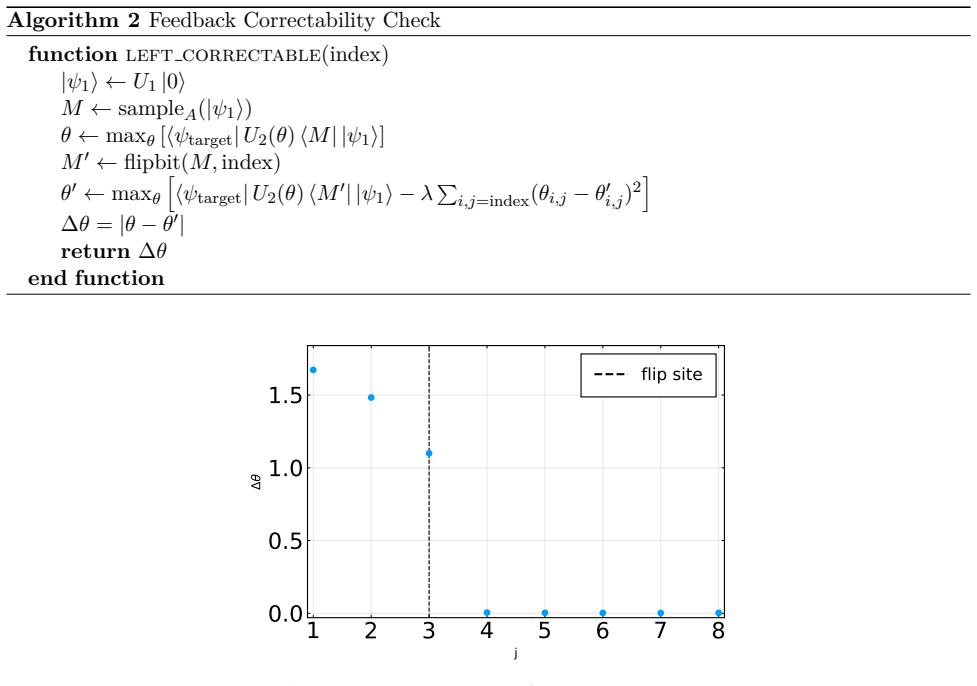
only information from one side is necessary to establish the feedback gates. Using the technique described here, it was confirmed that all protocols developed in this work are indeed left correctable. The feedback angles are first determined for a specific measurement outcomeM...
2025
Reviewed August 12, 2026 · model on record in the stance chip above.
Discussion (0). Continue with ORCID to comment.