REVIEW 4 major objections 5 minor 24 references
Revisiting Semantic Representation and Tree Search for Similar Question Retrieval
T0 review · 4 major / 5 minor · reviewed 2026-08-14 · deepseek-v4-flash
Pith's one-line read This paper claims that a k-means tree with beam search over fine-tuned BERT embeddings retrieves similar questions with 5-10x fewer distance computations and a small ranking-accuracy loss.
desk verdict A plausible but unproven speedup claim: the paper's own tables show a modest accuracy loss from tree search, but the '500-1000% speedup' is based on operation counts, not wall-clock time. read the letter →
The pith
A machine-rendered reading of the paper's core claim, the machinery that carries it, and where it could break.
The reading
What carries the argument
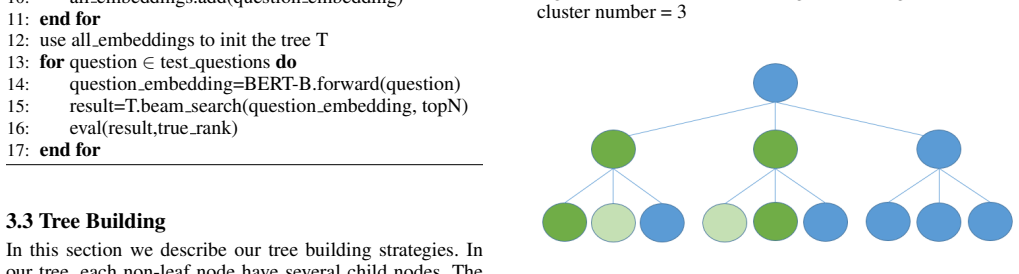
The engine of the method is the k-means tree. Test-question embeddings are clustered recursively with a branching factor of 5, 8, or 10 over five levels; leaf nodes store real question embeddings, and each non-leaf node's embedding is the k-means cluster center. At prediction time, beam search descends the tree: at each level it keeps the top N child nodes by cosine distance to the query vector and only scores leaves reachable through those nodes. The companion piece is the fine-tuning scheme: BERT is trained with a cosine-MSE loss so its pooled vector, with mean pooling working best, becomes a semantic embedding, and the paper credits prior observations that raw BERT representations are not good ranking embeddings as the motivation for this step.
What would settle it
Run the 10-K tree beam search on a query whose true nearest neighbor by cosine distance is known, and check whether that neighbor survives into the returned top 20. The paper's own Table 3 provides one failure case: for 'Who is the best bodybuilder of all time?', the 10-K tree misses the labeled correct question entirely; a systematic version would measure recall@20 over all 10,000 queries against the exhaustive cosine ranking.
Extended reading notes
Core claim
The paper's central claim is that a k-means tree whose non-leaf nodes carry cluster-center embeddings can guide beam search to the true top-20 similar questions with far fewer cosine computations than exhaustive scoring, provided the embeddings are produced by a fine-tuned BERT rather than its off-the-shelf representations. The authors show that a representation-based fine-tuning objective, where the same BERT encodes the two questions independently and the mean-squared error between the cosine similarity of the pooled vectors and the label is minimized, yields embeddings that make this approximation work. The mean-pooled variant reaches MAP 0.570 and P@1 0.493, above all the non-BERT sentence-embedding baselines and close to the compute-all ceiling of MAP 0.610. The tree's branching factor controls the trade-off: the 5-K tree costs 6,000-7,000 distance computations, and the 10-K tree costs 2,000-3,000 while losing another 0.019 MAP. The paper also describes an interaction-based variant that scores sentence pairs with BERT during tree search, but it is less accurate and slower, so the representation-based route is the one that carries the speed claim.
Load-bearing premise
The load-bearing premise is that k-means cluster centers faithfully represent their child nodes, so beam search that prunes by distance to these centers will not cut off the branch containing the true nearest neighbor.
Editorial extensions
If this is right
- A question-answering system can serve top-20 similar results with about 6,000-7,000 cosine computations per query instead of 36,735, making corpus-wide neural retrieval feasible without a separate lexical first stage.
- The branching factor of the k-means tree is a direct control knob for the speed-accuracy trade-off: the 5-K tree loses 0.040 MAP, the 10-K tree loses 0.059 MAP, and each step roughly halves the compute again.
- The same fine-tuned BERT embeddings used for retrieval also beat established sentence-embedding baselines on the constructed Quora ranking task, so the tree does not depend on a weak embedding model.
- The k-d tree baseline reaches the compute-all MAP of 0.610 but needs about 24,000 distance computations, so the k-means tree is the faster of the two approximate indexes at comparable accuracy.
Reading between the lines
- Beyond the paper, the fixed offline tree suggests the method fits static corpora best; growing question sets would need rebuilds or insertion logic, which the paper leaves unspecified.
- Beyond the paper, the Table 3 failure points to the cluster-center representation as the accuracy bottleneck; a learned routing function could close the 0.04 MAP gap without more search width.
- Beyond the paper, testing the same tree on STS benchmarks would show whether the 5-K tree's MAP loss stays near 0.04 as corpus size and domain change.
Signed reviews
Editorial analysis
A structured set of objections, weighed in public.
Referee Report
Summary. The paper addresses the problem of similar-question retrieval in a question-answering setting, where a query question must be matched against a large set of candidate questions. The authors fine-tune BERT in two ways: a representation-based method that produces sentence embeddings and scores candidates by cosine distance, and an interaction-based method that fine-tunes a BERT sentence-pair classifier to score candidates. To avoid exhaustive scoring, they build a k-means tree over the embeddings of the test corpus and perform beam search at query time, using either vector distances or BERT pair scores to guide the search. Experiments on a processed subset of Quora Question Pairs report MAP improvements over three static-embedding baselines (Arora et al., InferSent, Universal Sentence Encoder) and claim that the tree accelerates prediction speed by 500%-1000% while losing only a small amount of ranking accuracy. A case study is also provided, showing a retrieval failure for one query.
Significance. If the central speedup claim were substantiated, the proposed index-and-beam-search scheme would be a practically useful way to deploy BERT-based rankers in retrieval settings with large static corpora. The reported accuracy gains over static sentence embeddings are plausible and consistent with the broader finding that fine-tuned BERT yields stronger representations, and the paper is commendably transparent about a concrete failure case (Table 3). However, the speed claim is currently supported only by operation counts rather than measured time, and the evaluation protocol leaves important details unspecified. The paper also does not compare against standard lexical baselines or mature approximate-nearest-neighbor libraries, which limits the usefulness of the trade-off characterization. These issues are fixable in revision, but they are load-bearing for the paper's main contribution.
major comments (4)
- [§4.4, Table 4] The abstract's central claim of a 500%-1000% speedup is not supported by the evidence presented. Table 4 reports the number of vector-distance computations or pair-scoring calls, not elapsed time. For the representation-based method, the query must be encoded once by BERT in both the tree and compute-all conditions; this fixed cost is identical in both cases and, on typical hardware, dominates the subsequent cosine-distance computations. A reduction from 36,735 to 6,000-7,000 distance calls for the 5-K tree therefore does not imply a 5-6x end-to-end speedup. The paper should report wall-clock timings for the full prediction pipeline, including query encoding and any tree-construction or traversal overhead.
- [§4.1] The evaluation protocol is under-specified in a way that directly affects the interpretation of all reported metrics. The paper states that the 36,735-question corpus is built after removing duplicate questions, and that 10,000 positively labeled questions are used as queries, but it never states whether the query question itself appears in the corpus and whether it is excluded from the ranked list. If the query were in the corpus and not masked, its cosine distance to itself would be 1.0, trivially placing it at rank 1; the case study in Table 3 suggests this cannot be happening, but the protocol should be stated explicitly. Please clarify the relationship between queries and the corpus, the exclusion rule for self-retrieval, and how near-duplicate questions are handled.
- [Table 4 and §4.4] The interaction-based method is claimed to benefit from the tree, but no speed row for it appears in Table 4, and the counting methodology is not commensurate with the representation-based rows. A single BERT pair forward pass costs orders of magnitude more than a cosine distance, yet Table 4 counts each scoring event as one unit. Without either wall-clock timings or at least separate operation counts for the interaction-based variant, the speed trade-off for this method cannot be evaluated.
- [§4.3 and Table 2] The k-d tree baseline is described only as 'k-d tree' with Euclidean distance, with no implementation details such as whether it is exact or approximate, leaf size, or build time. The reported value of about 24,000 distance computations for 36,735 points is surprisingly high for a k-d tree in low effective dimensionality and makes the comparison uninformative. Please provide the exact algorithm and its parameters, and report wall-clock time for a fair comparison.
minor comments (5)
- [Algorithm 2, line 5] The comment 'fine-tune BERT-A to BERT-C on Fig 2.' appears to reference the wrong figure; the interaction-based fine-tuning should refer to Fig. 3, since Fig. 2 illustrates the representation-based architecture.
- [§4.1] The phrase '36736 questions' should be '36735 questions' to match the number given earlier in the same paragraph.
- [§5] The concluding paragraph contains the typo 'the tree's preformance'; it should be 'performance'.
- [References] The reference label for Xu et al. is 'Passage ranking with weak supervsion', which should be 'supervision'.
- [Algorithms 1 and 2] The tree is built on all test-question embeddings and then queried with test questions. This transductive setup is acceptable for a static-corpus retrieval experiment, but it should be stated explicitly, since the reported accuracy reflects an index built on the same corpus that is being queried.
Circularity Check
No circularity found: the tree retrieval result is measured against exhaustive scoring on the same embeddings, and the speed claim is an operation-count proxy, not a circular derivation.
full rationale
The paper's central claims are not circular. The tree-based retrieval accuracy is evaluated against a compute-all cosine baseline on the same BERT embeddings (Table 2: 'compute-all (cosine) 0.610' matches 'k-d tree 0.610'), so the accuracy comparison is a direct measurement rather than a reduction. The speed claim ('accelerate the predicting speed by 500%-1000%') is supported by counted vector-distance computations or BERT scoring calls (Table 4), which is a runtime-validity weakness, not a circularity: the operation count is not defined in terms of the claimed speedup. The tree index is built by k-means on test embeddings, but this is an unsupervised, label-free transductive setup that does not encode the target ranking; the paper's own Table 3 case study shows the tree can miss the correct answer entirely, demonstrating the result is not forced by construction. The accuracy baselines (Arora, InferSent, Universal Sentence Encoder) are external, and no fitted parameter is renamed as a prediction. Citations to prior tree-based work (Zhu et al. 2018, 2019) are external and motivational, not load-bearing self-citations that define the result. No equation or construction in the paper reduces to its own input, so the appropriate circularity score is 0.
Assumptions & free parameters
free parameters (5)
- k (clustering number) =
5, 8, 10 in experiments
- tree depth =
5 levels for 36735 vectors
- beam size =
top N
- nearest sentences per non-leaf node =
1-5
- pooling strategy =
mean (best), max, CLS
assumptions (5)
- standard math k-means clustering converges to a usable partition.
- domain assumption Vector distance over BERT embeddings proxies semantic similarity.
- domain assumption Test-set embeddings are available when building the tree.
- domain assumption Ground-truth similar questions are in the indexed set.
- domain assumption Cosine-loss fine-tuning yields embeddings that generalize to the test set.
Cite this review
Pith. "Pith review of Revisiting Semantic Representation and Tree Search for Similar Question Retrieval." pith.science (2026). https://pith.science/paper/UDPAEBZ6
@misc{pith2026190808326,
  author       = {Pith},
  title        = {Pith review of: Revisiting Semantic Representation and Tree Search for Similar Question Retrieval},
  year         = {2026},
  howpublished = {\url{https://pith.science/paper/UDPAEBZ6}},
  note         = {Machine review of arXiv:1908.08326}
}
read the original abstract
This paper studies the performances of BERT combined with tree structure in short sentence ranking task. In retrieval-based question answering system, we retrieve the most similar question of the query question by ranking all the questions in datasets. If we want to rank all the sentences by neural rankers, we need to score all the sentence pairs. However it consumes large amount of time. So we design a specific tree for searching and combine deep model to solve this problem. We fine-tune BERT on the training data to get semantic vector or sentence embeddings on the test data. We use all the sentence embeddings of test data to build our tree based on k-means and do beam search at predicting time when given a sentence as query. We do the experiments on the semantic textual similarity dataset, Quora Question Pairs, and process the dataset for sentence ranking. Experimental results show that our methods outperform the strong baseline. Our tree accelerate the predicting speed by 500%-1000% without losing too much ranking accuracy.
Figures


Figures from the paper (2 more)

Reference graph
Works this paper leans on
-
[1]
write newline
" write newline "" before.all 'output.state := FUNCTION fin.entry add.period write newline FUNCTION new.block output.state before.all = 'skip after.block 'output.state := if FUNCTION new.sentence output.state after.block = 'skip output.state before.all = 'skip after.sentence 'output.state := if if FUNCTION not #0 #1 if FUNCTION and 'skip pop #0 if FUNCTIO...
-
[2]
Arora, S.; Liang, Y.; and Ma, T. 2016. A simple but tough-to-beat baseline for sentence embeddings
work page 2016
-
[3]
Cer, D.; Diab, M.; Agirre, E.; Lopez-Gazpio, I.; and Specia, L. 2017. Semeval-2017 task 1: Semantic textual similarity-multilingual and cross-lingual focused evaluation. arXiv preprint arXiv:1708.00055
arXiv 2017
-
[4]
S.; Constant, N.; Guajardo-Cespedes, M.; Yuan, S.; Tar, C.; et al
Cer, D.; Yang, Y.; Kong, S.-y.; Hua, N.; Limtiaco, N.; John, R. S.; Constant, N.; Guajardo-Cespedes, M.; Yuan, S.; Tar, C.; et al. 2018. Universal sentence encoder. arXiv preprint arXiv:1803.11175
arXiv 2018
-
[5]
Conneau, A.; Kiela, D.; Schwenk, H.; Barrault, L.; and Bordes, A. 2017. Supervised learning of universal sentence representations from natural language inference data. arXiv preprint arXiv:1705.02364
arXiv 2017
-
[6]
Devlin, J.; Chang, M.-W.; Lee, K.; and Toutanova, K. 2018. Bert: Pre-training of deep bidirectional transformers for language understanding. arXiv preprint arXiv:1810.04805
arXiv 2018
-
[7]
Guo, J.; Fan, Y.; Ai, Q.; and Croft, W. B. 2016. A deep relevance matching model for ad-hoc retrieval. In Proceedings of the 25th ACM International on Conference on Information and Knowledge Management , 55--64. ACM
work page 2016
-
[8]
Guo, J.; Fan, Y.; Pang, L.; Yang, L.; Ai, Q.; Zamani, H.; Wu, C.; Croft, W. B.; and Cheng, X. 2019. A deep look into neural ranking models for information retrieval. arXiv preprint arXiv:1903.06902
arXiv 2019
Show all 24 references
-
[9]
Huang, P.-S.; He, X.; Gao, J.; Deng, L.; Acero, A.; and Heck, L. 2013. Learning deep structured semantic models for web search using clickthrough data. In Proceedings of the 22nd ACM international conference on Information & Knowledge Management , 2333--2338. ACM
2013
-
[10]
R.; Zemel, R.; Urtasun, R.; Torralba, A.; and Fidler, S
Kiros, R.; Zhu, Y.; Salakhutdinov, R. R.; Zemel, R.; Urtasun, R.; Torralba, A.; and Fidler, S. 2015. Skip-thought vectors. In Advances in neural information processing systems , 3294--3302
2015
-
[11]
Liu, Q.; Huang, Z.; Huang, Z.; Liu, C.; Chen, E.; Su, Y.; and Hu, G. 2018. Finding similar exercises in online education systems. In Proceedings of the 24th ACM SIGKDD International Conference on Knowledge Discovery & Data Mining , 1821--1830. ACM
2018
-
[12]
Liu, Y.; Ott, M.; Goyal, N.; Du, J.; Joshi, M.; Chen, D.; Levy, O.; Lewis, M.; Zettlemoyer, L.; and Stoyanov, V. 2019. Roberta: A robustly optimized bert pretraining approach. arXiv preprint arXiv:1907.11692
2019 arXiv
-
[13]
Palangi, H.; Deng, L.; Shen, Y.; Gao, J.; He, X.; Chen, J.; Song, X.; and Ward, R. 2016. Deep sentence embedding using long short-term memory networks: Analysis and application to information retrieval. IEEE/ACM Transactions on Audio, Speech and Language Processing (TASLP) 24(...
2016
-
[14]
Pennington, J.; Socher, R.; and Manning, C. 2014. Glove: Global vectors for word representation. In Proceedings of the 2014 conference on empirical methods in natural language processing (EMNLP) , 1532--1543
2014
-
[15]
Qiao, Y.; Xiong, C.; Liu, Z.; and Liu, Z. 2019. Understanding the behaviors of bert in ranking. arXiv preprint arXiv:1904.07531
2019 arXiv
-
[16]
Shen, Y.; He, X.; Gao, J.; Deng, L.; and Mesnil, G. 2014. A latent semantic model with convolutional-pooling structure for information retrieval. In Proceedings of the 23rd ACM international conference on conference on information and knowledge management , 101--110. ACM
2014
-
[17]
J.; Guez, A.; Sifre, L.; Van Den Driessche, G.; Schrittwieser, J.; Antonoglou, I.; Panneershelvam, V.; Lanctot, M.; et al
Silver, D.; Huang, A.; Maddison, C. J.; Guez, A.; Sifre, L.; Van Den Driessche, G.; Schrittwieser, J.; Antonoglou, I.; Panneershelvam, V.; Lanctot, M.; et al. 2016. Mastering the game of go with deep neural networks and tree search. nature 529(7587):484
2016
-
[18]
N.; Kaiser, .; and Polosukhin, I
Vaswani, A.; Shazeer, N.; Parmar, N.; Uszkoreit, J.; Jones, L.; Gomez, A. N.; Kaiser, .; and Polosukhin, I. 2017. Attention is all you need. In Advances in neural information processing systems , 5998--6008
2017
-
[19]
Wan, S.; Lan, Y.; Xu, J.; Guo, J.; Pang, L.; and Cheng, X. 2016. Match-srnn: Modeling the recursive matching structure with spatial rnn. arXiv preprint arXiv:1604.04378
2016 arXiv
-
[20]
Wang, Z.; Hamza, W.; and Florian, R. 2017. Bilateral multi-perspective matching for natural language sentences. arXiv preprint arXiv:1702.03814
2017 arXiv
-
[21]
Xu, P.; Ma, X.; Nallapati, R.; and Xiang, B. 2019. Passage ranking with weak supervsion. arXiv preprint arXiv:1905.05910
2019 arXiv
-
[22]
Yang, Z.; Dai, Z.; Yang, Y.; Carbonell, J.; Salakhutdinov, R.; and Le, Q. V. 2019. Xlnet: Generalized autoregressive pretraining for language understanding. arXiv preprint arXiv:1906.08237
2019 arXiv
-
[23]
Zhu, H.; Li, X.; Zhang, P.; Li, G.; He, J.; Li, H.; and Gai, K. 2018. Learning tree-based deep model for recommender systems. In Proceedings of the 24th ACM SIGKDD International Conference on Knowledge Discovery & Data Mining , 1079--1088. ACM
2018
-
[24]
Zhu, H.; Chang, D.; Xu, Z.; Zhang, P.; Li, X.; He, J.; Li, H.; Xu, J.; and Gai, K. 2019. Joint optimization of tree-based index and deep model for recommender systems. arXiv preprint arXiv:1902.07565
2019 arXiv
Reviewed August 14, 2026 · model on record in the stance chip above.
Discussion (0). Continue with ORCID to comment.