REVIEW 4 major objections 5 minor 90 references
Instructify: Demystifying Metadata to Visual Instruction Tuning Data Conversion
T0 review · 4 major / 5 minor · reviewed 2026-08-07 · deepseek-v4-flash
Pith's one-line read Instructify turns image metadata into training data with open LLMs, beating GPT-4 pipelines by 3% on average.
desk verdict Solid open-source pipeline, but the headline gains come from training on the test benchmarks—the clean comparison is a modest +0.58. read the letter →
The pith
A machine-rendered reading of the paper's core claim, the machinery that carries it, and where it could break.
The reading
What carries the argument
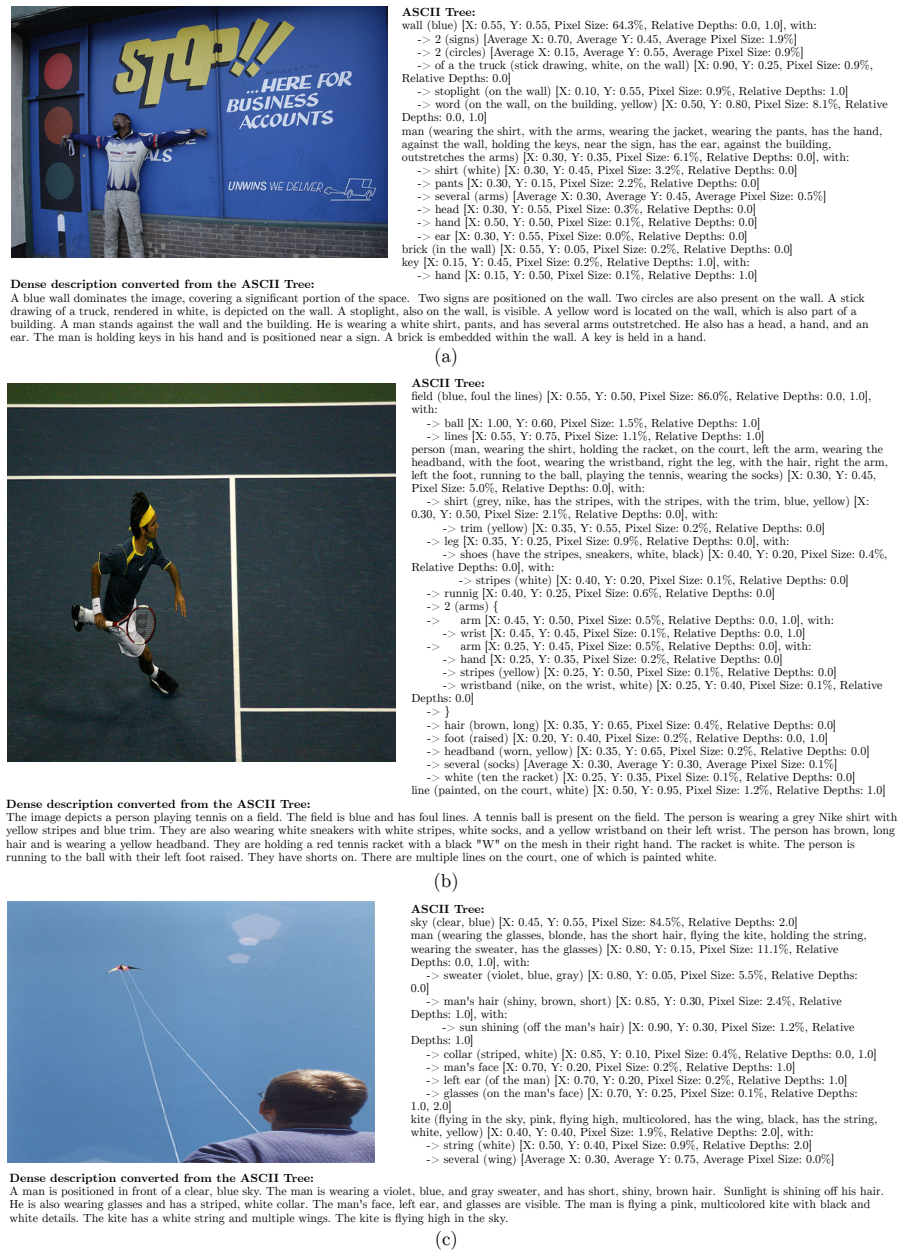
The load-bearing component is the ASCII tree: a hierarchical, indented text representation of image objects, their attributes, positions, sizes, depths, and containment relations, built from bounding boxes and masks (via SAM 2 and Depth Anything v2). This tree is serialized into natural-language factual statements that an LLM can exploit; it reduces conversion error from 18.5% (concatenation) to 9.8% in the LVIS study. Around it, the pipeline uses metadata grouping by image source, QA-to-fact reformatting, an iterative generation loop with context reduction (stopping when 85% of metadata is used), verification against the full context, and prompt-template sampling.
What would settle it
Train LLaVA-Next on LLaVA-mix plus (a) the original GPT-4 LLaVA-Instruct-150K and (b) Instructify's reproduction, controlling for exact sample count, image set, and removing ChartQA, DocVQA, TextVQA, and ScienceQA from both training and evaluation. If the Instructify-trained model no longer matches or exceeds the GPT-4-trained model on held-out benchmarks, or if the gains in Table 1 revert to losses, the central claim of reproduction-or-improvement is falsified. An even sharper test: build an Instructify variant that uses a deliberately non-hierarchical serialization (e.g., flat concatenation) and see whether its benchmark gains persist; the paper predicts they would drop.
Extended reading notes
Core claim
Instructify shows that converting image metadata into structured text, especially through a hierarchical ASCII tree that preserves object attributes, spatial relations, and depth, then feeding that text to an open LLM with staged prompt sampling and quality filtering, yields visual instruction-tuning data that is as good or better than data generated by proprietary GPT-4-based pipelines. Applied to the same images and metadata sources, models fine-tuned on Instructify-generated instruction sets outperform those trained on the original instruction sets by about 3% on average across 12 benchmarks, with individual gains up to 12%.
Load-bearing premise
The evaluation assumes that LLaVA-Next scores on 12 benchmarks isolate the quality of the candidate instruction set when LLaVA-mix is held fixed. That requires the compared datasets to match in size and composition, and the benchmarks to be independent of training metadata.
Editorial extensions
If this is right
- VisIT data generation no longer needs closed APIs; open models like Gemma 2 27B suffice for comparable or better instruction sets.
- The same metadata sources can be replayed through Instructify to reproduce or improve datasets like LLaVA-Instruct-150K, PF-1M, and LLaVAR without the original proprietary code.
- Scaling instruction data (adding more metadata sources or doubling instruction volume) yields further benchmark gains, suggesting a practical path to dataset expansion for niche domains.
- The ASCII-tree representation is a reusable technique for converting bounding-box/spatial annotations into LLM-friendly text, with a measured ~47% relative error reduction.
- The framework's Python-based, file-controlled distributed design supports high-throughput, horizontally scalable data generation for large-scale LMM training.
Reading between the lines
- The approach implies an evaluative shortcut: instead of judging instruction data by downstream benchmark scores alone, one could directly measure factual consistency against the metadata source, as the paper's LVIS error-rate study does; a community-wide version of that metric might make metadata-to-instruction fidelity a standard report card.
- The paper's finding that Gemma 2 27B outperforms LLaMA 3.1 70B in generation quality suggests that smaller, carefully tuned open models may be better suited for instruction-data synthesis than just larger parameter counts; a systematic sweep over open model families could identify even better generators.
- If the pipeline's quality hold under stricter evaluation, it would lower the barrier for building VisIT datasets in specialized domains (medical, remote sensing, document understanding) where proprietary API costs are prohibitive, but where modest quantities of high-quality metadata exist.
- The single-prompt simplification used for PF-1M, plus the observed gains on document-heavy benchmarks, hints that simpler prompt designs combined with rich structured context might transfer better across datasets than bespoke prompts.
Editorial analysis
A structured set of objections, weighed in public.
Referee Report
Summary. The paper introduces Instructify, a multi-stage open-source pipeline that converts image metadata (captions, bounding boxes, QA pairs) from over 40 public datasets into visual instruction tuning (VisIT) conversations using open-weight LLMs such as Gemma 2 27B and LLaMA 3.1 70B. The pipeline comprises data loading and organization, an ASCII-tree serialization of bounding-box metadata, iterative instruction generation with quality filtering and auto-retry, and prompt management. The authors evaluate the generated instruction sets by fine-tuning LLaVA-Next on LLaVA-mix plus a reproduced instruction set, and they compare against LLaVA-mix plus the original GPT-4-generated instruction sets for LLaVA-Instruct-150K, PF-1M, LLaVAR, and DocOwl DocReasoning. They report average gains of roughly 3% across 12 benchmarks and up to 12% on individual benchmarks, together with ablations on the choice of LLM, the ASCII-tree representation, and quality filtering.
Significance. If the quantitative claims hold, this is a useful contribution: it provides a reproducible, open alternative to closed-source GPT-4-based VisIT data generation, with concrete engineering details (ASCII tree, iterative verification, prompt sampling) and released code. The paper's framing as a systems and reproducibility contribution is appropriate, and the idea of unifying diverse metadata into structured text is likely to be adopted by other groups. However, the headline numbers are currently undermined by evaluation-design issues, most importantly the overlap between training metadata sources and evaluation benchmarks, and by unmatched training-data sizes in the PF-1M comparison. These issues are load-bearing because the central claim is explicitly quantitative ('improving GPT-4 generated VisIT instructions by ~3% on average and up to 12% on individual benchmarks').
major comments (4)
- [§A.1, Table 10, Table 2] The headline 'up to 12%' gain is not a controlled measure of instruction quality. The +14 Meta. Sources + 2×Instruct. Data condition in Table 2 adds ST-VQA, Chart-QA, and DocVQA as metadata sources (§A.1 states these make up 0.5% of the training data), and Table 2 then reports +12.88% on ChartQA in that condition. ChartQA, DocVQA, TextVQA, and ScienceQA also appear as evaluation benchmarks in Table 1 and Table 7, and several appear as training metadata in Table 10. Training on ChartQA or DocVQA metadata and then evaluating on those same benchmarks inflates scores independently of the quality of the generated conversations. Please recompute the headline result on a hold-out benchmark set, or explicitly exclude all benchmarks that overlap with training metadata sources; without this, the abstract's 'up to 12%' claim is unsupported.
- [§4.1, Table 1] The PF-1M reproduction is not matched in size or composition, so the reported gains conflate Instructify's quality with data quantity and source mixture. Section 4.1 says the authors applied the pipeline to a random subset of 19 out of 37 PF-1M datasets and used a single unified prompt, while Table 1 reports 602K samples for 'Our PF' versus 1M for the original PF-1M. This directly contradicts the paper's statement that the reproductions generate 'the same number of instructions for the same images as in the original sets.' The positive PF-1M gains in Table 1 (e.g., DocVQA +4.52, TextVQA +4.68) could be driven by the smaller, differently mixed training set rather than by Instructify. A matched-size comparison on identical source subsets, or an explicit scaling curve, is required before the reproduction claim can be accepted.
- [Tables 1–3] All main results are single training runs without error bars, multiple seeds, or significance tests. Many reported differences are within the run-to-run noise of visual-instruction tuning (e.g., AI2D +0.36, POPE +0.01, SeedBench -0.98 in Table 1; the Gemma2-vs-LLaMA comparison in Table 3 is -0.19). The abstract's '~3% on average' is also not tied to a specific table column: Table 1 does not report column averages, and Table 2 reports +2.56% only for the scaled condition. Please report means and standard deviations over at least 2–3 seeds, or a paired bootstrap over benchmarks, and state explicitly which configuration supports the '~3% average' claim.
- [§4.5, Table 8] The quality-control claims are based on very small samples, and one reported result contradicts the accompanying text. Table 5 reports precision 0.83 computed from 30 images, which gives a wide confidence interval and cannot support a strong claim of filtering effectiveness. In Table 8, removing object counting reduces the average error count by 0.41, yet the text states that 'every component contributes.' The authors should report sample sizes, the evaluation prompt and protocol, inter-annotator agreement (for manual or GPT-4o judgments), and correct the over-claim. This is load-bearing because quality control is presented as a key contribution of the pipeline.
minor comments (5)
- [Abstract] The abstract says the code 'facilities future metadata-to-VisIT data conversion'; 'facilities' should be 'facilitates.'
- [§4.3] The text says the scaled condition yields 'an average improvement of 5×' across the 12 benchmarks, but Table 2 shows the average rising from 52.36% to 54.92%, an improvement of 2.56 percentage points, not 5×; this appears to be a typo and should be corrected.
- [§4.1, Table 10] Section 4.1 states that each reproduction uses 'the same number of instructions for the same images,' but Table 10 reports 13,104 images for the LLaVAR reproduction while Table 1 reports 16K samples; please reconcile these numbers.
- [Table 4] The bounding-box conversion comparison does not state how many images were manually evaluated; please include the sample size and the annotation protocol.
- [Throughout] The model name is rendered inconsistently as 'LLaV A,' 'LLaVA,' and 'LlaV A-Next'; please standardize to 'LLaVA' and 'LLaVA-Next.'
Circularity Check
No circular derivation: the Instructify pipeline is an empirical data-conversion system evaluated on external benchmarks; the flagged ChartQA/DocVQA overlap is a validity concern, not a circular step.
full rationale
Instructify does not derive a result from its own assumptions. The central comparison is empirical: LLaVA-Next is fine-tuned on LLaVA-mix plus either the original GPT-4-generated VisIT data or Instructify's open-model reproduction, and then scored on 12 benchmarks. No component of Instructify is fitted to those benchmark scores, no load-bearing claim rests on a self-citation, and no equation reduces to its own input. The component ablations (ASCII tree, quality filtering) are assessed by human or GPT-4o checks and are independent of the main claim. The reviewer-flagged ChartQA/DocVQA overlap is real but is evaluation contamination: Section A.1 discloses that ChartQA and DocVQA were training metadata sources in the +14 metadata-sources and DocOwl conditions, while Tables 2 and 7 report large gains on those same benchmarks. This weakens those specific numbers as evidence of instruction quality, but it is a correctness risk, not circularity of the derivation chain. The COCO-only LLaVA reproduction and the overall 12-benchmark average provide external signal, so no significant circularity is present.
Assumptions & free parameters
free parameters (5)
- reduction threshold r_t =
0.85
- minimum information length l_min =
100 characters
- ASCII tree thresholds t_s, t_m, t_c =
not specified
- auto-retry count =
3
- prompt distribution P =
not specified
assumptions (4)
- domain assumption LLM-generated instructions from serialized metadata are a faithful proxy for image content, so fine-tuning on them transfers to benchmark tasks.
- domain assumption SAM2 and Depth Anything V2 provide sufficiently accurate masks and depth to build correct object hierarchies.
- domain assumption Reformatting QA pairs into declarative statements preserves semantic content.
- domain assumption LLaVA-mix is a neutral base; only the instruction subset being compared changes.
Cite this review
Pith. "Pith review of Instructify: Demystifying Metadata to Visual Instruction Tuning Data Conversion." pith.science (2026). https://pith.science/paper/UDYOYHLR
@misc{pith2026250518115,
  author       = {Pith},
  title        = {Pith review of: Instructify: Demystifying Metadata to Visual Instruction Tuning Data Conversion},
  year         = {2026},
  howpublished = {\url{https://pith.science/paper/UDYOYHLR}},
  note         = {Machine review of arXiv:2505.18115}
}
read the original abstract
Visual Instruction Tuning (VisIT) data, commonly available as human-assistant conversations with images interleaved in the human turns, are currently the most widespread vehicle for aligning strong LLMs to understand visual inputs, converting them to strong LMMs. While many VisIT datasets are available, most are constructed using ad-hoc techniques developed independently by different groups. They are often poorly documented, lack reproducible code, and rely on paid, closed-source model APIs such as GPT-4, Gemini, or Claude to convert image metadata (labels) into VisIT instructions. This leads to high costs and makes it challenging to scale, enhance quality, or generate VisIT data for new datasets. In this work, we address these challenges and propose an open and unified recipe and approach,~\textbf{\method}, for converting available metadata to VisIT instructions using open LLMs. Our multi-stage \method features an efficient framework for metadata grouping, quality control, data and prompt organization, and conversation sampling. We show that our approach can reproduce or enhance the data quality of available VisIT datasets when applied to the same image data and metadata sources, improving GPT-4 generated VisIT instructions by ~3\% on average and up to 12\% on individual benchmarks using open models, such as Gemma 2 27B and LLaMa 3.1 70B. Additionally, our approach enables effective performance scaling - both in quantity and quality - by enhancing the resulting LMM performance across a wide range of benchmarks. We also analyze the impact of various factors, including conversation format, base model selection, and resampling strategies. Our code, which supports the reproduction of equal or higher-quality VisIT datasets and facilities future metadata-to-VisIT data conversion for niche domains, is released at https://github.com/jacob-hansen/Instructify.
Figures


Figures from the paper (5 more)


Reference graph
Works this paper leans on
-
[1]
anthropic.com/news/claude-3-family, 2024
Introducing the next generation of claude.https://www. anthropic.com/news/claude-3-family, 2024. 2
2024
-
[2]
Marah Abdin, Sam Ade Jacobs, Ammar Ahmad Awan, Jyoti Aneja, Ahmed Awadallah, Hany Awadalla, Nguyen Bach, Amit Bahree, Arash Bakhtiari, Harkirat Behl, et al. Phi-3 technical report: A highly capable language model locally on your phone.arXiv preprint arXiv:2404.14219, 2024. 7
arXiv 2024
-
[3]
Easyocr: Ready-to-use ocr with 80+ supported languages, 2020
Jaided AI. Easyocr: Ready-to-use ocr with 80+ supported languages, 2020. Accessed: 2024-11-20. 9, 12
2020
-
[4]
Flamingo: a Visual Language Model for Few-Shot Learning
Jean-Baptiste Alayrac, Jeff Donahue, Pauline Luc, An- toine Miech, Iain Barr, Yana Hasson, Karel Lenc, Arthur Mensch, Katie Millican, Malcolm Reynolds, Roman Ring, Eliza Rutherford, Serkan Cabi, Tengda Han, Zhitao Gong, Sina Samangooei, Marianne Monteiro, Jacob Menick, Se- bastian Borgeaud, Andrew Brock, Aida Nematzadeh, Sa- hand Sharifzadeh, Mikolaj Bink...
arXiv 2022
-
[5]
Visual instruction tuning with polite flamingo, 2023
Delong Chen, Jianfeng Liu, Wenliang Dai, and Baoyuan Wang. Visual instruction tuning with polite flamingo, 2023. 6, 9, 12
2023
-
[6]
Feilong Chen, Minglun Han, Haozhi Zhao, Qingyang Zhang, Jing Shi, Shuang Xu, and Bo Xu. X-llm: Bootstrapping ad- vanced large language models by treating multi-modalities as foreign languages.arXiv preprint arXiv:2305.04160, 2023. 3
arXiv 2023
-
[7]
Allava: Harness- ing gpt4v-synthesized data for a lite vision-language model
Guiming Hardy Chen, Shunian Chen, Ruifei Zhang, Juny- ing Chen, Xiangbo Wu, Zhiyi Zhang, Zhihong Chen, Jian- quan Li, Xiang Wan, and Benyou Wang. Allava: Harness- ing gpt4v-synthesized data for a lite vision-language model. arXiv preprint arXiv:2402.11684, 2024. 2, 3
arXiv 2024
-
[8]
A spatial-temporal attention- based method and a new dataset for remote sensing image change detection.Remote Sensing, 12(10), 2020
Hao Chen and Zhenwei Shi. A spatial-temporal attention- based method and a new dataset for remote sensing image change detection.Remote Sensing, 12(10), 2020. 12
2020
Show all 90 references
-
[9]
Sharegpt4v: Improving large multi-modal models with better captions
Lin Chen, Jinsong Li, Xiaoyi Dong, Pan Zhang, Conghui He, Jiaqi Wang, Feng Zhao, and Dahua Lin. Sharegpt4v: Improving large multi-modal models with better captions. arXiv preprint arXiv:2311.12793, 2023. 2, 3
2023 arXiv
-
[10]
Sharegpt4video: Improving video understand- ing and generation with better captions.arXiv preprint arXiv:2406.04325, 2024
Lin Chen, Xilin Wei, Jinsong Li, Xiaoyi Dong, Pan Zhang, Yuhang Zang, Zehui Chen, Haodong Duan, Bin Lin, Zhenyu Tang, et al. Sharegpt4video: Improving video understand- ing and generation with better captions.arXiv preprint arXiv:2406.04325, 2024. 2, 3
2024 arXiv
-
[11]
Lawrence Zit- nick
Xinlei Chen, Hao Fang, Tsung-Yi Lin, Ramakrishna Vedan- tam, Saurabh Gupta, Piotr Dollar, and C. Lawrence Zit- nick. Microsoft coco captions: Data collection and evalu- ation server, 2015. 9, 12
2015
-
[12]
Microsoft coco captions: Data collection and evaluation server.arXiv preprint arXiv:1504.00325, 2015
Xinlei Chen, Hao Fang, Tsung-Yi Lin, Ramakrishna Vedan- tam, Saurabh Gupta, Piotr Doll ´ar, and C Lawrence Zitnick. Microsoft coco captions: Data collection and evaluation server.arXiv preprint arXiv:1504.00325, 2015. 3
2015 arXiv
-
[13]
Internvl: Scaling up vision foundation models and aligning for generic visual-linguistic tasks.arXiv preprint arXiv:2312.14238, 2023
Zhe Chen, Jiannan Wu, Wenhai Wang, Weijie Su, Guo Chen, Sen Xing, Muyan Zhong, Qinglong Zhang, Xizhou Zhu, Lewei Lu, Bin Li, Ping Luo, Tong Lu, Yu Qiao, and Jifeng Dai. Internvl: Scaling up vision foundation models and aligning for generic visual-linguistic tasks.arXiv preprin...
2023 arXiv
-
[14]
InstructBLIP: Towards General-purpose Vision- Language Models with Instruction Tuning
Wenliang Dai, Junnan Li, Dongxu Li, Anthony Tiong, Junqi Zhao, Weisheng Wang, Boyang Li, Pascale Fung, and Steven Hoi. InstructBLIP: Towards General-purpose Vision- Language Models with Instruction Tuning. InNeurIPS,
-
[15]
Molmo and pixmo: Open weights and open data for state-of-the-art multimodal models.arXiv preprint arXiv:2409.17146, 2024
Matt Deitke, Christopher Clark, Sangho Lee, Rohun Tri- pathi, Yue Yang, Jae Sung Park, Mohammadreza Salehi, Niklas Muennighoff, Kyle Lo, Luca Soldaini, et al. Molmo and pixmo: Open weights and open data for state-of-the-art multimodal models.arXiv preprint arXiv:2409.17146, 2024. 2
2024 arXiv
-
[16]
Vila 2: Vila augmented vila.arXiv preprint arXiv:2407.17453, 2024
Yunhao Fang, Ligeng Zhu, Yao Lu, Yan Wang, Pavlo Molchanov, Jang Hyun Cho, Marco Pavone, Song Han, and Hongxu Yin. Vila 2: Vila augmented vila.arXiv preprint arXiv:2407.17453, 2024. 2
2024 arXiv
-
[17]
Llama-adapter v2: Parameter-efficient vi- sual instruction model.arXiv preprint arXiv:2304.15010,
Peng Gao, Jiaming Han, Renrui Zhang, Ziyi Lin, Shijie Geng, Aojun Zhou, Wei Zhang, Pan Lu, Conghui He, Xi- angyu Yue, et al. Llama-adapter v2: Parameter-efficient vi- sual instruction model.arXiv preprint arXiv:2304.15010,
-
[18]
Multimodal-gpt: A vision and lan- guage model for dialogue with humans.arXiv preprint arXiv:2305.04790, 2023
Tao Gong, Chengqi Lyu, Shilong Zhang, Yudong Wang, Miao Zheng, Qian Zhao, Kuikun Liu, Wenwei Zhang, Ping Luo, and Kai Chen. Multimodal-gpt: A vision and lan- guage model for dialogue with humans.arXiv preprint arXiv:2305.04790, 2023. 3
2023 arXiv
-
[19]
Making the v in vqa matter: Elevating the role of image understanding in visual question answer- ing, 2017
Yash Goyal, Tejas Khot, Douglas Summers-Stay, Dhruv Ba- tra, and Devi Parikh. Making the v in vqa matter: Elevating the role of image understanding in visual question answer- ing, 2017. 12
2017
-
[20]
Lvis: A dataset for large vocabulary instance segmentation, 2019
Agrim Gupta, Piotr Doll ´ar, and Ross Girshick. Lvis: A dataset for large vocabulary instance segmentation, 2019. 3, 12
2019
-
[21]
Gqa: A new dataset for real-world visual reasoning and compositional question answering
Drew A Hudson and Christopher D Manning. Gqa: A new dataset for real-world visual reasoning and compositional question answering. InProceedings of the IEEE/CVF con- ference on computer vision and pattern recognition, pages 6700–6709, 2019. 3, 12
2019
-
[22]
A diagram is worth a dozen images
Aniruddha Kembhavi, Mike Salvato, Eric Kolve, Minjoon Seo, Hannaneh Hajishirzi, and Ali Farhadi. A diagram is worth a dozen images. InComputer Vision–ECCV 2016: 14th European Conference, Amsterdam, The Netherlands, October 11–14, 2016, Proceedings, Part IV 14, pages 235–
2016
-
[23]
A hierarchical approach for generating descriptive image paragraphs, 2017
Jonathan Krause, Justin Johnson, Ranjay Krishna, and Li Fei-Fei. A hierarchical approach for generating descriptive image paragraphs, 2017. 12
2017
-
[24]
Visual genome: Connecting language and vision using crowdsourced dense image annotations.International journal of computer vision, 123:32–73, 2017
Ranjay Krishna, Yuke Zhu, Oliver Groth, Justin Johnson, Kenji Hata, Joshua Kravitz, Stephanie Chen, Yannis Kalan- tidis, Li-Jia Li, David A Shamma, et al. Visual genome: Connecting language and vision using crowdsourced dense image annotations.International journal of computer...
2017
-
[25]
Seed-bench: Benchmarking mul- timodal llms with generative comprehension.arXiv preprint arXiv:2307.16125, 2023
Bohao Li, Rui Wang, Guangzhi Wang, Yuying Ge, Yix- iao Ge, and Ying Shan. Seed-bench: Benchmarking mul- timodal llms with generative comprehension.arXiv preprint arXiv:2307.16125, 2023. 7
2023 arXiv
-
[27]
LLaV A-OneVision: Easy Visual Task Trans- fer.arXiv preprint arXiv:2408.03326, 2024
Bo Li, Yuanhan Zhang, Dong Guo, Renrui Zhang, Feng Li, Hao Zhang, Kaichen Zhang, Yanwei Li, Ziwei Liu, and Chunyuan Li. LLaV A-OneVision: Easy Visual Task Trans- fer.arXiv preprint arXiv:2408.03326, 2024. 1
2024 arXiv
-
[28]
Llava-med: Training a large language- and-vision assistant for biomedicine in one day.Advances in Neural Information Processing Systems, 36, 2024
Chunyuan Li, Cliff Wong, Sheng Zhang, Naoto Usuyama, Haotian Liu, Jianwei Yang, Tristan Naumann, Hoifung Poon, and Jianfeng Gao. Llava-med: Training a large language- and-vision assistant for biomedicine in one day.Advances in Neural Information Processing Systems, 36, 2024. 3
2024
-
[29]
BLIP-2: Bootstrapping Language-Image Pre-training with Frozen Image Encoders and Large Language Models.arXiv preprint arXiv:2301.12597, 2023
Junnan Li, Dongxu Li, Silvio Savarese, and Steven Hoi. BLIP-2: Bootstrapping Language-Image Pre-training with Frozen Image Encoders and Large Language Models.arXiv preprint arXiv:2301.12597, 2023. 1
2023 arXiv
-
[30]
Videochat: Chat-centric video understanding.arXiv preprint arXiv:2305.06355, 2023
KunChang Li, Yinan He, Yi Wang, Yizhuo Li, Wenhai Wang, Ping Luo, Yali Wang, Limin Wang, and Yu Qiao. Videochat: Chat-centric video understanding.arXiv preprint arXiv:2305.06355, 2023. 3
2023 arXiv
-
[31]
M3it: A large-scale dataset towards multi- modal multilingual instruction tuning.arXiv preprint arXiv:2306.04387, 2023
Lei Li, Yuwei Yin, Shicheng Li, Liang Chen, Peiyi Wang, Shuhuai Ren, Mukai Li, Yazheng Yang, Jingjing Xu, Xu Sun, et al. M3it: A large-scale dataset towards multi- modal multilingual instruction tuning.arXiv preprint arXiv:2306.04387, 2023. 3
2023 arXiv
-
[32]
Vqa-e: Explaining, elaborating, and enhancing your answers for visual questions, 2018
Qing Li, Qingyi Tao, Shafiq Joty, Jianfei Cai, and Jiebo Luo. Vqa-e: Explaining, elaborating, and enhancing your answers for visual questions, 2018. 12
2018
-
[33]
Evaluating object hallucina- tion in large vision-language models.arXiv preprint arXiv:2305.10355, 2023
Yifan Li, Yifan Du, Kun Zhou, Jinpeng Wang, Wayne Xin Zhao, and Ji-Rong Wen. Evaluating object hallucina- tion in large vision-language models.arXiv preprint arXiv:2305.10355, 2023. 7
2023 arXiv
-
[34]
Visual spatial reasoning, 2023
Fangyu Liu, Guy Emerson, and Nigel Collier. Visual spatial reasoning, 2023. 12
2023
-
[35]
Mitigating hallucination in large multi-modal models via robust instruction tuning
Fuxiao Liu, Kevin Lin, Linjie Li, Jianfeng Wang, Yaser Ya- coob, and Lijuan Wang. Mitigating hallucination in large multi-modal models via robust instruction tuning. InThe Twelfth International Conference on Learning Representa- tions, 2023. 2, 3
2023
-
[36]
Re- moteclip: A vision language foundation model for remote sensing, 2024
Fan Liu, Delong Chen, Zhangqingyun Guan, Xiaocong Zhou, Jiale Zhu, Qiaolin Ye, Liyong Fu, and Jun Zhou. Re- moteclip: A vision language foundation model for remote sensing, 2024. 12
2024
-
[38]
LLaV A-Next (LLaV A 1.6).arXiv:2310.03744, 2023
Haotian Liu, Chunyuan Li, Yuheng Li, and Yong Jae Lee. LLaV A-Next (LLaV A 1.6).arXiv:2310.03744, 2023. 7
2023 arXiv
-
[39]
Visual Instruction Tuning
Haotian Liu, Chunyuan Li, Qingyang Wu, and Yong Jae Lee. Visual Instruction Tuning. InNeurIPS, 2023. 1, 2, 3, 6, 7, 9, 12
2023
-
[40]
On the hidden mystery of ocr in large multimodal models.arXiv preprint arXiv:2305.07895, 2023
Yuliang Liu, Zhang Li, Biao Yang, Chunyuan Li, Xucheng Yin, Cheng-lin Liu, Lianwen Jin, and Xiang Bai. On the hidden mystery of ocr in large multimodal models.arXiv preprint arXiv:2305.07895, 2023. 7
2023 arXiv
-
[41]
Learn to explain: Multimodal reasoning via thought chains for science question answering.Advances in Neural Information Processing Systems, 35:2507–2521,
Pan Lu, Swaroop Mishra, Tanglin Xia, Liang Qiu, Kai-Wei Chang, Song-Chun Zhu, Oyvind Tafjord, Peter Clark, and Ashwin Kalyan. Learn to explain: Multimodal reasoning via thought chains for science question answering.Advances in Neural Information Processing Systems, 35:2507–2521,
-
[42]
Cheap and quick: Efficient vision- language instruction tuning for large language models.Ad- vances in Neural Information Processing Systems, 36, 2024
Gen Luo, Yiyi Zhou, Tianhe Ren, Shengxin Chen, Xiaoshuai Sun, and Rongrong Ji. Cheap and quick: Efficient vision- language instruction tuning for large language models.Ad- vances in Neural Information Processing Systems, 36, 2024. 3
2024
-
[43]
Ok-vqa: A visual question answering benchmark requiring external knowledge
Kenneth Marino, Mohammad Rastegari, Ali Farhadi, and Roozbeh Mottaghi. Ok-vqa: A visual question answering benchmark requiring external knowledge. InProceedings of the IEEE/cvf conference on computer vision and pattern recognition, pages 3195–3204, 2019. 3, 12
2019
-
[44]
ChartQA: A benchmark for question answer- ing about charts with visual and logical reasoning
Ahmed Masry, Do Long, Jia Qing Tan, Shafiq Joty, and Ena- mul Hoque. ChartQA: A benchmark for question answer- ing about charts with visual and logical reasoning. InFind- ings of the Association for Computational Linguistics: ACL 2022, pages 2263–2279, Dublin, Ireland, 2022. A...
2022
-
[45]
Docvqa: A dataset for vqa on document images
Minesh Mathew, Dimosthenis Karatzas, and CV Jawahar. Docvqa: A dataset for vqa on document images. InProceed- ings of the IEEE/CVF winter conference on applications of computer vision, pages 2200–2209, 2021. 3, 7
2021
-
[46]
Docvqa: A dataset for vqa on document images
Minesh Mathew, Dimosthenis Karatzas, and CV Jawahar. Docvqa: A dataset for vqa on document images. InProceed- ings of the IEEE/CVF winter conference on applications of computer vision, pages 2200–2209, 2021. 12
2021
-
[47]
Infographicvqa
Minesh Mathew, Viraj Bagal, Rub `en Tito, Dimosthenis Karatzas, Ernest Valveny, and CV Jawahar. Infographicvqa. InProceedings of the IEEE/CVF Winter Conference on Ap- plications of Computer Vision, pages 1697–1706, 2022. 7, 12
2022
-
[48]
Introducing llama 3.1: Our most capable models to date, 2024
MetaAI. Introducing llama 3.1: Our most capable models to date, 2024. 2, 7, 8
2024
-
[49]
Ocr-vqa: Visual question answering by reading text in images
Anand Mishra, Shashank Shekhar, Ajeet Kumar Singh, and Anirban Chakraborty. Ocr-vqa: Visual question answering by reading text in images. InICDAR, 2019. 12
2019
-
[50]
Gpt-4 technical report.arXiv preprint arXiv:2303.08774, 2023
OpenAI. Gpt-4 technical report.arXiv preprint arXiv:2303.08774, 2023. 2
2023 arXiv
-
[51]
Gpt-4 technical report.ArXiv, 2303:08774,
R OpenAI et al. Gpt-4 technical report.ArXiv, 2303:08774,
-
[52]
Im2text: Describing images using 1 million captioned pho- tographs.Advances in neural information processing sys- tems, 24, 2011
Vicente Ordonez, Girish Kulkarni, and Tamara Berg. Im2text: Describing images using 1 million captioned pho- tographs.Advances in neural information processing sys- tems, 24, 2011. 3
2011
-
[53]
Flickr30k entities: Collecting region-to-phrase corre- spondences for richer image-to-sentence models
Bryan A Plummer, Liwei Wang, Chris M Cervantes, Juan C Caicedo, Julia Hockenmaier, and Svetlana Lazeb- nik. Flickr30k entities: Collecting region-to-phrase corre- spondences for richer image-to-sentence models. InPro- ceedings of the IEEE international conference on computer v...
2015
-
[54]
Connecting vision and lan- guage with localized narratives
Jordi Pont-Tuset, Jasper Uijlings, Soravit Changpinyo, Radu Soricut, and Vittorio Ferrari. Connecting vision and lan- guage with localized narratives. InComputer Vision–ECCV 2020: 16th European Conference, Glasgow, UK, August 23– 28, 2020, Proceedings, Part V 16, pages 647–664...
2020
-
[55]
Connecting vision and lan- guage with localized narratives, 2020
Jordi Pont-Tuset, Jasper Uijlings, Soravit Changpinyo, Radu Soricut, and Vittorio Ferrari. Connecting vision and lan- guage with localized narratives, 2020. 12
2020
-
[56]
Learning Transferable Visual Models from Natural Language Supervi- sion
Alec Radford, Jong Wook Kim, Chris Hallacy, Aditya Ramesh, Gabriel Goh, Sandhini Agarwal, Girish Sastry, Amanda Askell, Pamela Mishkin, Jack Clark, et al. Learning Transferable Visual Models from Natural Language Supervi- sion. 2021. 7
2021
-
[57]
Sam 2: Segment anything in images and videos,
Nikhila Ravi, Valentin Gabeur, Yuan-Ting Hu, Ronghang Hu, Chaitanya Ryali, Tengyu Ma, Haitham Khedr, Roman R¨adle, Chloe Rolland, Laura Gustafson, Eric Mintun, Junt- ing Pan, Kalyan Vasudev Alwala, Nicolas Carion, Chao- Yuan Wu, Ross Girshick, Piotr Doll´ar, and Christoph Feic...
-
[58]
Laion-5b: An open large-scale dataset for training next generation image-text models, 2022
Christoph Schuhmann, Romain Beaumont, Richard Vencu, Cade Gordon, Ross Wightman, Mehdi Cherti, Theo Coombes, Aarush Katta, Clayton Mullis, Mitchell Worts- man, Patrick Schramowski, Srivatsa Kundurthy, Katherine Crowson, Ludwig Schmidt, Robert Kaczmarczyk, and Jenia Jitsev. Lai...
2022
-
[59]
LAION-5b: An open large-scale dataset for training next generation image-text models
Christoph Schuhmann, Romain Beaumont, Richard Vencu, Cade W Gordon, Ross Wightman, Mehdi Cherti, Theo Coombes, Aarush Katta, Clayton Mullis, Mitchell Worts- man, Patrick Schramowski, Srivatsa R Kundurthy, Katherine Crowson, Ludwig Schmidt, Robert Kaczmarczyk, and Jenia Jitsev....
2022
-
[60]
A-okvqa: A benchmark for visual question answering using world knowl- edge, 2022
Dustin Schwenk, Apoorv Khandelwal, Christopher Clark, Kenneth Marino, and Roozbeh Mottaghi. A-okvqa: A benchmark for visual question answering using world knowl- edge, 2022. 12
2022
-
[61]
Conceptual captions: A cleaned, hypernymed, im- age alt-text dataset for automatic image captioning
Piyush Sharma, Nan Ding, Sebastian Goodman, and Radu Soricut. Conceptual captions: A cleaned, hypernymed, im- age alt-text dataset for automatic image captioning. InPro- ceedings of the 56th Annual Meeting of the Association for Computational Linguistics (Volume 1: Long Papers...
2018
-
[62]
Math- llava: Bootstrapping mathematical reasoning for multimodal large language models.arXiv preprint arXiv:2406.17294,
Wenhao Shi, Zhiqiang Hu, Yi Bin, Junhua Liu, Yang Yang, See-Kiong Ng, Lidong Bing, and Roy Ka-Wei Lee. Math- llava: Bootstrapping mathematical reasoning for multimodal large language models.arXiv preprint arXiv:2406.17294,
-
[63]
Textcaps: a dataset for image captioning with reading comprehension, 2020
Oleksii Sidorov, Ronghang Hu, Marcus Rohrbach, and Amanpreet Singh. Textcaps: a dataset for image captioning with reading comprehension, 2020. 12
2020
-
[64]
Towards vqa models that can read
Amanpreet Singh, Vivek Natarajan, Meet Shah, Yu Jiang, Xinlei Chen, Dhruv Batra, Devi Parikh, and Marcus Rohrbach. Towards vqa models that can read. InProceedings of the IEEE/CVF conference on computer vision and pattern recognition, pages 8317–8326, 2019. 7, 12
2019
-
[65]
Expressing visual relationships via language,
Hao Tan, Franck Dernoncourt, Zhe Lin, Trung Bui, and Mo- hit Bansal. Expressing visual relationships via language,
-
[66]
Vi- sualmrc: Machine reading comprehension on document im- ages, 2021
Ryota Tanaka, Kyosuke Nishida, and Sen Yoshida. Vi- sualmrc: Machine reading comprehension on document im- ages, 2021. 12
2021
-
[67]
Gemma 2: Improving open lan- guage models at a practical size, 2024.URL https://arxiv
Gemma Team, Morgane Riviere, Shreya Pathak, Pier Giuseppe Sessa, Cassidy Hardin, Surya Bhupati- raju, L´eonard Hussenot, Thomas Mesnard, Bobak Shahriari, Alexandre Ram ´e, et al. Gemma 2: Improving open lan- guage models at a practical size, 2024.URL https://arxiv. org/abs/240...
2024 arXiv
-
[68]
Gemini: a family of highly capable multimodal models.arXiv preprint arXiv:2312.11805, 2023
Gemini Team, Rohan Anil, Sebastian Borgeaud, Jean- Baptiste Alayrac, Jiahui Yu, Radu Soricut, Johan Schalkwyk, Andrew M Dai, Anja Hauth, Katie Millican, et al. Gemini: a family of highly capable multimodal models.arXiv preprint arXiv:2312.11805, 2023. 2
2023 arXiv
-
[69]
Cambrian- 1: A fully open, vision-centric exploration of multimodal llms.arXiv preprint arXiv:2406.16860, 2024
Shengbang Tong, Ellis Brown, Penghao Wu, Sanghyun Woo, Manoj Middepogu, Sai Charitha Akula, Jihan Yang, Shusheng Yang, Adithya Iyer, Xichen Pan, et al. Cambrian- 1: A fully open, vision-centric exploration of multimodal llms.arXiv preprint arXiv:2406.16860, 2024. 2
2024 arXiv
-
[70]
To see is to believe: Prompting gpt-4v for better visual instruction tuning.arXiv preprint arXiv:2311.07574, 2023
Junke Wang, Lingchen Meng, Zejia Weng, Bo He, Zuxuan Wu, and Yu-Gang Jiang. To see is to believe: Prompting gpt-4v for better visual instruction tuning.arXiv preprint arXiv:2311.07574, 2023. 2, 3
2023 arXiv
-
[71]
Caption anything: Interactive image description with diverse multi- modal controls.arXiv preprint arXiv:2305.02677, 2023
Teng Wang, Jinrui Zhang, Junjie Fei, Hao Zheng, Yunlong Tang, Zhe Li, Mingqi Gao, and Shanshan Zhao. Caption anything: Interactive image description with diverse multi- modal controls.arXiv preprint arXiv:2305.02677, 2023. 1
2023 arXiv
-
[72]
Visionllm: Large language model is also an open- ended decoder for vision-centric tasks.Advances in Neural Information Processing Systems, 36, 2024
Wenhai Wang, Zhe Chen, Xiaokang Chen, Jiannan Wu, Xizhou Zhu, Gang Zeng, Ping Luo, Tong Lu, Jie Zhou, Yu Qiao, et al. Visionllm: Large language model is also an open- ended decoder for vision-centric tasks.Advances in Neural Information Processing Systems, 36, 2024. 3
2024
-
[73]
Instructiongpt-4: A 200-instruction paradigm for fine-tuning minigpt-4.arXiv preprint arXiv:2308.12067, 2023
Lai Wei, Zihao Jiang, Weiran Huang, and Lichao Sun. Instructiongpt-4: A 200-instruction paradigm for fine-tuning minigpt-4.arXiv preprint arXiv:2308.12067, 2023. 3
2023 arXiv
-
[74]
Q-bench: A benchmark for general-purpose foundation models on low-level vision
Haoning Wu, Zicheng Zhang, Erli Zhang, Chaofeng Chen, Liang Liao, Annan Wang, Chunyi Li, Wenxiu Sun, Qiong Yan, Guangtao Zhai, et al. Q-bench: A benchmark for general-purpose foundation models on low-level vision. arXiv preprint arXiv:2309.14181, 2023. 7
2023 arXiv
-
[75]
Grok-1.5 vision preview, 2024
XAI. Grok-1.5 vision preview, 2024. 7
2024
-
[76]
Multiinstruct: Im- proving multi-modal zero-shot learning via instruction tun- ing.arXiv preprint arXiv:2212.10773, 2022
Zhiyang Xu, Ying Shen, and Lifu Huang. Multiinstruct: Im- proving multi-modal zero-shot learning via instruction tun- ing.arXiv preprint arXiv:2212.10773, 2022. 3
2022 arXiv
-
[77]
Depth any- thing v2, 2024
Lihe Yang, Bingyi Kang, Zilong Huang, Zhen Zhao, Xiao- gang Xu, Jiashi Feng, and Hengshuang Zhao. Depth any- thing v2, 2024. 5
2024
-
[78]
mplug-docowl: Modularized multimodal large language model for document understanding.arXiv preprint arXiv:2307.02499, 2023
Jiabo Ye, Anwen Hu, Haiyang Xu, Qinghao Ye, Ming Yan, Yuhao Dan, Chenlin Zhao, Guohai Xu, Chenliang Li, Jun- feng Tian, et al. mplug-docowl: Modularized multimodal large language model for document understanding.arXiv preprint arXiv:2307.02499, 2023. 10, 12
2023 arXiv
-
[79]
mplug-owl: Modularization empowers large language models with multimodality.arXiv preprint arXiv:2304.14178, 2023
Qinghao Ye, Haiyang Xu, Guohai Xu, Jiabo Ye, Ming Yan, Yiyang Zhou, Junyang Wang, Anwen Hu, Pengcheng Shi, Yaya Shi, et al. mplug-owl: Modularization empowers large language models with multimodality.arXiv preprint arXiv:2304.14178, 2023. 1
2023 arXiv
-
[80]
Berg, and Tamara L
Licheng Yu, Patrick Poirson, Shan Yang, Alexander C. Berg, and Tamara L. Berg. Modeling context in referring expres- sions, 2016. 3, 12
2016
-
[81]
Mmmu: A massive multi-discipline multimodal understanding and reasoning benchmark for ex- pert agi
Xiang Yue, Yuansheng Ni, Kai Zhang, Tianyu Zheng, Ruoqi Liu, Ge Zhang, Samuel Stevens, Dongfu Jiang, Weiming Ren, Yuxuan Sun, et al. Mmmu: A massive multi-discipline multimodal understanding and reasoning benchmark for ex- pert agi. InProceedings of the IEEE/CVF Conference on ...
2024
-
[82]
Yan Zeng, Hanbo Zhang, Jiani Zheng, Jiangnan Xia, Guo- qiang Wei, Yang Wei, Yuchen Zhang, Tao Kong, and Ruihua Song. What matters in training a gpt4-style language model with multimodal inputs? InProceedings of the 2024 Confer- ence of the North American Chapter of the Associa...
2024
-
[83]
Rsvg: Exploring data and models for visual grounding on remote sensing data
Yang Zhan, Zhitong Xiong, and Yuan Yuan. Rsvg: Exploring data and models for visual grounding on remote sensing data. IEEE Transactions on Geoscience and Remote Sensing, 61: 1–13, 2023. 12
2023
-
[84]
Lmms- eval: Reality check on the evaluation of large multimodal models, 2024
Kaichen Zhang, Bo Li, Peiyuan Zhang, Fanyi Pu, Joshua Adrian Cahyono, Kairui Hu, Shuai Liu, Yuanhan Zhang, Jingkang Yang, Chunyuan Li, and Ziwei Liu. Lmms- eval: Reality check on the evaluation of large multimodal models, 2024. 9
2024
-
[85]
Internlm- xcomposer: A vision-language large model for advanced text-image comprehension and composition.arXiv preprint arXiv:2309.15112, 2023
Pan Zhang, Xiaoyi Dong, Bin Wang, Yuhang Cao, Chao Xu, Linke Ouyang, Zhiyuan Zhao, Haodong Duan, Songyang Zhang, Shuangrui Ding, et al. Internlm- xcomposer: A vision-language large model for advanced text-image comprehension and composition.arXiv preprint arXiv:2309.15112, 2023. 2
2023 arXiv
-
[86]
Llama-adapter: Efficient fine-tuning of language models with zero-init attention.arXiv preprint arXiv:2303.16199, 2023
Renrui Zhang, Jiaming Han, Chris Liu, Peng Gao, Ao- jun Zhou, Xiangfei Hu, Shilin Yan, Pan Lu, Hongsheng Li, and Yu Qiao. Llama-adapter: Efficient fine-tuning of language models with zero-init attention.arXiv preprint arXiv:2303.16199, 2023. 3
2023 arXiv
-
[87]
Hierarchical and robust convolutional neural network for very high-resolution remote sensing object detection
Yuanlin Zhang, Yuan Yuan, Yachuang Feng, and Xiaoqiang Lu. Hierarchical and robust convolutional neural network for very high-resolution remote sensing object detection. IEEE Transactions on Geoscience and Remote Sensing, 57 (8):5535–5548, 2019. 12
2019
-
[88]
Llavar: Enhanced visual instruction tuning for text-rich image understanding
Yanzhe Zhang, Ruiyi Zhang, Jiuxiang Gu, Yufan Zhou, Nedim Lipka, Diyi Yang, and Tong Sun. Llavar: Enhanced visual instruction tuning for text-rich image understanding. arXiv preprint arXiv:2306.17107, 2023. 6, 9, 12
2023 arXiv
-
[89]
Svit: Scaling up visual instruction tuning.arXiv preprint arXiv:2307.04087, 2023
Bo Zhao, Boya Wu, Muyang He, and Tiejun Huang. Svit: Scaling up visual instruction tuning.arXiv preprint arXiv:2307.04087, 2023. 2, 3
2023 arXiv
-
[90]
Chatbridge: Bridging modalities with large language model as a language catalyst.arXiv preprint arXiv:2305.16103, 2023
Zijia Zhao, Longteng Guo, Tongtian Yue, Sihan Chen, Shuai Shao, Xinxin Zhu, Zehuan Yuan, and Jing Liu. Chatbridge: Bridging modalities with large language model as a language catalyst.arXiv preprint arXiv:2305.16103, 2023. 3
2023 arXiv
-
[91]
MiniGPT-4: Enhancing Vision-Language Understanding with Advanced Large Language Models
Deyao Zhu, Jun Chen, Xiaoqian Shen, Xiang Li, and Mo- hamed Elhoseiny. MiniGPT-4: Enhancing Vision-Language Understanding with Advanced Large Language Models. arXiv preprint arXiv:2304.10592, 2023. 1, 3
2023 arXiv
-
[92]
Visual7w: Grounded question answering in images, 2016
Yuke Zhu, Oliver Groth, Michael Bernstein, and Li Fei-Fei. Visual7w: Grounded question answering in images, 2016. 12
2016
Reviewed August 7, 2026 · model on record in the stance chip above.
Discussion (0). Sign in to comment.