REVIEW 4 major objections 6 minor 1 cited by
Adaptive Regularization of Labels
T0 review · 4 major / 6 minor · reviewed 2026-08-14 · deepseek-v4-flash
Pith's one-line read A self-learned regularizer that recycles a network's own mistakes improves classification accuracy across image and text benchmarks.
desk verdict The paper's own ImageNet table undercuts its 'all settings' claim, but the residual-label idea is a real variant on label smoothing and worth refereeing after the overstatement is fixed. read the letter →
The pith
A machine-rendered reading of the paper's core claim, the machinery that carries it, and where it could break.
The reading
What carries the argument
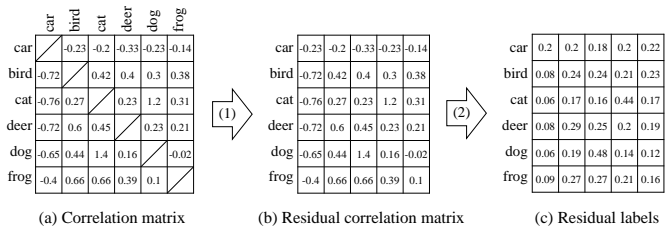
The load-bearing object is the residual correlation matrix: a $K \times (K-1)$ matrix whose $i$-th row, after softmax, gives the residual label, i.e. the probabilities that a sample of class $i$ is misclassified into each of the other $K-1$ classes. It is stored as the weight of an embedding layer, so a label can be converted to a residual label by lookup, and it is updated online by $L_{\mathrm{upd}}$ while $L_{\mathrm{res}}$ transfers the same distribution back to the backbone network. This two-way coupling is what lets the network learn from its own erroneous experience and is also what makes the method teacher-free.
What would settle it
Run the same training recipe on CIFAR-10 with a fraction of labels randomly flipped, or with one class heavily overrepresented; if the residual labels $q^{(\mathrm{res})}$ concentrate on the noisy or dominant classes and the final test accuracy falls below the plain baseline, the central assumption fails.
Extended reading notes
Core claim
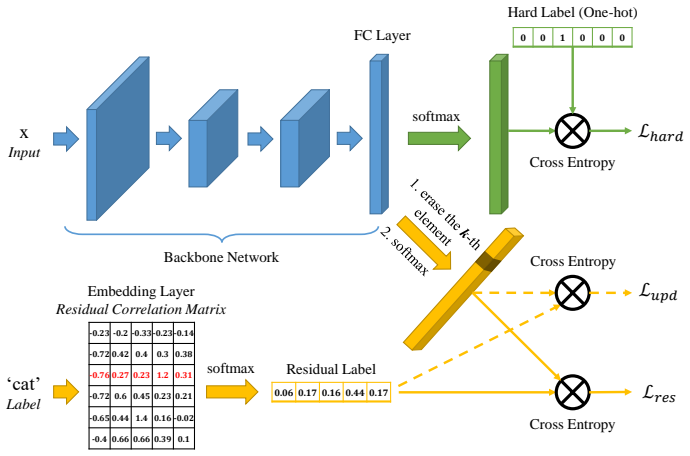
The central claim is that a network's own confusion pattern—what it tends to wrongly predict for each class—is useful training signal, not just noise. The method erases the ground-truth position from the network's output logits, builds a residual probability vector $p^{(\mathrm{res})}$ by softmax, and matches it to residual labels $q^{(\mathrm{res})}$ stored in an embedding layer. The update loss $L_{\mathrm{upd}}$ adapts $q^{(\mathrm{res})}$ to the current network, while the residual loss $L_{\mathrm{res}}$ pushes the network toward that same distribution, with a weight $(1 - \mathrm{acc}_{\mathrm{train}})$ that fades the correction as training accuracy rises. The paper reports that this adaptive label regularization improves top-1 accuracy over standard training under all tested image and text classification settings, and that combining it with label smoothing gives further gains.
Load-bearing premise
The method assumes that the patterns of a network's own mistakes on the training set are stable and trustworthy inter-class knowledge, so that updating residual labels online cannot amplify the model's errors.
Editorial extensions
If this is right
- A standard one-hot classifier can be augmented with a residual-label embedding of size roughly $K \times (K-1)$, adding only a few thousand parameters even for 100-class tasks.
- The method is architecture-agnostic in the reported experiments, improving ResNet, WideResNet, FastText, TextRNN, CharCNN, and Transformer baselines.
- Combining adaptive label regularization with label smoothing is complementary; the largest reported gain on CIFAR-100 reaches 1.54% over the baseline.
- On ImageNet, top-1 accuracy improves while top-5 accuracy can be slightly lower, indicating the regularization changes the structure of errors rather than only their rate.
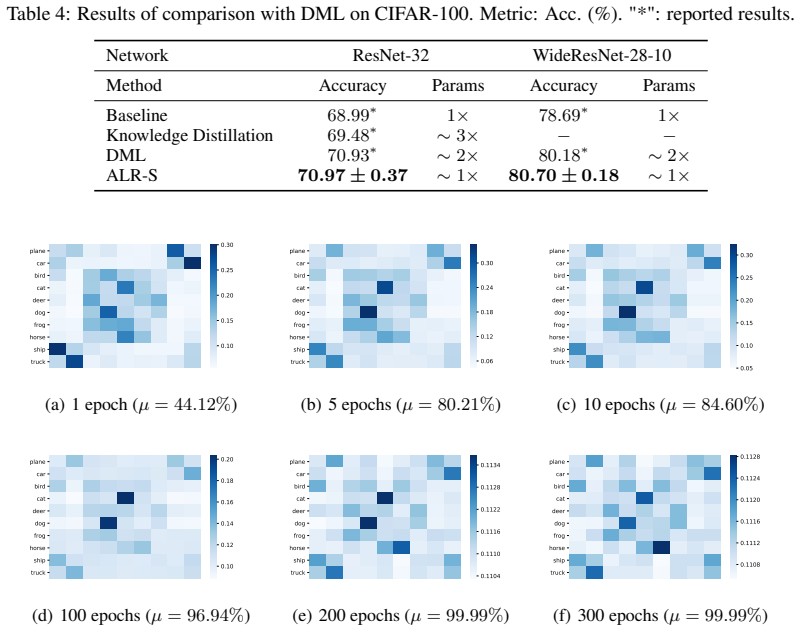
- The method reaches accuracy comparable to deep mutual learning while using only about half the parameters.
Reading between the lines
- Because residual labels are learned online from the network's own confusion, they may implicitly encode a data-driven taxonomy; a trained residual correlation matrix could be reused as a soft-label prior for transfer or semi-supervised learning.
- The method's safety likely depends on the training distribution being balanced and clean; a natural test is to run it under label noise or class imbalance, where the online-updated residual labels could drift toward the noise and turn $L_{\mathrm{res}}$ from a regularizer into an error amplifier.
- The $(1 - \mathrm{acc}_{\mathrm{train}})$ weighting suggests a testable variation: replace batch accuracy with per-class confidence or uncertainty estimates to see whether the correction schedule can be made more local.
Signed reviews
Editorial analysis
A structured set of objections, weighed in public.
Referee Report
Summary. The paper proposes Adaptive Label Regularization (ALR), a teacher-free method that maintains a residual correlation matrix as an embedding layer. Given a ground-truth label, this layer produces a residual label q^(res) over the K-1 non-ground-truth classes. The total loss is Ltot = Lhard + (1 - acctrain)Lres + Lupd, where Lupd fits q^(res) to the network's current residual prediction distribution p^(res) (Eq. 4) and Lres trains the network's residual predictions to match q^(res) (Eq. 5). The method is evaluated on CIFAR-10, CIFAR-100, ImageNet, and three text classification datasets, and is compared with label smoothing and Deep Mutual Learning. The authors claim significant improvement under all experimental settings and provide a qualitative visualization analysis of the learned residual labels on CIFAR-10.
Significance. If the claims are correct, ALR is an attractive low-overhead regularizer: it needs no teacher network, adds only a small embedding layer, can be combined with label smoothing, and shows gains across image and text classification. The paper's strengths are the simple formulation, the parameter efficiency compared with mutual-distillation baselines (Table 4), and the breadth of the evaluation. However, the headline claim is overstated by the paper's own ImageNet top-5 results, the gradient derivation contains a missing factor, statistical support is weak, and the stability of the self-referential residual-label update is not established. These issues are central to the paper's contribution and require substantial revision.
major comments (4)
- [Abstract; Section 4.1, Table 2] The abstract claims "significant improvement under all experimental settings," but Table 2 shows that ALR decreases ImageNet top-5 accuracy on all three backbones (ResNet-50: 93.03 to 92.73; ResNet-101: 93.82 to 93.63; ResNet-152: 93.89 to 93.80), and ALR-S decreases top-5 accuracy on ResNet-50 and ResNet-101. The authors acknowledge this in Section 4.1: "the top-5 accuracy of our methods is slightly lower than it of the baselines." This contradiction is load-bearing because the central empirical claim is the universality of the improvement. The authors must either restrict the claim to top-1 accuracy, temper the abstract, or provide a convincing explanation and analysis of the top-5 trade-off.
- [Section 3.2, Eqs. (4)-(8)] The gradient formula in Eq. (8) omits the 1/(K-1) factor that is present in the definition of Lres in Eq. (5). With Lres = -1/(K-1) * sum_i q_i^(res) log p_i^(res), direct differentiation over the softmax of the erased logits gives dLres/dz_i = (p_i^(res) - q_i^(res))/(K-1), not (p_i^(res) - q_i^(res)). In addition, Eq. (7) is presented as the gradient of Lb = Lhard + Lres, but the final training objective is Ltot = Lhard + (1 - acctrain)Lres + Lupd, so the displayed gradient does not correspond to the loss actually minimized. These are technical errors in the core derivation and should be corrected.
- [Section 4, Tables 1-3] The word "significant" is not supported by the reported statistics. On CIFAR-10, the ResNet-18 baseline is 95.28±0.21 and ALR is 95.42±0.16, a difference well within one standard deviation; on CIFAR-100 with WideResNet-28-10, baseline 81.20±0.08 vs ALR 81.31±0.14 likewise overlaps. Table 3 reports text-classification accuracies as single numbers with no standard deviations, repeated runs, or significance tests, and the ImageNet results appear to be single runs with no error bars. The authors should either provide error bars across multiple seeded runs and significance tests, or avoid claiming statistical significance.
- [Section 3.2, Eqs. (4)-(5); Section 5] The residual-label update is self-referential: Lupd moves q^(res) toward the network's own current p^(res), while Lres moves the network's p^(res) toward q^(res). At a fixed point p^(res) is approximately q^(res), so the regularizer ultimately targets the model's own error distribution. The paper offers no fixed-point analysis, no convergence argument, and no experiments under label noise or class imbalance; Section 5 provides only qualitative visualization on CIFAR-10. This leaves open the possibility that the method amplifies systematic errors or collapses to a degenerate distribution on harder or noisier problems, and the mechanism behind the reported gains remains underdetermined.
minor comments (6)
- [Section 1] In the discussion of knowledge distillation, "the hard loss Lsoft" should read "the hard loss Lhard"; this appears to be a typo.
- [Section 3.2, Eq. (3) and footnote 2] The notation defining the residual correlation matrix is garbled: the sentence "each row vector si = (ri)i 2" is incomplete and hard to parse. Please rewrite the definition of S and the erasing operation clearly.
- [Section 3.2] The text first defines Ltot = Lhard + Lres + Lupd (Eq. 6), then later writes Ltot = Lhard + (1 - acctrain)Lres + Lupd without renumbering, and Figure 2 does not show the (1 - acctrain) coefficient. Please reconcile the notation and the figure.
- [Section 3.2] The quantity acctrain is used as an adaptive weight but is never formally defined, for example whether it is a running average over the current epoch or over the whole training history.
- [Section 4.1] The paper states that ImageNet-12 consists of "more than14 million samples in 1,000 classes"; the ILSVRC2012 training set actually has roughly 1.28 million images. Please correct this factual detail.
- [Section 3.2] The claim that the method "has no hyper-parameter that needed to be manually adjusted" is overstated, because (1 - acctrain) is a hyperparameter of the loss and ALR-S additionally uses a label-smoothing coefficient.
Circularity Check
No circularity: the learned residual labels are self-referential by design, but test-time evaluation is independent and no load-bearing derivation reduces to its inputs.
full rationale
The paper's adaptive label regularization defines residual labels q^(res) that are updated online by Lupd (Eq. 4) to match the network's own non-ground-truth probabilities p^(res), while Lres (Eq. 5) trains the backbone toward q^(res). The text makes this explicit: 'Then we use the cross entropy loss between p^(res) and q^(res) as update loss Lupd to update residual labels. To regularize the output logits, we use the reverse cross entropy loss between p^(res) and q^(res) as residual loss Lres.' This is a self-referential feedback loop, but it is the method's stated design ('learn from erroneous experience'), not a hidden reduction of a predicted quantity to a fitted input. The residual labels are not presented as externally derived ground truth; they are explicitly learned from the network itself, and the paper's claims are evaluated by held-out test accuracy on CIFAR, ImageNet, and text datasets, which are independent of the training-time residual labels. There are no self-citations carrying a load-bearing argument, no imported uniqueness theorem, and no fitted parameter relabeled as a prediction. The abstract's 'significant improvement under all experimental settings' is contradicted by the ImageNet top-5 numbers in Table 2 (e.g., ResNet-50 top-5 93.03 baseline vs 92.73 ALR), but that is a correctness/support concern, not circularity. Under the circularity pass, no step reduces by construction to its own input.
Assumptions & free parameters
free parameters (3)
- Residual correlation matrix S =
learned online, not reported
- Residual loss weight (1 - acctrain) =
depends on running training accuracy
- Label smoothing coefficient in ALR-S =
not reported
assumptions (4)
- domain assumption The softmax of a row of the residual correlation matrix is a valid and useful target distribution for regularization.
- ad hoc to paper The model's training-set confusion distribution is stable and transferable enough that the online residual labels do not amplify errors.
- domain assumption Uniform initialization of residual labels maximizes entropy and is a safe starting point.
- domain assumption The modified ResNet and training schedules used in experiments are appropriate baselines.
invented entities (2)
-
Residual correlation matrix S
-
Residual label q^(res)
Cite this review
Pith. "Pith review of Adaptive Regularization of Labels." pith.science (2026). https://pith.science/paper/UEUE4YCD
@misc{pith2026190805474,
  author       = {Pith},
  title        = {Pith review of: Adaptive Regularization of Labels},
  year         = {2026},
  howpublished = {\url{https://pith.science/paper/UEUE4YCD}},
  note         = {Machine review of arXiv:1908.05474}
}
read the original abstract
Recently, a variety of regularization techniques have been widely applied in deep neural networks, such as dropout, batch normalization, data augmentation, and so on. These methods mainly focus on the regularization of weight parameters to prevent overfitting effectively. In addition, label regularization techniques such as label smoothing and label disturbance have also been proposed with the motivation of adding a stochastic perturbation to labels. In this paper, we propose a novel adaptive label regularization method, which enables the neural network to learn from the erroneous experience and update the optimal label representation online. On the other hand, compared with knowledge distillation, which learns the correlation of categories using teacher network, our proposed method requires only a minuscule increase in parameters without cumbersome teacher network. Furthermore, we evaluate our method on CIFAR-10/CIFAR-100/ImageNet datasets for image recognition tasks and AGNews/Yahoo/Yelp-Full datasets for text classification tasks. The empirical results show significant improvement under all experimental settings.
Figures
Forward citations
Cited by 1 Pith paper
-
Dynamic Frequency-Adaptive Knowledge Distillation for Speech Enhancement
A dynamic frequency-adaptive knowledge distillation method, using the steepest point in the running maximum of the teacher spectrum as a crossover, improves speech enhancement student models by small PESQ margins over...
Reference graph
Works this paper leans on
-
[1]
La- bel refinery: Improving imagenet classification through label progression
Hessam Bagherinezhad, Maxwell Horton, Mohammad Rastegari, and Ali Farhadi. La- bel refinery: Improving imagenet classification through label progression. arXiv preprint arXiv:1805.02641, 2018
arXiv 2018
-
[2]
Recur- rent batch normalization
Tim Cooijmans, Nicolas Ballas, César Laurent, Ça˘glar Gülçehre, and Aaron Courville. Recur- rent batch normalization. arXiv preprint arXiv:1603.09025, 2016
arXiv 2016
-
[3]
Gianna M Del Corso, Antonio Gulli, and Francesco Romani. Ranking a stream of news. In Proceedings of the 14th international conference on World Wide Web , pages 97–106. ACM, 2005
work page 2005
-
[4]
Ian J Goodfellow, David Warde-Farley, Mehdi Mirza, Aaron Courville, and Yoshua Bengio. Maxout networks. arXiv preprint arXiv:1302.4389, 2013
arXiv 2013
-
[5]
Deep residual learning for image recognition
Kaiming He, Xiangyu Zhang, Shaoqing Ren, and Jian Sun. Deep residual learning for image recognition. In Proceedings of the IEEE conference on computer vision and pattern recognition , pages 770–778, 2016
2016
-
[6]
Identity mappings in deep residual networks
Kaiming He, Xiangyu Zhang, Shaoqing Ren, and Jian Sun. Identity mappings in deep residual networks. In European conference on computer vision, pages 630–645. Springer, 2016
2016
-
[7]
Distilling the knowledge in a neural network
Geoffrey Hinton, Oriol Vinyals, and Jeff Dean. Distilling the knowledge in a neural network. arXiv preprint arXiv:1503.02531, 2015
arXiv 2015
-
[8]
Batch normalization: Accelerating deep network training by reducing internal covariate shift
Sergey Ioffe and Christian Szegedy. Batch normalization: Accelerating deep network training by reducing internal covariate shift. international conference on machine learning , pages 448–456, 2015
work page 2015
Show all 32 references
-
[9]
Information theory and statistical mechanics
E T Jaynes. Information theory and statistical mechanics. Physical Review, 106(2):620–630, 1957
1957
-
[10]
Bag of tricks for efficient text classification
Armand Joulin, Edouard Grave, Piotr Bojanowski, and Tomas Mikolov. Bag of tricks for efficient text classification. conference of the european chapter of the association for computational linguistics, 2:427–431, 2017
2017
-
[11]
Learning multiple layers of features from tiny images
Alex Krizhevsky and Geoffrey Hinton. Learning multiple layers of features from tiny images. Technical report, Citeseer, 2009
2009
-
[12]
Imagenet classification with deep convolutional neural networks
Alex Krizhevsky, Ilya Sutskever, and Geoffrey E Hinton. Imagenet classification with deep convolutional neural networks. In Advances in neural information processing systems , pages 1097–1105, 2012
2012
-
[13]
Recurrent convolutional neural networks for text classification
Siwei Lai, Liheng Xu, Kang Liu, and Jun Zhao. Recurrent convolutional neural networks for text classification. pages 2267–2273, 2015
2015
-
[14]
Deeply- supervised nets
Chen-Yu Lee, Saining Xie, Patrick Gallagher, Zhengyou Zhang, and Zhuowen Tu. Deeply- supervised nets. arXiv preprint arXiv:1409.5185, 2014
2014 arXiv
-
[15]
Unifying distillation and privileged information
David Lopez-Paz, Léon Bottou, Bernhard Schölkopf, and Vladimir Vapnik. Unifying distillation and privileged information. arXiv preprint arXiv:1511.03643, 2015
2015 arXiv
-
[16]
Mixed precision training
Paulius Micikevicius, Sharan Narang, Jonah Alben, Gregory Diamos, Erich Elsen, David Garcia, Boris Ginsburg, Michael Houston, Oleksii Kuchaiev, Ganesh Venkatesh, et al. Mixed precision training. arXiv preprint arXiv:1710.03740, 2017. 9
-
[17]
Reg- ularizing neural networks by penalizing confident output distributions
Gabriel Pereyra, George Tucker, Jan Chorowski, Łukasz Kaiser, and Geoffrey Hinton. Reg- ularizing neural networks by penalizing confident output distributions. arXiv preprint arXiv:1701.06548, 2017
2017 arXiv
-
[18]
Imagenet large scale visual recognition challenge
Olga Russakovsky, Jia Deng, Hao Su, Jonathan Krause, Sanjeev Satheesh, Sean Ma, Zhiheng Huang, Andrej Karpathy, Aditya Khosla, Michael Bernstein, et al. Imagenet large scale visual recognition challenge. International journal of computer vision , 115(3):211–252, 2015
2015
-
[19]
Dropout: a simple way to prevent neural networks from overfitting
Nitish Srivastava, Geoffrey Hinton, Alex Krizhevsky, Ilya Sutskever, and Ruslan Salakhutdinov. Dropout: a simple way to prevent neural networks from overfitting. The Journal of Machine Learning Research, 15(1):1929–1958, 2014
1929
-
[20]
Highway networks
Rupesh Kumar Srivastava, Klaus Greff, and Jürgen Schmidhuber. Highway networks. arXiv preprint arXiv:1505.00387, 2015
2015 arXiv
-
[21]
On the importance of initialization and momentum in deep learning
Ilya Sutskever, James Martens, George Dahl, and Geoffrey Hinton. On the importance of initialization and momentum in deep learning. In International conference on machine learning, pages 1139–1147, 2013
2013
-
[22]
Re- thinking the inception architecture for computer vision
Christian Szegedy, Vincent Vanhoucke, Sergey Ioffe, Jon Shlens, and Zbigniew Wojna. Re- thinking the inception architecture for computer vision. In Proceedings of the IEEE conference on computer vision and pattern recognition , pages 2818–2826, 2016
2016
-
[23]
Attention is all you need
Ashish Vaswani, Noam Shazeer, Niki Parmar, Jakob Uszkoreit, Llion Jones, Aidan N Gomez, Lukasz Kaiser, and Illia Polosukhin. Attention is all you need. neural information processing systems, pages 5998–6008, 2017
2017
-
[24]
Regularization of neural networks using dropconnect
Li Wan, Matthew Zeiler, Sixin Zhang, Yann Le Cun, and Rob Fergus. Regularization of neural networks using dropconnect. In International conference on machine learning , pages 1058–1066, 2013
2013
-
[25]
Group normalization
Yuxin Wu and Kaiming He. Group normalization. In Proceedings of the European Conference on Computer Vision (ECCV), pages 3–19, 2018
2018
-
[26]
Disturblabel: Regularizing cnn on the loss layer
Lingxi Xie, Jingdong Wang, Zhen Wei, Meng Wang, and Qi Tian. Disturblabel: Regularizing cnn on the loss layer. In Proceedings of the IEEE Conference on Computer Vision and Pattern Recognition, pages 4753–4762, 2016
2016
-
[27]
Shakedrop regulariza- tion for deep residual learning
Yoshihiro Yamada, Masakazu Iwamura, Takuya Akiba, and Koichi Kise. Shakedrop regulariza- tion for deep residual learning. arXiv preprint arXiv:1802.02375, 2018
2018 arXiv
-
[28]
Wide residual networks
Sergey Zagoruyko and Nikos Komodakis. Wide residual networks. arXiv preprint arXiv:1605.07146, 2016
2016 arXiv
-
[29]
Character-level convolutional networks for text classification
Xiang Zhang, Junbo Jake Zhao, and Yann Lecun. Character-level convolutional networks for text classification. neural information processing systems, pages 649–657, 2015
2015
-
[30]
Deep mutual learning
Ying Zhang, Tao Xiang, Timothy M Hospedales, and Huchuan Lu. Deep mutual learning. In Proceedings of the IEEE Conference on Computer Vision and Pattern Recognition , pages 4320–4328, 2018
2018
-
[31]
Knowledge distillation by on-the-fly native ensemble
Xiatian Zhu, Shaogang Gong, et al. Knowledge distillation by on-the-fly native ensemble. In Advances in Neural Information Processing Systems , pages 7517–7527, 2018
2018
-
[32]
Learning transferable architectures for scalable image recognition
Barret Zoph, Vijay Vasudevan, Jonathon Shlens, and Quoc V Le. Learning transferable architectures for scalable image recognition. InProceedings of the IEEE conference on computer vision and pattern recognition, pages 8697–8710, 2018. 10
2018
Reviewed August 14, 2026 · model on record in the stance chip above.
Discussion (0). Continue with ORCID to comment.