REVIEW 2 major objections 5 minor 47 references
Parity violating Friedmann Universes
T0 review · 2 major / 5 minor · reviewed 2026-08-14 · deepseek-v4-flash
Pith's one-line read This paper claims that in a varying-Lambda Einstein-Cartan theory, homogeneous and isotropic universes can violate parity through a torsional component that carries Weyl curvature and a genuinely new gravitational degree of freedom.
desk verdict Finds a genuinely new branch in the FRW minisuperspace of a varying-Lambda Einstein-Cartan theory, but the 'new degree of freedom' headline outruns the proof. read the letter →
The pith
A machine-rendered reading of the paper's core claim, the machinery that carries it, and where it could break.
The reading
What carries the argument
The object that carries the argument is the parity-odd torsion component $P$, or its conformal version $c=Pa$. It is the only FRW-compatible torsional degree of freedom with no tetrad counterpart, so its canonical momentum vanishes; the constraint algebra must then be closed in one of two ways. Imposing $c=0$ produces Theory 2, with the extra constraint that represents conformal invariance, while forming the combination of constraints that commutes with the vanishing momentum produces Theory 1, with only the Hamiltonian constraint. The Chern-Simons time constructed from $b$ and $c$ and the momentum conjugate to $\Lambda^{-1}$ are what allow the reduced action to be written in a form where this branching and the degree-of-freedom count become visible.
What would settle it
Perform a full 3+1 Hamiltonian constraint analysis of the action (7) without imposing FRW symmetry and count the constraints in the parity-odd sector. If new first-class or second-class constraints appear that remove the $P$ mode or change the counting back to the general-relativity values, then the claimed new degree of freedom is an artifact of the symmetric reduction.
Extended reading notes
Core claim
The central discovery is that the varying-$\Lambda$ Einstein-Cartan action (7), a self-dual combination of Palatini, Euler, Nieh-Yan, and Pontryagin terms with Immirzi parameter $\gamma$, admits Friedmann-Lemaitre-Robertson-Walker solutions with non-vanishing parity-odd torsion. With tetrad $e^0=dt$, $e^i=a\,dx^i$, homogeneity and isotropy permit $T^0=0$ and $T^i=-T\,e^0e^i+P\,\epsilon^i_{\ jk}e^je^k$; setting $P=0$ is an extra choice rather than a symmetry requirement. When $P\neq0$ the curvature has Weyl components proportional to $gP\,\epsilon^i_{\ jk}e^je^k$ and $(aP)^{\cdot}a^{-1}\epsilon^{ij}_{\ k}e^0e^k$, so FRW models can carry Weyl curvature. A Hamiltonian analysis of the FRW-reduced action then splits the theory into two branches: $P\neq0$ (Theory 1) has one Hamiltonian constraint and one degree of freedom in vacuum, two with matter, while $P=0$ (Theory 2) has an additional first-class constraint, conformal invariance, and no new degrees of freedom relative to general relativity. The paper concludes that the parity-odd mode is a genuinely new gravitational degree of freedom and that the two branches are effectively separate phases of the same theory.
Load-bearing premise
The load-bearing premise is that the degree-of-freedom count made from the homogeneous-isotropic reduced actions captures the full theory; if a full 3+1 analysis introduces additional spatial constraints, the parity-odd mode could be pure gauge or have different dynamics, and the central claim would fail.
Editorial extensions
If this is right
- On the parity-odd branch, the statement that FRW spacetimes have zero Weyl curvature is not a symmetry theorem but a consequence of the field equations, and it fails in this class of torsion theories.
- The parity-even branch has no new gravitational degree of freedom: in vacuum $\Lambda$ is pure gauge under conformal transformations, and with non-conformal matter $\Lambda$ is fixed by the matter density, so that branch is background-indistinguishable from general relativity.
- Theory 1 carries one extra degree of freedom relative to general relativity both in vacuum and with matter, so the parity-odd mode can modify the expansion history without introducing a new matter field.
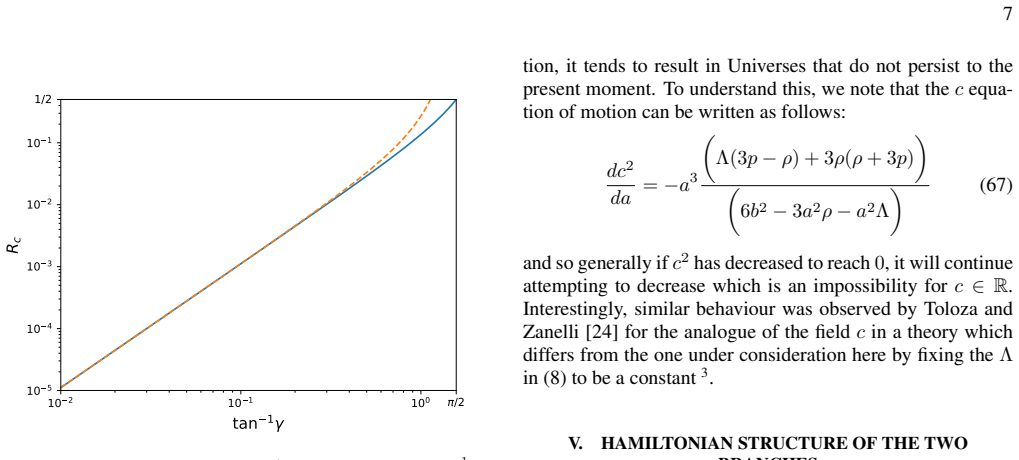
- For $\gamma\to\infty$ the tracking solutions force the parity-odd variable to contribute an effective energy density equal to half of the dominant matter component, or to behave like spatial curvature, which conflicts with data; at small finite $\gamma$ the required fraction drops to $\sim\gamma^2/9$, making a viable cosmology possible.
- A finite Immirzi/Pontryagin coupling generally rules out $P=0$ FRW solutions except in special cases, so turning on the Pontryagin term pushes the universe onto the parity-odd branch.
Reading between the lines
- If the Hamiltonian result survives a full 3+1 analysis, the parity-odd mode should also alter tensor and scalar perturbations, changing the graviton content relative to general relativity; the paper leaves this explicitly to future work.
- A homogeneous isotropic Weyl background is a new observational handle: CMB TB polarization and vector-mode weak lensing, named in the paper as promising, would be natural places to look for this parity-odd signal.
- Because $c^2$ enters the Hamiltonian constraint like negative spatial curvature, the parity-odd mode could masquerade as curvature or as a dark radiation component; separating it from $\Omega_k$ and $\Omega_r$ will be necessary in any observational test.
- The two-branch structure implies a symmetry-induced phase split: turning on parity violation removes the conformal constraint and changes the number of propagating degrees of freedom, a feature worth probing in a quantum treatment if the full theory confirms the count.
Signed reviews
Editorial analysis
A structured set of objections, weighed in public.
Referee Report
Summary. The paper studies an Einstein-Cartan theory in which the cosmological constant is promoted to a variable through the introduction of torsion, with the dynamics defined by the action (7). It shows that under FRW symmetry the parity-odd torsion component P is allowed, leading to nonvanishing Weyl curvature even in homogeneous and isotropic models, Eqs. (24)-(25). The authors derive the FRW field equations (26)-(30), then restrict to |gamma| -> infinity and obtain non-self-dual vacuum solutions (47)-(49), tracking and non-tracking matter solutions with severe phenomenological problems (60)-(63), and a preliminary finite-gamma mechanism to suppress the parity-odd contribution. The Hamiltonian analysis of the FRW-reduced action, Eqs. (70)-(74), reveals two branches: the parity-even Theory 2, with two first-class constraints and no new degree of freedom, and the parity-odd Theory 1, with one first-class constraint and one additional degree of freedom; Section VII reproduces this structure as a bifurcation in the treatment of the second-class pair (c, Pi_c). The paper concludes that the parity-odd branch contains a genuinely new degree of freedom.
Significance. If the central claim is fully established, this is a substantial contribution. The paper shows explicitly that standard statements about FRW universes — zero Weyl curvature and forced parity invariance — fail once torsion is allowed, identifies the extra constraint of the parity-even branch with conformal invariance, and exhibits a concrete two-branch Hamiltonian structure in which a torsion connection component acts as a new degree of freedom. The internal derivations are explicit and largely coherent: the gamma-to-infinity equations (32)-(36), the non-SD vacuum solutions (47)-(49), the scaling solutions (60)-(63), and the constraint algebras in Sections V-VII are all checkable and appear consistent. The paper also makes falsifiable statements about the observational failures of the gamma-to-infinity tracking solutions and about the role of finite gamma in suppressing the parity-odd mode. The main caveat is that the headline 'genuinely new degree of freedom' is established only in the minisuperspace reduction, and the finite-gamma results are tied to one specific action realization; these limitations are acknowledged in the body but not in the abstract.
major comments (2)
- [Section V, Eqs. (70)-(73), Table I; Section VIII] The central claim that the parity-odd branch contains a genuinely new degree of freedom rests entirely on the canonical analysis of the FRW-reduced action, not on a full 3+1 Dirac-Bergmann analysis of the theory defined by action (7). The paper itself states in Step 2 of Section V that 'within this approximation (spatial homogeneity and isotropy), this exposes the fact that c is a connection degree of freedom which does not have a conjugate metric variable,' and Section VIII defers tensor and scalar perturbations to future work. A minisuperspace reduction freezes all spatial gradients and imposes isotropy before the canonical analysis, so spatial constraints, Bianchi identities, or conjugate pairs associated with vector/tensor modes in the full theory cannot be seen in Table I. Without a full canonical analysis, or at minimum a linearized analysis around the parity-odd FRW background, the abstract's statement that the parity violating branch 'contains a genuinely new degree of freedom' is not supported. The authors should either provide the missing analysis or explicitly restrict the claim to the minisuperspace model.
- [Section II, Eq. (7); Section IV.B, Eqs. (64)-(66)] The action (7) is explicitly described by the authors as 'a possible answer' and 'not the most general' realization of the stated requirements, with the Pontryagin prefactor admitted to be arbitrary up to dimensional analysis. Nevertheless, the finite-gamma results — including the tracking equations (64)-(65), the small-gamma solution R_c ~ gamma^2/9 in Eq. (66) and Fig. 1, and the conclusion in the Introduction that 'finite gamma is needed for a viable cosmology' — are derived from this particular realization with the Immirzi parameter tied to the Pontryagin coefficient. If the prefactor can indeed be any function of Lambda, as the text states, then the finite-gamma phenomenological rescue is not a robust prediction of the framework. The abstract and conclusions should identify clearly which claims are specific to the chosen action (7) and which would survive for other duality-invariant realizations.
minor comments (5)
- [Section III, after Eq. (30)] The text refers to 'equations (14)-(42)' and later to 'the Euler term in (42)'; these should be Eqs. (14)-(16) and Eq. (30), respectively, and the sentence about the last (Pontryagin) term in Eq. (42) should be reworded to refer to Eq. (30).
- [Section V.D, paragraph before Table I] The sentence 'For Theory 2 in the presence of radiation we have three two-class constraints, two second-class constraints' should read 'two first-class constraints and two second-class constraints'; Table I itself, with F=2 and S=2, is correct.
- [Section IV.A, Eqs. (24)-(25) and following text] The sentence 'From (24) and (25) we see that W_ij = 0 for these solutions, but W_01 ≠ 0' should refer to the components W_0i, since the Weyl tensor here has two tetrad indices; the notation W_01 conflicts with the earlier notation W_0i.
- [Section III, Eq. (15)] The notation T[a eb] in Eq. (15) is not defined; please specify the antisymmetrization convention for the tetrad index a.
- [Throughout] There are several typographical errors, including 'Enstein' in Section IV, 'orgin' in Section V, and 'manifestion' in the conclusions; a careful proofreading pass is recommended.
Circularity Check
No circularity: the parity-odd branch and its degree-of-freedom count are derived in-paper from the stated action and constraint algebra, not imported from prior fits or self-citations.
full rationale
The paper's central claim is that the parity-odd torsion component P produces a distinct Hamiltonian branch with one additional degree of freedom. This claim is derived in the paper itself. The parity-odd component is introduced as the generally allowed homogeneous and isotropic torsion form (Eqs. 3-4), not as a quantity defined by the desired conclusion. The field equations (26)-(30) are obtained by varying the stated action (7), and the new branch is found by solving the algebraic equation (71), which explicitly factorizes into c = 0 and V = 2Na/b. The Hamiltonian actions (73) and (74) are obtained by rewriting and eliminating variables within the paper, and the constraint counts in Table I follow from computed Poisson brackets such as (81), (131)-(135). Nothing is fitted to data, and no target quantity is used as an input. The self-citations to [1,2,15,16] supply the starting action and the Chern-Simons time motivation, but the branch analysis and degree-of-freedom counting are performed in this paper and do not reduce to those citations. The acknowledged limitation that the counting is done at the FRW-minisuperspace level, so that a full 3+1 analysis might reveal extra constraints, is a correctness or scope concern rather than circularity; the paper itself restricts the claim to homogeneous and isotropic space-times in Section VIII. No circular step is identifiable.
Assumptions & free parameters
free parameters (2)
- Immirzi parameter gamma =
Infinity for the main solutions; finite in Sections IV.C and V.E
- Pontryagin pre-factor coefficient =
-3/(gamma*Lambda) in action (11)
assumptions (5)
- domain assumption The most general homogeneous and isotropic torsion is T0=0, Ti=-T e0 ei + P epsilon_ijk ej ek (Eqs. 3-4).
- domain assumption The matter action does not depend on the spin connection (delta S_M / delta omega = 0).
- ad hoc to paper Action (7) is a valid realization of the four requirements and the duality (5) is the organizing symmetry.
- domain assumption The FRW minisuperspace action (70)/(73) faithfully represents the Hamiltonian constraint structure of the full theory.
- standard math Dirac's conjecture that all first-class constraints generate gauge symmetries.
invented entities (1)
-
Parity-odd torsion component c = Pa
Cite this review
Pith. "Pith review of Parity violating Friedmann Universes." pith.science (2026). https://pith.science/paper/UEUGSBQ6
@misc{pith2026190805184,
  author       = {Pith},
  title        = {Pith review of: Parity violating Friedmann Universes},
  year         = {2026},
  howpublished = {\url{https://pith.science/paper/UEUGSBQ6}},
  note         = {Machine review of arXiv:1908.05184}
}
abstract
We revisit models, within the Einstein-Cartan theory, where the cosmological constant $\Lambda$ is promoted to a variable, at the cost of allowing for torsion even in the absence of spinors. We remark that some standard notions about FRW Universes collapse in these theories, most notably spatial homogeneity and isotropy may now co-exist with violations of parity invariance. The parity violating solutions have non-vanishing Weyl curvature even within FRW models. The presence of parity violating torsion opens up the space of possible such theories with relevant FRW modifications: in particular the Pontryagin term can play an important role even in the absence of spinorial matter. We present a number of parity violating solutions with and without matter. The former are the non-self dual vacuum solutions long suspected to exist. The latter lead to tracking and non-tracking solutions with a number of observational problems, unless we invoke the Pontryagin term. An examination of the Hamiltonian structure of the theory reveals that the parity even and the parity violating solutions belong to two distinct branches of the theory, with different gauge symmetries (constraints) and different numbers of degrees of freedom. The parity even branch is nothing but standard relativity with a cosmological constant which has become pure gauge under conformal invariance if matter is absent, or a slave of matter (and so not an independent degree of freedom) if non-conformally invariant matter is present. In contrast, the parity violating branch contains a genuinely new degree of freedom.
Figures

Reference graph
Works this paper leans on
-
[1]
One may ask what is the most general gravitational action which
that the SD condition trivially survives the promotion ofΛ to a field. One may ask what is the most general gravitational action which
-
[2]
is at most quadratic in the curvature
-
[3]
leaves the standard Einstein equations (the e equation) unmodified
-
[4]
contains the Palatini action as a term (or reduces to stan- dard torsion-free GR should Λ be constant)
-
[5]
(7) This action is evidently symmetric under (5)
is SD, remains invariant under duality (5)? A possible answer is: Sg =− ∫ 3 2Λ ( ϵabcd + 2 γηacηbd )( Rab− Λ 3eaeb )( Rcd− Λ 3eced ) − 2 γ ∫ TaTa. (7) This action is evidently symmetric under (5). It has the prop- erty that it satisfies a stronger version of 3), in that it reduces to the Holst action for constant Λ. It can be unwrapped into four termsSg =S...
-
[6]
The second term is the quasi-Euler term in the form con- templated in [1]. The pre-factor − 3 2Λ is fully determined by the duality. Following the “quasi-topological principle” ad- vocated in [1] (see Section II of that reference) one could add other quasi-topological terms preserving the duality. The term SNY is the Nieh-Yan invariant. Its first term is a...
-
[7]
Theory 2 in the presence of dust matter Using the results of Appendix II, it can be seen that for Theory 2 in the presence of dust we now have the Hamiltonian H2 =−2N √ a2H2−VV2 (95) whereV2 retains the form (80) and now H2 =k + (p 2 )2 − Λ 3a2−P 2a. (96) Working out the Poisson bracket between the two constraints we now find: {V2,H2} = Λ ( 1− 3P 4a3Λ ) 6 ...
-
[8]
Working out the Poisson bracket between the two constraints we find: {V2,H2} = Λ 6H2 + Λ 6a2χP4/3
Theory 2 in the presence of a radiation fluid For Theory 2 in the presence of a radiation fluid we have the Hamiltonian H2 =−2N √ a2H2−VV2 (105) whereV2 retains the form (80) and now H2 =k + (p 2 )2 − Λ 3a2−χP4/3 a2 (106) as explained in Appendix II. Working out the Poisson bracket between the two constraints we find: {V2,H2} = Λ 6H2 + Λ 6a2χP4/3. (107) Ther...
Show all 47 references
-
[9]
Theory 1 in the presence of matter It may be shown that in the presence of dust in the case of Theory 1 we now have: Hd 1 =−2N √ a2 (2 3 (p 2 )2 − 2Π 6p− Λ 3a2−P 2a ) (109) whereas in the presence of radiation we have Hr 1 =−2N √ a2 (2 3 (p 2 )2 − 2Π 6p− Λ 3a2−χP4/3 a2 ) (110)...
2007
-
[10]
Flanagan
Eanna E. Flanagan. Palatini form of 1/R gravity. Phys. Rev. Lett., 92:071101, 2004. doi:10.1103/PhysRevLett.92.071101
2004 doi
-
[11]
Liddle, Joo Magueijo, Robert Sims, and Lee Smolin
Stephon Alexander, Marina Cortłs, Andrew R. Liddle, Joo Magueijo, Robert Sims, and Lee Smolin. Zero-parameter extension of general relativity with a varying cosmologi- 16 cal constant. Phys. Rev. , D100(8):083506, 2019. doi: 10.1103/PhysRevD.100.083506
2019 doi
-
[12]
Liddle, Joo Magueijo, Robert Sims, and Lee Smolin
Stephon Alexander, Marina Cortłs, Andrew R. Liddle, Joo Magueijo, Robert Sims, and Lee Smolin. Cosmology of min- imal varying Lambda theories. Phys. Rev., D100(8):083507,
-
[13]
Spinor driven cosmic bounces and their cosmological per- turbations
Shane Farnsworth, Jean-Luc Lehners, and Taotao Qiu. Spinor driven cosmic bounces and their cosmological per- turbations. Phys. Rev. , D96(8):083530, 2017. doi: 10.1103/PhysRevD.96.083530
2017 doi
-
[14]
Brian P. Dolan. Chiral fermions and torsion in the early Universe. Class. Quant. Grav. , 27:095010, 2010. doi:10.1088/0264-9381/27/9/095010, 10.1088/0264- 9381/27/24/249801. [Erratum: Class. Quant. Grav.27,249801(2010)]
2010 doi
-
[15]
Interaction of the Barbero-Immirzi Field with Matter and Pseudo-Scalar Perturbations
Simone Mercuri and Victor Taveras. Interaction of the Barbero-Immirzi Field with Matter and Pseudo-Scalar Perturbations. Phys. Rev. , D80:104007, 2009. doi: 10.1103/PhysRevD.80.104007
2009 doi
-
[16]
Hehl, and James M
Peter Baekler, Friedrich W. Hehl, and James M. Nester. Poincare gauge theory of gravity: Friedman cosmology with even and odd parity modes. Analytic part. Phys. Rev., D83: 024001, 2011. doi:10.1103/PhysRevD.83.024001
2011 doi
-
[17]
Poplawski
Nikodem J. Poplawski. Nonsingular, big-bounce cosmology from spinor-torsion coupling. Phys. Rev., D85:107502, 2012. doi:10.1103/PhysRevD.85.107502
2012 doi
-
[18]
Torsion, an alternative to the cosmological constant? Int
Thomas Schucker and Andre Tilquin. Torsion, an alternative to the cosmological constant? Int. J. Mod. Phys. , D21:1250089,
-
[19]
E . Cartan. . Compt.Rend.Hebd.Seances Acad.Sci., 174:593, 1922
1922
-
[20]
Non-minimally coupled scalar field cosmology with torsion
Antonella Cid, Fernando Izaurieta, Genly Leon, Perla Med- ina, and Daniela Narbona. Non-minimally coupled scalar field cosmology with torsion. JCAP, 1804(04):041, 2018. doi: 10.1088/1475-7516/2018/04/041
2018 doi
-
[21]
Spacetime and dark matter from spontaneous break- ing of Lorentz symmetry
Tom Zlosnik, Federico Urban, Luca Marzola, and Tomi Koivisto. Spacetime and dark matter from spontaneous break- ing of Lorentz symmetry. Class. Quant. Grav., 35(23):235003,
-
[22]
Cosmological signature change in Cartan Gravity with dynamical symmetry breaking
Jo ˜ao Magueijo, Mat ´ıas Rodr´ıguez-V´azquez, Hans Westman, and Tom Zlosnik. Cosmological signature change in Cartan Gravity with dynamical symmetry breaking. Phys. Rev., D89: 063542, 2014. doi:10.1103/PhysRevD.89.063542
2014 doi
-
[23]
Westman and T
Hans F. Westman and T. G. Zlosnik. An introduction to the physics of Cartan gravity. Annals Phys., 361:330–376, 2015. doi:10.1016/j.aop.2015.06.013
2015 doi
-
[24]
Sotiriou
Thomas P. Sotiriou. Unification of inflation and cosmic acceler- ation in the Palatini formalism. Phys. Rev., D73:063515, 2006. doi:10.1103/PhysRevD.73.063515
2006 doi
-
[25]
Florian Bauer and Durmus A. Demir. Higgs-Palatini Infla- tion and Unitarity. Phys. Lett. , B698:425–429, 2011. doi: 10.1016/j.physletb.2011.03.042
2011 doi
-
[26]
P.A.M. Dirac. Lectures in quantum mechanics. Dover, NY, 2001
2001
-
[27]
Emergent inflation from a NambuJona-Lasinio mechanism in gravity with non-dynamical torsion
Andrea Addazi, Pisin Chen, and Antonino Marciano. Emergent inflation from a NambuJona-Lasinio mechanism in gravity with non-dynamical torsion. Eur. Phys. J., C79(4):297, 2019. doi: 10.1140/epjc/s10052-019-6803-7
2019 doi
-
[28]
The quan- tum cosmological constant, 2018
Stephon Alexander, Joao Magueijo, and Lee Smolin. The quan- tum cosmological constant, 2018
2018
-
[29]
A Universe that does not know the time
Jo ˜ao Magueijo and Lee Smolin. A Universe that does not know the time. 2018. doi:10.3390/universe5030084
2018 doi
-
[30]
The Chern-Simons invariant as the natural time variable for classical and quantum cosmol- ogy
Lee Smolin and Chopin Soo. The Chern-Simons invariant as the natural time variable for classical and quantum cosmol- ogy. Nucl. Phys. , B449:289–316, 1995. doi:10.1016/0550- 3213(95)00222-E
1995 doi
-
[31]
Richard Gott, III and Li-Xin Li
J. Richard Gott, III and Li-Xin Li. Can the universe create itself? Phys. Rev. , D58:023501, 1998. doi: 10.1103/PhysRevD.58.023501
1998 doi
-
[32]
David Brown and Karel V
J. David Brown and Karel V . Kuchar. Dust as a standard of space and time in canonical quantum gravity. Phys. Rev., D51: 5600–5629, 1995. doi:10.1103/PhysRevD.51.5600
1995 doi
-
[33]
Markus Lazar and Friedrich W. Hehl. Cartan’s spiral staircase in physics and, in particular, in the gauge theory of dislocations. Found. Phys., 40:1298–1325, 2010. doi:10.1007/s10701-010- 9440-4
2010 doi
-
[34]
S. Mignemi. The Dynamical structure of four-dimensional Chamseddine’s gauge theory of gravity. Phys. Rev. , D59: 064022, 1999. doi:10.1103/PhysRevD.59.064022
1999 doi
-
[37]
Cosmology with scalarEuler form coupling
Adolfo Toloza and Jorge Zanelli. Cosmology with scalarEuler form coupling. Class. Quant. Grav. , 30:135003, 2013. doi: 10.1088/0264-9381/30/13/135003
2013 doi
-
[38]
Zlosnik and Constantinos Skordis
Thomas G. Zlosnik and Constantinos Skordis. Cosmology of the Galileon extension of Bekensteins theory of relativistic modified Newtonian dynamics. Phys. Rev., D95:124023, 2017. doi:10.1103/PhysRevD.95.124023
2017 doi
-
[40]
Symmetries in Constrained Hamiltonian Systems
Leonardo Castellani. Symmetries in Constrained Hamiltonian Systems. Annals Phys. , 143:357, 1982. doi:10.1016/0003- 4916(82)90031-8
1982 doi
-
[41]
Gravitation and gauge symmetries
Blagojevic. Gravitation and gauge symmetries. CRC Press, 2001
2001
-
[42]
Contaldi, Joao Magueijo, and Lee Smolin
Carlo R. Contaldi, Joao Magueijo, and Lee Smolin. Anomalous CMB polarization and gravitational chirality. Phys. Rev. Lett., 101:141101, 2008. doi:10.1103/PhysRevLett.101.141101
2008 doi
-
[43]
Gravitational-Wave Tests of General Relativity with Ground-Based Detectors and Pulsar Timing-Arrays
Nicols Yunes and Xavier Siemens. Gravitational-Wave Tests of General Relativity with Ground-Based Detectors and Pulsar Timing-Arrays. Living Rev. Rel., 16:9, 2013. doi:10.12942/lrr- 2013-9
2013 doi
-
[44]
Thomas, Carlo R
Daniel B. Thomas, Carlo R. Contaldi, and Joao Magueijo. Ro- tation of galaxies as a signature of cosmic strings in weak lensing surveys. Phys. Rev. Lett. , 103:181301, 2009. doi: 10.1103/PhysRevLett.103.181301
2009 doi
-
[46]
Armendariz-Picon, Viatcheslav F
C. Armendariz-Picon, Viatcheslav F. Mukhanov, and Paul J. Steinhardt. Essentials of k essence. Phys. Rev., D63:103510,
-
[2001]
doi:10.1103/PhysRevD.63.103510
-
[2012]
doi:10.1142/S0218271812500897
-
[2013]
617656 Theories and Mod- els of the Dark Sector: DM, Dark Energy and Gravity
/ ERC Grant Agreement n. 617656 Theories and Mod- els of the Dark Sector: DM, Dark Energy and Gravity. JM was funded by the STFC Consolidated Grant ST/L00044X/1. APPENDIX I: FRW REDUCTION OF THE ACTION AND PARITY TRANSFORMATIONS In this appendix we provide a separate derivatio...
-
[2018]
doi:10.1088/1361-6382/aaea96
-
[2019]
doi:10.1103/PhysRevD.100.083507
Reviewed August 14, 2026 · model on record in the stance chip above.
Discussion (0). Continue with ORCID to comment.