REVIEW 3 major objections 6 minor 7 references
Quantum-Annealing Enhanced Machine Learning for Interpretable Phase Classification of High-Entropy Alloys
T0 review · 3 major / 6 minor · reviewed 2026-08-06 · deepseek-v4-flash
Pith's one-line read Quantum annealing provides competitive, interpretable phase classification for high-entropy alloys, with faster training in the authors' setup.
desk verdict A genuinely new application of QA-based QBoost/QSVM to HEA phase classification, but the label ambiguity in Table 4 undermines the headline accuracy claims. read the letter →
The pith
A machine-rendered reading of the paper's core claim, the machinery that carries it, and where it could break.
The reading
What carries the argument
The load-bearing object is the QUBO reformulation of both learners. For QBoost, the squared boosting loss over binary weights on single-feature decision stumps (thresholds on one physical descriptor) expands into a quadratic form whose coupling matrix is $C'_{ij} = \sum_s h_i(x_s) h_j(x_s)$; switching to spin variables turns it into an Ising Hamiltonian, so each feature's inclusion is one spin. For QSVM, each dual coefficient $\alpha_n$ is expanded in base $B$ with $K$ bits, and the SVM dual loss, plus a penalty $\xi (\sum_n \alpha_n y_n)^2$ for the equality constraint, becomes a QUBO matrix $Q$ with entries $B^k B^j y_n y_m [K(x_n, x_m) + \xi]$ minus the diagonal term; the annealer minimizes this matrix. The same binary-optimization architecture carries both models, and the interpretability comes from the one-descriptor-per-stump structure and from keeping features in their original physical units.
What would settle it
A reader can settle the generalization claim by scoring Table 4 under the natural rule 'phase present anywhere in the XRD assemblage counts as positive' and recomputing the per-phase test accuracies; for FCC the listed A1-containing multiphase alloys predicted FALSE would push the accuracy below the reported 0.8833. If the authors instead meant single-phase dominance, the same table needs a label definition before any reported accuracy is reproducible.
Extended reading notes
Core claim
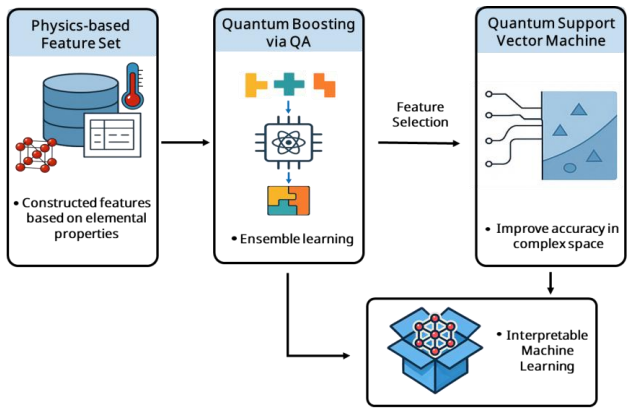
The central claim is that high-entropy alloy phase classification can be reformulated as QUBO and solved on current quantum annealing hardware without giving up accuracy. QBoost trains an ensemble of single-feature decision stumps with binary weights, so the optimized weight vector is simultaneously a classifier and a feature selector; QSVM encodes support-vector dual coefficients in binary and uses an RBF kernel, so the SVM dual loss becomes a QUBO matrix that the annealer minimizes. On five-fold cross-validation and on an independent test set of 86 experimentally synthesized and XRD-characterized alloys, the paper reports that quantum-annealed models match or beat simulated-annealing-selected models and classical SVMs on most phases, with QSVM particularly improving test accuracy for the harder intermetallic phases (RB2 test accuracy 0.93 versus 0.86 for the previous classical model). The authors further claim that the best QSVM models are obtained when the constraint $\sum_n \alpha_n y_n = 0$ is relaxed rather than strictly enforced, turning the annealer's stochastic near-optimal solutions into an implicit regularizer.
Load-bearing premise
The load-bearing premise is that the training and test labels mean the same thing for each phase—specifically, whether a phase counts as present when it appears in a multiphase X-ray diffraction assemblage—and Table 4 suggests this may not hold for FCC, so every reported accuracy depends on that labeling convention.
Editorial extensions
If this is right
- QBoost can act as a transparent feature selector, so a phase prediction comes with a short list of physical descriptors whose role in phase stability is already known.
- The adaptive pipeline means simple alloys can be handled by the compact QBoost model, while hard intermetallic phases are passed to QSVM with a physics-grounded feature subset.
- Because the reported QUBO solve times are orders of magnitude below the simulated-annealing baseline in this setup, retraining-heavy workflows such as active learning become more practical if the hardware overhead is included in the comparison.
- Relaxing the SVM equality constraint consistently improved test generalization in the paper's experiments, so the annealer's approximate solutions should be treated as a feature, not a bug.
- The method improves over the earlier feature-engineered model for Laves, Sigma, and RB2 but not for Heusler, marking the limit of the current descriptor set.
Reading between the lines
- The relaxed-constraint result points to a design rule for QUBO-based machine learning generally: deliberately leaving a KKT-type equality unsatisfied may act like dropout or early stopping. Testing the same penalty sweep on other datasets would show whether the effect is specific to this kernel and feature set.
- The runtime advantage is a hardware-and-implementation comparison, not a proven quantum speedup; a cleaner benchmark would measure end-to-end wall-clock time including embedding, against highly optimized classical QUBO solvers and classical SVMs.
- The Table 4 label ambiguity is the main reproducibility risk: if 'FCC FALSE' means the phase is not the dominant phase, rather than absent, then the reported 0.8833 test accuracy is not what a reader would compute by checking for A1 in each XRD assemblage. Publishing an explicit label definition or per-prediction error table would settle it.
- The selected-feature patterns could be compared against classical sparse classifiers on the same 31 descriptors to isolate what the quantum optimizer adds beyond sparsity, since QBoost's interpretability largely comes from the decision-stump structure rather than from quantum annealing itself.
Editorial analysis
A structured set of objections, weighed in public.
Referee Report
Summary. The paper proposes a quantum-annealing-based machine learning pipeline for classifying six crystallographic phases (FCC, BCC, Al-X-Y B2, Heusler, Sigma, Laves) in high-entropy alloys. The pipeline combines QBoost for interpretable feature selection and classification, and a QSVM for nonlinear classification, both formulated as QUBO problems and solved on a D-Wave annealer (with the hybrid solver for QSVM). The authors benchmark against simulated annealing and classical SVM, using cross-validation plus an independent test set of 86 experimentally synthesized alloys from a prior study, and report competitive accuracy, interpretable feature selection, and several orders of magnitude runtime reduction.
Significance. If substantiated, the work would be a practical demonstration of quantum annealing in an interpretable materials-informatics pipeline, with useful feature-selection insights and a real experimental test set. The core QUBO derivations for QBoost follow established work (Neven et al., Willsch et al.) and are clearly presented. The use of an independent experimental test set is a strength. However, the central empirical claims are not currently supported: the phase-label semantics underlying every accuracy number are ambiguous and inconsistent with Table 4; the QSVM is not a standard SVM because the equality constraint is dropped; and the runtime comparison uses an implausibly slow simulated annealing baseline. These issues are load-bearing for the headline conclusions of accuracy, generalization, and quantum advantage.
major comments (3)
- [Data Construction; Table 4] The label definition is ambiguous and internally inconsistent. The Methods section states that each dataset 'was constructed to capture both presence and absence of the phase of interest.' Under that semantics, an alloy whose XRD shows A1 (FCC) anywhere in a multiphase assemblage should have a positive FCC label, and one showing A2 should have a positive BCC label. Table 4 contradicts this: for example, Ag20Al20Cr20Mn20Ni20 (experimental B2+A1) is listed with FCC prediction FALSE; Al15Cr15Mo15Ni46W9 (B2+A1+A2) has both FCC and BCC FALSE; Al33Co17Nb33Ni17 (B2+Laves) has Laves FALSE; Al25Cr10Fe20Mn10Ni20Ti15 (L2₁, a Heusler phase) has Heusler FALSE; and Al10Co20Cr10Cu20Mn20Ni20 (A1+A2) has FCC TRUE but BCC FALSE. If 'presence' is the target, these are false negatives and the test accuracies in Tables 2 and 3 are not reproducible from the table. If the target is instead something like 'dominant phase' or 'single-phase presence,' that must be stated explicitly, and all reported accuracies, F1 scores, and the interpretability conclusions would need to be recomputed under that definition. Because every quantitative claim in the paper depends on this label choice, this ambiguity is load-bearing.
- [Quantum Support Vector Machine; Methods equation for bias] The QSVM is not a support vector machine as defined, because the equality constraint sum_n alpha_n y_n = 0 is not enforced in the best-performing models. Equation (3)-(4) define the dual SVM problem with constraint sum alpha_n y_n = 0; the QUBO in Methods includes a penalty term xi*(sum alpha_n y_n)^2, but Table 3 shows that all reported best QSVM models use xi = 0. The paper itself acknowledges that 'the best-performing QSVM models emerged when the constraint was relaxed rather than strictly enforced.' Without this constraint, the bias term b in the decision function is not well defined by the standard SVM formula given in Methods, since the denominator sum alpha_n (C - alpha_n) can vanish or the KKT conditions do not hold. The classifier is therefore a different model (a regularized kernel classifier with stochastic coefficients), and the comparison with a classical SVM that enforces the constraint is not a controlled comparison. To support the claim that quantum annealing provides a benefit, the authors should either enforce the constraint (nonzero xi) and report those results, or compare against a classical model that also relaxes the constraint in the same way.
- [Results; Methods - Simulated Annealing] The reported runtime advantage of roughly 10,000x is based on an unfair baseline. The paper states that QA solved each QUBO in approximately 0.01-0.02 seconds, while SA took about 300-400 seconds per instance on a CPU cluster. For a QUBO with only 31 binary variables and 1000 samples (the stated QA parameters), a well-implemented simulated annealer on a modern CPU should finish in milliseconds or at most a few seconds; 300-400 seconds suggests a pathological implementation or a mismatched workload (e.g., running SA on a dense, fully connected QUBO with default parameters that do not exploit sparsity). The Methods only says SA used 'D-Wave's reference implementation from Ocean SDK, using dimod package, matching the QA sample count and using default parameters,' which is not sufficient to establish a fair time-to-solution comparison. The paper's own caveat that speedups are hardware-dependent is appropriate, but the figure and the phrase 'orders-of-magnitude faster convergence' are not supported by the evidence as presented. The authors should benchmark SA with a standard, optimized implementation and report time-to-solution as a function of problem size, not just wall-clock time for a single instance.
minor comments (6)
- [Discussion] The claim that the framework 'consistently delivers competitive, and often superior, performance' is overstated relative to Table 3: classical SVM achieves higher test accuracy than QSVM for FCC (0.93 vs 0.90) and BCC (0.95 vs 0.92), equal for Laves (0.90), and higher for none of the remaining phases in a consistent pattern; the advantage is phase-dependent.
- [Data Construction] There are copy-paste errors in the dataset descriptions: the FCC dataset is said to comprise '132 HEAs with the FCC phase (Laves)' and the BCC dataset '178 HEAs with the FCC phase (Laves)'; these should refer to the FCC and BCC phases respectively.
- [Table 4] The entry 'Co18Cu18Fe18Mn18Ni18V10' lists experimental result 'A1+A1', which appears to be a typo (likely A1+A2 or another mixture); this should be corrected.
- [Introduction] The reference numbering is inconsistent: reference [32] is cited as both 'Pudenz & Lidar (2013)' and later 'Brown & Zhuang (2023)' in the same paragraph, and some references (e.g., [34]) have mismatched arXiv numbers; the reference list should be carefully reconciled.
- [Figure 5] The caption of Figure 5 does not specify which dataset or hyperparameters were used beyond 'RB2 dataset'; for reproducibility, the exact parameter settings (B, K, xi, gamma, number of reads) should be given.
- [Abstract] The abstract states 'rigorously curated test set' but the test set is drawn from the authors' prior study [20]; this is acceptable, but the text should clarify that these are the same compositions and that no new experimental data are reported here.
Circularity Check
No significant circularity: QBoost/QSVM QUBO constructions follow external Neven et al. and Willsch et al.; the held-out test set is prior experimental XRD data independent of training.
full rationale
The paper's central claims are empirical benchmarks, not analytic predictions derived from its inputs by construction. The QBoost loss (Eq. 2) and its QUBO expansion in the Methods follow the external Neven et al. constructions [30,31], and the QSVM binary encoding follows Willsch et al. [29]; neither is justified by a self-citation, and no uniqueness or ansatz result is imported from the authors' own prior work. The feature set is physics-based (Table 1) and independent of the outcome labels. Generalization is evaluated on 86 alloys from the authors' prior study [20], but those XRD measurements are independent experimental data not used in training or hyperparameter tuning, so using them as a test set is a standard external benchmark rather than a self-referential reduction. The 'implicit regularization' interpretation of stochastic QA solutions is post hoc and does not enter the derivation chain. The Table 4 label ambiguity (e.g., B2+A1 alloys marked FALSE for FCC despite FCC being present) is a reproducibility and correctness concern about whether ground-truth labels match their stated presence/absence semantics, not a circularity: it does not make the predictions equivalent to the inputs or to the fitted parameters. No load-bearing step reduces by construction, so the circularity score is 0.
Assumptions & free parameters
free parameters (7)
- lambda (QBoost L0 regularization) =
Tuned over {1, 0.1, 0.01, 0.001} with localized refinement
- gamma (RBF kernel width) =
Per phase; from {0.125, 0.25, 0.5, 1, 2, 4, 8}
- B (QSVM encoding base) =
Per phase; B in {2,3,4}
- K (QSVM bits per coefficient) =
Per phase; K in {2,3}
- xi (constraint penalty) =
Best models use 0
- chain_strength =
2.0
- under_sampling_rounds =
30
assumptions (7)
- standard math Convex dual SVM derivation and KKT conditions apply, including the role of the equality constraint.
- standard math The QUBO-to-Ising mapping via q_i = 2 omega_i - 1 is valid.
- domain assumption The 31 physics-informed descriptors are sufficient to predict phase formation.
- domain assumption The database labels (presence/absence of each phase) are correct and consistent.
- domain assumption Random under-sampling of the majority class over 30 rounds produces unbiased training sets.
- domain assumption D-Wave Advantage with minor embedding and chain strength 2.0 returns valid QUBO solutions.
- ad hoc to paper Dropping the SVM equality constraint (xi=0) still yields a well-defined classifier, with the annealer's stochastic search acting as a regularizer.
Cite this review
Pith. "Pith review of Quantum-Annealing Enhanced Machine Learning for Interpretable Phase Classification of High-Entropy Alloys." pith.science (2026). https://pith.science/paper/UEZSZPAV
@misc{pith2026250710237,
  author       = {Pith},
  title        = {Pith review of: Quantum-Annealing Enhanced Machine Learning for Interpretable Phase Classification of High-Entropy Alloys},
  year         = {2026},
  howpublished = {\url{https://pith.science/paper/UEZSZPAV}},
  note         = {Machine review of arXiv:2507.10237}
}
read the original abstract
High entropy alloys (HEAs) offer unprecedented compositional flexibility for designing advanced materials, yet predicting their crystallographic phases remains a key bottleneck due to limited data and complex phase formation behavior. Here, we present a quantum-enhanced machine learning framework that leverages quantum annealing to enhance phase classification in HEAs. Our pipeline integrates Quantum Boosting (QBoost) for interpretable feature selection and classification, with Quantum Support Vector Machines (QSVM) that use quantum-enhanced kernels to capture nonlinear relationships between physical descriptors. By reformulating both models as Quadratic Unconstrained Binary Optimization (QUBO) problems, we exploit the efficient sampling capabilities of quantum annealers to achieve rapid training and robust generalization, demonstrating notable runtime reductions relative to classical baselines in our setup. We target six key phases: FCC, BCC, Sigma, Laves, Heusler, and AlXY B2, and benchmark model performance using both cross-validation and a rigorously curated test set of prior experimentally synthesized HEAs. The results confirm strong alignment between predicted and measured phases. Our findings demonstrate that quantum-enhanced classifiers match or exceed classical models in accuracy and offer insights grounded in interpretable physical descriptors. This work constitutes an important step toward practical quantum acceleration in materials discovery pipelines.
Figures
Reference graph
Works this paper leans on
-
[1]
1 X. Wang, W. Guo, Y. Fu, High-entropy alloys: emerging materials for advanced functional applications. J. Mater. Chem. A 9(2), 663–701 (2021). https://doi.org/10.1039/D0TA09601F 2 E.P. George, W.A. Curtin, C.C. Tasan, High entropy alloys: a focused review of mechanical properties and deformation mechanisms. Acta Mater. 188, 435–474 (2020). https://doi.or...
arXiv 2021
-
[20]
PMID: 39565853; PMCID: PMC11639200. 10 Ma, Y., Kou, Z., Yang, W. et al. A one-step fabrication of soft-magnetic high entropy alloy fiber with excellent strength and flexibility. Nat Commun 15, 10549 (2024). https://doi.org/10.1038/s41467 -024- 54984-7 11 J.M. Rickman et al., Machine learning strategies for high-entropy alloys. J. Appl. Phys. (2020). https...
doi:10.1038/s41467 2024
-
[45]
https://doi.org/10.1038/s41524-024-01505-1 30 24 Sandt, R., & Spatschek, R. (2023). Efficient low temperature Monte Carlo sampling using quantum annealing. Scientific Reports, 13,
-
[348]
Training a Binary Classifier with the Quantum Adiabatic Algorithm
31 Neven, H., Denchev, V. S., Rose, G., & Macready, W. G. (2008). Training a Binary Classifier with the Quantum Adiabatic Algorithm. arXiv:0811.0416. https://arxiv.org/abs/0811.0416 32 Pudenz, K. L., & Lidar, D. A. (2013). Quantum adiabatic machine learning. Quantum Information Processing, 12, 2027–2070. https://doi.org/10.1007/s11128-012-0506-4 33 Sallou...
work page Pith review arXiv 2008
-
[400]
https://doi.org/10.3390/met14040400 29 15 Zhao, S., Yuan, R., Liao, W., Zhao, Y., Wang, J., Li, J., & Lookman, T. (2024). Descriptors for phase prediction of high entropy alloys using interpretable machine learning. Journal of Materials Chemistry A, 12, 2807–2815. https://doi.org/10.1039/D3TA06402F 16 Iyengar, M. S., Anirudh, M. K., Desik, P. H. A., & Pha...
-
[1239]
https://doi.org/10.1126/science.abn7293 23 Zhang, Y., et al. (2024). Quantum annealing-assisted lattice optimization. npj Computational Materials, 10(1),
-
[6754]
https://doi.org/10.1038/s41598-023-33845-6 25 Camino, B., et al. (2023). Quantum computing and materials science: A practical guide to applying quantum annealing to the configurational analysis of materials. Journal of Applied Physics, 133(22), 221102. https://doi.org/10.1063/5.0151346 26 Guo, Y., Tang, M., Li, Z., & Chen, Y. (2024). Harnessing quantum po...
work page Pith review arXiv 2023
Reviewed August 6, 2026 · model on record in the stance chip above.
Discussion (0). Continue with ORCID to comment.