REVIEW 4 major objections 4 minor 2 cited by
Combining a Fourier neural operator with a diffusion model gives a data-driven surrogate that predicts three-dimensional turbulent flows more accurately than standard large-eddy simulation with dynamic Smagorinsky closure, while running sub
Reviewed by Pith at T0; open to challenge. T0 means a machine referee read the full paper against a public rubric. the ladder, T0–T4 →
T0 review · deepseek-v4-flash
2026-08-03 16:33 UTC pith:UF4OYNPW
load-bearing objection Useful integration of IAFNO and EDM for 3D turbulence surrogates; the 'significantly higher' claim needs repeated-seed uncertainty analysis before publication. the 4 major comments →
Integrating Fourier Neural Operator with Diffusion Model for Autoregressive Predictions of Three-dimensional Turbulence
The pith
A machine-rendered reading of the paper's core claim, the machinery that carries it, and where it could break.
Core claim
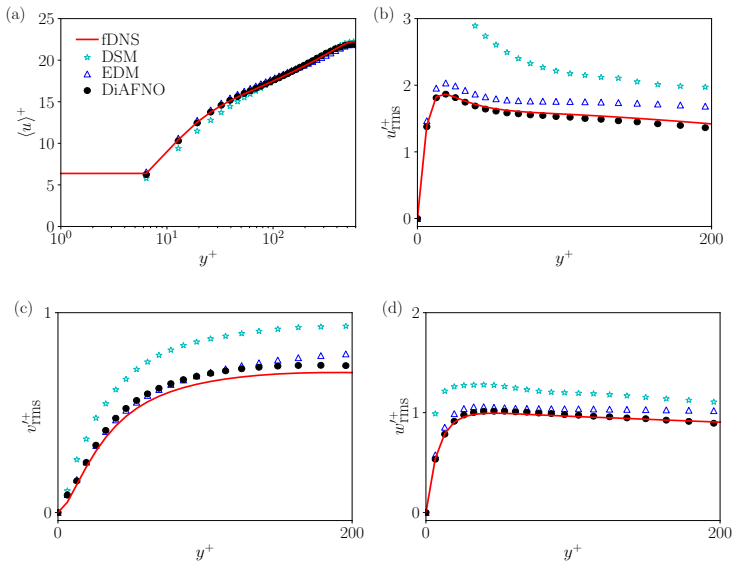
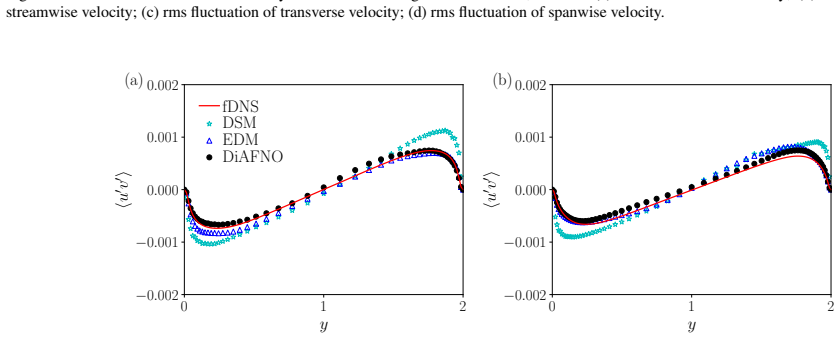
The central claim is that integrating IAFNO as the denoising network inside the EDM sampler yields a generative model that learns a per-step conditional map from one filtered flow field to the next, and that rolling this map forward gives stable long-term predictions of 3D turbulence. On forced HIT, decaying HIT, and channel flow at Reτ ≈ 395 and 590, DiAFNO reproduces velocity spectra, rms values, and Reynolds stresses with higher fidelity than the EDM baseline and the dynamic Smagorinsky LES, with fewer parameters than EDM and roughly half its wall-clock time in the channel cases.
What carries the argument
The key object is the DiAFNO denoiser: the implicit adaptive Fourier neural operator (IAFNO) iterated L times as F_θ in the EDM preconditioning formula D_θ(x;σ)=c_skip(σ)x+c_out(σ)F_θ(c_in(σ)x;c_noise(σ)). IAFNO works in Fourier space with block-diagonal weight matrices and soft-thresholding, which captures global frequency structure; the diffusion sampler applies this denoiser over 32 steps, and the autoregressive framework feeds each sampled next field back as the condition for the following step.
Load-bearing premise
The load-bearing assumption is that a single-snapshot conditional distribution learned from filtered DNS is enough to reproduce the filtered dynamics, so the one-step denoising errors do not compound fatally over hundreds of rollout steps.
What would settle it
An independent test that pushes DiAFNO to a Taylor Reynolds number it has not seen (e.g., Rλ ≈ 200) and checks whether the energy spectrum stays inside the fDNS band for more than 10 turnover times, or a multi-seed rollout study that shows the spectral spread widening sharply, would settle the claim.
If this is right
- DiAFNO provides a parameter-light alternative to diffusion-based surrogates: it uses ~2.3–4.6 million parameters versus 6.4 million for EDM, while matching or exceeding accuracy.
- The autoregressive scheme yields stable predictions over 50 large-eddy turnover times for forced HIT, which the authors attribute to the global frequency consistency enforced by the Fourier denoiser.
- In the channel-flow cases DiAFNO's inference time is roughly 2× faster than EDM and 3–4× faster than LES with DSM, suggesting that trained data-driven surrogates can be practical for repeated simulations.
- The fixed hyperparameters across all four flows indicate that the architecture transfers across different types of 3D turbulence without per-case tuning.
Where Pith is reading between the lines
- One implicit consequence is that the single-step conditional distribution p(U_{m+1}|U_m) may itself contain subgrid information, and DiAFNO's success suggests that learned generative models can serve as implicit LES closures; a natural extension is to test whether sampling from the same model conditioned on a partially resolved field can act as a stochastic subgrid model at higher Reynolds numbers
- The stochastic sampler injects noise at each step, which may act as a regularizer that prevents spectral collapse; an untested follow-up would be to quantify whether DiAFNO's rollout quality degrades with deterministic (ODE) sampling, isolating the role of noise.
- Because the model is trained on filtered DNS snapshots at one resolution, a testable extension is whether it can be fine-tuned across grid resolutions or Reynolds numbers with transfer learning, which would address the data-hunger limitation the authors note.
Editorial analysis
A structured set of objections, weighed in public.
Referee Report
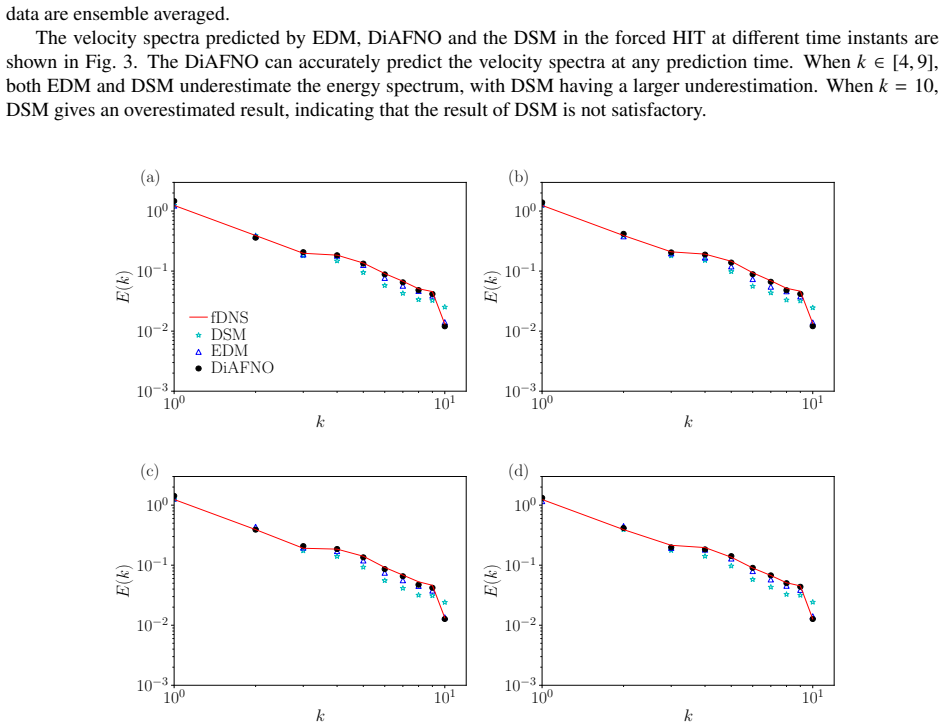
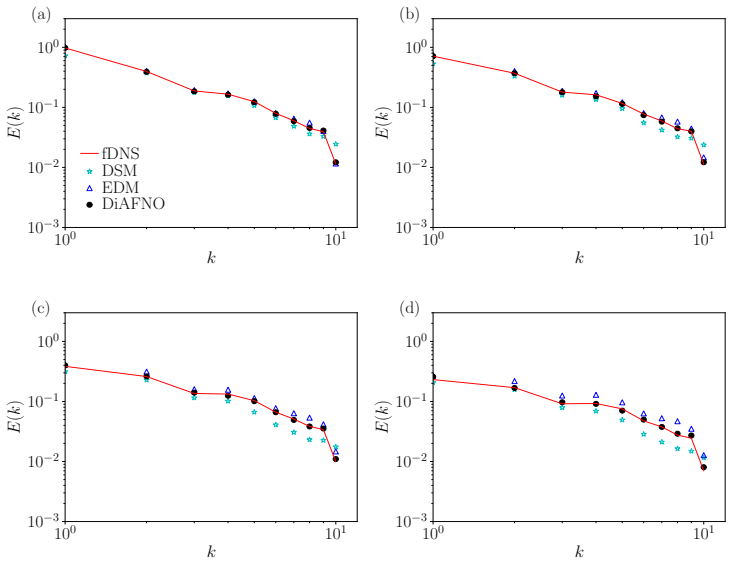
Summary. The paper proposes DiAFNO, a conditional diffusion model that uses an implicit adaptive Fourier neural operator (IAFNO) as the denoising network inside the EDM sampler, and applies it autoregressively to predict filtered 3D turbulence fields. The model is trained and tested on filtered DNS data for forced homogeneous isotropic turbulence (Re_lambda≈100), decaying HIT (initial Re_lambda≈100), and turbulent channel flow at Re_tau≈395 and 590, with fixed architecture hyperparameters across cases. The a posteriori comparison against an EDM baseline and LES with the dynamic Smagorinsky model reports velocity spectra, vorticity PDFs, rms velocity/vorticity, Reynolds stresses, mean velocity, and kinetic energy spectra. The authors claim DiAFNO achieves significantly higher accuracy in most statistics and is faster than DSM at inference.
Significance. If the empirical claims hold, DiAFNO would be a useful data-driven LES surrogate that combines the spectral/spatial representation of a Fourier neural operator with stochastic sampling from a diffusion model, showing stable long-time autoregressive behavior across several 3D flow configurations. The study is valuable for its breadth: four flow setups, separate training and validation datasets, long rollouts, and comparison with both a learned baseline (EDM) and a classical LES model (DSM). The paper also reports inference costs and model sizes. The main weakness is that the headline claim of "significantly higher" accuracy is not backed by repeated stochastic sampling or any uncertainty quantification, which is especially important because both data-driven models are stochastic samplers.
major comments (4)
- [§3.2, Figs. 3–15; Abstract] DiAFNO and EDM are stochastic: each autoregressive rollout is a random draw. The reported spectra, PDFs, rms values, and Reynolds stresses are computed from single rollouts per initial condition (10 for forced HIT, 5 for dHIT, 1 per channel-flow case), with no repeated sampling, confidence intervals, or significance tests. The word "significantly" in the abstract and conclusions is therefore a statistical claim that the current evidence does not support. In Fig. 5(a), EDM is actually closer to fDNS over some time intervals, so the "most statistics" conclusion may hinge on differences smaller than the sampler noise. Please provide repeated-seed ensembles and error bars or statistical tests for the key comparisons.
- [§3.2, Eq. (28); Tables 2, 3, 5] The data-splitting description is inconsistent. Section 3.1 describes separate training and validation samples (40/5 for forced HIT, 320/5 for dHIT, 20/1 for channel flow), but §3.2 states that 80% of input-output pairs are used for training and 20% for testing. If the 20% test pairs are drawn from the same long trajectories as the training pairs, the autoregressive rollouts could involve sequences partially seen during training. Please clarify exactly which samples are used for the reported a posteriori rollouts and ensure that no trajectory overlap exists between training and evaluation sequences.
- [§3.1, Table 6, Table 8] The abstract and conclusions emphasize that identical/fixed hyperparameters are used across all flow configurations, but Table 8 reports different DiAFNO parameter counts for HIT (2.318M), Re_tau=395 (3.884M), and Re_tau=590 (4.621M). If these differences arise from different input resolutions or patch arrangements, that should be stated explicitly; otherwise, the claim of fixed hyperparameters is misleading. This matters because the transferability claim is one of the paper's selling points.
- [§2.3, §3.2.1–3.2.3] The paper attributes DiAFNO's accuracy to the combination of IAFNO's global frequency representation with diffusion sampling, but it does not compare against a deterministic IAFNO predictor. Without such an ablation, the improvement over EDM could be due to the IAFNO backbone alone rather than the diffusion mechanism. Adding an IAFNO-only (non-diffusion) baseline would isolate the contribution of the diffusion component and materially strengthen the paper's central architectural claim.
minor comments (4)
- [§3.2.1, Fig. 6] The text states "there is no inherent difference between the performance of DiAFNO and EDM" for the vorticity contours, which is in tension with the abstract's claim of significantly higher accuracy. Please reconcile or qualify this statement.
- [§2.2, Eq. (20)] The notation c_noise = ln(σ)/4 is introduced without a derivation or reference to the EDM paper's justification; a brief explanation or citation would help readers unfamiliar with the EDM formulation.
- [Table 7] The table reports minimum training and testing losses over 100 epochs, but no standard deviation or seed variation is provided. Given the stochastic nature of diffusion training and sampling, adding a small number of seeds would improve reliability.
- [General] The manuscript does not include a data/code availability statement. For reproducibility in a data-driven turbulence paper, providing access to the generated fDNS datasets and trained model configurations would be valuable.
Circularity Check
No significant circularity: the central accuracy claim is supported by independent a posteriori comparisons, not by construction.
full rationale
The paper's central claim is an empirical comparison: DiAFNO achieves higher prediction accuracy than EDM and DSM on velocity spectra, RMS values, vorticity PDFs, and Reynolds stresses. These statistics are obtained by running autoregressive rollouts and comparing them against filtered DNS data (fDNS), a genuinely independent benchmark. The training objective (Eq. 21 and Eq. 28, Fig. 1) minimizes an L2 error between the denoised prediction x' and the ground-truth next snapshot U_{m+1}; no reported statistic is used as a training target or fitting constraint and then relabeled as a prediction. The IAFNO backbone is cited from the authors' prior work [19], and related group references [16,17] are used for architectural background; these self-citations justify design choices but are not load-bearing for the comparative accuracy claim, which stands or falls on the independent fDNS comparison. The paper does not invoke a uniqueness theorem, does not smuggle in an ansatz via a self-citation, and does not rename a known empirical pattern as a derivation. The wording "significantly higher" lacks repeated-sampling confidence intervals and significance tests, especially since DiAFNO is stochastic, but this is a statistical-rigor and uncertainty-quantification issue, not circularity. No equation in the paper reduces to its own input by construction. Score 1 reflects only the presence of minor architectural self-citations, none of which forces the reported results.
Axiom & Free-Parameter Ledger
free parameters (4)
- Diffusion sampling steps =
32
- IAFNO architecture hyperparameters =
implicit_layers=4, explicit_layers=2, patch_size=(2,2,2), embed_dim=180, num_blocks=1, hidden_size_factor=4, learning_ra
- Max-Min normalization constants =
per-dataset x_min/x_max/y_min/y_max
- Training epochs and batch size =
100 epochs, batch_size=4
axioms (4)
- domain assumption The single-snapshot conditional distribution p(U_{m+1}|U_m) is a sufficient model of the filtered dynamics.
- domain assumption Filtered DNS data are unbiased ground truth for evaluating LES and machine-learning surrogates.
- standard math The EDM stochastic sampler yields valid samples from the learned conditional distribution.
- ad hoc to paper Fixed hyperparameters are adequate across all four flow configurations.
read the original abstract
Accurately autoregressive prediction of three-dimensional (3D) turbulence has been one of the most challenging problems for machine learning approaches. Diffusion models have demonstrated high accuracy in predicting two-dimensional (2D) turbulence, but their applications in 3D turbulence are relatively limited. To achieve reliable autoregressive predictions of 3D turbulence, we propose the DiAFNO model which integrates the implicit adaptive Fourier neural operator (IAFNO) with diffusion model. IAFNO can effectively capture the global frequency and structural features, which is crucial for global consistent reconstructions of the denoising process in diffusion models. Furthermore, based on conditional generation from diffusion models, we design an autoregressive framework in DiAFNO to achieve long-term stable predictions of 3D turbulence. The proposed DiAFNO model is systematically trained and tested separately with fixed hyperparameters in several types of 3D turbulence, including forced homogeneous isotropic turbulence (HIT) at Taylor Reynolds number 100, decaying HIT at initial Taylor Reynolds number at 100 and turbulent channel flow at friction Reynolds numbers 395 and 590 with case-specific training at each Reynolds number. The results in the \textit{a posteriori} tests demonstrate that DiAFNO exhibits a significantly higher prediction accuracy in most of the analyzed statistics (such as the velocity spectra, the root-mean-square (RMS) values of both velocity and vorticity, and Reynolds stresses), as compared to the elucidated diffusion model (EDM) and the traditional large-eddy simulation (LES) using dynamic Smagorinsky model (DSM). Although DiAFNO is not optimal in certain statistics, its overall performance is substantially better than all baseline models (EDM and DSM). Ignoring training costs, the well-trained DiAFNO achieves higher inference efficiency than EDM and LES with DSM.
Figures








Forward citations
Cited by 2 Pith papers
-
SGNO: Spectral Generator Neural Operators for Stable Long Horizon PDE Rollouts
SGNO achieves stable long-horizon PDE rollouts by organizing autoregressive steps as spectral evolution updates with a constrained diagonal generator and learned correction, delivering a median 74.8% reduction in GMea...
-
Predictivity and Utility of Neural Surrogates of Multiscale PDEs
Neural surrogates systematically under-resolve high-frequency content in multiscale PDEs due to spectral bias and irreversible coarse-graining losses, with success confined to low-dimensional manifolds and weather pre...
Reference graph
Works this paper leans on
-
[1]
S. B. Pope, Turbulent Flows, Cambridge University Press, 2000
2000
-
[2]
P. Moin, K. Mahesh, Direct numerical simulation: a tool in turbulence research, Annual Review of Fluid Me- chanics 30 (1) (1998) 539–578
1998
-
[3]
Ishihara, T
T. Ishihara, T. Gotoh, Y . Kaneda, Study of high–Reynolds number isotropic turbulence by direct numerical simulation, Annual Review of Fluid Mechanics 41 (1) (2009) 165–180
2009
-
[4]
Meneveau, J
C. Meneveau, J. Katz, Scale-invariance and turbulence models for large-eddy simulation, Annual Review of Fluid Mechanics 32 (1) (2000) 1–32
2000
-
[5]
Motegi, Y
K. Motegi, Y . Sibamoto, T. Hibiki, Reynolds-averaged Navier-Stokes simulations of opposing flow turbulent mixed convection heat transfer in a vertical tube, International Journal of Heat and Mass Transfer 237 (2025) 126406
2025
-
[6]
Songyue, L
L. Songyue, L. Qiusheng, L. Bin, H. Junyi, Prediction of offshore wind turbine wake and output power us- ing large eddy simulation and convolutional neural network, Energy Conversion and Management 324 (2025) 119326
2025
-
[7]
Duraisamy, G
K. Duraisamy, G. Iaccarino, H. Xiao, Turbulence modeling in the age of data, Annual Review of Fluid Mechanics 51 (1) (2019) 357–377
2019
-
[8]
S. L. Brunton, B. R. Noack, P. Koumoutsakos, Machine learning for fluid mechanics, Annual Review of Fluid Mechanics 52 (1) (2020) 477–508
2020
-
[9]
Raissi, P
M. Raissi, P. Perdikaris, G. E. Karniadakis, Physics-informed neural networks: A deep learning framework for solving forward and inverse problems involving nonlinear partial differential equations, Journal of Computa- tional Physics 378 (2019) 686–707
2019
-
[10]
X. Jin, S. Cai, H. Li, G. E. Karniadakis, NSFnets (Navier-Stokes flow nets): Physics-informed neural networks for the incompressible Navier-Stokes equations, Journal of Computational Physics 426 (2021) 109951
2021
-
[11]
L. Lu, P. Jin, G. Pang, Z. Zhang, G. E. Karniadakis, Learning nonlinear operators via DeepONet based on the universal approximation theorem of operators, Nature machine intelligence 3 (3) (2021) 218–229
2021
-
[12]
Z. Li, N. Kovachki, K. Azizzadenesheli, B. Liu, K. Bhattacharya, A. Stuart, A. Anandkumar, Fourier neural operator for parametric partial differential equations, arXiv preprint arXiv:2010.08895 (2020)
Pith/arXiv arXiv 2010
-
[13]
S. Zhao, Z. Li, B. Fan, Y . Wang, H. Yang, J. Wang, LESnets (Large-Eddy Simulation nets): Physics-informed neural operator for large-eddy simulation of turbulence, Journal of Computational Physics (2025) 114125
2025
-
[14]
G. Wen, Z. Li, K. Azizzadenesheli, A. Anandkumar, S. M. Benson, U-FNO—An enhanced Fourier neural operator-based deep-learning model for multiphase flow, Advances in Water Resources 163 (2022) 104180
2022
-
[15]
H. You, Q. Zhang, C. J. Ross, C.-H. Lee, Y . Yu, Learning deep implicit Fourier neural operators (IFNOs) with applications to heterogeneous material modeling, Computer Methods in Applied Mechanics and Engineering 398 (2022) 115296
2022
-
[16]
Z. Li, W. Peng, Z. Yuan, J. Wang, Long-term predictions of turbulence by implicit U-Net enhanced Fourier neural operator, Physics of Fluids 35 (7) (2023) 075145
2023
-
[17]
Y . Wang, Z. Li, Z. Yuan, W. Peng, T. Liu, J. Wang, Prediction of turbulent channel flow using Fourier neural operator-based machine-learning strategy, Physical Review Fluids 9 (8) (2024) 084604
2024
-
[18]
J. Guibas, M. Mardani, Z. Li, A. Tao, A. Anandkumar, B. Catanzaro, Adaptive Fourier Neural Operators: Effi- cient Token Mixers for Transformers, arXiv preprint arXiv:2111.13587 (2021). 25
Pith/arXiv arXiv 2021
-
[19]
Jiang, Z
Y . Jiang, Z. Li, Y . Wang, H. Yang, J. Wang, An Implicit Adaptive Fourier Neural Operator for Long-term Predictions of Three-dimensional Turbulence, Acta Mechanica Sinica 42 (2026) 325478
2026
-
[20]
Vaswani, Attention is all you need, Advances in Neural Information Processing Systems (2017)
A. Vaswani, Attention is all you need, Advances in Neural Information Processing Systems (2017)
2017
-
[21]
Chattopadhyay, M
A. Chattopadhyay, M. Mustafa, P. Hassanzadeh, K. Kashinath, Deep spatial Transformers for autoregressive data-driven forecasting of geophysical turbulence, in: Proceedings of the 10th international conference on cli- mate informatics, 2020, pp. 106–112
2020
-
[22]
Z. Li, K. Meidani, A. B. Farimani, Transformer for partial differential equations’ operator learning, arXiv preprint arXiv:2205.13671 (2022)
Pith/arXiv arXiv 2022
-
[23]
Y . Dang, Z. Hu, M. Cranmer, M. Eickenberg, S. Ho, TNT: Vision Transformer for Turbulence Simulations, arXiv preprint arXiv:2207.04616 (2022)
Pith/arXiv arXiv 2022
-
[24]
M. Z. Yousif, M. Zhang, L. Yu, R. Vinuesa, H. Lim, A Transformer-based synthetic-inflow generator for spatially developing turbulent boundary layers, Journal of Fluid Mechanics 957 (2023) A6
2023
-
[25]
Z. Li, T. Liu, W. Peng, Z. Yuan, J. Wang, A Transformer-based neural operator for large-eddy simulation of turbulence, Physics of Fluids 36 (6) (2024)
2024
-
[26]
Cao, Choose a Transformer: Fourier or Galerkin, Advances in neural information processing systems 34 (2021) 24924–24940
S. Cao, Choose a Transformer: Fourier or Galerkin, Advances in neural information processing systems 34 (2021) 24924–24940
2021
-
[27]
H. Li, J. Xie, C. Zhang, Y . Zhang, Y . Zhao, A transformer-based convolutional method to model inverse cascade in forced two-dimensional turbulence, Journal of Computational Physics 520 (2025) 113475
2025
-
[28]
X. Hu, J. Zhang, K. Yan, T. Wan, X. Zheng, Physics-Informed Transformer for Efficient Fluid Dynamics Pre- dictions, in: International Conference on Wireless Artificial Intelligent Computing Systems and Applications, Springer, 2025, pp. 356–368
2025
-
[29]
Z. Li, D. Shu, A. Barati Farimani, Scalable transformer for PDE surrogate modeling, Advances in Neural Infor- mation Processing Systems 36 (2024)
2024
-
[30]
H. Yang, Z. Li, X. Wang, J. Wang, An Implicit Factorized Transformer with Applications to Fast Prediction of Three-dimensional Turbulence, Theoretical and Applied Mechanics Letters 14 (6) (2024) 100527
2024
-
[31]
H. Yang, Y . Wang, J. Wang, Implicit factorized transformer approach to fast prediction of turbulent channel flows, SCIENCE CHINA Physics, Mechanics & Astronomy 69 (1) (2026) 214606
2026
-
[32]
J. Ho, A. Jain, P. Abbeel, Denoising diffusion probabilistic models, Advances in neural information processing systems 33 (2020) 6840–6851
2020
-
[33]
Y . Song, J. Sohl-Dickstein, D. P. Kingma, A. Kumar, S. Ermon, B. Poole, Score-based generative modeling through stochastic differential equations, arXiv preprint arXiv:2011.13456 (2020)
Pith/arXiv arXiv 2011
-
[34]
Karras, M
T. Karras, M. Aittala, T. Aila, S. Laine, Elucidating the design space of diffusion-based generative models, Advances in neural information processing systems 35 (2022) 26565–26577
2022
-
[35]
X. Liu, H. Tang, DiffFNO: Diffusion Fourier Neural Operator, in: Proceedings of the Computer Vision and Pattern Recognition Conference, 2025, pp. 150–160
2025
-
[36]
X. Fan, D. Akhare, J.-X. Wang, Neural differentiable modeling with diffusion-based super-resolution for two- dimensional spatiotemporal turbulence, Computer Methods in Applied Mechanics and Engineering 433 (2025) 117478
2025
-
[37]
Sardar, A
M. Sardar, A. Skillen, M. Zimo´n, S. Draycott, A. Revell, Spectrally decomposed denoising diffusion probabilistic models for generative turbulence super-resolution, Physics of Fluids 36 (11) (2024). 26
2024
-
[38]
Y . Guo, J. Song, X. Cao, C. Zhao, H. Leng, Physics Field Super-resolution Reconstruction via Enhanced Diffu- sion Model and Fourier Neural Operator, Theoretical and Applied Mechanics Letters (2025) 100604
2025
-
[39]
S. Wang, Z. Dou, T.-R. Liu, L. Lu, Fundiff: Diffusion models over function spaces for physics-informed gener- ative modeling, arXiv preprint arXiv:2506.07902 (2025)
arXiv 2025
-
[40]
D. Shu, Z. Li, A. B. Farimani, A physics-informed diffusion model for high-fidelity flow field reconstruction, Journal of Computational Physics 478 (2023) 111972
2023
-
[41]
Z. Li, W. Han, Y . Zhang, Q. Fu, J. Li, L. Qin, R. Dong, H. Sun, Y . Deng, L. Yang, Learning spatiotemporal dynamics with a pretrained generative model, Nature Machine Intelligence 6 (12) (2024) 1566–1579
2024
-
[42]
T. Li, L. Biferale, F. Bonaccorso, M. A. Scarpolini, M. Buzzicotti, Synthetic Lagrangian turbulence by generative diffusion models, Nature Machine Intelligence 6 (4) (2024) 393–403
2024
-
[43]
T. Li, L. Biferale, F. Bonaccorso, M. Buzzicotti, L. Centurioni, Stochastic reconstruction of gappy Lagrangian turbulent signals by conditional diffusion models, Communications Physics 8 (1) (2025) 372
2025
-
[44]
T. Li, F. Tuteri, M. Buzzicotti, F. Bonaccorso, L. Biferale, Deterministic diffusion models for Lagrangian tur- bulence: Robustness and encoding of extreme events, European Journal of Mechanics-B/Fluids 116 (2026) 204402
2026
-
[45]
P. Du, M. H. Parikh, X. Fan, X.-Y . Liu, J.-X. Wang, Conditional neural field latent diffusion model for generating spatiotemporal turbulence, Nature Communications 15 (1) (2024) 10416
2024
-
[46]
M. Lienen, D. Lüdke, J. Hansen-Palmus, S. Günnemann, From zero to turbulence: Generative modeling for 3D flow simulation, arXiv preprint arXiv:2306.01776 (2023)
Pith/arXiv arXiv 2023
-
[47]
Whittaker, R
T. Whittaker, R. A. Janik, Y . Oz, Turbulence scaling from deep learning diffusion generative models, Journal of Computational Physics 514 (2024) 113239
2024
-
[48]
H. Gao, X. Han, X. Fan, L. Sun, L.-P. Liu, L. Duan, J.-X. Wang, Bayesian conditional diffusion models for versatile spatiotemporal turbulence generation, Computer Methods in Applied Mechanics and Engineering 427 (2024) 117023
2024
-
[49]
G. Kohl, L.-W. Chen, N. Thuerey, Benchmarking autoregressive conditional diffusion models for turbulent flow simulation, arXiv preprint arXiv:2309.01745 (2023)
Pith/arXiv arXiv 2023
-
[50]
Tahmasebi, G
S. Tahmasebi, G. Tian, S. Qin, A. Marey, L. L. Wang, S. Rayegan, Using diffusion models for reducing spa- tiotemporal errors of deep learning based urban microclimate predictions at post-processing stage, Physics of Fluids 37 (3) (2025)
2025
-
[51]
Sambamurthy, A
A. Sambamurthy, A. Chattopadhyay, Lazy Diffusion: Mitigating spectral collapse in generative diffusion-based stable autoregressive emulation of turbulent flows (2025)
2025
-
[52]
N. T. Mücke, B. Sanderse, Physics-aware generative models for turbulent fluid flows through energy-consistent stochastic interpolants, arXiv preprint arXiv:2504.05852 (2025)
Pith/arXiv arXiv 2025
-
[53]
X.-Y . Liu, M. H. Parikh, X. Fan, P. Du, Q. Wang, Y .-F. Chen, J.-X. Wang, CoNFiLD-inlet: Synthetic turbulence inflow using generative latent diffusion models with neural fields, Physical Review Fluids 10 (5) (2025) 054901
2025
-
[54]
H. Gao, S. Kaltenbach, P. Koumoutsakos, Generative learning for forecasting the dynamics of high-dimensional complex systems, Nature Communications 15 (1) (2024) 8904
2024
-
[55]
Oommen, A
V . Oommen, A. Bora, Z. Zhang, G. E. Karniadakis, Integrating neural operators with diffusion models im- proves spectral representation in turbulence modelling, Proceedings of the Royal Society A 481 (2309) (2025) 20240819. 27
2025
-
[56]
Smagorinsky, General circulation experiments with the primitive equations: I
J. Smagorinsky, General circulation experiments with the primitive equations: I. The basic experiment, Monthly Weather Review 91 (3) (1963) 99–164
1963
-
[57]
J. W. Deardorff, A numerical study of three-dimensional turbulent channel flow at large Reynolds numbers, Journal of Fluid Mechanics 41 (2) (1970) 453–480
1970
-
[58]
Germano, Turbulence: the filtering approach, Journal of Fluid Mechanics 238 (1992) 325–336
M. Germano, Turbulence: the filtering approach, Journal of Fluid Mechanics 238 (1992) 325–336
1992
-
[59]
Lesieur, O
M. Lesieur, O. Metais, New trends in large-eddy simulations of turbulence, Annual Review of Fluid Mechanics 28 (1) (1996) 45–82
1996
-
[60]
Meneveau, J
C. Meneveau, J. Katz, Dynamic testing of subgrid models in large eddy simulation based on the Germano identity, Physics of Fluids 11 (2) (1999) 245–247
1999
-
[61]
Lilly, A proposed modification of the Germano sugrid-scale closure method, Physics of Fluids A 4 (1992) 633–635
D. Lilly, A proposed modification of the Germano sugrid-scale closure method, Physics of Fluids A 4 (1992) 633–635
1992
-
[62]
Y . Wang, Z. Yuan, X. Wang, J. Wang, Constant-coefficient spatial gradient models for the sub-grid scale closure in large-eddy simulation of turbulence, Physics of Fluids 34 (9) (2022) 095108
2022
-
[63]
Y . Lipman, R. T. Chen, H. Ben-Hamu, M. Nickel, M. Le, Flow matching for generative modeling, arXiv preprint arXiv:2210.02747 (2022)
Pith/arXiv arXiv 2022
-
[64]
J. Ho, X. Chen, A. Srinivas, Y . Duan, P. Abbeel, Flow++: Improving flow-based generative models with vari- ational dequantization and architecture design, in: International conference on machine learning, PMLR, 2019, pp. 2722–2730
2019
-
[65]
H. C. Ku, R. S. Hirsh, T. D. Taylor, A pseudospectral method for solution of the three-dimensional incompress- ible Navier-Stokes equations, Journal of Computational Physics 70 (2) (1987) 439–462
1987
-
[66]
S. Chen, G. D. Doolen, R. H. Kraichnan, Z.-S. She, On statistical correlations between velocity increments and locally averaged dissipation in homogeneous turbulence, Physics of Fluids A: Fluid Dynamics 5 (2) (1993) 458–463
1993
-
[67]
Y . He, W. Sun, Stability and convergence of the Crank–Nicolson/Adams–Bashforth scheme for the time- dependent Navier–Stokes equations, SIAM Journal on Numerical Analysis 45 (2) (2007) 837–869
2007
-
[68]
Z. Yuan, C. Xie, J. Wang, Deconvolutional artificial neural network models for large eddy simulation of turbu- lence, Physics of Fluids 32 (11) (2020) 115106
2020
-
[69]
C. Xie, J. Wang, W. E, Modeling subgrid-scale forces by spatial artificial neural networks in large eddy simula- tion of turbulence, Physical Review Fluids 5 (5) (2020) 054606
2020
-
[70]
Munters, C
W. Munters, C. Meneveau, J. Meyers, Shifted periodic boundary conditions for simulations of wall-bounded turbulent flows, Physics of Fluids 28 (2) (2016) 025112
2016
-
[71]
M. Y . Hussaini, T. A. Zang, Spectral methods in fluid dynamics, Annual Review of Fluid Mechanics 19 (1987) 339–367
1987
-
[72]
Laizet, E
S. Laizet, E. Lamballais, High-order compact schemes for incompressible flows: A simple and efficient method with quasi-spectral accuracy, Journal of Computational Physics 228 (16) (2009) 5989–6015
2009
-
[73]
Bartholomew, G
P. Bartholomew, G. Deskos, R. A. Frantz, F. N. Schuch, E. Lamballais, S. Laizet, Xcompact3D: An open-source framework for solving turbulence problems on a Cartesian mesh, SoftwareX 12 (2020) 100550
2020
-
[74]
Z. Li, D. Z. Huang, B. Liu, A. Anandkumar, Fourier Neural Operator with Learned Deformations for PDEs on General Geometries, Journal of Machine Learning Research 24 (388) (2023) 1–26. 28
2023
-
[75]
Z. Li, W. Peng, Z. Yuan, J. Wang, Fourier neural operator approach to large eddy simulation of three-dimensional turbulence, Theoretical and Applied Mechanics Letters 12 (6) (2022) 100389
2022
-
[76]
J. Kim, P. Moin, R. Moser, Turbulence statistics in fully developed channel flow at low Reynolds number, Journal of Fluid Mechanics 177 (1987) 133–166
1987
-
[77]
S. Wang, H. Wang, P. Perdikaris, Learning the solution operator of parametric partial differential equations with physics-informed DeepONets, Science advances 7 (40) (2021) eabi8605
2021
-
[78]
S. Wang, P. Perdikaris, Long-time integration of parametric evolution equations with physics-informed Deep- ONets, Journal of Computational Physics 475 (2023) 111855
2023
-
[79]
Z. Li, H. Zheng, N. Kovachki, D. Jin, H. Chen, B. Liu, K. Azizzadenesheli, A. Anandkumar, Physics-informed neural operator for learning partial differential equations, ACM/JMS Journal of Data Science 1 (3) (2024) 1–27
2024
-
[80]
Zanardi, S
I. Zanardi, S. Venturi, M. Panesi, Adaptive physics-informed neural operator for coarse-grained non-equilibrium flows, Scientific reports 13 (1) (2023) 15497
2023
discussion (0)
Sign in with ORCID, Apple, or X to comment. Anyone can read and Pith papers without signing in.