Short-Range Forces Can Catalyze Extreme Orbital Evolution in Hierarchical Triples
Pith reviewed 2026-06-26 19:29 UTC · model grok-4.3
The pith
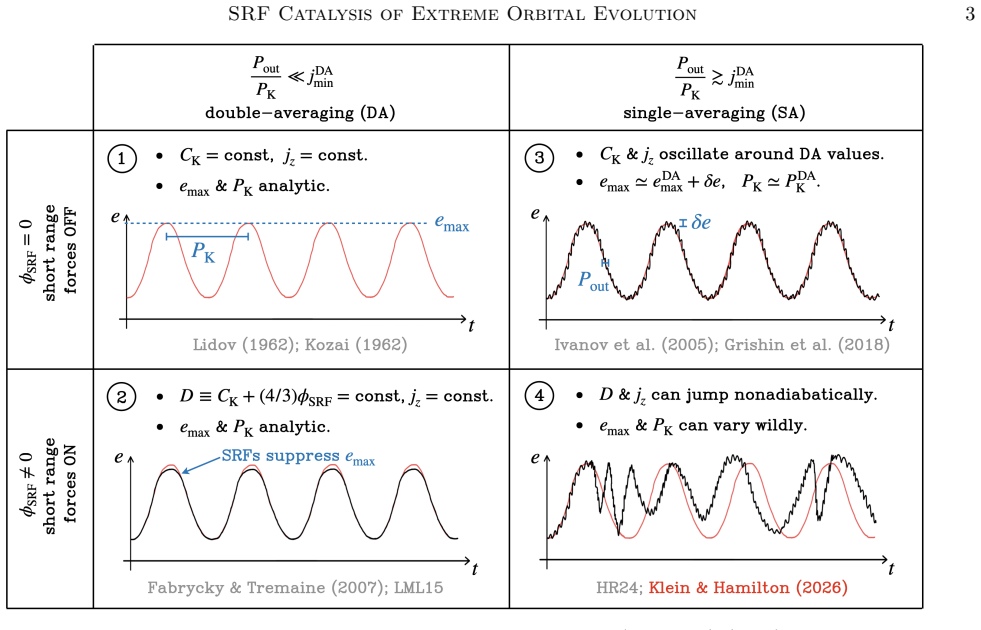
Short-range forces catalyze extreme eccentricity swings in triples by driving jumps in adiabatic invariants when averaging is relaxed.
A machine-rendered reading of the paper's core claim, the machinery that carries it, and where it could break.
Core claim
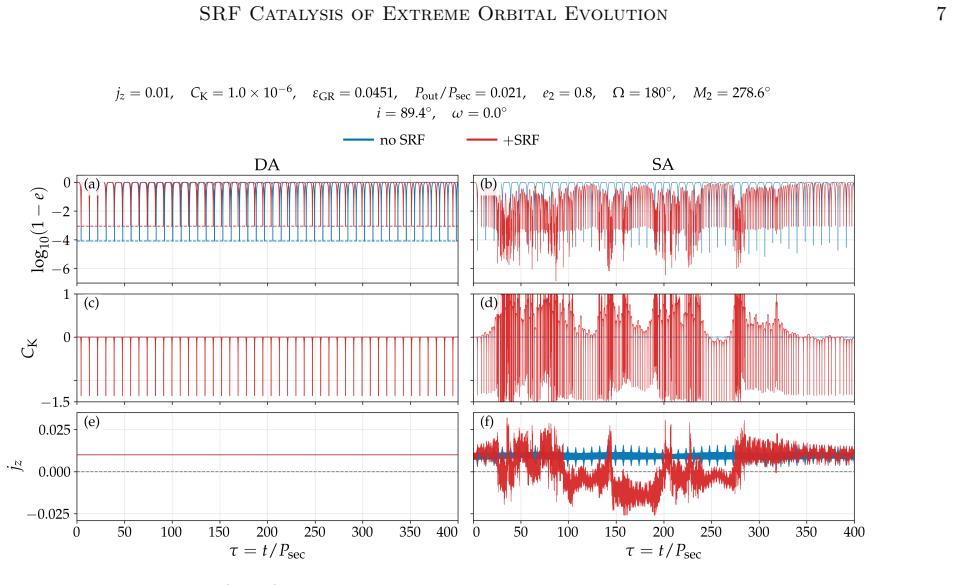
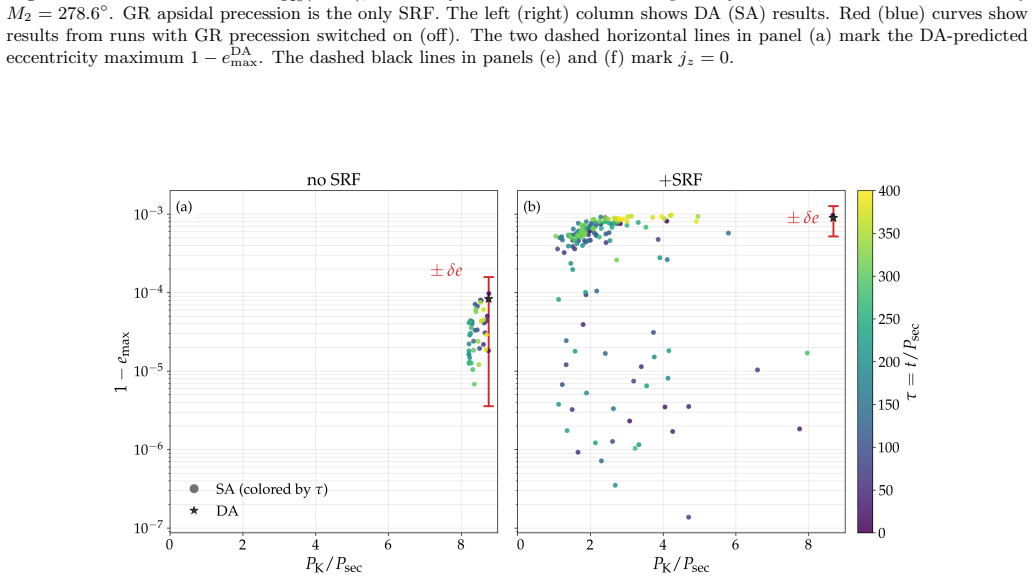
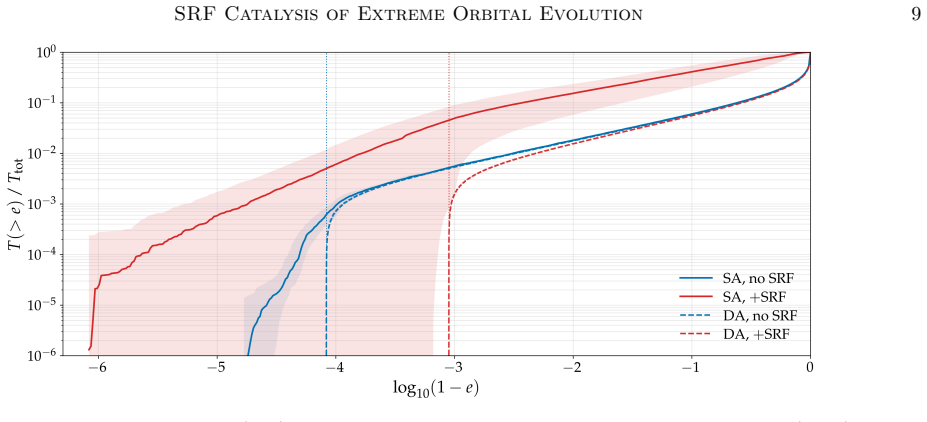
When the double-averaged approximation to the ZLK effect is relaxed, short-range forces drive large discrete jumps in the binary's adiabatic invariants during high-eccentricity episodes; these jumps alter maximum and minimum eccentricity, secular period, and allow secular evolution of j_z at quadrupole order.
What carries the argument
Nonadiabatic jumps in adiabatic invariants induced by short-range forces during high-eccentricity pericenter passages in the non-double-averaged ZLK problem.
If this is right
- Binaries can reach higher eccentricities than predicted by any semi-analytic ZLK theory that retains the double-averaged approximation.
- Systems previously considered unaffected by short-range forces can now display extreme eccentricity behavior.
- The angular-momentum component j_z evolves secularly from a pure quadrupole three-body mechanism.
- The phase space accessible to hierarchical triples is substantially larger than implied by existing analytic models.
Where Pith is reading between the lines
- Rates of close encounters or mergers driven by the ZLK channel may be higher than double-averaged calculations suggest.
- Full three-body integrations without averaging are required to capture the full range of outcomes in triples with short-range forces.
- The same jump mechanism could appear in other secular problems once averaging approximations are removed.
Load-bearing premise
Nonadiabatic jumps in adiabatic invariants occur under astrophysically relevant conditions at the test-particle quadrupole level once the double-averaged approximation is relaxed.
What would settle it
A direct numerical integration of a hierarchical triple at quadrupole order with short-range forces included but without double averaging that exhibits no discrete jumps in the invariants and no secular change in j_z.
Figures
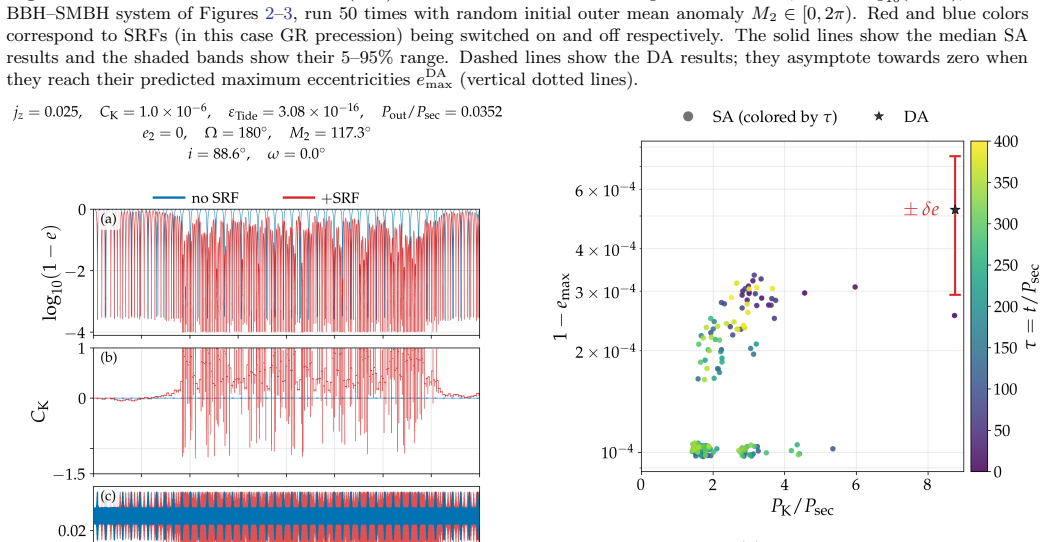
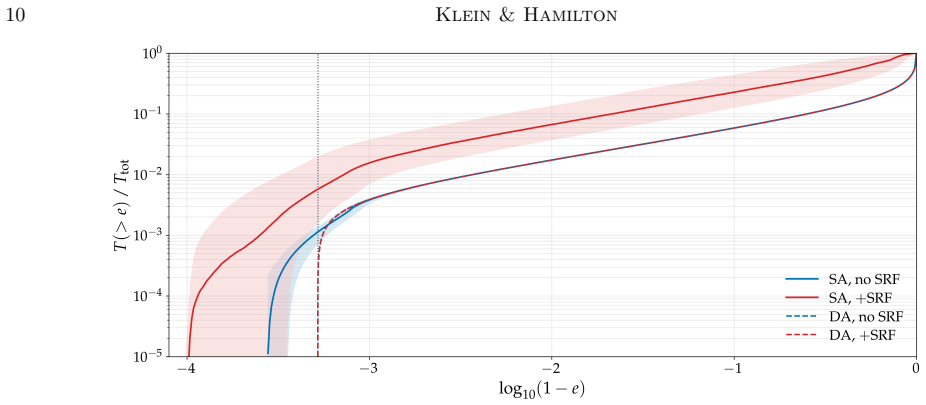
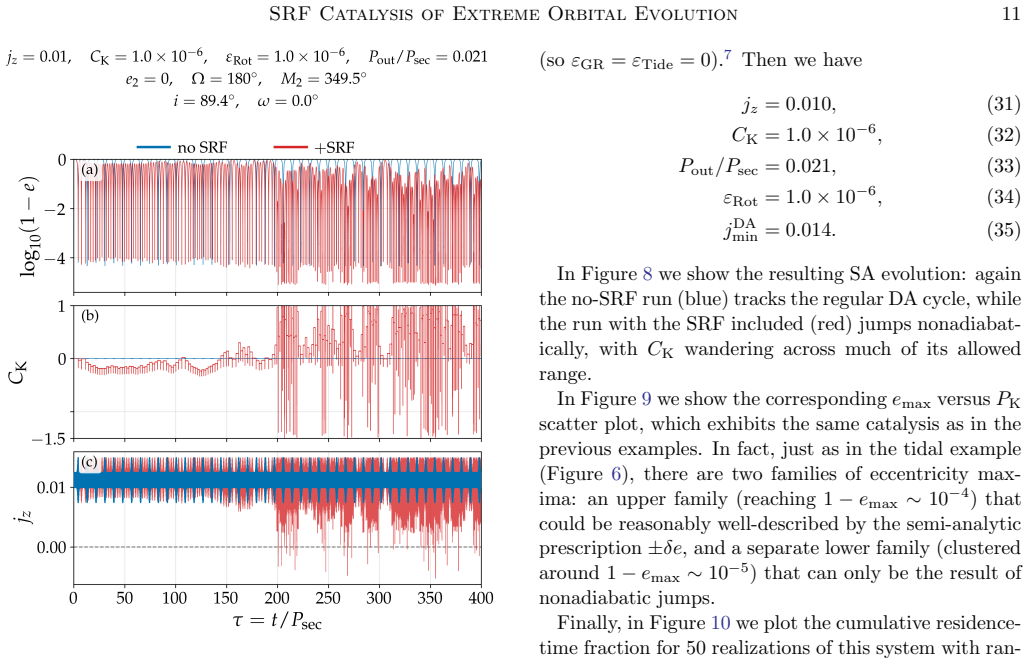
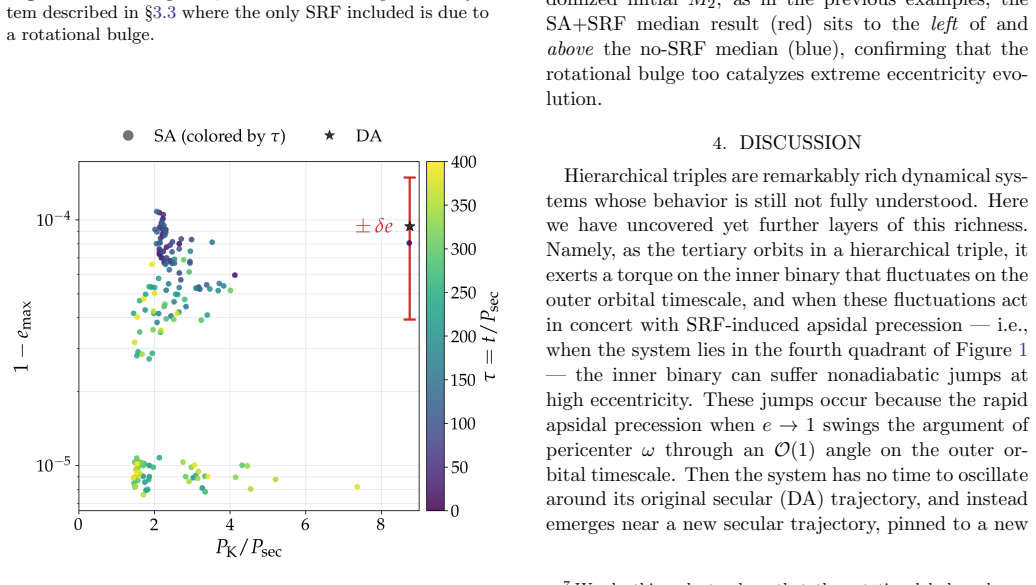
read the original abstract
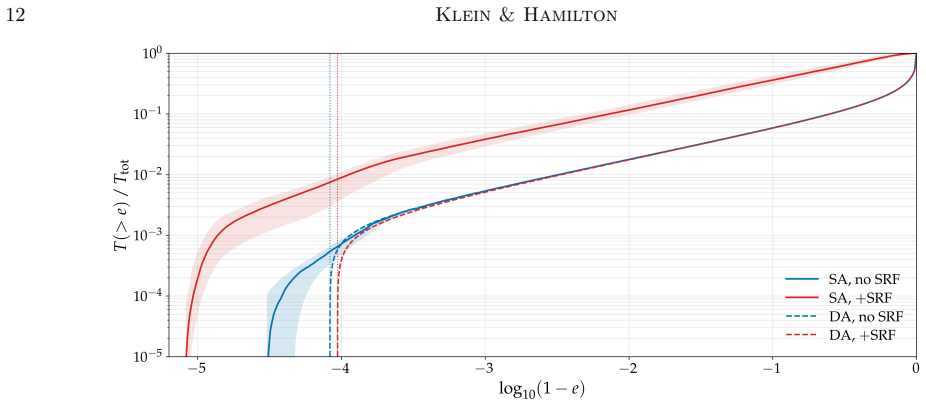
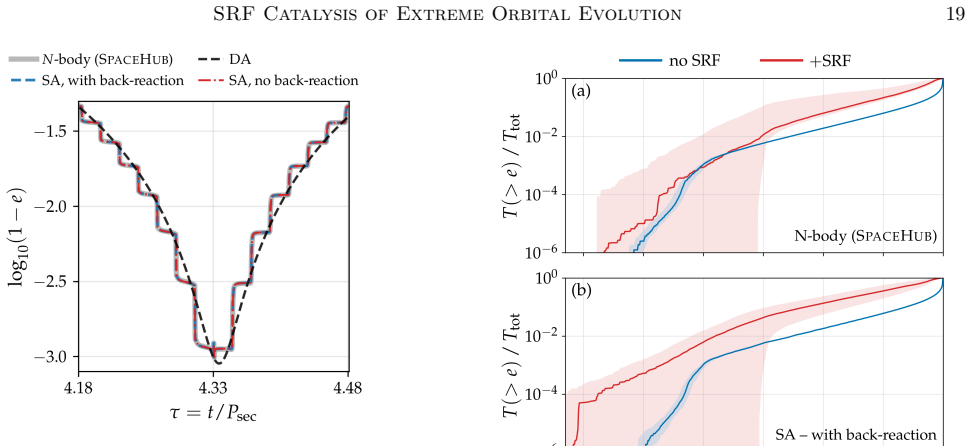
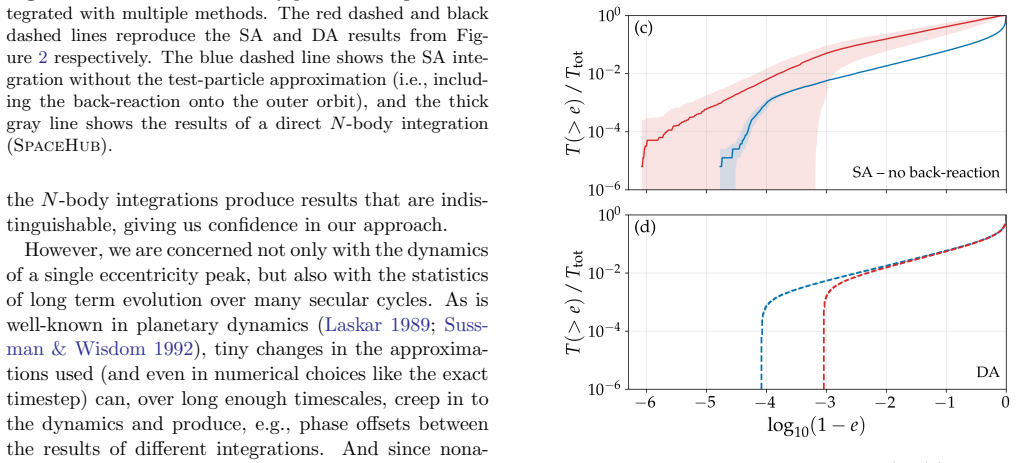
Hierarchical triples are promising environments for producing exotica such as black hole mergers and hot Jupiters, because of the von Zeipel-Lidov-Kozai (ZLK) effect, whereby a distant tertiary can torque an inner binary to high eccentricity over secular timescales. In the double-averaged (DA) approximation to ZLK, this eccentricity excitation is suppressed by apsidal precession due to `short-range forces' (SRFs) like relativity and tidal/rotational bulges. Here we show that, when the DA approximation is relaxed, SRFs often catalyze, rather than suppress, extreme eccentricity behavior. This occurs because SRFs can drive large, discrete jumps in the binary's effective `adiabatic invariants' during high-eccentricity episodes. These nonadiabatic jumps can dramatically alter the maximum/minimum eccentricity and secular period of astrophysically relevant triples, including some for which SRFs were previously thought irrelevant. Even the angular momentum component $j_z$ evolves secularly -- to our knowledge, this is the first time such evolution has been demonstrated from a quadrupole-order, three-body mechanism. In short, binaries may explore much more of phase space than is implied by any (semi-)analytic ZLK theory of which we are aware. We demonstrate this at the test-particle quadrupole level; in a companion paper we show how even more-extreme behavior occurs when the jumps are combined with octupolar ZLK evolution.
Editorial analysis
A structured set of objections, weighed in public.
Referee Report
Summary. The manuscript claims that relaxing the double-averaged (DA) approximation to the von Zeipel-Lidov-Kozai (ZLK) mechanism in hierarchical triples allows short-range forces (SRFs) such as general relativity and tidal bulges to catalyze, rather than suppress, extreme eccentricity excitations. This catalysis occurs via large, discrete nonadiabatic jumps in the binary's effective adiabatic invariants during high-eccentricity episodes, which can alter maximum/minimum eccentricity and secular period. The paper further asserts that even the angular momentum component j_z evolves secularly at quadrupole order in the test-particle limit—the first such demonstration from a three-body mechanism—and that binaries may explore more phase space than implied by existing (semi-)analytic ZLK theories. The result is demonstrated at the test-particle quadrupole level, with a companion paper addressing octupolar effects.
Significance. If the central claim is substantiated with explicit parameter ranges and verification, the result would be significant for models of exotica formation (black hole mergers, hot Jupiters) in triples. It reverses the conventional role of SRFs in ZLK evolution and introduces a new quadrupole-order mechanism for secular j_z change. The controlled test-particle quadrupole setting and the explicit mention of a companion paper exploring combined effects are strengths that allow the claim to be tested in a well-defined limit.
major comments (2)
- [Abstract] Abstract: the claim that SRFs 'often catalyze' extreme eccentricity behavior and that jumps occur for 'astrophysically relevant triples, including some for which SRFs were previously thought irrelevant' is not accompanied by any thresholds (SRF-to-ZLK timescale ratio, initial inclinations, semi-major axis values, or jump amplitudes) at which the nonadiabatic jumps dominate the usual SRF suppression. This quantification is load-bearing for determining whether the catalysis is generic or confined to narrow regimes where the test-particle quadrupole approximation already fails.
- [Abstract] Abstract: the assertion of secular j_z evolution 'from a quadrupole-order, three-body mechanism' and that binaries 'may explore much more of phase space than is implied by any (semi-)analytic ZLK theory' lacks any supporting equations, numerical examples, or verification that the discrete jumps in effective adiabatic invariants actually occur with sufficient amplitude under the stated conditions.
Simulated Author's Rebuttal
We thank the referee for their thoughtful and constructive report. We appreciate the recognition of the potential significance of our results on short-range forces catalyzing extreme eccentricity evolution when the double-averaged approximation is relaxed. We address the two major comments on the abstract below, agreeing that greater quantification and explicit linkage to the paper's results will improve clarity. We propose targeted revisions to the abstract while preserving the manuscript's core claims, which are substantiated in the main text at the test-particle quadrupole level.
read point-by-point responses
-
Referee: [Abstract] Abstract: the claim that SRFs 'often catalyze' extreme eccentricity behavior and that jumps occur for 'astrophysically relevant triples, including some for which SRFs were previously thought irrelevant' is not accompanied by any thresholds (SRF-to-ZLK timescale ratio, initial inclinations, semi-major axis values, or jump amplitudes) at which the nonadiabatic jumps dominate the usual SRF suppression. This quantification is load-bearing for determining whether the catalysis is generic or confined to narrow regimes where the test-particle quadrupole approximation already fails.
Authors: We agree that the abstract would be strengthened by explicit thresholds to allow readers to assess the scope of the catalysis effect. The main text contains numerical results across a range of parameters (e.g., SRF-to-ZLK timescale ratios from ~0.01 to ~1 and inclinations near 90°), showing where jumps dominate suppression. In revision we will update the abstract to include representative values drawn directly from those simulations, such as the range of semi-major axes and jump amplitudes where the effect appears in astrophysically relevant systems. This addresses the concern without altering the test-particle quadrupole framework of the present work. revision: yes
-
Referee: [Abstract] Abstract: the assertion of secular j_z evolution 'from a quadrupole-order, three-body mechanism' and that binaries 'may explore much more of phase space than is implied by any (semi-)analytic ZLK theory' lacks any supporting equations, numerical examples, or verification that the discrete jumps in effective adiabatic invariants actually occur with sufficient amplitude under the stated conditions.
Authors: The manuscript demonstrates secular j_z evolution and the associated phase-space exploration through explicit numerical integrations of the quadrupole-order equations, tracking discrete jumps in the effective adiabatic invariants (detailed in Sections 3 and 4 with supporting figures). These results are obtained in the test-particle limit and show j_z changes of order 0.1–0.3 in normalized units during high-eccentricity episodes. While the abstract is necessarily concise, we acknowledge it would benefit from a brief qualifier linking the claim to the numerical verification. We will revise the abstract to note that the j_z evolution and expanded phase space are shown by our quadrupole simulations, ensuring the statement is tied to the paper's content. revision: partial
Circularity Check
No significant circularity; derivation is a direct exploration of relaxed DA equations at quadrupole order
full rationale
The paper's central claim follows from relaxing the double-averaged approximation in the standard ZLK quadrupole equations and integrating the resulting dynamics, which produces nonadiabatic jumps in effective adiabatic invariants (including secular j_z evolution). No parameter is fitted to a data subset and then relabeled a prediction; no ansatz is imported via self-citation; the uniqueness of the result is not asserted via prior author theorems; and the j_z evolution is presented as a direct numerical/analytic consequence rather than a renaming of a known pattern. The derivation chain is therefore self-contained against the underlying three-body equations and does not reduce to its inputs by construction.
Axiom & Free-Parameter Ledger
Reference graph
Works this paper leans on
-
[1]
, year = 2022, month = apr, volume =
Kepler-1656b's Extreme Eccentricity: Signature of a Gentle Giant. , year = 2022, month = apr, volume =
2022
-
[2]
, year = 2016, month = mar, volume =
Formation and stellar spin-orbit misalignment of hot Jupiters from Lidov-Kozai oscillations in stellar binaries. , year = 2016, month = mar, volume =. doi:10.1093/mnras/stv2906 , archivePrefix =
-
[3]
, year = 2017, month = may, volume =
Eccentricity and spin-orbit misalignment in short-period stellar binaries as a signpost of hidden tertiary companions. , year = 2017, month = may, volume =. doi:10.1093/mnras/stx293 , archivePrefix =
-
[4]
, year = 2015, month = oct, volume =
Timescales of Kozai-Lidov oscillations at quadrupole and octupole order in the test particle limit. , year = 2015, month = oct, volume =. doi:10.1093/mnras/stv1552 , archivePrefix =
-
[5]
, year = 2012, month = sep, volume =
Secular Evolution of Compact Binaries near Massive Black Holes: Gravitational Wave Sources and Other Exotica. , year = 2012, month = sep, volume =. doi:10.1088/0004-637X/757/1/27 , archivePrefix =
-
[6]
, year = 2014, month = jan, volume =
Black Hole Triple Dynamics: A Breakdown of the Orbit Average Approximation and Implications for Gravitational Wave Detections. , year = 2014, month = jan, volume =. doi:10.1088/0004-637X/781/1/45 , archivePrefix =
-
[7]
, year = 2025, month = jul, volume =
Kozai--Lidov cycles = simple pendulum. , year = 2025, month = jul, volume =. doi:10.1093/mnrasl/slaf050 , archivePrefix =
-
[8]
, year = 2014, month = feb, volume =
Production of EMRIs in supermassive black hole binaries. , year = 2014, month = feb, volume =
2014
-
[9]
, year = 2015, month = mar, volume =
Secular motion in a hierarchic triple stellar system. , year = 2015, month = mar, volume =
2015
-
[10]
Application of Satellite Theory
The Stellar Problem of Three Bodies: I. Application of Satellite Theory. , year = 1936, month = nov, volume =
1936
-
[11]
The Equations of Motion with a Simplified Solution
The Stellar Problem of Three Bodies: II. The Equations of Motion with a Simplified Solution. , year = 1936, month = nov, volume =
1936
-
[12]
The Motions of the Apse and Node with Applications to the Moon
The Stellar Problem of Three Bodies: III. The Motions of the Apse and Node with Applications to the Moon. , year = 1936, month = nov, volume =
1936
-
[13]
, year = 2004, month = nov, volume =
On the Secular Behavior of Irregular Satellites. , year = 2004, month = nov, volume =
2004
-
[14]
2007, ApJ, 669, 1298, doi: 10.1086/521702
Shrinking Binary and Planetary Orbits by Kozai Cycles with Tidal Friction. , year = 2007, month = nov, volume =. doi:10.1086/521702 , archivePrefix =
-
[15]
, year = 2018, month = jun, volume =
Dynamics of quadruple systems composed of two binaries: stars, white dwarfs, and implications for Ia supernovae. , year = 2018, month = jun, volume =. doi:10.1093/mnras/sty472 , archivePrefix =
-
[16]
, year = 2002, month = oct, volume =
The Kozai Mechanism and the Evolution of Binary Supermassive Black Holes. , year = 2002, month = oct, volume =. doi:10.1086/342655 , archivePrefix =
-
[17]
, year = 2000, month = may, volume =
Secular Evolution of Hierarchical Triple Star Systems. , year = 2000, month = may, volume =
2000
-
[18]
, year = 2018, month = dec, volume =
Quasi-secular evolution of mildly hierarchical triple systems: analytics and applications for GW sources and hot Jupiters. , year = 2018, month = dec, volume =. doi:10.1093/mnras/sty2477 , archivePrefix =
-
[19]
Fixed points and librating orbits of the Brown Hamiltonian
Irregular fixation: I. Fixed points and librating orbits of the Brown Hamiltonian. , year = 2024, month = sep, volume =. doi:10.1093/mnras/stae1833 , archivePrefix =
-
[20]
, year = 2025, month = sep, volume =
Eccentric von Zeipel--Lidov--Kozai effects under mildly hierarchical triple systems: influence of Brown corrections upon orbit flipping. , year = 2025, month = sep, volume =. doi:10.1093/mnras/staf1243 , archivePrefix =
-
[21]
, year = 2019, month = aug, volume =
Compact Object Binary Mergers Driven By Cluster Tides: A New Channel for LIGO/Virgo Gravitational-wave Events. , year = 2019, month = aug, volume =. doi:10.3847/2041-8213/ab3468 , archivePrefix =
-
[22]
Secular dynamics of binaries in stellar clusters -- II . Dynamical evolution. , year = 2019, month = oct, volume =. doi:10.1093/mnras/stz2026 , archivePrefix =
-
[23]
Doubly averaged dynamics in the presence of general-relativistic precession
Secular dynamics of binaries in stellar clusters -- III . Doubly averaged dynamics in the presence of general-relativistic precession. , year = 2021, month = aug, volume =. doi:10.1093/mnras/stab1284 , archivePrefix =
-
[24]
, year = 2022, month = nov, volume =
Anatomy of a Slow Merger: Dissecting Secularly Driven Inspirals of LIGO/Virgo Gravitational Wave Sources. , year = 2022, month = nov, volume =. doi:10.3847/1538-4357/ac93f6 , archivePrefix =
-
[25]
, year = 2024, month = feb, volume =
Relativistic Phase Space Diffusion of Compact Object Binaries in Stellar Clusters and Hierarchical Triples. , year = 2024, month = feb, volume =. doi:10.3847/1538-4357/ad0be2 , archivePrefix =
-
[26]
, year = 2018, month = sep, volume =
Extreme close approaches in hierarchical triple systems with comparable masses. , year = 2018, month = sep, volume =. doi:10.1093/mnras/sty1588 , archivePrefix =
-
[27]
, year = 2026, month = feb, volume =
Limiting Eccentricity in Restricted Hierarchical Three-body Systems with Short-range Forces. , year = 2026, month = feb, volume =. doi:10.3847/1538-4357/ae3e8a , archivePrefix =
-
[28]
Monographs on Environment, Earth and Planets , year = 2019, month = nov, volume =
The Lidov-Kozai Oscillation and Hugo von Zeipel. Monographs on Environment, Earth and Planets , year = 2019, month = nov, volume =. doi:10.5047/meep.2019.00701.0001 , archivePrefix =
-
[29]
The tidal disruption rate in dense galactic cusps containing a supermassive binary black hole. , year = 2005, month = apr, volume =. doi:10.1111/j.1365-2966.2005.08843.x , archivePrefix =
-
[30]
, year = 2011, month = oct, volume =
Long-Term Cycling of Kozai-Lidov Cycles: Extreme Eccentricities and Inclinations Excited by a Distant Eccentric Perturber. , year = 2011, month = oct, volume =. doi:10.1103/PhysRevLett.107.181101 , archivePrefix =
-
[31]
arXiv e-prints , year = 2012, month = nov, eid =
The rate of WD-WD head-on collisions may be as high as the SNe Ia rate. arXiv e-prints , year = 2012, month = nov, eid =
2012
-
[32]
A high-accuracy model for von Zeipel--Lidov--Kozai oscillations
Extensions of Brown Hamiltonian - I. A high-accuracy model for von Zeipel--Lidov--Kozai oscillations. , year = 2025, month = jul, volume =. doi:10.1093/mnras/staf843 , archivePrefix =
-
[33]
Analytical study on the modified von Zeipel--Lidov--Kozai effects
Extensions of Brown Hamiltonian - II. Analytical study on the modified von Zeipel--Lidov--Kozai effects. , year = 2025, month = aug, volume =. doi:10.1093/mnras/staf1171 , archivePrefix =
-
[34]
, year = 2022, month = apr, volume =
A Systematic Study about Orbit Flips of Test Particles Caused by Eccentric von Zeipel--Lidov--Kozai Effects. , year = 2022, month = apr, volume =
2022
-
[35]
Analytic understanding of the resonant nature of Kozai-Lidov Cycles with a precessing quadrupole potential. , year = 2023, month = aug, volume =. doi:10.3847/2041-8213/aceae7 , archivePrefix =
-
[36]
, year = 2024, month = nov, volume =
Hierarchical three-body problem at high eccentricities = simple pendulum I: octupole. , year = 2024, month = nov, volume =. doi:10.1093/mnrasl/slae088 , archivePrefix =
-
[37]
, year = 2024, month = nov, volume =
Hierarchical Three-Body Problem at High Eccentricities = Simple Pendulum II: Octupole including Brown's Hamiltonian. , year = 2024, month = nov, volume =. doi:10.1093/mnrasl/slae089 , archivePrefix =
-
[38]
Hierarchical three-body problem at high eccentricities = simple pendulum - III. Precessing quadrupole. , year = 2025, month = may, volume =. doi:10.1093/mnrasl/slaf015 , archivePrefix =
-
[39]
Librating Kozai-Lidov Cycles with a Precessing Quadrupole Potential Are Analytically Approximately Solved. , year = 2024, month = feb, volume =. doi:10.3847/1538-3881/ad18b6 , archivePrefix =
-
[40]
Nonadiabatic jumps and octupolar Kozai-Lidov oscillations
-
[41]
Celestial Mechanics and Dynamical Astronomy , year = 2007, month = may, volume =
General solution of the Kozai mechanism. Celestial Mechanics and Dynamical Astronomy , year = 2007, month = may, volume =
2007
-
[42]
, year = 2022, month = jan, volume =
Precession resonances in hierarchical triple systems. , year = 2022, month = jan, volume =. doi:10.1103/PhysRevD.105.024017 , archivePrefix =
-
[43]
, year = 1962, month = nov, volume =
Secular perturbations of asteroids with high inclination and eccentricity. , year = 1962, month = nov, volume =
1962
-
[44]
The evolution of orbits of artificial satellites of planets under the action of gravitational perturbations of external bodies. Planet. Space Sci. , year = 1962, month = oct, volume =
1962
-
[45]
, year = 2011, month = dec, volume =
The Eccentric Kozai Mechanism for a Test Particle. , year = 2011, month = dec, volume =. doi:10.1088/0004-637X/742/2/94 , archivePrefix =
-
[46]
Suppression of extreme orbital evolution in triple systems with short-range forces. , year = 2015, month = feb, volume =. doi:10.1093/mnras/stu2396 , archivePrefix =
-
[47]
, year = 2017, month = sep, volume =
Spin-Orbit Misalignment of Merging Black Hole Binaries with Tertiary Companions. , year = 2017, month = sep, volume =. doi:10.3847/2041-8213/aa8727 , archivePrefix =
-
[48]
, year = 2018, month = aug, volume =
Black Hole and Neutron Star Binary Mergers in Triple Systems: Merger Fraction and Spin-Orbit Misalignment. , year = 2018, month = aug, volume =. doi:10.3847/1538-4357/aad09f , archivePrefix =
-
[49]
, year = 2019, month = sep, volume =
Binary Mergers near a Supermassive Black Hole: Relativistic Effects in Triples. , year = 2019, month = sep, volume =
2019
-
[50]
, year = 2019, month = mar, volume =
Enhanced Black-Hole Mergers in Binary-Binary Interactions. , year = 2019, month = mar, volume =. doi:10.1093/mnras/sty3432 , archivePrefix =
-
[51]
, year = 2002, month = sep, volume =
Four-Body Effects in Globular Cluster Black Hole Coalescence. , year = 2002, month = sep, volume =
2002
-
[52]
, year = 2016, month = jul, volume =
The formation efficiency of close-in planets via Lidov-Kozai migration: analytic calculations. , year = 2016, month = jul, volume =. doi:10.1093/mnras/stw983 , archivePrefix =
-
[53]
, year = 2016, month = may, volume =
Double-averaging can fail to characterize the long-term evolution of Lidov-Kozai Cycles and derivation of an analytical correction. , year = 2016, month = may, volume =. doi:10.1093/mnras/stw475 , archivePrefix =
-
[54]
Uber die verwendung vektorieller bahnelemente in der storungsrechnung. Bull. Serb. Acad. Math. Nat. A , year = 1939, volume =
1939
-
[55]
, year = 2024, month = jan, volume =
Tidal Disruption Events from the Combined Effects of Two-body Relaxation and the Eccentric Kozai-Lidov Mechanism. , year = 2024, month = jan, volume =. doi:10.3847/1538-4357/acfee0 , archivePrefix =
-
[56]
, year = 2011, month = may, volume =
Hot Jupiters from secular planet-planet interactions. , year = 2011, month = may, volume =. doi:10.1038/nature10076 , archivePrefix =
-
[57]
, year = 2012, month = jul, volume =
On the Formation of Hot Jupiters in Stellar Binaries. , year = 2012, month = jul, volume =
2012
-
[58]
, year = 2013, month = may, volume =
Secular dynamics in hierarchical three-body systems. , year = 2013, month = may, volume =. doi:10.1093/mnras/stt302 , archivePrefix =
-
[59]
, year = 2013, month = aug, volume =
Resonant Post-Newtonian Eccentricity Excitation in Hierarchical Three-body Systems. , year = 2013, month = aug, volume =. doi:10.1088/0004-637X/773/2/187 , archivePrefix =
-
[60]
, year = 2016, month = sep, volume =
The Eccentric Kozai-Lidov Effect and Its Applications. , year = 2016, month = sep, volume =. doi:10.1146/annurev-astro-081915-023315 , archivePrefix =
-
[61]
, year = 2021, month = feb, volume =
Enhanced Lidov-Kozai migration and the formation of the transiting giant planet WD 1856+534 b. , year = 2021, month = feb, volume =. doi:10.1093/mnras/staa3723 , archivePrefix =
-
[62]
, year = 2018, month = oct, volume =
Photoevaporation and high-eccentricity migration created the sub-Jovian desert. , year = 2018, month = oct, volume =. doi:10.1093/mnras/sty1760 , archivePrefix =
-
[63]
2015, ApJ, 799, 27, doi: 10.1088/0004-637X/799/1/27
Steady-state Planet Migration by the Kozai-Lidov Mechanism in Stellar Binaries. , year = 2015, month = jan, volume =. doi:10.1088/0004-637X/799/1/27 , archivePrefix =
-
[64]
2017, ApJ, 846, 146, doi: 10.3847/1538-4357/aa8628
Greatly Enhanced Merger Rates of Compact-object Binaries in Non-spherical Nuclear Star Clusters. , year = 2017, month = sep, volume =. doi:10.3847/1538-4357/aa8628 , archivePrefix =
-
[65]
, year = 2013, month = oct, volume =
Greatly enhanced eccentricity oscillations in quadruple systems composed of two binaries: implications for stars, planets, and transients. , year = 2013, month = oct, volume =. doi:10.1093/mnras/stt1281 , archivePrefix =
-
[66]
, year = 1977, month = dec, volume =
Love numbers of the giant planets. , year = 1977, month = dec, volume =
1977
-
[67]
, year = 2018, month = apr, volume =
On the Terminal Rotation Rates of Giant Planets. , year = 2018, month = apr, volume =
2018
-
[68]
, year = 2026, month = jun, volume =
An Enhanced Formation Channel for Galactic Dual-line Gravitational-wave Sources: von Zeipel-Lidov-Kozai Effect in Triples Involving Sgr A*. , year = 2026, month = jun, volume =
2026
-
[69]
, year = 1939, month = mar, volume =
Apsidal motion in binary stars. , year = 1939, month = mar, volume =
1939
-
[70]
, year = 2016, month = aug, volume =
Merging binaries in the Galactic Center: the eccentric Kozai-Lidov mechanism with stellar evolution. , year = 2016, month = aug, volume =. doi:10.1093/mnras/stw1220 , archivePrefix =
-
[71]
, year = 2021, month = nov, volume =
Giant Planets, Tiny Stars: Producing Short-period Planets around White Dwarfs with the Eccentric Kozai-Lidov Mechanism. , year = 2021, month = nov, volume =. doi:10.3847/1538-4357/ac22a9 , archivePrefix =
-
[72]
The eccentric Kozai--Lidov effect as a resonance phenomenon. Celest. Mech. Dyn. Astron. , year = 2018, month = dec, volume =
2018
-
[73]
, year = 2025, month = oct, volume =
Gas meets Kozai: the influence of a gas-rich accretion disc on hierarchical triples undergoing von Zeipel--Lidov--Kozai oscillations. , year = 2025, month = oct, volume =. doi:10.1093/mnras/staf1592 , archivePrefix =
-
[74]
Application to Algol and lambda Tauri
The three-body problem and eclipsing binaries. Application to Algol and lambda Tauri. , year = 1975, month = aug, volume =
1975
-
[75]
, year = 2013, month = dec, volume =
Extreme Orbital Evolution from Hierarchical Secular Coupling of Two Giant Planets. , year = 2013, month = dec, volume =
2013
-
[76]
, year = 2019, month = jun, volume =
Formation of hot Jupiters through secular chaos and dynamical tides. , year = 2019, month = jun, volume =. doi:10.1093/mnras/stz1011 , archivePrefix =
-
[77]
, year = 2023, volume =
The Hamiltonian for von Zeipel--Lidov--Kozai oscillations. , year = 2023, volume =
2023
-
[78]
Astronomy Letters , year = 1999, month = jul, volume =
Evolution of the orbits of distant satellites of Uranus. Astronomy Letters , year = 1999, month = jul, volume =
1999
-
[79]
, year = 2019, month = apr, volume =
Chaotic tides in migrating gas giants: forming hot and transient warm Jupiters via Lidov-Kozai migration. , year = 2019, month = apr, volume =. doi:10.1093/mnras/stz354 , archivePrefix =
-
[80]
, year = 2010, month = jun, volume =
Secular Orbital Dynamics of Hierarchical Two-planet Systems. , year = 2010, month = jun, volume =. doi:10.1088/0004-637X/715/2/803 , archivePrefix =
discussion (0)
Sign in with ORCID, Apple, or X to comment. Anyone can read and Pith papers without signing in.