NICER Constraints on Low density Interpolation and High density Continuation in Neutron Star Equations of State
Pith reviewed 2026-06-27 20:14 UTC · model grok-4.3
The pith
NICER data constrain neutron star high-density continuations primarily but also indirectly restrict low-density matching parameters.
A machine-rendered reading of the paper's core claim, the machinery that carries it, and where it could break.
Core claim
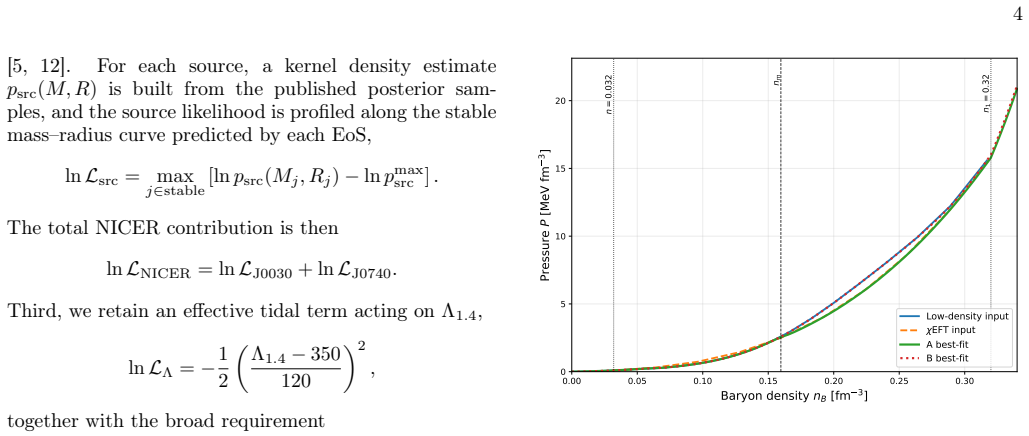
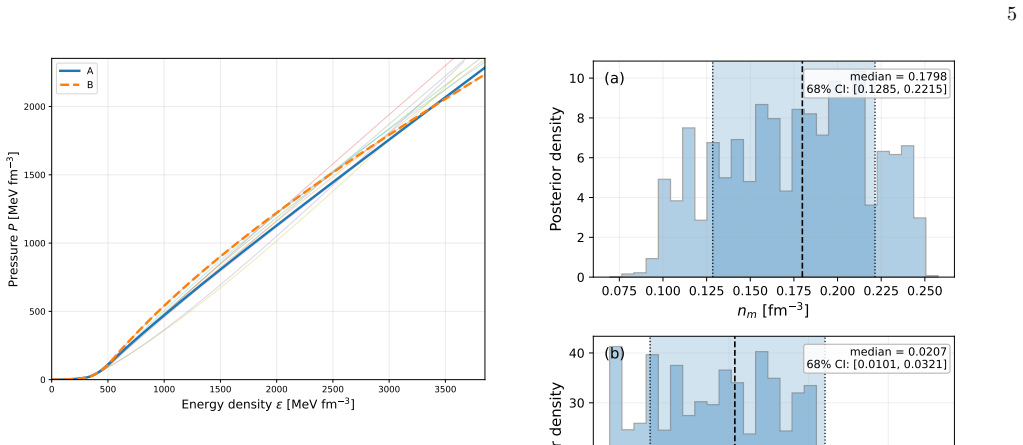
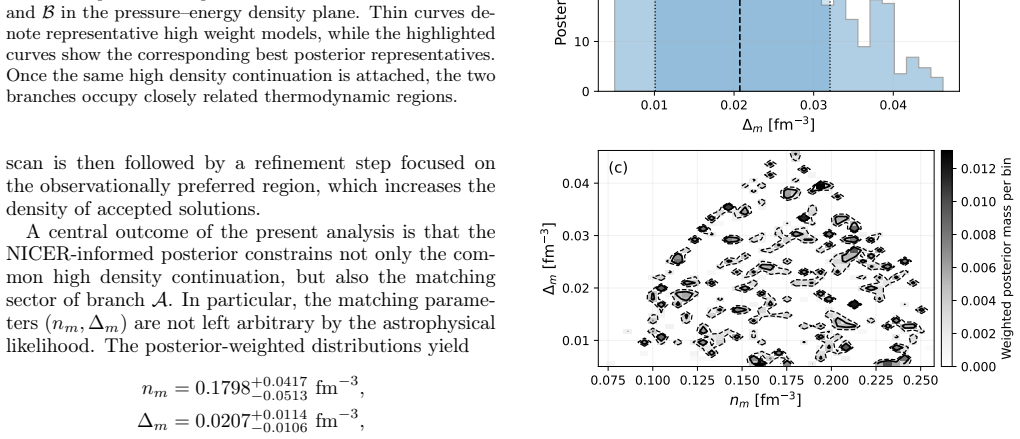
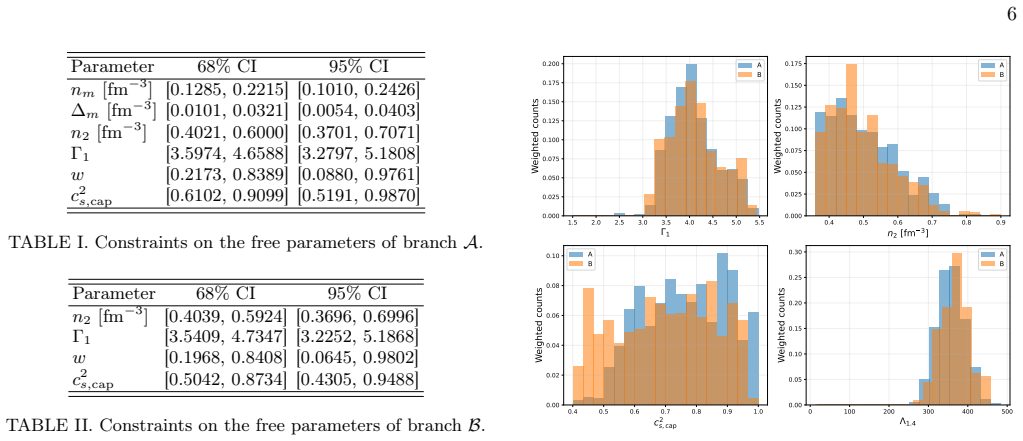
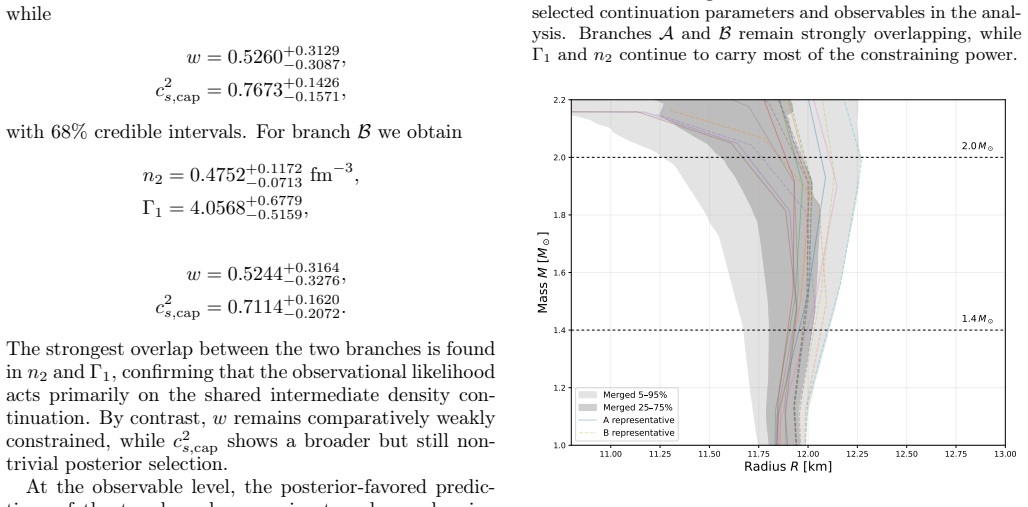
We compare two low density branches propagated through a common high density extension and confront them with direct NICER mass-radius posteriors, a lower bound on the maximum mass, and an effective constraint on Λ_{1.4}. We find that the observable predictions of the two branches remain strongly overlapping, while the NICER-informed posterior still induces a nontrivial constraint on the matching parameters. Current data therefore constrain primarily the shared continuation above n1, but also indirectly restrict the low-density matching sector.
What carries the argument
Two distinct low-density branches attached to one shared high-density continuation, with the resulting neutron-star observables tested directly against NICER mass-radius posteriors and related bounds.
If this is right
- The shared high-density continuation above n1 receives the dominant share of the observational constraint.
- Matching parameters at the low-to-high density interface still experience a measurable indirect restriction.
- Different low-density choices remain difficult to distinguish with present data once a common continuation is fixed.
- The method isolates the matching sector as an independent target for future tighter observations.
Where Pith is reading between the lines
- If additional observables such as post-merger gravitational waves become available, they could further separate the low-density branches even with a fixed continuation.
- The same two-branch comparison could be repeated with nuclear-physics priors on the low-density side to test consistency between terrestrial and astrophysical constraints.
- Extending the test to more than two branches would quantify how much of the low-density freedom is actually reachable by current data.
Load-bearing premise
The two chosen low-density branches adequately sample the relevant variation in low-density EOS behavior and the high-density extension can be treated as independent of the low-density matching choice.
What would settle it
A future dataset in which the two branches produce clearly separated mass-radius or tidal-deformability posteriors under the identical high-density extension, or in which the joint posterior shows no tightening on the matching parameters at all.
Figures
read the original abstract
We investigate whether current astrophysical data constrain not only the high density continuation of the neutron star equation of state, but also the low density matching procedure itself. To this end, we compare two low density branches propagated through a common high density extension and confront them with direct NICER mass-radius posteriors, a lower bound on the maximum mass, and an effective constraint on $\Lambda_{1.4}$. We find that the observable predictions of the two branches remain strongly overlapping, while the NICER-informed posterior still induces a nontrivial constraint on the matching parameters. Current data therefore constrain primarily the shared continuation above $n_1$, but also indirectly restrict the low-density matching sector.
Editorial analysis
A structured set of objections, weighed in public.
Referee Report
Summary. The manuscript investigates whether current astrophysical data constrain not only the high-density continuation of the neutron star equation of state but also the low-density matching procedure. It compares two low-density branches propagated through a common high-density extension against direct NICER mass-radius posteriors, a lower bound on the maximum mass, and an effective constraint on Λ_{1.4}. The authors find that observable predictions of the two branches remain strongly overlapping, while the NICER-informed posterior still induces a nontrivial constraint on the matching parameters, concluding that data constrain primarily the shared continuation above n_1 but also indirectly restrict the low-density matching sector.
Significance. If the central result holds after addressing sampling robustness, it would indicate that current observations can provide indirect leverage on low-density EOS matching choices, which is relevant for reducing modeling uncertainties in unified neutron-star EOS constructions. The use of direct mass-radius posteriors rather than derived quantities is a methodological strength.
major comments (2)
- [Abstract] Abstract: the claim that the NICER-informed posterior induces a nontrivial constraint on the matching parameters (and thus indirectly restricts the low-density sector) is load-bearing for the central conclusion, yet it rests on the untested assumption that the two chosen low-density branches adequately sample the relevant variation in low-density EOS behavior; other matching procedures or parameter ranges below n_1 could produce non-overlapping predictions or erase the posterior constraint.
- [Abstract] Abstract: the independence assumption that the high-density extension can be treated as fixed and independent of the low-density matching choice is stated but not demonstrated; any coupling between the matching sector and the continuation above n_1 would invalidate treating the extension as common and undermine the interpretation of overlapping predictions.
minor comments (1)
- [Abstract] The abstract introduces n_1 without a brief definition or reference to its typical value; this should be clarified for readers unfamiliar with the notation.
Simulated Author's Rebuttal
We thank the referee for the constructive and detailed comments. The two major points raised highlight important aspects of our sampling choices and modeling assumptions. We address each below and indicate where revisions will be made to strengthen the manuscript.
read point-by-point responses
-
Referee: [Abstract] Abstract: the claim that the NICER-informed posterior induces a nontrivial constraint on the matching parameters (and thus indirectly restricts the low-density sector) is load-bearing for the central conclusion, yet it rests on the untested assumption that the two chosen low-density branches adequately sample the relevant variation in low-density EOS behavior; other matching procedures or parameter ranges below n_1 could produce non-overlapping predictions or erase the posterior constraint.
Authors: We chose the two low-density branches to represent distinct and widely used classes of models (one chiral-EFT informed and one phenomenological) that bracket typical variations below n1. The strong overlap in predictions and the persistence of the NICER-induced constraint on matching parameters are the central observations. We agree that demonstrating robustness against a broader set of low-density models would make the claim more general. In revision we will add at least two additional low-density branches (or a systematic parameter variation) and recompute the overlap and posterior constraints to test whether the reported behavior persists. revision: yes
-
Referee: [Abstract] Abstract: the independence assumption that the high-density extension can be treated as fixed and independent of the low-density matching choice is stated but not demonstrated; any coupling between the matching sector and the continuation above n_1 would invalidate treating the extension as common and undermine the interpretation of overlapping predictions.
Authors: The high-density continuation is constructed by matching at n1 and then using a parameterization whose parameters are chosen independently of the EOS below n1; the same continuation is applied to both branches by design. We will expand the methods section to explicitly document the matching procedure, list the high-density parameters, and verify that no functional dependence on the low-density sector is introduced. This will make the independence assumption transparent and testable. revision: yes
Circularity Check
No significant circularity; derivation uses external NICER data to constrain parameters without self-referential reduction.
full rationale
The paper compares two low-density EOS branches through a shared high-density extension and confronts the resulting mass-radius predictions against independent NICER posteriors, a maximum-mass bound, and a tidal-deformability constraint. No quoted step defines a quantity in terms of itself, renames a fit as a prediction, or relies on a load-bearing self-citation whose content reduces to the present result. The reported posterior constraint on matching parameters is generated by external astrophysical data rather than by construction from the branches themselves. The analysis therefore remains self-contained against the cited observational inputs.
Axiom & Free-Parameter Ledger
free parameters (1)
- low-density matching parameters
axioms (1)
- domain assumption The high-density extension is identical for both low-density branches
Reference graph
Works this paper leans on
-
[1]
A mas- sive pulsar in a compact relativistic binary,
J.Antoniadis, P.C.C.Freire, N.Wex, T.M.Tauris, R.S. Lynch, M. H. van Kerkwijk, M. Kramer, C. Bassa, V. S. Dhillon, T. Driebe, J. W. T. Hessels, V. M. Kaspi, V. I. Kondratiev, N. Langer, T. R. Marsh, M. A. McLaugh- lin, T. T. Pennucci, S. M. Ransom, I. H. Stairs, J. van Leeuwen, J. P. W. Verbiest, and D. G. Whelan, “A mas- sive pulsar in a compact relativi...
2013
-
[2]
Refined mass and geometric measurements of the high-mass PSR j0740+6620,
E. Fonseca, H. T. Cromartie, T. T. Pennucci, P. S. Ray, A. Y. Kirichenko, S. M. Ransom, P. B. Demorest, I. H. Stairs, Z. Arzoumanian, L. Guillemot, A. Parthasarathy, M. Kerr, I. Cognard, P. T. Bakeret al., “Refined mass and geometric measurements of the high-mass PSR j0740+6620,”Astrophysical Journal Letters, vol. 915, no. 1, p. L12, 2021
2021
-
[3]
Properties of the binary neutron star merger GW170817,
LIGO Scientific Collaboration and Virgo Collabora- tion, “Properties of the binary neutron star merger GW170817,”Physical Review X, vol. 9, p. 011001, 2019
2019
-
[4]
A NICER view of PSR j0030+0451: Up- dated constraints from six years of NICER observations,
Y. Kini, L. Mauviard, T. Salmi, A. L. Watts, S. Guillot, B. Dorsman, D. Choudhury, D. González- Caniulef, M. Hoogkamer, D. Huppenkothen, C. Kazant- sev, M. Kerr, S. Nissanke, P. S. Ray, P. Stammler, and S. Vinciguerra, “A NICER view of PSR j0030+0451: Up- dated constraints from six years of NICER observations,” arXiv e-prints, p. arXiv:2602.23743, 2026
arXiv 2026
-
[5]
A more precise measurement of the radius of PSR j0740+6620 using updated NICER data,
A. J. Dittmann, M. C. Miller, F. K. Lamb, I. Holt, C. Chirenti, M. T. Wolff, S. Bogdanov, S. Guillot, W. C. G. Ho, S. M. Morsink, Z. Arzoumanian, and K. C. Gendreau, “A more precise measurement of the radius of PSR j0740+6620 using updated NICER data,”The Astrophysical Journal, vol. 974, no. 2, p. 295, 2024
2024
-
[6]
A nicer view of psr j0030+0451: Millisecond pulsar parameter estimation,
T. E. Riley, A. L. Watts, S. Bogdanovet al., “A nicer view of psr j0030+0451: Millisecond pulsar parameter estimation,”The Astrophysical Journal Letters, vol. 887, no. 1, p. L21, 2019
2019
-
[7]
A nicer view of psr j0030+0451: Implications for the dense mat- ter equation of state,
G. Raaijmakers, T. E. Riley, A. L. Wattset al., “A nicer view of psr j0030+0451: Implications for the dense mat- ter equation of state,”The Astrophysical Journal Letters, vol. 887, no. 1, p. L22, 2019
2019
-
[8]
A comparison of three methods for selecting values of input variablesintheanalysisofoutputfromacomputercode,
M. D. McKay, R. J. Beckman, and W. J. Conover, “A comparison of three methods for selecting values of input variablesintheanalysisofoutputfromacomputercode,” Technometrics, vol. 21, no. 2, pp. 239–245, 1979
1979
-
[9]
Large sample properties of simulations using latin hypercube sampling,
M. Stein, “Large sample properties of simulations using latin hypercube sampling,”Technometrics, vol. 29, no. 2, pp. 143–151, 1987
1987
-
[10]
Exploratory designs for computational experiments,
M. D. Morris and T. J. Mitchell, “Exploratory designs for computational experiments,”Journal of Statistical Plan- ning and Inference, vol. 43, no. 3, pp. 381–402, 1995
1995
-
[11]
Y. Kiniet al., “Dataset for “A NICER View of PSR J0030+0451: Updated Constraints from Six Years of NICER Observations”,” https://zenodo.org/records/ 20271881, 2026, zenodo record 20271881. [Online]. Available: https://zenodo.org/records/20271881
arXiv 2026
-
[12]
Updated nicer psr j0740+6620 posterior samples,
A. J. Dittmannet al., “Updated nicer psr j0740+6620 posterior samples,” https://zenodo.org/ records/10215109, 2024, zenodo record 10215109. [On- line]. Available: https://zenodo.org/records/10215109
arXiv 2024
-
[13]
Building neutron stars with the muses calculation engine,
M. R. Pelicer, N. Cruz-Camacho, C. Conde-Ocazionez, D. Friedenberg, S. Roy, Z. Zhang, T. A. Manning, M. G. Alford, A. Clevinger, J. Grefa, R. Haas, A. Haber, M. Hippert, J. W. Holt, J. Jahan, M. Kahangirwe, R. Kumar, J. Peterson, H. Shah, A. W. Steiner, H. Tan, Y. Yang, V. Vovchenko, V. Dexheimer, J. Noronha, J. Noronha-Hostler, C. Ratti, and N. Yunes, “B...
-
[14]
Muses calculation engine,
T. A. Manning, “Muses calculation engine,” 2 2025. [Online]. Available: https://musesframework.io
2025
-
[15]
Structure of neutron star crusts from new skyrme effective interactions constrained by chiral effective field theory,
Y. Lim and J. W. Holt, “Structure of neutron star crusts from new skyrme effective interactions constrained by chiral effective field theory,”Physical Review C, vol. 95, no. 6, p. 065805, 2017
2017
-
[16]
Chiral effective field theory and nuclear forces,
R. Machleidt and D. Entem, “Chiral effective field theory and nuclear forces,”Phys. Rep., vol. 503, pp. 1–75, 2011
2011
-
[17]
Accurate charge-dependent nucleon-nucleonpotentialatfourthorderofchiralpertur- bation theory,
D. Entem and R. Machleidt, “Accurate charge-dependent nucleon-nucleonpotentialatfourthorderofchiralpertur- bation theory,”Phys. Rev. C, vol. 68, p. 041001, 2003
2003
-
[18]
Chiral three-nucleon interaction and the 14c-datingβdecay,
J. Holt, N. Kaiser, and W. Weise, “Chiral three-nucleon interaction and the 14c-datingβdecay,”Phys. Rev. C, vol. 79, p. 054331, 2009
2009
-
[19]
Density-dependent effective nucleon-nucleon inter- action from chiral three-nucleon forces,
——, “Density-dependent effective nucleon-nucleon inter- action from chiral three-nucleon forces,”Phys. Rev. C, vol. 81, p. 024002, 2010
2010
-
[20]
Nuclear-matter equation of state with consistent two- and three-body perturba- tive chiral interactions,
L. Coraggio, J. W. Holt, N. Itaco, R. Machleidt, L. E. Marcucci, and F. Sammarruca, “Nuclear-matter equation of state with consistent two- and three-body perturba- tive chiral interactions,”Phys. Rev. C, vol. 89, p. 044321, 2014
2014
-
[21]
Monotone piecewise cu- bic interpolation,
F. N. Fritsch and R. E. Carlson, “Monotone piecewise cu- bic interpolation,”SIAM Journal on Numerical Analysis, vol. 17, no. 2, pp. 238–246, 1980
1980
-
[22]
A method for construct- ing local monotone piecewise cubic interpolants,
F. N. Fritsch and J. Butland, “A method for construct- ing local monotone piecewise cubic interpolants,”SIAM Journal on Scientific and Statistical Computing, vol. 5, no. 2, pp. 300–304, 1984
1984
-
[23]
Equation of state of dense nuclear matter and neutron star structure from nuclear chiral interactions,
I. Bombaci and D. Logoteta, “Equation of state of dense nuclear matter and neutron star structure from nuclear chiral interactions,”Astronomy & Astrophysics, vol. 609, p. A128, 2018
2018
-
[24]
On massive neu- tron cores,
J. R. Oppenheimer and G. M. Volkoff, “On massive neu- tron cores,”Physical Review, vol. 55, no. 4, p. 374, 1939
1939
-
[25]
Tidal love numbers of neutron stars,
T. Hinderer, “Tidal love numbers of neutron stars,”The Astrophysical Journal, vol. 677, no. 2, p. 1216, 2008
2008
-
[26]
Tidal deformability of neutron stars with realistic equa- tions of state and their gravitational wave signatures in binary inspiral,
T. Hinderer, B. D. Lackey, R. N. Lang, and J. S. Read, “Tidal deformability of neutron stars with realistic equa- tions of state and their gravitational wave signatures in binary inspiral,”Physical Review D, vol. 81, no. 12, p. 123016, 2010
2010
-
[27]
Gelman, J
A. Gelman, J. B. Carlin, H. S. Stern, D. B. Dunson, A. Vehtari, and D. B. Rubin,Bayesian Data Analysis, 3rd ed. Chapman and Hall/CRC, 2013
2013
-
[28]
Bayes in the sky: Bayesian inference and model selection in cosmology,
R. Trotta, “Bayes in the sky: Bayesian inference and model selection in cosmology,”Contemporary Physics, vol. 49, no. 2, pp. 71–104, 2008
2008
discussion (0)
Sign in with ORCID, Apple, or X to comment. Anyone can read and Pith papers without signing in.