REVIEW 4 major objections 4 minor 9 references
Efficient dataset construction using active learning and uncertainty-aware neural networks for plasma turbulent transport surrogate models
T0 review · 4 major / 4 minor · reviewed 2026-08-06 · deepseek-v4-flash
Pith's one-line read Active learning with uncertainty-aware networks can build compact tokamak turbulence surrogate datasets, reaching F1 around 0.8 and R2 around 0.75 with about ten thousand labels and beating random sampling.
desk verdict A solid, honest proof-of-principle that active learning with uncertainty-aware single models can build QuaLiKiz surrogates as efficiently as the ADEPT ensemble pipeline, with the caveat that the efficiency is only demonstrated in the same Gaussian-distributed pool used for training. read the letter →
The pith
A machine-rendered reading of the paper's core claim, the machinery that carries it, and where it could break.
The reading
What carries the argument
The pipeline is built on Bayesian last layer architectures: a spectral-normalized Gaussian process classifier produces a mode-presence probability with an uncertainty output, and a Bayesian neural network with noise-contrastive prior regressor returns a mean prediction, a model-uncertainty estimate, and a data-uncertainty estimate. A custom acquisition function combines classifier uncertainty with a weighted sum of absolute and relative regressor uncertainties, and a low-discrepancy sampler generates random weight vectors so that multiple transport outputs compete fairly in a multi-objective selection. A closed-form Fisher-Rao distance metric replaces the asymmetric KL-divergence in the regressor loss, improving training robustness, and physics-based filters clean the labelled outputs before they are appended. The loop works by evaluating the current models on a random subset of a very large unlabelled pool, scoring candidates, sending the top-scoring inputs to QuaLiKiz for labelling, and growing the training set.
What would settle it
Run the identical active-learning pipeline with the unlabelled pool drawn from a uniform distribution over the same input bounds while the test set remains Gaussian, and compare final F1 and R2; the paper's own mismatch study says the Gaussian-pool/uniform-application combination collapses the regressor, so if the uncertainty-aware pipeline shows the same collapse the reported efficiency is pool-specific, and if it does not the method is more general than the paper claims.
Extended reading notes
Core claim
The central claim is that a single-model, uncertainty-aware architecture can drive an active-learning loop that constructs a QuaLiKiz surrogate dataset about as efficiently as the earlier ensemble-based pipeline, but with only one network to train, store, and load per output variable. Starting from a 100-point seed set and adding roughly 200 labelled points per iteration over 45 iterations, the classifier-regressor pairs reach $F_1$ around 0.8 and $R^2$ around 0.75 on a test set drawn from the same distribution that generated the unlabelled pool. The paper presents this as a proof-of-principle for smaller datasets, explicitly framed as a proxy for more expensive gyrokinetic codes, and states that the final performance is notably better than random acquisition from the pool at the same dataset size.
Load-bearing premise
The load-bearing premise is that the hand-fitted multivariate Gaussian distribution used to generate the unlabelled pool describes the domain where the surrogate will actually be applied; the test set is drawn from that same distribution, and Appendix B shows regressor performance degrades sharply when the application distribution does not match the pool.
Editorial extensions
If this is right
- If the claim holds, a surrogate for a costly gyrokinetic code can be trained with roughly 10,000 high-value simulator runs instead of relying on a comparably performing random dataset of the same size.
- Deployment keeps one trained network per output instead of an ensemble, reducing memory, training time, and loading overhead in integrated transport solvers.
- The multi-objective acquisition scheme means one active-learning campaign can simultaneously improve classification and multiple flux regressors for all three turbulence modes.
- The Fisher-Rao loss replacement, if it generalizes, gives other uncertainty-aware regression models a more stable training signal in low-data regimes.
- The same simulator-in-the-loop design can be ported to other expensive physics codes as long as a suitable unlabelled pool and physics filters exist.
Reading between the lines
- An implication the paper leaves implicit is that the 45-iteration schedule and fixed candidate buffer may not be the main driver of efficiency; the same pipeline with adaptive batch sizes or an adaptive acquisition-function schedule could show faster convergence, since the paper itself notes diminishing returns.
- A testable extension would swap the pool distribution while holding all other components fixed; the appendix's mismatch study suggests regressors are the fragile part, so a production version should validate the pool against the target machine's expected operating space before trusting the reported numbers.
- Because classifier and regressor outputs are blended, classifier errors can feed into regressor acquisition in later iterations; the paper flags this feedback risk but does not quantify it, so tracking per-iteration classifier F1 as a real-time gate could be a cheap safeguard.
- The single multi-output Bayesian network experiment failing while single-output models succeed suggests the covariance information between transport channels is not captured; an explicit covariance-aware loss or a small final correlation layer would be a natural next step to recover that information.
Signed reviews
Editorial analysis
A structured set of objections, weighed in public.
Referee Report
Summary. This paper presents a proof-of-principle active-learning pipeline for constructing training datasets for QuaLiKiz turbulent transport surrogates. It combines an SNGP classifier for instability presence with a BNN-NCP regressor for each flux channel, evaluates uncertainty-based acquisition functions over a large unlabelled pool generated from a hand-fitted multivariate Gaussian, and labels selected candidates with in-the-loop QuaLiKiz simulations. After 45 iterations growing the training set from 100 to roughly 10^4 points, the authors report F1 around 0.8 and R2 around 0.75 on a test set drawn from the same Gaussian distribution, and argue this is notably better than random sampling and extrapolates toward the earlier ADEPT ensemble approach. The paper also introduces a Fisher-Rao replacement for the KL-divergence terms in the BNN loss and a Sobol-weighted multi-objective acquisition function.
Significance. If the in-distribution result is taken at face value, the paper makes a useful contribution: it demonstrates that single-model uncertainty-aware architectures can replace deep ensembles in an active-learning loop for a high-dimensional plasma physics surrogate, with open-source code, physics-based filtering, and honest reporting of failure modes in Appendix B. The multi-objective acquisition and the Fisher-Rao based robust training loss are practical innovations. However, the headline efficiency claims are conditional on the unlabelled pool and test set sharing the same hand-fitted Gaussian, the metrics are single-run point estimates with some channels much weaker than others, and the ADEPT parity is extrapolated rather than measured. The significance is therefore that of a well-scoped proof-of-principle, not a validated general-purpose methodology.
major comments (4)
- [Section 3.2 / Appendix A / Appendix B] The efficiency claim is demonstrated only in-distribution. The unlabelled pool (Section 3.2) and the test set are both drawn from the same hand-fitted multivariate Gaussian defined in Appendix A (Eqs. 18-20), and Appendix B's Figure 12 shows that when the application distribution is uniform while the pool is Gaussian, the regressor performance collapses catastrophically. Because the stated goal is a multi-machine surrogate built from a JET-fitted pool, this is a load-bearing assumption behind the Section 5 statement that the AL result is notably better than randomly sampling an equivalently sized dataset. The paper itself acknowledges this in Appendix B by advising that the high-probability region of the Gaussian must cover the application domain, but it does not remove the limitation. I request either an additional experiment measuring AL versus random sampling under a distribution shift, or a revised claim that explicitly scopes the efficiency result to the case where the pool distribution matches the application distribution.
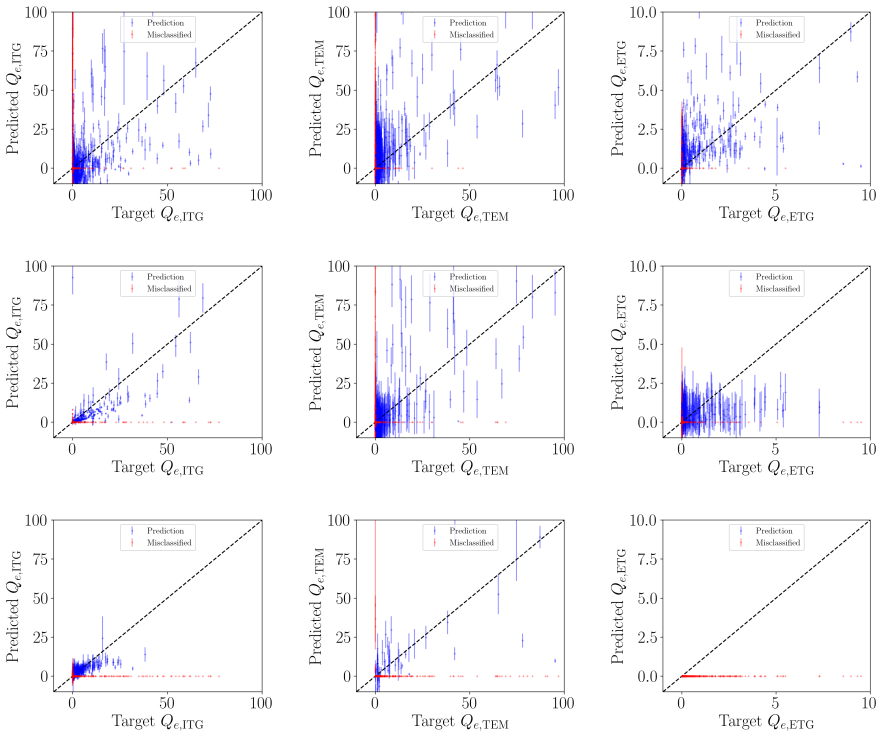
- [Section 4.1, Figures 6-7] The headline F1 around 0.8 and R2 around 0.75 are single-run point estimates with no error bars or multiple-seed variability. Figure 7 shows the classifier F1 is essentially flat as the training set grows, and Figure 6 (top right) shows the ETG Qe regressor is markedly weaker than the other channels, sometimes at or below zero. The abstract and conclusion state these metrics across all outputs, which overstates what is shown. Please report per-output final metrics, ideally with means and standard deviations over at least three to five seeds, and clarify that the summary metrics are not uniform across modes and channels.
- [Section 5] The comparison with the ADEPT ensemble is extrapolative, not measured. The text says that by extrapolating the observed performance trajectory, the AL methodology appears to approach the previous ADEPT performance, and no ADEPT model is evaluated on the same test set in this paper. This extrapolation is reasonable as a discussion point, but it should be presented explicitly as an extrapolation rather than as an established equivalence. If feasible, a head-to-head comparison on a common test set would substantially strengthen the claim.
- [Section 3.3 and Section 4.1] The efficiency comparison does not include an analysis of sensitivity to acquisition hyperparameters or to the manual per-iteration adjustment of the candidate buffer size. Because these choices directly affect the number and location of labels, their absence leaves open the possibility that part of the reported AL advantage over random sampling stems from these manual choices rather than from the uncertainty-aware acquisition itself. A brief sensitivity study, or at least an explicit statement of which results depend on manual tuning, would make the efficiency claim more robust.
minor comments (4)
- [Figure 16 caption] The caption refers to the ion heat flux, Pi_i, but Pi_i was defined in Section 3.2 as the ion momentum flux; please correct the caption.
- [Section 3.3] The sentence 'QuaLiKiz executions continued to simultaneous produce the necessary output' contains a typo; 'simultaneous' should be 'simultaneously'.
- [Table 5 caption] The caption states that gamma_abs,d and gamma_rel,d are equal across channels, but the main text explains why negative values are useful; adding one sentence on this to the caption would improve readability.
- [Figure 6 caption] The caption says that models with R2 <= 0 are set to zero, which visually inflates the apparent improvement; please state how many such points occur, or plot the negative values explicitly.
Circularity Check
No significant circularity: the AL-versus-random result is an empirical comparison on an independent, simulator-labelled test set, and the pool/test distribution match is an explicitly stated limitation rather than a definitional reduction.
full rationale
The paper's central claim—that uncertainty-aware active learning constructs more efficient QuaLiKiz surrogate training sets than random sampling—is an empirical measurement, not a derivation that reduces to its inputs. The reported F1 and R2 values are evaluated on a held-out test set of 1000 QuaLiKiz-labelled points (Section 3.3), while the acquisition function (Equations 13–16) is driven by model uncertainty outputs and Sobol-weighted multi-objective scores; the random baseline is correctly drawn from the same unlabelled pool. The multivariate Gaussian pool in Appendix A is fitted to JET-based statistics, but the surrogate targets are QuaLiKiz outputs, not values computed from that fitted distribution or from the paper's prior publications. The test set is intentionally sampled from the same distribution as the pool, and Appendix B explicitly quantifies the resulting limitation under distribution mismatch, including catastrophic regressor degradation when the application is uniform; this is an external-validity caveat, not a circular identity. Self-citations to ADEPT [27], QLKNN [17], and EuroPED-NN [57] are used as motivation, architecture choices, and baselines, but the improvement over random sampling is demonstrated with data and models produced in this study. The validation set is used to scale acquisition hyperparameters (Section 3.3), which is standard model selection and could introduce optimism, but it does not rename a fitted parameter as a prediction, and the test set remains independent. No quoted equation is equivalent to another by construction, and no fitted parameter is relabelled as a predicted result. Thus the derivation chain is self-contained for the in-distribution proof-of-principle it claims.
Assumptions & free parameters
free parameters (7)
- Pool distribution moments (Eqs. 18-20) =
Means, stds, correlations as polynomial/exponential functions of x
- Acquisition function hyperparameters (Table 5) =
gamma_cls=2, gamma_reg=1e-5 to 1e-4, gamma_rel=1e4, gamma_abs,d=-0.5, gamma_rel,d=-0.5
- Modified NLL mixing parameter gamma_s =
0.1
- Classifier-regressor blending threshold sigma_thr =
0.1
- Physics filter thresholds (Table 2) =
epsilon values 0.05, 0.1; flux caps
- Candidate buffer size (manual per iteration) =
20-200 per iteration
- OOD width and prior uncertainties for BNN =
OOD width 0.5, epistemic/aleatoric priors 1e-3
assumptions (6)
- domain assumption QuaLiKiz quasilinear gyrokinetic outputs are treated as ground truth for the turbulent transport fluxes and mode stability.
- domain assumption The 16 dimensionless input parameters fully constrain the local plasma state for electrostatic turbulence with the chosen species mix.
- domain assumption The multivariate Gaussian pool distribution fitted to JET data covers the intended application domain.
- domain assumption The post-labelling physics filters remove numerical noise without removing informative signal.
- domain assumption Model uncertainty from SNGP/BNN-NCP is a useful proxy for regions of poor predictive accuracy.
- domain assumption The independent test set drawn from the same distribution as the pool measures the performance relevant to the target application.
Cite this review
Pith. "Pith review of Efficient dataset construction using active learning and uncertainty-aware neural networks for plasma turbulent transport surrogate models." pith.science (2026). https://pith.science/paper/UFPHOAC5
@misc{pith2026250715976,
  author       = {Pith},
  title        = {Pith review of: Efficient dataset construction using active learning and uncertainty-aware neural networks for plasma turbulent transport surrogate models},
  year         = {2026},
  howpublished = {\url{https://pith.science/paper/UFPHOAC5}},
  note         = {Machine review of arXiv:2507.15976}
}
abstract
This work demonstrates a proof-of-principle for using uncertainty-aware architectures, in combination with active learning techniques and an in-the-loop physics simulation code as a data labeller, to construct efficient datasets for data-driven surrogate model generation. Building off of a previous proof-of-principle successfully demonstrating training set reduction on static pre-labelled datasets, using the ADEPT framework, this strategy was applied again to the plasma turbulent transport problem within tokamak fusion plasmas, specifically the QuaLiKiz quasilinear electrostatic gyrokinetic turbulent transport code. While QuaLiKiz provides relatively fast evaluations, this study specifically targeted small datasets to serve as a proxy for more expensive codes, such as CGYRO or GENE. The newly implemented algorithm uses the SNGP architecture for the classification component of the problem and the BNN-NCP architecture for the regression component, training models for all turbulent modes (ITG, TEM, ETG) and all transport fluxes ($Q_e$, $Q_i$, $\Gamma_e$, $\Gamma_i$, and $\Pi_i$) described by the general QuaLiKiz output. With 45 active learning iterations, moving from a small initial training set of $10^{2}$ to a final set of $10^{4}$, the resulting models reached a $F_1$ classification performance of ~0.8 and a $R^2$ regression performance of ~0.75 on an independent test set across all outputs. This extrapolates to reaching the same performance and efficiency as the previous ADEPT pipeline, although on a problem with 1 extra input dimension. While the improvement rate achieved in this implementation diminishes faster than expected, the overall technique is formulated with components that can be upgraded and generalized to many surrogate modeling applications beyond plasma turbulent transport predictions.
Figures


Figures from the paper (12 more)




Reference graph
Works this paper leans on
-
[1]
Enhanc- ing predictive capabilities in fusion burning plas- mas through surrogate-based optimization in core transport solvers
1P. Rodriguez-Fernandez, N. T. Howard, A. Saltz- man, S. Kantamneni, J. Candy, C. Holland, M. Balandat, S. Ament, and A. E. White, “Enhanc- ing predictive capabilities in fusion burning plas- mas through surrogate-based optimization in core transport solvers”, Nuclear Fusion 64, Publisher: IOP Publishing, 076034 (2024). 2M. Romanelli, G. Corrigan, V. Para...
2024
-
[5]
Akaike’s information criterion and recent developments in information complexity
(July 27, 2004), II–104 Vol.2. 39H. Bozdogan, “Akaike’s information criterion and recent developments in information complexity”, Journal of Mathematical Psychology 44, 62–91 (2000). 40J. F. Traub and A. G. Werschulz, Complexity and information, Vol. 26862 (Cambridge University Press, 1998). 41Y. Gal and Z. Ghahramani, “Dropout as a bayesian approximation...
work page 2000
-
[9]
Development of compact tokamak fusion reactor use cases to inform future transport studies
74C. Holland, E. Bass, D. Orlov, J. McClenaghan, B. Lyons, B. Grierson, X. Jian, N. Howard, and P. Rodriguez-Fernandez, “Development of compact tokamak fusion reactor use cases to inform future transport studies”, Journal of Plasma Physics 89, 905890418 (2023). A Development of the multivariate Gaussian sampling distribution In order to build upon the ini...
work page 2023
-
[634]
Improving gen- eralization with active learning
32D. Cohn, L. Atlas, and R. Ladner, “Improving gen- eralization with active learning”, Machine Learning 15, 201–221 (1994). 33J. Snoek, H. Larochelle, and R. P. Adams, “Prac- tical Bayesian optimization of machine learning al- gorithms”, in Advances in neural information pro- cessing systems, Vol. 25, edited by F. Pereira, C. Burges, L. Bottou, and K. Wei...
work page 1994
-
[2004]
Vol. 2, Journal Abbreviation: Proceedings of the 2004 IEEE Computer Society Conference on Computer Vision and Pattern Recognition,
work page 2004
-
[2018]
Deep learning in neural networks: An overview
36J. Schmidhuber, “Deep learning in neural networks: An overview”, CoRR, eprint: 1404.7828 (2014). 37G. E. Hinton, “Learning multiple layers of repre- sentation”, Trends in Cognitive Sciences 11, 428– 434 (2007). 38Y. LeCun, Fu Jie Huang, and L. Bottou, “Learning methods for generic object recognition with invari- ance to pose and lighting”, in Proceeding...
arXiv 2014
-
[2019]
Latent derivative bayesian last layer networks
53J. Watson, J. Andreas Lin, P. Klink, J. Pajarinen, and J. Peters, “Latent derivative bayesian last layer networks”, in Proceedings of the 24th international conference on artificial intelligence and statistics, Vol. 130, edited by A. Banerjee and K. Fukumizu, Proceedings of Machine Learning Research (13–15 Apr 2021), pp. 1198–1206. 54M. Lazaro-Gredilla ...
work page 2010
-
[2020]
Adam: A method for stochastic optimization
70D. P. Kingma and J. Ba, “Adam: A method for stochastic optimization”, in CoRR, Vol. abs/1412.6980 (2015). 71R. H. Byrd, P. Lu, J. Nocedal, and C. Zhu, “A lim- ited memory algorithm for bound constrained opti- mization”, SIAM Journal on Scientific Computing 16, 1190–1208 (1995). 72S. Burhenne, D. Jacob, and G. P. Henze, “Sam- pling based on Sobol sequenc...
arXiv 2015
Show all 9 references
-
[2021]
Addressing deep learning model calibration using evidential neural networks and uncertainty-aware training
47T. Dawood, E. Chan, R. Razavi, A. P. King, and E. Puyol-Ant´ on, “Addressing deep learning model calibration using evidential neural networks and uncertainty-aware training”, in 2023 IEEE 20th international symposium on biomedical imag- ing (ISBI), Journal Abbreviation: 2023...
2018
Reviewed August 6, 2026 · model on record in the stance chip above.
Discussion (0). Continue with ORCID to comment.