REVIEW 3 major objections 4 minor 46 references
Trajectory-wise Control Variates for Variance Reduction in Policy Gradient Methods
T0 review · 3 major / 4 minor · reviewed 2026-08-14 · deepseek-v4-flash
Pith's one-line read The paper claims that the natural chronological ordering of states and actions yields the optimal trajectory-wise control variate for policy gradients, cutting variance from future policy randomness at no extra learning cost.
desk verdict The TrajCV estimator is sound and the variance decomposition is useful, but the paper's headline optimality result rests on a proof step that goes beyond Lemma A.1's independence assumption. read the letter →
The pith
A machine-rendered reading of the paper's core claim, the machinery that carries it, and where it could break.
The reading
What carries the argument
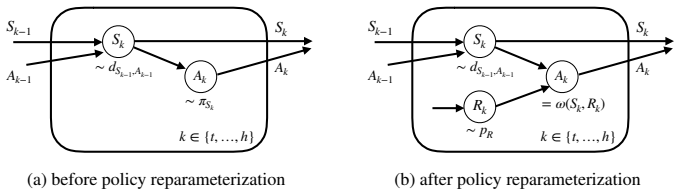
The load-bearing object is the difference estimator built from a recursive law-of-total-variance decomposition. For each gradient component $G_t$, the paper orders the random variables causally, identifies the variance attributed to each future action $A_k$, and chooses the optimal CV for that term, which is a function of $(S_k,A_k)$ whose conditional expectation over $A_k$ is available because only the policy distribution is used. Summing these per-step terms gives estimator (12); the optimality proof rests on an inequality (Lemma A.1) saying that conditioning on an earlier variable leaves no more residue, plus a feasibility argument based on the Bayes network that blocks unknown-dynamics dependencies when action randomness precedes future states. The natural ordering is what makes the CV computable from the Q-function alone.
What would settle it
Enumerate all feasible orderings on a small three-step MDP with known dynamics, a Gaussian policy, and an exact Q-function, and compute the residue variance remaining after each ordering's optimal CV; if any feasible ordering has strictly smaller residue than the natural ordering, Theorem 4.1 is false.
Extended reading notes
Core claim
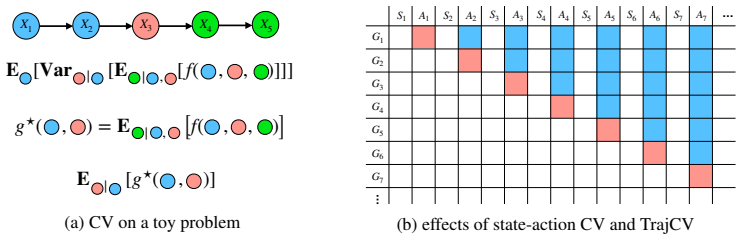
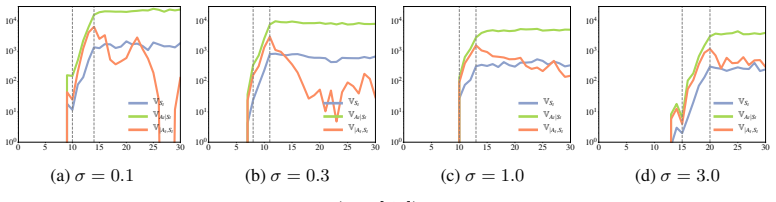
The paper's central claim is that the natural chronological ordering $S_t\to A_t\to S_{t+1}\to A_{t+1}\to\cdots\to S_h\to A_h$ is the best ordering for designing a control variate for each policy gradient component $G_t=N_t C_{t:h}$, and that the estimator (12) is the optimal trajectory-wise control variate in the sense of minimizing the residue variance once the optimal CV for each ordering is attainable. The estimator subtracts from $G_t$ the sum over $k$ from $t$ to $h$ of $\left(N_t \hat{Q}_k - \mathbb{E}_{A_k|S_k}[N_t \hat{Q}_k]\right)$, which cancels variance caused by policy randomness at every future action while leaving the expectation unchanged. With deterministic dynamics and an exact Q-function, all of the variance $V_{A_t|S_t}$ and $V_{|S_t,A_t}$ is removed from each component. The paper also shows by a variance decomposition that the third term $V_{|S_t,A_t}$, ignored by previous state-action CVs, is as large as the action-conditional term for Gaussian policies with small variance, which is why the extra terms matter.
Load-bearing premise
The optimality theorem depends on an inequality that is proven only for independent variables being applied to dependent MDP variables during the ordering exchanges in the proof; if that step fails, the natural ordering may not be optimal, though the estimator would still be unbiased.
Editorial extensions
If this is right
- Long horizons become less punishing: the dominant long-term variance $V_{|S_t,A_t}$ is reduced by the extra terms, whereas state-action CVs leave it untouched.
- Sample efficiency improves without changing the learning target: only a Q-function approximator is required, the same object as existing state-action control variates.
- When transition dynamics are deterministic and the Q-function estimate is accurate, the per-component variance collapses to only the state-marginal term $V_{S_t}$.
- Trajectory-wise CVs can be computed in $O(h)$ time per trajectory, so the variance gain does not require additional rollouts.
Reading between the lines
- The paper's optimality argument assumes exact Q-functions; in practice, with imperfect critics, a different ordering that samples action randomness first could beat the natural ordering when a learned dynamics model is more accurate than the Q-function estimate.
- The same divide-and-conquer variance decomposition should carry over to off-policy or importance-weighted policy gradients, where the known distribution is the behavior policy rather than the target policy; that is a testable extension the paper does not develop.
- Viewing state-action baselines as the diagonal of an upper-triangular variance structure suggests a general recipe: any known conditional distribution along a trajectory can supply an unbiased per-step control variate.
Signed reviews
Editorial analysis
A structured set of objections, weighed in public.
Referee Report
Summary. The paper studies control variates for policy-gradient estimation in finite-horizon MDPs. It observes that the usual state-action control variate (6) reduces only the variance due to the action at the current step, and proposes TrajCV, which adds terms for later steps so that the estimator (12) also reduces variance due to future policy randomness along the trajectory. The construction is derived by repeatedly applying the law of total variance under the ordering (11), and the authors claim in Theorem 4.1 that this natural ordering minimizes the residual variance among all orderings of the reparameterized variables when the optimal control variate for each ordering is attainable. Section 3 gives asymptotic variance bounds for Gaussian policies (Theorem 3.1), and Section 5 reports CartPole experiments comparing naive Monte Carlo, state-dependent CV, state-action CV, and TrajCV.
Significance. If Theorem 4.1 were established, the paper would give a clean optimality justification for a simple and practical variance-reduction scheme that requires only approximate Q-functions and can be computed recursively. The estimator itself is unbiased, and the divide-and-conquer derivation in Section 4.1 is transparent and useful. Theorem 3.1 also provides a concrete asymptotic picture of why the future-trajectory variance component matters. However, the proof of Theorem 4.1 in Appendix A.1 relies on an unproved extension of Lemma A.1 to dependent variables, and the reduction to the natural ordering is not rigorously established; the headline optimality claim is therefore not currently supported by the manuscript.
major comments (3)
- [Appendix A.1, Lemma A.1 and operation (b)] Lemma A.1 proves inequality (15) only for independent X and Y. Operation (b) moves R_k after S_u in the reparameterized Bayes net of Figure 2b, where R_k is an ancestor of S_u and the two variables are dependent. The proof asserts that this exchange does not increase the residue 'because of the discussion after Lemma A.1', but no conditional-independence or d-separation conditions are verified at this step. Without such a generalized inequality, the optimality of the natural ordering in Theorem 4.1 is unproven; for dependent variables the inequality in Lemma A.1 can fail. This is load-bearing for the paper's central claim.
- [Appendix A.1, operation (b)] The configuration S_v -> R_k -> S_u with v > u > k is incompatible with the proof's own definition of a feasible ordering, which requires R_k to appear before S_{k+1,h}. If S_v appears before R_k and v > u > k, then a state after k appears before R_k, violating feasibility. Thus the exchange operation described in the proof cannot be applied to any feasible ordering, and the claimed transformation to the natural ordering is not well-defined. A different exchange argument or a formal characterization of feasible orderings is needed.
- [Appendix A.1, operation (a)] The statement that two states S_v and S_u with v > u can be exchanged 'without affecting residue' is asserted without computation. States in the MDP are dependent through the dynamics, and the residue is defined through conditional expectations and variances with respect to a specific ordering; changing the order of states changes the conditioning sets in the law-of-total-variance decomposition. This invariance requires proof, not assertion, and this gap is independent of the issue with dependent action randomness.
minor comments (4)
- [Section 4.2, Eq. (12)] The displayed estimator has summation indices ∑_{t=1}^h and then ∑_{k=1}^h; for component G_t the sum should be over k = t, ..., h. As written the first sum is ill-defined and inconsistent with the preceding display. Please correct the indices.
- [Figures 4 and 5] The legend entries such as 'state-action CV (MC)' and 'TrajCV (MC)' are not self-explanatory; the caption should state that MC refers to the 1000-sample approximation of E_{A|S}[\hat Q].
- [Notation, Eqs. (7)-(8) and Figure 3] The third variance component is written V_{|S_t,A_t} in Eq. (8) but V_{|A_t,S_t} in Figure 3; please use one consistent ordering of the subscripts.
- [Introduction, related work] The text acknowledges that reference [24] reports exactly equation (12), but the relation is only discussed in the final paragraph of the introduction; it would be clearer to state this overlap explicitly when the estimator is introduced.
Circularity Check
No circularity found: the trajectory-wise control variate derivation is self-contained, with no fitted parameter renamed as a prediction and no load-bearing self-citation.
full rationale
The paper's central claim is that the estimator (12) is an optimal trajectory-wise control variate and that the natural ordering (11) minimizes residue variance. The derivation constructs the estimator from a recursive law-of-total-variance decomposition, with the Q-function approximator as a standard learned input rather than a parameter fitted to force the result. Theorem 4.1 is proved in Appendix A.1 using Lemma A.1 and ordering-exchange operations; the theorem's conclusion is not assumed by any definition. The possible weakness identified in the proof, namely that Lemma A.1 is stated for independent X and Y while the exchange operation moves dependent MDP variables, is a rigor or correctness gap, not circularity: it does not reduce the theorem to its statement. The paper's self-citations ([6] and [8]) appear in citation clusters for convergence guarantees and policy optimization speed, and they are not used to justify the main variance-reduction result or to forbid alternative orderings. The experimental section compares against standard Monte Carlo and existing control-variate baselines, so no fitted input is relabeled as a prediction. Therefore the derivation chain is self-contained and no circular step can be exhibited.
Assumptions & free parameters
assumptions (7)
- standard math Law of total variance with nested conditioning
- standard math Jensen's inequality in Lemma A.1 for independent X and Y
- domain assumption MDP with finite horizon, known cost, unknown dynamics and policy
- domain assumption Gaussian policy, bounded cost, Q-function analytic in action, small sigma for Theorem 3.1
- ad hoc to paper Optimal CV of a given ordering is attainable (exact Q-function)
- ad hoc to paper Fact 1 separation property: a CV term affects only its corresponding variance component
- ad hoc to paper Generalized exchange inequality for dependent MDP variables (extension of Lemma A.1)
Cite this review
Pith. "Pith review of Trajectory-wise Control Variates for Variance Reduction in Policy Gradient Methods." pith.science (2026). https://pith.science/paper/UFS4R5JT
@misc{pith2026190803263,
  author       = {Pith},
  title        = {Pith review of: Trajectory-wise Control Variates for Variance Reduction in Policy Gradient Methods},
  year         = {2026},
  howpublished = {\url{https://pith.science/paper/UFS4R5JT}},
  note         = {Machine review of arXiv:1908.03263}
}
read the original abstract
Policy gradient methods have demonstrated success in reinforcement learning tasks that have high-dimensional continuous state and action spaces. However, policy gradient methods are also notoriously sample inefficient. This can be attributed, at least in part, to the high variance in estimating the gradient of the task objective with Monte Carlo methods. Previous research has endeavored to contend with this problem by studying control variates (CVs) that can reduce the variance of estimates without introducing bias, including the early use of baselines, state dependent CVs, and the more recent state-action dependent CVs. In this work, we analyze the properties and drawbacks of previous CV techniques and, surprisingly, we find that these works have overlooked an important fact that Monte Carlo gradient estimates are generated by trajectories of states and actions. We show that ignoring the correlation across the trajectories can result in suboptimal variance reduction, and we propose a simple fix: a class of "trajectory-wise" CVs, that can further drive down the variance. We show that constructing trajectory-wise CVs can be done recursively and requires only learning state-action value functions like the previous CVs for policy gradient. We further prove that the proposed trajectory-wise CVs are optimal for variance reduction under reasonable assumptions.
Figures
Reference graph
Works this paper leans on
-
[1]
R. J. Williams. Simple statistical gradient-following algorithms for connectionist reinforce- ment learning. Machine learning, 8(3-4):229–256, 1992
work page 1992
-
[2]
R. S. Sutton, D. A. McAllester, S. P. Singh, and Y . Mansour. Policy gradient methods for reinforcement learning with function approximation. In Advances in Neural Information Pro- cessing Systems, pages 1057–1063, 2000
work page 2000
-
[3]
S. M. Kakade. A natural policy gradient. In Advances in Neural Information Processing Systems, pages 1531–1538, 2002
work page 2002
-
[4]
J. Peters and S. Schaal. Natural actor-critic. Neurocomputing, 71(7-9):1180–1190, 2008
work page 2008
-
[5]
Schulman, S
J. Schulman, S. Levine, P. Abbeel, M. Jordan, and P. Moritz. Trust region policy optimization. In International Conference on Machine Learning, pages 1889–1897, 2015
2015
- [6]
-
[7]
V . R. Konda and J. N. Tsitsiklis. Actor-critic algorithms. In Advances in Neural Information Processing Systems, pages 1008–1014, 2000
work page 2000
- [8]
Show all 46 references
-
[9]
Yang and Y
L. Yang and Y . Zhang. Policy optimization with stochastic mirror descent. arXiv preprint arXiv:1906.10462, 2019
1906 arXiv
-
[10]
Ghadimi, G
S. Ghadimi, G. Lan, and H. Zhang. Mini-batch stochastic approximation methods for non- convex stochastic composite optimization. Mathematical Programming, 155(1-2):267–305, 2016
2016
-
[11]
Kimura, S
H. Kimura, S. Kobayashi, et al. An analysis of actor-critic algorithms using eligibility traces: reinforcement learning with imperfect value functions. Journal of Japanese Society for Artifi- cial Intelligence, 15(2):267–275, 2000
2000
-
[12]
P. Thomas. Bias in natural actor-critic algorithms. In International Conference on Machine Learning, pages 441–448, 2014
2014
-
[13]
Silver, G
D. Silver, G. Lever, N. Heess, T. Degris, D. Wierstra, and M. Riedmiller. Deterministic policy gradient algorithms. In International Conference on Machine Learning, 2014
2014
-
[14]
Schulman, P
J. Schulman, P. Moritz, S. Levine, M. Jordan, and P. Abbeel. High-dimensional continuous control using generalized advantage estimation. In International Conference on Learning Rep- resentations, 2016
2016
-
[15]
W. Sun, J. A. Bagnell, and B. Boots. Truncated horizon policy search: Combining reinforce- ment learning & imitation learning. In International Conference on Learning Representations, 2018
2018
-
[16]
Efroni, G
Y . Efroni, G. Dalal, B. Scherrer, and S. Mannor. Beyond the one step greedy approach in reinforcement learning. In International Conference on Machine Learning, 2019
2019
-
[17]
A. Y . Ng, D. Harada, and S. Russell. Policy invariance under reward transformations: The- ory and application to reward shaping. In International Conference on Machine Learning , volume 99, pages 278–287, 1999
1999
-
[18]
Greensmith, P
E. Greensmith, P. L. Bartlett, and J. Baxter. Variance reduction techniques for gradient esti- mates in reinforcement learning. Journal of Machine Learning Research, 5(Nov):1471–1530, 2004
2004
-
[19]
Jie and P
T. Jie and P. Abbeel. On a connection between importance sampling and the likelihood ratio policy gradient. In Advances in Neural Information Processing Systems , pages 1000–1008, 2010. 11
2010
-
[20]
S. Gu, T. Lillicrap, Z. Ghahramani, R. E. Turner, and S. Levine. Q-prop: Sample-efficient policy gradient with an off-policy critic. In International Conference on Learning Representa- tions, 2017
2017
-
[21]
H. Liu, Y . Feng, Y . Mao, D. Zhou, J. Peng, and Q. Liu. Action-depedent control variates for policy optimization via stein’s identity. In International Conference on Learning Representa- tions, 2018
2018
-
[22]
Grathwohl, D
W. Grathwohl, D. Choi, Y . Wu, G. Roeder, and D. Duvenaud. Backpropagation through the void: Optimizing control variates for black-box gradient estimation. In International Confer- ence on Learning Representations, 2018
2018
-
[23]
Tucker, S
G. Tucker, S. Bhupatiraju, S. Gu, R. E. Turner, Z. Ghahramani, and S. Levine. The mirage of action-dependent baselines in reinforcement learning. arXiv preprint arXiv:1802.10031, 2018
2018 arXiv
-
[24]
S. Pankov. Reward-estimation variance elimination in sequential decision processes. arXiv preprint arXiv:1811.06225, 2018
2018 arXiv
-
[25]
C. Wu, A. Rajeswaran, Y . Duan, V . Kumar, A. M. Bayen, S. Kakade, I. Mordatch, and P. Abbeel. Variance reduction for policy gradient with action-dependent factorized baselines. In International Conference on Learning Representation, 2018
2018
-
[26]
R. Bellman. A Markovian decision process. Journal of Mathematics and Mechanics , pages 679–684, 1957
1957
-
[27]
D. P. Bertsekas, D. P. Bertsekas, D. P. Bertsekas, and D. P. Bertsekas. Dynamic programming and optimal control, volume 1. Athena scientific Belmont, MA, 1995
1995
-
[28]
Beck and M
A. Beck and M. Teboulle. Mirror descent and nonlinear projected subgradient methods for convex optimization. Operations Research Letters, 31(3):167–175, 2003
2003
-
[29]
S. M. Kakade et al. On the sample complexity of reinforcement learning. PhD thesis, University of London London, England, 2003
2003
-
[30]
Vemula, W
A. Vemula, W. Sun, and J. A. Bagnell. Contrasting exploration in parameter and action space: A zeroth-order optimization perspective. In International Conference on Artificial Intelligence and Statistics, 2019
2019
-
[31]
S. M. Ross. A course in simulation. Prentice Hall PTR, 1990
1990
-
[32]
A. B. Owen. Monte Carlo theory, methods and examples. 2013
2013
-
[33]
Schmidt, N
M. Schmidt, N. Le Roux, and F. Bach. Minimizing finite sums with the stochastic average gradient. Mathematical Programming, 162(1-2):83–112, 2017
2017
-
[34]
Johnson and T
R. Johnson and T. Zhang. Accelerating stochastic gradient descent using predictive variance reduction. In Advances in Neural Information Processing Systems, pages 315–323, 2013
2013
-
[35]
Defazio, F
A. Defazio, F. Bach, and S. Lacoste-Julien. Saga: A fast incremental gradient method with support for non-strongly convex composite objectives. In Advances in Neural Information Processing Systems, pages 1646–1654, 2014
2014
-
[36]
C. Wang, X. Chen, A. J. Smola, and E. P. Xing. Variance reduction for stochastic gradient optimization. In Advances in Neural Information Processing Systems, pages 181–189, 2013
2013
-
[37]
Ciosek and S
K. Ciosek and S. Whiteson. Expected policy gradients for reinforcement learning. arXiv preprint arXiv:1801.03326, 2018
2018 arXiv
-
[38]
S. P. Singh and R. S. Sutton. Reinforcement learning with replacing eligibility traces. Machine learning, 22(1-3):123–158, 1996
1996
-
[39]
K. L. Chung. A course in probability theory. Academic press, 2001
2001
-
[40]
Baxter and P
J. Baxter and P. L. Bartlett. Infinite-horizon policy-gradient estimation. Journal of Artificial Intelligence Research, 15:319–350, 2001. 12
2001
-
[41]
Landau and E
L. Landau and E. Lifshitz. Statistical physics (course of theoretical physics vol 5). 1958
1958
-
[42]
Brockman, V
G. Brockman, V . Cheung, L. Pettersson, J. Schneider, J. Schulman, J. Tang, and W. Zaremba. OpenAI Gym. arXiv preprint arXiv:1606.01540, 2016
2016 arXiv
-
[43]
J. Lee, M. X. Grey, S. Ha, T. Kunz, S. Jain, Y . Ye, S. S. Srinivasa, M. Stilman, and C. K. Liu. DART: Dynamic animation and robotics toolkit. The Journal of Open Source Software, 3(22): 500, feb 2018
2018
-
[44]
C. M. Bishop. Pattern recognition and machine learning. springer, 2006. 13 Appendix A Missing Proofs A.1 Proof for Theorem 4.1 To understand how the ordering matters, we consider a toy example of estimating EX,Y [f(X,Y )] of some functionf of two random variablesX andY . We pr...
2006
-
[45]
That is, a feasible ordering must be causal at least in actions: the action randomness that causes a state must be arranged before that state in the ordering
We show that when dynamics is the MDP is unknown, an ordering is feasible, if and only if,Rk appears beforeSk+1,h for allt≤k <h. That is, a feasible ordering must be causal at least in actions: the action randomness that causes a state must be arranged before that state in the...
-
[46]
We consider the following operations (a) Suppose, in an ordering, there isSv→Su,v >u, then we can exchange them without affecting residue
We show that any feasible ordering can be transformed into the natural ordering in (11) using operations that do not increase the residue. We consider the following operations (a) Suppose, in an ordering, there isSv→Su,v >u, then we can exchange them without affecting residue....
Reviewed August 14, 2026 · model on record in the stance chip above.
Discussion (0). Continue with ORCID to comment.