REVIEW 4 major objections 5 minor 19 references
Towards Scalable O-RAN Resource Management: Graph-Augmented Proximal Policy Optimization
T0 review · 4 major / 5 minor · reviewed 2026-08-05 · deepseek-v4-flash
Pith's one-line read GPPO claims graph-based reinforcement learning keeps O-RAN placements feasible and 18% cheaper at 64 radio heads.
desk verdict A reasonable engineering combination of GNN and masked PPO for O-RAN split/placement, but the headline generalization claim is contradicted by the paper's own evaluation protocol, and the closest prior work is never benchmarked. read the letter →
The pith
A machine-rendered reading of the paper's core claim, the machinery that carries it, and where it could break.
The reading
What carries the argument
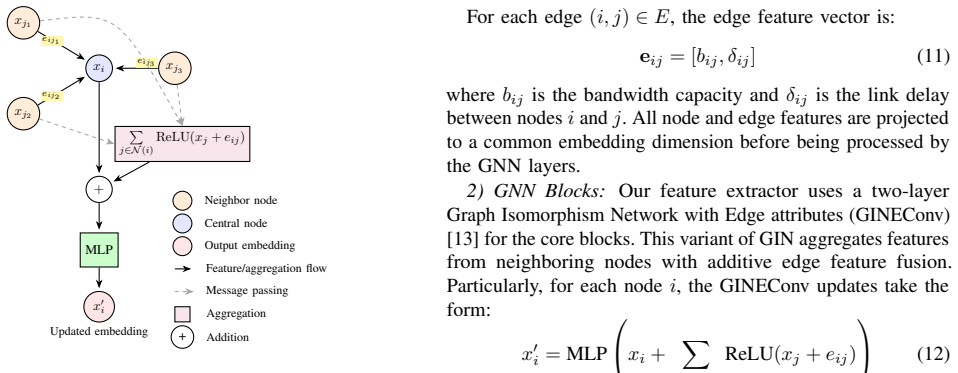
Two-layer GINEConv (Graph Isomorphism Network with edge attributes) message passing: each node's embedding is updated as MLP(x_i + sum over neighbors ReLU(x_j + e_ij)), so link delays and bandwidths enter the state representation through aggregation. Global mean pooling produces the graph-level embedding fed to PPO's policy and value networks. Action masking, applied to the action logits before softmax, confines the agent to placements that keep a valid RU-DU-CU path, reducing exploration of infeasible actions.
What would settle it
Train GPPO and MPPO on a fixed set of generated topologies and test on a disjoint set of topologies with different node counts and connectivity (never seen in training); if GPPO's success rate or cost advantage disappears, the topology-generalization claim is falsified. A cheaper check is to vary the cost coefficients across orders of magnitude and see whether the 18% gap persists; if the gap only appears for the paper's hand-set coefficients, the scalability result is an artifact of that cost structure.
Extended reading notes
Core claim
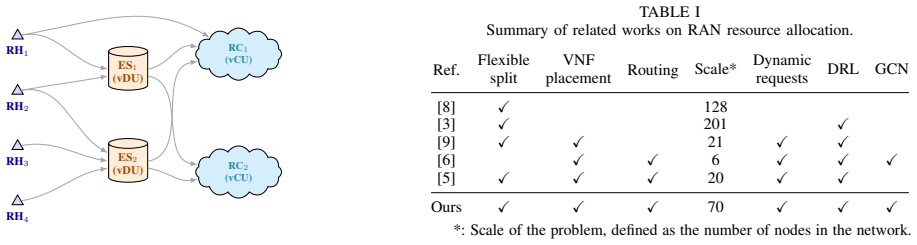
GPPO's central claim is that representing the O-RAN substrate as a graph and encoding node and edge attributes—remaining compute, traffic demand, latency requirement, link delay, bandwidth—with edge-aware graph isomorphism message passing lets a proximal-policy-optimization agent jointly decide functional split, vDU edge server, and vCU regional cloud for every radio head in one forward pass. The graph embedding is pooled into a global state vector feeding both policy and value networks, and action masks remove placements that violate hard connectivity. On the paper's simulated small topology, GPPO improves little over masked PPO alone; on the 64-radio-head topology the gap becomes qualitati
Load-bearing premise
The claimed gains assume the simulated topologies, delay/bandwidth samples, slice request distributions, and hand-set cost coefficients represent real O-RAN economics; the generalization test also trains and evaluates on the same five topologies, so transfer to truly unseen topologies is not demonstrated.
Editorial extensions
If this is right
- If GPPO's results hold, joint functional-split and vDU/vCU placement is tractable for O-RAN networks at least up to 64 radio heads, where flat-vector RL baselines fail to produce any feasible policy.
- Action masking alone is not enough: MPPO's 50% success rate at 64 RHs shows that topological awareness, not just constraint pruning, carries the scalability.
- A single GPPO policy can serve multiple topologies with lower average cost and higher reward than masked PPO, suggesting learned policies are not purely topology-specific.
- Perfect reliability at scale means an operator could deploy the policy without fallback heuristics for feasibility, provided the simulation cost structure matches real deployments.
- The 18% cost reduction and 25% reward gain quantify the value of GNN encoding compared with the strongest masked-PPO baseline.
Reading between the lines
- The paper trains the generalization model on five topologies and evaluates on the same five, so 'unseen' transfer is not actually tested; a direct test on topologies excluded from training—especially with different numbers of radio heads—would likely show a smaller or conditional advantage.
- Because every cost coefficient and topology distribution is hand-set, the 18% figure is tied to that cost structure; varying the routing-cost and reconfiguration penalties could change which split choices dominate, and would be a cheap sensitivity check.
- The same GNN-plus-masking architecture could be applied to other combinatorial resource-allocation problems with a graph substrate, such as service function chain placement or multi-access edge computing, where the paper's difficulty—combinatorial action space plus topology coupling—recurs.
- A natural next experiment is to compare GPPO with an exact ILP solver on small instances to measure how far the learned policy is from optimal deployment cost; the paper reports only baselines, not optimality gaps.
Editorial analysis
A structured set of objections, weighed in public.
Referee Report
Summary. The paper addresses joint functional split selection and vDU/vCU placement in O-RAN via a PPO agent augmented with a GNN feature extractor and invalid-action masking (GPPO). It formulates a constrained optimization problem, recasts it as an MDP with a bounded reward, and evaluates on 8-RH and 64-RH simulated topologies against MLP-based PPO, DDPG, and masked PPO (MPPO). The reported results show GPPO achieving lower deployment costs and higher rewards, with 6/6 successful training runs at 64-RH versus 3/6 for MPPO, and an 18.2% cost reduction over MPPO. A 'generalization' experiment on five 8-RH topologies reports a 19% cost reduction and 25% reward improvement over MPPO, which the text interprets as evidence of transfer to unseen network structures.
Significance. If the results hold, GPPO would be a practically useful scalable method for O-RAN orchestration, since it combines graph-based state encoding with action masking and shows that generic MLP RL fails at 64-RH scale while GNN-augmented PPO remains feasible. Strengths include a clean MDP formulation with explicit constraints, Optuna-based hyperparameter tuning for all baselines, six independent training runs, and a clear internal comparison showing that removing the GNN component (MPPO) degrades reliability at scale. However, the contribution is currently overstated: the generalization experiment evaluates only topologies seen in training, the closest prior methods ([5], [6]) are not benchmarked, and 'perfect reliability' is measured per training run rather than as an episode-level success probability. These issues affect the paper's headline claims and need to be fixed before publication.
major comments (4)
- [VI.B.6, VI.C.3, Table VI] The 'generalization' test does not evaluate unseen topologies. Section VI.B.6 states that the DRL model is trained on 5 different 8-RH topologies simultaneously and evaluated on the same 5 topologies. Section VI.C.3 then concludes that GPPO 'generalize[s] learned policies to unseen network structures.' Because every evaluation topology was used during training, the 19% cost reduction and 25% reward improvement in Table VI do not support transfer to unseen structures. Please either hold out topologies during training, resample new topologies from the same generator for evaluation, or remove the 'unseen/generalization' interpretation from the abstract and Section VI.C.3.
- [I, II, VI.B.1, Table V] The paper identifies [5] and [6] as the closest prior works (Section I and Table I), but never benchmarks them. The baselines are generic DDPG, PPO, and masked PPO. Consequently, the abstract's claim that GPPO 'consistently outperforms state-of-the-art baselines' is unsupported. Add comparisons with [5] and [6] on the same simulator, or revise the claim to specify that the comparison is against generic RL baselines rather than state-of-the-art O-RAN orchestration methods.
- [VI.C.4, Table V] The 'perfect reliability'/'perfect success rate' claim is based on 6/6 independent training runs, not on the fraction of feasible evaluation episodes. For the large-scale topology, MPPO's 3/6 is also a run-level statistic; the text later interprets this as a '50% success rate' suitable for production decisions. Please report episode-level success rates (e.g., over the 10 evaluation episodes per run) and define the reliability metric precisely, since the abstract's 'perfect reliability' is otherwise ambiguous.
- [VI.A, VI.C.1] The large-scale result (18.2% cost reduction) is based on a single randomly generated 64-RH topology, uniform link delay/bandwidth samples, and hand-set cost weights (psi, phi_R, phi_L). While not an internal inconsistency, this limits the practical scalability claim. Please include a sensitivity analysis over multiple large-scale topologies and cost-coefficient values, or moderate the claim that GPPO is ready for practical O-RAN deployments.
minor comments (5)
- [V.A.3, Eq. (6)] Equation (6) contains a duplicated resource-violation term: 'max(R_i - p_i, 0)' appears twice for i in D∪C. Also, p_i is not defined; it should be the total computing consumption on server i (analogous to p_d and p_c in constraints C5–C6).
- [V.C.2] The text refers to 'Section 4.3' for the GNN blocks; this should be Section V.C.2. Also, 'GINEConv' is mentioned with reference [13], but the specific edge-attribute formulation in Eq. (12) should be linked precisely to that reference.
- [V.B] The symbols e_rd and e_rc are used in the action-masking description but are not defined in Table III or the text. Please define the substrate connectivity matrix (or list) used for RH–ES and RH–RC adjacency.
- [VI.A.6] The units of the cost coefficients are described as 'CCs per Mbps' for psi_DU_s and psi_CU_s, but Eq. (1) multiplies c_s (computing resource requirement) by psi_s. Please clarify the units so the cost computation is unambiguous.
- [VI.C.3] Table VI reports 'Mean Cost' and 'Mean Reward' but not standard deviations as fractions; the text reports 19% and 25% improvements. It would be helpful to include the standard deviations in the percentages or in the table for reader interpretation.
Circularity Check
Generalization evidence is circular: train and test topologies coincide, so the 'unseen structures' claim is unsupported.
-
fitted input called prediction
[Section VI.B.6 (Evaluation Protocol) and Section VI.C.3 (Generalization); Table VI]
"In the generalization setup, we trained a DRL model on 5 different 8-RH topologies simultaneously and evaluated them on the same 5 topologies for 100 evaluation episodes in total. ... This demonstrates GPPO’s superior ability to generalize learned policies to unseen network structures"
The evaluation set equals the training set by construction: the same 5 topologies are used for both fitting the policy and measuring 'generalization'. The reported 19% cost reduction and 25% reward improvement are therefore training-set performances, not predictions about unseen structures. The conclusion that GPPO generalizes to unseen network structures is thus not derived from held-out evidence; it reduces to an interpolation check on the very topologies the model was trained on. This is a fitted-input-called-prediction pattern: the policy is fitted to the 5 topologies, then the result on those same topologies is presented as evidence of transfer to unseen inputs.
full rationale
The core derivation chain is otherwise non-circular: the ILP formulation is converted into an MDP, the reward is constructed from the same cost components that the agent optimizes (standard RL design, not a tautological prediction), and the cost coefficients, slice distributions, and resource capacities are imported from external prior work rather than from the paper's own fitted results. There are no load-bearing self-citations, no imported uniqueness theorems, and no ansatz smuggled in via citation. The one genuine circular element is the generalization evaluation: Section VI.B.6 trains and evaluates on the same five topologies, while Section VI.C.3 and the abstract claim this demonstrates transfer to unseen network structures. That makes the abstract's '25% higher reward in generalization tests' an artifact of the evaluation design rather than a supported prediction about new topologies. The remaining large-scale cost and reward comparisons, measured on the training topology, are still legitimate benchmark results, so the circularity is partial rather than total.
Assumptions & free parameters
free parameters (5)
- Optuna-tuned PPO hyperparameters =
lr=1e-4, batch=128, gamma=0.98, GAE lambda=0.97, clip=0.3, entropy=1e-6
- Network architecture sizes =
MLP 256x256; GNN hidden 1024; 2 GINEConv layers
- Cost weights =
phi_R=1, phi_L=1
- Split processing cost coefficients =
psi_DU={0.05,0.04,0.00325,0}, psi_CU={0,0.001,0.00175,0.05} CC/Mbps
- Topology and resource configuration =
8/64 RH; 3/4 ES; 2 RC; ES=20, RC=100 CC; link bandwidth U(10,40) Gbps; delay U(0,3.6) ms; split-4 direct link prob 10%;
assumptions (5)
- domain assumption Synthetic topologies with guaranteed RH-ES-RC connectivity represent O-RAN substrates.
- domain assumption Slice request distributions from [14] represent real SLA mixes.
- domain assumption The linear cost model (processing, routing, reconfiguration) reflects operator deployment costs.
- standard math PPO with invalid action masking produces a valid policy gradient.
- domain assumption GNN mean pooling plus node-order feature preserves enough positional information for action indexing.
Cite this review
Pith. "Pith review of Towards Scalable O-RAN Resource Management: Graph-Augmented Proximal Policy Optimization." pith.science (2026). https://pith.science/paper/UGH3WGWJ
@misc{pith2026250910499,
  author       = {Pith},
  title        = {Pith review of: Towards Scalable O-RAN Resource Management: Graph-Augmented Proximal Policy Optimization},
  year         = {2026},
  howpublished = {\url{https://pith.science/paper/UGH3WGWJ}},
  note         = {Machine review of arXiv:2509.10499}
}
read the original abstract
Open Radio Access Network (O-RAN) architectures enable flexible, scalable, and cost-efficient mobile networks by disaggregating and virtualizing baseband functions. However, this flexibility introduces significant challenges for resource management, requiring joint optimization of functional split selection and virtualized unit placement under dynamic demands and complex topologies. Existing solutions often address these aspects separately or lack scalability in large and real-world scenarios. In this work, we propose a novel Graph-Augmented Proximal Policy Optimization (GPPO) framework that leverages Graph Neural Networks (GNNs) for topology-aware feature extraction and integrates action masking to efficiently navigate the combinatorial decision space. Our approach jointly optimizes functional split and placement decisions, capturing the full complexity of O-RAN resource allocation. Extensive experiments on both small-and large-scale O-RAN scenarios demonstrate that GPPO consistently outperforms state-of-the-art baselines, achieving up to 18% lower deployment cost and 25% higher reward in generalization tests, while maintaining perfect reliability. These results highlight the effectiveness and scalability of GPPO for practical O-RAN deployments.
Figures


Figures from the paper (4 more)


Reference graph
Works this paper leans on
-
[5]
Deep Reinforcement Learning for Orchestrating Cost-Aware Reconfigurations of vRANs,
F. W. Murti, S. Ali, G. Iosifidis, and M. Latva-aho, “Deep Reinforcement Learning for Orchestrating Cost-Aware Reconfigurations of vRANs,” IEEE Transactions on Network and Service Management , vol. 21, no. 1, pp. 200–216, Feb. 2024
work page 2024
-
[6]
NetMind: Adaptive RAN Baseband Function Placement by GCN Encoding and Maze-solving DRL,
H. Li, P. Li, K. D. Assis, A. Aijaz, S. Shen, R. Nejabati, S. Yan, and D. Simeonidou, “NetMind: Adaptive RAN Baseband Function Placement by GCN Encoding and Maze-solving DRL,” in 2024 IEEE Wireless Communications and Networking Conference (WCNC) , Apr. 2024, pp. 1–6
work page 2024
-
[1]
Scalable and cost-efficient algorithms for baseband unit (bbu) function split placement,
N. Mharsi, M. Hadji, D. Niyato, W. Diego, and R. Krishnaswamy, “Scalable and cost-efficient algorithms for baseband unit (bbu) function split placement,” in 2018 IEEE Wireless Communications and Networking Conference (WCNC), 2018, pp. 1–6
work page 2018
-
[2]
Flexible functional split in 5G networks,
D. Harutyunyan and R. Riggio, “Flexible functional split in 5G networks,” in 2017 13th International Conference on Network and Service Management (CNSM), Oct. 2017, pp. 1–9
work page 2017
-
[3]
Constrained Deep Reinforcement Based Functional Split Optimization in Virtualized RANs,
F. W. Murti, S. Ali, and M. Latva-Aho, “Constrained Deep Reinforcement Based Functional Split Optimization in Virtualized RANs,” IEEE Transactions on Wireless Communications , vol. 21, no. 11, pp. 9850– 9864, Oct. 2022
work page 2022
-
[4]
Deep Reinforcement Learning for Robust VNF Reconfigurations in O-RAN,
E. Amiri, N. Wang, M. Shojafar, M. Q. Hamdan, C. H. Foh, and R. Tafa- zolli, “Deep Reinforcement Learning for Robust VNF Reconfigurations in O-RAN,” IEEE Transactions on Network and Service Management , vol. 21, no. 1, pp. 1115–1128, Feb. 2024
work page 2024
-
[7]
Proactive VNF Scaling and Placement in 5G O-RAN Using ML,
K. Ali and M. Jammal, “Proactive VNF Scaling and Placement in 5G O-RAN Using ML,” IEEE Transactions on Network and Service Management, vol. 21, no. 1, pp. 174–186, Feb. 2024
work page 2024
-
[8]
PlaceRAN: Optimal placement of virtualized network functions in Beyond 5G radio access networks,
F. Z. Morais, G. M. F. De Almeida, L. L. Pinto, K. Cardoso, L. M. Contreras, R. D. R. Righi, and C. B. Both, “PlaceRAN: Optimal placement of virtualized network functions in Beyond 5G radio access networks,” IEEE Transactions on Mobile Computing , pp. 1–1, 2022
work page 2022
Show all 19 references
-
[9]
O-RAN- Oriented Approach for Dynamic VNF Placement Focused on Interference Mitigation,
V . H. L. Lopes, G. M. Almeida, A. Klautau, and K. V . Cardoso, “O-RAN- Oriented Approach for Dynamic VNF Placement Focused on Interference Mitigation,” IEEE International Conference on Communications , 2024
2024
-
[10]
Proximal policy optimization algorithms,
J. Schulman, F. Wolski, P. Dhariwal, A. Radford, and O. Klimov, “Proximal policy optimization algorithms,” CoRR, vol. abs/1707.06347, 2017
2017 arXiv
-
[11]
Trust region policy optimization,
J. Schulman, S. Levine, P. Abbeel, M. Jordan, and P. Moritz, “Trust region policy optimization,” in International conference on machine learning. PMLR, 2015, pp. 1889–1897
2015
-
[12]
A closer look at invalid action masking in policy gradient algorithms,
S. Huang and S. Onta ˜n´on, “A closer look at invalid action masking in policy gradient algorithms,” arXiv preprint arXiv:2006.14171 , 2020
2006 arXiv
-
[13]
Strategies for pre-training graph neural networks,
W. Hu, B. Liu, J. Gomes, M. Zitnik, P. Liang, V . Pande, and J. Leskovec, “Strategies for pre-training graph neural networks,” in International Conference on Learning Representations (ICLR) , 2020
2020
-
[14]
Slicing Enabled Flexible Functional Split and Multi-Dimensional Resource Provisioning in 5G- and-Beyond RAN,
Y . Wu, L. Liang, Y . Jia, W. Wen, and Z. Chen, “Slicing Enabled Flexible Functional Split and Multi-Dimensional Resource Provisioning in 5G- and-Beyond RAN,” IEEE Transactions on Wireless Communications , vol. 23, no. 2, pp. 1213–1227, Feb. 2024
2024
-
[15]
Continuous control with deep reinforcement learning,
T. P. Lillicrap, J. J. Hunt, A. Pritzel, N. Heess, T. Erez, Y . Tassa, D. Silver, and D. Wierstra, “Continuous control with deep reinforcement learning,” arXiv preprint arXiv:1509.02971 , 2015
2015 arXiv
-
[16]
Stable baselines3 contrib,
A. Raffin, A. Hill, M. Ernestus, A. Gleave, A. Kanervisto, and N. Dormann, “Stable baselines3 contrib,” https://github.com/ Stable-Baselines-Team/stable-baselines3-contrib, 2021
2021
-
[17]
Stable-baselines3: Reliable reinforcement learning imple- mentations,
A. Raffin, A. Hill, A. Gleave, A. Kanervisto, M. Ernestus, and N. Dormann, “Stable-baselines3: Reliable reinforcement learning imple- mentations,” Journal of Machine Learning Research , vol. 22, no. 268, pp. 1–8, 2021
2021
-
[18]
Optuna: A next-generation hyperparameter optimization framework,
T. Akiba, S. Sano, T. Yanase, T. Ohta, and M. Koyama, “Optuna: A next-generation hyperparameter optimization framework,” in Proceedings of the 25th ACM SIGKDD International Conference on Knowledge Discovery and Data Mining , 2019, pp. 2623–2631
2019
-
[19]
Understanding the difficulty of training deep feedforward neural networks,
X. Glorot and Y . Bengio, “Understanding the difficulty of training deep feedforward neural networks,” in Proceedings of the thirteenth international conference on artificial intelligence and statistics . JMLR Workshop and Conference Proceedings, 2010, pp. 249–256
2010
Reviewed August 5, 2026 · model on record in the stance chip above.
Discussion (0). Continue with ORCID to comment.