REVIEW 4 major objections 4 minor 154 references
Influence of density-dependent bag function $B(n)$ on strange stars for non-zero strange quark mass ($m_s\neq0$) in $f(R,T)$ gravity consistent with observational validation
T0 review · 4 major / 4 minor · reviewed 2026-08-15 · deepseek-v4-flash
Pith's one-line read A strange-star model with a density-dependent quark bag in $f(R,T)$ gravity reaches $2.03\,M_\odot$ and radius $11.49$ km, passing its stability and tidal checks.
desk verdict The density-dependent bag advertised in the title never enters the stellar-structure equations; the paper actually solves a constant-bag f(R,T) star, and the 'predicted' radii are fits to each object. read the letter →
The pith
A machine-rendered reading of the paper's core claim, the machinery that carries it, and where it could break.
The reading
What carries the argument
The load-bearing object is the linear bag relation $p=(\rho-4B_1)/3$, where $B_1=(4B_g+\rho_s-3p_s)/4$ packages the bag constant together with the pressure and energy density of the strange quark. The density dependence enters through Eq. (11), a two-parameter exponential $B(n)=B_0e^{-(a_1x^2+a_2x)}$ with $x=n/n_0$, which fixes $B_1$ once a baryon number density is chosen. The third component is a modified quadratic density profile for $\rho(r)$ that reduces to the standard compact-star profile when $\zeta=0$; this choice is what keeps the field equations solvable in closed form. Together these pieces convert a microphysical bag parameter into explicit metric potentials, a mass formula, and mass-radius sequences without numerical integration of the stress-energy profile.
What would settle it
Evaluate the same model with a radial baryon-density profile: derive $n(r)$ from the local chemical potentials, set $B(n(r))$ at each shell, integrate the TOV equations without assuming constant $B_1$, and compare the mass-radius curves and maximum mass with the paper's fixed-$n$ results; any significant shift would show that the reported $2.03\,M_\odot$ maximum depends on the constant-$B_1$ ansatz rather than on the density-dependent bag itself.
Extended reading notes
Core claim
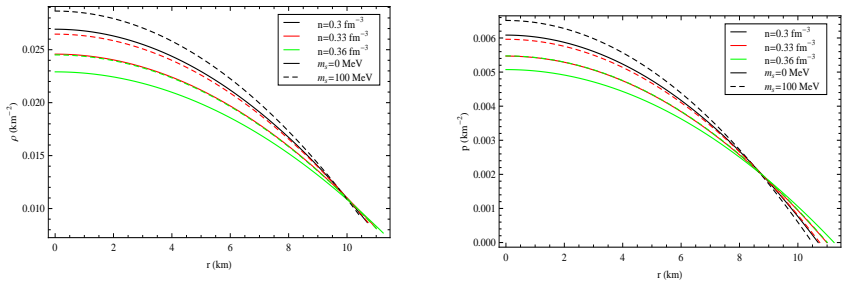
Within $f(R,T)=R+2\zeta T$, the paper solves the isotropic stellar structure problem for deconfined $u,d,s$ quarks plus electrons, using the linear bag EoS $p=(\rho-4B_1)/3$ with $B_1=(4B_g+\rho_s-3p_s)/4$ and the density profile $\rho(r)=\rho_c[1-(1-\rho_0/\rho_c)(r^2/R^2)]+\zeta\rho_c(1-r^2/R^2)$. The bag constant follows the exponential parametrization $B(n)=B_0e^{-(a_1x^2+a_2x)}$, with $x=n/n_0$ and $n_0=0.17$ fm$^{-3}$, chosen so that the energy per baryon $E_B$ lies in the absolutely stable window below $930.4$ MeV. Numerical TOV integration gives $M_{\max}=2.03\,M_\odot$ and $R=11.49$ km for $m_s=0$, $n=0.36$ fm$^{-3}$, $\zeta=-0.1$, with $1.98\,M_\odot$ and $11.20$ km for $m_s=100$ MeV; increasing $\zeta$ lowers both quantities. The paper reports that the resulting stars obey all energy conditions, have sound speed $v^2=1/3$, adiabatic index above $4/3$, positive radial eigenfrequencies, and tidal deformabilities below the GW170817 constraint.
Load-bearing premise
The paper's solutions treat $B_1$ as constant throughout each stellar model even though $B(n)$ is a density-dependent bag; if the local baryon density were used to evaluate $B(n)$ at every radius, Eq. (10) would no longer be the simple linear EoS and the closed-form solutions and TOV results would change.
Editorial extensions
If this is right
- Strange stars in $f(R,T)=R+2\zeta T$ with this EoS can reach $2.03\,M_\odot$, crossing the two-solar-mass threshold that rules out many softer quark-matter equations of state.
- Larger $\zeta$ lowers both maximum mass and radius, while the negative-coupling branch supports the heaviest stars, so a confirmed $\sim2\,M_\odot$ strange star would favour $\zeta<0$ in this theory.
- Within the stable window, higher baryon density $n$ gives heavier and larger stars, while higher $m_s$ gives smaller, lighter stars and a narrower stable window.
- The constant sound speed $v^2=1/3$ automatically satisfies causality and the Zeldovich condition for every admissible parameter choice.
- The predicted tidal deformabilities stay below the GW170817 bound, so the model is not ruled out by the first binary-neutron-star merger constraint.
Reading between the lines
- The density dependence is implemented between configurations: each star gets one fixed $n$ and hence one fixed $B_1$. A fully self-consistent model with $B$ evaluated on the local density profile is the natural testable extension and could change the reported maximum mass.
- The paper's own stability windows imply that low-density solutions classed as metastable or unstable would look like hybrid or purely hadronic stars; under this model, objects whose radii are reproduced only at low $n$ are not clean strange-star candidates.
- If the model is right, simultaneous mass and radius measurements for several sources could constrain $m_s$ and $\zeta$ together, potentially turning the strange quark mass into an astrophysical observable.
- The same $B(n)$ machinery could be extended to anisotropic or rotating configurations, where the constant-$B_1$ simplification is less tenable and where the mass-radius predictions would be directly comparable to precision radius measurements.
Signed reviews
Editorial analysis
A structured set of objections, weighed in public.
Referee Report
Summary. This manuscript constructs analytical models of static, spherically symmetric strange stars in f(R,T)=R+2ζT gravity, using a modified Mak-Harko density profile and the MIT bag equation of state p=(ρ-4B1)/3 with a finite strange quark mass ms. A baryon-density-dependent bag function B(n) is introduced in Sec. 3 following Prasad and Bhalerao, and the energy-per-baryon stability window is used to select values of n. Exact metric potentials are derived, the TOV equations are claimed to be integrated numerically, and maximum masses, radii, energy conditions, stability criteria, and tidal deformabilities are computed and compared with candidate compact objects. The headline result is M_max≈2.03 M_sun at R≈11.49 km for ms=0, n=0.36 fm^-3, and ζ=-0.1.
Significance. If the density-dependent bag function were actually fed into the stellar-structure equations, the paper could be a useful contribution to strange-star modeling in modified gravity, since the medium dependence of the bag constant is a genuine open issue and f(R,T) extensions are widely explored. The manuscript also supplies explicit algebraic metric potentials and a broad parameter scan. However, the main advertised novelty, the influence of B(n) on the stellar structure, is not implemented in the calculation: the solved model is the constant-B bag model with B1 set at a chosen reference density. In addition, the TOV system is not written out, the 'predicted radii' in Table 3 are parameter fits rather than blind predictions, and the tidal and oscillation analyses rely on imported equations whose validity in this setting is not demonstrated. The paper is therefore not currently a reliable basis for the physical conclusions it draws.
major comments (4)
- [Secs. 3, 5, 7.1] The density-dependent bag function is not used in the stellar-structure calculation. Equation (11) defines B(n), but the equation of state actually used in the field equations is Eq. (10), p=(ρ-4B1)/3, with B1 treated as a constant; Sec. 7.1 then obtains v^2=dp/dρ=1/3. The quantity n in Tables 1 and 2 enters only as a label that selects the constant value B1=B(n) via Eq. (11). If B were evaluated at the local baryon density n(r), the pressure would be p(r)=(ρ(r)-4B1(n(r)))/3, the sound speed would contain a dB1/dρ term, and the closed-form solutions (22)-(27), the mass formula (29), and the M-R curves in Figs. 3-6 would no longer follow. The paper nowhere states or justifies the constant-B1 approximation, so the central claim that B(n) influences the stellar structure is not realized in the calculation.
- [Table 3 and Sec. 5.2] The claimed observational validation is based on fitting rather than prediction. For each object in Table 3, the authors choose ζ and n separately (see the columns 'ζ' and 'n') to reproduce the observed radius, and the resulting model radii track the observed values. This is not a prediction of the model: the parameters are not fixed a priori, no common selection rule is given, and there is no discussion of uncertainties or of how many degrees of freedom are being tuned. Moreover, the ζ values used in Table 3 include 0.42 and -0.3, which lie outside the set ζ=-0.1, -0.2, 0.2 that the text in Sec. 5.2 states is used, and no justification is provided for those outliers. The statement that the model has been 'validated observationally' is therefore overstated.
- [Sec. 6] The TOV calculation is not reproducible from the text. The paper provides an analytic solution (22)-(27) based on the density ansatz (21) and the constant-B equation of state, but it does not write the modified TOV equations, the boundary conditions, or the relation between the numerically integrated M-R curves in Figs. 3-6 and the surface mass formula (29). The sentence that 'the TOV equations, as presented in references [52, 131], have been solved numerically' is insufficient, because in f(R,T)=R+2ζT the energy-momentum tensor is not conserved and the hydrostatic equilibrium equation takes the modified form (34). Without the explicit ODE system and the definition of the central density used in the integrations, the entries in Table 2 cannot be checked.
- [Sec. 8.3 and 8.4] The stability and tidal results are based on imported equations whose applicability is not established. The radial perturbation equations (36)-(37) are taken from Pretel et al. [147], and the tidal equation (41)-(43) and Love-number formula (44) are taken from earlier f(R,T) studies, but the present paper does not derive these equations, specify the junction conditions for the f(R,T) exterior, or justify using the standard GR boundary term y=RH'(R)/H(R) when the trace T is discontinuous at the stellar surface. The positive eigenfrequencies in Fig. 24 and the numerical values of k2 and Λ in Table 4 therefore rest on an unverified theoretical basis.
minor comments (4)
- [Sec. 5.2] The derivation of the coupling bounds (30) and (31) is not shown; the steps from the assumptions ρc>0 and ρc>ρ0 to the two inequalities are omitted, and the text later uses ζ values outside the range it claims to adopt.
- [Abstract and Table 1] The abstract and title emphasize non-zero strange quark mass (ms≠0), but Table 1 and Fig. 1 include the case ms=0, which is also used for the headline maximum mass. The wording should be adjusted to say that both zero and non-zero ms are considered.
- [Notation throughout] The notation and typography need cleanup: expressions such as 'n¡ 0.103' should read n<0.103, the object name '4U 1820−30' is typeset inconsistently, and the chemical-potential equations (4)-(7) should be checked for consistent subscript conventions for mu, md, ms, and me.
- [Fig. 24 caption] The caption of Fig. 24 lists ζ=-0.1, 0.0, and -0.1; the third value should presumably be 0.1, and the line styles should be described consistently with the legend in the figure.
Circularity Check
Table 3 radius 'predictions' are per-object fits of ζ and n; the density-dependent bag B(n) is not implemented locally in the TOV solutions.
-
fitted input called prediction
[Sec. 7, Table 3 (and Fig. 17)]
"the radii of several compact objects are predicted within the allowed parameter space of the model and the results are tabulated in Table 3. ... V ELA X− 1 1.77[135] 9.56 ±0.08 0.18 0.25 9.87 0.15 0.30 10.33; 4U 1820− 30 1.58[143] 9.11 ±0.4 0.14 0.15 9.14 0.42 0.30 10.39"
Each object in Table 3 is assigned its own free pair (ζ, n), with n fixing the constant bag value through Eq. (11). For example, VELA X−1 uses ζ=0.18, n=0.25; 4U 1820−30 uses ζ=0.14, n=0.15; SMC X−4 uses ζ=0.08, n=0.15. The model's M−R curves are then read at the observed mass to produce R. Because ζ and n are not fixed a priori but are chosen separately for each object, the calculation is equivalent to selecting free parameters so that the M−R curve passes through the observed mass-radius point. The observed radius is thus an input to the parameter choice, not an independent output, so the 'predicted radius' is a fit by construction rather than a genuine prediction.
full rationale
The core TOV construction in Secs. 4–6 is self-contained: given the Ansatz density profile (21), the EoS (10), and a chosen constant B1, the metric potentials (22)–(23), the mass formula (29), and the M−R curves follow algebraically/numerically with no hidden circularity, and the maximum-mass values in Table 2 are genuine outputs for stated parameters. The circular part is the observational validation in Table 3. There the radii are called 'predicted' while each object gets its own (ζ, n) pair, so the model is tuned to reproduce the observed radius; varying these free parameters moves the M−R curve through the observed mass-radius point. This is aggravated by the fact that the advertised density-dependent bag is not actually evaluated inside the star: the stellar-structure equations use Eq. (10) with constant B1, as confirmed by the sound speed v^2 = 1/3 in Sec. 7.1, so n enters only as a label selecting a constant bag value. The self-citations to [121] for the junction condition and tidal equations are auxiliary formalism and are not the source of the fitted radius claim; they are not counted as load-bearing circularity here. The score of 6 reflects that one or more 'predictions' reduce to fitted inputs, while the maximum-mass and stability calculations retain independent content.
Assumptions & free parameters
free parameters (5)
- ζ (coupling constant) =
0.04 to 0.42 in Table 3; -0.3 to 0.2 in Table 2
- n (baryon number density) =
0.15 to 0.36 fm^-3
- m_s (strange quark mass) =
0, 50, 100, 120, 200 MeV
- ρ_c (central energy density) =
1.91 to 2.71 x 10^15 g/cm^3 (Table 2)
- Bag parametrization constants B0, a1, a2 =
B0=114 MeV/fm^3, a1=0.0125657, a2=0.29522
assumptions (7)
- domain assumption f(R,T)=R+2ζT is the correct gravitational theory.
- domain assumption The MIT bag model EoS p=(ρ-4B1)/3 describes strange quark matter.
- domain assumption The matter Lagrangian is Lm = p (or equivalently -ρ).
- ad hoc to paper The modified Mak-Harko density profile Eq. (21) is a valid interior density distribution.
- domain assumption Strange quark matter is stable if E_B ≤ 930.4 MeV relative to 56Fe.
- domain assumption The bag constant range 57.55-95.11 MeV/fm^3 is the allowed physical range.
- domain assumption Darmois junction conditions apply in f(R,T) gravity.
Cite this review
Pith. "Pith review of Influence of density-dependent bag function $B(n)$ on strange stars for non-zero strange quark mass ($m_s\neq0$) in $f(R,T)$ gravity consistent with observational validation." pith.science (2026). https://pith.science/paper/UGIIULDF
@misc{pith2026250508379,
  author       = {Pith},
  title        = {Pith review of: Influence of density-dependent bag function $B(n)$ on strange stars for non-zero strange quark mass ($m_s\neq0$) in $f(R,T)$ gravity consistent with observational validation},
  year         = {2026},
  howpublished = {\url{https://pith.science/paper/UGIIULDF}},
  note         = {Machine review of arXiv:2505.08379}
}
abstract
In this work, a new class of solution of the Einstein field equation for an isotropic strange star using the modified Mak-Harko type density profile along with the equation of state as proposed in the MIT bag model and considering finite mass of the strange quark ($m_s$) is presented in the framework of $f(R,T)$ gravity with $f(R,T)=R+2\zeta T$, where, $\zeta$ is the coupling parameter. To incorporate the quark matter hypothesis with a physically viable stellar framework, a baryon number density ($n$) dependent bag function $B(n)$ is analysed, using exponential type parametrisation. The energy per baryon ($E_B$) has been investigated to restrict $B(n)$ and corresponding $n$ within a stable window, specifically satisfying the condition $E_B\leq 930.4~MeV$, which corresponds to the binding energy of $\isotope[56]{Fe}$. We note a lower limit of $n$ below which $E_B>930.4~MeV$ as $E_B$ increases with the decrease of $n$. This value, however, depends on $m_s$. Additionally, $n$ has a maximum value of $0.36~fm^{-3}$ irrespective of $m_s$ depending on the range of bag function. All the essential characteristics are satisfactorily fulfilled within the stellar interior for the selected set of parameter space. In this model, the maximum mass and radius are found by solving the TOV equations numerically which yields $M=2.03~M_{\odot}$ with a radius of $11.49~km$ for $m_s=0~MeV$ and $n=0.36~fm^{-3}$ and $\zeta=-0.1$. It is also noted that the maximum mass and the corresponding radius are the function of $m_s$, $\zeta$ and $n$. The proposed model has been shown to comply with the required energy conditions and satisfies the criterion for dynamical stability, thereby confirming its physical plausibility as a physically consistent stellar model within the parameter space used.
Figures


Figures from the paper (12 more)




Reference graph
Works this paper leans on
-
[147]
J. M. Z. Pretel, E. S. Jor ´as, R. R. R. Reis, D. V . J. Arba ˜nil, JCAP 04 (2021) 064; doi:10.1088/1475-7516/2021/04/064
-
[1]
I. H. Stairs, Living Rev. Rel. 6 (2003) 5
2003
-
[2]
B. P. Abbott et al. (Virgo, LIGO Scientific), Phys. Rev. Lett. 116 (2016) 061102
2016
-
[3]
B. P. Abbott et al. (Virgo, LIGO Scientific), Annalen der Physik 529 (2017) 1600209
2017
-
[4]
Weyl, Eine neue Erweiterung der Relativit ¨atstheorie
H. Weyl, Eine neue Erweiterung der Relativit ¨atstheorie. Ann. der Phys. 364 (1919) 101
1919
-
[5]
A. G. Riess et al., Astron. J. 116 (1998) 1009. [astro-ph/9805201v1]
arXiv 1998
-
[6]
Perlmutter et al., Astrophys. J. 517 (1999) 565. [astro-ph/9812133]
arXiv 1999
-
[7]
Bernardis et al., Nature (London) 404 (2000) 955
2000
Show all 154 references
-
[8]
Hanany et al., Astrophys. J. 545 (2000) L5. [astro-ph/0005123]
2000 arXiv
-
[9]
P. J. E. Peebles and B. Ratra, Rev. Mod. Phys. 75 (2003) 559. [astro-ph/0207347]
2003 arXiv
- [10]
-
[11]
Perivolaropoulos, F
L. Perivolaropoulos, F. Skara, New Astron. Rev. 95 (2022) 101659
2022
-
[12]
Bullock, M.B
J.S. Bullock, M.B. Kolchin, Annu. Rev. Astron. Astrophys. 55 (2017) 343
2017
-
[13]
Nojiri, S.D
S. Nojiri, S.D. Odintsov, Phys. Rev. D 68 (2003) 123512
2003
-
[14]
Carroll, V
S.M. Carroll, V . Duvvuri, M. Trodden, M.S. Turner, Phys. Rev. D70 (2004) 042528
2004
-
[15]
Starobinsky, J
A.A. Starobinsky, J. Exp. Theor. Phys. Lett. 86 (2007) 157
2007
-
[16]
Bamba, S
K. Bamba, S. Nojiri, S.D. Odintsov, J. Cosmol. Astropart. Phys. 0810 (2008) 045
2008
-
[17]
Setare, M
M.R. Setare, M. Jamil, Gen. Relativity Gravitation 43 (2011) 293
2011
-
[18]
Jamil, F.M
M. Jamil, F.M. Mahomed, D. Momeni, Phys. Lett. B 702 (2011) 315
2011
-
[19]
Hussain, M
I. Hussain, M. Jamil, F.M. Mahomed, Astrophys. Space Sci. 337 (2012) 373. 22
2012
- [20]
-
[21]
Doboszewski, N
J. Doboszewski, N. Linnemann, Found. Phys. 48 (2018) 237
2018
-
[22]
Bajardi, F
F. Bajardi, F. Bascone, S. Capozziello, Universe 2021 (2021) 148
2021
-
[23]
Singh, L.N
T. Singh, L.N. Rai, Gen. Relativity Gravitation 15 (1983) 875
1983
-
[24]
Bahamonde, et al., Rep
S. Bahamonde, et al., Rep. Progr. Phys. 86 (2023) 026901
2023
-
[25]
Nordstr ¨om, Phys
G. Nordstr ¨om, Phys. Z. 13 (1912) 1126
1912
-
[26]
Nordstr ¨om, Ann
G. Nordstr ¨om, Ann. Phys. 42 (1913) 533
1913
-
[27]
Page, B.O.J
C. Page, B.O.J. Tupper, Mon. Not. R. Astron. Soc. 138 (1968) 67
1968
-
[28]
Kaluza, Sitz
T. Kaluza, Sitz. Preuss. Acad. Wiss. F1 (1921) 966
1921
-
[29]
Klein, Z
O. Klein, Z. Phys. 37 (1926) 895
1926
-
[30]
R. Howl, R. Penrose, I. Fuentes, New J. Phys. 21 (2019) 043047
2019
-
[31]
Capozziello, Internat
S. Capozziello, Internat. J. Modern Phys. D 483 (2002) 11
2002
-
[32]
T.Harko, F.S.N.Lobo, S.Nojiri and S.D.Odintsov, Phys.Rev.D, 84, (2011) 024020
2011
-
[33]
Harko, Phys
T. Harko, Phys. Rev. D 81 (2010) 044021
2010
-
[34]
Chakraborty, Gen
S. Chakraborty, Gen. Relativ. Gravit. 45 (2013) 2039
2013
-
[35]
Sharif, M
M. Sharif, M. Zubair, J. Cosmol. Astropart. Phys. 03 (2012) 028
2012
-
[36]
Momeni, P.H.R.S
D. Momeni, P.H.R.S. Moraes, R. Myrzakulov, Astrophys. Space Sci. 361 (2016) 228
2016
-
[37]
Moraes, J.D.V
P.H.R.S. Moraes, J.D.V . Arba ˜nil, M. Malheiro, J. Cosmol. Astropart. Phys. 06 (2016) 005
2016
-
[38]
Alves, P
M. Alves, P. Moraes, J. de Araujo, M. Malheiro, Phys. Rev. D 94 (2016) 024032
2016
-
[39]
A. Das, S. Ghosh, B.K. Guha, S. Das, F. Rahaman, S. Ray, Phys. Rev. D 95 (2017) 124011
2017
-
[40]
Rahaman, Ksh
M. Rahaman, Ksh. N. Singh, A. Errehymy, F. Rahaman, M. Daoud, Eur. Phys. J. C 80 (2020) 272
2020
-
[41]
A. Das, F. Rahaman, B. K. Guha and S. Ray, Eur. Phys. J. C, 76, (2016) 654
2016
-
[42]
Ksh. N. Singh, A. Errehymy, F. Rahaman, M. Daoud, Chinese Phys. C 44 (2020) 105106
2020
-
[43]
Carvalho, S.I
G.A. Carvalho, S.I. Dos Santos, P.H.R.S. Moraes, M. Malheiro, Int. J. Mod. Phys. D 29 (2020) 2050075
2020
-
[44]
P. Bhar, P. Rej, M. Zubair, Chinese J. Phys. 77 (2022) 2201
2022
-
[45]
P. Bhar, P. Rej, A. Siddiqa, G. Abbas, Int. J. Geom. Methods Mod. Phys. 18 (2021) 2150160
2021
-
[46]
P. Rej, P. Bhar, M. Govender, Eur. Phys. J. C 81 (2021) 316
2021
-
[47]
Mondal, F
M. Mondal, F. Rahaman, Universe 2023 (2023) 122
2023
-
[48]
D Bhattacharjee and P K Chattopadhyay, Phys. Scr. 100 (2025) 055016
2025
-
[49]
Srinivasan, Bull
G. Srinivasan, Bull. Astron. Soc. India 30 (2002) 523
2002
-
[50]
Chandrasekhar, An Introduction to the Study of Stellar Structure (The University of Chicago Press, Chicago, Illinois) (1938)
S. Chandrasekhar, An Introduction to the Study of Stellar Structure (The University of Chicago Press, Chicago, Illinois) (1938)
1938
-
[51]
Mukhopadhyay, Phys
D.Das, B. Mukhopadhyay, Phys. Rev. Lett., 110 (2013) 071102
2013
-
[52]
Oppenheimer, G.M
J.R. Oppenheimer, G.M. V olkoff, Phys. Rev.55 (1939) 374
1939
-
[53]
C. E. Rhoades and R. Ruffini, Phys. Rev. Lett. 32 (1974) 324
1974
-
[54]
Nauenberg and G
M. Nauenberg and G. Chapline Jr, Astrophys. J. 179 (1973) 417
1973
-
[55]
A. G. Sabbadini and J. B. Hartle, Astrophys. Space Sci. 25 (1973) 117
1973
-
[56]
Haensel, Equation of state of dense matter and maximum mass of neutron stars Final Stages of Stellar Evolution vol
P. Haensel, Equation of state of dense matter and maximum mass of neutron stars Final Stages of Stellar Evolution vol. 7 (EAS Publications Series) ed J M Hameury and C Motch (Les Ulis, France: EDP Sciences, CERN Document Server), (2003) p 35 [astro-ph/0301073]
2003 arXiv
-
[57]
Annala, T
E. Annala, T. Gorda, A. Kurkela, A. Vuorinen, Phys. Rev. Lett. 120 (2018) 172703
2018
-
[58]
Itoh, Prog
N. Itoh, Prog. Theor . Phys.44 (1970) 291
1970
-
[59]
J Madsen, 1999 Physics and astrophysics of strange quark matter , In Hadrons in Dense Matter and Hadrosynthesis(Lecture Notes in Physics) vol 516, ed. J. Cleymans, H.B. Geyer, F. G. Scholtz, (Springer, Berlin, Heidelberg, 1998) p-42
1999
-
[60]
Baym G and S.A
G. Baym G and S.A. Chin, Phys. Lett. B, 62 (1976) 241
1976
-
[61]
Alcock, E
C. Alcock, E. Farhi and A. Olinto, Astrophys. J., 310 (1986) 261
1986
-
[62]
N. K. Glendenning, Mod. Phys. Lett. A, 5 (1990) 2197
1990
-
[63]
Witten, Phys
E. Witten, Phys. Rev. D 30 (1984) 272
1984
- [64]
-
[65]
A.Chodos,R. L. Jaffe, K. Jonson, C. B. Thern and V . F. Weisskopf, Phys. Rev. D9 (1974) 3471
1974
-
[66]
Naseer, Phys
M Sharif and T. Naseer, Phys. Scr., 97 (2022) 125016
2022
-
[67]
Sharif and T
M. Sharif and T. Naseer, Fortschr. Phys., 71 (2023) 2200147
2023
-
[68]
Sharif and T
M. Sharif and T. Naseer, Phys. Scr., 98 (2023) 105009
2023
-
[69]
Naseer and M
T. Naseer and M. Sharif, Chin. J. Phys. 88 (2024) 10
2024
-
[70]
Naseer and M
T. Naseer and M. Sharif Phys. Scr., 99 (2024) 095028
2024
-
[71]
Reinhardt, B
H. Reinhardt, B. V . Dang, Phys. Lett. B 173 (1986) 473
1986
-
[72]
G. F. Burgio, et al., 2002. Phys. Lett. B 526 (2002) 19
2002
-
[73]
Sharif, T
M. Sharif, T. Naseer and A. Tabassum, Chin. J. Phys. 92 (2024) 579
2024
-
[74]
Naseer, J.L
T. Naseer, J.L. Said, M. Sharif, et al. Eur. Phys. J. C 85 (2025) 471
2025
-
[75]
Naseer, J.L Said, Eur
T. Naseer, J.L Said, Eur. Phys. J. C, 84 (2024) 808
2024
-
[76]
Sharif, T
M. Sharif, T. Naseer, A. Tabassum, Nucl. Phys. B, 1017 (2024) 116960
2024
-
[77]
M.K. Mak, T. Harko, Chin. J. Astron. Astrophys. 2 (2002) 248
2002
-
[78]
Kettner, F
Ch. Kettner, F. Weber, M.K. Weigel and N.K. Glendenning, Phys. Rev. D, 51 (1995) 1440
1995
-
[79]
G. X. Peng et al., Phys. Rev. C, 62, (2000) 025801
2000
-
[80]
Kapusta, Finite-Temperature Field Theory(United Kingdom: Cambridge Univ
J. Kapusta, Finite-Temperature Field Theory(United Kingdom: Cambridge Univ. Press), (1994) 163
1994
-
[81]
Annala, et al., Nat
E. Annala, et al., Nat. Phys. 16, (2020) 907
2020
-
[82]
P. A. Guichon, Phys. Lett. B 200, (1988) 235. 23
1988
-
[83]
D. H. Lu, K. Tsushima, A. W. Thomas, A. G. Williams and K. Saito, Nucl. Phys. A 634 (1998) 443
1998
-
[84]
X. Jin, B. K. Jennings, Phys. Lett. B 374, (1996) 13
1996
-
[85]
Jin and B
X. Jin and B. K. Jennings, Phys. Rev. C, 54 (1996) 1427
1996
-
[86]
Jin and B
X. Jin and B. K. Jennings, Phys. Rev. C 55 (1997) 1567
1997
-
[87]
M ¨ullar, B
H. M ¨ullar, B. K. Jennings, Nucl. Phys. A, 626, (1997) 966; A 640 (1998) 55
1997
-
[88]
H. Guo, J. Phys. G 25 (1999) 1701
1999
-
[89]
P. Wang, R. K. Su, H. Q. Song and L. L. Zhang, Nucl. Phys. A 653 (1999) 166
1999
-
[90]
L. L. Zhang, H. Q. Song, P. Wang and R. K. Su, J. Phys. G 26 (2000) 1301
2000
-
[91]
R. T. Cahill , C. D. Roberts, Phys. Rev. D 32 (1985) 2419
1985
-
[92]
R. T. Cahill, C. D. Roberts, and J. Praschifka, Ann. Phys. (N.Y.) 188 (1988) 20
1988
-
[93]
C. D. Roberts, R. T. Cahill, M. E. Sevior and N. Iannella, Phys. Rev. D 49 (1994) 125
1994
-
[94]
M. R. Frank and P. C. Tandy, Phys. Rev. C 46 (1992) 338; C. W. Johnson and G. Fai, Phys. Rev. C 56 (1997) 3353
1992
-
[95]
P. C. Tandy, Prog. Part. Nucl. Phys. 39 (1997) 177
1997
-
[96]
X. F. L ¨u, Y . X. Liu, H. S. Zong and E. G. Zhao,Phys. Rev. C 58 (1998) 1195
1998
-
[97]
Liu, D.f
Y .X. Liu, D.f. Gao and H. Guo, Nucl. Phys. A, 695 (2001) 353
2001
-
[98]
Aguirre, Phys
R. Aguirre, Phys. Lett. B, 559 (2003) 207
2003
-
[99]
Prasad and R.S
N. Prasad and R.S. Bhalerao, Phys.Rev.D 69 (2004) 103001
2004
-
[100]
Tanabashi et al., Phys
M. Tanabashi et al., Phys. Rev. D, 98 (2018) 030001
2018
-
[101]
Particle Data Group, P. A. Zyla et al., Prog. Theor. Exp. Phys. 2020 (2020) 083C01
2020
-
[102]
L. D. Landau and E. M. Lifshitz, The Classical Theory of Fields, Butterworth-Heinemann, Oxford (1998)
1998
-
[103]
Faraoni, Phys
V . Faraoni, Phys. Rev. D, 80 (2009) 124040
2009
-
[104]
Pretel Mod
J.M.Z. Pretel Mod. Phys. Lett. A , 37 (2022) 2250188
2022
-
[105]
F. G. Alvarenga, A. de la Cruz-Dombriz, M. J. S. Houndjo, M. E. Rodrigues,and D. S ´aez-G ´omez, Phys. Rev. D., 87 (2013) 103526
2013
-
[106]
Lobato et al., J
R. Lobato et al., J. Cosmol. Astropart. Phys., 2020 (2020) 039
2020
-
[107]
G. A. Carvalho et al., Eur . Phys. J. C, 77 (2017) 871
2017
-
[108]
Bhattacharjee and P
S. Bhattacharjee and P. K. Sahoo, Gravitation and Cosmology, 26 (2020) 281
2020
-
[109]
Velten and T
H. Velten and T. R. P. Caram ˆes, Phys. Rev. D, 95 (2017) 123536
2017
-
[110]
Shabani and M
H. Shabani and M. Farhoudi, Phys. Rev. D, 88 (2013) 044048. [gr-qc/1306.3164]
2013 arXiv
-
[111]
Shabani and M
H. Shabani and M. Farhoudi, Phys. Rev. D, 90 (2014) 044031. [gr-qc/1407.6187]
2014 arXiv
-
[112]
Singh and C
V . Singh and C. P. Singh, Astrophys. Space Sci., 356 (2015) 153
2015
-
[113]
P. H. R. S. Moraes, Astrophys. Space Sci., 352 (2014) 273
2014
-
[114]
P. H. R. S. Moraes, Eur. Phys. J. C, 75 (2015) 168
2015
-
[115]
P. H. R. S. Moraes, Int. J. Theor. Phys., 55 (2016) 1307
2016
-
[116]
P. H. R. S. Moraes, R. A. C. Correa and R. V . Lobato, J. Cosmol. Astropart. Phys. 07, (2017) 029 [gr-qc/1701.01028]
2017 arXiv
-
[117]
Sharif and M
M. Sharif and M. Zubair, Astrophys. Space Sci. 349 (2014) 457
2014
-
[118]
D. R. K. Reddy and R. Shantikumar, Astrophys. Space Sci. 344 (2013) 253
2013
-
[119]
Kumar and C
P. Kumar and C. P. Singh, Astrophys. Space Sci. 357 (2015) 120
2015
-
[120]
M. F. Shamir, Eur. Phys. J. C, 75, (2015) 354
2015
-
[121]
K. B. Goswami, D. Bhattacharjee, P. K. Chattopadhyay and A. Saha, Phys. of the Dark Universe 47 (2025) 101752
2025
-
[122]
Sarkar, N
S. Sarkar, N. Sarkar and F. Rahaman, Chin. J. Phys., 77 (2022) 2028
2022
-
[123]
Sharif and Z
M. Sharif and Z. Yousaf, Astrophys. Space Sci., 354 (2014) 471
2014
-
[124]
A. K. Yadav, M. Mondal and F. Rahaman, Pramana J. Phys., 94 (2020) 90
2020
-
[125]
Bhar and P
P. Bhar and P. Rej, New Astronomy, 100 (2023) 101990
2023
-
[126]
D. Deb, F. Rahaman, S. Ray and B. K. Guha, J. Cosmol. Astropart. Phys., 03 (2018) 044
2018
-
[127]
G. A. Carvalho, S. I. Dos Santos, P. H. R. S. Moraes and M. Malheiro, Int. J. Mod. Phys. D, 29 (2019) 2050075
2019
-
[128]
Darmois, Memorial des Sciences Mathematiques XXV , Fasticule XXV , Gauthier-Villars, Paris, France, Chap
G. Darmois, Memorial des Sciences Mathematiques XXV , Fasticule XXV , Gauthier-Villars, Paris, France, Chap. V (1927)
1927
-
[129]
Mafa Takisa, S.D
P. Mafa Takisa, S.D. Maharaj, C. Mulangu, Pramana J. Phys. 92 (2019) 40
2019
-
[130]
Zel’dovich, Zh
Y .B. Zel’dovich, Zh. Eksp. Teor. Fiz.41 (1961) 1609. [Engl. transl: Sov. Phys. JETP 14, 1143 (1962)]
1961
-
[131]
R. C. Tolman, Phys. Rev. 55 (1939) 364
1939
-
[132]
Y . B. Zeldovich, I. D. Novikov, Relativistic Astrophysics V ol. 1: Stars and Relativity (University of Chicago Press, Chicago), (1971)
1971
-
[133]
B. K. Harrison, K. S. Thorne, M.Wakano, J. A. Wheeler,Gravitational Theory and Gravitational Collapse (University of Chicago Press, Chicago), (1965)
1965
-
[134]
Bhattacharya, R
S. Bhattacharya, R. Sharma and S. D. Maharaj, Eur. Phys. J. C, 84 (2024) 64
2024
-
[135]
Gangopadhyay, S
T. Gangopadhyay, S. Ray, X.D. Li, J. Dey, M. Dey, Mon. Not. R. Astron. Soc. 431 (2013) 3216
2013
-
[136]
C. A. Kolassis, N. O. Santos and D. Tsoubelis, Class. Quantum Gravity 5 (1988) 1329
1988
-
[137]
S. W. Hawking and G. F. R. Ellis, The Large Scale Structure of Spacetime (Cambridge University Press: Cambridge, UK), (1973)
1973
-
[138]
Wald, General Relativity (University of Chicago Press: Chicago, IL, USA), (1984)
R. Wald, General Relativity (University of Chicago Press: Chicago, IL, USA), (1984)
1984
-
[139]
Brassel, S.D
B.P. Brassel, S.D. Maharaj, and R. Goswami, Entropy 23 (2021) 1400
2021
-
[140]
Brassel, S.D
B.P. Brassel, S.D. Maharaj and R. Goswami Prog. Theor. Exp. Phys. 2021 103E01 (2021)
2021
-
[141]
Demorest, et al., Nature 467 (2010) 1081
P.B. Demorest, et al., Nature 467 (2010) 1081
2010
-
[142]
G ¨uver, et al., Astrophys
T. G ¨uver, et al., Astrophys. J. 712 (2010) 964
2010
-
[143]
G ¨uver, et al., Astrophys
T. G ¨uver, et al., Astrophys. J. 719 (2010) 1807
2010
-
[144]
Miller, et al., Astrophys
M.C. Miller, et al., Astrophys. J. Lett. 887 (2019) L24
2019
-
[145]
Grøn, Phys
Ø. Grøn, Phys. Rev. D 31 (1985) 2129
1985
-
[146]
Heintzmann, W
H. Heintzmann, W. Hillebrandt, Astron. Astrophys. 38 (1975) 51. 24
1975
-
[148]
E. E. Flanagan, T. Hinderer, Phys.Rev.D 77 (2008) 021502
2008
-
[149]
K. S. Thorne and A. Campolattaro, ApJ, 149 (1967) 591
1967
-
[150]
Regge, J
T. Regge, J. A. Wheeler, Phys. Rev. 108 (1957) 1063
1957
-
[151]
Hinderer, Astrophys
T. Hinderer, Astrophys. J. 677 (2008) 1216
2008
-
[152]
Hinderer, B.D
T. Hinderer, B.D. Lackey, R.N. Lang, J.S. Read, Phys. Rev. D 81, (2010) 123016
2010
-
[153]
Abbott R
B.P. Abbott R. Abbott, (LIGO Scientific Collaboration and Virgo Collaboration), Phys. Rev. Lett. 119 (2017) 161101
2017
-
[154]
Bauswein, et al., AIP Conf
A. Bauswein, et al., AIP Conf. Proc. 2127 (2019) 020013. 25
2019
Reviewed August 15, 2026 · model on record in the stance chip above.
Discussion (0). Continue with ORCID to comment.