REVIEW 2 major objections 1 minor 2 cited by
Pinning Down the Geometry of the Type Ic Broad-Line Supernova 2026gzf
T0 review · 2 major / 1 minor · reviewed 2026-06-26 · grok-4.3
Pith's one-line read Polarimetry shows SN 2026gzf has spherical outer ejecta but an axisymmetric Ca II structure viewed at about 40 degrees from its symmetry axis.
desk verdict New polarimetry data on SN 2026gzf with a Monte-Carlo viewing angle of ~40 degrees, but the model setup is described too thinly to judge its robustness. read the letter →
The pith
A machine-rendered reading of the paper's core claim, the machinery that carries it, and where it could break.
The reading
What carries the argument
Three-dimensional Monte-Carlo radiative-transfer calculation applied to an axisymmetric distribution of Ca II line opacity.
What would settle it
New spectropolarimetric observations of the Ca II triplet in SN 2026gzf or a similar event that cannot be matched by any viewing angle in an axisymmetric opacity model.
Extended reading notes
Core claim
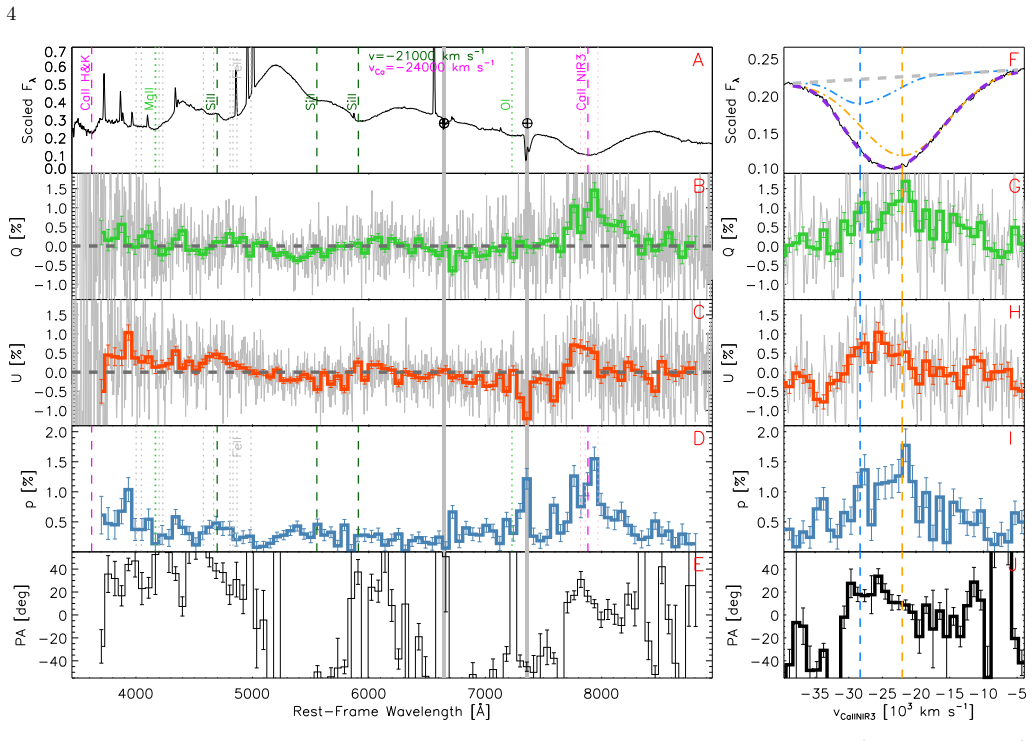
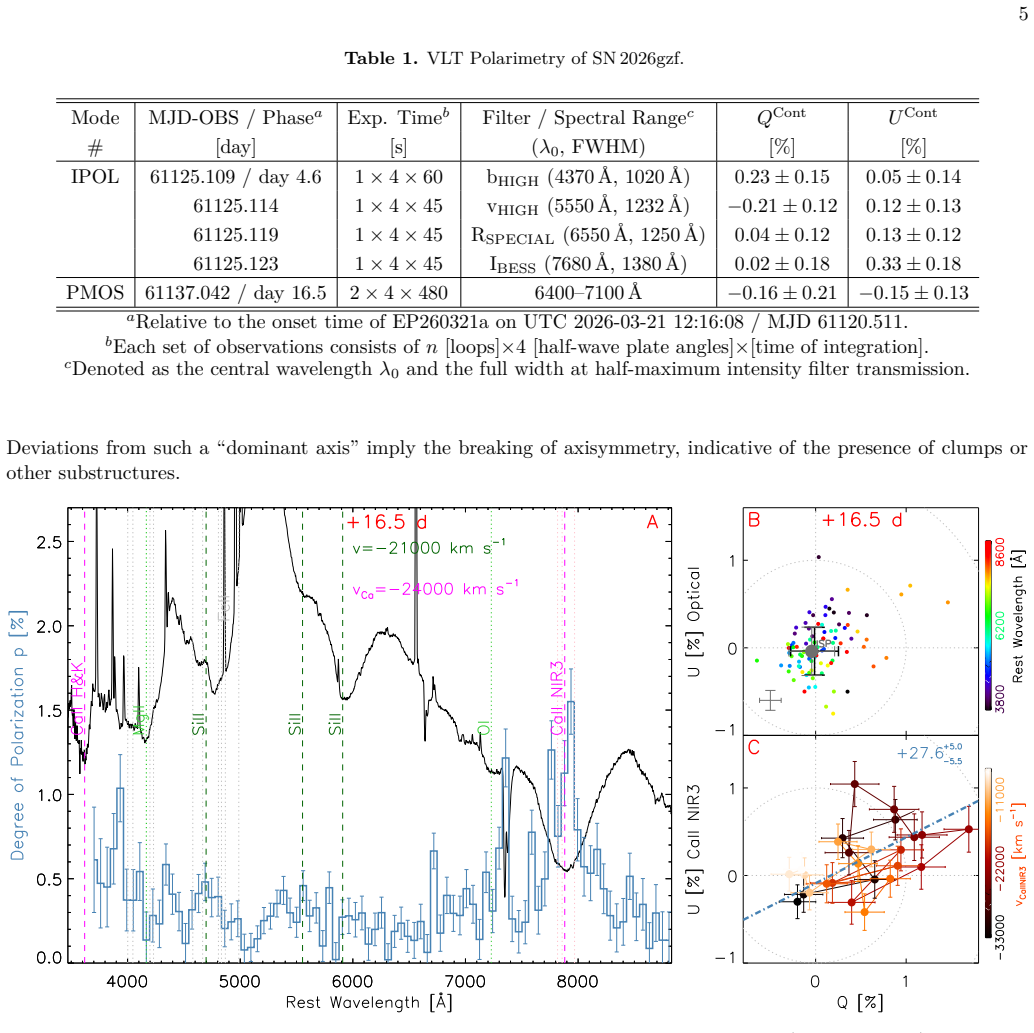
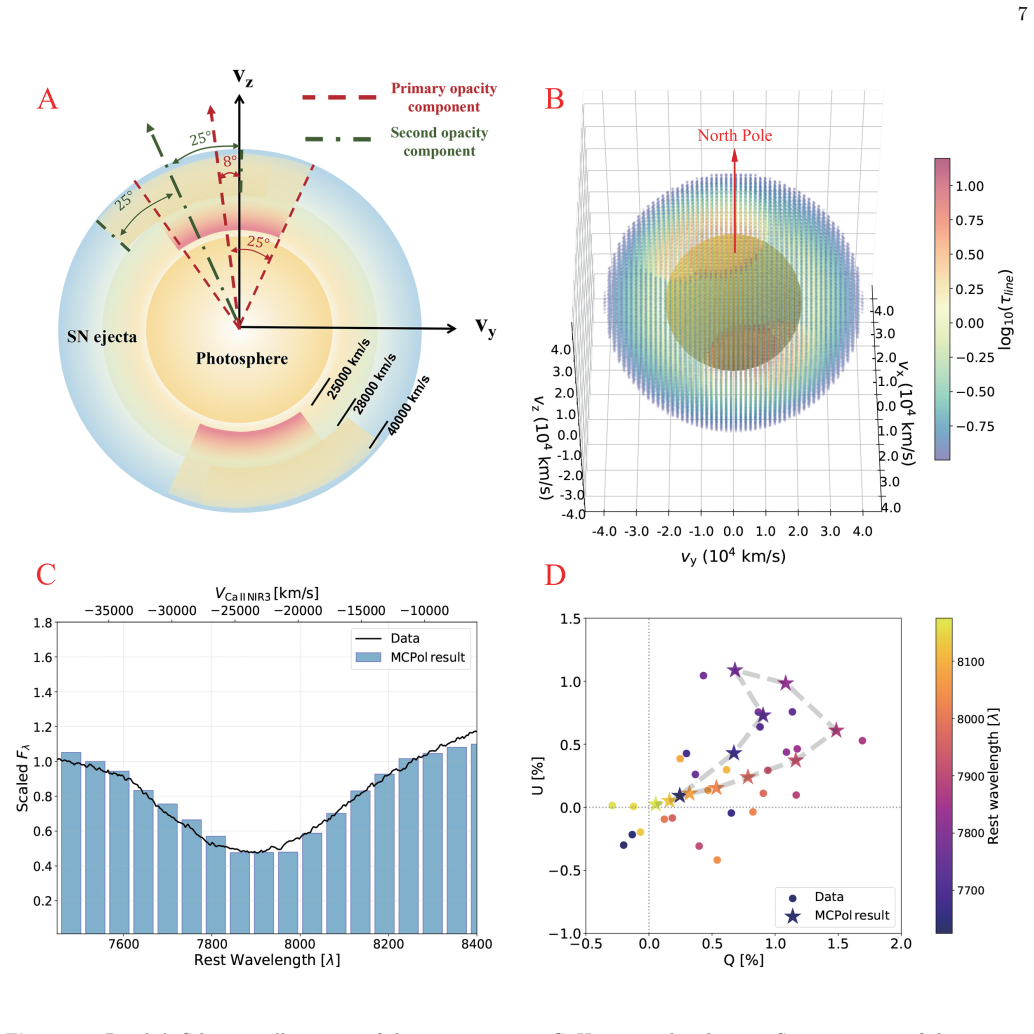
The geometry of the line opacity associated with the Ca II triplet is compatible with an axisymmetric configuration. The spatial distribution of such oxygen-burning ashes thus indicates the presence of a symmetry axis of the excitation structure within the nearly spherical ejecta. By implementing a three-dimensional Monte-Carlo calculation, a viewing angle of approximately 40 degrees from the symmetry axis of the excitation structure could plausibly reproduce the observed spectral and polarization profiles of the Ca II triplet.
Load-bearing premise
The polarization signal in the Ca II triplet arises solely from the geometric distribution of line opacity in an axisymmetric configuration, and the Monte-Carlo model captures the ejecta structure without unaccounted contributions from clumping, magnetic fields, or other effects.
Editorial extensions
If this is right
- The outer layer remains mostly spherical, indicating the explosion did not significantly disrupt the progenitor envelope.
- The Ca II triplet profile is dominated by a primary component at 25,000-40,000 km/s together with a distinct secondary component above 28,000 km/s whose polarization implies non-axisymmetric geometry in the outer ejecta.
- The persistent low continuum polarization from day 4.6 to day 16.5 confirms that the outer ejecta geometry stays largely spherical.
- The presence of a symmetry axis in the excitation structure is inferred directly from the spatial distribution of oxygen-burning ashes.
Reading between the lines
- Similar polarimetric signatures in other SNe Ic-BL could be used to test whether a preferred axis is common in the inner ejecta of these events.
- The separation of spherical outer layers from axisymmetric inner structure may constrain how the explosion couples to any central engine or jet.
- Future multi-epoch polarimetry could reveal whether the secondary high-velocity component evolves differently from the primary component.
Editorial analysis
A structured set of objections, weighed in public.
Referee Report
Summary. The paper reports imaging polarimetry and spectropolarimetry of the Type Ic-BL SN 2026gzf at 4.6 and 16.5 days after the X-ray shock breakout EP260321a. It finds persistent low continuum polarization indicating a mostly spherical outer ejecta layer, while the Ca II near-infrared triplet at day 16.5 shows peak polarization above 1.5% whose geometry is compatible with an axisymmetric configuration of line opacity. A three-dimensional Monte-Carlo radiative-transfer calculation is used to infer that a viewing angle of ~40° from the symmetry axis of the excitation structure plausibly reproduces the observed spectral and polarization profiles of the Ca II triplet, which also shows a primary velocity component (~25,000–40,000 km/s) and a distinct secondary high-velocity component (>28,000 km/s).
Significance. If the modeling result holds after proper documentation, the work would provide a rare quantitative constraint on the viewing angle and symmetry axis of the excitation structure in a Type Ic-BL supernova, linking the spatial distribution of oxygen-burning ashes to explosion dynamics within an otherwise spherical ejecta. The early-time polarimetry combined with line-specific polarization modeling could help test axisymmetric versus non-axisymmetric geometries in stripped-envelope events.
major comments (2)
- [Abstract / modeling paragraph] Abstract / modeling paragraph: The claim that a viewing angle of ~40° 'could plausibly reproduce' the Ca II triplet profiles rests on a three-dimensional Monte-Carlo calculation whose ejecta density law, excitation structure, number of free parameters, and convergence tests are not supplied. This leaves open the possibility that additional tunable parameters (clumping factor, ionization gradient, or non-axisymmetric perturbations) were adjusted to fit the secondary high-velocity component, making the viewing-angle inference under-constrained and the axisymmetric assumption untested.
- [Abstract] Abstract: No error bars on the polarization measurements, no data-reduction details, and no explicit checks against alternative explanations (clumping, magnetic fields, or other effects) for the >1.5% Ca II polarization signal are provided, so the assertion that the signal arises solely from the geometric distribution of line opacity in an axisymmetric configuration cannot be evaluated.
minor comments (1)
- [Abstract] The abstract states 'persistent low continuum polarization' without quoting the measured value or its uncertainty, and the description of the secondary high-velocity component's polarization implications is not quantified.
Simulated Author's Rebuttal
We thank the referee for their careful reading and constructive comments on our manuscript. We address each major comment below, indicating where revisions will strengthen the presentation.
read point-by-point responses
-
Referee: [Abstract / modeling paragraph] Abstract / modeling paragraph: The claim that a viewing angle of ~40° 'could plausibly reproduce' the Ca II triplet profiles rests on a three-dimensional Monte-Carlo calculation whose ejecta density law, excitation structure, number of free parameters, and convergence tests are not supplied. This leaves open the possibility that additional tunable parameters (clumping factor, ionization gradient, or non-axisymmetric perturbations) were adjusted to fit the secondary high-velocity component, making the viewing-angle inference under-constrained and the axisymmetric assumption untested.
Authors: The full details of the Monte-Carlo calculation are given in Section 4, including the adopted broken power-law density profile, the axisymmetric excitation structure with a single axis-ratio parameter, the limited free parameters (primarily viewing angle), and convergence verified by increasing photon packets from 10^6 to 10^7. No additional parameters such as clumping or ionization gradients were introduced to fit the secondary component. Spherical models are explicitly shown to fail to reproduce the observed polarization, supporting the axisymmetric geometry. To address the referee's concern directly, we will add an expanded methods paragraph and a parameter table in the revised manuscript. revision: partial
-
Referee: [Abstract] Abstract: No error bars on the polarization measurements, no data-reduction details, and no explicit checks against alternative explanations (clumping, magnetic fields, or other effects) for the >1.5% Ca II polarization signal are provided, so the assertion that the signal arises solely from the geometric distribution of line opacity in an axisymmetric configuration cannot be evaluated.
Authors: The abstract is space-limited and therefore omits these elements, which appear in the main text: error bars are reported in Section 2 and Figure 1 (derived from photon statistics and repeat observations), data reduction follows the standard pipeline described in Section 2.1, and Section 5 discusses why clumping or magnetic fields are unlikely to produce the observed line polarization without violating other constraints. We will revise the abstract to include a short clause on the error analysis and geometric origin, and ensure the discussion of alternatives is more prominent. revision: partial
Circularity Check
No significant circularity in the derivation chain
full rationale
The paper implements a 3D Monte-Carlo radiative-transfer model and reports that a viewing angle of ~40° reproduces the Ca II triplet profiles. This is presented as an inference from fitting the model to data rather than a first-principles derivation. No equations, self-citations, or ansatzes are quoted that reduce the result to its inputs by construction, nor is any uniqueness theorem or fitted parameter renamed as a prediction. The axisymmetric assumption is stated as compatible with the polarization data, but the reproduction step does not exhibit the specific self-definitional or load-bearing circular patterns required for a positive finding. The modeling chain is therefore self-contained as an interpretive application of an external code to the observations.
Assumptions & free parameters
free parameters (1)
- viewing angle =
~40 degrees
assumptions (2)
- domain assumption Observed polarization is produced by scattering in an axisymmetric line-opacity distribution
- domain assumption The 3D Monte-Carlo code correctly captures radiative transfer for the Ca II lines in the ejecta
Cite this review
Pith. "Pith review of Pinning Down the Geometry of the Type Ic Broad-Line Supernova 2026gzf." pith.science (2026). https://pith.science/paper/UHFTKY4E
@misc{pith2026260618881,
  author       = {Pith},
  title        = {Pith review of: Pinning Down the Geometry of the Type Ic Broad-Line Supernova 2026gzf},
  year         = {2026},
  howpublished = {\url{https://pith.science/paper/UHFTKY4E}},
  note         = {Machine review of arXiv:2606.18881}
}
read the original abstract
Type Ic broad-line supernovae (SNe Ic-BL) are often associated with energetic explosions that display a prompt outburst of high-energy emission. Since their progenitor lost the H and He envelopes before the explosion exposing the C/O core, their explosion dynamics and geometry can be seen in an unobscured and undistorted way. We present imaging polarimetry and spectropolarimetry of the Type Ic-BL SN 2026gzf obtained 4.6 and 16.5 days after the X-ray shock breakout, which was recorded by the Einstein Probe satellite as EP260321a, showing it to be one of the softest and intrinsically dimmest extragalactic fast X-ray transients. The persistent low continuum polarization indicates that the outer layer of SN 2026gzf is mostly spherical, suggesting the explosion did not significantly disrupt the progenitor envelope. At day 16.5, the calcium near-infrared triplet displays a peak polarization above 1.5%. The geometry of the associated line opacity is also compatible with an axisymmetric configuration. The spatial distribution of such oxygen-burning ashes thus indicates the presence of a symmetry axis of the excitation structure within the nearly spherical ejecta. The Ca II triplet profile is dominated by a primary component spanning ~25,000--40,000 km/s, alongside a distinct secondary component extending above 28,000 km/s whose polarization implies a non-axisymmetric, complex excitation geometry toward the outer ejecta By implementing a three-dimensional Monte-Carlo calculation, we infer that a viewing angle of ~40 degree from the symmetry axis of the excitation structure could plausibly reproduce the observed spectral and polarization profiles of the Ca II triplet.
Figures
Forward citations
Cited by 2 Pith papers
-
Shock breakout from mildly relativistic ejecta in a dense wind: the case of EP260321a/SN~2026gzf
The X-ray burst EP260321a is best explained as a supernova shock breaking out of a dense wind, implying fast outer ejecta (≈3.5×10^49 erg) and a ≈10^-5 solar-mass circumstellar cloud.
-
Multi-wavelength Constraints on the Transient EP250905a
EP250905a is best explained as a mildly off-axis structured-jet afterglow at z=2.714, possibly weakly magnified by a foreground galaxy at z=0.374.
Reviewed June 26, 2026 · model on record in the stance chip above.
Discussion (0). Continue with ORCID to comment.