REVIEW 2 major objections 6 minor 300 references
Reviewed by Pith at T0; open to challenge.
T0 means a machine referee read the full paper against a public rubric. The mark states how deep the mechanical check went, never who wrote it. the ladder, T0–T4 →
T0 review · grok-4.5
EP250905a is best explained as a mildly off-axis structured-jet afterglow at redshift 2.714, with possible weak lensing by a foreground galaxy.
2026-07-10 13:14 UTC pith:IWOU6HWZ
load-bearing objection Solid multi-wavelength package on a new EP FXT; the high-z structured-jet story is the cleanest reading of the data once G2 is adopted, but that host choice remains statistical and the afterglow fit is under-constrained. the 2 major comments →
Multi-wavelength Constraints on the Transient EP250905a
The pith
A machine-rendered reading of the paper's core claim, the machinery that carries it, and where it could break.
Core claim
The multi-wavelength properties of EP250905a are best explained as afterglow emission from a mildly off-axis structured jet at redshift z=2.714. That single interpretation simultaneously accounts for the steep-then-shallow X-ray decay, the early optical detection that fades below later limits, the non-detections in the near-infrared and radio, and the possibility of weak lensing by the foreground galaxy G1.
What carries the argument
A Gaussian structured-jet afterglow model (fitted with redback at fixed z=2.714, electron index p=2.6 and standard microphysical parameters) that returns a mildly off-axis viewing angle together with a singular-isothermal-sphere lens estimate for the foreground galaxy that yields moderate magnification μ≈3.9.
Load-bearing premise
That the fainter, higher-redshift galaxy is the true host, based mainly on a lower chance of random alignment and the fact that the resulting luminosities then look normal for a jet afterglow.
What would settle it
A secure spectroscopic redshift of the optical counterpart itself, or a later detection of a supernova or radio afterglow that is only consistent with one of the two candidate host redshifts.
Editorial analysis
A structured set of objections, weighed in public.
Referee Report
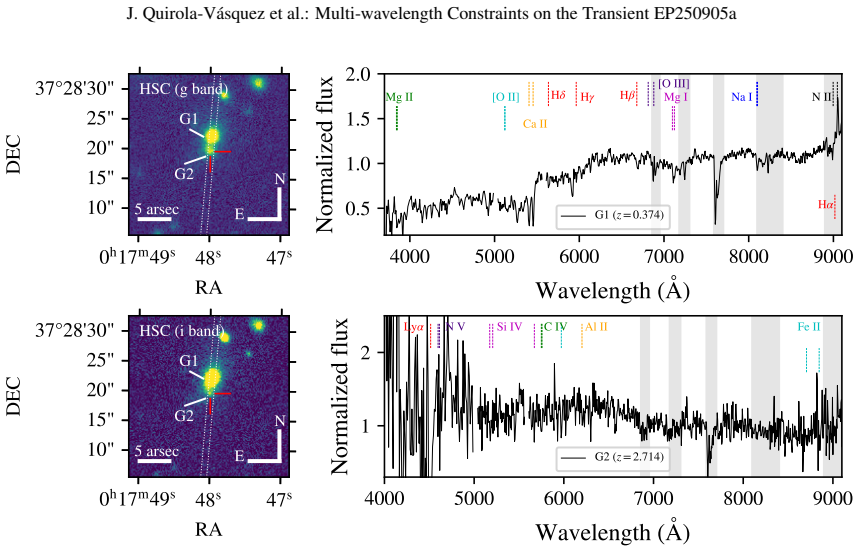
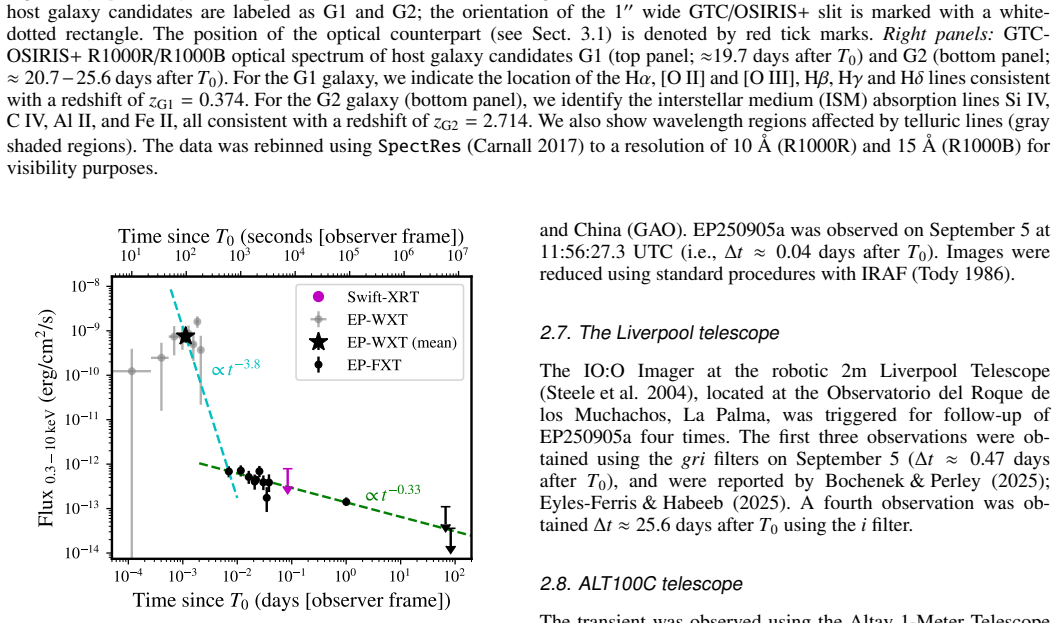
Summary. The paper presents multi-wavelength observations (EP-WXT/FXT, Swift-XRT, GTC/OSIRIS+, NOT, LCO, Liverpool, ALT100C, VLT/X-shooter, MeerKAT, Fermi-GBM) of the Einstein Probe fast X-ray transient EP250905a. An early optical counterpart is detected at mi = 23.23 ± 0.18 (GTC E1) and fades rapidly; no NIR or radio counterpart is found. Two nearby galaxies are spectroscopically redshifted (G1 at z = 0.374; G2 at z = 2.714). Chance-alignment probabilities and multi-wavelength consistency lead the authors to adopt G2 as the host. At z = 2.714 the X-ray light curve shows a steep early decay followed by a shallow phase, β_OX ≈ −0.8, and a redback Gaussian structured-jet afterglow model yields a mildly off-axis solution (θ_observer ≈ 5.7°, θ_core ≈ 3.4°). Weak lensing by G1 (θ_E ≈ 1.9″, μ ≈ 3.9) is considered but not required. The low-z (G1) solution is disfavored because the luminosities become anomalously faint and standard transient classes are excluded.
Significance. EP is delivering ~100 FXTs per year; secure multi-wavelength classifications remain rare. This work supplies carefully reduced photometry, spectra, and upper limits (Tables F.1–F.3), a clear temporal break, and a broadband SED, and places EP250905a in the context of long-GRB afterglows at moderate redshift. The explicit comparison of both host candidates and the quantitative (if uncertain) lensing estimate are useful. The afterglow modeling uses a public library (redback) with documented priors and posteriors (Table D.1, Fig. D.1). If the high-z host association holds, the event adds a well-observed, possibly weakly lensed, mildly off-axis afterglow to the growing EP sample.
major comments (2)
- Sect. 3.2 and 4.1: Host association with G2 rests on P_ch ≈ (3–6)×10⁻⁴ versus 6×10⁻³ for G1 and a 0.27″ offset; no absorption or emission feature is detected at the transient position itself. The central claim (mildly off-axis structured jet at z = 2.714) is viable only once this redshift is adopted. At z_G1 = 0.374 the same data become anomalously faint and most standard classes are ruled out (Sect. 4.2). The manuscript should state more explicitly that the physical classification is conditional on the statistical host preference, quantify the residual probability that G1 is the host, and present the low-z solution as a fully developed alternative rather than a brief dismissal.
- Sect. 4.2, Fig. 10 and Table D.1: The redback Gaussian-jet fit freezes p = 2.6, log ε_e = −0.66, log ε_B = −2.0 and ξ_N = 1, leaving only a handful of free parameters against a sparse detection set (one optical point, two X-ray detections, many upper limits). The resulting θ_observer and θ_core are consistent with both mildly off-axis and on-axis geometries within the quoted uncertainties. The paper already notes the limited constraints; it should either (i) explore a modest grid over the frozen microphysical parameters or (ii) rephrase the conclusion as “consistent with a structured-jet afterglow” rather than “best explained as a mildly off-axis structured jet,” so that the claim does not outrun the data.
minor comments (6)
- Abstract and Introduction: “high-energy suggested origins” is ungrammatical; rephrase to “high-energy events with suggested origins ranging from…”.
- Fig. 1 caption and text: T90 is reported as a lower limit because the observation was interrupted; make this explicit in the abstract/results summary as well.
- Sect. 2.1.2: The boresight-corrected EP-FXT position and the ~6.58″ offset relative to Wang et al. (2025) are important; a short note on how this affects earlier optical candidate claims would help the reader.
- Sect. 4.3: The SIS lensing calculation yields μ = 3.9+5.7−1.4; the large asymmetric uncertainty should be carried into any statement that the emission “might be moderately magnified.”
- Table F.1: Several upper limits are listed without specifying the aperture or PSF-matching details used after HOTPANTS subtraction; a one-sentence note would aid reproducibility.
- Fig. 6–8: Rest-frame comparisons assume z = 2.714; a parenthetical reminder in each caption would avoid confusion if a reader is still considering the low-z solution.
Circularity Check
No load-bearing circularity; host choice is statistical plus consistency check, and the redback afterglow fit is ordinary parameter estimation on new data.
full rationale
The paper's central claim (mildly off-axis structured-jet afterglow at z=2.714) rests on two independent inputs: (i) the Bloom et al. (2002) chance-alignment probabilities that already favor G2 by ~1 dex, and (ii) a standard external afterglow library (redback Gaussian-jet model) whose free parameters are sampled against the new multi-wavelength photometry while several microphysical parameters are fixed to literature values or to the observed β_OX. Neither step reduces by construction to its own output. The low-z alternative is examined and disfavored on energetic grounds, which is ordinary model comparison rather than a circular loop. Self-citations to prior EP papers supply context only and are not invoked as uniqueness theorems that force the present interpretation. Lensing magnification is presented as optional and non-decisive. Consequently the derivation chain is self-contained against external benchmarks and scores at most 1.
Axiom & Free-Parameter Ledger
free parameters (5)
- θ_observer (viewing angle) =
5.7^{+1.7}_{-1.1} deg
- log E_K,iso =
52.02^{+0.13}_{-0.14}
- θ_core, θ_edge =
θ_core=3.4±1.1 deg, θ_edge=6.9^{+2.9}_{-2.3} deg
- log n_ISM, Γ_0 =
log n ≈ −0.07, Γ_0 ≈ 346
- σ (G1 velocity dispersion) =
300±50 km s^{-1}
axioms (4)
- domain assumption ΛCDM cosmology with H0=67.66 km s^{-1} Mpc^{-1}, Ω_Λ=0.69
- domain assumption Standard external-shock synchrotron afterglow in the slow-cooling regime with fixed microphysical parameters p=2.6, log ε_e=−0.66, log ε_B=−2.0, ξ_N=1
- domain assumption Singular isothermal sphere mass profile for the foreground galaxy G1
- domain assumption Chance-alignment probability formalism of Bloom et al. (2002)
read the original abstract
Fast X-ray transients (FXTs) are a diverse class of high-energy suggested origins, ranging from stellar explosions to compact object mergers. The Einstein Probe (EP) satellite discovers approximately 100 FXTs per year. We aim to constrain the physical origin of EP250905a. We analyze X-ray, optical, near-infrared (NIR), and radio temporal and spectral properties of EP250905a. In addition, we assess the possible role of weak gravitational lensing in shaping its observed characteristics. EP250905a fades rapidly in X-rays, and we detect no NIR or radio emission, but we detect early optical emission that rapidly fades beyond the detection limits. Two nearby galaxies are identified for which we derive spectroscopic redshifts of $z=0.374$ (G1) and $z=2.714$ (G2). Our analysis favors G2 as the host of the FXT EP250905a. The angular separation of 2.56\arcsec\, between the FXT's optical counterpart and the center of the G1 galaxy suggests the emission of the FXT might be moderately magnified by lensing effects ($\mu\approx3.9$) given the inferred Einstein radius of G1 ($\theta_E\approx1.9$ arcsec). The data are best explained as an afterglow from a mildly off-axis structured jet at $z=2.714$, providing a consistent broadband interpretation that also allows for weakly lensed emission of EP250905a.
Figures




Reference graph
Works this paper leans on
-
[1]
Late-time Evolution of Afterglows from Off-Axis Neutron-Star Mergers
Late-time evolution of afterglows from off-axis neutron star mergers. , keywords =. doi:10.1093/mnras/sty2196 , archivePrefix =. 1806.03843 , primaryClass =
work page internal anchor Pith review Pith/arXiv arXiv doi:10.1093/mnras/sty2196
-
[2]
Astronomical Data Analysis Software and Systems XVI , year = 2007, editor =
CASA Architecture and Applications. Astronomical Data Analysis Software and Systems XVI , year = 2007, editor =
work page 2007
-
[3]
CASA, the Common Astronomy Software Applications for Radio Astronomy
CASA, the Common Astronomy Software Applications for Radio Astronomy. , keywords =. doi:10.1088/1538-3873/ac9642 , archivePrefix =. 2210.02276 , primaryClass =
work page internal anchor Pith review Pith/arXiv arXiv doi:10.1088/1538-3873/ac9642
-
[4]
CubiCal - Fast radio interferometric calibration suite exploiting complex optimisation
CUBICAL - fast radio interferometric calibration suite exploiting complex optimization. , keywords =. doi:10.1093/mnras/sty1221 , archivePrefix =. 1805.03410 , primaryClass =
work page internal anchor Pith review Pith/arXiv arXiv doi:10.1093/mnras/sty1221
-
[5]
Radio Monitoring of the Tidal Disruption Event Swift J164449.3+573451. II. The Relativistic Jet Shuts Off and a Transition to Forward Shock X-Ray/Radio Emission. , keywords =. doi:10.1088/0004-637X/767/2/152 , archivePrefix =. 1212.1173 , primaryClass =
work page internal anchor Pith review Pith/arXiv arXiv doi:10.1088/0004-637x/767/2/152
-
[6]
Discovery of an outflow from radio observations of the tidal disruption event ASASSN-14li
Discovery of an Outflow from Radio Observations of the Tidal Disruption Event ASASSN-14li. , keywords =. doi:10.3847/2041-8205/819/2/L25 , archivePrefix =. 1510.01226 , primaryClass =
work page internal anchor Pith review Pith/arXiv arXiv doi:10.3847/2041-8205/819/2/l25 2041
-
[7]
Radio Monitoring of the Tidal Disruption Event Swift J164449.3+573451. III. Late-time Jet Energetics and a Deviation from Equipartition. , keywords =. doi:10.3847/1538-4357/aaa8e0 , archivePrefix =. 1710.07289 , primaryClass =
work page internal anchor Pith review Pith/arXiv arXiv doi:10.3847/1538-4357/aaa8e0
-
[8]
Strongly Lensed Transient Sources: A Review
Strongly Lensed Transient Sources: A Review. Chinese Physics Letters , keywords =. doi:10.1088/0256-307X/39/11/119801 , archivePrefix =. 2207.13489 , primaryClass =
work page internal anchor Pith review Pith/arXiv arXiv doi:10.1088/0256-307x/39/11/119801
-
[9]
Lectures on Gravitational Lensing
Lectures on Gravitational Lensing. arXiv e-prints , keywords =. doi:10.48550/arXiv.astro-ph/9606001 , archivePrefix =. astro-ph/9606001 , primaryClass =
work page internal anchor Pith review Pith/arXiv arXiv doi:10.48550/arxiv.astro-ph/9606001
-
[10]
doi:10.1007/978-3-662-03758-4 , adsurl =
Gravitational Lenses. doi:10.1007/978-3-662-03758-4 , adsurl =
-
[11]
Evidence for an intermediate-mass black hole from a gravitationally lensed gamma-ray burst
Evidence for an intermediate-mass black hole from a gravitationally lensed gamma-ray burst. Nature Astronomy , keywords =. doi:10.1038/s41550-021-01307-1 , archivePrefix =. 2103.15414 , primaryClass =
work page internal anchor Pith review Pith/arXiv arXiv doi:10.1038/s41550-021-01307-1
-
[12]
A search for gravitationally lensed supernovae within the Zwicky Transient Facility public survey
A search for gravitationally lensed supernovae within the Zwicky transient facility public survey. , keywords =. doi:10.1093/mnras/stad2263 , archivePrefix =. 2303.15439 , primaryClass =
work page internal anchor Pith review Pith/arXiv arXiv doi:10.1093/mnras/stad2263
-
[13]
A Gravitationally Lensed Supernova with an Observable Two-Decade Time Delay
A gravitationally lensed supernova with an observable two-decade time delay. Nature Astronomy , keywords =. doi:10.1038/s41550-021-01450-9 , archivePrefix =. 2106.08935 , primaryClass =
work page internal anchor Pith review Pith/arXiv arXiv doi:10.1038/s41550-021-01450-9
-
[14]
Philosophical Transactions of the Royal Society of London Series A , keywords =
Gravitational lensing in gamma-ray bursts. Philosophical Transactions of the Royal Society of London Series A , keywords =. doi:10.1098/rsta.2024.0122 , archivePrefix =. 2503.19977 , primaryClass =
-
[15]
Real-time processing of the imaging data from the network of Las Cumbres Observatory Telescopes using BANZAI. Software and Cyberinfrastructure for Astronomy V , year = 2018, editor =. doi:10.1117/12.2314340 , archivePrefix =. 1811.04163 , primaryClass =
work page internal anchor Pith review Pith/arXiv arXiv doi:10.1117/12.2314340 2018
-
[16]
Ground-based Telescopes , year = 2004, editor =
The Liverpool Telescope: performance and first results. Ground-based Telescopes , year = 2004, editor =. doi:10.1117/12.551456 , adsurl =
-
[17]
nessai: Nested sampling with artificial intelligence
-
[18]
Reverse shocks in the relativistic outflows of gravitational wave-detected neutron star binary mergers. , keywords =. doi:10.1093/mnras/stz2252 , archivePrefix =. 1903.03320 , primaryClass =
work page internal anchor Pith review Pith/arXiv arXiv doi:10.1093/mnras/stz2252 1903
-
[19]
Radiation Detection Technology and Methods , keywords =
Data reduction and processing for the Follow-up X-ray Telescope onboard Einstein Probe. Radiation Detection Technology and Methods , keywords =. doi:10.1007/s41605-025-00526-8 , adsurl =
-
[20]
Magnetic Fields In Relativistic Collisionless Shocks
Magnetic Fields in Relativistic Collisionless Shocks. , keywords =. doi:10.1088/0004-637X/785/1/29 , archivePrefix =. 1309.3277 , primaryClass =
work page internal anchor Pith review Pith/arXiv arXiv doi:10.1088/0004-637x/785/1/29
-
[21]
Swift Identification of Dark Gamma-Ray Bursts
Swift Identification of Dark Gamma-Ray Bursts. , keywords =. doi:10.1086/427089 , archivePrefix =. astro-ph/0411036 , primaryClass =
work page internal anchor Pith review Pith/arXiv arXiv doi:10.1086/427089
-
[22]
Decadal pre-explosion activity and circumstellar interaction in a supernova
Decadal pre-explosion activity and circumstellar interaction in a supernova. arXiv e-prints , keywords =. doi:10.48550/arXiv.2606.10009 , archivePrefix =. 2606.10009 , primaryClass =
work page internal anchor Pith review Pith/arXiv arXiv doi:10.48550/arxiv.2606.10009
-
[23]
Pinning Down the Geometry of the Type Ic Broad-Line Supernova 2026gzf
Pinning Down the Geometry of the Type Ic Broad-Line Supernova 2026gzf. arXiv e-prints , keywords =. doi:10.48550/arXiv.2606.18881 , archivePrefix =. 2606.18881 , primaryClass =
work page internal anchor Pith review Pith/arXiv arXiv doi:10.48550/arxiv.2606.18881
-
[24]
EP260321a/SN 2026gzf: The Faintest Shock Breakout Associated with a Broad-Lined Supernova
EP260321a/SN 2026gzf: The Faintest Shock Breakout Associated with a Broad-Lined Supernova. arXiv e-prints , keywords =. doi:10.48550/arXiv.2606.09992 , archivePrefix =. 2606.09992 , primaryClass =
work page internal anchor Pith review Pith/arXiv arXiv doi:10.48550/arxiv.2606.09992
-
[25]
A Multi-Wavelength View of the First Type Ic-BL Supernova with an Einstein Probe X-ray Shock Breakout. arXiv e-prints , keywords =. doi:10.48550/arXiv.2606.10011 , archivePrefix =. 2606.10011 , primaryClass =
work page internal anchor Pith review Pith/arXiv arXiv doi:10.48550/arxiv.2606.10011
-
[26]
Failed jet breakout in the metal-poor broad-lined type Ic supernova 2026gzf
Failed jet breakout in the metal-poor broad-lined type Ic supernova 2026gzf. arXiv e-prints , keywords =. doi:10.48550/arXiv.2606.10002 , archivePrefix =. 2606.10002 , primaryClass =
work page internal anchor Pith review Pith/arXiv arXiv doi:10.48550/arxiv.2606.10002
-
[27]
X-rays breaking out of pre-explosion ejecta mark a supernova's first light
Thermal X-rays breaking out from pre-explosion ejecta of a dying massive star. arXiv e-prints , keywords =. doi:10.48550/arXiv.2606.10014 , archivePrefix =. 2606.10014 , primaryClass =
work page internal anchor Pith review Pith/arXiv arXiv doi:10.48550/arxiv.2606.10014
-
[28]
Gamma-ray burst efficiency and possible physical processes shaping the early afterglow. , keywords =. doi:10.1111/j.1365-2966.2006.10280.x , archivePrefix =. astro-ph/0601054 , primaryClass =
-
[29]
Impulsive and Varying Injection in GRB Afterglows
Impulsive and Varying Injection in Gamma-Ray Burst Afterglows. , keywords =. doi:10.1086/312689 , archivePrefix =. astro-ph/0003406 , primaryClass =
work page internal anchor Pith review Pith/arXiv arXiv doi:10.1086/312689
-
[30]
Evidence for chromatic X-ray light-curve breaks in Swift gamma-ray burst afterglows and their theoretical implications. , keywords =. doi:10.1111/j.1365-2966.2006.10453.x , archivePrefix =. astro-ph/0604105 , primaryClass =
-
[31]
Uhm, Z. Lucas and Zhang, Bing and Hascoët, Romain and Daigne, Frédéric and Mochkovitch, Robert and Park, Il H. , title =. 2012 , month =. doi:10.1088/0004-637X/761/2/147 , url =
-
[32]
HEAsoft: Unified Release of FTOOLS and XANADU
-
[33]
Ground Calibration Result of the Lobster Eye Imager for Astronomy
Ground calibration result of the Lobster Eye Imager for Astronomy. Experimental Astronomy , keywords =. doi:10.1007/s10686-024-09932-0 , archivePrefix =. 2312.06964 , primaryClass =
work page internal anchor Pith review Pith/arXiv arXiv doi:10.1007/s10686-024-09932-0
-
[34]
Planck 2018 results. VI. Cosmological parameters. , keywords =. doi:10.1051/0004-6361/201833910 , archivePrefix =. 1807.06209 , primaryClass =
work page internal anchor Pith review Pith/arXiv arXiv doi:10.1051/0004-6361/201833910 2018
-
[35]
GRB Coordinates Network , year = 2025, month = mar, volume =
EP250321a: VLT/X-shooter redshift z = 4.368. GRB Coordinates Network , year = 2025, month = mar, volume =
work page 2025
-
[36]
GRB Coordinates Network , year = 2026, month = jan, volume =
EP260119A: GTC/OSIRIS+ spectroscopic redshift z = 5.47. GRB Coordinates Network , year = 2026, month = jan, volume =
work page 2026
-
[37]
A fast powerful X-ray transient from possible tidal disruption of a white dwarf. Science Bulletin , keywords =. doi:10.1016/j.scib.2025.12.050 , archivePrefix =. 2509.25877 , primaryClass =
-
[38]
The day-long, repeating GRB 250702BDE / EP250702a: A unique extragalactic transient
The Day-long, Repeating GRB 250702B: A Unique Extragalactic Transient. , keywords =. doi:10.3847/2041-8213/adf8e1 , archivePrefix =. 2507.14286 , primaryClass =
work page internal anchor Pith review Pith/arXiv arXiv doi:10.3847/2041-8213/adf8e1 2041
-
[39]
JWST and HST Observations of the Host Galaxy and Supernova SN 2024aihh in EP240801a at z = 1.67. , keywords =. doi:10.3847/2041-8213/ae28db , archivePrefix =. 2512.11572 , primaryClass =
-
[40]
GRB Coordinates Network , year = 2025, month = mar, volume =
EP250304a: TRT optical counterpart detection. GRB Coordinates Network , year = 2025, month = mar, volume =
work page 2025
-
[41]
GRB Coordinates Network , year = 2025, month = jan, volume =
EP250108a: Liverpool Telescope likely optical counterpart. GRB Coordinates Network , year = 2025, month = jan, volume =
work page 2025
-
[42]
GRB Coordinates Network , year = 2024, month = aug, volume =
EP240806a: GSP optical counterpart detection. GRB Coordinates Network , year = 2024, month = aug, volume =
work page 2024
-
[43]
GRB Coordinates Network , year = 2024, month = apr, volume =
EP240414a: Kinder optical counterpart candidate possibly associated with the galaxy SDSS J124601.99-094309.3. GRB Coordinates Network , year = 2024, month = apr, volume =
work page 2024
-
[44]
GRB Coordinates Network , year = 2024, month = mar, volume =
AT2024eju: followup observations with Liverpool Telescope suggest a fading transient. GRB Coordinates Network , year = 2024, month = mar, volume =
work page 2024
-
[45]
The Radio and X-ray Luminous Type Ibc Supernova 2003L
The Radio and X-Ray-Luminous Type Ibc Supernova 2003L. , keywords =. doi:10.1086/427649 , archivePrefix =. astro-ph/0410163 , primaryClass =
work page internal anchor Pith review Pith/arXiv arXiv doi:10.1086/427649
-
[46]
SN 2007bg: the complex circumstellar medium around one of the most radio-luminous broad-lined Type Ic supernovae. , keywords =. doi:10.1093/mnras/sts104 , archivePrefix =. 1208.3455 , primaryClass =
work page internal anchor Pith review Pith/arXiv arXiv doi:10.1093/mnras/sts104
-
[47]
Radio Supernovae. , keywords =. doi:10.1086/163944 , adsurl =
-
[48]
JWST Spectroscopy of GRB 250702B: An Extremely Rare and Exceptionally Energetic Burst in a Dusty, Massive Galaxy at z = 1.036. , keywords =. doi:10.3847/2041-8213/ae2ed9 , archivePrefix =. 2509.22778 , primaryClass =
-
[49]
Updates to the Fermi GBM Targeted Sub-threshold Search in Preparation for the Third Observing Run of LIGO/Virgo. arXiv e-prints , keywords =. doi:10.48550/arXiv.1903.12597 , archivePrefix =. 1903.12597 , primaryClass =
work page internal anchor Pith review Pith/arXiv arXiv doi:10.48550/arxiv.1903.12597 1903
-
[50]
, year = 1998, month = oct, volume =
Radio emission from the unusual supernova 1998bw and its association with the -ray burst of 25 April 1998. , year = 1998, month = oct, volume =. doi:10.1038/27139 , adsurl =
-
[51]
A Relativistic Type Ibc Supernova Without a Detected Gamma-ray Burst
A relativistic type Ibc supernova without a detected -ray burst. , keywords =. doi:10.1038/nature08714 , archivePrefix =. 0908.2817 , primaryClass =
work page internal anchor Pith review Pith/arXiv arXiv doi:10.1038/nature08714
-
[52]
A Common Origin for Cosmic Explosions Inferred from Fireball Calorimetry
A common origin for cosmic explosions inferred from calorimetry of GRB030329. , keywords =. doi:10.1038/nature01998 , archivePrefix =. astro-ph/0308187 , primaryClass =
work page internal anchor Pith review Pith/arXiv arXiv doi:10.1038/nature01998
-
[53]
GRB Coordinates Network , year = 2012, month = jan, volume =
GRB111209A: ATCA detection at 5.5, 9, and 18GHz. GRB Coordinates Network , year = 2012, month = jan, volume =
work page 2012
-
[54]
The Afterglow of GRB 130427A from 1 to 10^16 GHz
The Afterglow of GRB 130427A from 1 to 10 ^ 16 GHz. , keywords =. doi:10.1088/0004-637X/781/1/37 , archivePrefix =. 1307.4401 , primaryClass =
work page internal anchor Pith review Pith/arXiv arXiv doi:10.1088/0004-637x/781/1/37
-
[55]
A Comprehensive Radio View of the Extremely Bright Gamma-Ray Burst 130427A
A comprehensive radio view of the extremely bright gamma-ray burst 130427A. , keywords =. doi:10.1093/mnras/stu1664 , archivePrefix =. 1404.1945 , primaryClass =
work page internal anchor Pith review Pith/arXiv arXiv doi:10.1093/mnras/stu1664 1945
-
[56]
A Mildly Relativistic Outflow from the Energetic, Fast-rising Blue Optical Transient CSS161010 in a Dwarf Galaxy. , keywords =. doi:10.3847/2041-8213/ab8cc7 , archivePrefix =. 2003.10503 , primaryClass =
work page internal anchor Pith review Pith/arXiv arXiv doi:10.3847/2041-8213/ab8cc7 2041
-
[57]
Observatory Operations: Strategies, Processes, and Systems III , year = 2010, editor =
The X-shooter pipeline. Observatory Operations: Strategies, Processes, and Systems III , year = 2010, editor =. doi:10.1117/12.857211 , adsurl =
-
[58]
X-shooter, the new wide band intermediate resolution spectrograph at the ESO Very Large Telescope
X-shooter, the new wide band intermediate resolution spectrograph at the ESO Very Large Telescope. , keywords =. doi:10.1051/0004-6361/201117752 , archivePrefix =. 1110.1944 , primaryClass =
work page internal anchor Pith review Pith/arXiv arXiv doi:10.1051/0004-6361/201117752 1944
-
[59]
BATSE Observations of Gamma-Ray Burst Spectra. I. Spectral Diversity. , keywords =. doi:10.1086/172995 , adsurl =
-
[60]
Properties of Relativistic Jets in Gamma-Ray Burst Afterglows. , keywords =. doi:10.1086/340094 , adsurl =
-
[61]
On the electron energy distribution index of Swift Gamma-Ray Burst Afterglows
On the Electron Energy Distribution Index of Swift Gamma-ray Burst Afterglows. , keywords =. doi:10.1088/2041-8205/716/2/L135 , archivePrefix =. 0908.0891 , primaryClass =
work page internal anchor Pith review Pith/arXiv arXiv doi:10.1088/2041-8205/716/2/l135 2041
-
[62]
The Koala: A Fast Blue Optical Transient with Luminous Radio Emission from a Starburst Dwarf Galaxy at z = 0.27. , keywords =. doi:10.3847/1538-4357/ab8bcf , archivePrefix =. 2003.01222 , primaryClass =
work page internal anchor Pith review Pith/arXiv arXiv doi:10.3847/1538-4357/ab8bcf 2003
-
[63]
WSClean: an implementation of a fast, generic wide-field imager for radio astronomy
WSCLEAN: an implementation of a fast, generic wide-field imager for radio astronomy. , keywords =. doi:10.1093/mnras/stu1368 , archivePrefix =. 1407.1943 , primaryClass =
work page internal anchor Pith review Pith/arXiv arXiv doi:10.1093/mnras/stu1368 1943
-
[64]
oxkat: Semi-automated imaging of MeerKAT observations
-
[65]
Proper image subtraction - optimal transient detection, photometry and hypothesis testing
Proper Image Subtraction Optimal Transient Detection, Photometry, and Hypothesis Testing. , keywords =. doi:10.3847/0004-637X/830/1/27 , archivePrefix =. 1601.02655 , primaryClass =
work page internal anchor Pith review Pith/arXiv arXiv doi:10.3847/0004-637x/830/1/27
-
[66]
HOTPANTS: High Order Transform of PSF ANd Template Subtraction
-
[67]
Unveiling the nature of the Einstein Probe transient EP241021a. , keywords =. doi:10.1093/mnras/staf2064 , archivePrefix =. 2511.13314 , primaryClass =
-
[68]
GRB Coordinates Network , year = 2025, month = sep, volume =
EP250905a: refined analysis of the EP-WXT and EP-FXT observations. GRB Coordinates Network , year = 2025, month = sep, volume =
work page 2025
-
[69]
GRB Coordinates Network , year = 2025, month = sep, volume =
EP250905a: Liverpool Telescope i-band upper limits. GRB Coordinates Network , year = 2025, month = sep, volume =
work page 2025
-
[70]
GRB Coordinates Network , year = 2025, month = sep, volume =
EP250905a: Liverpool Telescope observations. GRB Coordinates Network , year = 2025, month = sep, volume =
work page 2025
-
[71]
GRB Coordinates Network , year = 2025, month = sep, volume =
EP250905a: FTW one optical and multiple NIR counterpart candidates. GRB Coordinates Network , year = 2025, month = sep, volume =
work page 2025
-
[72]
GRB Coordinates Network , year = 2025, month = sep, volume =
EP250905a: Global MASTER-Net observations report. GRB Coordinates Network , year = 2025, month = sep, volume =
work page 2025
-
[73]
GRB Coordinates Network , year = 2025, month = sep, volume =
EP250905a: JinShan likely optical counterpart detection. GRB Coordinates Network , year = 2025, month = sep, volume =
work page 2025
-
[74]
GRB Coordinates Network , year = 2025, month = sep, volume =
EP250905a: Einstein Probe detection of an X-ray transient. GRB Coordinates Network , year = 2025, month = sep, volume =
work page 2025
-
[75]
Redback: A Bayesian inference software package for electromagnetic transients
REDBACK: a Bayesian inference software package for electromagnetic transients. , keywords =. doi:10.1093/mnras/stae1238 , archivePrefix =. 2308.12806 , primaryClass =
work page internal anchor Pith review Pith/arXiv arXiv doi:10.1093/mnras/stae1238
-
[76]
Multiple Sub-Jet Model of Gamma Ray Bursts and Possible Origin of X-ray Precursors and Post-cursors
Multiple Sub-Jet Model of Gamma-Ray Bursts and Possible Origin of X-Ray Precursors and Postcursors. , keywords =. doi:10.1086/312663 , archivePrefix =. astro-ph/0004008 , primaryClass =
work page internal anchor Pith review Pith/arXiv arXiv doi:10.1086/312663
-
[77]
Variabilities of Gamma-Ray Burst Afterglows: Long-acting Engine, Anisotropic Jet, or Many Fluctuating Regions?. , keywords =. doi:10.1086/432567 , archivePrefix =. astro-ph/0409376 , primaryClass =
work page internal anchor Pith review Pith/arXiv arXiv doi:10.1086/432567
-
[78]
The Seventh Data Release of the Sloan Digital Sky Survey
The Seventh Data Release of the Sloan Digital Sky Survey. , keywords =. 2009. doi:10.1088/0067-0049/182/2/543 , archivePrefix =. 0812.0649 , primaryClass =
work page internal anchor Pith review Pith/arXiv arXiv doi:10.1088/0067-0049/182/2/543 2009
-
[79]
GRB Coordinates Network , year = 2024, month = oct, volume =
EP241021a: TRT optical observations. GRB Coordinates Network , year = 2024, month = oct, volume =
work page 2024
-
[80]
GRB Coordinates Network , year = 2024, month = oct, volume =
EP241021a: EP-FXT follow-up observation update. GRB Coordinates Network , year = 2024, month = oct, volume =
work page 2024
discussion (0)
Sign in with ORCID, Apple, or X to comment. Anyone can read and Pith papers without signing in.