REVIEW 5 major objections 5 minor 42 references
Sentence Specified Dynamic Video Thumbnail Generation
T0 review · 5 major / 5 minor · reviewed 2026-08-14 · deepseek-v4-flash
Pith's one-line read A sentence-conditioned graph network that selects video clips in temporal order outperforms prior methods at generating query-specific video thumbnails.
desk verdict New sentence-conditioned multi-clip thumbnail task with a reasonable model and a useful new dataset, but the reported leaderboard margins are not yet statistically supported. read the letter →
The pith
A machine-rendered reading of the paper's core claim, the machinery that carries it, and where it could break.
The reading
What carries the argument
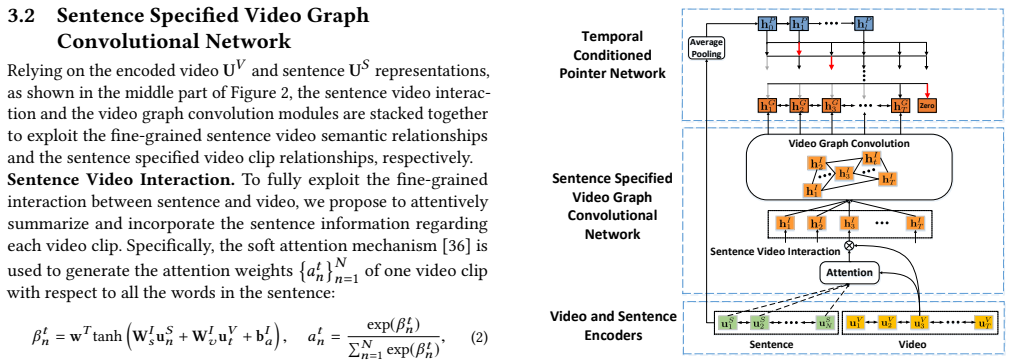
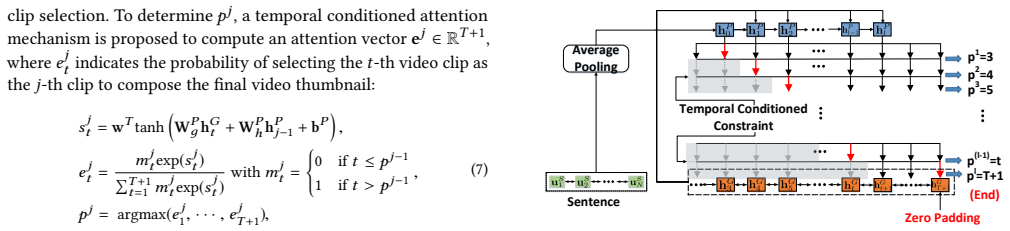
The machinery is the graph convolved video thumbnail pointer (GTP), composed of two named modules. The sentence specified video graph convolutional network builds a graph over video clips: each clip's feature is first merged with a sentence representation through word-by-clip attention, and the edge between two clips is their sentence-conditioned affinity, normalized row-wise; graph convolution then propagates information between semantically related clips. The temporal conditioned pointer network is a pointer network with a GRU and attention that selects one clip index per step, but applies a binary mask zeroing out every index at or before the previously chosen one, guaranteeing strictly increasing time order while still allowing gaps and a variable stop at a padding token. Together they turn the task into sequential, order-preserving selection from a sentence-aware video graph.
What would settle it
A reader could download the released dataset and recompute the evaluation two ways: use the single most-consistent annotation as the only ground truth for testing (instead of the maximum over all four), or average the metrics over all four annotations. If GTP's margin over the strongest baseline shrinks to nothing under either variant, the claim that GTP outperforms existing methods on this task would be undermined.
Extended reading notes
Core claim
The central claim is that sentence-conditioned dynamic thumbnails are learnable, and that GTP outperforms several baseline methods on the created dataset. GTP first applies word-by-clip attention so each clip absorbs the sentence context, then treats the video as a graph whose nodes are these sentence-aware clip features and whose edge weights are their semantic similarities; graph convolution propagates information along those edges. A temporal conditioned pointer network then emits the selected clip indices one at a time, using a binary mask that forbids moving backward, so the chosen clips keep their chronological order even when they are not temporally consecutive. The reported numbers (precision 0.5055, recall 0.5742, F1 0.5285, IoU 0.3933) beat the previous best baseline on every metric, with the largest gap in recall and IoU, and the ablations show that removing either the graph convolution or the temporal mask lowers performance.
Load-bearing premise
The whole comparison rests on the assumption that four annotators' choices of up to five 2-second clips define a trustworthy ground truth for what a good sentence-specific thumbnail is; if their selections are too inconsistent for many pairs, the reported advantage of GTP over the baselines would not measure thumbnail quality reliably.
Editorial extensions
If this is right
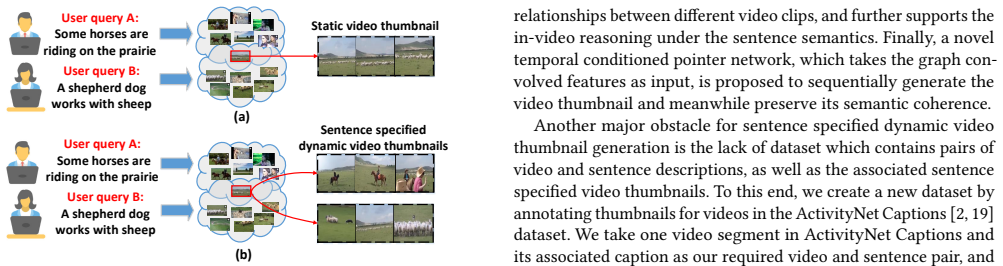
- Video thumbnails can be produced at query time: the same video yields different thumbnails for different sentence queries, matching the user's search intent.
- The temporal mask lets a thumbnail contain several disjoint clips without losing chronological coherence, so a short preview can jump across a long video and still read naturally.
- Because selection is sequential and can stop early, thumbnail length is flexible rather than fixed to a predetermined number of clips.
- Modeling clip relationships through the graph is what lets selection respond to global video content, not just to the local match between a clip and the sentence.
- The released dataset with 10,204 video-sentence pairs and four thumbnails per pair gives the research community a benchmark for this task.
Reading between the lines
- The same selection mechanism could be applied to query-conditioned video summarization or to composing ordered shot lists for storytelling, since the graph convolution supplies global context and the pointer supplies ordering.
- Using the maximum score over four annotations as the test metric means a method only needs to agree with one annotator; an average-over-annotations variant might reward methods that capture the common agreement instead, and could behave differently against baselines.
- The binary temporal mask is a simple, transferable idea for any pointer network that must respect a total order, such as assembling sentences into a paragraph or arranging retrieved passages.
- If inter-annotator agreement is low, the task is partly subjective; a natural next step would be predicting a distribution over plausible thumbnails rather than a single selection.
Signed reviews
Editorial analysis
A structured set of objections, weighed in public.
Referee Report
Summary. This paper defines a new task, sentence-specified dynamic video thumbnail generation, in which a natural-language sentence conditions the selection of a set of possibly non-consecutive video clips that are concatenated into a thumbnail. The authors propose GTP, an end-to-end model consisting of Bi-GRU encoders for video clips and words, a word-by-clip attention interaction, a sentence-specified graph convolutional network over clip nodes, and a temporal-conditioned pointer network that sequentially selects clips under a monotone temporal mask. They construct a dataset of 10,204 video-sentence pairs from ActivityNet Captions, each with four independent thumbnail annotations, and report precision, recall, F1, and IoU against several baselines, claiming improved performance. Ablation studies and qualitative graph-learning analyses are also presented.
Significance. If the reported results are robust, the paper would contribute a new benchmark and a reasonable architecture for query-specific dynamic thumbnails. The dataset and code are released, the experimental setup is reproducible in principle, and the ablations cover the main components. The primary value is the formulation of the task and the dataset rather than a large algorithmic leap. However, the current evaluation does not yet support the headline comparative claims because of test-set hyperparameter selection, missing variance estimates, and metric choices; the conclusions are plausible but not yet established. I see no circularity: the model is trained on a training split and evaluated on held-out samples.
major comments (5)
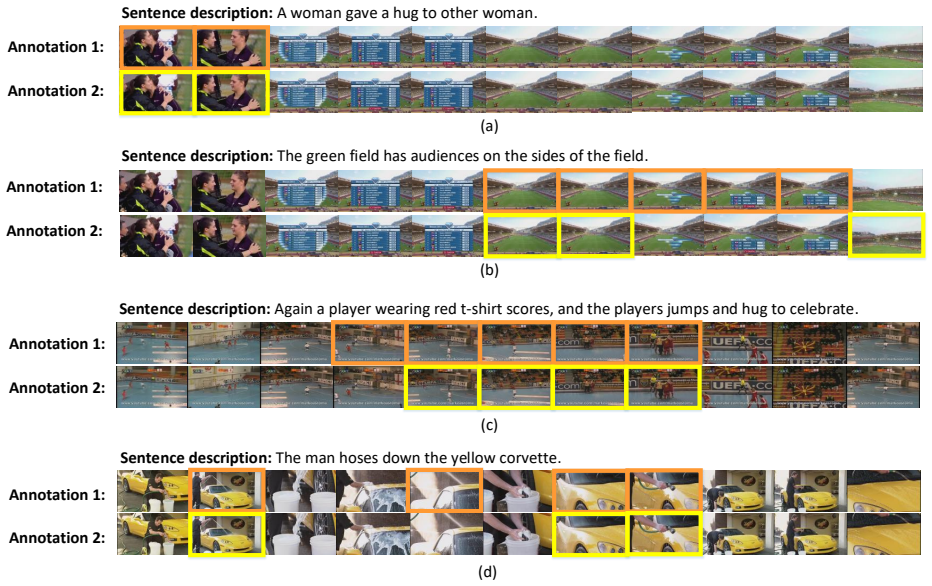
- [§5.2, §5.4, Table 3] The final model configuration appears to be selected on the test set. The implementation section fixes the number of graph-convolution layers to 2 and λ to 150, and Table 3 then reports test-set metrics for GTP-1 through GTP-4, with GTP-2 chosen as best. If the same test split used in Table 1 was used for this selection, the GTP row in Table 1 is optimistically biased and the comparison with baselines is not a clean holdout evaluation. Please select hyperparameters on the validation split, or at minimum report the validation results used for model selection, and confirm that the test set was used only once.
- [§5.3, Table 1] No variance or significance information is reported. The table appears to reflect a single run, and the precision margin over ACRN is only 0.0088 (0.5055 vs 0.4967), while the layer-count sweep in Table 3 changes F1 by up to 0.0069 and IoU by up to 0.0079. This means the headline precision difference is within the range of configuration variation. Please report results over multiple seeds, bootstrapped confidence intervals, or a paired significance test, so the claim that GTP outperforms baselines is statistically supported.
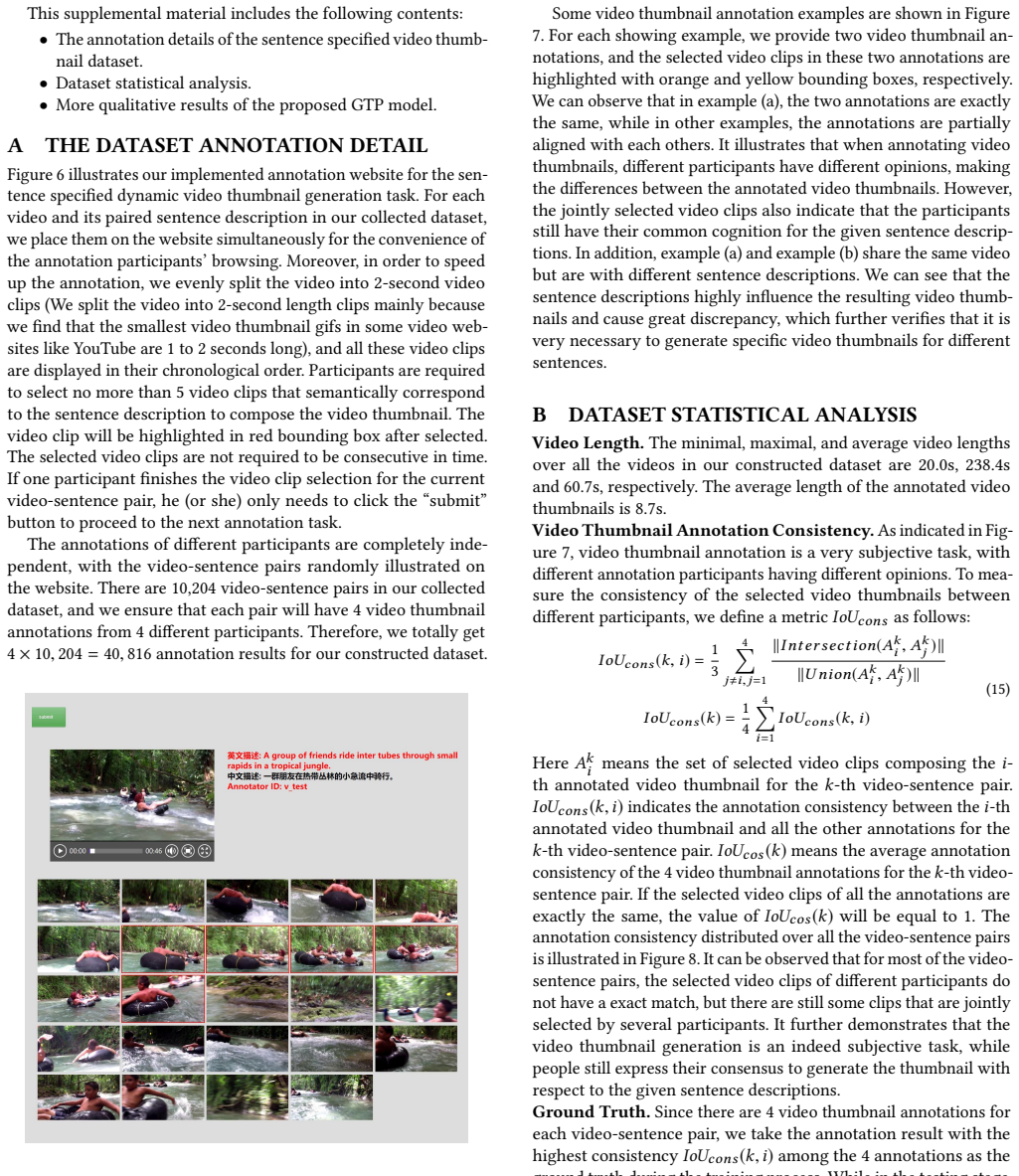
- [Eqs. (11)–(14), supplemental B] The evaluation metric takes a per-sample maximum over the four annotations, and it does so separately for precision, recall, F1, and IoU; for a given sample the reported precision and recall can come from different annotators. This inflates scores and makes the reported P/R/F1 triple internally inconsistent. The supplemental consistency distribution also shows substantial disagreement, but no numeric agreement statistics are given. Please report inter-annotator agreement quantitatively and show that the conclusions are stable under a different aggregation, such as averaging over annotations or matching to the single most-consistent annotation used at training time.
- [§5.4, ablation GTP-G] The GTP-G ablation removes the graph convolutional network but also replaces the word-by-clip attention interaction with a simple average of word features. The improvement from GTP-G to GTP therefore cannot be attributed specifically to graph convolution. Please add an ablation that retains the sentence-video interaction module but removes only the GCN, or otherwise factor the two changes.
- [§5.1, Tables 1] The temporal-localization baselines CTRL and ACRN are adapted by converting the thumbnail ground truth into the longest continuous segment and are then evaluated against multi-clip ground-truth thumbnails. This adaptation constrains their output to one segment, so their lower recall may reflect the constrained output space rather than a deficiency in modeling. Please either provide these baselines with a multi-clip output pathway, such as top-k segments or thresholded clips, and evaluate that, or clearly frame the result as showing that single-segment methods are unsuitable for the new task rather than as a head-to-head model comparison.
minor comments (5)
- [§3.3, Eq. (7)] The temporal mask uses p_{j-1}, but p_0 is not defined; please define p_0 = 0 or state the convention for the first selection step.
- [§4 and supplemental A/B] Please report the number of annotators, the exact definition and tie-breaking rule for the 'highest consistency' annotation used as training ground truth, and numeric summary statistics for IoUcons (mean, median, quartiles).
- [§5.2] 'We set the number of the graph convolution layer as 2' should be 'layers', and 'Standford' should be 'Stanford'.
- [§5.1] 'We directly run the source codes' should be 'source code'; please specify versions or commit hashes for the baselines to make reproducibility concrete.
- [Figure 3] The annotation 'p(l-1)=t' at the bottom of the figure is ambiguous; please label the stopping step (selection of the zero-padding state) explicitly.
Circularity Check
No circularity found: GTP is trained and evaluated on a held-out split of the authors' new dataset, and the reported comparisons do not reduce to the model's inputs by construction.
full rationale
The paper's central claim is an empirical comparison on a newly annotated dataset: GTP is trained with a cross-entropy loss against a chosen ground-truth annotation (Eq. 9) and evaluated on a held-out test split using precision, recall, F1, and IoU averaged over test samples (Eqs. 11-14). None of these equations defines the result as equivalent to an input or to a fitted parameter. The training-stage choice to use the most consistent of four annotations as ground truth is a data-preprocessing decision, not a prediction constructed from the model's own outputs. The test-stage max over the four annotations is an evaluation metric choice; while it may affect score magnitude, it does not make the model's output equal to its input by construction. The paper's self-citation [37] appears only in a related-work list of temporal sentence localization methods and is not load-bearing for the proposed method. Possible concerns about annotator agreement, test-set-based model selection in Table 3, and missing error bars are correctness or robustness issues, not circularity. Therefore no circular step is present, and the derivation is self-contained as an empirical evaluation.
Assumptions & free parameters
free parameters (6)
- Graph similarity scaling factor lambda =
150
- Number of graph convolution layers =
2
- Hidden state dimension of GRUs =
256
- Video clip length =
2 seconds
- Maximum number of clips in a thumbnail =
5
- Initial learning rate =
0.001
assumptions (3)
- domain assumption C3D features from ActivityNet Challenge 2016 are sufficient visual representations of 2-second clips for sentence-video matching.
- domain assumption Four annotators' clip selections define a reliable ground truth for sentence-specified thumbnails.
- domain assumption A temporal mask that permits only increasing clip indices is the right structural constraint for thumbnails.
Cite this review
Pith. "Pith review of Sentence Specified Dynamic Video Thumbnail Generation." pith.science (2026). https://pith.science/paper/UHH7ENIC
@misc{pith2026190804052,
  author       = {Pith},
  title        = {Pith review of: Sentence Specified Dynamic Video Thumbnail Generation},
  year         = {2026},
  howpublished = {\url{https://pith.science/paper/UHH7ENIC}},
  note         = {Machine review of arXiv:1908.04052}
}
read the original abstract
With the tremendous growth of videos over the Internet, video thumbnails, providing video content previews, are becoming increasingly crucial to influencing users' online searching experiences. Conventional video thumbnails are generated once purely based on the visual characteristics of videos, and then displayed as requested. Hence, such video thumbnails, without considering the users' searching intentions, cannot provide a meaningful snapshot of the video contents that users concern. In this paper, we define a distinctively new task, namely sentence specified dynamic video thumbnail generation, where the generated thumbnails not only provide a concise preview of the original video contents but also dynamically relate to the users' searching intentions with semantic correspondences to the users' query sentences. To tackle such a challenging task, we propose a novel graph convolved video thumbnail pointer (GTP). Specifically, GTP leverages a sentence specified video graph convolutional network to model both the sentence-video semantic interaction and the internal video relationships incorporated with the sentence information, based on which a temporal conditioned pointer network is then introduced to sequentially generate the sentence specified video thumbnails. Moreover, we annotate a new dataset based on ActivityNet Captions for the proposed new task, which consists of 10,000+ video-sentence pairs with each accompanied by an annotated sentence specified video thumbnail. We demonstrate that our proposed GTP outperforms several baseline methods on the created dataset, and thus believe that our initial results along with the release of the new dataset will inspire further research on sentence specified dynamic video thumbnail generation. Dataset and code are available at https://github.com/yytzsy/GTP.
Figures
Figures from the paper (7 more)




Reference graph
Works this paper leans on
-
[1]
Jimmy Lei Ba, Jamie Ryan Kiros, and Geoffrey E Hinton. 2016. Layer normaliza- tion. arXiv preprint arXiv:1607.06450 (2016)
arXiv 2016
-
[2]
Fabian Caba Heilbron, Victor Escorcia, Bernard Ghanem, and Juan Carlos Niebles
-
[3]
Jingyuan Chen, Xinpeng Chen, Lin Ma, Zequn Jie, and Tat-Seng Chua. 2018. Tem- porally Grounding Natural Sentence in Video. In EMNLP 2018: 2018 Conference on Empirical Methods in Natural Language Processing . 162–171
work page 2018
-
[4]
Jingyuan Chen, Lin Ma, Xinpeng Chen, Zequn Jie, and Jiebo Luo. 2019. Localizing Natural Language in Videos. In AAAI
work page 2019
-
[5]
Zhenfang Chen, Lin Ma, Wenhan Luo, and Kwan-Yee K Wong. 2019. Weakly- Supervised Spatio-Temporally Grounding Natural Sentence in Video. In ACL
work page 2019
-
[6]
Kyunghyun Cho, Bart Van Merrienboer, Caglar Gulcehre, Dzmitry Bahdanau, Fethi Bougares, Holger Schwenk, and Yoshua Bengio. 2014. Learning Phrase Representations using RNN Encoder-Decoder for Statistical Machine Translation. Computer Science (2014)
work page 2014
-
[7]
F Dirfaux. 2000. Key frame selection to represent a video. In IEEE International Conference on Image Processing , Vol. 2. 275–278
work page 2000
-
[8]
Andrea Frome, Greg S Corrado, Jon Shlens, Samy Bengio, Jeff Dean, Tomas Mikolov, et al. 2013. Devise: A deep visual-semantic embedding model. In Ad- vances in neural information processing systems . 2121–2129
2013
Show all 42 references
-
[9]
Jiyang Gao, Chen Sun, Zhenheng Yang, and Ram Nevatia. 2017. TALL: Temporal Activity Localization via Language Query. InProceedings of the IEEE International Conference on Computer Vision
2017
-
[10]
Yuli Gao, Tong Zhang, and Jun Xiao. 2009. Thematic video thumbnail selection. In IEEE International Conference on Image Processing . 4333–4336
2009
-
[11]
Ross Girshick. 2015. Fast R-CNN. In Proceedings of the IEEE International Confer- ence on Computer Vision . 1440–1448
2015
-
[12]
Ross Girshick, Jeff Donahue, Trevor Darrell, and Jitendra Malik. 2014. Rich feature hierarchies for accurate object detection and semantic segmentation. In Proceedings of the IEEE Conference on Computer vision and Pattern Recognition . 580–587
2014
-
[13]
Michael Gygli, Yale Song, and Liangliang Cao. 2016. Video2gif: Automatic gen- eration of animated gifs from video. In Proceedings of the IEEE Conference on Computer Vision and Pattern Recognition . 1001–1009
2016
-
[14]
Satoshi Hasebe, Makoto Nagumo, Shogo Muramatsu, and Hisakazu Kikuchi. 2004. Video key frame selection by clustering wavelet coefficients. In Signal Processing Conference, 2004 12th European . 2303–2306
2004
-
[15]
Lisa Anne Hendricks, Oliver Wang, Eli Shechtman, Josef Sivic, Trevor Darrell, and Bryan Russell. 2017. Localizing Moments in Video with Natural Language. In Proceedings of the IEEE International Conference on Computer Vision
2017
-
[16]
Xian-Sheng Hua, Linjun Yang, Jingdong Wang, Jing Wang, Ming Ye, Kuansan Wang, Yong Rui, and Jin Li. 2013. Clickage: Towards bridging semantic and intent gaps via mining click logs of search engines. In Proceedings of the 21st ACM international conference on Multimedia . 243–252
2013
-
[17]
Hong-Wen Kang and Xian-Sheng Hua. 2005. To learn representativeness of video frames. In Proceedings of the 13th annual ACM international conference on Multimedia. 423–426
2005
-
[18]
Thomas N Kipf and Max Welling. 2016. Semi-supervised classification with graph convolutional networks. arXiv preprint arXiv:1609.02907 (2016)
2016 arXiv
-
[19]
Ranjay Krishna, Kenji Hata, Frederic Ren, Li Fei-Fei, and Juan Carlos Niebles
-
[20]
Chunxi Liu, Qingming Huang, and Shuqiang Jiang. 2011. Query sensitive dynamic web video thumbnail generation. In IEEE International Conference on Image Processing. 2449–2452
2011
-
[21]
Jing Liu, Bin Wang, Mingjing Li, Zhiwei Li, Weiying Ma, Hanqing Lu, and Songde Ma. 2007. Dual cross-media relevance model for image annotation. InProceedings of the 15th ACM international conference on Multimedia . ACM, 605–614
2007
-
[22]
Meng Liu, Xiang Wang, Liqiang Nie, Xiangnan He, Baoquan Chen, and Tat-Seng Chua. 2018. Attentive Moment Retrieval in Videos. In The 41st International ACM SIGIR Conference on Research & Development in Information Retrieval . 15–24
2018
-
[23]
Wu Liu, Tao Mei, Yongdong Zhang, Cherry Che, and Jiebo Luo. 2015. Multi-task deep visual-semantic embedding for video thumbnail selection. In Proceedings of the IEEE Conference on Computer Vision and Pattern Recognition . 3707–3715
2015
-
[24]
Jiebo Luo, Christophe Papin, and Kathleen Costello. 2009. Towards extracting semantically meaningful key frames from personal video clips: from humans to computers. IEEE Transactions on Circuits and Systems for Video Technology 19, 2 (2009), 289–301
2009
-
[25]
Christopher Manning, Mihai Surdeanu, John Bauer, Jenny Finkel, Steven Bethard, and David McClosky. 2014. The Stanford CoreNLP natural language processing toolkit. In Proceedings of 52nd annual meeting of the association for computational linguistics: system demonstrations. 55–60
2014
-
[26]
Tao Mei, Bo Yang, Shi-Qiang Yang, and Xian-Sheng Hua. 2009. Video collage: presenting a video sequence using a single image. The Visual Computer 25, 1 (2009), 39–51
2009
-
[27]
Yingwei Pan, Ting Yao, Tao Mei, Houqiang Li, Chong-Wah Ngo, and Yong Rui
-
[28]
Jeffrey Pennington, Richard Socher, and Christopher Manning. 2014. Glove: Global vectors for word representation. In Proceedings of the 2014 conference on empirical methods in natural language processing (EMNLP) . 1532–1543
2014
-
[29]
Yale Song, Miriam Redi, Jordi Vallmitjana, and Alejandro Jaimes. 2016. To click or not to click: Automatic selection of beautiful thumbnails from videos. In Proceedings of the 25th ACM International on Conference on Information and Knowledge Management. 659–668
2016
-
[30]
Du Tran, Lubomir Bourdev, Rob Fergus, Lorenzo Torresani, and Manohar Paluri
-
[31]
Arun Balajee Vasudevan, Michael Gygli, Anna Volokitin, and Luc Van Gool. 2017. Query-adaptive Video Summarization via Quality-aware Relevance Estimation. In Proceedings of the 2017 ACM on Multimedia Conference . 582–590
2017
-
[32]
Ashish Vaswani, Noam Shazeer, Niki Parmar, Jakob Uszkoreit, Llion Jones, Aidan N Gomez, Łukasz Kaiser, and Illia Polosukhin. 2017. Attention is all you need. In Advances in Neural Information Processing Systems . 5998–6008
2017
-
[33]
Oriol Vinyals, Meire Fortunato, and Navdeep Jaitly. 2015. Pointer networks. In Advances in Neural Information Processing Systems . 2692–2700
2015
-
[34]
In Proceedings of the IEEE International Conference on Computer Vision
Learning spatiotemporal features with 3d convolutional networks. In Proceedings of the IEEE International Conference on Computer Vision . 4489–4497
-
[35]
Zheshen Wang, Mrityunjay Kumar, Jiebo Luo, and Baoxin Li. 2011. Extracting key frames from consumer videos using bi-layer group sparsity. InProceedings of the 19th ACM international conference on Multimedia . 1505–1508
2011
-
[36]
Courville, Ruslan Salakhutdinov, Richard S
Kelvin Xu, Jimmy Ba, Ryan Kiros, Kyunghyun Cho, Aaron C. Courville, Ruslan Salakhutdinov, Richard S. Zemel, and Yoshua Bengio. 2015. Show, Attend and Tell: Neural Image Caption Generation with Visual Attention. In Proceedings of the 32nd International Conference on Machine Lea...
2015
-
[37]
Yitian Yuan, Tao Mei, and Wenwu Zhu. 2019. To Find Where You Talk: Temporal Sentence Localization in Video with Attention Based Location Regression. In Thirty-Third AAAI Conference on Artificial Intelligence . This supplemental material includes the following contents: • The a...
2019
-
[38]
Xiaolong Wang and Abhinav Gupta. 2018. Videos as Space-Time Region Graphs. arXiv preprint arXiv:1806.01810 (2018)
2018 arXiv
-
[42]
skateboarding
For each showing example, we provide two video thumbnail an- notations, and the selected video clips in these two annotations are highlighted with orange and yellow bounding boxes, respectively. We can observe that in example (a), the two annotations are exactly the same, whil...
-
[2014]
In Proceedings of the 37th international ACM SIGIR conference on Research & development in information retrieval
Click-through-based cross-view learning for image search. In Proceedings of the 37th international ACM SIGIR conference on Research & development in information retrieval. 717–726
-
[2015]
In Proceedings of the IEEE Conference on Computer Vision and Pattern Recognition
Activitynet: A large-scale video benchmark for human activity under- standing. In Proceedings of the IEEE Conference on Computer Vision and Pattern Recognition. 961–970
-
[2017]
InProceedings of the IEEE International Conference on Computer Vision
Dense-Captioning Events in Videos.. InProceedings of the IEEE International Conference on Computer Vision . 706–715
Reviewed August 14, 2026 · model on record in the stance chip above.
Discussion (0). Continue with ORCID to comment.