REVIEW 3 major objections 5 minor 69 references
CoEvoKG: Co-Evolving Knowledge Graphs with Self-Evolving Search Agents
T0 review · 3 major / 5 minor · reviewed 2026-08-04 · deepseek-v4-flash
Pith's one-line read Closed-loop knowledge graph memory lifts search-agent self-play by about 10 macro points on six QA benchmarks.
desk verdict Genuinely new closed-loop KG self-play, but the write-back term that closes the loop is the weakest-supported part (+0.6 points) and the path-support scorer may be self-confirming; referee it, but ask for calibration and variance. read the letter →
The pith
A machine-rendered reading of the paper's core claim, the machinery that carries it, and where it could break.
The reading
What carries the argument
The central mechanism is the evolving chain pool (graph memory): entity chains sampled from a Wikipedia-based knowledge graph, each node an article with its passage and each edge a typed relation label. Three components operate on it in a loop: (1) chain-based task generation, where a proposer turns sampled 2–3 hop chains into questions passing a quality gate; (2) a hybrid solver reward R_s = R_ans(1 + β S_path), where S_path is the geometric mean of a deterministic relation consistency score M(u,v) over adjacent entities in the searched path; and (3) verified evidence write-back, which appends deduplicated retrieved passages from correct, path-supported trajectories back into the originatin
What would settle it
Compute M(u,v) on held-out human-annotated entity-pair support labels; if the score does not track human judgments, the process reward is misaligned and CoEvoKG's reported gains could in part come from training to a heuristic rather than to evidence-supported reasoning.
Extended reading notes
Core claim
The paper's central claim is that a knowledge graph can serve simultaneously as a source of verifiable multihop training tasks and as a persistent evidence memory for the agent's own successful searches, and that closing the loop between these two roles is what makes self-play stable and effective. In each round a proposer generates questions from sampled entity chains, a solver answers them with multi-turn search, and any correct trajectory whose entity path is supported by graph evidence is verified, deduplicated, and written back into the graph memory. Later rounds sample from enriched chains and score path support against the enriched graph, so the task distribution and the reward signal
Load-bearing premise
The load-bearing premise is that the deterministic relation consistency score M(u,v) is a calibrated proxy for evidence-supported search; the paper states that any calibrated scorer could replace it, but calibration is asserted rather than demonstrated, and the thresholds and weights are deferred to an appendix.
Editorial extensions
If this is right
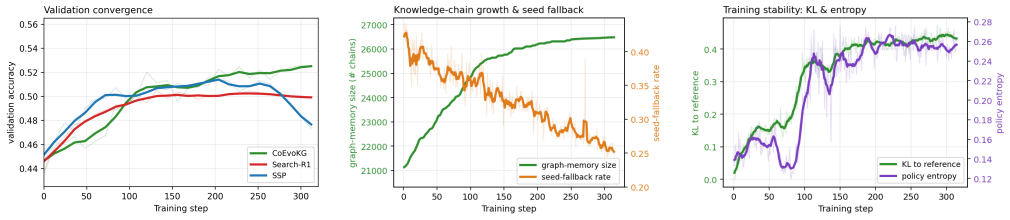
- Under matched training budgets, CoEvoKG beats static-data agentic RL (Search-R1) and self-play (SSP) by 2.6–3.7 macro average points, and its validation accuracy keeps rising while SSP degrades after mid-training.
- The process reward separates evidence-supported correct answers from lucky guesses, so training rewards search behavior rather than answer generation alone.
- The verified chain pool grows then plateaus as deduplication kicks in, indicating the loop naturally saturates without collapsing onto seed questions.
- The difficulty-annealed proposer keeps generated questions at the solver's competence frontier, with comparable success rates to seed questions but higher average hop count (2.23 vs ≈1.75), explaining larger gains on multihop benchmarks.
- The seed-fallback rate declines from ≈0.40 to ≈0.25, showing the proposer increasingly produces admissible questions as training proceeds.
Reading between the lines
- The paper's own ablation isolates write-back as a small (+0.6 point) contribution; extrapolating, the framework's gains may be mostly from chain-grounded task generation and path/difficulty rewards, meaning the memory loop's main role is sustaining a hard task distribution.
- Because 25–40% of solver slots are human seed questions and this is disclosed but not ablated against SSP, part of the reported gains could come from the fixed seed pool rather than the co-evolution loop; a controlled ablation would settle this.
- The risk of a self-confirming loop is real: if the graph is written back with the solver's own successful paths, S_path thresholds may become easier to satisfy as training progresses, so the process reward measures internal consistency rather than external truth; a test would be to freeze the graph after some round and continue training to see if gains persist.
- The framework's design is portable to other structured evidence sources (e.g., citation graphs, molecular interaction networks, legal or biomedical databases) wherever entity chains and verifiable relations exist.
Editorial analysis
A structured set of objections, weighed in public.
Referee Report
Summary. CoEvoKG couples a task generator and a search agent through a shared knowledge-graph chain pool. The generator samples multihop entity chains and produces questions filtered by a quality gate; the solver is trained with GRPO on a reward that combines answer correctness with a path-support score computed against the current graph; proposer training uses a difficulty-bell reward on solver success rate. Correct, path-supported solver trajectories are written back into the graph, advancing G_t to G_{t+1}, which is intended to provide a persistent evidence memory and richer future tasks. On six QA benchmarks (NQ, TriviaQA, PopQA, HotpotQA, 2WikiMultiHopQA, Bamboogle) and three backbones, the paper reports macro-average gains of +11.2, +10.1, and +11.6 over base models, and +2.6 to +3.7 over Search-R1 and SSP under a matched budget. A build-up ablation attributes +1.5 to KG task generation (p=0.0011), +1.1 to path/difficulty rewards (p=0.0141), and +0.6 to evidence write-back (p=0.0314).
Significance. If the co-evolution loop is real, this is a useful and practical contribution: it shows that self-play search agents can be stabilized by treating the knowledge graph not only as a task source but also as a persistent, evidence-accumulating memory. The paper has several genuine strengths: evaluation on external, human-curated held-out subsets (the SSP release) with greedy decoding; a transparent build-up ablation that reports paired sign tests and openly states that write-back is 'positive but weaker'; a matched training budget across methods; and released code. These design choices make the central claim externally anchored rather than definitionally circular. The main risk is that the verification signal used to gate and reward write-back is computed from the same graph memory that write-back mutates, so the loop's only direct contribution may be partially self-confirming. That concern, together with the unablated seed-fallback mixture, means the manuscript needs additional controls before the co-evolution claim is fully established.
major comments (3)
- [§3.3–3.4, Eqs. (7)–(9)] The path-support verification is not independent of the memory it gates. M(u,v) is computed deterministically from records in the current graph G_t, and write-back advances G_t to G_{t+1} using trajectories that passed Spath≥τ_path. Once a correct trajectory adds evidence for an entity pair, later trajectories over the same pair receive a higher M, making the threshold and the Eq. (7) process reward easier to satisfy. This is a self-confirmation loop rather than an external check. The paper concedes in §3.3 that 'any calibrated scorer could replace it' but provides no calibration evidence. This matters because Table 2 attributes only +0.6 macro points (p=0.0314) to write-back, exactly the term most exposed to the bias. Please add an external/oracle verification ablation or calibrate M on a fixed held-out set of trajectory–graph pairs that is frozen before write-back begins.
- [§3.2, Fig. 3, Table 2] The seed fallback injects human-written verified questions into 25–40% of solver slots, declining over training. The comparison against SSP in Table 1 therefore conflates KG-chain task generation with a human-question curriculum; no ablation controls for seed fraction. Because C1 (KG task generation) is the largest ablation gain (+1.5, p=0.0011), the reader cannot tell how much of the superiority over SSP comes from KG chains versus the presence of 25–40% verified human questions. Please report an ablation that matches the seed mixture across methods (e.g., SSP augmented with the same seed pool, or CoEvoKG without seed fallback) and report the seed fraction per method per round.
- [Table 1, §4.1] The headline matched-budget gains (+2.6 to +3.7 macro points over SSP/Search-R1) are reported without variance, number of seeds, or per-benchmark significance. A single seed and a single checkpoint selection can be noisy; paired sign tests are given only for the Table 2 ablation, not the main results. Please provide at least three seeds (or bootstrapped confidence intervals over the 2,625 held-out examples) for the main table and state the checkpoint-selection variance. This is especially important for Bamboogle, which has only 125 evaluation questions.
minor comments (5)
- [§3.5, Eq. (12)] The symbol G_t is used both for the graph memory at round t and for the discounted return in the REINFORCE++ estimator. Rename the return variable (e.g., R_t or G_return_t) to avoid notation collision.
- [Eqs. (8)–(9)] Clarify whether the extracted chain êτ always has the same length L as the original chain c. If the solver path length varies, define the relevant length in Eq. (9) explicitly.
- [§3.2–3.3, Appendix] The exact values of α, β_text, γ, η, τ_path, the quality-gate retention threshold, the verifier model, and the annealing schedule (p*_s, p*_e, σ) are all deferred to the appendix. Please include these in the supplement or the main text, since they are needed to reproduce the path-support score.
- [Fig. 3] The caption does not specify the vertical axes for the pool-size and seed-fallback-rate panels. Add axis labels and units so the 'grows then plateaus' and 'declines' claims can be read quantitatively.
- [§4.4] The comparison of mean solver success rates (0.405 vs. 0.410) should state how many rollouts and which checkpoint produced these numbers. A one-line description would make the diagnostic reproducible.
Circularity Check
Path-support gate and write-back are mutually recursive; verified graph memory partially certifies its own outputs, though headline accuracy is externally anchored.
-
self definitional
[Sec. 3.3 'Path support verification' (Eqs. 7–9) and Sec. 3.4 'Verified Graph Memory']
"We verify ˆcτ against the current evidence graph Gt ... M(u, v) ∈ [0,1] deterministically ... from the current chain evidence: over records mentioning both entities ... by default, evidence write back is applied to trajectories that are both correct and supported by the path score (Rans=1 and Spath ≥ τ path) ... Enriched chains return to the pool, forming a denser graph Gt+1, so later rounds let the proposer condition on richer contexts and the verifier draw on more evidence."
The write-back gate defines 'supported evidence' via S_path, computed from M(·,·) over records in the current graph G_t (Eq. 9). Section 3.4 then writes exactly those supported trajectories back into G_{t+1}. Hence the evidence used to verify later trajectories is partly the solver's own earlier verified outputs: G_{t+1} = G_t ∪ {τ : R_ans(τ)=1 ∧ S_path(τ; G_t) ≥ τ_path}. The support score is therefore not an independent check; it becomes easier to satisfy as past successes add records for the same entity pairs, so the process reward and the write-back gate are partially self-certifying. The C3 ablation (+0.6 macro points, p=0.0314) is precisely the term most exposed to this self-confirmation. The external accuracy numbers are not circular because final evaluation uses held-out benchmarks,
full rationale
CoEvoKG's headline result is not definitionally circular: macro-average gains are measured on external, human-curated SSP held-out subsets (500 questions per benchmark, 125 for Bamboogle), and the comparison against Search-R1 and SSP is under a matched budget. No fitted parameter is renamed as a prediction; no uniqueness theorem or ansatz is imported from co-author citations. The only overlapping self-citation (Cognitive Scaffold, Ai et al. 2026) is used for related-work contrast, not as load-bearing support. The main circularity concern is the verification loop inside the method: S_path (Eq. 9) is computed deterministically from records in the current graph memory G_t, and Section 3.4 admits trajectories with S_path ≥ τ_path into G_{t+1}. This makes 'verified' evidence self-referential — the graph used to judge support is enriched by the trajectories it judged supported. The paper's own ablation shows write-back is the weakest contribution (+0.6 macro points, p=0.0314), which is consistent with partial self-confirmation rather than independent signal. Seed fallback (≈25–40% of solver slots) is a real confound for the task-generation rows but is disclosed and not a circularity. M's weights/thresholds are deferred to the appendix and 'any calibrated scorer could replace it' is an acknowledged modularity, not a circular step. Overall, central claim retains independent content; one component is partially circular, so score 4.
Assumptions & free parameters
free parameters (6)
- beta (solver path-support reward weight) =
0.2
- relation score weights alpha, beta_text, gamma, eta =
appendix
- path support thresholds (local and global tau_path) =
appendix
- difficulty bell parameters sigma, p_start, p_end and annealing schedule =
appendix
- quality gate retention threshold and dimension aggregation =
appendix
- solver group size G =
8
assumptions (7)
- domain assumption Random walks over the KILT Wikipedia knowledge graph produce chains that support unique-answer, genuinely multihop questions.
- domain assumption The E5 dense retriever over Wikipedia returns, within the 8-turn budget, passages sufficient to answer generated questions.
- ad hoc to paper The deterministic relation consistency score M(u,v), with hand-set weights, is a calibrated proxy for trajectory path support.
- domain assumption The LLM quality gate (Eq. 6) correctly enforces no leakage, chain faithfulness, multihop requirement, single-answer focus, and clarity.
- ad hoc to paper A single annealed difficulty schedule p*(t) is appropriate for all three backbones.
- standard math GRPO/REINFORCE++ style updates with KL penalty and advantage whitening keep the two-policy self-play loop stable.
- domain assumption The SSP evaluation subsets (500 questions per benchmark) are unbiased external targets and the seed pool excludes them.
Cite this review
Pith. "Pith review of CoEvoKG: Co-Evolving Knowledge Graphs with Self-Evolving Search Agents." pith.science (2026). https://pith.science/paper/UHHOMB4Z
@misc{pith2026260801904,
  author       = {Pith},
  title        = {Pith review of: CoEvoKG: Co-Evolving Knowledge Graphs with Self-Evolving Search Agents},
  year         = {2026},
  howpublished = {\url{https://pith.science/paper/UHHOMB4Z}},
  note         = {Machine review of arXiv:2608.01904}
}
read the original abstract
Large language models can improve with reinforcement learning for search agents, yet existing self play agents repeatedly generate tasks while discarding the knowledge gained during successful searches. We introduce CoEvoKG, a framework that turns a knowledge graph into both a source of verifiable training tasks and a persistent evidence memory for agent evolution. CoEvoKG jointly trains a task generator and a search agent: the generator creates multihop questions from entity chains sampled from the knowledge graph, while the agent learns from rewards for answer correctness and search trajectories whose entity paths are supported by graph evidence. When a search succeeds, CoEvoKG verifies and deduplicates the retrieved evidence, then writes it back to the corresponding graph nodes and edges. Future rounds reuse this enriched graph for task generation and reward computation, closing the loop between model self evolution and knowledge accumulation. Experiments on six QA benchmarks (NQ, TriviaQA, PopQA, HotpotQA, 2WikiMultiHopQA, and Bamboogle) with three backbone models show that CoEvoKG improves macro average accuracy over the corresponding base models by +11.2, +10.1, and +11.6 points on Qwen2.5-3B-Instruct, Qwen2.5-7B-Instruct, and Llama-3.1-8B-Instruct, respectively. Under matched training budgets, CoEvoKG further improves over competitive self play baselines and RL baselines for search agents by +2.6 to +3.7 macro average points across the three backbones. Code is available at https://github.com/lazzy1225/CoEvoKG.
Figures


Figures from the paper (1 more)

Reference graph
Works this paper leans on
-
[1]
2025 , month = sep, doi =
Guo, Daya and others , journal =. 2025 , month = sep, doi =
2025
-
[2]
2024 , eprint =
DeepSeekMath: Pushing the Limits of Mathematical Reasoning in Open Language Models , author =. 2024 , eprint =
2024
-
[3]
International Conference on Learning Representations , year =
Decoupled Weight Decay Regularization , author =. International Conference on Learning Representations , year =
-
[4]
and Wang, Dong and Zamani, Hamed and Han, Jiawei , booktitle =
Jin, Bowen and Zeng, Hansi and Yue, Zhenrui and Yoon, Jinsung and Arik, Sercan O. and Wang, Dong and Zamani, Hamed and Han, Jiawei , booktitle =. Search-. 2025 , url =
2025
-
[5]
and Zhang, Wen and Chen, Huajun and Yang, Fan and Zhou, Zenan and Chen, Weipeng , booktitle =
Chen, Mingyang and Sun, Linzhuang and Li, Tianpeng and Sun, Haoze and Zhou, Yijie and Zhu, Chenzheng and Wang, Haofen and Pan, Jeff Z. and Zhang, Wen and Chen, Huajun and Yang, Fan and Zhou, Zenan and Chen, Weipeng , booktitle =. 2025 , url =
2025
-
[6]
Lu, Hongliang and Wen, Yuhang and Cheng, Pengyu and Ding, Ruijin and Guo, Jiaqi and Xu, Haotian and Wang, Chutian and Chen, Haonan and Jiang, Xiaoxi and Jiang, Guanjun , booktitle =. Search. 2026 , url =
2026
-
[7]
2025 , eprint=
DeepDive: Advancing Deep Search Agents with Knowledge Graphs and Multi-Turn RL , author=. 2025 , eprint=
2025
-
[8]
2025 , eprint =
DeepResearcher: Scaling Deep Research via Reinforcement Learning in Real-world Environments , author =. 2025 , eprint =
2025
Show all 69 references
-
[9]
The Landscape of Agentic Reinforcement Learning for
Zhang, Guibin and Geng, Hejia and Yu, Xiaohang and Yin, Zhenfei and Zhang, Zaibin and Tan, Zelin and Zhou, Heng and Li, Zhong-Zhi and Xue, Xiangyuan and Li, Yijiang and Zhou, Yifan and Chen, Yang and Zhang, Chen and Fan, Yutao and Wang, Zihu and Huang, Songtao and Velez, Franc...
2026
-
[10]
Beyond Pass@1: Self-Play with Variational Problem Synthesis Sustains
Liang, Xiao and Li, Zhong-Zhi and Gong, Yeyun and Shen, Yelong and Wu, Ying Nian and Guo, Zhijiang and Chen, Weizhu , booktitle =. Beyond Pass@1: Self-Play with Variational Problem Synthesis Sustains. 2026 , url =
2026
-
[11]
Retrieval-Augmented Generation for Knowledge-Intensive
Lewis, Patrick and Perez, Ethan and Piktus, Aleksandra and Petroni, Fabio and Karpukhin, Vladimir and Goyal, Naman and K. Retrieval-Augmented Generation for Knowledge-Intensive. Advances in Neural Information Processing Systems , volume =
-
[12]
Proceedings of the 2021 Conference of the North American Chapter of the Association for Computational Linguistics: Human Language Technologies (NAACL-HLT) , pages =
Petroni, Fabio and Piktus, Aleksandra and Fan, Angela and Lewis, Patrick and Yazdani, Majid and De Cao, Nicola and Thorne, James and Jernite, Yacine and Karpukhin, Vladimir and Maillard, Jean and Plachouras, Vassilis and Rockt. Proceedings of the 2021 Conference of the North A...
2021
-
[13]
Proceedings of the 2018 Conference on Empirical Methods in Natural Language Processing (EMNLP) , pages =
HotpotQA: A Dataset for Diverse, Explainable Multi-hop Question Answering , author =. Proceedings of the 2018 Conference on Empirical Methods in Natural Language Processing (EMNLP) , pages =
2018
-
[14]
Proceedings of the 28th International Conference on Computational Linguistics (COLING) , pages =
Constructing A Multi-hop QA Dataset for Comprehensive Evaluation of Reasoning Steps , author =. Proceedings of the 28th International Conference on Computational Linguistics (COLING) , pages =
-
[15]
International Conference on Learning Representations (ICLR) , year =
Intrinsic Motivation and Automatic Curricula via Asymmetric Self-Play , author =. International Conference on Learning Representations (ICLR) , year =
-
[16]
International Conference on Machine Learning (ICML) , year =
Self-Play Fine-Tuning Converts Weak Language Models to Strong Language Models , author =. International Conference on Machine Learning (ICML) , year =
-
[17]
Proceedings of the 61st Annual Meeting of the Association for Computational Linguistics (ACL) , pages =
Self-Instruct: Aligning Language Models with Self-Generated Instructions , author =. Proceedings of the 61st Annual Meeting of the Association for Computational Linguistics (ACL) , pages =
-
[18]
Absolute Zero: Reinforced
Zhao, Andrew and Wu, Yiran and Wu, Tong and Xu, Quentin and Yue, Yang and Lin, Matthieu and Wang, Shenzhi and Wu, Qingyun and Zheng, Zilong and Huang, Gao , booktitle =. Absolute Zero: Reinforced. 2025 , url =
2025
-
[19]
2024 , eprint =
From Local to Global: A Graph RAG Approach to Query-Focused Summarization , author =. 2024 , eprint =
2024
-
[20]
International Conference on Learning Representations (ICLR) , year =
Think-on-Graph: Deep and Responsible Reasoning of Large Language Model on Knowledge Graph , author =. International Conference on Learning Representations (ICLR) , year =
-
[21]
2025 , eprint =
EPERM: An Evidence Path Enhanced Reasoning Model for Knowledge Graph Question and Answering , author =. 2025 , eprint =
2025
-
[22]
Advances in Neural Information Processing Systems , volume =
Reflexion: Language Agents with Verbal Reinforcement Learning , author =. Advances in Neural Information Processing Systems , volume =. 2023 , url =
2023
-
[23]
International Conference on Learning Representations (ICLR) , year =
Self-RAG: Learning to Retrieve, Generate, and Critique through Self-Reflection , author =. International Conference on Learning Representations (ICLR) , year =
-
[24]
2022 , eprint =
Text Embeddings by Weakly-Supervised Contrastive Pre-training , author =. 2022 , eprint =
2022
-
[27]
Do Not Let Low-Probability Tokens Over-Dominate in
Yang, Zhihe and Luo, Xufang and Wang, Zilong and Han, Dongqi and He, Zhiyuan and Li, Dongsheng and Xu, Yunjian , booktitle =. Do Not Let Low-Probability Tokens Over-Dominate in. 2026 , url =
2026
-
[28]
Transactions of the Association for Computational Linguistics (TACL) , volume =
Natural Questions: A Benchmark for Question Answering Research , author =. Transactions of the Association for Computational Linguistics (TACL) , volume =
-
[29]
Proceedings of the 55th Annual Meeting of the Association for Computational Linguistics (ACL) , pages =
TriviaQA: A Large Scale Distantly Supervised Challenge Dataset for Reading Comprehension , author =. Proceedings of the 55th Annual Meeting of the Association for Computational Linguistics (ACL) , pages =
-
[30]
Proceedings of the 61st Annual Meeting of the Association for Computational Linguistics (ACL) , pages =
When Not to Trust Language Models: Investigating Effectiveness of Parametric and Non-Parametric Memories , author =. Proceedings of the 61st Annual Meeting of the Association for Computational Linguistics (ACL) , pages =
-
[31]
Findings of the Association for Computational Linguistics: EMNLP , pages =
Measuring and Narrowing the Compositionality Gap in Language Models , author =. Findings of the Association for Computational Linguistics: EMNLP , pages =
-
[32]
2024 , eprint =
The Llama 3 Herd of Models , author =. 2024 , eprint =
2024
-
[33]
2025 , doi =
Sheng, Guangming and Zhang, Chi and Ye, Zilingfeng and Wu, Xibin and Zhang, Wang and Zhang, Ru and Peng, Yanghua and Lin, Haibin and Wu, Chuan , booktitle =. 2025 , doi =
2025
-
[34]
and Barrett, Clark and Sheng, Ying , booktitle =
Zheng, Lianmin and Yin, Liangsheng and Xie, Zhiqiang and Sun, Chuyue and Huang, Jeff and Yu, Cody Hao and Cao, Shiyi and Kozyrakis, Christos and Stoica, Ion and Gonzalez, Joseph E. and Barrett, Clark and Sheng, Ying , booktitle =
-
[35]
Proceedings of the 64th Annual Meeting of the Association for Computational Linguistics (ACL) , pages =
Cognitive Scaffold: From Fluid Context to Crystallized Memory for Long-Horizon DeepResearch Agents , author =. Proceedings of the 64th Annual Meeting of the Association for Computational Linguistics (ACL) , pages =
-
[36]
Ai, Q.; Fu, Z.; Li, Z.; Jiang, P.; Wu, H.; Song, J.; and He, G. 2026. Cognitive Scaffold: From Fluid Context to Crystallized Memory for Long-Horizon DeepResearch Agents. In Proceedings of the 64th Annual Meeting of the Association for Computational Linguistics (ACL), 25526--25542
2026
-
[37]
Asai, A.; Wu, Z.; Wang, Y.; Sil, A.; and Hajishirzi, H. 2024. Self-RAG: Learning to Retrieve, Generate, and Critique through Self-Reflection. In International Conference on Learning Representations (ICLR)
2024
-
[38]
Z.; Zhang, W.; Chen, H.; Yang, F.; Zhou, Z.; and Chen, W
Chen, M.; Sun, L.; Li, T.; Sun, H.; Zhou, Y.; Zhu, C.; Wang, H.; Pan, J. Z.; Zhang, W.; Chen, H.; Yang, F.; Zhou, Z.; and Chen, W. 2025. ReSearch : Learning to Reason with Search for LLM s via Reinforcement Learning. In Advances in Neural Information Processing Systems, volume 38
2025
-
[39]
Chen, Z.; Deng, Y.; Yuan, H.; Ji, K.; and Gu, Q. 2024. Self-Play Fine-Tuning Converts Weak Language Models to Strong Language Models. In International Conference on Machine Learning (ICML)
2024
-
[40]
O.; and Larson, J
Edge, D.; Trinh, H.; Cheng, N.; Bradley, J.; Chao, A.; Mody, A.; Truitt, S.; Metropolitansky, D.; Ness, R. O.; and Larson, J. 2024. From Local to Global: A Graph RAG Approach to Query-Focused Summarization. arXiv:2404.16130
2024 arXiv
-
[41]
Grattafiori, A.; Dubey, A.; Jauhri, A.; et al. 2024. The Llama 3 Herd of Models. arXiv:2407.21783
2024 arXiv
-
[42]
Guo, D.; et al. 2025. DeepSeek-R1 incentivizes reasoning in LLMs through reinforcement learning. Nature, 645(8081): 633--638
2025
-
[43]
Ho, X.; Duong Nguyen, A.-K.; Sugawara, S.; and Aizawa, A. 2020. Constructing A Multi-hop QA Dataset for Comprehensive Evaluation of Reasoning Steps. In Proceedings of the 28th International Conference on Computational Linguistics (COLING), 6609--6625
2020
-
[44]
K.; Xu, H.; and Shen, W
Hu, J.; Liu, J. K.; Xu, H.; and Shen, W. 2025. REINFORCE++ : Stabilizing Critic-Free Policy Optimization with Global Advantage Normalization. arXiv:2501.03262v9
2025 arXiv
-
[45]
O.; Wang, D.; Zamani, H.; and Han, J
Jin, B.; Zeng, H.; Yue, Z.; Yoon, J.; Arik, S. O.; Wang, D.; Zamani, H.; and Han, J. 2025. Search- R1 : Training LLM s to Reason and Leverage Search Engines with Reinforcement Learning. In Second Conference on Language Modeling
2025
-
[46]
S.; and Zettlemoyer, L
Joshi, M.; Choi, E.; Weld, D. S.; and Zettlemoyer, L. 2017. TriviaQA: A Large Scale Distantly Supervised Challenge Dataset for Reading Comprehension. In Proceedings of the 55th Annual Meeting of the Association for Computational Linguistics (ACL), 1601--1611
2017
-
[47]
M.; Uszkoreit, J.; Le, Q.; and Petrov, S
Kwiatkowski, T.; Palomaki, J.; Redfield, O.; Collins, M.; Parikh, A.; Alberti, C.; Epstein, D.; Polosukhin, I.; Devlin, J.; Lee, K.; Toutanova, K.; Jones, L.; Kelcey, M.; Chang, M.-W.; Dai, A. M.; Uszkoreit, J.; Le, Q.; and Petrov, S. 2019. Natural Questions: A Benchmark for Q...
2019
-
[48]
u ttler, H.; Lewis, M.; Yih, W.-t.; Rockt \
Lewis, P.; Perez, E.; Piktus, A.; Petroni, F.; Karpukhin, V.; Goyal, N.; K \"u ttler, H.; Lewis, M.; Yih, W.-t.; Rockt \"a schel, T.; Riedel, S.; and Kiela, D. 2020. Retrieval-Augmented Generation for Knowledge-Intensive NLP Tasks. In Advances in Neural Information Processing ...
2020
-
[49]
N.; Guo, Z.; and Chen, W
Liang, X.; Li, Z.-Z.; Gong, Y.; Shen, Y.; Wu, Y. N.; Guo, Z.; and Chen, W. 2026. Beyond Pass@1: Self-Play with Variational Problem Synthesis Sustains RLVR . In The Fourteenth International Conference on Learning Representations
2026
-
[50]
Long, X.; Zhuang, L.; Li, A.; Yao, M.; and Wang, S. 2025. EPERM: An Evidence Path Enhanced Reasoning Model for Knowledge Graph Question and Answering. arXiv:2502.16171
2025 arXiv
-
[51]
Lu, H.; Wen, Y.; Cheng, P.; Ding, R.; Guo, J.; Xu, H.; Wang, C.; Chen, H.; Jiang, X.; and Jiang, G. 2026. Search Self-Play : Pushing the Frontier of Agent Capability without Supervision. In The Fourteenth International Conference on Learning Representations
2026
-
[52]
Lu, R.; Hou, Z.; Wang, Z.; Zhang, H.; Liu, X.; Li, Y.; Feng, S.; Tang, J.; and Dong, Y. 2025. DeepDive: Advancing Deep Search Agents with Knowledge Graphs and Multi-Turn RL. arXiv:2509.10446
2025
-
[53]
Mallen, A.; Asai, A.; Zhong, V.; Das, R.; Khashabi, D.; and Hajishirzi, H. 2023. When Not to Trust Language Models: Investigating Effectiveness of Parametric and Non-Parametric Memories. In Proceedings of the 61st Annual Meeting of the Association for Computational Linguistics...
2023
-
[54]
OpenAI . 2024. OpenAI o1 System Card. arXiv:2412.16720
2024 arXiv
-
[55]
Petroni, F.; Piktus, A.; Fan, A.; Lewis, P.; Yazdani, M.; De Cao, N.; Thorne, J.; Jernite, Y.; Karpukhin, V.; Maillard, J.; Plachouras, V.; Rockt \"a schel, T.; and Riedel, S. 2021. KILT : a Benchmark for Knowledge Intensive Language Tasks. In Proceedings of the 2021 Conferenc...
2021
-
[56]
A.; and Lewis, M
Press, O.; Zhang, M.; Min, S.; Schmidt, L.; Smith, N. A.; and Lewis, M. 2023. Measuring and Narrowing the Compositionality Gap in Language Models. In Findings of the Association for Computational Linguistics: EMNLP, 5687--5711
2023
-
[57]
Qwen ; Yang, A.; Yang, B.; Zhang, B.; Hui, B.; Zheng, B.; Yu, B.; Li, C.; Liu, D.; Huang, F.; Wei, H.; Lin, H.; Yang, J.; Tu, J.; Zhang, J.; Yang, J.; Yang, J.; Zhou, J.; Lin, J.; Dang, K.; Lu, K.; Bao, K.; Yang, K.; Yu, L.; Li, M.; Xue, M.; Zhang, P.; Zhu, Q.; Men, R.; Lin, R...
2025 arXiv
-
[58]
Schulman, J.; Wolski, F.; Dhariwal, P.; Radford, A.; and Klimov, O. 2017. Proximal Policy Optimization Algorithms. arXiv preprint arXiv:1707.06347
2017 arXiv
-
[59]
K.; Wu, Y.; and Guo, D
Shao, Z.; Wang, P.; Zhu, Q.; Xu, R.; Song, J.; Bi, X.; Zhang, H.; Zhang, M.; Li, Y. K.; Wu, Y.; and Guo, D. 2024. DeepSeekMath: Pushing the Limits of Mathematical Reasoning in Open Language Models. arXiv:2402.03300
2024 arXiv
-
[60]
Sheng, G.; Zhang, C.; Ye, Z.; Wu, X.; Zhang, W.; Zhang, R.; Peng, Y.; Lin, H.; and Wu, C. 2025. HybridFlow : A Flexible and Efficient RLHF Framework. In Proceedings of the Twentieth European Conference on Computer Systems, 1279--1297. ACM
2025
-
[61]
Shinn, N.; Cassano, F.; Gopinath, A.; Narasimhan, K.; and Yao, S. 2023. Reflexion: Language Agents with Verbal Reinforcement Learning. In Advances in Neural Information Processing Systems, volume 36
2023
-
[62]
Sukhbaatar, S.; Lin, Z.; Kostrikov, I.; Synnaeve, G.; Szlam, A.; and Fergus, R. 2018. Intrinsic Motivation and Automatic Curricula via Asymmetric Self-Play. In International Conference on Learning Representations (ICLR)
2018
-
[63]
M.; Shum, H.-Y.; and Guo, J
Sun, J.; Xu, C.; Tang, L.; Wang, S.; Lin, C.; Gong, Y.; Ni, L. M.; Shum, H.-Y.; and Guo, J. 2024. Think-on-Graph: Deep and Responsible Reasoning of Large Language Model on Knowledge Graph. In International Conference on Learning Representations (ICLR)
2024
-
[64]
Wang, L.; Yang, N.; Huang, X.; Jiao, B.; Yang, L.; Jiang, D.; Majumder, R.; and Wei, F. 2022. Text Embeddings by Weakly-Supervised Contrastive Pre-training. arXiv:2212.03533
2022 arXiv
-
[65]
A.; Khashabi, D.; and Hajishirzi, H
Wang, Y.; Kordi, Y.; Mishra, S.; Liu, A.; Smith, N. A.; Khashabi, D.; and Hajishirzi, H. 2023. Self-Instruct: Aligning Language Models with Self-Generated Instructions. In Proceedings of the 61st Annual Meeting of the Association for Computational Linguistics (ACL), 13484--13508
2023
-
[66]
Yang, Z.; Luo, X.; Wang, Z.; Han, D.; He, Z.; Li, D.; and Xu, Y. 2026. Do Not Let Low-Probability Tokens Over-Dominate in RL for LLM s. In The Fourteenth International Conference on Learning Representations
2026
-
[67]
W.; Salakhutdinov, R.; and Manning, C
Yang, Z.; Qi, P.; Zhang, S.; Bengio, Y.; Cohen, W. W.; Salakhutdinov, R.; and Manning, C. D. 2018. HotpotQA: A Dataset for Diverse, Explainable Multi-hop Question Answering. In Proceedings of the 2018 Conference on Empirical Methods in Natural Language Processing (EMNLP), 2369--2380
2018
-
[68]
P.; Liao, Y.; Wang, H.; Yang, M.; Ji, H.; Wang, J.; Yan, S.; Torr, P.; and Bai, L
Zhang, G.; Geng, H.; Yu, X.; Yin, Z.; Zhang, Z.; Tan, Z.; Zhou, H.; Li, Z.-Z.; Xue, X.; Li, Y.; Zhou, Y.; Chen, Y.; Zhang, C.; Fan, Y.; Wang, Z.; Huang, S.; Velez, F. P.; Liao, Y.; Wang, H.; Yang, M.; Ji, H.; Wang, J.; Yan, S.; Torr, P.; and Bai, L. 2026. The Landscape of Agen...
2026
-
[69]
Zhao, A.; Wu, Y.; Wu, T.; Xu, Q.; Yue, Y.; Lin, M.; Wang, S.; Wu, Q.; Zheng, Z.; and Huang, G. 2025. Absolute Zero: Reinforced Self-Play Reasoning with Zero Data. In Advances in Neural Information Processing Systems, volume 38
2025
-
[70]
H.; Cao, S.; Kozyrakis, C.; Stoica, I.; Gonzalez, J
Zheng, L.; Yin, L.; Xie, Z.; Sun, C.; Huang, J.; Yu, C. H.; Cao, S.; Kozyrakis, C.; Stoica, I.; Gonzalez, J. E.; Barrett, C.; and Sheng, Y. 2024. SGLang : Efficient Execution of Structured Language Model Programs. In Advances in Neural Information Processing Systems, volume 37...
2024
-
[71]
Zheng, Y.; Fu, D.; Hu, X.; Cai, X.; Ye, L.; Lu, P.; and Liu, P. 2025. DeepResearcher: Scaling Deep Research via Reinforcement Learning in Real-world Environments. arXiv:2504.03160
2025 arXiv
Reviewed August 4, 2026 · model on record in the stance chip above.
Discussion (0). Sign in to comment.