REVIEW 4 major objections 7 minor 37 references
EmoTrace: An Emotion Trajectory-Centered Framework for Psychological Support Dialogue Generation
T0 review · 4 major / 7 minor · reviewed 2026-07-30 · grok-4.5
Pith's one-line read Centering counseling-dialogue generation on the seeker’s controllable emotional trajectory produces richer emotions and stronger empathy than counselor-first methods.
desk verdict Solid seeker-side corpus recipe with real engineering value; headline “emotional richness” gains are partly scored on properties the controller and filter were built to produce. read the letter →
The pith
A machine-rendered reading of the paper's core claim, the machinery that carries it, and where it could break.
The reading
What carries the argument
EmoTrace: interactive role-play among a seeker module (persona + emotional-schema activation with consecutive/total frequency caps), a counselor module (EFT analysis–planning then response generation), and an Emotional Trajectory Control (ETC) module that assigns the seeker to Initial Impact / Turbulence / Integration zones and issues next-turn expression guidance without hard-coding the words.
What would settle it
Hold out real multi-turn counseling transcripts with annotated seeker valence/arousal and schema-like defenses; train or evaluate the same base model on EmoTrace-D versus prior corpora and test whether gains in emotional richness and targeted empathy still hold against human counselors and unstable human seekers, not only LLM judges.
Extended reading notes
Core claim
The paper establishes that a seeker-emotion-trajectory-centered generation pipeline—persona plus emotional schemas with activation constraints, a three-stage emotional trajectory controller, and an EFT-grounded counselor planner—yields multi-turn psychological support dialogues and a fine-tuned model that outperform prior counselor-centered corpora and systems on emotional richness and empathy quality.
Load-bearing premise
That scripted LLM role-play under hand-set stage caps, schema frequency rules, and EFT prompts, judged mainly by other LLMs plus a small expert panel, faithfully captures real emotionally unstable counseling dynamics.
Editorial extensions
If this is right
- Counseling LLMs trained this way should handle non-compliant, fluctuating seekers better than models trained on flat, compliant synthetic seekers.
- Emotion-focused planning (awareness → deepening → transformation) can be operationalized as structured intermediate plans inside generation pipelines, not only as free-form style.
- Valence–arousal trajectory plots and seeker-side metrics become first-class dataset quality checks alongside counselor professionalism scores.
- Releasing EmoTrace-D and EmoTrace-M would give a concrete baseline for seeker-centered rather than counselor-centered corpus construction.
Reading between the lines
- If stage caps and schema frequency rules are doing most of the work, simpler trajectory schedules without full EFT planning might retain much of the richness at lower generation cost—the paper’s own scalability limitation points here.
- The slight empathy-score rise when schemas are ablated suggests evaluation rubrics may still reward easy shallow empathy; future benchmarks may need adversarial, schema-defended seekers by design.
- The same trajectory-plus-schema idea could transfer to other long affective dialogues (crisis hotlines, coaching) where the user’s internal state, not the helper’s script, is the scarce modeling target.
Editorial analysis
A structured set of objections, weighed in public.
Referee Report
Summary. The paper proposes EmoTrace, a pipeline for synthesizing multi-turn psychological support dialogues in which generation is organized around the seeker's emotional trajectory rather than the counselor's strategy. A persona-profile constructor (with eight "emotional schemas" drawn from CBT/Leahy), a schema-activation mechanism with frequency constraints, an Emotion Trajectory Control (ETC) module enforcing a three-stage progression (Initial Impact / Turbulence / Integration), and an EFT-grounded counselor module jointly drive GPT-4.1-mini role-play. The resulting corpus (EmoTrace-D, 1,114 dialogues) is filtered for full stage coverage, and Qwen3-8B is fine-tuned on it (EmoTrace-M). The authors evaluate the corpus against four prior datasets using two external rubrics (CpsyCoun, PsyDT) plus a new in-house rubric (EmoTrace-E), all scored by averaging two LLM judges; they evaluate the model against six baselines using LLM-simulated seekers plus a small human evaluation (4 experts, 6 graduate students); an ablation removes ETC and the schema mechanism. Reported results favor EmoTrace-D and EmoTrace-M on nearly all dimensions, with the largest margins on the in-house EmoTrace-E metrics.
Significance. If the results hold, the contribution is meaningful for the counseling-dialogue subfield: the reframing of corpus construction around controllable seeker emotional trajectories (rather than counselor strategy optimization) is a genuinely different design axis; the framework is specified to an unusual level of detail (full prompts in Figs. 7–11, pseudocode in Algorithm 1, stage definitions in Table 6), which aids reproducibility; the paper ships an ablation isolating ETC and schema contributions (Table 4), dual LLM judges to mitigate single-judge bias, and a human evaluation with ten psychology-trained raters (Fig. 5), and commits to releasing the dataset and model. The components that are independently checkable — the external-matrix comparisons and the human study — are the right kind of evidence, but they currently show parity-to-modest gains rather than the large improvements the abstract advertises. The work is publishable in principle, but the strength of the central claim must be matched to evidence that is not partially manufactured by the generation pipeline itself.
major comments (4)
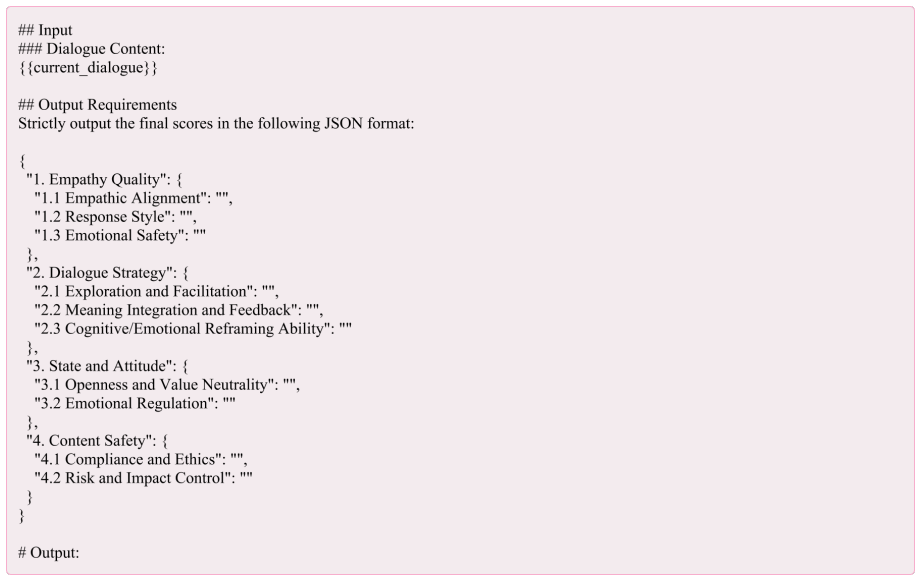
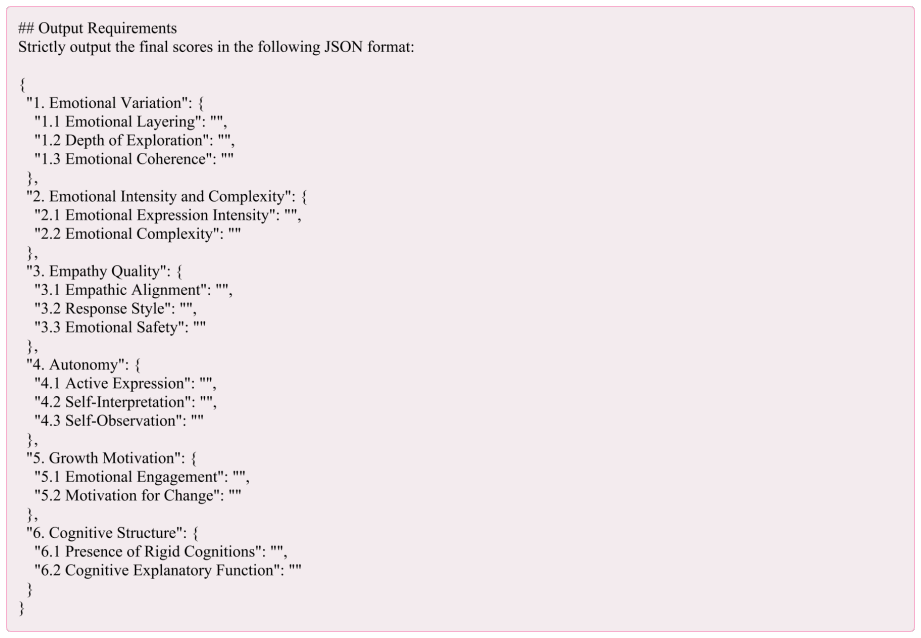
- [§4, Table 2; §3.3; Fig. 11; Fig. 15] The headline claim of superior 'emotional richness' rests on EmoTrace-E, a rubric whose dimensions are largely the properties the pipeline manufactures and selects for. §3.3 states the corpus is filtered to retain only dialogues with 'full coverage of the seeker's three emotional stages and reasonable stage duration'; the ETC prompt (Fig. 11) mandates stage progression (max 3 turns Initial Impact, max 5 Turbulence, forced guidance to Integration after turn 8); EmoTrace-E (Fig. 15) then scores Emotional Layering, Depth of Exploration, Self-Observation, and Motivation for Change — i.e., the stage-trajectory signature. EmoTrace-D's 4.74 vs PsyDTCorpus's 4.21 on Emotional Changes is therefore close to re-measuring the filter criterion. Tellingly, on the two external frameworks EmoTrace-D is only at parity with PsyDTCorpus and in fact loses on Comprehensiveness (1.90 vs 1.95), Professionalism
- [§5.2, Table 3] The model comparison evaluates each counselor model against a GPT-4.1-mini seeker that 'retains emotional schemas and the schema activation mechanism' — the same seeker generator and mechanism used to construct EmoTrace-D. EmoTrace-M is fine-tuned on exactly this seeker distribution, so the 'complex emotional scenarios' test is in-distribution for the proposed model and out-of-distribution for the baselines; the large margins in Table 3 (e.g., Emo. 4.51 vs 3.59 for the best open baseline) are confounded by this match. A defensible fix is to repeat the evaluation with a different seeker generator (different LLM and/or profiles not derived from PsyDT seeds) and, ideally, a small human-seeker or expert role-play condition; at minimum the confound must be acknowledged and the claim tempered.
- [§5.2–5.3, Figure 5] The human evaluation is the main evidence independent of LLM judges, but it is under-specified to the point of being unverifiable: no statement on whether raters were blind to model identity, no inter-annotator agreement statistic, no report of how many dialogues each rater scored (50 profiles, but per-model N is unclear), and the significance markers in Figure 5 do not name the test. Only two baselines were carried into human eval, chosen post hoc as the automatic-eval leaders, which introduces selection bias. Please report blinding, per-dimension agreement (e.g., Krippendorff's alpha), the statistical test and effect sizes, and include at least one baseline not selected via the LLM-judge leaderboard.
- [§4, Table 2; §5.3, Table 3; §5.4, Table 4] No uncertainty estimates accompany any quantitative result. Table 2 uses n=100 dialogues per dataset and Table 3 uses 50 simulated dialogues per model, reported as point scores to two decimals; several claimed advantages on external matrices (e.g., Emotional Empathy 2.85 vs 2.80; State and Attitude 2.89 vs 2.81) are plausibly within sampling noise of the dual-judge average. Table 4 is a single run per ablation variant. Confidence intervals and significance tests (or bootstrap over dialogues) are needed to support 'outperforms' / 'significant decline' language, and the training is single-seed, so model-level variance is unknown.
minor comments (7)
- [Table 2, Table 3] Safety metrics saturate (all datasets score 1.0 or near-1.0 on CpsyCoun/PsyDT safety; 1.94/2 for EmoTrace-M in Table 3), making these columns uninformative; either use a safety probe set designed to discriminate or drop the columns.
- [§5.2] Model-evaluation dialogues are capped at 10 turns (§5.2), but EmoTrace-D averages 12.2 turns (Table 1) and the ETC design pushes Integration after turn 8; the truncation may differentially affect models. Please justify the cap or report sensitivity to it.
- [Table 4] Table 4: the bold/underline formatting is inconsistent with the 'best/runner-up' convention (e.g., 'w/o Schema' shows 4.71 for Empathy Quality, above 'all' at 4.61, yet the text only discusses this in prose). Please re-check the highlighting and add the Cognitive Structure metric definition reference.
- [§4, Figure 4] The claim that EmoTrace-D's arousal trajectory has 'the largest fluctuation amplitude without being overly erratic' introduces an undefined criterion ('overly erratic'); either operationalize it (e.g., turn-to-turn variance bound) or remove it.
- [§3.2.3, Algorithm 1] The schema-activation thresholds (two consecutive activations or five total, Algorithm 1) and the 'at least two of four conditions' activation criterion (Fig. 8) are heuristic; a brief ablation or sensitivity note on these constants would strengthen the design.
- [Abstract, §3.2.2, §4, Appendix B] Numerous copyediting issues: 'we proposeEmoTrace' and 'we construct' (capitalization) in the abstract; 'These issues result in LLM that lack'; 'such ascore beliefs'; 'which are essential' (agreement); 'better captures' (§3.2.2); 'its scores lower than' (§4); 'occasionall', 'pasively', 'felings' in Fig. 16–17 prompts; 'Narate' in Fig. 7. The MindChat reference ('Dong Xue* Xin Yan') is malformed.
- [Abstract / Ethical Statement] Dataset and model release is conditioned on acceptance ('will be made publicly available once the paper is accepted'); an anonymized sample at submission would materially help reviewers assess data quality.
Circularity Check
Emotional-richness gains on EmoTrace-E partly re-measure stage coverage the ETC controller and post-hoc filter were built to enforce; model eval reuses the same schema-activated seeker.
-
other
[§3.2.2 ETC + Fig. 11 Transition Rules; §3.3 Dialogue Generation filter]
"After a maximum of 3 turns in the Initial Impact Zone, progression to the Turbulence Zone is mandatory.- After a maximum of 5 turns in the Turbulence Zone, progression to the Integration Zone is mandatory.-If the total number of dialogue turns exceeds 8 and the seeker remains in the Turbulence Zone,the expression_guidance must explicitly guide the seeker toward the Integration Zone... To ensure the completeness of emotional progression, we filter data by two criteria: full coverage of the seeker's three emotional stages and reasonable stage duration"
Stage occupancy and terminal Integration are mandatory outputs of the generator and of the retention filter. Any downstream score that rewards multi-stage progressive emotional evolution is therefore scoring a property the pipeline cannot fail to exhibit on retained data. The ‘prediction’ that EmoTrace-D has richer trajectories is true largely by construction of ETC+filter, not by independent observation.
-
other
[§4 EmoTrace-E definition (Fig. 15) vs Table 2 Emotional Changes / Intensity; Figs. 3–4 VA trajectories]
"###1.Emotional Variation Whether the seeker's emotions exhibit a layered, progressive, coherent, and reasonably dynamic evolutionary process throughout the dialogue... 1.1 Emotional Layering... gradual transition... from surface-level emotions to deeper-level emotions... 1.2 Depth of Exploration... 5.Growth Motivation... willingness to change... EmoTrace-D ... Emotional Changes (0–5) ... 4.74 ... The trajectory of EmoTrace-D shows the largest peak and the smallest valley compared to the other datasets, meaning it has the broadest emotional coverage and thus the highest emotional richness."
EmoTrace-E’s primary axes (layering, progressive deepening, coherence, growth/change motivation) are operational restatements of the three-zone EFT trajectory the ETC module enforces and the corpus filter selects for. Reporting a large win on Emotional Changes / VA range is therefore partly tautological: the metric was purpose-built to credit the same signature the controller manufactures. This is not a fitted-parameter rename, but a construction–evaluation closed loop on the paper’s strongest dataset claim.
1 more flagged steps
-
other
[§5.2 Evaluation Methods (model adaptation experiment)]
"GPT-4.1-mini simulates the seeker based on 50 persona profiles that were not used in corpus generation. To introduce a certain degree of emotional instability, this process retains emotional schemas and the schema activation mechanism. The seeker engages in multi-turn dialogues with each model, limited to 10 turns per dialogue."
EmoTrace-M is trained on dialogues whose seeker side was generated under schema activation + ETC, then evaluated as counselor against a seeker that deliberately keeps the same schema activation mechanism. The ‘complex / unstable emotional scenarios’ test distribution is therefore matched to the training seeker policy by design; superior scores partly reflect in-distribution adaptation rather than transfer to independently unstable seekers. Milder than the dataset metric loop, but it weakens the model-level generalization claim.
full rationale
This is an engineering corpus paper, not a first-principles derivation, so classic self-definitional math circularity is absent. The load-bearing empirical claim—that trajectory-centered generation yields superior emotional richness and empathy—is only partly independent of its inputs. The ETC module hard-caps stage dwell times and forces progression into Integration; §3.3 then retains only dialogues with full three-stage coverage; EmoTrace-E’s top dimensions (Emotional Variation / Changes, Intensity & Complexity, Autonomy, Growth Motivation) score exactly the layered progressive signature that construction and filtering guarantee. Table 2’s large Emotional Changes gap (4.74 vs 4.21) and the VA “largest peak / smallest valley” plots are therefore close to re-describing the controller+filter rather than an external authenticity test. A parallel, milder loop appears in §5.2: EmoTrace-M is stress-tested against a GPT-4.1-mini seeker that retains the same emotional schemas and activation mechanism used to build the training corpus, so “complex emotional scenarios” are in-distribution by design. Mitigating factors keep the score at mid-range rather than 8–10: (i) ablation removing ETC still drops emotion metrics, showing the controller is doing real work inside the loop; (ii) CpsyCoun/PsyDT matrices and human ratings are not pure restatements of the three-zone filter; (iii) no self-citation uniqueness theorem or renamed known law carries the argument. Net: partial construction–metric tautology on the headline emotional-richness claim, not total circularity of the method.
Assumptions & free parameters
free parameters (4)
- ETC stage duration caps =
max 3 / max 5 / force after 8
- Schema activation frequency limits =
2 consecutive or 5 total
- Fine-tune and decode hyperparameters =
lr=1e-4, T=0.7, top_p=0.9, 4 epochs
- Dialogue filter and profile counts =
1423 profiles → 1114 dialogues
assumptions (5)
- domain assumption Emotion-Focused Therapy’s awareness→deepening→transformation staging is an appropriate and sufficient backbone for synthetic counselor planning in general psychological support chats.
- domain assumption Eight emotional schemas on self/others/world axes (from CBT core beliefs and Leahy’s emotional schema model) adequately capture seeker cognitive structure for dialogue generation.
- domain assumption Interactive LLM role-play (GPT-4.1-mini) under profile+guidance constraints produces sufficiently realistic multi-turn counseling behavior for training and ranking systems.
- ad hoc to paper Averaging dual LLM judges (DeepSeek-V3.2 and Gemini-3-flash) on CpsyCoun/PsyDT/EmoTrace-E rubrics is a valid proxy for emotional richness and empathy quality.
- domain assumption Standard supervised fine-tuning on the synthetic corpus transfers seeker-trajectory handling skill to the counselor model under a GPT-simulated unstable seeker testbed.
invented entities (4)
-
Emotional Trajectory Control (ETC) three zones (Initial Impact / Turbulence / Integration)
-
Schema activation constraint mechanism (Algorithm 1)
-
EmoTrace-E evaluation matrix
-
EmoTrace-D / EmoTrace-M
Cite this review
Pith. "Pith review of EmoTrace: An Emotion Trajectory-Centered Framework for Psychological Support Dialogue Generation." pith.science (2026). https://pith.science/paper/UHLXKLIG
@misc{pith2026260723648,
  author       = {Pith},
  title        = {Pith review of: EmoTrace: An Emotion Trajectory-Centered Framework for Psychological Support Dialogue Generation},
  year         = {2026},
  howpublished = {\url{https://pith.science/paper/UHLXKLIG}},
  note         = {Machine review of arXiv:2607.23648}
}
read the original abstract
Using large language models (LLMs) to assist psychological counseling is an important task in the field of natural language processing. The construction of high-quality psychological support dialogue corpora serves as a critical foundation for training counseling-oriented conversational models. However, existing data generation approaches generally suffer from several limitations, including emotionally stable seekers, limited variation in emotional dynamics, and a high degree of compliance with counselors' guidance. These issues result in LLM that lack the capability to effectively respond to emotionally unstable scenarios. In addition, counselor responses are typically driven by problem-solving objectives, thereby overlooking the role of emotion-focused interaction, which are essential in psychological counseling. To address these gaps, we propose EmoTrace, a multi-turn dialogue corpus generation framework centered on modeling seekers' emotional trajectories. we construct seekers' cognitive profile and introduce a seeker module with emotional schemas and an associated activation mechanism, a counselor module, and an emotional trajectory control module, thereby enhancing the layering of the seeker's emotional expression and the counselor's targeted empathic expression. Experimental results demonstrate that the proposed method outperforms existing approaches in terms of emotional richness and empathy quality.
Figures


Figures from the paper (16 more)




Reference graph
Works this paper leans on
-
[1]
The lancet , volume=
No health without mental health , author=. The lancet , volume=. 2007 , publisher=
2007
-
[2]
Npj mental health research , volume=
Mental illness, mental health, and mental well-being , author=. Npj mental health research , volume=. 2026 , publisher=
2026
-
[3]
arXiv preprint arXiv:2303.08774 , year=
Gpt-4 technical report , author=. arXiv preprint arXiv:2303.08774 , year=
-
[4]
arXiv preprint arXiv:2302.13971 , year=
Llama: Open and efficient foundation language models , author=. arXiv preprint arXiv:2302.13971 , year=
-
[5]
Findings of the Association for Computational Linguistics: EMNLP 2024 , pages=
Smile: Single-turn to multi-turn inclusive language expansion via chatgpt for mental health support , author=. Findings of the Association for Computational Linguistics: EMNLP 2024 , pages=
2024
-
[6]
Findings of the Association for Computational Linguistics: ACL 2024 , pages=
Cpsycoun: A report-based multi-turn dialogue reconstruction and evaluation framework for chinese psychological counseling , author=. Findings of the Association for Computational Linguistics: ACL 2024 , pages=
2024
-
[7]
GitHub repository , howpublished =
Xin Yan, Dong Xue* , title=. GitHub repository , howpublished =. 2023 , publisher=
2023
-
[8]
Proceedings of the 2025 Conference on Empirical Methods in Natural Language Processing , pages=
DeepWell-Adol: A Scalable Expert-Based Dialogue Corpus for Adolescent Positive Mental Health and Wellbeing Promotion , author=. Proceedings of the 2025 Conference on Empirical Methods in Natural Language Processing , pages=
2025
Show all 37 references
-
[9]
Proceedings of the 63rd Annual Meeting of the Association for Computational Linguistics (Volume 1: Long Papers) , pages=
Psydt: Using llms to construct the digital twin of psychological counselor with personalized counseling style for psychological counseling , author=. Proceedings of the 63rd Annual Meeting of the Association for Computational Linguistics (Volume 1: Long Papers) , pages=
-
[10]
Towards emotional support dialog systems , author=. Proceedings of the 59th annual meeting of the association for computational linguistics and the 11th international joint conference on natural language processing (volume 1: Long papers) , pages=
-
[11]
arXiv preprint arXiv:2502.03821 , year=
Psyplay: Personality-infused role-playing conversational agents , author=. arXiv preprint arXiv:2502.03821 , year=
-
[12]
Clinical Psychology & Psychotherapy: An International Journal of Theory & Practice , volume=
Emotion--focused therapy , author=. Clinical Psychology & Psychotherapy: An International Journal of Theory & Practice , volume=. 2004 , publisher=
2004
-
[13]
arXiv preprint arXiv:2211.12360 , year=
GDPR compliant collection of Therapist-Patient-Dialogues , author=. arXiv preprint arXiv:2211.12360 , year=
-
[14]
Focus , volume=
Emotion-focused therapy: A clinical synthesis , author=. Focus , volume=. 2010 , publisher=
2010
-
[15]
Findings of the Association for Computational Linguistics: ACL 2024 , pages=
Rolellm: Benchmarking, eliciting, and enhancing role-playing abilities of large language models , author=. Findings of the Association for Computational Linguistics: ACL 2024 , pages=
2024
-
[16]
2024 , publisher=
Cognitive therapy of depression , author=. 2024 , publisher=
2024
-
[17]
Cognitive and behavioral practice , volume=
A model of emotional schemas , author=. Cognitive and behavioral practice , volume=. 2002 , publisher=
2002
-
[18]
Proceedings of the 63rd Annual Meeting of the Association for Computational Linguistics (Volume 1: Long Papers) , pages=
Kokorochat: A japanese psychological counseling dialogue dataset collected via role-playing by trained counselors , author=. Proceedings of the 63rd Annual Meeting of the Association for Computational Linguistics (Volume 1: Long Papers) , pages=
-
[19]
, author=
Emotions, the great captains of our lives: their role in the process of change in psychotherapy. , author=. American Psychologist , volume=. 2012 , publisher=
2012
-
[20]
, author=
Comparative effectiveness of six counselor verbal responses. , author=. Journal of Counseling Psychology , volume=. 1979 , publisher=
1979
-
[21]
Journal of Contemporary Psychotherapy , volume=
A review of empirical studies investigating narrative, emotion and meaning-making modes and client process markers in psychotherapy , author=. Journal of Contemporary Psychotherapy , volume=. 2021 , publisher=
2021
-
[22]
Proceedings of the 62nd annual meeting of the association for computational linguistics (volume 3: system demonstrations) , pages=
Llamafactory: Unified efficient fine-tuning of 100+ language models , author=. Proceedings of the 62nd annual meeting of the association for computational linguistics (volume 3: system demonstrations) , pages=
-
[23]
arXiv preprint arXiv:2505.09388 , year=
Qwen3 technical report , author=. arXiv preprint arXiv:2505.09388 , year=
-
[24]
arXiv preprint arXiv:2406.12793 , year=
Chatglm: A family of large language models from glm-130b to glm-4 all tools , author=. arXiv preprint arXiv:2406.12793 , year=
-
[25]
Proceedings of the 29th International Conference on Computational Linguistics , pages=
Curating a large-scale motivational interviewing dataset using peer support forums , author=. Proceedings of the 29th International Conference on Computational Linguistics , pages=
-
[26]
Findings of the association for computational linguistics: ACL-IJCNLP 2021 , pages=
Psyqa: A chinese dataset for generating long counseling text for mental health support , author=. Findings of the association for computational linguistics: ACL-IJCNLP 2021 , pages=
2021
-
[27]
Proceedings of the 57th annual meeting of the association for computational linguistics , pages=
Persuasion for good: Towards a personalized persuasive dialogue system for social good , author=. Proceedings of the 57th annual meeting of the association for computational linguistics , pages=
-
[28]
Findings of the Association for Computational Linguistics: EMNLP 2024 , pages=
Cactus: Towards psychological counseling conversations using cognitive behavioral theory , author=. Findings of the Association for Computational Linguistics: EMNLP 2024 , pages=
2024
-
[29]
arXiv preprint arXiv:2509.02999 , year=
DiaCBT: A Long-Periodic Dialogue Corpus Guided by Cognitive Conceptualization Diagram for CBT-based Psychological Counseling , author=. arXiv preprint arXiv:2509.02999 , year=
-
[30]
Proceedings of the AAAI Conference on Artificial Intelligence , volume=
Simulating Human-Like Counseling: A Path-and Scenario-Guided Framework for Psychological Support Dialogue , author=. Proceedings of the AAAI Conference on Artificial Intelligence , volume=
-
[31]
Proceedings of the 2025 Conference on Empirical Methods in Natural Language Processing , pages=
Crisp: Cognitive restructuring of negative thoughts through multi-turn supportive dialogues , author=. Proceedings of the 2025 Conference on Empirical Methods in Natural Language Processing , pages=
2025
-
[32]
Findings of the Association for Computational Linguistics: EMNLP 2023 , pages=
Soulchat: Improving llms’ empathy, listening, and comfort abilities through fine-tuning with multi-turn empathy conversations , author=. Findings of the Association for Computational Linguistics: EMNLP 2023 , pages=
2023
-
[33]
npj Digital Medicine , year=
WiseMind: a knowledge-guided multi-agent framework for accurate and empathetic psychiatric diagnosis , author=. npj Digital Medicine , year=
-
[34]
Proceedings of the ACM Web Conference 2026 , pages=
Theramind: A strategic and adaptive agent for longitudinal psychological counseling , author=. Proceedings of the ACM Web Conference 2026 , pages=
2026
-
[35]
, author=
Assimilation of problematic experiences by clients in psychotherapy. , author=. Psychotherapy: Theory, Research, Practice, Training , volume=. 1990 , publisher=
1990
-
[36]
, author=
A circumplex model of affect. , author=. Journal of personality and social psychology , volume=. 1980 , publisher=
1980
-
[37]
Journal of medical Internet research , volume=
Large language models and empathy: systematic review , author=. Journal of medical Internet research , volume=. 2024 , publisher=
2024
Reviewed July 30, 2026 · model on record in the stance chip above.
Discussion (0). Sign in to comment.